 |
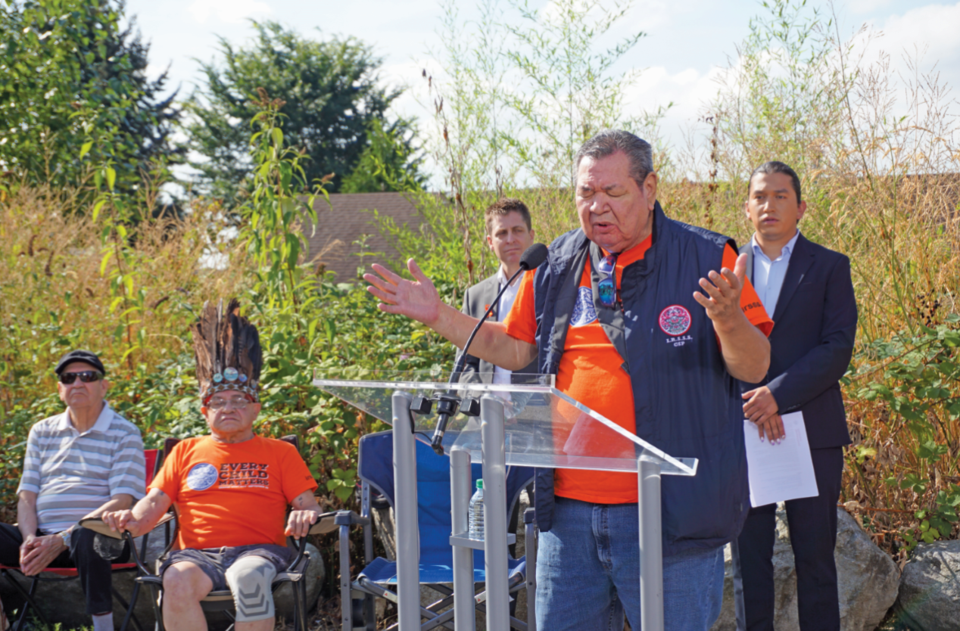
| Byron
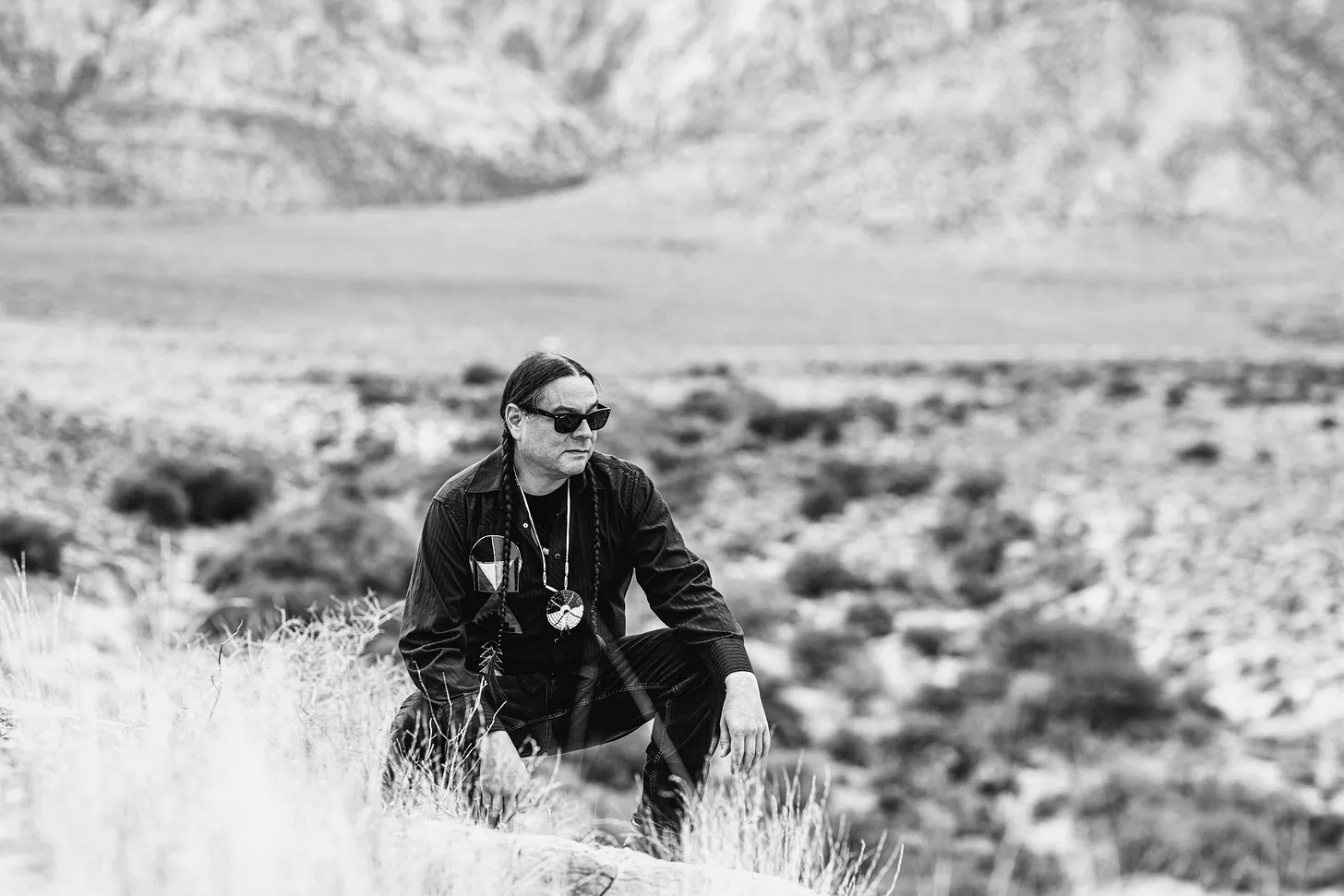
Joseph, Elder, Sḵwx̱wú7mesh Úxwumixw (Squamish Nation), who led an
opening prayer, called on the crowd gathered wearing orange to come
together and help one another through this difficult time, as Squamish
Nation begins an investigation of the former St. Paul's Indian
Residential School site. Elisia Seeber |
Sḵwx̱wú7mesh
Úxwumixw (Squamish Nation) has announced it has launched an
investigation into the former St. Paul’s Indian Residential School site
to find answers about the children who attended the institution but never made it home.
On Tuesday (Aug 10) standing outside the site of the former
institution, which once stood on the 500 block of West Keith Road in
North Vancouver, Khelsilem (Dustin Rivers), Sḵwx̱wú7mesh Úxwumixw
spokesperson, said the Nation had embarked on an Indigenous-led
initiative, on behalf of its people and in partnership with its
relatives, the xʷməθkʷəy̓əm (Musqueam) and səl̓ilw̓ətaʔɬ
(Tsleil-Waututh) Nations, to investigate the site for burial grounds and
unmarked graves.
“We will begin that work to investigate and gather all information to
honour and find those children who might not have gone home that had
attended St. Paul’s Indian Residential School,” he said, adding that the
work would be done with the support of the Roman Catholic Archdiocese.
Khelsilem said the investigation was just in the beginning stages and
the process was still taking shape but would involve an inquiry into
the site and a field investigation.
The phases of the investigation will include an interview process
with survivors to help narrow down or expand investigation search areas,
gathering all records related to the school throughout its history, and
remote sensing searches, which may include ground-penetrating radar
studies.
The announcement comes after the Tk’emlúps te Secwépemc First Nation
shared the discovery of the remains of an estimated 215 children in
unmarked graves at the former Kamloops Indian Residential School at the
end of May. Since then, further Nations have announced their own such
findings.
As the St. Paul’s site is now home to St. Thomas Aquinas Secondary,
Khelsilem said it had unique considerations in comparison to other sites
being investigated, which had to be considered during the
investigation, including the extensive development that has occurred at
the site.

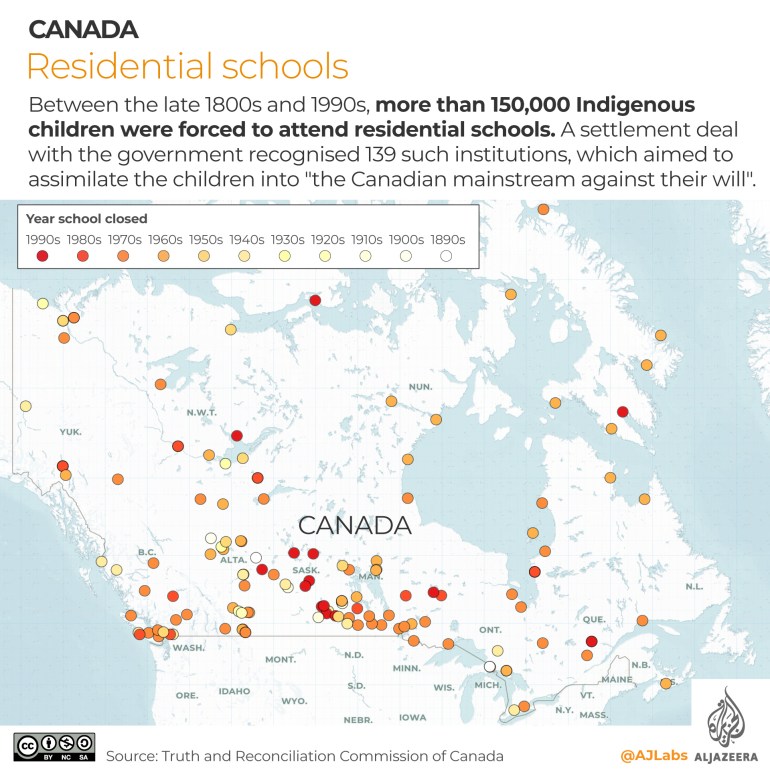
There were 18 residential schools in B.C. St. Paul’s, located next to
the Sḵwx̱wú7mesh community of Eslhá7an, was the only institution in
the Metro Vancouver area.
It was opened in 1899 by the federal government’s Department of
Indian Affairs and was managed and operated by the Roman Catholic
Religious Teaching Order, the Sisters of Child Jesus.
Over 2,000 Indigenous children, representing six generations of
Sḵwx̱wú7mesh, xʷməθkʷəy̓əm, and səl̓ilw̓ətaʔɬ Nations, and other
Indigenous communities, were institutionalized there from grades one
through eight until it closed in 1959.
Children in the school were segregated by age group and gender, often
not permitted to visit other family members, stripped of their culture,
and punished for speaking their native languages or taking part in
their cultural traditions.
Sḵwx̱wú7mesh Úxwumixw says oral histories told by St. Paul’s survivors include stories about children who disappeared.
“According to public records, 12 unidentified students died while
attending St. Paul’s between 1904 and 1913,” the Nation said in a
release, adding that the goal with the investigation is to find the
location of each of these children and “bring them home to rest.”
Sḵwx̱wú7mesh Úxwumixw held a private gathering on Monday (Aug. 9) to tell members that the work was beginning at the site.
“This work is really sacred and really important to our people and,
first and foremost, this work is about protecting and helping our
survivors,” Khelsilem said. “They’re first in our minds, as we begin this work.”
James Borkowski, the archbishop’s delegate for operations for the
Roman Catholic Archdiocese of Vancouver, who spoke on behalf of
Archbishop Michael Miller, said the work to uncover the truth had
already begun over the past two months, and “continues as an urgent
priority.”
Earlier this summer, the archbishop shared an apology and a firm
commitment on behalf of the local Catholic Church, to provide immediate
supports and co-operation in ensuring that all documents related to
residential schools be made available and accessible.
“We have much to learn and act on, as we hear from the Nations, and
community members in this journey of truth and reconciliation related to
the church’s historic and damaging role with residential schools,”
Borkowski said.
“Our hope as Catholics is that our Creator will give us the courage and strength to follow the truth wherever it takes us.”
On June 28, the B.C. government allocated $12 million to support
First Nations throughout the province with investigative work at former
residential school sites, as well as cultural and wellness supports.
Each caretaker community can receive up to $475,000 for each site.
The province has also appointed First Nations liaisons to support communities through the work.
On Aug 10, the federal government also announced a further $321 million in additional support for Indigenous-led initiatives.
Chief Jen Thomas, səl̓ilw̓ətaʔɬ, whose father is a survivor of St.
Paul’s, said she was “grateful for the work that’s going to be done”
saying it was the “start of our healing journey for our survivors.”
Chief Wayne Sparrow (xʷməθkʷəy̓əm) added on behalf of his community
that “we’re going to work with each and every one of you to get to the
truth.”
He acknowledged all Nations involved, both the federal and provincial
governments and the Catholic Archdiocese for stepping up to do the
work.
“The only way that we’re going to heal is doing it together,” Sparrow said.
Elder Byron Joseph of Sḵwx̱wú7mesh Úxwumixw, who led an opening
prayer, called on the crowd gathered wearing orange to come together and
help one another through this difficult time.
“This is a time where our people come forward,” he said. “The ones
that have been forgotten. Those are the ones we have to honour. Those
are the ones these prayers are for.
“Keep a strong mind and strong heart as we go through this together.”
**By Elisia Seeber
**Source






![A child holds a flag that reads 'Every Child Matters' during a march in British Columbia after the discovery of hundreds of unmarked graves of Indigenous children at residential schools across Canada [File: Kevin Light/Reuters]](https://www.aljazeera.com/wp-content/uploads/2021/08/2021-08-02T180901Z_1854223407_RC24XO9GZWLJ_RTRMADP_3_CANADA-INDIGENOUS-CHILDREN.jpg?resize=770%2C513)









 Posts
Posts