


|

|
|

|
|
|
Back in July, the governing Liberals decided to quietly announce they were cutting funding to Indigenous searches for unmarked children’s graves around residential schools.
Indigenous communities were initially offered up to $3 million per year to help defray the costs of identification.
However, the federal government chose to cap those funds — in the absence of any consultations with Indigenous leaders — at $500,000. Thankfully, the Trudeau government reversed course in August and restored the original funding allotment of $3 million.
It is instructive to note that Ottawa has constitutional competence for — and thus a fiduciary responsibility to — Indigenous Peoples in Canada.
All of this got me thinking about one of the most enduring features of Indigenous/non-Indigenous relations in Canada — namely, the federal government’s obsession with pinching pennies when it comes to our Indigenous communities.
One of the critical areas of investigation around this topic is fully understanding its key drivers.
Why would monetary considerations be top of mind for colonial and Canadian governments for hundreds of years? What should we infer from that fixation with dollars and cents?
Significantly, I’m not talking about budget constraints, lower reserve costs, special circumstances or an increase in wealthier Indigenous communities.
I’m suggesting there has been a deliberate and ongoing mindset in Ottawa that starts with this premise: How do we find ways to cut funding for Indigenous Peoples?
The whole point of
colonial and Canadian government policies toward Indigenous Peoples was
to assimilate them and, if that didn’t work, to eradicate them outright. (kill off)
That way, the federal government’s “honour of the Crown” and its fiduciary commitment would come to a screeching halt. Crudely put, the costs associated with “Indian status” would no longer be necessary.
Residential schools in Canada were intended, among other things, to sever the bond between Indigenous children and their parents and reserve community. As they assimilated into white society, this would eventually lead to fewer First Nations people on the government’s payrolls.
The schools (many were of poor construction and deadly firetraps) were a case study in cost-cutting: Indigenous children constantly complained of being hungry and cold and often went without medications. Even when children died at these schools, the government refused to pay the costs of returning them to their Indigenous families.
Similarly, the horrible “Sixties Scoop” was a continuation of this same line of thinking: force Indigenous kids into foster care and foreign adoption to reduce costs over time.
The federal government moved in the late 1950s with the express intention of saving money by turning the care and welfare of Indigenous children over to provincial child protection services.
With respect to the National Inquiry into Missing and Murdered Indigenous Women and Girls, the Trudeau Liberals have been excruciatingly slow in implementing many of the final report’s 231 “calls for justice.”
Only five per cent or so of the government’s promise to spend $724 million on supporting Indigenous women and girls with new shelters and transitional housing has been spent.
From the advent of colonial governments in Canada in the mid-1700s, each one has sought to reduce expenditures for Indigenous Peoples. Officials in the old Department of Indian Affairs — long before its current iteration as the Department of Crown Indigenous Relations — were always crunching the actuarial numbers to identify when payments to Indigenous communities would finally end.
Don’t forget the cost-savings sought through violating solemn treaties, withholding annuity and land dispossession payments, building low-budget “Indian hospitals” and even denying benefits for returning Indigenous soldiers from the world wars.
Much of the cutting of Indigenous monies is consistent with a colonial mindset or project that has devalued, dehumanized and degraded Indigenous Peoples from the very beginning.
The racist rationale was simple: they were only going to die off anyway, they would forever be ””uncivilized,” pagan “savages,” they would never be smart enough to know what to do with the land and financial resources, and they would always be expendable, largely invisible and, most assuredly worthless.
I’m sure that I’ve missed many other examples of damaging government cost-cutting. But one common theme that is painfully obvious is that Canadian governments have historically sought to short-change Indigenous Peoples.
In the end, the First Peoples just weren’t worth spending government money on. You have to conclude that the real power brokers of this country never really accorded them much value from the outset.

The site of a former British Columbia residential school that had its own cemetery since the early 1920s is now the location of potential unmarked graves, says the chief of a Fraser Lake area First Nation.
Nadleh Whut'en First Nation Chief Beverly Ketlo said after almost two years of geophysical survey work, the nation believes it can confirm potential unmarked graves at the site of the former Lejac Indian Residential School, located about 160 kilometres west of Prince George.
The First Nation had always known children were buried at the church-run institution because many of their graves were marked in a cemetery that had been there since 1922, when the school opened, but the survey's findings suggest a number of unmarked graves, she said at a news conference Saturday.
"We have information today that shows that there are likely grave sites in the location of the Lejac school," said Ketlo. "We know there were more children there, we just didn't know where. How many, and this is a question I ask everybody I meet, how many of the schools you attended had graveyards in the backyard?"
The survey did not positively identify any unmarked graves, but indicated "23 markers" of potential burial locations, she said.
The geophysical survey work, using ground-penetrating radar and magnetometry, started in the winter of 2023 and focused on areas identified by survivors of the residential school, said Ketlo.
About 7,850 Indigenous children attended Lejac school, which was in operation from 1922 to 1976.
The Nadleh Whut'en First Nation said there were 38 documented deaths at the institution.
Ketlo said among the Lejac Indian Residential School's darkest chapters was the deaths of four boys in 1937.

Recently a politician from a village in Prince Edward Island displayed an offensive sign on his property in which he proclaimed there is a “mass grave hoax” regarding the former Indian Residential Schools in Canada. Although many have called for him to resign, he is just one of many people who subscribe to this false theory.
A hoax is an act intended to trick people into believing something that isn’t true. Commentary that a “hoax” exists began circulating in 2021 around the time of public announcements from First Nations across the country that — through the use of ground penetrating radar and other means — the remains of Indigenous children are suspected to be in unmarked graves at or near some former residential schools.
Commentators circulating allegations of a “hoax” contend journalists have misrepresented news of the potential unmarked graves, circulating sensational, attention-grabbing headlines and using the term “mass grave” to do so. They also contend some First Nations, activists or politicians used this language for political gain — to shock and guilt Canadians into caring about Indigenous Peoples and reconciliation.
Like the councillor in P.E.I., many people — in Canada and internationally, fuelled partly by misinformation from the far-right — are accepting and promoting the “mass grave hoax” narrative and casting doubt on the searches for missing children and unmarked burials being undertaken by First Nations across Canada.
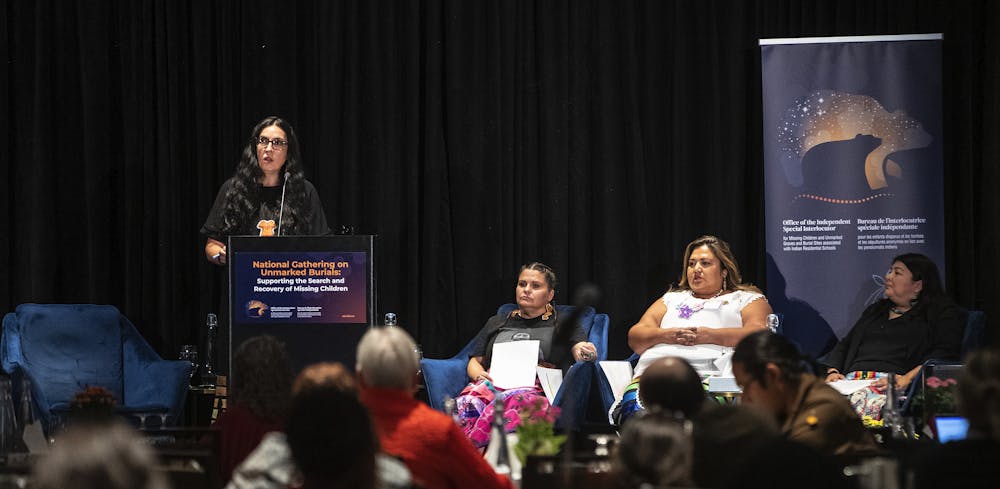
It appears that some journalists and commentators misunderstood a large number of potential or likely unmarked graves for mass graves in late May/June 2021. By September, denialists were misrepresenting the extent of media errors to push the conspiratorial “mass grave hoax” narrative online.
Our research shows that the “mass grave hoax” narrative hinges on a misrepresentation of how Canadian journalists reported on the identification of potential unmarked graves at former residential school sites in 2021. And we hope our report sparks a national conversation about how important language is when covering this issue.
Media needs to be precise with language and also acknowledge its errors (and avoid future ones), or clarify details in a way that feeds truth, empathy and more accurate reporting — not denialism, hate and conspiracy.


Your History Class Was a F*cking Lie by Sean Sherman (Or: How the American Educational System Has Always Been a Racist Propaganda Program...






 Posts
All Comments
Posts
All Comments


