BOOZHOO! We've amassed tons of information and important history on this blog since 2010. If you have a keyword, use the search box below. Also check out the reference section above. If you have a question or need help searching, use the contact form at the bottom of the blog.
We want you to use BOOKSHOP to buy books! (the editor will earn a small amount of money or commission. (we thank you) (that is our disclaimer statement)
This is a blog. It is not a peer-reviewed journal, not a sponsored publication... WE DO NOT HAVE ADS or earn MONEY from this website. The ideas, news and thoughts posted are sourced… or written by the editor or contributors.
EMAIL ME: tracelara@pm.me (outlook email is gone)
THANK YOU CHI MEGWETCH!
SEARCH
Showing posts with label Quaker Indian Boarding Schools. Show all posts
Showing posts with label Quaker Indian Boarding Schools. Show all posts
In
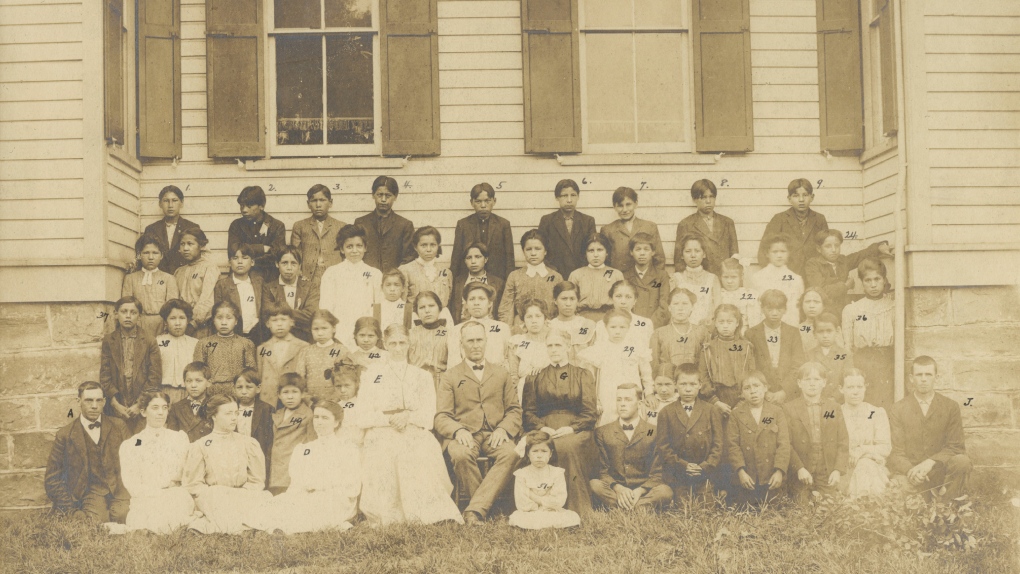
this photo taken in 1906, provided by the Quaker and Special
Collections at Haverford College, teachers and students gather for a
portrait at Tunesassa School in Tunesassa, New York. THE CANADIAN
PRESS/AP, Quaker and Special Collections, Haverford College
OTTAWA --
A coalition advocating for Indigenous Peoples forced to attend boarding
schools in the United States is planning to digitize 20,000 archival
pages related to schools that were operated by the Quakers.
Outside of Native Nations, most people aren't even aware these schools
were an integral part of history and U.S. federal Indian policy, said
Samuel Torres, the deputy CEO of the Native American Boarding School
Healing Coalition.
He and his team are trying to change that, drawing inspiration -- and
lessons learned -- from Canada's Truth and Reconciliation Commission and
the National Centre for Truth and Reconciliation.
The
city of Palmdale, California is moving forward on a housing project
that keeps siblings in foster care housed together. Photo by Annie
Spratt via unsplash.com.
If children must enter foster care while their
parents sort out mental health crises, violent relationships or
addiction, the trauma of abuse and neglect, and the pain of separation
can be long-lasting. But there’s one clear way to minimize the impact:
keeping siblings together.
Public officials in a high-desert bedroom community north of downtown
Los Angeles have committed to building housing that facilitates those
critical family ties. Within a year, according to local and county
officials, the city of Palmdale will be the first site in California to
begin construction of a development built specifically for sibling
groups in foster care.
The aim of these temporary homes and the staff who will oversee them,
said Mike Miller, director of neighborhood services for the city of
Palmdale, is to get the children safely back to their families once
problems at home have been sorted out.
“They’re helping the children, but they’re also working with the
parents because ultimately I think our wish for all foster kids and
parents is that this family stays together,” he said. “These aren’t kids
just getting thrown into a home somewhere,” he added. “This is also
about valuing the family, and keeping the kids together. That’s
transformational.”
The $19 million project will include a dozen three-bedroom townhomes. Up to six siblings will live in each home, together with a specially
trained professional caregiver. The housing project will also include
two units for young adults transitioning out of foster care, and offices
for case managers and support staff.
Last week, in accordance with its goal of creating “quality
affordable housing” for “low, very low and extremely low-income”
residents, the Palmdale City Council and Housing Authority authorized a
$1.2 million “acquisition and pre-development” loan for the project. The
Los Angeles County Development Authority has also committed to a
$500,000 loan, with the remaining costs covered by private financing,
according to a city staff report.
The project, which will be constructed on the north side of McAdam
Park on 30th St. East in Palmdale, is being developed by SOS Children’s
Villages. The more than 70-year-old agency describes its aim as building
families for orphaned, abandoned and other vulnerable children in 135
countries, including the United States.
SOS Children’s Villages is now a global organization, but it began
humbly, its first “village” built in 1949 in Imst, Austria to house
children left behind during World War II. The group now operates more
than 550 “villages” serving approximately 13 million children, youth and
families.
Los Angeles County Supervisor Kathryn Barger
Palmdale will be the first location of its type to open in
California, but the developer of the site runs three similar housing
projects in Illinois, and one in Florida.
“I’m a proud supporter and funder of the SOS Children’s Villages
project in Palmdale,” L.A. County Supervisor Kathryn Barger said in an
email to The Imprint, adding that she met with the project’s leadership
at length. “I’m impressed by their long-standing commitment to family
reunification efforts, and to providing compassionate care to foster
youth and those at risk of entering the system.”
Keeping siblings together
The hazards of failing to keep siblings in foster care are widely
acknowledged, and “placing siblings in the same home should always be
the priority,” states a 2019 federal Children’s Bureau bulletin.
Although the relationships can be expansive in definition —
biological siblings, step siblings, foster siblings, or other close
relatives or nonrelatives with whom they have lived, even siblings
they’ve never met — maintaining an attachment is essential to the
children’s well-being.
“For some siblings in care,” the bulletin says, “their separation or
infrequent visiting can cause those relationships to wither, sometimes
to the point of permanent estrangement.”
When foster children stay close to their siblings, they are more
likely to remain in stable homes, and more likely to “achieve
permanency” through family reunification, adoption or legal
guardianship. The pairing of siblings helps them adapt to new living
situations, whatever they may be, in part because they are less worried
about where their other family members are and how they are doing.
Researchers have also found
that contact with brothers and sisters soothes the trauma of childhood
abuse and neglect, as well as the traumatic experience of being
separated from parents and the only home a child has ever known.
Children who have positive relationships with siblings are less likely
to suffer behavioral problems, such as anxiety and depression.
For siblings who can’t be housed together, child welfare experts
encourage close placement, frequent visits and ongoing contact through
letters, email, social media, cards and phone calls.
Numerous federal laws aim to promote sibling connections.
The Fostering Connections to Success and Increasing Adoptions Act of
2008 was the first federal law stressing the importance of sibling
relationships in the foster care system. It requires that any child
welfare agency relying on federal funding to seek placements that keep
siblings in the same home or, if that’s not possible, provide ongoing
contact and visits.
In 2014, the Preventing Sex Trafficking and Strengthening Families
Act required that the parents of siblings be included as people to be
notified when a child needs placement, as a means to keep children
within extended kin networks.
Four years later, the Family First Prevention Services Act
passed, allowing states to waive the number of children who can be
placed in a single foster home, as a way to better accommodate sibling
groups.
Changing the profile of Antelope Valley
The region known as the Antelope Valley — which includes the cities
of Palmdale and Lancaster — has some of the highest poverty and child
maltreatment rates in Los Angeles County. Three horrific and highly
publicized child deaths
in the area over a six-year period put the child welfare agency’s
delayed response to household warning signs under a harsh spotlight. The
area has also experienced a relatively high level of turnover among
social workers and CPS line staff.
Referring to the torture and killing of 8-year-old Gabriel Fernandez in 2013 — crimes committed by his mother and her boyfriend — Miller said the tragedy also spurred action.
“It really heightened our community to tell us that we need to do
more,” he said. “And the community’s really stuck to that promise of
trying to do more for the kids. So this SOS project is just right on
that path of commitment that came as a result of that tragedy.”
Miller said the sibling housing project will take some time to
complete, given the complexity of the project’s funders, agencies
involved and unique requirements. But he expects construction will begin
within a year.
“These projects really do take time but this one just strikes to the
heart and it has such momentum and support,” Miller said. “What we’re
hoping is that this is a model that other government entities here in
California will use to do the exact same thing up and down the state.”
Tim McCormick, CEO of the SOS Children’s Villages Illinois, got
esoteric in describing the project. He said it’s meaningful that the
site will be located in the high desert, and the architecture will be
environmentally friendly and reflect the region’s natural colors and
hues.
“There’s really an intrinsic beauty of life out there,” McCormick said. “It’s kind of a hidden gem.”
McCormick also noted that the sibling groups who will live at the
site more than likely will have come from impoverished households. But
once built, their temporary home will serve as a resource center for
these low-income children and families. It will also nourish cultural
life, with an outdoor theater for the arts, music and spoken word —
“almost like a Greek auditorium,” McCormick described. “So that’s what
we hope to do there, is to bring in resources that are outside Palmdale
and inside Palmdale, to blend them together and create and strengthen a
narrative of a child’s life and a family’s history.”
Opened in 1871 by Quaker missionaries, Riverside is the nation’s
oldest boarding school operated by the federal government. It is one of
the 408 across the U.S. identified in Haaland’s recently launched Federal Boarding School Initiative
— described by the Department of the Interior as the government’s first
comprehensive attempt “to shed light on the troubled history of Federal
Indian boarding school policies and their legacy for Indigenous
Peoples.”
Haaland has pledged to document the schools’ troubled pasts, address
their intergenerational impact and fully account for the trauma they
inflicted throughout Indian Country.
The National Native American Boarding
School Healing Coalition says that for healing to occur, the full truth
about the boarding schools and the policy of forced assimilation must
come to light in our country, as it has in Canada. The first step in a
truth, reconciliation, and healing process, they say, is truth telling. A
significant piece of the truth about the boarding schools is held by
the Christian churches that collaborated with the federal government’s
policy of forced assimilation.
Quakers were among the strongest
promoters of this policy and managed over 30 schools for Indian
children, most of them boarding schools, during the nineteenth and early
twentieth centuries. The coalition is urging the churches to research
our roles during the boarding school era, contribute this research to
the truth and reconciliation process, and ask ourselves what this
history means to us today.
Quaker teachers, families, and students at the Ottawa School, Indian
Territory, 1872. Courtesy of the Quaker Collection at Haverford College.
South Carolina court drops contempt charge against Dusten Brown Dusten Brown and the Cherokee Nation rea...
Bookshop
You are not alone
To Veronica Brown
Veronica, we adult adoptees are thinking of you today and every day. We will be here when you need us. Your journey in the adopted life has begun, nothing can revoke that now, the damage cannot be undone. Be courageous, you have what no adoptee before you has had; a strong group of adult adoptees who know your story, who are behind you and will always be so.
Diane Tells His Name
click photo
Lost Birds on Al Jazeera Fault Lines
click to read and listen about Trace, Diane, Julie and Suzie
NO MORE STOLEN SISTERS
click image
We conclude this series & continue the conversation by naming that adoption is genocide. This naming refers to the process of genocide that breaks kinship ties through adoption & other forms of family separation & policing 🧵#NAAM2022#AdoptionIsTraumaAND#AdopteeTwitter#FFY 1/6 pic.twitter.com/46v0mWISZ1
As the single largest unregulated industry in the United States, adoption is viewed as a benevolent action that results in the formation of “forever families.” The truth is that it is a very lucrative business with a known sales pitch. With profits last estimated at over $1.44 billion dollars a year, mothers who consider adoption for their babies need to be very aware that all of this promotion clouds the facts and only though independent research can they get an accurate account of what life might be like for both them and their child after signing the adoption paperwork.











 Posts
Posts

