They Took Us Away

They Took Us Away
click image to see more and read more

it's free

click

How to Use this Blog

BOOZHOO! We've amassed tons of information and important history on this blog since 2010. If you have a keyword, use the search box below. Also check out the reference section above. If you have a question or need help searching, use the contact form at the bottom of the blog.


We want you to use BOOKSHOP to buy books! (the editor will earn a small amount of money or commission. (we thank you) (that is our disclaimer statement)

This is a blog. It is not a peer-reviewed journal, not a sponsored publication... WE DO NOT HAVE ADS or earn MONEY from this website. The ideas, news and thoughts posted are sourced… or written by the editor or contributors.

EMAIL ME: tracelara@pm.me (outlook email is gone) THANK YOU CHI MEGWETCH!

SEARCH

Showing posts with label Blood Memory. Show all posts

Thursday, July 15, 2021

This entire country is haunted (Canada)

OPINION

Alicia Elliott: As we’re seeing more and more every day, this entire country is a real-life Indian burial ground—one that criminals parading as teachers, religious leaders and politicians took great care to cover up

Alicia Elliott is a Mohawk writer and author of the award-winning book A Mind Spread Out on the Ground.

A mere 15-minute drive from where I now type this in Brantford, Ont., is the Mohawk Institute, one of the oldest residential schools in Canada. It’s a building whose purpose—which, in Sir John A. Macdonald’s words, was to withdraw Indigenous children “as much as possible from parental influence” so they could “acquire the habits and modes of thought of white men”—had been established for 36 more years than Canada as an independent nation had even existed. Remember this.

In 2016, I went to an art and performance installation on the grounds of the Mohawk Institute, otherwise known to the hundreds of Indigenous students who were trapped within its walls over its 139 years as “the Mush Hole.” They called it such because, despite the students working on nearby farms without pay as soon as school was done, thus furnishing the staff dining table with fresh, delicious produce, the children themselves had nothing more to eat than mush. Sometimes the mush had worms crawling in it. It didn’t matter. That was what they were fed. Remember this, too.

The art exhibit was called The Mush Hole Project. Survivors of the school acted as tour guides, leading us through the still-standing building—the places where the children bunked, the places where they were “taught.” Our tour guide was a woman from my reserve, Six Nations of the Grand River. Her daughter and granddaughter were on the tour with us. This was the first time either of them had heard their mother/grandmother speak of her experiences. She spoke in few words about the physical and emotional pain of having her language beaten out of her. Her daughter later spoke of how she and her own daughter were learning Kanien’kéha. The woman who had attended the school said nothing. It was as if, along with English, she had been taught the Christian tradition of silence. These days, I’m recognizing it’s also a Canadian tradition.

As soon as the tour took us into the boiler room, I felt physically sick. My stomach dropped and my head started to hurt and I focused on the words coming from our tour guide’s mouth: that this was where many Indigenous children were taken by staff to be abused, because the sound of the boiler would better mask their screams. Don’t even bother trying to forget this.

Before that moment, I had always wondered whether ghosts were real. I’d watched horror movies about angry poltergeists slamming furniture around old houses and Ouija boards whose planchettes seemed to move by themselves, spelling out otherworldly knowledge. But there, in that room, as my chest got heavy with breath that felt barricaded in my lungs, I was certain: this place was haunted. The pain those Anglican priests and teachers caused those children—many from my rez—lingered thick in the air. Like the criminals they were, the priests and teachers found the room most likely to help them hide their crimes. Remember this most of all.

A building built on an Indian burial ground is a trope in horror movies. The protagonists in these films are always white families who are pure and innocent as the snow. They step into these houses or hotels unaware of the Indigenous blood that was spilled before they came. If they find out about the history of the land they’re settling, the haunting that colonialism has created, like in Pet Sematary, that doesn’t stop them from settling in and expecting uninterrupted colonial happiness. After all, this land was cleared for them to settle.

And yet, once the haunting starts, we’re not supposed to empathize with the nameless Indigenous people whose bodies were buried beneath these homes. We’re not supposed to even think of them. We’re supposed to empathize with the white families being terrorized—the very people who decided it was okay to build their lives atop Indigenous death.

The very people who thought that because they themselves didn’t commit the crimes that allowed them to have their homes on Native land, they were still somehow innocent.

As we’re seeing more and more every day, this entire country is a real-life Indian burial ground—one that criminals parading as teachers, religious leaders and politicians took great care to cover up. However, unlike the nameless, often nationless Indigenous people whose deaths are used to clumsily explain hauntings in the movies, the children whose tiny bodies have been unearthed on the grounds of residential schools across the country in recent weeks had names and nations and communities. They had families who ached for their return, who asked after them and were deliberately told nothing.

Just like those white families in horror movies, though, non-Indigenous people of Canada seem to believe they are innocent. If they don’t acknowledge the violence that’s been done historically on their behalf to Indigenous children via residential schools, if they don’t acknowledge the violence being done today to Indigenous children via the foster care system, then they can continue their lives, unencumbered by inconvenient guilt. They lean into the silence that’s expected of them, hoping that the nationalistic myth of Canada—polite, multicultural, consistently more tolerant and humanitarian than the United States—will overcome the gruesome facts of how this country was actually forged.

But the reality is this entire country is haunted by the violence enacted to create what we now call “Canada.” These acts were done on behalf of every non-Indigenous family who proudly calls themselves Canadians, because this is what its leaders deemed necessary to carve out this colonial, capitalist nation from the already occupied land it once was.

We can no longer ignore the human cost of creating this haunted nation. In fact, we must remember. The question is: what, if anything, will this country, its leaders and its citizens do to actually show that they’ve changed?


 

Tuesday, July 6, 2021

Sixties Scoop survivor speaks her truth: 'I'm not going to hide it'


Sharon Boutilier was born in September of 1966, she is a survivor of the Sixties Scoop. (Photo courtesy of Sharon Boutilier).

CALGARY (660 NEWS) — Sharon Boutilier is of Whitefish River First Nation in Ontario, but she did not know that until she was 18 years old.

Born in 1966, Boutilier was taken from her family and adopted out to a Catholic family in Toronto, during a period known as “The Sixties Scoop”.

“My adoptive parents always told me that I was ‘Indian’, but I didn’t know what that meant, or if it was true,” Boutilier told 660 News.

“It was like growing up without an identity because you know people would ask me ‘where are you from’ and ‘what nationality are you?’ and I didn’t even really know who I was,” Boutilier explained.

“My [adoptive] mother was really good, but my dad was sexually abusive, and that was kind of hard. It was like, why are you doing this? Is it because I’m not your child?” Boutilier said.

She says that in order to move past this she had to learn to be honest about her story and speak her truth.

“I’m not going to hide it to protect anybody. Protecting other people was hurting me,” Boutilier explained.

When she turned 18, Boutilier went to the Catholic Children’s Aid Society with her adoptive mother, where she was given information about her birth family.

“You can get information about your family once you turn 18, but it’s non-disclosure so they don’t name them,” Boutilier explained.

“So when I got that information from the Catholic Children’s Aid, I knew I was Native. Even though I had blonde hair and blue eyes, now I knew for sure that I was Native,” she added.

Now that she was sure of her ancestry, Boutilier began to search for her family.

“I got the information to contact a woman on the reserve named Jenny Jocko, who happened to be friends with my family,” Boutilier explained.

LISTEN: Reporter Devon Banfield speaks with Sharon Boutilier 

Jocko was able to connect Boutilier with her birth mother.

“Then I got to meet my brother and sisters, and it was awesome,” Boutilier said.

When she reconnected with her family, she had wanted to learn more about her culture and background. But Boutilier learned that her family had been forcibly converted to Catholicism.

“They went to residential schools; they were taught from an early age to disconnect from your identity. Being traditional was sacrilegious,” Boutilier explained.

Despite this, she said that when she first went to meet her relatives, she felt like that was where she belonged.

“It was freaky but I felt like I was at home on the reserve. It’s called Blood Memory — that familiar feeling even though I hadn’t been there since I was a baby,” she told 660 NEWS.

Still looking to learn more about her ancestry, Boutilier soon got a job at the Native Canadian Centre of Toronto.

“I worked with a program called visiting schools where we would teach students about Native culture, like how to create regalia, drumming and dancing, and other things,” she explained.

Boutilier says that through her time working with the Native Canadian Centre of Toronto she gained a better understanding of how the residential school system has affected generations of families in First Nations, Metis, and Inuit communities.

“How’re you going to know how to be a parent when you never had parents, if you were raised in an institution. If you weren’t shown that love and caring of what it is to be a family or what is to be a mother, then how are you going to know when you have your own children?” Boutilier explained.

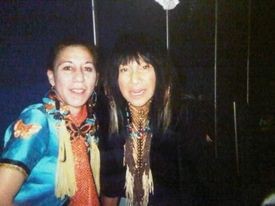
“My [adoptive] mom would always say that I was Indian like Buffy, but I didn’t understand what it meant to be Indigenous.” Boutilier with Buffy St. John, Toronto 2008.

“My mother has struggled with addictions her entire life, after spending most of her childhood seperated from her family and culture by these institutions,” she added.

It’s been over 30 years since Sharon Boutilier first reconnected with her family, and Boutilier says that meeting them was the first step in healing from her own trauma.

“One thing that really helped me in my journey was when an Elder told me that we come from the stars,” she explained. 

“We are put on this Earth to learn more, it made me feel like I was on the right path by learning about my Peoples.”

Boutilier says the Canadian Government’s reaction to recent discoveries on the grounds of former residential schools is insulting to Indigenous communities.

“When Stephen Harper made his apology in 2008 I worked at the Native Centre. I watched the Natives breakdown in tears, the Elders, watching the apology on TV and I heard the stories about what they went through,” Boutilier explained.

“I believe the Prime Minister needs to stand up and stop saying that the Canadian Government is shocked. This was planned by the government, executed by the churches as a cultural genocide,” she added.

Boutilier said that recent marches, protests and vigils in support of the Indigenous communities has given her hope for the future.

“Seeing all the people turning out to these events brought tears to my eyes, because it feels like Canadians are finally waking up,” Boutilier said.

“The Sixties Scoop” occurred from the early 1950s through the 1980s, and saw tens of thousands of Indigenous children removed from their families and adopted out to non-Indigenous families.

Wednesday, November 11, 2020

World Channel: ‘Blood Memory’ tells history of Native American adoption


World Channel in partnership with Vision Maker Media commemorates Native American Heritage Month and Veterans Day with films showcasing the rich culture and history of Native Americans highlighting documentaries like ‘Blood Memory’ Nov. 17 and ‘The Blessing’ Nov. 24.

More information about the film can be found at https://www.bloodmemorydoc.com/ and at www.worldchannel.org, where audiences can also find the line-up of films being shown as part of Native American Heritage Month. 

A trailer of the film is available at https://worldchannel.org/episode/arf-blood-memory/?asset_slug=arf-blood-memory-promo.

GOOD NEWS: World Channel: ‘Blood Memory’ tells history of Native American adoption | Navajo-Hopi Observer | Navajo & Hopi Nations, AZ


Are you searching? READ THIS: https://blog.americanindianadoptees.com/2020/07/what-can-adoptee-do-i-want-my-obc.html

Tuesday, October 29, 2019

16th Annual Gathering for Our Children & Returning Adoptees Pow Wow

"It's that time of year again when we call out for our relatives who are making their way back to the circle. We encourage birth mothers/fathers and relatives to be part of this celebration of life and healing. Dancers! Please come dance and welcome our relatives back to our circle. Adoptees, formerly fostered individuals, birth relatives, foster parents, foster youth, adoptive parents and your children - this pow wow is for you, come and celebrate and let us celebrate with you!" 
Sandy White Hawk


Tuesday, March 12, 2019

The business of Indian adoption

Archive: Terry Cross
Adoption of native children broke families apart while others profitted

Char-Koosta News

PABLO– Sandra White Hawk (Sicangu Lakota) said she was 18-months-old when she recalled being taken in a red pickup truck. “I remembered sitting between these two strangers,” she said. “I didn’t know where I was going. I had an outer body experience from the trauma of it all and I remember watching myself drive down the dirt road with these people.”

The strangers were White Hawk’s adoptive parents and they were a white missionary couple originally from Illinois. White Hawk said she suffered abuse during her upbringing in their home. “It was difficult being the only Native person in town and there was racism,” she said. “My adoptive mother suffered from mental illness and I was subjected to abuse.”

White Hawk said she was placed in the foster care system through a referral made by a Catholic church that operated on the Rosebud Reservation in South Dakota. “Churches received federal funding for referring Native children into the foster care system on my reservation,” she said. “The truth is this is a business and it’s tearing many Native people from their homes.”

White Hawk collaborated with filmmakers Drew Nicholas and Megan Whitmer to document her experience as a foster care survivor in the film “Blood Memory,” which was screened at Salish Kootenai College. “I’m thankful that this story could be shared,” White Hawk said. “There are many survivors out there without a voice.”

The film investigates the epidemic of Native American children being taken from their homes since the Indian Civilization Act (1819), which resulted in over 60,000 Native American children being forced to attend government funded boarding schools throughout the country. Whitmer said she was horrified reading through old accounts from boarding school staff. “They discussed the money they were receiving from the government,” she said. “They talked about how the schools were cheaper than what it would cost to kill the Native people but this was a business since early on.”

The business of adoption and child welfare in America is a $16 billion industry, according to 2018 reports from the business market research firm IBIS World. Nicholas has been working on the project since 2010 and said it was a learning experience. “It was eye-opening for me to learn that adoption isn’t just this beautiful thing, we’re seeing that it can be really terrible too,” he said. “It’s a huge industry and historically Native communities have been the most vulnerable.”

The film highlights the “Indian Adoption Era,” which was a federal program conducted between 1958 through 1967, which resulted in 35 percent of all Native American children being forcibly removed from their homes and adopted into white families. “There is this white superiority complex that says that we as Native people can’t take care of ourselves and that mentality has been very destructive,” White Hawk said.

Thanks to the testimony of Native American mothers who went before Congress, the Indian Child Welfare Act was passed in 1978. The legislation is now considered the “gold standard” in adoption practices and governs legislation over Native American children. “It took 20 years for this epidemic of Native children being placed in the foster care system to be addressed by the federal government,” Nicholas said. “The women who went before Congress truly were heroic.”

Since ICWA passed, Native American children are still overrepresented in the foster care system. The National Indian Child Welfare Association (NICWA) reports that rates of Native American children in the foster care system are 2.7 times greater than the general population in 2017 and 40 percent of the cases are placed by tribal authorities. In Montana, Native American children account for 30 percent of the state’s out of home care cases.

White Hawk works with fellow Native American survivors of the foster care system. “Blood Memory” is currently being screened across the country and was an official selection for the 2019 Big Sky Documentary Film Festival.

For more information on the film, visit: www.bloodmemorydoc.com

Wednesday, November 21, 2018

“Blood Memory”

From left, Drew Nicholas, producer of “Blood Memory,” speaks along the side of Oglala Lakota tribe member Jerry Dearly, Sandy White Hawk, founding director of First Nations Repatriation Institute, and fellow “Blood Memory” producer Megan Whitmer, during a panel on the preview screening in the Beus Center for Law and Society on Nov. 20, 2018. (Jonmaesha Beltran/DD)
BLOOD MEMORY MOVIE

Happy Visitors!

WRITTEN BY HUMANS!

WRITTEN BY HUMANS!

Blog Archive

Featured Post

Your History Class Was a F*cking Lie | #NOMOAR

  Your History Class Was a F*cking Lie by Sean Sherman (Or: How the American Educational System Has Always Been a Racist Propaganda Program...


Native Circles

Native Circles
click logo for podcasts!

Most READ Posts

Bookshop

You are not alone

You are not alone

To Veronica Brown

Veronica, we adult adoptees are thinking of you today and every day. We will be here when you need us. Your journey in the adopted life has begun, nothing can revoke that now, the damage cannot be undone. Be courageous, you have what no adoptee before you has had; a strong group of adult adoptees who know your story, who are behind you and will always be so.

Diane Tells His Name


click photo

Lost Birds on Al Jazeera Fault Lines

Lost Birds on Al Jazeera Fault Lines
click to read and listen about Trace, Diane, Julie and Suzie

NO MORE STOLEN SISTERS

NO MORE STOLEN SISTERS
click image

ADOPTION TRUTH

As the single largest unregulated industry in the United States, adoption is viewed as a benevolent action that results in the formation of “forever families.”
The truth is that it is a very lucrative business with a known sales pitch. With profits last estimated at over $1.44 billion dollars a year, mothers who consider adoption for their babies need to be very aware that all of this promotion clouds the facts and only though independent research can they get an accurate account of what life might be like for both them and their child after signing the adoption paperwork.

Original Birth Certificate Map in the USA

Google Followers