


Two approaches to addiction aim to help as many homeless drinkers as possible
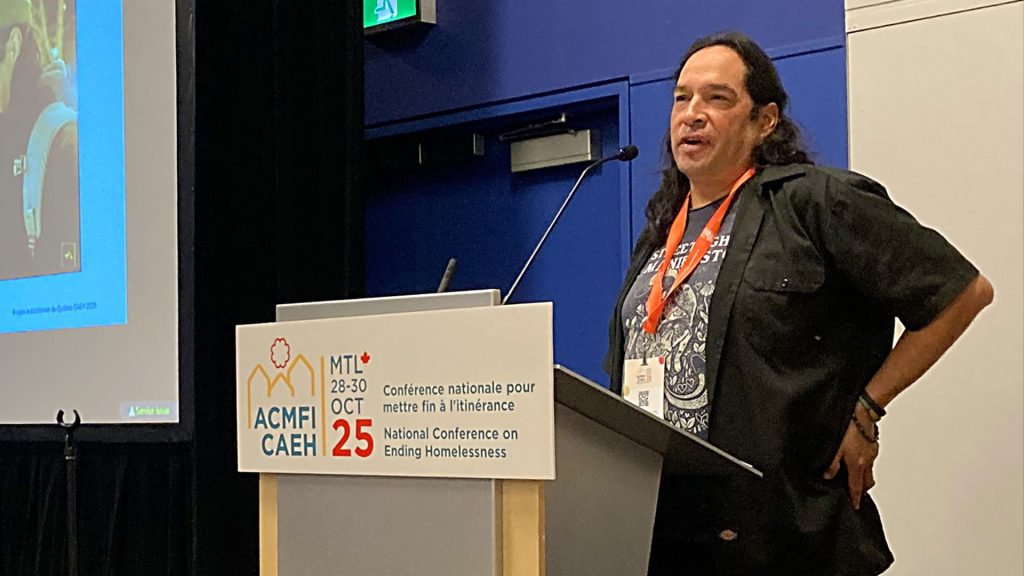
Chris Brown speaks to the 2025 National Conference on Ending Homelessness about his experience quitting drinking and leaving the street for Projets Autochtones du Québec's long-term sober residence. Photo: Jesse Staniforth/APTN News
Chris Brown has been sober for two years.
Born Christopher Lee Roy in Moose Jaw, Sask., Brown was part of the Sixties Scoop.
He was adopted into a non-Indigenous home and struggled with his life and family until 1992, when a friend told him he should consider running away to Montreal.
There, he became a street kid. He recalls discovering even at 16 he could walk into one of the city’s many dépanneur corner stores and buy a beer and a cigarette for under two dollars, no questions asked.
“That really kept me moving forward through my addictions,” he said.
Until two years ago, when he felt he was approaching the end of his time as a drinker.
“My body wasn’t holding on to it,” he recalls. “My mind was going. And you know, those things that they say to you, like ‘jail, insanity, death, those are the only options.’ I believe that. And I really thought about the insanity part of it. My mind was only thinking about my next drink when I woke up.”
Today, Brown lives in one of the 14 rooms at the Annagiarvik House in downtown Montreal, a long-term transitional residence for sober Indigenous people leaving the street.
The Annagiarvik House is operated by Projets Autochtones du Québec (PAQ), an organization providing shelter to members of the Montreal urban Indigenous community struggling with housing.
Brown discussed his experiences as part of a panel on Indigenous approaches to harm reduction and cultural safety during the 2025 National Conference on Ending Homelessness in Montreal.
KEEP READING👇









 Posts
Posts

