They Took Us Away

They Took Us Away
click image to see more and read more

it's free

click

How to Use this Blog

BOOZHOO! We've amassed tons of information and important history on this blog since 2010. If you have a keyword, use the search box below. Also check out the reference section above. If you have a question or need help searching, use the contact form at the bottom of the blog.


We want you to use BOOKSHOP to buy books! (the editor will earn a small amount of money or commission. (we thank you) (that is our disclaimer statement)

This is a blog. It is not a peer-reviewed journal, not a sponsored publication... WE DO NOT HAVE ADS or earn MONEY from this website. The ideas, news and thoughts posted are sourced… or written by the editor or contributors.

EMAIL ME: tracelara@pm.me (outlook email is gone) THANK YOU CHI MEGWETCH!

SEARCH

Showing posts with label Lamanites. Show all posts

Thursday, December 29, 2022

Wyoming: Indigenous women discuss growing up with non-Native guardians

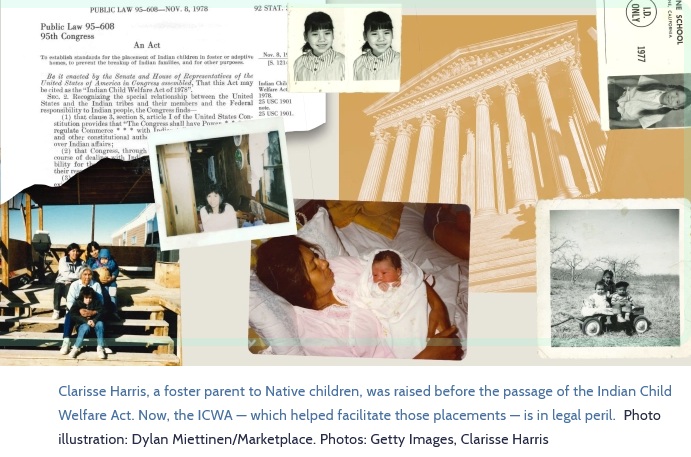
Clarisse and Pat Harris are in their mid-70s. They live in a white house on a hill in Ethete, Wyoming, with the seven children they’re raising.  In the yard, there’s a chicken coop, a sweat lodge and a view of two snow-capped mountain ranges: the Wind River to the west and the Owl Creek to the north. STORY

Federal protections for Native children in jeopardy

WYOMING:  The Riverton Peace Mission’s online discussion about the Indian Child Welfare Act highlighted the experiences of two local Indigenous women who were fostered or adopted by non-Native families before the federal law was put into place.

Since 1978, ICWA has given Tribal nations “sole authority (to) determine what happens with children who belong to their Tribe,” RPM co-chair Chesie Lee explained at the beginning of the Thursday event.

But before the law was enacted, “large numbers of Native children were being separated from their parents (and) placed outside of their families and communities – even when fit and willing relatives were available,” according to the National Indian Child Welfare Association.

“Congressional testimony documented the devastating impact this was having upon Native children, families, and tribes,” the association says. “The intent of Congress under ICWA was to ‘protect the best interests of Indian children and to promote the stability and security of Indian tribes and families.'”

Identity

Both of the women who shared their stories Thursday said growing up in non-Native homes impacted their sense of identity.

“We didn’t know who we were,” said Clarisse Harris, a Northern Paiute from the Big Pine Reservation in California who has lived in Ethete for decades.

Harris and her younger siblings were sent to live with white foster parents when she was 10 years old, and she said their guardians did a good job making the children feel like “part of (the) family.”

“We did everything like everybody else,” Harris said, recalling 4H activities, long bus rides to school, family celebrations and trips throughout the region. “But that was not who we were. … We were Native Americans. And we should have been told that.”

The foster parents “didn’t try to change us,” Harris noted, and “we weren’t abused or anything,” so “compared to some people (we) had it pretty good.”

The “only thing” missing, she said, was “access” to information about their Tribe.

“No one in the home or in the community that we lived in ever talked about it,” she said. “We (didn’t have) anyone to say, you know, this is what you do, this is what your Tribe does, or anything like that.”

‘Two worlds’

When she turned 18, Harris returned to live with her biological family, and over time she learned more about her Tribal community.

Now, she says she is able to “walk in two worlds.”

“I know both sides,” she said. “And I choose the Native side. I can make that choice. (And) that’s the way I raise my kids.”

Harris’ biological children are enrolled members of the Northern Arapaho Tribe, and before they became teenagers, the family decided they should move to the Wind River Reservation so they could be closer to the community there.

“(My kids) learned how to be Arapahos, and the language and the ways,” Harris said. “That was important. … It’s important that our people know where we’re from (and) who we are.”

She makes sure the same community connection is available for all of the Arapaho children she has fostered “on and off” for the past 40 years.

“The children that I have in my homes, they all know they’re enrolled Arapahos,” she said. “(They) know that they’re Native Americans.”

Those messages are re-emphasized in the local schools, which are “a lot” different now than they were when she first moved to Fremont County, Harris added.

“Everything is slowly changing to reflect Native American culture,” she said, referencing lessons on Indigenous languages, dress, dances and songs. “Forty years ago, they didn’t have that. (But) it’s the core of the schools now.”

‘A Lamanite’

Carol Harper of Riverton said she was “impressed” with Harris’ ability to “walk (in) two worlds” – a skill Harper has begun to develop later in life.

“I’m on my own journey now … to understand my Native roots and my heritage,” Harper said. “After all these years I’m really trying to define myself.”

Harper was born in Fremont County to a Native American and Hispanic woman who gave her up for adoption to a white family in Riverton when Harper was still an infant.

Her adopted parents allowed her to visit with her birth mother and other Native relatives on the reservation when she was a baby, Harper said, but when she got older, they decided it would be “too confusing” for her to maintain those relationships.

They did not take the same steps to shield her from the confusion she experienced as a Native American member of the Church of Jesus Christ of Latter-Day Saints, where she said she was “programmed to believe” that she was a Lamanite – a class of people defined in the Book of Mormon as “dark, filthy and loathsome.”

“That was very, very confusing for me,” Harper said.

She also had to contend with the fact that some of her adopted relatives were “very racist against Natives” and other minority groups – opinions that were handed down to her adopted mother “by default.”

“My mom had a hard time with me,” Harper said, describing multiple instances when her adopted mother physically and emotionally abused her in the home. “She would say she was going to beat the Indian out of me one way or another. (So) I just relented, and I conformed.”

Harper went to college at Brigham Young University, and she got married in the Salt Lake Temple to an LDS man who also was physically abusive.

She later divorced her husband and then left the LDS church.

Around that same time, Harper also received a call from her adopted mother, who “tearfully apologized for the abuse that she perpetrated throughout my childhood.”

“And I forgave her,” Harper said. “But I obviously haven’t forgotten about it.”

She explained that her childhood experiences, both at home and at church, had “devastating” and lasting impacts on her sense of self.

“That religion stole my identity,” Harper said. “I feel like I’m a baby again, trying to get my identity back with my Tribe.”

She’s also interested in learning more about her ancestors of Hispanic and Welsch descent, Harper said, prompting Harris to point out that every child in the foster or adoption system should have access to information about their biological background, no matter where they’re from.

“(They) have the right to know that,” Harris said, urging the guardians of Native children, in particular, to “take it upon” themselves to “provide that baby with what it needs to be a Native American,” regardless of the outcome of the ICWA case next year.

To learn more about ICWA, click here.

Friday, May 4, 2012

Indian Origins and the Book of Mormon

Where Did Joseph Smith Get His Ideas
for the Book of Mormon?

By Sandra Tanner

One of the claims often made by LDS people is that there was no information on the Indian ruins in Mexico and Guatemala available prior to 1830. Actually, numerous books recounting similar ideas as those in Joseph Smith’s Book of Mormon had already been published.
Many of the books published on the American Indians claimed a possible tie to the lost tribes of Israel. The Book of Mormon follows this idea and claims that the main group in the story is Israelites from Jerusalem. Other ideas found in the Book of Mormon that are also found in books of Smith’s time include: two groups warring against each other, a white group destroyed by war, horses, use of the wheel, mammoth bones, Hebrew writings, Egyptian influence, the use of stone boxes, written records, temples, grand ruins, highways, fortifications, etc. These commonly held theories prepared the way for people to more readily believe the Book of Mormon.
However, current findings and non-LDS scholars now reject these ideas and see no relationship between the American Indians and Hebrews or the civilization depicted in the Book of Mormon.
Below is a partial list of books published prior to 1830 dealing with the Indians (condensed from Indian Origins and the Book of Mormon, Dan Vogel, Signature Books, Salt Lake City, Utah, 1986, pp. 105-132).

Adair, James, The History of the American Indians, London, 1775.
  • Adair’s evidence for the Indian-Israelite theory consists of twenty-three parallels between Indian and Jewish customs. For example, he claims the Indians spoke a corrupt form of Hebrew, honored the Jewish Sabbath, performed circumcision, and offered animal sacrifice.
Boudinot, Elias, A Star in the West; or a Humble Attempt to Discover the Long Lost Ten Tribes of Israel, Trenton, 1816.
  • He relies heavily on evidences compiled by James Adair. He also mentions the Indians’ lost book of God.
Burke, Edmund, An Account of the European Settlements in America, 2 vol. 2nd ed., London, 1758 — many editions including one in 1808.
  • Mentions the Mexican and Peruvian temples.
Cusick, David, Sketches of the Ancient History of the Six Nations, Lewistone, NY, 1827.
  • Records Indian fables, which he believes, support the mound builder myth. One fable, for example, speaks of the descendants of two brothers continually at war with the other until one group is finally destroyed in North America.
Flint, Timothy, Recollections of the Last Ten Years, Passed in Occasional Residences and Journeyings in the Valley of the Mississippi, Boston, 1826.
  • He mentions the idea that the Indians were Jewish but does not commit himself on the subject. He describes various burial mounds and fortifications of North America and mentions the discovery of mammoth bones and stone coffins.
Haywood, John, The Natural and Aboriginal History of Tennessee, Nashville, 1823.
  • Compares American antiquities with those of Hindus, Egyptians, and Hebrews. He describes North American fortifications and Mexican temples, use of metals, including steel, copper and brass plates, describes stone boxes, possible use of the wheel and horse in ancient America, and concludes that the mound builders were a white people destroyed by the Indians.
Humboldt, Alexander, three different books on American Indian; one 4 vol. set was titled Political Essay on the Kingdom of New Spain. Baltimore, 1813.
  • Describes Mexican fortifications and temples, use of metals.
Imlay, George, A Topographical Description of the Western Territory of North America, London, 1793.
  • Discusses, among other things, the practice of the mound builders to bury their dead in stone boxes.
Israel, Manasseh ben, The Hope of Israel, London, 1652 and 1792.
  • Includes story of a remnant of the ten tribes of Israel being discovered in Peru.
Juarros, Domingo, A Statistical and Commercial History of the Kingdom of Guatemala, London, 1823.
  • Claims Indians from the Old World, claims original inhabitants arrived in the New World shortly after the dispersion from the tower of Babel, describes Guatemalan fortifications, buildings, temples, and palaces, including the ruins of Palenque.
Loudon, Archibald, A Selection of Some of the Most Interesting Narratives of Outrages Committed by the Indians, in Their Wars with the White People, 2 vols. Carlisle, PA, 1811.
  • He supports the ten tribe theory, mentions that the Spaniards dug up Indian tombstones covered with Hebrew characters, and compares Peruvian temples to Jewish synagogues.
McCulloh, James H., Researches on America; Being an Attempt to Settle Some Points Relative to the Aborigines of America &c., Baltimore, 1817.
  • Discusses various theories explaining Indian origins, problems of transoceanic crossing, and discusses the theory that the mound builders were a white group more advanced than the Indians.
Mather, Cotton, India Christiana. A Discourse, Delivered unto the Commissioners, for the Propagation of the Gospel among the American Indians, Boston, 1721.
  • Suggests that those in the Old World could have sailed to America.
Mather, Samuel, An Attempt to Shew, that America Must Be Known to the Ancients, Boston, 1773.
  • He believes that America was populated by two major migrations, one from the tower of Babel and the other, centuries later, from Asia or possibly Phoenicia. He also subscribes to the theory that ancient America was visited by Christ's apostles or perhaps by some of the seventy.
Mills, Nicholas, History of Mexico, London, 1824.
  • Describes Mexican pyramids and compares them with those of Egypt.
Moulton, William, A Concise Extract, from the Sea Journal of William Moulton, Utica, NY, 1804.
  • He describes his visits to ruined Peruvian cities with "large palaces" and "elegant buildings" and Incan highways running over a thousand miles.
Niles, John Milton, A View of South America and Mexico, New York, 1825 (various ed. after that).
  • Describes palaces and temples in Peru.
Parrish, Elijah, A New System of Modern Geography, Newburyport, MA, 1810.
  • Parrish wrote his geography for use in New England schools. He describes mounds in North America and the Peruvian temple at Cusco. Includes a comparison of Indian and Israelite customs.
Poinsett, Joel Roberts, Notes on Mexico, Made in the Autumn of 1822, Philadelphia, 1824.
  • Mentions the Mexican tradition of the Flood, notes their immense pyramids and long paved roads, and mentions their hieroglyphic drawings and knowledge of astronomy and metallurgy.
Priest, Josiah, The Wonders of Nature and Providence, Displayed, Albany, 1825 and 1826.
  • A compilation of many previously published works, includes an extract from Francisco Clavigero's History of Mexico recounting the ancient Mexican traditions of idolatry and human sacrifice and a portion from Ethan Smith's View of the Hebrews detailing evidence that Indians were of Hebrew origin.
Rio, Antonio del, Description of the Ruins of an Ancient City, Discovered Near Palenque, in the Kingdom of Guatemala, London, 1822.
  • Rio describes various ruins at Palenque, includes plates of some of the structures, several Mayan codices. He suggests that the ancient Americans came by sea. He also mentions the tradition of an eclipse in AD 34 and speculates that the Mexican god Quetzalcoatl was St. Thomas preaching the gospel in ancient America.
Sewall, Samuel, Phaenomena Quaedam Apocalyptica, Boston, 1697 and 1727.
  • Suggests that the Indians are Israelites, that America might be the place of the New Jerusalem, and that the 'other sheep' mentioned in John 10:16 are the American Indians.
Smith, Ethan, View of the Hebrews; or the Tribes of Israel in America, Poultney, VT, 1823 and 1825.
  • Ethan Smith's is by far the most important and interesting work dealing with the origin of the American Indians and the mound builders. Suggests that the first settlers of the New World were the lost ten tribes of Israel. Includes extracts from von Humboldt's description of Mexican antiquities, Atwater's description of the mounds, and evidence from Adair and Boudinot to connect Indians with the lost ten tribes. He also mentions the Indian legend of the lost book of God, which would one day be returned.
Sullivan, James, The History of the District of Main, Boston, 1795.
  • He maintains the Ohio fortifications were built by people from Mexico and Peru because North American Indians did not possess the knowledge to construct them.
Thorowgood, Thomas, Jews in America, or, Probabilities That the Americans are of that Race, London, 1652.
  • He mentions the notion that the gospel was anciently preached in America. Emphasized the millennialistic nature of his Indian-Israelite identification and the importance of the Indians' conversion to Christianity.
Walton, William, Present State of the Spanish Colonies, 2 vols. London, 1810.
  • Mentions the Indian belief in the Creation and Flood and includes a description of Mexican architecture and metalwork.
Williams, Roger, A Key into the Language of America, Boston, 1827.
  • He believes that Indian language is a form of Hebrew and that their customs resemble those of the Jews. Although he is tolerant of the Indians, Williams believes their religion is devil inspired.
Williams, Samuel, The Natural and Civil History of Vermont, Burlington, VT, 1809.
  • Discusses various theories of Indian origins. Mentions the discovery of mammoth bones in North America.
Worsley, Israel, A View of the American Indians, London, 1828.
  • Relies heavily on Ethan Smith's View of the Hebrews. Believes mound builders had been destroyed by the Indians, mentions the discovery of large stone crosses in Central America and records the Indian tradition of a lost book of God.
Yates, John and Joseph Moulton, History of the State of New York, 1824.
  • They describe mounds and fortifications in their state and neighboring states, as well as the ruins of an ancient city near Palenque. According to them, these mounds, part of a great chain running down through Mexico and into South America, were built by a separate race of white-skinned people who were destroyed by the Indians. They mention the discovery of hieroglyphic writing and mammoth bones, and include reports that Indians in certain locales possessed the signs and tokens of Freemasonry.

The claims of Israelite origins, Hebrew and Egyptian writing, knowledge of the wheel, use of the horse, Freemasonry, a white race destroyed by the Indians, etc., have been refuted by current scholars.
But the existence and popularity of so many books making these claims prior to the publishing of the Book of Mormon demonstrates that Smith could have gotten his ideas for the Book of Mormon from sources in his community.

History continues to be an intrepretation and religion often its misguided messenger...Trace

Happy Visitors!

WRITTEN BY HUMANS!

WRITTEN BY HUMANS!

Blog Archive

Featured Post

Your History Class Was a F*cking Lie | #NOMOAR

  Your History Class Was a F*cking Lie by Sean Sherman (Or: How the American Educational System Has Always Been a Racist Propaganda Program...


Native Circles

Native Circles
click logo for podcasts!

Most READ Posts

Bookshop

You are not alone

You are not alone

To Veronica Brown

Veronica, we adult adoptees are thinking of you today and every day. We will be here when you need us. Your journey in the adopted life has begun, nothing can revoke that now, the damage cannot be undone. Be courageous, you have what no adoptee before you has had; a strong group of adult adoptees who know your story, who are behind you and will always be so.

Diane Tells His Name


click photo

Lost Birds on Al Jazeera Fault Lines

Lost Birds on Al Jazeera Fault Lines
click to read and listen about Trace, Diane, Julie and Suzie

NO MORE STOLEN SISTERS

NO MORE STOLEN SISTERS
click image

ADOPTION TRUTH

As the single largest unregulated industry in the United States, adoption is viewed as a benevolent action that results in the formation of “forever families.”
The truth is that it is a very lucrative business with a known sales pitch. With profits last estimated at over $1.44 billion dollars a year, mothers who consider adoption for their babies need to be very aware that all of this promotion clouds the facts and only though independent research can they get an accurate account of what life might be like for both them and their child after signing the adoption paperwork.

Original Birth Certificate Map in the USA

Google Followers