BOOZHOO! We've amassed tons of information and important history on this blog since 2010. If you have a keyword, use the search box below. Also check out the reference section above. If you have a question or need help searching, use the contact form at the bottom of the blog.
We want you to use BOOKSHOP to buy books! (the editor will earn a small amount of money or commission. (we thank you) (that is our disclaimer statement)
This is a blog. It is not a peer-reviewed journal, not a sponsored publication... WE DO NOT HAVE ADS or earn MONEY from this website. The ideas, news and thoughts posted are sourced… or written by the editor or contributors.
EMAIL ME: tracelara@pm.me (outlook email is gone)
THANK YOU CHI MEGWETCH!
Over the past couple years, you’ve heard several times from us about
the Indigenous resistance to construction of what’s slated to become the
world’s largest lithium mine near Peehee Mu’huh (Thacker
Pass), on the ancestral lands of our Paiute and Shoshone relatives in
so-called Nevada. We remain ever grateful to Lakota Law supporters like
you who have taken action to try to stop the mine and helped us raise
funds to help support the legal defense of water and land protectors
targeted by law enforcement there.
Those issues aren’t going away. But today, I want to share with you
something I hope will lift your spirits. Each year, on Sept. 12, the
descendants of Ox Sam (according to the lore of the people, one of just
three Paiutes who survived the 1885 Mountain Meadow Massacre) host a run
to honor his memory — and all who were lost. This year, I traveled out
to participate with my daughter, Tokata, and Antoine Running Bear of the
Native American Youth Organization (NAYO).
I invite you to watch our new video,
narrated by Tokata, which highlights her participation in the run and
offers our appreciation to the grandmothers and all those who organized
this important recognition of history and resilience.
Watch: Tokata put in some miles to honor our Paiute relatives and their ancestors!
It should go without saying, but these lands — and many sites
contained within them — are sacred. While we may not, in the end, be
able to halt the mine’s construction, I’m grateful that you have helped
us make an impact by publicizing its threat to Native homelands, sacred
burial grounds, and a delicate ecosystem with several threatened
species. Your support has empowered what must be an ongoing conversation
about the continued necessity to gain consent from frontline
communities as we transition from fossil fuels to “clean” energy like
lithium, cobalt, and other critical minerals.
20% of these sought-after commodities lie under land currently
controlled by tribal governments. Even more minerals and other resources
are contained within land Native nations possess and over which we hold
legal claims — titles which have never been extinguished. We have a
right to be in our lands and withhold our consent on infrastructure
which puts us in the sacrifice zone.
Thank you for helping us make new friends in this struggle. Part of
what Lakota Law always aims to accomplish — with a renewed emphasis as
we complete our transition to full Indigenous leadership under the
Sacred Defense Fund — is the forging of rock-solid relationships and
partnerships with our fellow Indigenous People, across Turtle Island and
the world. On this trip, we met Ivan Bender, from the Hualapai Tribe in
Arizona, whose lands are also currently threatened by an exploratory
drilling project for lithium. Mining for lithium, gold, and other
resources also remains a major issue closer to home in the Black Hills.
Please stay with us as we move forward. We’ll have much more to say —
and there will be more you can help us do — to protect sacred lands,
elevate Indigenous voices, and safeguard the Native communities who seem
always to be disproportionately affected by incursions from extractive
industries. Your friendship means the world to us.
Wopila tanka — thank you for standing up for the sacred!
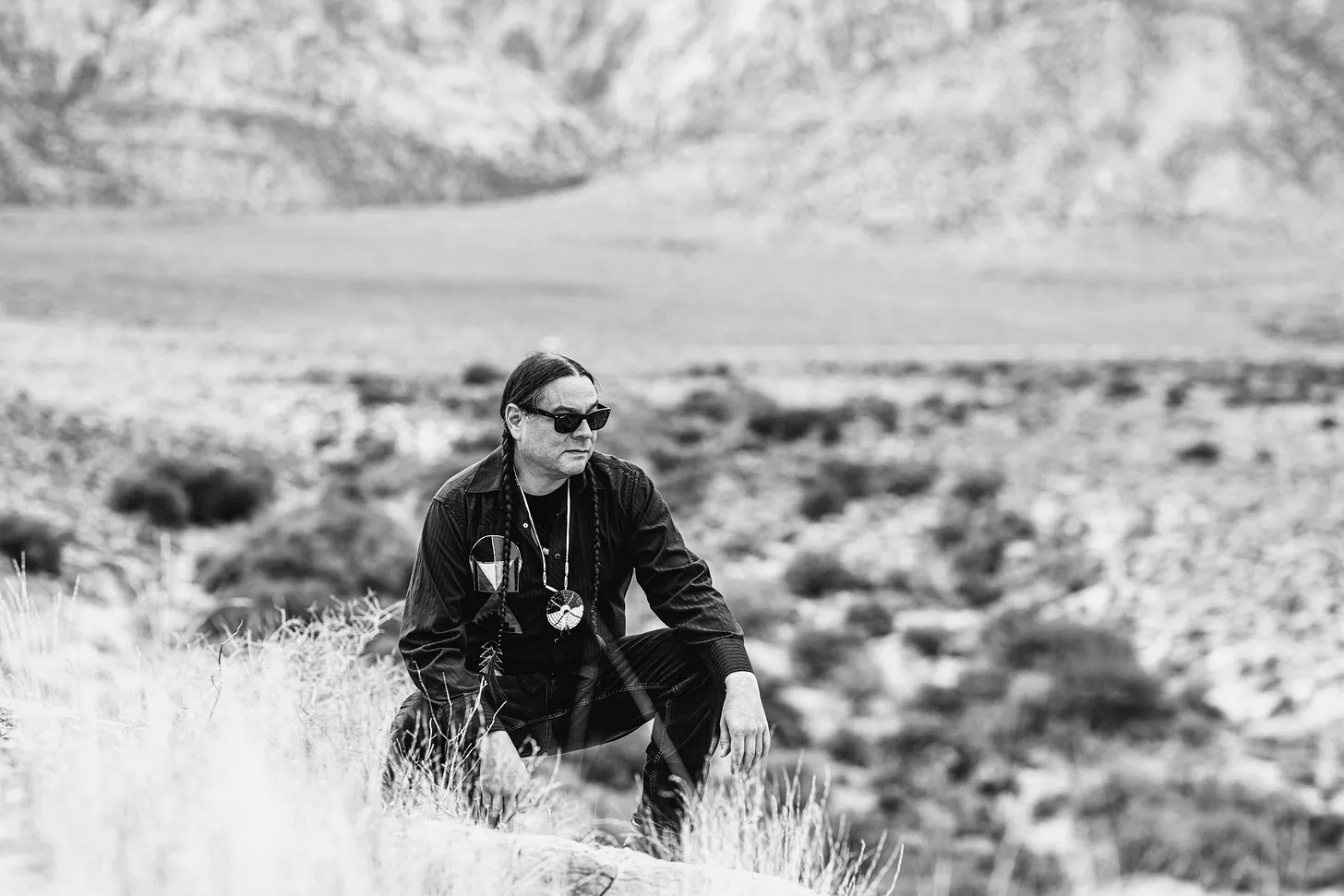
Chase Iron Eyes
Director and Lead Counsel
Lakota People’s Law Project
Sacred Defense Fund
PHOTO/FRANK
X. MULLEN: The cemetery now known as the “Old Stewart Indian Cemetery”
or the “Dat-So-La-Lee Cemetery,” after the master Washoe basket weaver
who is buried there. Most of the stones are simple marble tablets but
there are also a few wooden, concrete and sandstone markers, as well as
numerous unmarked graves. In the 1940s, a new cemetery was established
less than a mile to the west of the old cemetery. Both are on Washoe
tribal property. Photos used in this story were taken from outside the
fence line.
Starting
in the late 1800s, a system of more than 350 Indian boarding schools
was tasked with stripping indigenous Americans of their language and
culture, while isolating them from their families and tribes, in an
effort to “assimilate” the students into white society.
At Stewart
Indian School, which opened in 1890, the very existence and memory of
about 200 native people, presumably children, were erased as well.
At
the old school cemetery adjacent to the 240-acre campus, southwest of
central Carson City, there are more than 170 marked graves. Those range
in time from 1880, a year before the school existed, to the early 2000s.
The marked gravesites include many with weathered, nearly-illegible
headstones as well as easily-read marble markers and well-tended family
plots. The wind-swept site on tribal land, protected by a fence and
ringed with gnarled sagebrush, also encompasses an estimated 200
unmarked plots, whose occupants and dates of interment are a mystery.
The
institution is among hundreds of Indian boarding schools that will be
examined by the federal government in an effort to document their
histories, including identifying the students who attended them and
those who never went home. That review, announced in June by U.S. Interior Secretary Deb Haaland, came after nearly 1,000 unmarked graves were found at former Indian boarding schools in Canada.
Stacey Montooth, the executive director of the Nevada Indian Commission,
last month inspected the Stewart cemetery and reported her findings to
the Interior Department, which decided to add the institution to its
review.
“I hope we find
the names of every student who attended the Stewart Indian School and
find those dates (of attendance) and their tribal affiliations. I’m
hopeful that we can share that information with their families, their
descendants. Then that will give new insights for their loved ones and
allow them to have a new appreciation for the experience of their
ancestors or their elders.”
– Stacey Montooth, executive director of the Nevada Indian Commission.
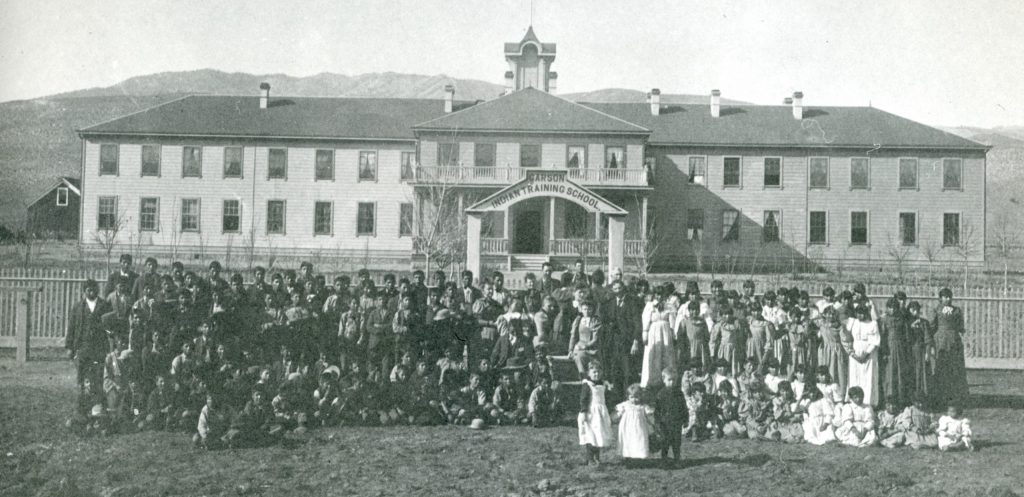
PHOTO/STEWART INDIAN SCHOOL MUSEUM AND CULTURAL CENTER: Students in front of the old main school building in the early 1900s.
Inherited trauma
Montooth
said the review is about more than cataloging names and gathering data.
Learning about students’ experiences at the school, she said, could
help tribal people understand “some of the dynamics in their families,
and with reflection, quite possibly make those families stronger and
more grounded in their culture, which would lead to stronger
communities.”
The history of the Stewart Indian School, the topic of a sidebar to this story,
is a mixture of proud achievement and shameful treatment; school
spirit, loneliness and resilience. What was called “assimilation” from
the early 1800s to the 1930s is today seen as an attempt at cultural
genocide, even ethnic cleansing. The boarding schools’ initial goal to
“kill the Indian, save the man” failed, but the human price of those
policies reverberates down through generations of tribal people.
The
costs yet to be tallied include information about those who rest in the
unmarked burials among the headstones in the old school cemetery,
located on land returned to the Washoe Tribe of California and Nevada.
Permission from the tribe is required for entry.
“We
must shed light on what happened at federal boarding schools. As we
move forward in this work, we will engage in tribal consultation on how
best to use this information, protect burial sites, and respect families
and communities.”
— Principal Deputy Assistant Secretary for Indian Affairs Bryan Newland.
Some records lost
Montooth
said the Nevada Indian Commission is gathering what records are
available, but has not yet received specific direction from the
Department of Interior about how to proceed. The commission will work
with tribal leaders and school alumni during the course of the review,
she said.
There is no complete roster of Stewart students, but
according to an estimate by the Nevada State Museum, about 30,000
children were enrolled there during the 90-year life of the school. Some
pupils attended for many years; others for just a few months. When the
institution closed in 1980, some school documents and records were lost
and others were sent to federal repositories, said Bobbi Rahder,
director of the Stewart Indian School Museum and Cultural Center.
PHOTO/FRANK
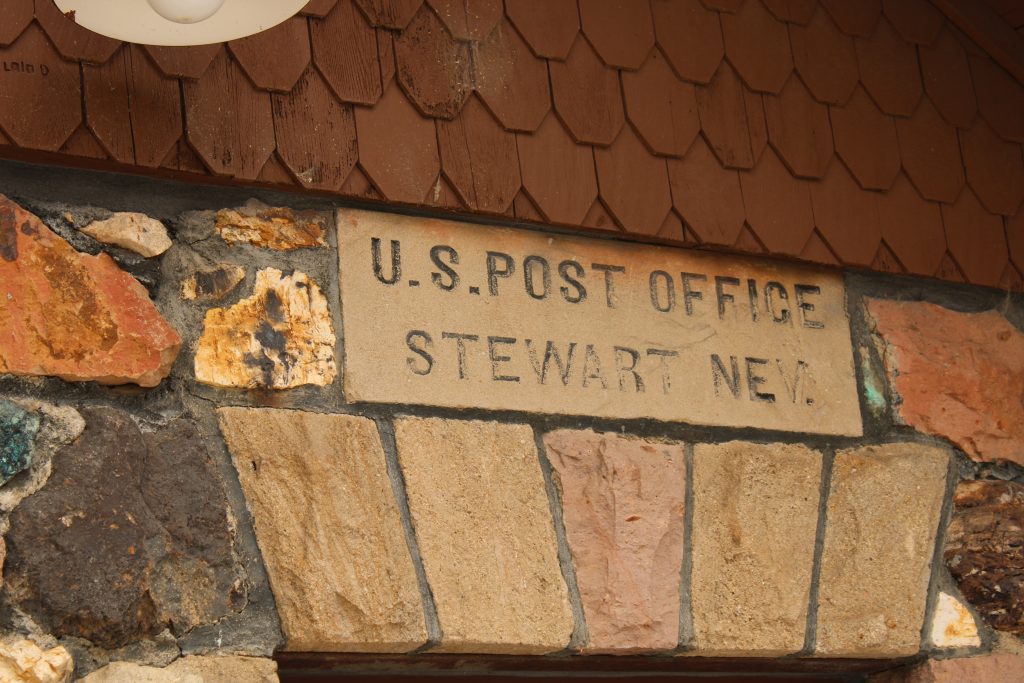
X. MULLEN: Student stonemasons in the 1920s built the colorful stone
buildings on the campus. The old Post Office is now a museum gift shop.
Montooth
said that when federal authorities suddenly closed the school, “there
was absolutely no transition plan. It was a shock to staff, students,
faculty and the state of Nevada.” In addition to the documents stored at
federal facilities, she said, some documents and artifacts formerly
displayed in the school are now under the control of the Bureau of
Indian Affairs and kept in a warehouse in Carson City.
“We’re
hopeful that eventually those items will be returned to the Nevada
Indian Commission, especially in light of the Secretary of the
Interior’s initiative that aims to find out the names, dates and tribal
affiliations of all people who attended boarding school,” she said. “…It
would not only help in the healing, but allow (tribal people) a place
to come and do research to find out about their families. It also would
be very helpful to us in filling in the holes we have in the records.”
Volunteers cleaned up site
Researchers
have located some of the documents related to the school housed at the
San Bruno National Archives in California. In 2007, the Nevada
Department of Transportation initiated the Old Stewart Indian Cemetery Clean-up Project,
an effort that involved the Washoe Tribe, the Nevada Indian Commission,
the Virginia City Cemetery Foundation and the Stewart Indian Colony
Youth Group. The young volunteers cleaned up the site, repaired broken
grave markers, and documented more than 250 gravesites. Researchers
pored through federal records, copies of the school newspaper,
obituaries, death certificates and other sources to find out more about
the people who rest there.
Some of the results of that research are listed on the Find a Grave website,
where 176 Stewart cemetery graves are catalogued. The people interred
beneath those markers were students who died while enrolled at the
school, staff members, alumni, and their relatives. About half of those
buried in the 176 plots listed on Find a Grave were adults, the rest
were children, including some infants.
Students who died at the school also are buried in other cemeteries around Northern Nevada.
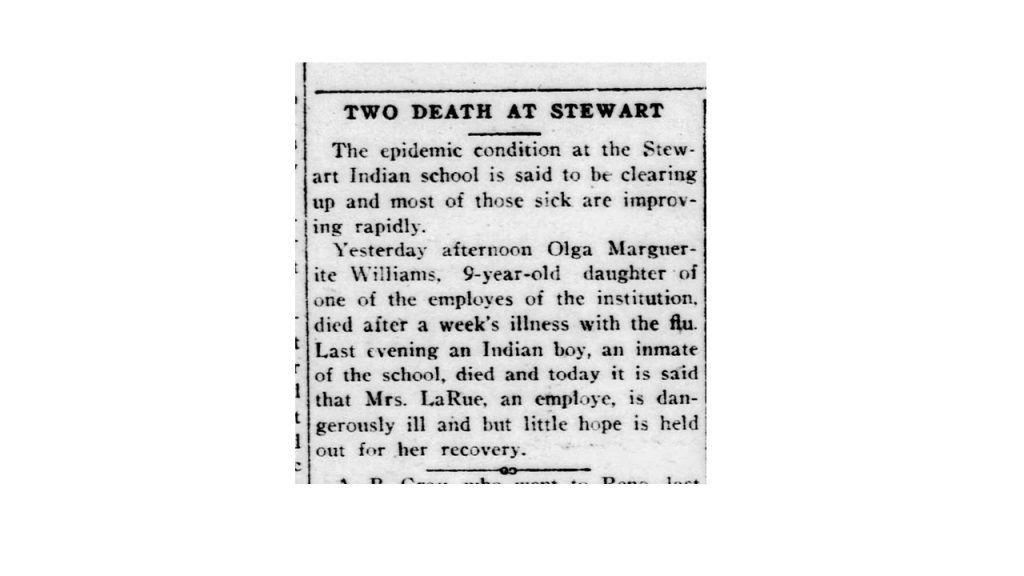
Nevada Appeal, March 26, 1919
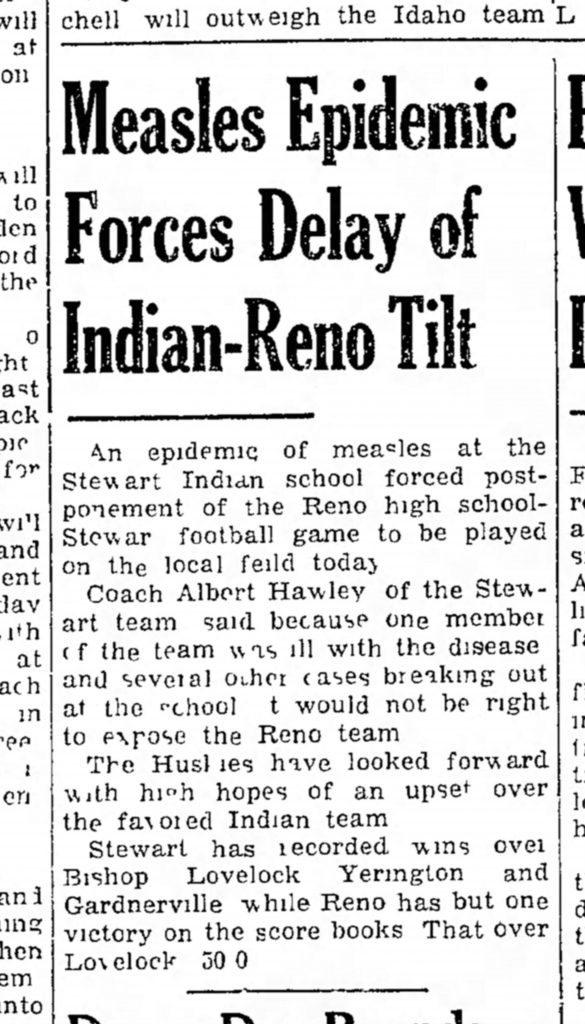
Reno Evening Gazette, Nov. 23, 1935
Epidemics and outbreaks
Those
researching the names on the Old Stewart Cemetery markers found
evidence documenting students who died of communicable diseases, which
spread easily in the close conditions at the institution.
Other
deaths are connected to epidemics. In 1896, for example, four children
between the ages of 7 and 13 were interred there. Researchers attributed
some of those deaths to the “Russian flu.”
In 1919, four children between the ages of 12 and 15 were buried in the
cemetery. Newspapers at the time reported that a total of five children
and three staff members died in the third wave of the Spanish flu
pandemic.
A similar spike in burials occurred in 1906, when five
children ranging in age from 7 to 10, and a 21-year-old male student
were interred, but researchers found no connection to a disease outbreak
at the school that year.
The public summary of the clean-up
project notes the existence of unmarked graves in the cemetery, but no
number is noted. More detailed information, including a digitized map of
gravesites, is in the custody of the Washoe Tribe. The tribe created an
on-line virtual “cemetery,” where relatives can share photographs,
stories and information about their loved ones.
Scientific racism
When
the school opened in a single wooden building 1890, it had no medical
facilities. During the first half century of its history, tuberculosis
and trachoma (an eye infection than can result in blindness) were
endemic at the school. Epidemics swept through the student body and
outbreaks of illnesses, including measles, mumps and related infections,
were common.
Bonnie Thompson wrote her doctoral thesis about the
school and the evolution of its policies on student health in 2013,
while a student at Arizona State University. Thompson wrote that the
school opened during an era of scientific racism, which continued through 1905.
“Medical
officials and the Indian Office largely believed that Indians’ ‘savage’
lifestyle and traditional beliefs predisposed them to chronic diseases…
Following this logic, the Indian Office did little to prevent students
from contracting these diseases or other illnesses other than isolating
contagious students.”
— Bonnie Thompson, doctoral thesis, 2013.
An
infirmary was built on campus in 1905 and a full-time nurse joined the
school staff. Germ theory eventually took hold, but the consistency of
better nutrition, good sanitation and the best-available health
practices varied over the years.
“Mumps, scabies, impetigo,
measles, smallpox, and influenza all reached epidemic proportions at
Stewart between 1890 and 1940,” Thompson wrote. “…The sheer magnitude of
these epidemics struck fear into the children and their parents and
reinforced the idea that boarding schools were death traps.”
Sent home to die
A
sanatorium for students infected with tuberculosis was built in 1916,
but it was always inadequate for the demand. Often, critically ill
children were sent home.
“To avoid deaths at the school, the
sanatorium also sent home students with advanced tuberculosis as soon as
possible,” Thompson wrote. “The wishes of parents and children
certainly played a role in the students’ return to their families.
Parents wanted to say goodbye to their children before they died. But by
sending the children home, the school pushed its responsibility for
sickness and the cost of further care onto other Indian agencies and
families themselves.”
Superintendents only reported deaths that occurred on campus, several researchers noted.
PHOTOS/
Special Collections and University Archives Department, University of
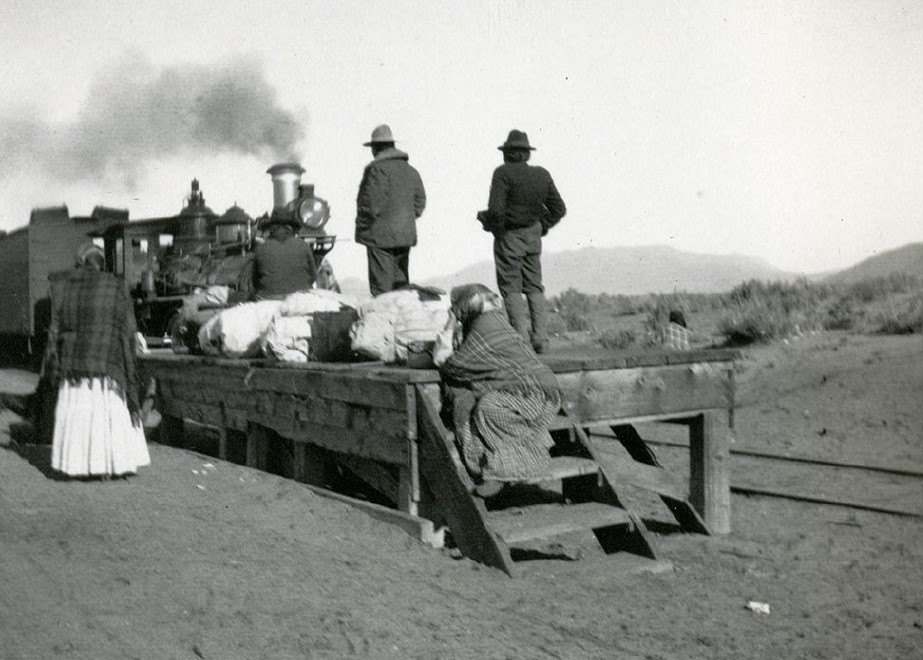
Nevada, Reno. On left, men and women wait for a train on thee V&T
Railroad platform in this undated photo (unrsp-P27102870). On right,
children pose near the school, circa 1930s.
The ‘Indian New Deal’
In
1928, the federal Meriam Report laid bare the problems at Indian
boarding schools, including the dismal states of nutrition and health
care. The Indian Reorganization Act of 1934, dubbed the “Indian New
Deal,” resulted in tribes using their new political power to pressure
the federal Indian Office to reform its policies.
Stewart stepped
up its education and prevention programs, but budget constraints and
changes in leadership got in the way of implementing best practices.
“Pupils at Stewart often complained about the quality and quantity of
food, physical exhaustion from their work regimen, and crowded
dormitories where they often slept two to a bed,” Thompson wrote.
Finding
more records may provide more insight into how children lived – and
died – at Stewart Indian School, but some gaps in the narrative may
never be filled.
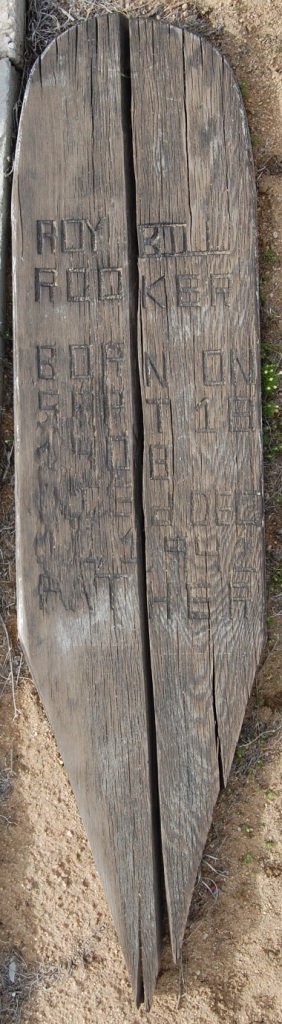
PHOTO: FIND A GRAVE
Numbers, not names
Nicholas
Jackson, a graduate student in education at the University of Nevada,
Reno, wrote his 1969 master’s thesis about the history of Stewart. He
noted that quantifying the number of children who died of disease at
Stewart, or at any federal boarding school, can be challenging.
“On
an institutional level, superintendents reported deaths of nameless
students in their annual reports to the Commissioner of Indian Affairs,”
Jackson wrote. “Even then, no complete record exists and the rates of
morbidity and mortality have to be pieced together from reports,
letters, death certificates, student records, and grave stones.”
That’s
part of what the federal review is trying to accomplish. The results
may not be comprehensive, but any further information will shed more
light on the experiences of the children who attended the school for
generations.
Dedicated to the task
Filling
in those gaps in the school’s history “looks like the direction the
Secretary of the Interior wants us to take and that’s what we want to
do,” Montooth said. Even if it’s possible to identify every student who
was enrolled, many of their fates may remain unknown.
“If they
were here and didn’t come back, you may not know why they didn’t come
back,” she said. “Did they run away, make it home, and were able to hide
(from the truant officer)? Did they not come back because they
perished? It’s such a complex situation. Most of the alumni and staff
records we have specific to the school indicate that there wasn’t a big
focus on record-keeping here. It followed that if the operation was
violent, and would reflect poorly on the federal government, then the
folks who had the ability to keep those records wouldn’t have made that a
priority.”
Still, Montooth said, every effort will be made to
learn as much as possible. “We want to be transparent and to be able to
tell relatives that, yes, this is when your relatives went to this
school and this is what we now know about them.” SOURCE
Kim Wheeler was adopted during the Sixties Scoop and fought to find her way back to her culture My name is Kim Wheeler but some know me as...
Bookshop
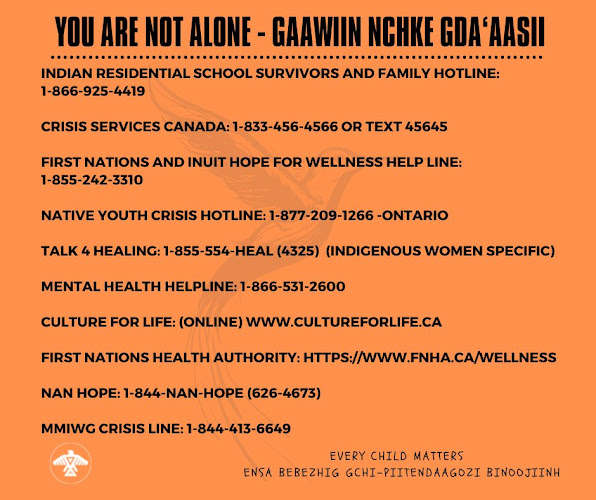
You are not alone
To Veronica Brown
Veronica, we adult adoptees are thinking of you today and every day. We will be here when you need us. Your journey in the adopted life has begun, nothing can revoke that now, the damage cannot be undone. Be courageous, you have what no adoptee before you has had; a strong group of adult adoptees who know your story, who are behind you and will always be so.
Diane Tells His Name
click photo
Lost Birds on Al Jazeera Fault Lines
click to read and listen about Trace, Diane, Julie and Suzie
NO MORE STOLEN SISTERS
click image
We conclude this series & continue the conversation by naming that adoption is genocide. This naming refers to the process of genocide that breaks kinship ties through adoption & other forms of family separation & policing 🧵#NAAM2022#AdoptionIsTraumaAND#AdopteeTwitter#FFY 1/6 pic.twitter.com/46v0mWISZ1
As the single largest unregulated industry in the United States, adoption is viewed as a benevolent action that results in the formation of “forever families.” The truth is that it is a very lucrative business with a known sales pitch. With profits last estimated at over $1.44 billion dollars a year, mothers who consider adoption for their babies need to be very aware that all of this promotion clouds the facts and only though independent research can they get an accurate account of what life might be like for both them and their child after signing the adoption paperwork.












 Posts
Posts

