They Took Us Away

They Took Us Away
click image to see more and read more

it's free

click

How to Use this Blog

BOOZHOO! We've amassed tons of information and important history on this blog since 2010. If you have a keyword, use the search box below. Also check out the reference section above. If you have a question or need help searching, use the contact form at the bottom of the blog.


We want you to use BOOKSHOP to buy books! (the editor will earn a small amount of money or commission. (we thank you) (that is our disclaimer statement)

This is a blog. It is not a peer-reviewed journal, not a sponsored publication... WE DO NOT HAVE ADS or earn MONEY from this website. The ideas, news and thoughts posted are sourced… or written by the editor or contributors.

EMAIL ME: tracelara@pm.me (outlook email is gone) THANK YOU CHI MEGWETCH!

SEARCH

Showing posts with label domestic violence. Show all posts

Wednesday, June 28, 2023

StrongHearts Announces Blue Campaign Collaboration #MMIR #HumanTrafficking

Missing and Murdered Indigenous Relatives (MMIR)

MMIR Intersects with Human Trafficking


(EAGAN, Minn., June 24, 2023) – 

“We recognize that the crisis of our Missing and Murdered Indigenous Relatives (MMIR) intersects with human trafficking and that eradicating violence against Native people hinges upon our ability to educate the public,” said CEO Lori Jump, StrongHearts Native Helpline. “That is why we are embracing a partnership with the Department of Homeland Security (DHS) Blue Campaign.”

The Blue Campaign is a public awareness campaign created to educate the general public, law enforcement and industry partners to recognize the indicators of human trafficking and how to appropriately respond to possible cases. DHS Blue Campaign works closely with other DHS components and various partners to develop general awareness training, as well as specific educational resources to help reduce victimization of human trafficking.

DHS Blue Campaign and StrongHearts Advertising Campaign

Blue Campaign and StrongHearts’ are collaborating on advertising efforts between the months of July and September 2023 to be distributed throughout the state of Washington. More importantly, StrongHearts and DHS staff will develop training for StrongHearts advocates on best practices when responding to Human Trafficking.

“We are diversifying training for StrongHearts advocates to enable them to better serve the needs of our people,” Jump added. “Washington is a progressive state that has implemented a Missing Indigenous Person Alert (MIPA) as well as launched a cold case unit for missing and murdered Indigenous people. Engaging in this partnership with the DHS will help to eradicate violence against our relatives.”

Expanded Reach

The DHS partnership expands the reach of StrongHearts by creating another avenue for spreading awareness that culturally appropriate support and advocacy is available for Native Americans experiencing human trafficking, domestic and sexual violence. It’s a collaboration that will open lines of communications between Native centered service providers and our relatives who need help.

The Blue Campaign leverages partnerships with the private sector, Non-Governmental Organizations (NGO), law enforcement, and state/local authorities to maximize national public engagement. Blue Campaign’s educational awareness objectives consist of two foundational elements: prevention of human trafficking and protection of exploited persons.

Recognizing Human Trafficking

Human trafficking is an exploitation-based crime against a person that involves force, fraud and/or coercion to obtain some type of labor or commercial sex act - victims can be any age, race, gender, or nationality. Key indicators can include:

The person appears disconnected from family, friends, and community.

The child stopped attending school.

The person had a sudden or dramatic change in behavior.

A juvenile engages in commercial sex acts.

The person is disoriented or confused/showing signs of mental or physical abuse.

The person may have bruises in various stages of healing.

The person is fearful, timid, or submissive and shows signs of neglect.

Someone else seems to be in control of where they go or who they talk to.


StrongHearts Can Help

If you are experiencing domestic violence and/or sexual violence, StrongHearts advocates can help by providing: peer support and advocacy, personalized safety planning, crisis intervention, referrals to Native-centered service providers; and support finding health facilities and crisis centers trained in the care of survivors of sexual assault, general information about jurisdiction, and legal advocacy referrals.

Serving all individuals who reach out for their services regardless of race, ethnicity, gender, gender identity, age, religion, national origin, sexual orientation, disability, or any other factor protected by local, state, or federal law, StrongHearts Native Helpline can be reached by calling or texting 1-844-7NATIVE (762-8483) or by online chat at strongheartshelpline.org, 24 hours a day, 7 days a week, 365 days a year.

To report suspected human trafficking, please call DHS tip line at 1-866-347-2423. To get help from the National Human Trafficking Hotline call 1-888-373-7888 or text HELP or INFO to BeFree (233733).

Tuesday, October 26, 2021

Survivors see a link between Indigenous boarding schools’ harsh discipline and later domestic violence

 Utah had boarding schools in Aneth, Intermountain, Ouray, Uintah and Panguitch.

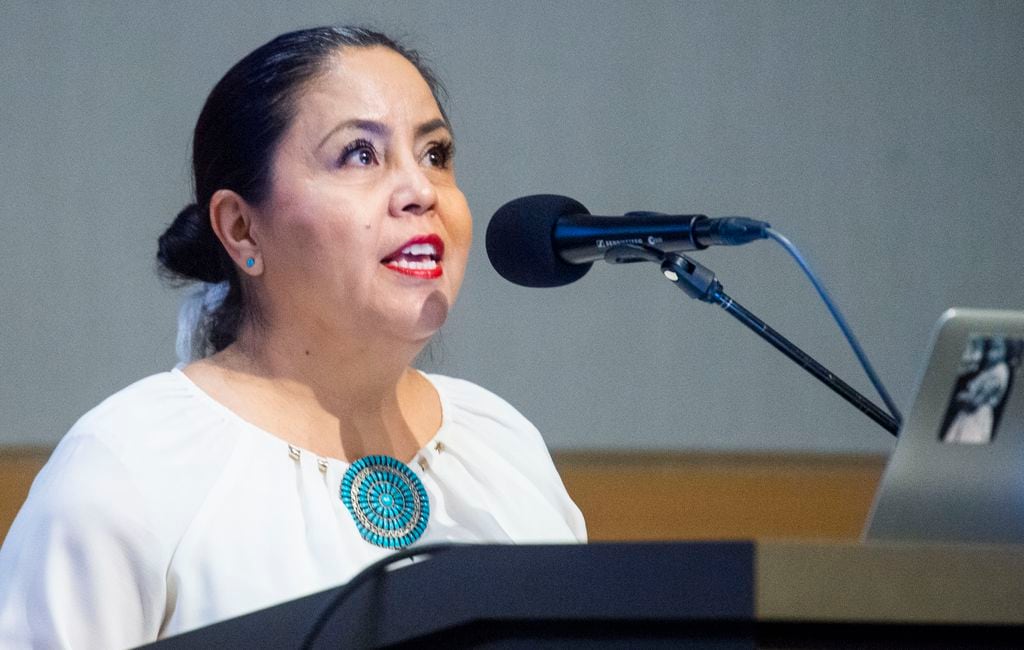
(Rick Egan  |  The Salt Lake Tribune)   Yolanda Francisco-Nez, Executive Director, Restoring Ancestral Winds, speaks about "Missing and Murdered Indigenous People in Utah" during a workshop at the Salt Lake City Library Auditorium, Monday, July 22, 2019.
(Rick Egan | The Salt Lake Tribune) Yolanda Francisco-Nez, Executive Director, Restoring Ancestral Winds, speaks about "Missing and Murdered Indigenous People in Utah" during a workshop at the Salt Lake City Library Auditorium, Monday, July 22, 2019.


Since the discovery of Indigenous children at boarding schools in Canada and then the unverified findings of Paiute bodies at the Panguitch Boarding School, the nonprofit Restoring Ancestral Winds (RAW) began research on the association between Indigenous boarding schools and domestic violence across Utah’s Indigenous communities.

On a panel called “Utah Native American Boarding Schools and other Assimilation Projects on Native Children and Families” hosted by RAW, Indigenous organizers said the Indian Civilization Act of 1819 is a precursor to some of the domestic violence among Native Americans in Utah.

The Indian Civilization Act, or Civilization Fund Act of 1819, is a federal policy that encouraged the assimilation of Indigenous children via boarding schools. From that policy came the formation of Utah boarding schools in Aneth, Intermountain, Ouray, Uintah and Panguitch.

“We have known that there’s a connection between missing and murdered Indigenous women, girls and two-spirit with domestic violence,” said Yolanda Francisco, executive director for RAW. Two-spirit people identify as being both feminine and masculine in spirit. “We have to mention that domestic violence plays a role; it’s a precursor to going missing or murdered.”

While the correlation between domestic violence and Indigenous boarding school has not been well studied, Francisco says she knows that the discipline experienced among Indigenous children influences how they eventually parent.

“There is definitely a role that punishment plays in the life of an individual who survives the boarding school experience, particularly those who were victims of that abuse that occurred,” she said.

Children were subjected to harsh punishments in the schools, ranging from the forced cutting of their hair, which is considered an important part of tribal identity, to eating soap for speaking their language, and other physical, emotional and sexual abuse. The living conditions were also poor and kids died from tuberculosis, whooping cough, measles, the flu and smallpox.

Thursday’s panel featured speakers Davina Smith, who is Navajo (Diné), Denae Shanidiin, who is Diné and Korean, and Kalama Ku’ikahi, who is Diné and Native Hawaiian, who all shared their experiences of boarding schools — either as survivors or through the experience of their parents and grandparents.

“When I think about boarding and foster care children, they’re also considered underneath this umbrella of missing and murdered Indigenous peoples,” Shanidiin said. She hoped the panel would bring more awareness of the Paiute children who attended the Panguitch Boarding School and other Indigenous children at other schools.

Ku’ikahi made connections between the Indian Civilization Act and the early boarding schools in Utah, noting that Christian churches and missionaries influenced the policy.

For example, the Uintah Boarding School, or Ute Indian Boarding School, was established in 1881 by the Episcopal Mission, as was the Ouray Boarding School in 1885. The Panguitch school was Presbyterian.

The Church of Jesus Christ of Latter-day Saints’ Indian Student Placement Program, which operated from 1947 to 2000, took approximately 50,000 Native children from reservations and placed them in Latter-day Saint homes, he said.

Smith said the connections between domestic violence and boarding schools run deep in her family.

Recently, Smith ran over 360 miles from Bears Ears National Monument and Grand Staircase Escalante National Monument to bring awareness to Indigenous issues like boarding schools and missing and murdered Indigenous people.

“I know for me I had to end that generational trauma for my kids because I did not want them to go through that,” Smith said. “And it was also about me talking and opening up my traumas with my kids. Just recently, I was able to open up to my mother and talk about it.”

Saturday, October 23, 2021

Creating a Separation Plan and Preparedness Kit


From the StrongHearts Native Helpline
 

It has been a long time coming, but you’ve made up your mind. It’s time to escape a life of domestic and sexual violence and leave an abusive partner. You're scared and for good reason. Danger increases when leaving an abusive partner because they often lash out to regain control over their partner. It is imperative that you carefully navigate the following process.  

You are the best judge of your own safety. Consider a safety plan — a personalized, practical plan that includes ways to remain safe while in an abusive relationship, planning to leave or after you leave. Safety plans can be continuously updated, even if you return to a partner that is abusive.

Separation Plan

A separation plan can help you to safely leave an abusive partner. A preparedness kit contains documents, clothing and comfort items needed to stay away from home for an extended period of time. Once you complete your separation plan and preparedness kit, be sure to keep any documentation of them in an accessible but secure location and/or consider storing them with a trusted friend, family member or advocate. 

The Escape Route

The important first step to creating a separation plan is being mindful of your surroundings and to plan an escape route from any room in the home. You may also want to identify alternate routes to the grocery store, school and/or work. Practice using escape routes regularly. When tensions are starting to escalate, plan to do the following:

      Try to be in a room close to an exit and/or plan an escape route from any room in the home. 

      Look for potential exits through windows and practice using them. 

      Stay away from the kitchen where the abuser has access to weapons.

      Stay away from bathrooms, closets, or small spaces where the abuser can trap you. 

      If the violence escalates, call for help! Call 911, a close relative, friend or neighbor.

Assemble a Preparedness Kit 

When assembling a preparedness kit, pack a bag with a change of clothes for you (and your children) and include comfort items. Store the preparedness kit outside of the home either with a trusted neighbor, friend or relative or keep it in a secret location where you can safely retrieve it. Important documents can be included or stored separately.

Important documents include:

      Identification 

      Tribe-issued enrollment card

      Driver’s License or State ID

      School ID(s)

      Passport(s)

      Social security card(s)

      Birth certificate(s)

      Health insurance card(s)

      Copy of Protection/Restraining Order

      Marriage, divorce and custody papers

      Vehicle registration and insurance

      Lease or rental agreements 

Important items include:

      A change of clothes for you (and your child)

      An extra cell phone and/or cell phone charger

      Extra set of house and car keys

      Medication (e.g., asthma inhaler, insulin, Epi-Pen)

      Cash or ATM card

      Personal items such as your medicines, smudge and sentimental items

      Comfort items such as a favorite stuffed animal, blankets and baby supplies (formula, diapers, and wipes).

There Is Hope

There is hope in planning to leave an abusive relationship. You can escape violence. You can call for help. StrongHearts advocates are available 24/7 to support all victim-survivors of domestic and sexual violence regardless of relationship status, gender identity or sexual preference. To speak with an advocate: Call or Text 1-844 672-8483 or chat online at strongheartshelpline.org

Other resources include: National Domestic Violence Hotline: Call 1-800-799-SAFE (7233) or 1-800-787-3224 (TTY). Domestic Abuse Helpline for Men and Women: Call 1-888-7HELPLINE (1-888-743-5754). The National Teen Dating Abuse Helpline: Call 1-866-331-9474 or 1-866-331-8453 (TTY).

Preparedness kit adapted from information from The National Domestic Violence Hotline. 


October is Domestic Violence Awareness Month

Monday, July 5, 2021

Safety During a Violent Encounter


From
: StrongHearts Native Helpline

Be aware that in an abusive relationship, violence is used as a tactic for the abuser to maintain power and control over the victim-survivor. The violence will continue and may escalate in intensity and frequency.

Safety planning is an individualized process where a practical plan is created that includes ways to remain safe while in an abusive relationship. An advocate can help you produce a plan and discuss your options with you.

If a violent encounter seems imminent and unavoidable, there are a few options to consider to keep you safe. These tips cannot guarantee your safety, but by using your experience and intuition, along with these tips, you may be safer. You are the best person to judge your safety.


     Try to control your breathing in through your nose and out through your mouth so you can continue to think clearly.

     Say or do whatever you can to de-escalate the situation.

     Avoid rooms or areas without an easy escape.

     Stay on the ground floor if possible.

     For example, a basement with stairs and one point of entry will be difficult to escape from during a violent attack.

     Mentally plan how you might escape from each room in advance.

     Be aware of your surroundings. Think about what you could use to shield yourself when your partner becomes abusive.

     Avoid getting into a vehicle.

     Avoid areas where weapons are easily accessible.

     Kitchens are dangerous because of the access to knives. Bathrooms are dangerous because of slipping and the many hard surfaces in a small area. Garages or sheds can also be dangerous because of access to tools and other heavy equipment.

     Avoid any areas where firearms are stored or kept, even if they are locked securely.

     Remove necklaces and scarves if possible as these could be used to strangle you. Remove earrings.

     Move away from any children in the area.

     Consider safe places to go after escaping.

     Choose a code word or signal that would let children, relatives or neighbors know they should call for help.

     Hide spare keys and money in a safe place or ask a safe person to hold onto them for you in case you need to flee unexpectedly.

     If you are unable to get away from the abuser and are being assaulted, try to make yourself as small as possible to minimize any injuries. Get into a corner or put your back to a wall, bring your knees to your chest and use your arms to cover your neck.

     You have the right to protect yourself and that includes calling the police. 

After the Violence

After a violent encounter, it can be difficult to process what has happened, take time for yourself to recover and reconnect with yourself. Seek medical attention if needed and is safe to do so. Consider documenting the violence and abuse. Take pictures and write descriptions of the abuse in a journal or open an email account and email them to yourself. If there are any medical or police reports documenting the abuse, keep the records. Make sure your information is kept in a safe place. Keeping documentation will allow you to have an option to pursue legal action in the future.

Participating in self-care activities like exercise, eating healthy, counseling, journaling, knowing when and how to emotionally check out during times of duress could be helpful. Be gentle with yourself mentally and physically. Practice your spirituality by smudging, praying or sitting with your traditional medicines if this helps heal your spirit.

“Immediate safety is important and long-term safety planning should be considered when you are in or exiting an abusive relationship,” said StrongHearts Services Manager Joy Samuelson (Standing Rock Sioux Tribe). “Our advocates can help you plan for your safety, no matter what your current situation is.”

StrongHearts Native Helpline is a 24/7 culturally-appropriate, anonymous, confidential and free service dedicated to serving Native survivors, concerned family members and friends affected by domestic, dating and sexual violence. 

Call or text 1-844-762-8483 or click on the chat icon at strongheartshelpline.org to connect with an advocate. 

StrongHearts Native Helpline is a project of the National Indigenous Women’s Resource Center and the National Domestic Violence Hotline.

*Tips adapted from The National Domestic Violence Hotline.

Thursday, October 1, 2020

Elders Can Experience Domestic Violence #ViolenceAwarenessMonth


StrongHearts Native Helpline: 
October is Domestic Violence Awareness Month


Native American Elders

A Native American is usually considered an elder when they are above the age of 60 to 65, although it varies from tribe to tribe.

In our Native communities, we are taught to respect our elders. We honor them at ceremony, community gatherings, and pow wows. Their presence is considered to be an honor. We depend on them for wisdom and guidance gleaned from their years of experience. They are invaluable to us. Yet, they can still be victims of domestic violence.

Abuse can happen to anyone. It is not limited to a specific age, class, religion, gender or sexual orientation. Abuse can happen in relationships where couples are married, living together, dating or have children together. Violent behavior can appear at any time in a relationship, though possessive, controlling and other alarming behavior often reveals itself as the relationship becomes more serious.

Domestic violence happens when an intimate partner uses a repetitive pattern of abuse to maintain power and control over their partner. The abuse can physically harm, intimidate, prevent a person from acting freely, or force them to behave in ways they do not want.

Types of Abuse

What can domestic violence look like in elder relationships? Domestic violence can look similar in elder relationships as it does in their younger counterparts, but some elders may be more vulnerable to the impacts of abuse and less able to get support. 

      Physical abuse includes inflicting physical pain or injury upon the victim like pushing, holding or pinching. It can also include prohibiting one to get medical help, withholding medicine, or not allowing one time to heal after illness or surgery. 

      Emotional abuse includes verbal assaults, threats of abuse, and intimidation. It also includes isolation, where the abusive partner will not let the victim visit with their relatives. Isolation can be particularly harmful to elders as they may already have limited mobility or relationships.   

      Gaslighting is also a form of emotional abuse. This can occur when the abusive partner blames the victim for their behavior in such a way that the victim begins to question their own version of events or reality. In this situation, it can be very difficult for the victim to recognize that abuse is happening. 

      Spiritual and cultural abuse happens when the abusive partners uses hurtful stereotypes to criticize the victim, uses tribal membership against them, won’t allow them to participate in traditions, or restricts them from honoring their beliefs.

      Sexual abuse includes grabbing and hurting the sexual parts of the victim’s body, pressuring the victim for sex and becoming angry or violent when refused sex.

      Financial abuse happens when an abusive partner keeps money, accounts or financial information hidden from the victim. The abusive partner may also give an allowance to the victim or keep the victim’s social security or per capita checks. They may also use gaslighting as a tactic of control here. They may say things like, “I’ve always controlled the money.” or “You aren’t good with money.”; or “You have everything you need, don’t you?”

      Digital abuse happens when the abusive partner takes away phones, iPads, or computers in a bid to control who the victim can contact. 

A Stay Together Era

Elders can be more traditional. They came of age when families stayed together even during abuse. Some elders have endured a lifetime of domestic violence. To understand why elder-survivors of domestic violence stay, consider the following.

      Love: They have a long history of loving their partner and believe the abuse will someday end.

      Family: They want to maintain harmony within the family.

      Normalization: Elders may feel they have lived through the violence their whole life and there is no need or way to change it now. 

      Community: They fear having to leave the community in order to escape the abuse or are embarrassed about what other members of the community would think about the abuse.

      Manipulation and Low Self-Esteem: They blame themselves for the abuse, or feel hopeless. 

      No Money/Resources: They don’t have the resources to leave their situation, or feel a responsibility to financially support their abusive partner.

      Denial/Shame: Denial or shame happens when a survivor is embarrassed and wants to protect themselves, their children and/or families from being associated with the stigma of abuse.

Help is Available

At StrongHearts Native Helpline, we know that Native American elders are humble and it can be difficult for them to ask for help. Native Americans and Alaska Natives experience domestic violence at higher rates than any other ethnic group and that elders still suffer intimate partner violence.

 Domestic violence and dating violence are not Native American traditions, and neither is ever okay. 

StrongHearts Native Helpline is a free, culturally-appropriate, and anonymous helpline for Native Americans and Alaska Natives impacted by domestic violence and dating violence. We acknowledge and support all victims regardless of age, gender, sexual orientation or relationship status. If you or someone you love is experiencing domestic violence, help is available.

Contact StrongHearts at 1-844-7NATIVE or click on the Chat Now icon to connect one-on-one with and advocate daily from 7 a.m. to 10 p.m. CT. As a collaborative effort of the National Domestic Violence Hotline (The Hotline) and the National Indigenous Women’s Resource Center, after-hour callers can connect with The Hotline by choosing option one.


Happy Visitors!

WRITTEN BY HUMANS!

WRITTEN BY HUMANS!

Blog Archive

Featured Post

Your History Class Was a F*cking Lie | #NOMOAR

  Your History Class Was a F*cking Lie by Sean Sherman (Or: How the American Educational System Has Always Been a Racist Propaganda Program...


Native Circles

Native Circles
click logo for podcasts!

Most READ Posts

Bookshop

You are not alone

You are not alone

To Veronica Brown

Veronica, we adult adoptees are thinking of you today and every day. We will be here when you need us. Your journey in the adopted life has begun, nothing can revoke that now, the damage cannot be undone. Be courageous, you have what no adoptee before you has had; a strong group of adult adoptees who know your story, who are behind you and will always be so.

Diane Tells His Name


click photo

Lost Birds on Al Jazeera Fault Lines

Lost Birds on Al Jazeera Fault Lines
click to read and listen about Trace, Diane, Julie and Suzie

NO MORE STOLEN SISTERS

NO MORE STOLEN SISTERS
click image

ADOPTION TRUTH

As the single largest unregulated industry in the United States, adoption is viewed as a benevolent action that results in the formation of “forever families.”
The truth is that it is a very lucrative business with a known sales pitch. With profits last estimated at over $1.44 billion dollars a year, mothers who consider adoption for their babies need to be very aware that all of this promotion clouds the facts and only though independent research can they get an accurate account of what life might be like for both them and their child after signing the adoption paperwork.

Original Birth Certificate Map in the USA

Google Followers