


Deb Haaland marks first year in office
|

|
| Opinion by Kirsten Matoy Carlson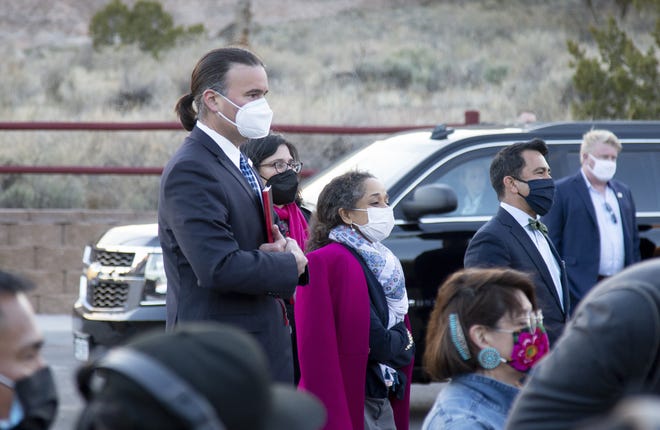
It was a historic ceremony: U.S. Secretary of the Interior Deb Haaland, the first tribal citizen to hold the position, swearing in Bryan Newland, a citizen of the Bay Mills Indian Community, as Assistant Secretary of Indian Affairs.
For the first time in American history, tribal citizens lead the U.S. in its government-to-government relationship with American Indian and Alaska Native Nations.
As assistant secretary, Newland becomes the highest-ranking official in the Bureau of Indian Affairs. One of the oldest federal agencies, the Bureau of Indian Affairs exists to enhance the quality of life, promote economic opportunity, and carry out the federal responsibility to protect and improve the trust assets of American Indians, tribal governments and Alaska Natives.
Newland’s experiences as an attorney for tribal governments, a policy advisor in the Obama Administration, the Chief Judge of the Bay Mills Indian Community, and the President of the Bay Mills Indian Community make him especially qualified to lead the Bureau of Indian Affairs. The Bay Mills Indian Community is located near the Upper Peninsula's Whitefish Bay, on the shores of Lake Superior.
Newland is uniquely positioned to advance the Biden Administration’s priorities of upholding the United States’ trust responsibility to tribal nations, strengthening the nation-to-nation relationship between the United States and Indian tribes, and working to empower tribal nations to govern their own communities and make their own decisions.
In leading the BIA, Newland will draw on many of his own experiences as a tribal leader to improve the relationship between tribal governments and the United States.
Having just finished serving his community as tribal president, Newland knows firsthand the struggles faced by tribal governments in developing sustainable economies, protecting their territories, and serving their communities. He showed tremendous leadership during the pandemic, urging the BIA to provide adequate testing in Indian country and ensuring that tribal governments received funding allocated to them under the CARES Act.
His advocacy for federal government accountability to Indian country demonstrates his deep understanding of the trust relationship between the United States government and Indian tribes. This understanding will serve him well as he takes on a key role in implementing the trust relationship and assisting tribal governments as they recover from a pandemic, which has disproportionately affected their communities.
Newland’s vision for helping tribal governments stems from his knowledge that tribal communities are best served when they are empowered to craft their own solutions to problems. Like President Biden and Secretary Haaland, he is dedicated to advancing the federal government’s commitment to ensuring tribal consultation on and input into federal policymaking. As a former Tribal President, he brings key insights into what works for tribal leaders in this process as he seeks to improve it.
Newland shares many of the values of other tribal leaders and will prioritize them as Assistant Secretary of Indian Affairs. Raised in his traditional Anishinaabek homeland along the shores of Lake Superior, he values the restoring and strengthening of tribal homelands so that every Native person has a place to call home. He understands that tribal homelands must be economically viable and has emphasized the need to restore tribal wealth to tribal communities so that they will thrive for generations yet to come. As tribal president, he sought to protect his own tribal homeland by vocally opposing Enbridge’s Line 5.
In addition to his on the ground experiences in Indian country, Newland understands the challenges facing the BIA, which has not always served Indian country well.
He acknowledges that the agency has contributed to the state of affairs in Indian country and sees undoing colonization as intergenerational work. He has emphasized the importance of children to Native communities and acknowledged the incredible harm done to tribal families, cultures, and communities when their children are removed.
As assistant secretary, he will support enforcement of the Indian Child Welfare Act, which prevents the unnecessary removal of Indian children from their tribal communities.
Newland’s appointment, alongside Haaland's historic appointment, will usher in a transformative new era in federal Indian affairs. As head of the BIA during an administration devoted to tribal sovereignty and racial equity, Newland can start to undo the colonization that has pervaded federal Indian law and policy from within.
Kirsten Matoy Carlson is a professor of law and adjunct associate professor of political science at the Wayne State University Law School, and is a leading authority on federal Indian law and legislation.
 Data collection on Native American involvement in adoption and foster care is needed to remedy courts’ failures.
More than four decades after the U.S. Congress passed the Indian Child Welfare Act (ICWA), state courts still do not reliably fulfill their obligations under the statute. As a result, Native American children, families, and communities are too often denied the very protections the ICWA sought to establish.
Congress enacted the ICWA in 1978 to address the disproportionate rates at which Native American children were—and continue to be—removed from their homes and placed with overwhelmingly non-Native adoptive and foster families. These removals, Congress recognized, were frequently unwarranted, harmful to Native families and communities, and infringed upon Tribes’ inherent rights of sovereignty and self-governance.
The Interior Department sought to address this problem through a second ICWA rule also issued in 2016.
GOOD READ: Promoting Indian Child Welfare Through Inquiry and Data | The Regulatory Review

In a historic vote on Monday, Debra Haaland was confirmed as President Biden’s Interior secretary. As a member of the Laguna Pueblo tribe, she will be the first Native American cabinet secretary in U.S. history.
Haaland, a former representative from New Mexico, was confirmed with a 51 to 40 split in the Senate, the narrowest margin of any of Biden’s cabinet picks so far. At the helm of the Department of the Interior, which houses the Department of Indian Affairs, she will oversee 500 million acres of public land, including the national parks system and oil and gas drilling on federal land. The Interior has an important part to play in tackling climate change, as one-quarter of all U.S. emissions can be attributed to fossil fuels extracted on these lands.
READ: Deb Haaland makes history as first Indigenous cabinet secretary


Your History Class Was a F*cking Lie by Sean Sherman (Or: How the American Educational System Has Always Been a Racist Propaganda Program...





 Posts
All Comments
Posts
All Comments


