They Took Us Away

They Took Us Away
click image to see more and read more

it's free

click

How to Use this Blog

BOOZHOO! We've amassed tons of information and important history on this blog since 2010. If you have a keyword, use the search box below. Also check out the reference section above. If you have a question or need help searching, use the contact form at the bottom of the blog.


We want you to use BOOKSHOP to buy books! (the editor will earn a small amount of money or commission. (we thank you) (that is our disclaimer statement)

This is a blog. It is not a peer-reviewed journal, not a sponsored publication... WE DO NOT HAVE ADS or earn MONEY from this website. The ideas, news and thoughts posted are sourced… or written by the editor or contributors.

EMAIL ME: tracelara@pm.me (outlook email is gone) THANK YOU CHI MEGWETCH!

SEARCH

Showing posts with label Native Americans. Show all posts

Monday, February 16, 2026

In Their Own Words

 US Presidents in Their Own Words Concerning American Indians

Here's a brief history of presidential remarks about Native Americans and here's to hoping that someday soon we can add a quote from a president of American Indian, Alaska Native or Native Hawaiian heritage.  


"Indians and wolves are both beasts of prey, tho' they differ in shape."

George Washington

"If ever we are constrained to lift the hatchet against any tribe, we will never lay it down till that tribe is exterminated, or driven beyond the Mississippi… in war, they will kill some of us; we shall destroy them all."

Thomas Jefferson
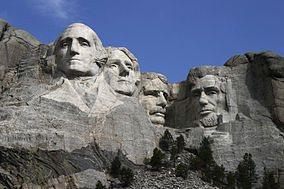
A large stone monument featuring the carved faces of four U.S. presidents on a mountain.

"My original convictions upon this subject have been confirmed by the course of events for several years, and experience is every day adding to their strength. That those tribes cannot exist surrounded by our settlements and in continual contact with our citizens is certain. They have neither the intelligence, the industry, the moral habits, nor the desire of improvement which are essential to any favorable change in their condition. Established in the midst of another and a superior race, and without appreciating the causes of their inferiority or seeking to control them, they must necessarily yield to the force of circumstances and ere long disappear."

Andrew Jackson

"Ordered that of the Indians and Half-breeds sentenced to be hanged by the military commission, composed of Colonel Crooks, Lt. Colonel Marshall, Captain Grant, Captain Bailey, and Lieutenant Olin, and lately sitting in Minnesota, you cause to be executed on Friday the nineteenth day of December, instant, the following names, to wit… " - Text from order made by President Lincoln to General Sibley ordering the execution of American Indians in Minnesota.

Abraham Lincoln

"I don't go so far as to think that the only good Indians are dead Indians, but I believe nine out of ten are, and I shouldn't like to inquire too closely into the case of the tenth."

Theodore Roosevelt

"All of our people all over the country - except the pure blooded Indians - are immigrants or descendants of immigrants, including even those who came over here on the Mayflower."

Franklin Roosevelt

"The United States, which would live on Christian principles with all of the peoples of the world, cannot omit a fair deal for its own Indian citizens."

Harry Truman

"There has been a vigorous acceleration of health, resource and education programs designed to advance the role of the American Indian in our society. Last Fall, for example, 91 percent of the Indian children between the ages of 6 and 18 on reservations were enrolled in school. This is a rise of 12 percent since 1953."

Dwight Eisenhower
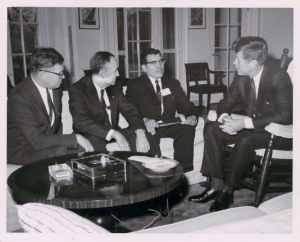
President John F. Kennedy meeting with National Congress of American Indians president Walter Wetzel, Sen. Lee Metcalf and Sen. Mike Mansfield, 1963. (Photo probably by Robert L. Knudsen / National Museum of the American Indian) President John F. Kennedy meeting with National Congress of American Indians president Walter Wetzel, Sen. Lee Metcalf and Sen. Mike Mansfield, 1963. (Photo probably by Robert L. Knudsen / National Museum of the American Indian)

"For a subject worked and reworked so often in novels, motion pictures, and television, American Indians remain probably the least understood and most misunderstood Americans of us all."

John Kennedy

"The American Indian, once proud and free, is torn now between White and tribal values; between the politics and language of the White man and his own historic culture. His problems, sharpened by years of defeat and exploitation, neglect and inadequate effort, will take many years to overcome."

Lyndon Johnson

"What we have done with the American Indian is in its way as bad as what we imposed on the Negroes. We took a proud and independent race and virtually destroyed them. We have to find ways to bring them back into decent lives in this country."

Richard Nixon

"I am committed to furthering the self-determination of Indian communities but without terminating the special relationship between the Federal Government and the Indian people. I am strongly opposed to termination. Self-determination means that you can decide the nature of your tribe's relationship with the Federal Government within the framework of the Self-Determination Act, which I signed in January of 1975."

Gerald Ford

"It is the fundamental right of every American, as guaranteed by the first amendment of the Constitution, to worship as he or she pleases … This legislation sets forth the policy of the United States to protect and preserve the inherent right of American Indian, Eskimo, Aleut, and Native Hawaiian people to believe, express, and exercise their traditional religions."

as he signed into law the American Indian Religious Freedom Act.

Jimmy Carter

"Let me tell you just a little something about the American Indian in our land. We have provided millions of acres of land for what are called preservations - or reservations, I should say. They, from the beginning, announced that they wanted to maintain their way of life, as they had always lived there in the desert and the plains and so forth. And we set up these reservations so they could, and have a Bureau of Indian Affairs to help take care of them. At the same time, we provide education for them - schools on the reservations. And they're free also to leave the reservations and be American citizens among the rest of us, and many do. Some still prefer, however, that way - that early way of life. And we've done everything we can to meet their demands as to how they want to live. Maybe we made a mistake. Maybe we should not have humored them in that wanting to stay in that kind of primitive lifestyle. Maybe we should have said, no, come join us; be citizens along with the rest of us."

Ronald Reagan

"This government-to-government relationship is the result of sovereign and independent tribal governments being incorporated into the fabric of our Nation, of Indian tribes becoming what our courts have come to refer to as quasi-sovereign domestic dependent nations. Over the years the relationship has flourished, grown, and evolved into a vibrant partnership in which over 500 tribal governments stand shoulder to shoulder with the other governmental units that form our Republic."

George Herbert Walker Bush

"Let us rededicate ourselves to the principle that all Americans have the tools to make the most of their God-given potential. For Indian tribes and tribal members, this means that the authority of tribal governments must be accorded the respect and support to which they are entitled under the law. It means that American Indian children and youth must be provided a solid education and the opportunity to go on to college. It means that more must be done to stimulate tribal economies, create jobs, and increase economic opportunities."

Bill Clinton

"Tribal sovereignty means that. It's sovereign. You're a… you're a… you've been given sovereignty and you're viewed as a sovereign entity."

George W. Bush

"We also recommit to supporting tribal self-determination, security, and prosperity for all Native Americans. While we cannot erase the scourges or broken promises of our past, we will move ahead together in writing a new, brighter chapter in our joint history."

Barack Obama

"You were here long before any of us were here. Although we have a representative in Congress who they say was here a long time ago. They call her 'Pocahontas.' 

Donald Trump
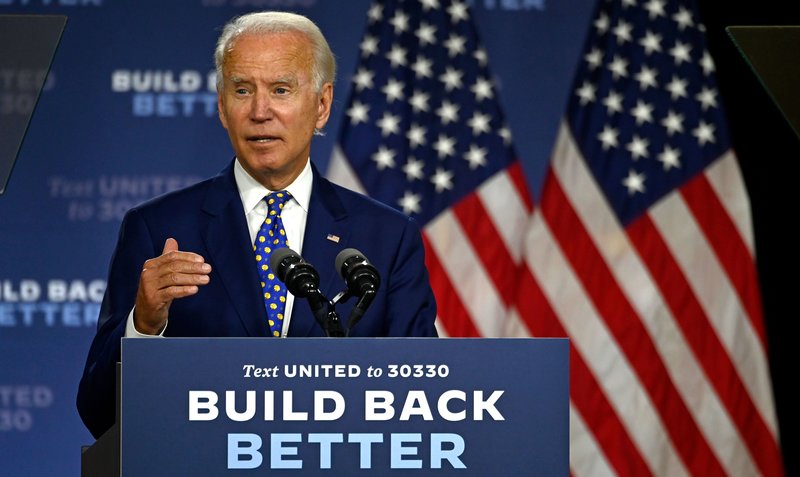
President Joe Biden (Photo/The White House)
 

“The federal government has long broken promises to Native American tribes who have been on this land since time immemorial. With her appointment, Congresswoman Haaland will help me strengthen the nation-to-nation relationship.” 

Joe Biden


 “Considering the Lumbee Tribe's historical and modern significance, it is the policy of the United States to support the full Federal recognition, including the authority to receive full Federal benefits, of the Lumbee Tribe of North Carolina,” -- Donald Trump, passing the process back to the Department of the Interior
 

Friday, May 16, 2025

"I grew up hearing stories of massacres"

 Tommy Orange

"The data is bad, and we'll have to hold on for a long time to avoid going backwards."


By Sílvia Marimon 5/12/2025

In Wandering stars, all the characters carry some trauma. They are Native Americans of different generations who have survived many types of violence and cannot find their place. The author, Tommy Orange (Oakland, 1982), a member of the Cheyenne and Arapaho tribes and a very powerful voice in the new North American narrative, claims an identity far removed from stereotypes. With his first book, There there (2018; Neither here nor there, in Alliance), was a finalist for the Pulitzer Prize.  With Wandering stars, it was a Booker Prize finalist.

In the book, you talk about different generations of Native Americans, from the Sand Creek Massacre in 1864 to the present day. Is it possible to preserve identity after so many episodes of violence?

— Yes, but it's not like before. It's a fragmented novel; the characters are wandering stars searching for a place. And identity is something similar, a fragmented mosaic. You can't preserve identity as it was before the violence; rather, you could say we're capable of preserving it, including all the damage.  Sometimes we're asked to do the impossible: to be as we were 500 years ago.  If we're not as we were, it's as if we weren't real. I think we need to explain a modern version of ourselves and the consequences of all this violence.

And in the face of a global and homogeneous culture?

— Yes, there's a lot of homogeneity, but also some diversity.  With Trump, it might seem like the United States is a country of crazy patriots.  I write about us to change the way people see Native Americans.  We're like everyone else, but there are also differences.  I grew up hearing stories of massacres, and my father's first language was Cheyenne.  So, there's been a transmission; the parents I've had have made me different.  My son has a father known for writing stories about Native Americans.  I don't think we should practice an old tradition that others might recognize to maintain our identity.

In the book, you travel back in time. How has it been nurtured, considering that we've rarely heard the voices of Native Americans?

— I've done my research, but my goal wasn't to provide a lot of data or facts.  I mostly travel inside people and imagine what it would be like to be in that situation.  I hope I've been convincing by, for example, delving into the mind of a 19th-century Cheiene who loses the ability to speak and then discovers alcohol, Christianity, and peyot.

There are many types of violence. There's massacre, and there's violence in schools, where the goal was, I quote from the book, "to kill the Indian, to save humanity."

— Before the massacre, just contact with another culture had already lost something. Then came the experiments; they locked the children in boarding schools, and did the same thing they did with the adults: they Christianized them and disciplined them militarily.  All of this shows how they dehumanized the natives.  Only in this way can cruelty be understood.  They took many things from us.  For me, colonialism, when it does all this to demonstrate its superiority, achieves the exact opposite.  Killing and cruelly punishing children is extremely base.

Is violence still being perpetrated against Native Americans in the 21st century?

— With Trump, aggression and violence against minorities have returned with a vengeance.  He's trying to strip away protections from many lands to exploit them and seize their oil.  There's another kind of violence.  There are families who inherit wealth generation after generation; we've inherited the trauma of having been victims of systematic violence.   It's not all setbacks; we've also made progress.  There have been improvements, for example, in the case of women.  Even so, they continue to be victims of violence.  There's the Missing and Murdered Indigenous Women movement that fights against this violence.  There are very high rates of sex trafficking, especially in oil-producing areas.

Is the narrative changing in the academic field, in universities?

— Yes, if you talk to history professors, most will agree with me.  But universities tend to be more open-minded and unafraid to look into the dark corners of history; that's why Trump is now attacking them.  The average citizen shouldn't be critical.  Trump does what dictators do: persecute institutions that try to create critical citizens.

Relates trauma to addictions.

— Many people who suffer trauma and systematic violence cope with the pain through substance abuse.  Of course, there are those who overcome it without drugs and those who become addicted without any trauma.  But if you look at the numbers, there's a correlation between victims of violence and addictions.  Sometimes, addicts are blamed, as if they were morally guilty. O r too weak.  I think it's because people don't want to dig deeper and look at the causes.

Have you ever felt the need to write a story that went against the general perception of what Native Americans are like? To incorporate the version of younger generations and Native Americans who live in big cities rather than on reservations?

— Yes, sadly.  There aren't many writers writing about urban life.  When I published my first book in 2018, 80% of Native Americans lived in big cities, not on reservations.  Yet, most books still only talk about life on reservations or the past.

And what reading does it do?

— I guess it's because it's not what people expect.  As if real life were only possible on reservations.  There's a certain insecurity, as if they feel they don't have the right to speak if they don't live on reservations.

The US government's census has seen an exponential increase in the population identifying as Native American. How is it determined who is eligible?

I'm just writing a book, The pretendings, in which I talk about all this.  There are people who don't have a real claim, but they do it to make a profit.  This is a problem we have today.  Buffy Sainte-Marie is a well-known singer-songwriter who pretended to be of Native American descent, and an investigation recently showed that she was actually of Italian and English descent.  And, on the other hand, historically, many have hidden or concealed the fact that they are Native American descendants.  First, because it could be dangerous, and also because they thought they had a better chance of success if they hid it.  If you look at the data, historically, it was more advantageous to hide it.  In the past, the government paid a lot of dollars for Native American scalps.  Now, the ways of identifying the Native population are also changing.  I have the Certificate of Degree of Indian Blood, an official United States document issued by the Bureau of Indian Affairs, which certifies that a person has a specific degree of Native American blood. It's all very complicated.

Thursday, December 29, 2022

Harvard’s Peabody Museum Keeping Native Remains Is Just One Attack on the Rights of Indigenous Children


Harvard’s influence on this tragic story cannot be understated.  It stands as a symbol of the early stages of colonialism in America and has not fully reckoned with this past.  In October, Native alumni of Harvard Law School called for the immediate return of more than previously announced 6,500 Native remains in a letter to the president of the University, stating that the institution should “dedicate the resources and place the priority on returning them to the appropriate places and relatives. Not sometime, not soon, but now.”

As with Harvard Medical School and Indigenous health, we believe Harvard Law does not provide its law students an adequate education on Indian law, even though the Supreme Court has decided an average of 2.6 federal Indian law cases per term since 1959.  Three such Indian law cases are currently underway for the 2022-2023 term.  The future of our Native Nations lies largely in the hands of  legal scholars who can graduate from top law schools like Harvard without ever having to take an Indian law course or even hearing the words “tribal sovereignty.” 

We do appreciate the Peabody's recent transparency, and celebrate the announcement of Harvard University’s new president, but we hope to move beyond apologies and toward action that addresses the erasure of Native Americans and Alaska Natives at the University, and the burdens they carry as a consequence. Whether it's the Peabody having Native children’s hair or Harvard-trained Supreme Court justices deciding on the Indian Child Welfare Act, the fate of future generations of our tribal Nations — our Native children — remains bound up in Harvard's history of colonialism and the legacies it leaves behind, legacies Native students here feel every day.

KEEP READING 

Wednesday, December 4, 2019

Native American in newsrooms

(2015) The following story is KEY to any discussion about Native Americans in news rooms and across Indian County. We need good stories and websites and newspapers who give accurate reporting and reflect the truth.

Police kill Native Americans at almost the same rate as African-Americans, according to the Centers for Disease Control and Prevention (CDC). Between 1999 and 2013, an average of .29 per 100,000 Native Americans were killed by police, compared to .3 per 100,000 for blacks and .11 per 100,000 for whites. “America should be aware of this,” argues Chase Iron Eyes, a lawyer and a leader of the Lakota People’s Law Project, which runs a publicity campaign called Native Lives Matter. But for the most part, America is not aware of this.

That may be changing, albeit slowly, as both mainstream media and Native American-run digital outlets begin to cover American Indian issues more robustly.

“We’re not necessarily focusing on the shadows and the sadness,” says Jason Begay, a Navajo who grew up on a reservation and runs the Native News Project, “but on how people are persevering.”
Tristan Ahtone, a member of the Kiowa tribe of Oklahoma who often reported for Al Jazeera America, won a following among Native Americans and others for writing about new topics, such as how one tribe is invoking treaty rights to stop another oil pipeline, the rethinking of the militant American Indian Movement that grew up alongside the Black Panthers in the 1960s, and an international indigenous basketball tournament. His approach: “Stop looking at Indian Country as a foreign place with foreign people doing foreign things. It keeps us apart from each other, and reinforces the idea that these people are different, that they’re victims, that they’re helpless. They get covered when there’s doom, gloom, or there’s blood. The cumulative effect is that you’ve got communities that are isolated from the rest of the country and generally distrustful of journalists, and that just creates a continuing cycle.”
Ahtone is one of only a handful of Native American journalists. There are 118 self-identified Indian journalists working at U.S. daily newspapers, according to 2015 data from the American Society of News Editors. That’s .36 percent of all U.S. newsroom employees.  Native American activists say there need to be more newsroom internships and training programs for aspiring Native American journalists.

READ ON…

And I’ll leave you with this quote about diversity in writing and publishing:

“You will be tokenized. Even when you get to write about your own experience of being a minority in America—you know, even that can be turned against you. Are you going to be used later on as leverage against an accusation of racism? Will you then be seen as a collaborator? In most cases the answer is yes….
“Hiring is a crucial step, but it is reformist. It’s not going to really fix anything, just sand off the rough edges, right? Because there is far more concern about appearing racist rather than not doing racist things. It’s not just a publishing thing. What else can I say but dismantle capitalism? And I don’t know that anything radical enough to do that wouldn’t hurt a lot of the people that we are trying to save. Barring world historical change, I don’t see really anything happening but a new paint job. It is systemic racism for a reason, it’s so essentially wound up with the system upon which everything is built.  You can ameliorate it.  You can palliate it.  But you can’t cure it.  This is what I sound like when I’m optimistic.” —Tony Tulathimutte, novelist, Private Citizens
My writing on this blog (and publishing new books here) is my humble attempt to broaden perspectives about Indigenous People/American Indians/First Nations… Thank you all for reading and following this blog! You matter to me! xoxoxo  Blog Editor Trace Hentz

Wednesday, November 4, 2015

Bad Seeds & Split-Feathers: November’s Happy Adoption Month

tabulaRasaFB
November is a surreal and painful month for me: it’s National Adoption Month, Native American Month and possibly my birth month. The perfect traumatic trifecta!

While non-adoptive families are preparing to be grateful and thankful for their lives with their loved ones (Thanksgiving, Christmas), I am preparing to endure another year of not knowing my biological family and trying to accept that I will die, never seeing my birth mother’s face, or hearing her voice or receiving a hug from her.

I will die like I have lived, as the mythical changeling, forever severed from heritage, family and identity. And I will die knowing I failed miserably as the replacement baby that was supposed to cure my adoptive mother’s infertility.

So why am I upset about November celebrating Native American Month? Because I was told by my adoptive mother that I was mixed-blood American Indian and Irish. Given that I was adopted in 1958, I most probably am one of the babies that was stolen from my American Indian mother during the U.S. Government’s collusion with adoption agencies to exterminate native people (Indian Adoption Act of 1958). The adoption agencies that worked with the federal government made sure that Indian babies were transported across state lines so the mothers could never find them—some of the babies came from Canada. And because I was adopted through Catholic Social Services, my birth date was most probably changed. All I know is that my earliest pictures are labelled on the back like this: Changeling 3-4 1/2 months?

Before she died, my adoptive mother destroyed all my adoption papers plus the baby moccasins  I was wearing the day she got me. She remained committed to her promise to Catholic Social Services to obscure my past so I could never find my heritage, my family and roots.

My adoptive parents were not thrilled when I became an adult and was accepted by numerous American Indians—to the point that I was taught traditions and ceremonies. In fact, I was so welcomed and loved by these people, I raised my sons as traditional Eastern Woodland American Indians. Then, after years of feeling I had a place in the world—even though I didn’t know my mother and father—everything changed with the US Government’s passing of the Indian Arts and Crafts Act of 1990. Suddenly, having a Bureau of Indian Affairs (BIA) card certifying American Indian heritage was necessary to participate in pow wows and ceremonies. Thus began the attack by Full-blood Indians against mixed-blood Indians which is continuing to this day.

Overnight I and my sons morphed in white wannabees—who had no right to claim any of my heritage— I didn’t have “proof on paper”. After 25 years of acceptance, I was ostracized and lost the closest thing I had to a heritage and belonging that non-adoptive people take for granted.

So, ya, November is a terrible month for me. I am reminded by adoption agencies and adoptive parents, and some birth mothers, as well as non-adoptive people, that I should be grateful and happy I was taken from my mother the day I was born—I was “saved” from having a terrible life. I am reminded that without my original birth certificate and without a blood-quantum paper trail from the US Government, I cannot practice my American Indian beliefs and traditions—without the risk of going to jail. I am reminded that before the Indian Arts & Crafts Act of 1990, I was part of a vital and life-sustaining culture that my soul resonated with. And, because I am part of some groups that are welcoming Split-Feathers home to their tribes (those American Indian adoptees that were lucky enough to find their paperwork) I am reminded that I will never experience the welcome home pow wows and ceremonies that are intended to help adopted Indians heal.

November this year is worse than previous years—I am close to sixty—I’ve lived more years, than I have years to live before I die. And I know now, I will die without ever seeing my mother’s face or being accepted by my tribe.

Happy Adoption Month! Happy Native American Month! And (maybe?) Happy Birthday to Me!


ABOUT NoName Changeling: I am an adult adoptee who is finally coming to terms with my past and the psychological damage that occurred the day I was born. For fifty-seven years I believed I was worthless and that all the problems and challenges I had were totally my fault. After thirty years of psychological counseling for chronic depression, severe anxiety and late-diagnosis ADHD, I found my “family”—other adult adoptees that had similar experiences and characteristics. This blog is about freeing myself from the trauma of  adoption and taking back my power from the adults who treated me as a disposable commodity.

Saturday, May 5, 2012

The Canary Effect (on Indigenous People)


The Canary Effect ►Devastating effects on Native Americans◄ from ◄☼ First ♥ People ☼► on Vimeo.
The Canary Effect is a 2006 documentary that looks into the effects of that the United States and its policies have on the Indigenous peoples (Native Americans) who are residents. It premiered at the Tribeca Film Festival and won the Stanley Kubrick Award at the 2006 Traverse City Film Festival (Michael Moore hosts).

The movie was directed by Robin Davey and Yellow Thunder Woman, who are both members of LA Based alternative pop group The Bastard Fairies. The documentary was released on DVD in 2008.           

Happy Visitors!

NEW WEB ADDRESS

Because we don't want to lose information on this blog, we now have a domain name: American Indian Adoptees.com - click and save this link:

2026: WE HAVE A BACK UP BLOG COMING SOON: www.americanindianadoptees.blog (on wordpress) We are no longer on Facebook. We deleted our accounts.

WRITTEN BY HUMANS!

WRITTEN BY HUMANS!

Blog Archive

Featured Post

Your History Class Was a F*cking Lie | #NOMOAR

  Your History Class Was a F*cking Lie by Sean Sherman (Or: How the American Educational System Has Always Been a Racist Propaganda Program...


Native Circles

Native Circles
click logo for podcasts!

Most READ Posts

Bookshop

You are not alone

You are not alone

To Veronica Brown

Veronica, we adult adoptees are thinking of you today and every day. We will be here when you need us. Your journey in the adopted life has begun, nothing can revoke that now, the damage cannot be undone. Be courageous, you have what no adoptee before you has had; a strong group of adult adoptees who know your story, who are behind you and will always be so.

Diane Tells His Name


click photo

Lost Birds on Al Jazeera Fault Lines

Lost Birds on Al Jazeera Fault Lines
click to read and listen about Trace, Diane, Julie and Suzie

NO MORE STOLEN SISTERS

NO MORE STOLEN SISTERS
click image

ADOPTION TRUTH

As the single largest unregulated industry in the United States, adoption is viewed as a benevolent action that results in the formation of “forever families.”
The truth is that it is a very lucrative business with a known sales pitch. With profits last estimated at over $1.44 billion dollars a year, mothers who consider adoption for their babies need to be very aware that all of this promotion clouds the facts and only though independent research can they get an accurate account of what life might be like for both them and their child after signing the adoption paperwork.

Original Birth Certificate Map in the USA

Google Followers