They Took Us Away

They Took Us Away
click image to see more and read more

it's free

click

How to Use this Blog

BOOZHOO! We've amassed tons of information and important history on this blog since 2010. If you have a keyword, use the search box below. Also check out the reference section above. If you have a question or need help searching, use the contact form at the bottom of the blog.


We want you to use BOOKSHOP to buy books! (the editor will earn a small amount of money or commission. (we thank you) (that is our disclaimer statement)

This is a blog. It is not a peer-reviewed journal, not a sponsored publication... WE DO NOT HAVE ADS or earn MONEY from this website. The ideas, news and thoughts posted are sourced… or written by the editor or contributors.

EMAIL ME: tracelara@pm.me (outlook email is gone) THANK YOU CHI MEGWETCH!

SEARCH

Showing posts with label Katherine Legrange. Show all posts

Sunday, January 19, 2025

It's believed somewhere between 11,000-20,000 children were removed from their homes

From 2021

'Canada must own up': Manitoba First Nations leaders call for national inquiry into Sixties Scoop

Beginning in the mid-1950s and lasting until the early 1980s, a series of policies enacted by provincial child welfare authorities saw thousands of First Nations children taken from their homes and families, placed in foster homes, and eventually adopted out to white families from across Canada and the United States. (Sheila North/CBC)

First Nations leaders in Manitoba are adding their voices to the call for a federal inquiry into a dark history known as the Sixties Scoop.

Beginning in the mid-1950s and lasting until the early 1990s, a series of policies enacted by provincial child welfare authorities saw thousands of First Nations and Inuit children taken from their homes and families, placed in foster homes, and eventually adopted out to white families from across Canada and the United States.

The children lost their names, their languages and connections to their heritage.

"The Sixties Scoop legacy was just a continuation of violent and ignorant policies that were designed by Canada to disrupt and destroy First Nations families and communities," Grand Chief Jerry Daniels of the Southern Chiefs' Organization in Manitoba said Monday at press conference at the Canadian Museum for Human Rights in Winnipeg.

He called the practice, which began in the mid-1950s and lasted until the early 1980s, the definition of state-sponsored violence.

"By attacking the family structures and incentivizing the apprehension of our families by not only the church, but now Canadian and foreign families, they made everyday citizens complicit in the violence and reliant on the financial compensation it came with," Daniels said.

'Trauma, hurt, pain to children'

Manitoba Keewatinowi Okimakanak Grand Chief Garrison Settee said parents who had their children taken suffered deeply while their children were used as commodities without any explanation from the government, he said.

"There were commercials — government commercials — to advertise for the adoption of First Nation children. What kind of mentality goes into that kind of mindset to actually use our children as commodities?" Settee asked.

"The people that were behind this policy are responsible for trauma, hurt, pain to children. And Canada must own up to that. That's why there should be an inquiry."

Former Canadian senator Murray Sinclair and a group called 60s Scoop Legacy of Canada first issued the call in early August for an inquiry.

Daniels and Settee said their organizations held a summit in September and unanimously passed a resolution in support of the inquiry call as well as long-term funding support for survivors.

"It's important that Canada understands what happened to every single one of the children that were impacted by this. Until that's done I think we haven't really done justice for Canadians and for all the children that were taken away," said Daniels.

They also want to see the immediate release of any records held by state or church-run entities "to expedite the process of bringing families back together and to bring some closure."

The SCO represents 34 Anishinaabe and Dakota communities in southern Manitoba while MKO represents 26 First Nations in the province's north.

It's believed somewhere between 11,000 and 20,000 children were removed from their homes and placed with new families in Canada, the U.S. and Europe.

Need to analyze numbers, effects of scoop

The estimates vary greatly because many children are believed to have not been recorded as status Indian in their child services records.

There is a need to determine exactly how many children were taken, where they were taken to and the longterm effects of the trauma they have suffered, said Katherine Legrange, a scoop survivor who became the founder and director of 60s Scoop Legacy of Canada, a peer support and advocacy group based in Manitoba.

Katherine Legrange is a scoop survivor and director of 60s Scoop Legacy of Canada, a peer support and advocacy group based in Manitoba. (CBC)

"Our parents and grandparents need to know that this was not their fault, that this was a result of [government] policies," she said.

"This was not our fault. We did nothing wrong as children. And so that's what I really want to emphasize in this inquiry going forward."

Legrange was taken just after birth from a Winnipeg hospital. By the time she learned, as an adult, that her birth family was from Crane River, it was too late to seek them out.

Both parents died before she turned 10, "so I'm still struggling to put the pieces of my birth story together," she said.

She has four siblings — one who died this past summer in Winnipeg of an overdose, and three who are reluctant to meet.

Sixties Scoop survivor Teri Starr was taken from her family at three months old. She said she was raised in a really good home but many of the other adoptees cannot say that. (CBC)

"I was told that was one of the reasons why I was scooped is because my parents didn't love me, or that community didn't love me," said Teri Starr, who was taken from her family in Sagkeeng First Nation at three months old.

"But it was due to a policy and other peoples' hand that was able to scoop the children. Those questions need to be asked: Why? Why was that all right?"

Between two worlds

She said there is a feeling for many adoptees of being untethered once they are made aware they were part of the scoop. It's a feeling of being between two worlds and trying to balance that out. 

"You try to go back and learn your culture, but that's been taken away. Where do you start and where do you go? Who do you ask?" she said.

Starr said she was raised in a really good home but still faced difficult question from herself and others as a dark-haired, dark-skinned, dark-eyed girl in a family with light features.

Now as she begins her search for the past, she faces difficulties in trying not to hurt those who adopted her, she said.

"I want to respect the family that raised me, and I don't want to disrespect them [by] going and trying to find my family, but that piece is important to me as well," she said.


Thursday, January 11, 2024

Sister's Emotional Reunion #60sScoop

 READ: https://globalnews.ca/news/10211379/sisters-reunite-sixties-scoop-vancouver/

WARNING: This story deals with disturbing subject matter that may upset and trigger some readers. Discretion is advised.

It was a reunion decades in the making and a kickoff to the new year the Quill family will never forget.

Sisters Nita and Brandy Quill met for the first time at a SkyTrain station in Vancouver last week, more than 30 years after they were separated during a period of colonial violence against Indigenous families known as the ’60s Scoop.  The pair found each other on Facebook in the years after their mother’s death.

“It’s surreal. Nothing like this has ever happened in our lives before,” Brandy said, embracing her long-lost sister at Burrard Station downtown.

“This is to me a miracle. I’m just trying to take it in. It will probably take a long time to process it. It’s a dream come true.”

’60s Scoop advocate Katherine Legrange on the need for a national inquiry
Click to play video: '’60s Scoop advocate Katherine Legrange on the need for a national inquiry' 

The ’60s Scoop refers to a period between the 1950s and 1980s after amendments to the Indian Act let provincial governments take over Indigenous child welfare. Thousands of First Nations, Inuit and Métis children were taken from their birth families, usually without consent, and placed in non-Indigenous homes.

Many were stripped of their language and culture, and left with complex questions about their identities. Many also experienced physical, sexual, mental and spiritual abuse.

“So much of our lives has been taken from us, so to ever be in a moment where we don’t have to be afraid of who we are, that we’ve been given our meeting, it just feels like it’s the beginning of something new — not just for us but for the country,” Brandy said. “I only wish our mom was still here to see it with us.”

’60s Scoop advocate Colleen Cardinal on challenges reconnecting to birth communities
Click to play video: '’60s Scoop advocate Colleen Cardinal on challenges reconnecting to birth communities' 

Nita and Brandy are the daughters of Linda Quill, a Sapotoweyak Cree woman from Manitoba and a residential school survivor.  Linda was abused and malnourished at residential school, eventually contracted tuberculosis and was placed in a sanitorium without her family’s knowledge, Brandy told Global News.

Brandy was born in Edmonton, placed in foster care at the age of five and eventually shipped off to an Ontario group home where she aged out of care and has lived independently since then. Nita was born in Winnipeg, taken from Linda at 18 months of age and adopted by a family in Scotland.

“I’ve always known there’s more to me, there’s more to who I am, there’s more to my story,” said Nita, who also met her niece — Brandy’s daughter Taylor — at the station last week.

“Blood memory goes very deep so I’ve been nervous for the last 24 hours. Meeting my sister definitely calms me. It’s a relief. It’s the end of an era but it’s also the beginning.”

Linda Quill is seen with her youngest daughter Brandy Quill in an undated photo. Courtesy: Brandy Quill

Brandy said she and her mother “cried for years” wondering what happened to Nita, the eldest sister.

Nita eventually left her adoptive family in Scotland with no knowledge of her Sapotaweyak and Wuskwi Sipihk family in northern Manitoba, but through a Facebook post, connected with Brandy.

Both she and Brandy said they were told false stories of their mother having tried to leave them after their births.

“My story — it’s always been a journey of identity, of belonging, understanding. My story is one that’s repeated so much within a lot of families. It’s a story of being lost,” Nita said.

“The bigger picture is we are together and there’s a lot of hope … for a lot of the pain to go away and a lot of the happiness to come in. This is a promising day.”

Click to play video: 'Appeal could have wide-ranging impacts on B.C. Indigenous child protection system'

The Manitoba government apologized for its role in the ’60s Scoop in 2015.  The Alberta government followed suit in 2018 and Saskatchewan Premier Scott Moe did the same in 2019.

In 2022, the Sixties Scoop Indigenous Society of Alberta pressed the B.C. government to follow suit. No such apology has been delivered at the B.C. legislature.

“In B.C., we are committed to a respectful and genuine dialogue with the survivors, families and communities impacted by these historical wrongs on how best to move towards an apology that will be part of the healing process,” wrote B.C.’s Ministry of Children and Family Development in a Tuesday statement.

“We recognize an apology must also address the continued impact of colonization on Indigenous families, especially in terms of the child welfare system. This process must be sensitive and trauma-informed in order to reach a meaningful apology.”

Click to play video: '‘Our children have an inherent right to know who they are’: Sts’ailes former chief on new legislation in MCFD'
‘Our children have an inherent right to know who they are’: Sts’ailes former chief on new legislation in MCFD

Nita, Brandy and Taylor shared many tight hugs in Vancouver before going out for a meal and getting to know each other better. They credited their mother for their reunion and said they know she was watching, smiling from the Spirit World, as her daughters and granddaughter reunited.

“We’re just so blessed to be able to continue the next bit of our path together so we’ll see where that takes us,” Brandy said.

The family said they hope their story inspires others who have been through similar experiences and fosters empathy among those who haven’t.

— with files from Cliff Shim and Aaron McArthur 

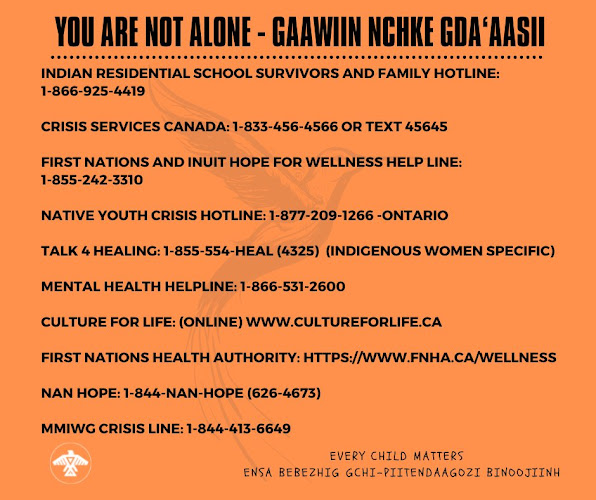
The Hope for Wellness Help Line offers culturally competent counselling and crisis intervention to all Indigenous peoples experiencing trauma, distress, strong emotions and painful memories. The line can be reached any time toll-free at 1-855-242-3310.

Thursday, April 21, 2022

‘60s Scoop survivor says healing foundation is no help at all | APTN News


‘I haven’t heard a word:’ ‘60s Scoop survivor says healing foundation is no help at all 

Some survivors of the ‘60s Scoop say they’re frustrated by the lack of response they’re getting from the organization set up to help them heal.

“I’ve been waiting to hear from the Sixties Scoop (Healing Foundation) to tell me what they have planned,” says survivor Darlene Gilbert of Annapolis Valley First Nation in Nova Scotia.

“I’ve heard nothing.”

The Sixties Scoop Healing Foundation was created with $50 million from the $875-million national class-action settlement that compensated Inuit and First Nations survivors for the loss of their cultural identities.

As children, they were taken from their homes between the 1950s and 1990s to be placed with non-Indigenous foster and adoptive families across Canada and around the world. Métis and non-status Indigenous peoples were excluded from the settlement agreement.

According to the Class Action Scoop Settlement Agreement website, 20,167 people have been approved to receive $25,000 in compensation including Gilbert.

The foundation says on its website its mission is to “accompany Survivors and their descendants along their healing journey by supporting cultural reclamation and reunification, holistic wellness services, advocacy, commemoration, and education initiatives.”

healing foundation
Darlene Gilbert was 10 years old when she was taken from her family. Photo: Angel Moore/APTN.

Gilbert, who was removed from her family when she was 10 years old, was placed in a number of temporary spaces and group homes in Nova Scotia.

She says she contacted the foundation using the phone number listed on its website to access therapy to deal with the traumatic effects of losing her culture and language.

“There’s supposed to be healing money,” she said in an interview. “We need therapy, our families need therapy, our children, our grandchildren may.

“I haven’t heard a word, not a word; so that was just like I felt brushed under the carpet like we all do.”

Katherine Legrange, a ‘60s Scoop survivor and director of the national non-profit support group 60s Scoop Legacy of Canada, feels the foundation isn’t working so far.

“I’d say that the communication with survivors has been really poor to date, it’s really unclear about how the healing foundation intends to directly help survivors,” she says from Winnipeg.

“I feel like they are really struggling to connect with survivors and share what their plans are; even if there are no plans, share that.”

Call for a national inquiry

Legrange has called for a national inquiry to examine the ‘60s Scoop and “make that connection with residential schools, with MMIWG (missing and murdered Indigenous women and girls), with the justice system, because we know that lots of us ended up in these kinds of unfortunate situations.”

The National Centre for Truth and Reconciliation, a research and archive centre established after the Indian Residential Schools Settlement Agreement, “is in full support of the 60’s Scoop Legacy of Canada and their call for the federal government to commission a national inquiry into Indigenous child removal.

“The Residential School system came first, followed by the Scoop,” the centre says.

“Finding this truth means hearing from those affected directly – nationally and internationally – to hear from all the children, the families and the individuals that ran those systems to fully understand the colonial historical record of the Scoop and what really happened.”

APTN News tried reaching the foundation using the phone number and email on its website and didn’t receive a response.

APTN also requested an interview with the foundation’s inaugural CEO, Dr. Jacqueline Maurice of Saskatchewan.

Maurice, a Métis-Indigenous Scoop survivor with a Ph.D. in social work and a medical degree, was appointed in September 2021.

Her vision for the foundation, described in a statement following her appointment, includes the concept of one survivor helping another survivor on the path to healing.

“In this new role, [Maurice] will be responsible for the development and implementation of programs and services to support survivors and will play an integral part in the development of grants, services and supports to survivors,” the statement added.

A few months later, the foundation distributed its first round of grants – valued at just over $1 million – to eight community groups.

“This year’s pilot program begins the foundation’s legacy of investment into healing and serving Sixties Scoop survivors across the nation,” Maurice said at the time.

“The initial grant process will inform the design of future funding streams that will deliver valuable services to those who need them most.”

But Gilbert is still in the dark about what’s available to her and whether it’s in Nova Scotia.

She feels a national inquiry would help.

“We should be able to tell the government how they tried to colonize us, break us, take our language, keep us away from our communities,” she says.

“This is important for this generation – the ‘60s Scoop – to be able to say, ‘Hey, we need this healing in order to break what has come behind us and [so] it doesn’t come [back] in the future.”

With files from Kathleen Martens


Happy Visitors!

NEW WEB ADDRESS

Because we don't want to lose information on this blog, we now have a domain name: American Indian Adoptees.com - click and save this link:

2026: WE HAVE A BACK UP BLOG COMING SOON: www.americanindianadoptees.blog (on wordpress) We are no longer on Facebook. We deleted our accounts.

WRITTEN BY HUMANS!

WRITTEN BY HUMANS!

Blog Archive

Featured Post

Your History Class Was a F*cking Lie | #NOMOAR

  Your History Class Was a F*cking Lie by Sean Sherman (Or: How the American Educational System Has Always Been a Racist Propaganda Program...


Native Circles

Native Circles
click logo for podcasts!

Most READ Posts

Bookshop

You are not alone

You are not alone

To Veronica Brown

Veronica, we adult adoptees are thinking of you today and every day. We will be here when you need us. Your journey in the adopted life has begun, nothing can revoke that now, the damage cannot be undone. Be courageous, you have what no adoptee before you has had; a strong group of adult adoptees who know your story, who are behind you and will always be so.

Diane Tells His Name


click photo

Lost Birds on Al Jazeera Fault Lines

Lost Birds on Al Jazeera Fault Lines
click to read and listen about Trace, Diane, Julie and Suzie

NO MORE STOLEN SISTERS

NO MORE STOLEN SISTERS
click image

ADOPTION TRUTH

As the single largest unregulated industry in the United States, adoption is viewed as a benevolent action that results in the formation of “forever families.”
The truth is that it is a very lucrative business with a known sales pitch. With profits last estimated at over $1.44 billion dollars a year, mothers who consider adoption for their babies need to be very aware that all of this promotion clouds the facts and only though independent research can they get an accurate account of what life might be like for both them and their child after signing the adoption paperwork.

Original Birth Certificate Map in the USA

Google Followers