BOOZHOO! We've amassed tons of information and important history on this blog since 2010. If you have a keyword, use the search box below. Also check out the reference section above. If you have a question or need help searching, use the contact form at the bottom of the blog.
We want you to use BOOKSHOP to buy books! (the editor will earn a small amount of money or commission. (we thank you) (that is our disclaimer statement)
This is a blog. It is not a peer-reviewed journal, not a sponsored publication... WE DO NOT HAVE ADS or earn MONEY from this website. The ideas, news and thoughts posted are sourced… or written by the editor or contributors.
EMAIL ME: tracelara@pm.me (outlook email is gone)
THANK YOU CHI MEGWETCH!
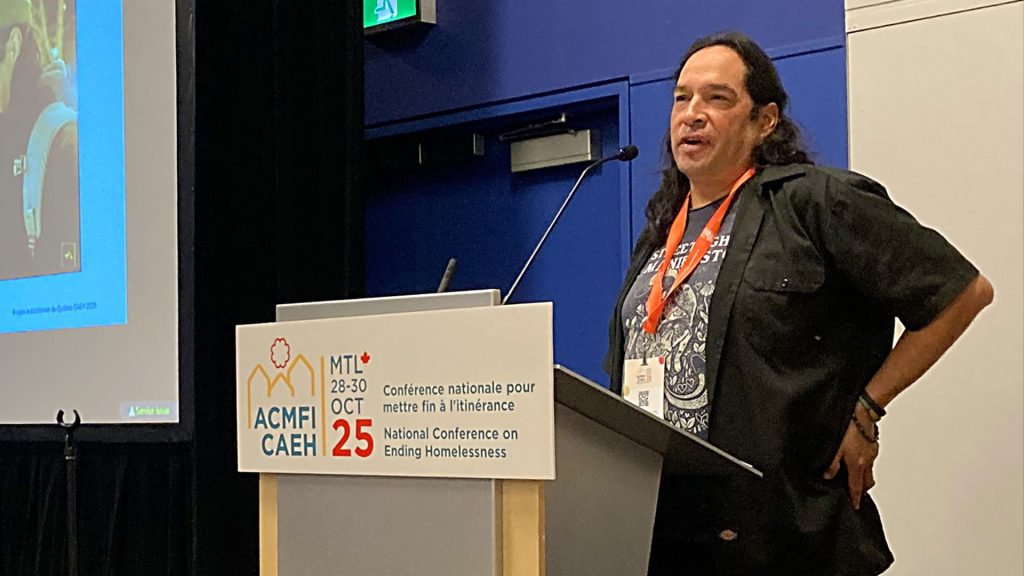
Chris Brown speaks to the 2025 National Conference
on Ending Homelessness about his experience quitting drinking and
leaving the street for Projets Autochtones du Québec's long-term sober
residence. Photo: Jesse Staniforth/APTN News
Chris Brown has been sober for two years.
Born Christopher Lee Roy in Moose Jaw, Sask., Brown was part of the Sixties Scoop.
He was adopted into a non-Indigenous home and struggled with his life
and family until 1992, when a friend told him he should consider
running away to Montreal.
There, he became a street kid. He recalls discovering even at 16 he
could walk into one of the city’s many dépanneur corner stores and buy a
beer and a cigarette for under two dollars, no questions asked.
“That really kept me moving forward through my addictions,” he said.
Until two years ago, when he felt he was approaching the end of his time as a drinker.
“My body wasn’t holding on to it,” he recalls. “My mind was going.
And you know, those things that they say to you, like ‘jail, insanity,
death, those are the only options.’ I believe that. And I really thought
about the insanity part of it. My mind was only thinking about my next
drink when I woke up.”
Today, Brown lives in one of the 14 rooms at the Annagiarvik House in downtown Montreal, a long-term transitional residence for sober Indigenous people leaving the street.
The Annagiarvik House is operated by Projets Autochtones du Québec (PAQ), an organization providing shelter to members of the Montreal urban Indigenous community struggling with housing.
Brown discussed his experiences as part of a panel on Indigenous
approaches to harm reduction and cultural safety during the 2025
National Conference on Ending Homelessness in Montreal.
During the Sixties Scoop, thousands of Indigenous youth in Canada
were taken from their reserves by child welfare services to be adopted
or placed with non-Indigenous foster families. With sensitivity, the
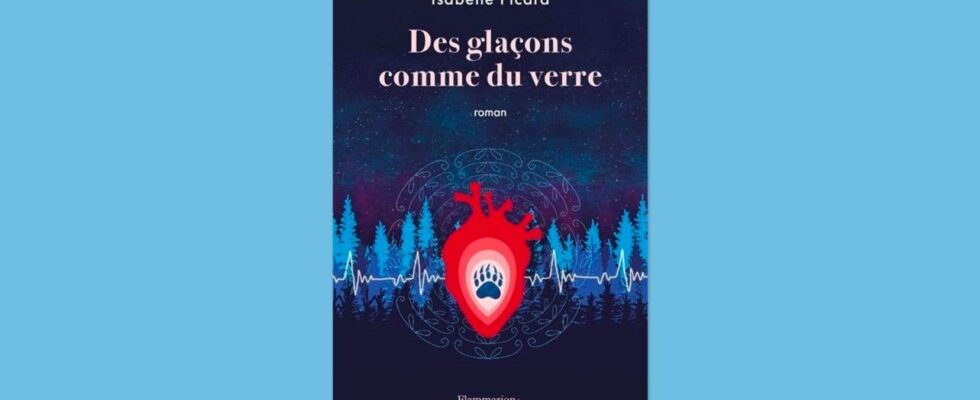
novel Ice cubes like glass evokes this dark part of the country’s
past, which has left immense scars within communities. Inspired by
Canadian history as well as that of her ancestors, ethnologist and
author Isabelle Picard, originally from Wendake, immerses us in the pain
of a Huron father, Henri. The latter sees his family being divided up
by the government while remaining powerless. Through this poignant
story, the writer succeeds in injecting depth into the many characters,
such as the patriarch, his wife, Belle, and their host of children. The
eldest, Liliane, is particularly touching because of the fight she
leads to keep her family afloat. A necessary work, which remains
captivating until the end.
Opinion: It may further embolden those who, regardless of official policies,
already won't provide health or police services to Indigenous people in
English.
Nakuset • Special to Montreal Gazette | Sep 17, 2021
Nakuset,
executive director of the Native Women’s Shelter of Montreal, says that
regardless of what the official policies may be, English-speaking
Indigenous people are already getting services refused because they
can’t speak French, and she says she fears Bill 96 will make things
worse.Photo by Pierre Obendrauf /Montreal Gazette
An Indigenous woman is raped.
She
summons the courage to report her assault to Montreal police, but they
won’t let her recount it in English. Adding to this humiliating
experience, she doesn’t understand that the police have to process the
crime scene at her apartment.
So
when the police show up at her door unannounced, she has to pack up her
things and spend the night at a friend’s house, unsure exactly what’s
going on. The experience left her shattered.
This
happened to someone I know and it’s one example of how access to English
services is crucial for Indigenous people living in Quebec. So when I testified about Bill 96 Tuesday at the Quebec Community Groups Network hearings, I expressed my fears that the new language law will have dire consequences for Indigenous people in life-or-death situations.
To Lagacé, who claims I’m fear-mongering, I would simply say this:
As a Cree woman, whose mother is a residential school survivor, and who was subsequently stolen from her family and community during the ’60s scoop, much of my life has been defined by a loss of culture and language.
Subjected
to aggressive assimilationist policies, I have seen much damage and
suffering to Indigenous people who have moved to urban areas and tried
to make a better life. I watch how they fall through the cracks. It was
this awareness that led me to seek an education and dedicate my life to
improving the situation.
In the early days of residential schools, children had to learn English
and were told that their language was evil, the devil’s language. The
language was beaten out of them. Upon returning from residential
schools, they had difficulty communicating with their parents, as they
lost their Indigenous language, further alienating them from their
family, community and culture.
While
many of the laws that were created to explicitly deny rights to
Indigenous people have since been repealed, we still live in a society
whose foundation was built on our oppression. The result is that we live
with systemic racism and racial profiling. Here in Quebec, few of the
142 Viens Commission recommendations have been implemented and Indigenous youth in care are still denied the right to use their traditional languages.
And so, Indigenous people are struggling. Most were sent to English residential schools
and have had difficulty accessing services in the only language they
speak. Regardless of what the official policies may be, they are already
getting services refused because they can’t speak French. I know this
because I run a women’s shelter where Indigenous women routinely report
these kinds of incidents to me.
Now
imagine what it would be like if you’re homeless, have been assaulted,
raped or are otherwise in crisis and Bill 96 further emboldens those who
already think they don’t need to bother to speak English to Indigenous
people. How will you explain your predicament if you can’t express it in
French?
Indigenous people, be they English-speaking or French-speaking, are still afraid of entering hospitals since the death of Joyce Echaquan. As systemic racism is still rampant in institutions,
we now have to worry about the way we communicate our emergencies and
whether they will be understood. In her documentary Indecently Exposed,
diversity educator Jane Elliott says “If you make the situation
uncomfortable enough, people will refuse to tolerate it, and they will
leave.”
Indigenous
people will continue to experience emergency situations, but if the
climate of the institutions is oppressive, they will not subject
themselves to this treatment. It is far too painful.
In 2008,
Brian Sinclair arrived at the Health Sciences Centre ER in Winnipeg.
When he passed out in a wheelchair, staff assumed he was drunk, when in
fact he had died. I was outspoken when the government announced the
COVID-19 curfew and had stated at a protest that someone could die
because of the failure to acknowledge the realities of homeless people.
Unfortunately, Raphaël André was collateral damage, and therefore, I spearheaded the establishment of the Raphaël André Memorial tent, in the hope of keeping others safe.
My testimony at the hearings was meant to demonstrate our reality and no, we are not fearful, we are terrified.
Nakuset
is executive director of the Native Women’s Shelter of Montreal and the
director of development and philanthropy for the day shelter Resilience Montreal.
Kim Wheeler was adopted during the Sixties Scoop and fought to find her way back to her culture My name is Kim Wheeler but some know me as...
Bookshop
You are not alone
To Veronica Brown
Veronica, we adult adoptees are thinking of you today and every day. We will be here when you need us. Your journey in the adopted life has begun, nothing can revoke that now, the damage cannot be undone. Be courageous, you have what no adoptee before you has had; a strong group of adult adoptees who know your story, who are behind you and will always be so.
Diane Tells His Name
click photo
Lost Birds on Al Jazeera Fault Lines
click to read and listen about Trace, Diane, Julie and Suzie
NO MORE STOLEN SISTERS
click image
We conclude this series & continue the conversation by naming that adoption is genocide. This naming refers to the process of genocide that breaks kinship ties through adoption & other forms of family separation & policing 🧵#NAAM2022#AdoptionIsTraumaAND#AdopteeTwitter#FFY 1/6 pic.twitter.com/46v0mWISZ1
As the single largest unregulated industry in the United States, adoption is viewed as a benevolent action that results in the formation of “forever families.” The truth is that it is a very lucrative business with a known sales pitch. With profits last estimated at over $1.44 billion dollars a year, mothers who consider adoption for their babies need to be very aware that all of this promotion clouds the facts and only though independent research can they get an accurate account of what life might be like for both them and their child after signing the adoption paperwork.












 Posts
Posts

