BOOZHOO! We've amassed tons of information and important history on this blog since 2010. If you have a keyword, use the search box below. Also check out the reference section above. If you have a question or need help searching, use the contact form at the bottom of the blog.
We want you to use BOOKSHOP to buy books! (the editor will earn a small amount of money or commission. (we thank you) (that is our disclaimer statement)
This is a blog. It is not a peer-reviewed journal, not a sponsored publication... WE DO NOT HAVE ADS or earn MONEY from this website. The ideas, news and thoughts posted are sourced… or written by the editor or contributors.
EMAIL ME: tracelara@pm.me (outlook email is gone)
THANK YOU CHI MEGWETCH!
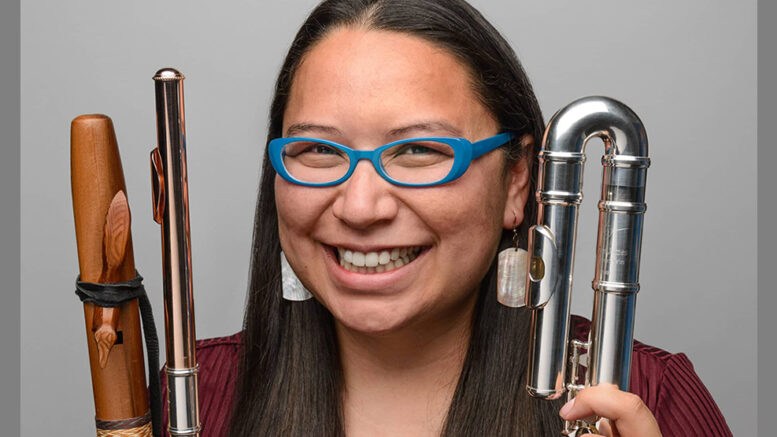
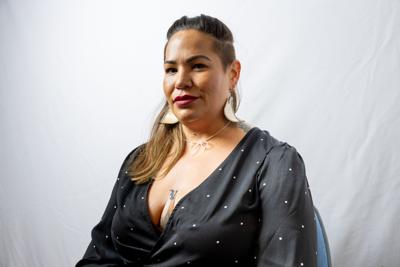
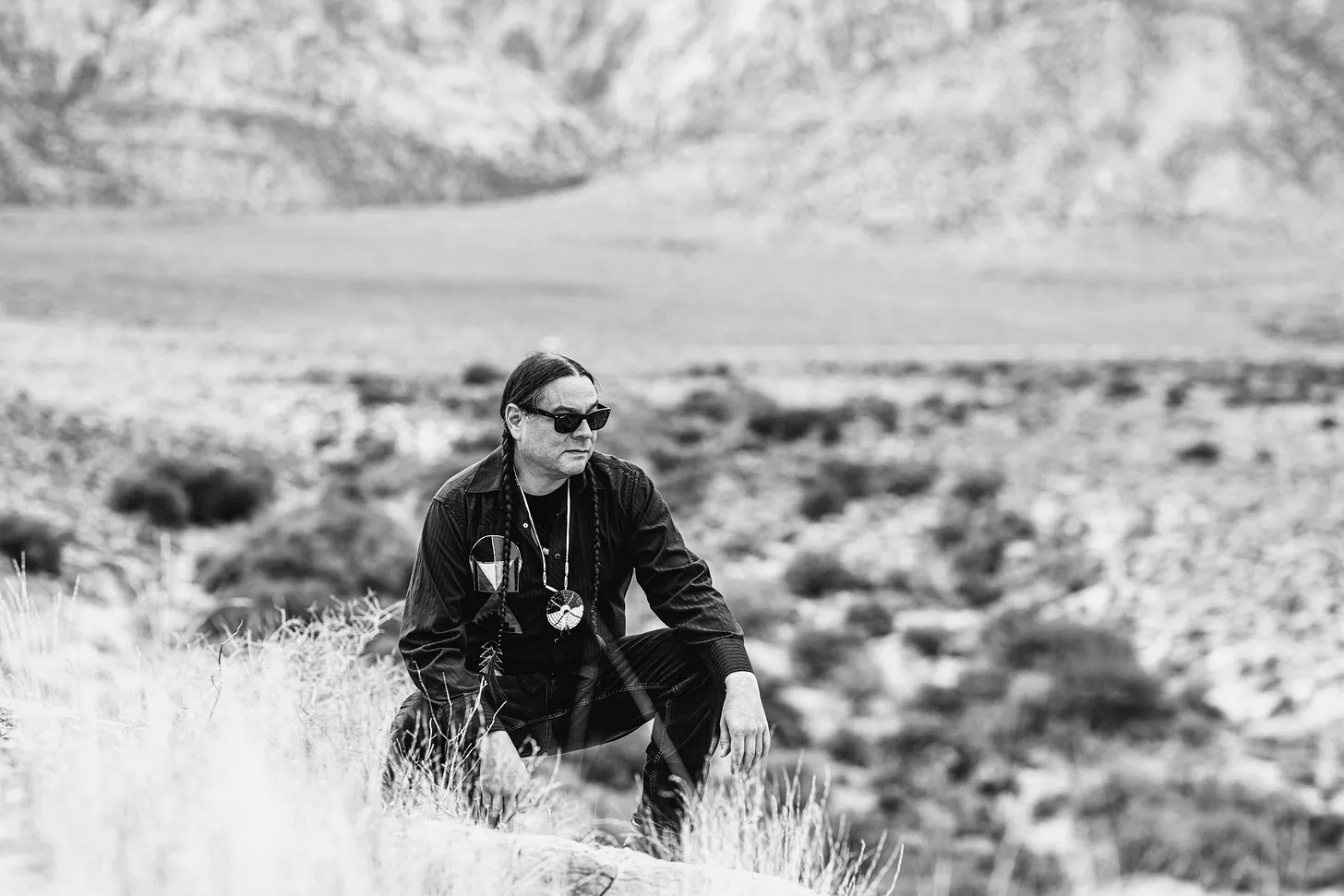
Cree artist, musician, composer and curator Virginia J. Sparvier-Wells. Facebook photo.
August 6, 2026
By Chevi Rabbit, Local Journalism Initiative Reporter
ALBERTA (ANNews) – For Cree artist, musician, composer and curator Virginia
J. Sparvier-Wells, reclaiming her birth name has become more than a
legal process. It has become a journey of healing, reconnection and
reclaiming a story that was interrupted through adoption.
“It has been a long time coming,” Sparvier-Wells said.
After years of creating and performing professionally as Jessica
McMann, Sparvier-Wells began the process of reclaiming her birth name
while honouring her marriage and artistic journey. She chose to keep
Jessica as her middle name because much of her previous creative work
was released under that name.
For Sparvier-Wells, a name carries family, history and belonging.
“There is something about the name that your mother gives you,” she
said. “A lot of Indigenous kids never get to keep that connection to
their family, their lineage, and even the place.”
Her decision to reclaim her name is deeply connected to her
experience as a Sixties Scoop survivor and her journey of understanding
the impacts of being separated from family, culture and community.
For
many years, Sparvier-Wells searched for a deeper understanding of where
she came from and where she belonged. That search eventually led her
back to Cowessess First Nation, where she began reconnecting with family
and community. “I really needed to know a family aspect,” she said.
Returning home introduced her to relatives she had never known,
including aunties, cousins and her grandmother, Viola GoodEagle. “I met
like 15 aunties and a whole bunch of cousins,” she said. “It was very
overwhelming.”
A defining moment came when she attended a powwow and was introduced
to her grandmother. “That brought me home. It really literally did,”
Sparvier-Wells said. “If I wasn’t called that thing, I wouldn’t have
ended up there, and I wouldn’t have been dancing that year that I met my
Nana.”
For Sparvier-Wells, dance became the bridge between her past and her future. “It was my dancing that brought me home,” she said.
That connection to community became the foundation for her artistic journey.
Sparvier-Wells said her earlier creative work focused on processing
the experiences of adoption, racism and disconnection. Art became a way
to understand her story and begin healing. “My previous work that I
created was really about the trauma of adoption and the things that you
don’t learn,” she said.
Growing up in Calgary, Sparvier-Wells said she often experienced
racism without having the language or support to understand what was
happening. “I was in a really white neighbourhood. There were no other
Indigenous people in my school,” she said.
Through music, writing, dance and performance, she began transforming
those experiences into stories of resilience and reconnection. “I
forgot to mention that when I was talking about my past work, it was
also a way to heal through it,” she said.
Today, Sparvier-Wells said her artistic direction has entered a new
chapter. “My new work is moving towards celebrating and looking towards a
positive future now,” she said.
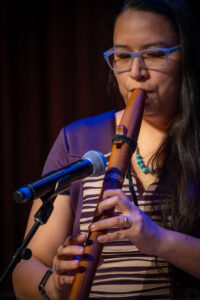
That future is reflected in her work as a classically trained
flutist, composer and Indigenous classical artist. Sparvier-Wells is
expanding the possibilities of what Indigenous expression can look like
within classical music.
Rather than seeing classical music and Indigenous traditions as
separate worlds, she brings them together through personal experience,
storytelling and cultural connection. “I create my work based on my own
experiences in my life,” she said. “I don’t think artwork should be used
in a commercial way to connect with one culture,” she said. “I think
you connect with your culture, and then the work flows.”
Her artistic vision is about bringing together every influence that
has shaped her journey. “I think everything that I want to do is going
to be mine,” she said. “It’s going to be merging everything that I’ve
learned – jazz, classical, my experiences and what I’ve learned playing
Indigenous music.”
Her path in classical music has been strengthened by Indigenous
artists who helped create space for others. She credits the late Cree
cellist and composer Cris Derksen of North Tallcree First Nation as an
important mentor and supporter. “I’m really thankful for everything that
she did for all of us,” Sparvier-Wells said.
Her own work continues to create those opportunities for future generations. Through projects such as Prairie Dusk and Incandescent Tales of Prairie Dust, Sparvier-Wells has brought Indigenous voices into classical music spaces through collaboration and composition.
Her work has included collaborations with Indigenous classical
musicians and composers, including Connor Chee, a Diné composer and
pianist who is creating a new flute concerto written specifically for
her. “This is going to be the first concerto that is written for me,”
she said.
The project represents another milestone in her career as she
continues expanding Indigenous presence within orchestral and classical
music spaces.
Beyond performing, Sparvier-Wells has also worked as a curator and
art consultant, advocating for Indigenous leadership in museums,
galleries and public arts. “When you have Indigenous-led voices and
authentic Indigenous people leading these things, then you get a really
deep contemporary look at things,” she said.
She believes Indigenous art should not be limited by stereotypes or
expectations. “We’ve always been a contemporary people, evolving with
the years,” she said.
For Sparvier-Wells, Indigenous art is living, changing and continuing
to tell new stories. She encourages people to support Indigenous
artists by showing up, learning and engaging with local arts
communities. “Even if it feels weird, get out and see that local
Indigenous art show,” she said. “There are so many amazing artists in
this province that we can support.”
Through reclaiming her name, reconnecting with her family and
creating new pathways in classical music, Sparvier-Wells is helping
redefine what Indigenous artistry can be. Her journey is not only about
looking back at what was lost. It is about creating a future filled with
connection, creativity and belonging.
“There’s always somebody there,” Sparvier-Wells said. “There’s always at least one person.”
(60s Scoop Adoptee) D’Arcy J. Moses on Survival, Fashion, and Rebuilding in a Changing Industry
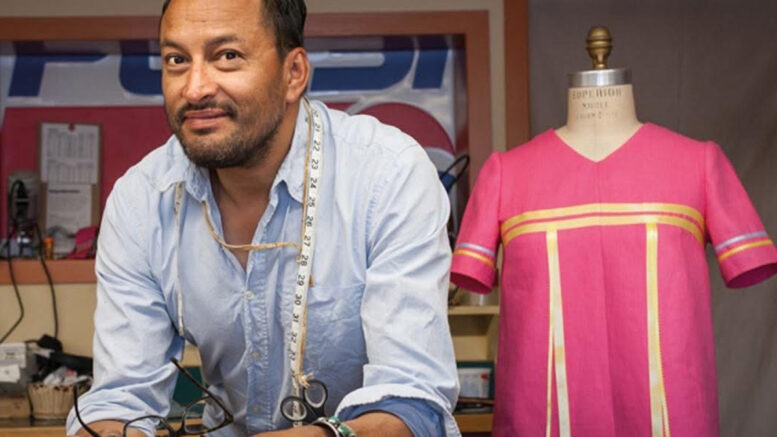
Fashion designer D'Arcy Moses reflects on his journey and his vision for the future.
June 22, 2026
By Chevi Rabbit, Local Journalism Initiative Reporter
(ANNews) – For D’Arcy J. Moses, fashion has never simply been about clothing.
It became a path back to identity, a form of ceremony, and ultimately
a way to rebuild a life shaped by separation, loss, and resilience.
Born Dene and impacted by the Sixties Scoop, Moses was taken from his
family as an infant and raised by a non-Indigenous family on a farm
outside Camrose, Alberta.
“I’m a ’60s Scooper,” he says. “I was adopted out as an infant. The
church took me away from my mother, and I was raised by non-Native
people on a farm in Alberta.”
Growing up disconnected from his culture, he found himself drawn to
another world – one found in the glossy pages of fashion magazines. “My
mother used to have Harper’s Bazaar and Vogue
magazines, and I was enamoured by them,” he recalls. “High fashion –
haute couture – that’s what first really sparked my interest.”
Those magazines offered a glimpse of possibility. By his
mid-teens, Moses understood that creativity would define his future. “I
knew from a young age that I was creative, but I didn’t realize until my
mid-teens that I wanted to get into clothing design.”
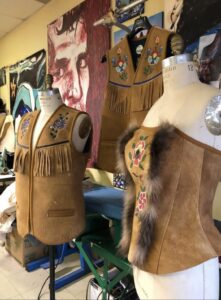
Current fashion designs by D’Arcy Moses.
Years later, after moving to Vancouver and Toronto, that childhood
fascination began to take shape professionally. Along the way,
Indigenous Elders recognized his talent and introduced him to the art of
regalia making. “In my early twenties I was in Vancouver. I had some
Elders take me under their wings and introduce me to regalia making.”
While refining his craft, Moses worked relentlessly to support
himself. “I worked two or three jobs at a time – waiting tables, working
in a sawmill, a lumber mill of all things. And in the evenings and
weekends, I would just create.”
That persistence eventually paid off. “I had a few lucky breaks,” he
says. “One of them was the Toronto Festival of Fashion, and the next day
one of my garments ended up on the cover of The Globe and Mail, which was really big news at the time.”
Darlene and Mervin Petit share a passion for teaching traditional ways of life to others. (Campbell Stevenson/SRC)
CBC's road trip series Land of Living Stories explores
inspiring stories of community spirit from across Saskatchewan. In our
latest visit, CBC-Radio Canada hit the road to Buffalo Narrows. This is
one story in a multi-part series from that community.
WARNING: This story contains details of abuse.
When
Darlene Petit first moved back to Buffalo Narrows, Sask., she wouldn't
eat or even touch a wild rabbit, though her husband Mervin often went
out to set snares. When he would bring her onto his boat, she'd take a
book and read while he fished.
But their relationship over the
years has reconnected her to a life and culture she almost lost, when
she was taken from her family in Buffalo Narrows as part of the Sixties Scoop.
"Mervin
was a big, big influence in my life, teaching me my cultural
background," the 62-year-old said, explaining how her husband showed her
the joys of catching their own food, from rabbit to wild chickens to
moose. Thanks to him, she reconnected with the traditions of her Métis
and First Nations ancestors.
"I started fishing and learning how to catch fish, and now I can outfish anybody," she said, laughing.
Mervin
Petit grew up fishing and hunting; within half an hour, he pulls up 30
fish in a net. It's a passion he's passed on to his wife, Darlene. (Campbell Stevenson/SRC)
Now
the pair can often be seen sitting quietly in their boat, watching the
bears and deer in the distance, or setting a net and hauling up fish
they share with others in the village.
It's a fight to keep these
cultural traditions alive, as people are losing touch with ways of life
that go back hundreds of years, said 61-year-old Mervin. That's why he's
so keen to help anyone who's interested learn how to hunt, fish and
prepare food.
"I want everybody to feel that, all the young
people, all the older people that don't know this stuff, I want them all
to understand this stuff and keep doing it," he says.
The pair
say they don't need to rely on groceries, but instead eat the wild game
and fish they catch themselves. It's a self-reliance they want to pass
on to future generations.
"You're gonna need this more than ever
in the coming years because of all the stuff that's going on now in the
world; it's so expensive living," Mervin says.
WATCH | This couple are dedicated to sharing traditions and love for the land:
Sharing traditional knowledge strengthens Buffalo Narrows power couple's bond
Darlene
and Mervin Petit have been together for 43 years, and have grown closer
through sharing their love of living off the land. Now they hope to
pass that knowledge on to others in the community.
Scooped from childhood
While
Mervin's memories are deeply rooted in fishing and trapping, Darlene
was taken from her family when she was three. She was relocated to
Lebret, Sask, 780 kilometres south of Buffalo Narrows, and bounced from
foster home to foster home.
It was a traumatizing time.
"I
was bathed in hot Javex water and things like that," she said. "And then
when you're in foster homes, you're abused by other children that are
in the home."
Darlene
Petit, pictured front row, second from left, is seen here with her
siblings. They were separated as children by the Sixties Scoop. (Submitted by Darlene Petit)
Fortunately,
her mother successfully fought to regain custody of her children, and
Darlene was finally reunited with her family when she was 12.
Vanessa Ambtman-Smith’s first experience at a hospital lasted 21 days.
Now,
she’s making it her life’s mission to make sure Indigenous children
never have to fight for their rights in Canada’s healthcare system
again.
Born during the Sixties Scoop,
Vanessa was removed from her home and immediately placed into the child
welfare system. After 21 days of waiting in the hospital, she was
adopted by a non-Indigenous family in Alberta.
Today,
Vanessa is an assistant professor in both the department of geography
and environment and the Indigenous studies program at Western
University. Before that, she spent two decades working in the healthcare
field.
“My
journey has naturally gone from working as an advocate in Indigenous
healthcare to becoming a professor and an Indigenous health researcher.
I’ve had to be an educator my whole career,” says Vanessa.
Her
research explores Indigenous healing practices and traditional healing
spaces within hospital settings. Through education and policy reform,
Vanessa is committed to removing the colonial foundations of healthcare
systems and making sure that hospitals are safe places for Indigenous
patients.
According
to Vanessa, anti-Indigenous racism is one of the most significant
determinants of Indigenous health. She attributes this outcome to how
non-Indigenous people have been educated to carry biases and stereotypes
towards Indigenous people.
Vanessa recounts the story of Brian Sinclair, an Indigenous man, who died from a bladder infection after waiting for 34 hours in a hospital emergency room.
To
honour the voices of Indigenous residential school and ‘60s Scoop
survivors, a gathering was held at the MacKenzie Art Gallery.
Diane
Campeau, who goes by Ji-gaabiikwe, has been on a journey for over a
decade trying to obtain documentation from when she was born.
“I
was taken from Saskatchewan and then flown across the country to an
American family in Nova Scotia. It was a horrific experience and that
adoption broke down,” she shared.
“When I was a
teenager, I suffered mental health addictions all because I didn’t know
who I was and dealing with the traumas, not only of the former adoptive
home, but just my journey in general.”
It was not until her late twenties that Ji-gaabiikwe became aware she was a ‘60s Scoop survivor.
“I
fully don’t understand what it means to be a ‘60s Scoop survivor
because the gravity of the loss and what happened to us is just, it’s
overwhelming,” she said.
A
panel of survivors who attended Lebret Indian Residential School in the
1960s shared their stories at the MacKenzie Art Gallery on Thursday.
(Sierra D'Souza Butts/CTV News)
Events like these help create a safe and welcoming environment where survivors like herself can feel supported, she added.
“We
get the tail end of residential school survivors and so for things like
this it’s more of an awareness that the genocidal policies of the
Canadian government not only was with the residential schools, but also
the 60s Scoop, and then now the millennial scoop,” Ji-gaabiikwe said.
“Being
able to gather and come together with other survivors and share some of
our lived experience continues to keep our voices alive.”
In
addition to Ji-gaabiikwe, people also heard from a panel of survivors
from Carry the Kettle Nakoda Nation who attended Lebret Indian
Residential School in the 1960s. Speakers who attended boarding homes
also spoke at the event.
The event was
organized by the gallery in partnership with the Buffalo People Arts
Institute. One of the organizers, Tracey George Heese, said providing a
platform for survivors helps educate the public about Saskatchewan’s
history of Indigenous people.
“A majority of
society is only beginning to understand about the residential schools.
With regards to the Truth and Reconciliation, the 94 Calls to Action,”
George Heese said.
“A
lot of people in Saskatchewan specifically were not aware about the
‘60s Scoop either. In my case, my parents were unaware of what was going
on, these different policies that government implemented to colonize
First Nations people, that was started after the treaty was signed.”
She
added that having the support from local organizations helps First
Nation communities continue the conversation while working towards a
path of healing.
“It’s bringing awareness and
also bringing about the discussions to hear the story, to witness the
stories, to come together as community,” said George Heese.
The
Buffalo People Arts Institute continues to partner with organizations
and First Nations in effort to remind and integrate the significance of
the buffalo to communities.
“As nations there
are communities that are bringing the buffalo back and the Buffalo
People Arts Institute that has been their focus, of bringing awareness
of the buffalo to our Treaty 4,” explained George Heese.
“It’s
in our DNA and it was our whole life, our whole sustenance. Lorne
Kequahtooway and Joely BigEagle-Kequahtooway go out into communities,
scrape buffalo hides, share the teachings of the buffalo, share stories
of the buffalo.”
HOMELANDS celebrates the eightieth year in the life of Mvskoke artist
Rick Grimster. Born to an English mother and a Native American father,
war baby Rick was raised by adoptive parents in the UK.
In this series of acrylic paintings, Grimster playfully merges
abstract impressions of England and America through masterful use of
colour, pattern and texture. Together these autobiographical landscapes
chart his remarkable passage through time on two continents and his
lifelong journey of transformation from adoptee to Indigenous elder.
HOMELANDS is a love letter to the people and places that gave life to this extraordinary artist.
This exhibition coincides with National Adoption Week.
Brittany Penner. Photo supplied. Credit Michael Maren.
By Shari Narine, Windspeaker.com Books Feature Writer September 4th, 2025
Children Like Us: A Métis Woman's Memoir of Family, Identity and Walking Herself Home is Brittany Penner’s account of being adopted as a baby by a Mennonite family in Manitoba and searching for her birth parents.
Such an adoption practise—having white families raise Indigenous children—continues, points out Penner, who is now 36 years old.
“I
really keep thinking about…how many children and teenagers are still
facing realities like this where…they have been cut off from their first
families, where they're being raised outside of their culture, and how
it's not something that's in the past. It is something that is still
very present across our country today,” said Penner, who has
Anishinaabe, Cree and European settler lineage.
When
Penner started writing her memoir, it was under a different title. But
when she explained it to people, the phrase “children like us” kept
coming up.
“It was always in reference
to…children who were Indigenous, who were placed for adoption or
relinquished or apprehended or in foster care. And that was just how I
think, and my siblings and my cousins, collectively, thought of
ourselves,” she said.
Penner and the
other Indigenous children who were fostered or adopted by her extended
Mennonite family were part of the Sixties Scoop, a common practise by
the Canadian government to place Métis, First Nations and Inuit children
with non-Indigenous families in other provinces and sometimes in other
countries. The Sixties Scoop began in the 1950s, ramped up in the 1960s,
and carried through until mid-1980. It’s estimated 20,000 children were
taken.
Penner was the only child her
parents adopted. She had numerous foster siblings (21 before her seventh
birthday), who she connected with as brothers and sisters only to have
them torn away from her over the years. Due to these losses, as a
youngster she became obsessed with when she would be taken away, and it
was a fear she lived with despite her mother’s attempted reassurances
that that that would not happen to her. Her father’s Mennonite family,
including his parents, adopted and fostered numerous Indigenous
children. These were the Native aunts and uncles and cousins that Penner
grew up with.
In offering her story,
Penner cautions the reader in the book’s foreword that this is “not a
memoir wherein I ask you to choose a side.” She says that mattered to
her because, when she was growing up, she was told she “should be
grateful” that her adoptive parents had chosen her.
As
she writes in her memoir, “I’m adopted. I’m reminded of this again and
again and again—until I begin to believe there is something inherently
wrong with me for not feeling unendingly lucky.”
What brought you to Santa Fe? Were you born on nearby Diné land?
I
was born in ‘64. The Indian Child Welfare Act was [enacted] after I was
born, so I was adopted out. During Indian relocation in the 60s, my mom
was relocated to Ohio, which was a very common way that the government
spread out the Native youth to break up the uprisings.
She
got pregnant with me out in the middle of nowhere in the Midwest, and I
got snatched up by Catholic Charities and adopted out with no
connection to my birth family and was raised by non-natives in the
Midwest.
I
had a great childhood, but no connection to culture — not for lack of
love, just for lack of education and lack of protocol by the government.
It’s a little bit different now: I'm very supportive of the Indian
Child Welfare Act because it protects our children from what I've been
through.
In hindsight, I
learned amazing things in the outside world that I'm able to bring back.
My reintegration— coming home — was in 2019. My daughter graduated high
school, so in my empty nest phase, I was like, I'm going to learn what
it means to become a Dinemicmatriarch. I came home.
In the fall of 2024, @cbcmusic and @SOCANmusic launched Reverie: The Indigenous Music Residency, an initiative created to foster the talents of Indigenous musicians. The program brought together six artists, including singer-songwriter @ravenreid9080 , an incredible artist with ancestral ties to the Mikisew First Nation. Originally from Yellowknife, NWT, and raised in Prince Albert, she now lives and creates in Saskatoon. Reid’s voice is powerful both in and out of her music. She is also a respected public speaker, using her platform to share her personal story and advocate for survivors of the Sixties Scoop.
Meet Raven Reid | Reverie 2024, Raven Reid, Sixties Scoop survivor, Indigenous folk music, singer-songwriter, Indigenous artist, Mikisew Cree First Nation, Yellowknife, Saskatoon, healing music, storytelling, folk singer, Canadian music, protest songs, social justice, Indigenous rights, mental health awareness, resilience, overcoming adversity, inspirational music, new music, independent artist, live performance, guitar songs, powerful vocals, songwriter, Indigenous culture, First Nations, singer, acoustic, folk
As a little girl, I was always afraid to cross bridges over turbulent waters. This
irrational fear complicated things for my parents since I grew up in
Valladolid, a small city in northeastern Spain with a river passing
through it. Every time we crossed the Pisuerga River with its abundant current, I asked them to grip my hand and not let go. I had recurring nightmares in which the river overflowed and I was swept away; my parents were unable to rescue me.
The years went by and I learned to manage
this terror until last October 30, 2024, when I saw the images of the
unexpected flash flood that swept through several municipalities of
Valencia. My memory could not stop the images of my childhood terror and
the reason for which I grew up in Europe and not in my country of
origin, Colombia.
I saw photos of Valencia’s destroyed
streets, immersed in water and mud, cars carried away by the current,
227 dead, families looking on helplessly as they gathered up the little
that remained of their possessions. “Why didn’t they warn us sooner?”
was a constant refrain. I thought my wounds were a thing
of the past, but with the relentless floods in Spain, my emotional
memory brought me back to the disaster—the mud and water— that marked my
life before I could truly remember it: the tragedy of Armero, Colombia.
It has been 40 years since my town was
completely destroyed by the eruption of a volcano, taking the lives of
more than 23,000 people. I am one of the survivors, but I also belong to
the silenced past of thousands of forced migrations and the open wounds
of a diaspora of people adopted throughout the world.
I was given in adoption and taken to
Spain, where I grew up with a family that always told me the little they
knew about my history of adoption, but always with many unanswered
questions about my roots.
For many years, these questions lay dormant
inside of me, like the lava accumulating under a volcano that appears
to be sleeping. But the fire inside sooner or later seeks a way to get
out.
My reply has been the creation of Hija del Volcán
(the Volcano’s Daughter), a documentatry that tells the story of my
search for my origins as an adopted child in the context of one of the
worst natural disasters in Latin America. The film began not only as an
exercise of personal memory, but as a way of putting into context that
which had never been named.
Cyrus Edward Dallin, “Appeal to the Great Spirit” (1909) in front of
Alan Michelson’s “The Knowledge Keepers” (2024) at the Museum of Fine
Arts, Boston (photo Hrag Vartanian/Hyperallergic)
As a child, Alan Michelson often rode the T past sculptor Cyrus Edward
Dallin’s “Appeal to the Great Spirit” (1908) outside the Museum of Fine
Arts, Boston. He was riveted by the statue’s grand horse and the
powerful yet melancholy figure wearing a striking Plains Indian war
bonnet. It was only in his 20s that the artist learned that he had been
separated through adoption from his own Native heritage and Mohawk birth
family in the Six Nations of the Grand River in Ontario, Canada. He
soon learned that the Dallin sculpture he marveled at in childhood
symbolized the nefarious “Vanishing Indian” myth, which cast Indigenous
peoples as doomed to extinction.
Jay
Mitchell by the Yukon River in Whitehorse. Mitchell has spent most of
his life in Alberta and Ontario and believed he was Métis — until a DNA
test helped him find his true biological family in the Yukon, and
prompted him to pick up and move to the North. (Cali McTavish/CBC)
Having
spent his whole life in bigger cities, Jay Mitchell says he's still
getting used to the pace of life in the relatively small town of
Whitehorse.
"It's a shock. I'm so used to city life," said Mitchell.
He's
also getting used to meeting new members of his extended biological
family. He says people often come up to him on the street in Whitehorse
and tell him, "you're my cousin," "you're my second cousin," or "you're
my nephew."
Mitchell moved to the Yukon last May after discovering
errors in his Sixties Scoop adoption papers and then learning the truth
about his ancestry. He spent most of his life believing he was Métis,
only to have a DNA test reveal that both of his biological parents were
from Yukon First Nations.
Mitchell says he misses his wife and son
back home in Oshawa, Ont., but he says they'll join him soon. He's
grateful to the Kwanlin Dün First Nation in Whitehorse for embracing him
and giving him a job, and a place to live, while he waits for his
family. He is now a citizen of Kwanlin Dün, and works as a records
keeper for the First Nation.
Mitchell's family's move to the
North is about building connections with his biological family,
and finding support for Mitchell's 17-year-old son Nicholas who has
autism.
A photo of a younger Mitchell with his wife Lisa Hughes and their son, Nicholas Hughes Mitchell who is now 17 years old. (Submitted by Jay Mitchell)
"We're
doing this for my son," says Mitchell, "to make sure that, you know,
there's family to take care of him, if anything happens to us."
A case of mistaken identity
Mitchell,
57, was born in Edmonton and raised there by his adoptive family before
they moved to Oshawa. He was 10 years old when his mother told him he
had been adopted. He says it was a shock.
"I had no idea," said Mitchell.
His
mother also then showed him his birth certificate which said
Mitchell was Métis. That set him on a path to discover his cultural
roots.
"I went to Métis celebrations, and I met the Ontario Métis chief in Oshawa," he recalled.
When
he was in his 50s, a health issue prompted a doctor
to encourage Mitchell to try to learn about his biological family's
medical history. That led to another surprise for Mitchell, when a DNA
test and an ancestry research service revealed that he was not in
fact Métis.
He learned that his biological family were Yukon First
Nations members. He soon connected with his biological half-brother
Jeffrey Kalles in Whitehorse, and eventually his two half-sisters as
well.
Jay Mitchell, centre, with his adoptive mother Barb Mitchell, and his son Nicholas Hughes Mitchell. (Submitted by Jay Mitchell)
Kalles describes the first time he talked on the phone with Mitchell.
"Hearing that voice, and just really realizing that's [my] big brother — it's surreal," Kalles recalled.
It was also surreal for Mitchell to learn about his biological family.
"The
funny thing is that with my adopted family, I'm the baby of all the
siblings — and in my biological family, I'm the oldest. It's kind of
weird how that works," said Mitchell.
Kwanlin
Dün First Nation members welcome Mitchell to Whitehorse last year.
Mitchell is standing at the back with a ball cap and red vest on. (Submitted by Jay Mitchell)
Putting the pieces together
Through
a Freedom of Information request, Mitchell was able to get his adoption
records from the Alberta government and confirm the identities of his
biological parents as Yukon First Nations.
"I don't understand
why they didn't put me as First Nations. It's kind of puzzling, but a
lot of people say that things were different back then, in the '60s,"
said Mitchell.
The Sixties Scoop refers to the practice from the
1950s to the 1980s of removing First Nations and Inuit children from
their families and communities and placing them in foster care or
adopting them out to non-Indigenous families. According to Sixties Scoop class action lawsuit settlement website, many claimants described being cut off from their culture and language.
Mitchell
says when he learned about the class action lawsuit he was told he
didn't qualify because of his Métis status. By the time he found out the
truth about his Indigenous ancestry, the deadline to join the claim had
passed.
'A lot of people were shocked ... that I existed'
After
moving to Whitehorse and reuniting with biological family, Mitchell
learned there were two people he would not be able to meet: his
biological parents. Dennis Ladue and Joyce Jonathan had both died a few
years earlier.
"A lot of people were shocked about who I was, and that I existed," says Mitchell.
Duran Henry is one of Mitchell's cousins. He thinks Ladue would have loved to meet Mitchell.
Mitchell, left, with his cousin Duran Henry. (Submitted by Jay Mitchell)
"I think he would have been surprised, and then just overwhelmed by joy and love," says Henry.
He says sometimes Mitchell reminds him of Ladue.
"The way he laughs and, you know, the way we joke around — he's just a happy guy, and [Ladue] was like that."
Kalles was
also adopted and also never met Joyce Jonathan, his biological mother.
But he says their parents live on through the siblings.
Jay Mitchell's biological parents Dennis Ladue and Joyce Jonathan who both died before Mitchell had a chance to meet them. (Submitted by Jay Mitchell)
"There
are these idiosyncrasies — we didn't grow up together, but the way we
talk and the way he looks around and stuff like that. I guess, when I
talk to him and look at him, I just know, that's my brother,"
said Kalles.
Mitchell says he can't wait for his family to join him in Whitehorse this summer.
"Every day I miss my wife and son. My son and I do everything together," he said.
Kalles says he's also excited to meet more of his extended family.
"I'm going to retire here shortly, so I'll have a lot of time to hopefully show them around the Yukon," said Kalles.
Powerhouse restaurateur Inez Cook (traditional name: Snitsmana) is originally from Bella
Coola’s Nuxalk Nation, but she grew up in Vancouver and went on to
spend 33 years in the airline industry, tasting her way around global
cities (Paris, naturally, was a favourite). In 2022, Cook left airlines
to dedicate herself full-time to running the wildly delicious Salmon n’ Bannock Bistro—Vancouver’s
only Indigenous restaurant—as well as opening Salmon n’ Bannock on the
Fly at YVR and penning two children’s books about her experience as a
child of the Sixties Scoop. When she’s not busy hosting customers at
“SnB,” this is where Cook’s dining around town.
Founder of the NWT Native Court Workers Association, former
Yellowknife city councillor and member of the NWT Human Rights
Commission passed away this week at the age of 71.
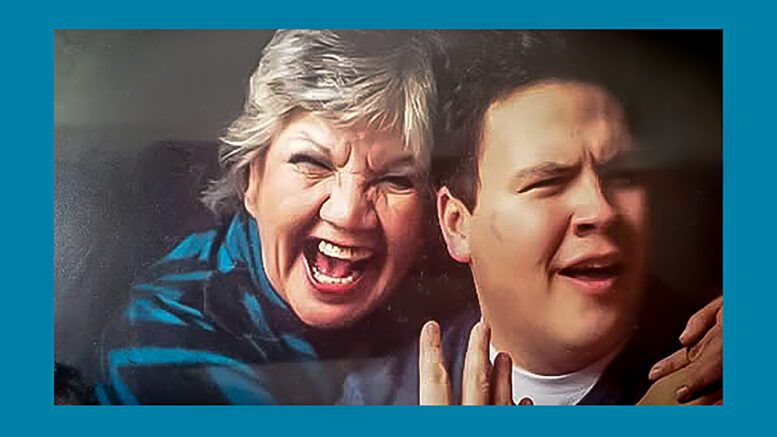
Gail Cyr and son Jesse Wheeler. (Photo courtesy Jesse Wheeler via Facebook)
Gail Cyr was known for her unwavering bravery fighting for
Indigenous people in the North, and her life’s work was recognized
nationally in 2022, when she was invested into the Order of Canada.
Cyr passed away on Tuesday, her son Jesse Wheeler posted to social media. She was 71.
“Thank you for your kind words and your sharing of stories,” Wheeler
stated. “She led an incredibly full life. She leaves this place much
better than she found it.
Gail Cyr, on the right, works with an unidentified woman in 1983. (Photo courtesy of NWT Archives/Arthur Boutilier fonds)
“That is all we can ask of a person. She did it tenfold. One-hundred fold.”
Cyr is originally from Nelson House, MB. A survivor of the Sixties
Scoop, Gail was one of seven siblings all apprehended from her Cree
parents.
In a 2022 profile in UpHere Magazine, Cyr stated: “There were a lot of rough times, and there were a lot of lonely times.”
The racism and sexism she recalled after moving to Winnipeg, led her to move to Yellowknife in 1974.
Cyr wrote a series of columns for Northern News Services in recent
years, one detailed her early experiences in her new home of Yellowknife
— on the Range.
“I started work at the Gold Range behind the bar pouring drinks as I
had at the Spaghetti Factory in Winnipeg, with the one exception that
hot pants and high heels were required as hostess wear,” she wrote in
her column.
“I made it to the floor from bartending. I loved it. We walked miles
every night carrying a tray of 16 of the largest draft glasses in
Canada, perhaps 14 ounces – not like the wimpy glasses from down south –
and ashtrays, change and a walled folder for bills.”
Cyr later was a coordinator with the Indian Brotherhood of the NWT,
and was the first executive director of the NWT Native Court Workers
Association.
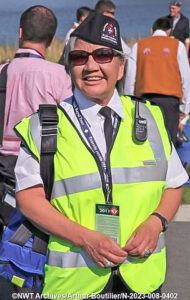
Gail
Cyr, a St. John Ambulance volunteer, at the 2011 visit of the Duke and
Duchess of Cambridge. (Photo courtesy of NWT Archives/Arthur Boutilier
fonds)
She served on Yellowknife city council, worked for the territorial
government and was a special advisor on Missing and Murdered Indigenous
Women and Girls.
She also enjoyed live performances, producing costumes for the
Northern Arts and Cultural Centre and performing with her son, Jesse.
Cyr was the former executive director of the Native Women’s
Association and up until her passing, was on the NWT Human Rights
Commission.
Charles Dent currently chairs the commission. He recalls first
meeting Cyr at one of the first Folk on the Rocks festivals in the 1980s
when Cyr was with St. John Ambulance and he was a volunteer
firefighter.
Later on, when the pair were on Yellowknife City Council in the
1980s, with Cyr being the only Indigenous councillor. Dent said Cyr
impressed by doing all the required reading and really made an effort to
make good decisions to help the city develop.
Then, when Cyr joined the Human Rights Commission, Dent said she translated her personal experiences into leadership.
“She brought her … understanding and empathy that goes with having
experienced the discrimination she personally went through during the
Sixties Scoop,” he said.
“She was never afraid to talk about her experiences, never afraid to
talk about how that affected her and others like her that you know had
experienced the same sorts of things.
“She was courageous, because she was willing to share her experience.
She tried to help people empathize with what people have gone through,
and help along our path to reconciliation.
“As we developed the Commission, we developed our reconciliation
strategy, she was key to helping us set that up, and I’m gonna miss her.
We’re gonna miss her.”
CKLB will update this story when Cyr’s funeral arrangements are known.
“You will be told you are ugly or
‘too beautiful to be Indigenous!’ If you were fostered into a white
home, you will be told to your parents were drinkers, and you will be
told to ignore any pull to your family you lost.”
– Gail Cyr, on growing up in a non-Indigenous community
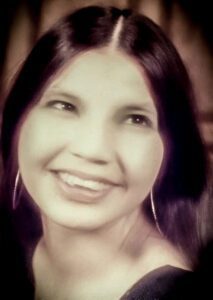
Gail Cyr as a teenager. (Photo courtesy of Cyr family via Facebook)
Lori Long Chase disappeared in 1983, and so did much of her life story.
Her body had been unknowingly found almost a month after she was last seen by family. But she remained nameless for decades and her homicide went unsolved.
Now after 41 years, Lori is able to reclaim her name, as the details of her life and death begin to unfold.
Lori was adopted out of the San Carlos Apache Reservation in about 1965 when she was only days old, her little sister, Memory Long Chase, says. Memory was also adopted 13 years later as a baby out of the Standing Rock Sioux Reservation in South Dakota. She’s now one of the last surviving people ever to know Lori.
This reporting was supported by the International Women’s Media Foundation’s Fund for Indigenous Journalists: Reporting on Missing and Murdered Indigenous Women, Girls, Two Spirit and Transgender People (MMIWG2T).
“I want to think that she knows I didn’t forget her,” says Memory, who was only 5 years old when Lori went missing. Most of what she knows is based on her childhood memory and bits of information she’s heard from their family over the years.
Lori Long Chase (Phoenix Police Department)
“Maybe I’ve invented some in my mind as I’m kind of piecing things together but I want to think that they’re real,” she says of her memories of her big sister Lori.
Lori was a distance swimmer, and a really good one, Memory says. She swam the 1500-meter butterfly and might’ve held a state record at one point. Memory remembers a detective with the Phoenix Police Department sharing a yearbook photo they found of Lori “in that Michael Phelps pose.”
One memory that stands out in Memory’s mind is the time Lori used the money she made from her first job to buy her a book about Disney’s Snow White and the Seven Dwarfs. “It was a really big book … it had all these artist drawings and storyboards. It was the coolest thing ever,” she says before becoming silent for a moment.
“It’s so unfair that those are the only memories I have of her,” Memory says, her voice quavering. “But they were pretty great, the ones I do have.”
Missing since 1983
On the first Saturday in October, about a dozen people attended a memorial service honoring Lori, even though most had never met her.
They gathered under a ramada outside the St. John the Baptist Parish on the Gila River Indian Community where a rosary and mass had just ended. Nearly everyone who showed up for Memory and Lori wore red — a color that’s come to symbolize the Missing and Murdered Indigenous People’s movement.
“I think one of the hardest parts about this was knowing that there’s so few alive that remember who she was and so I wanted to keep (Lori’s memory) alive because it mattered to me that she lived,” Memory says as everyone sat around a few folding tables to listen to her talk. “I’m sorry that her life was brief and I’m sorry it was difficult.”
Lori was just a few months shy of her 18th birthday when she went missing in Phoenix on about July 21, 1983. It was the same day she started a new job at a pizza restaurant, Memory and a spokesperson for the Phoenix Police Department told Arizona Luminaria. When her mom went to pick up Lori at the end of her shift, she was told her daughter had been fired because her boyfriend kept showing up and being disruptive.
That was the last time anyone in their family saw or heard from Lori, Memory says. At the memorial people around her quietly nibbled on slices of pizza, which Memory picked to signify the day Lori went missing.
Candles bearing the words "We love you" and "Gone too soon" at Lori Long Chase's memorial service at the St. John the Baptist Parish on the Gila River Indian Community on Oct. 5, 2024.
Until recently, most of what was known publicly about Lori was written across a missing person flyer from the Phoenix Police Department. At its center is a cropped photo of Lori that Memory says was taken outside her family’s new home on the Gila River Indian Community weeks, maybe even days, before her disappearance.
The uncropped version of the photo shows Lori sitting against the hood of a Triumph Spitfire and staring directly at the camera. Her brown hair is fluffed and feathered, like many teens her age styled it in the 1980s.
And while her smile illuminates through the old photo’s fading color, it’d likely been a tough time for Lori. Several months earlier she lost her baby boy shortly after he was born.
Reclaiming her name
Lori’s disappearance would go unsolved for the next four decades, though she wasn’t officially reported missing to the Phoenix Police Department until 2021. Memory says she doesn’t know if their mom, who died in 2016, ever tried to report Lori missing before then.
“My mom wouldn’t want to talk about it,” Memory says.
Four years ago, Memory contacted detectives because she believed an unidentified girl listed on the police department’s website could be Lori. The girl — known at the time only as Ahwatukee Jane Doe — was believed to be affiliated with the San Carlos Apache Tribe and had been found dead nearly a month after Lori disappeared.
“The first composite drawing has really tightly curly hair. I didn’t remember Lori having curly hair. But, page 2, that composite drawing is almost identical to that last picture that we have of her,” Memory says.
Because Memory wasn’t biologically related to Lori she couldn’t undergo DNA tests to help confirm the girl’s identity. Ahwatukee Jane Doe remained unnamed. Lori remained missing.
In May 2022, the department released a video with photos of Lori and a plea on National Missing and Murdered Indigenous People’s Awareness Day. They described a young woman found on the banks of a canal in Ahwatukee and asked for information to help locate potential biological relatives of Lori for DNA testing.
"Last year, a family came forward saying this might be their adopted sister, Lori Megan Long Chase, who went missing around the same time period in the early 80s," said Ryan Cody, a spokesman for the Phoenix Police Department. "Now, almost 40 years later, we are asking the public for their help again to identify this Jane Doe."
No one has yet come forward.
The department decided to find the burial place for Lori’s infant son, Bronson Hawk Long Chase. With help from the Maricopa County Office of the Medical Examiner, Lori’s baby and her only known blood relative was exhumed for DNA testing.
More than a year passed as Memory waited. And on Sept. 5 her phone rang. The DNA testing had confirmed Ahwatukee Jane Doe was indeed Lori, closing the chapter on her missing person case but opening another into her death.
“This leg of the journey is over, but Part 2 begins,” Memory says. “It’s so surreal because her being missing has been a fact in my existence for most of my existence so now it’s like I don’t even know what to do with myself.”
“It took 41 years for science to give Lori her name back and so I think we have every reason to hope that science will give her justice,” she later added.
Heurich, who helped launch the program in the early 2000s, described NamUs as “a one-stop-shop tool” that helps law enforcement, medical examiners, coroners, and the general public track missing, unidentified and unclaimed persons cases. The program can also help resolve cases by offering resources such as investigative support, training and outreach and forensic sciences similar to what investigators used to identify Lori.
Heurich has worked on hundreds of cases over the past two decades. Finding resolution in missing and unidentified person cases, he said, can bring about feelings of immense gratitude for the family and investigators involved.
Even in instances when a missing person is later discovered to have been a victim of a violent crime, he said, families may be comforted in the fact that they’re closer to justice and can lay their loved one to rest.
“It's undescribable when you have a family member come up and hug you … and they cry on your shoulder,” Heurich said. “I've cried with a lot of family members whose cases have been solved and whose cases have been unsolved and it's probably one of the most impactful experiences I have had through my career.”
NamUs is a voluntary program, meaning there is no federal law requiring agencies to enter cases into the database, he said. Sixteen states including Arizona have legislation mandating the use of NamUs for either missing and/or unidentified person cases, according to the program’s website. However, none of those state statutes include an enforcement component making it difficult to ensure agencies are complying with the law, Heurich said.
In Arizona, law enforcement agencies are required to submit information about a missing, kidnapped or runaway child to NamUs, among others, within two hours of receiving a report. No other Arizona laws specifically mention NamUs and it is not clear if any Tribal Nations in Arizona have laws related to NamUs.
“The numbers of cases in NamUs are vastly different from the numbers of cases we’re hearing out in the United States,” Heurich said, adding that the missing people in its system only represent cases reported to the program.
In order for a case to be published in the database, there has to be an active missing person report created by a law enforcement agency, he said. As part of the services the program provides, NamUS staff can work with law enforcement to create a report for a missing person at the request of families.
“We do understand there is a very large issue out there not just in the tribal communities but in the law enforcement community, in general, with actually taking missing persons reports, especially with people over the age of 18 who are considered adults,” he said.
“For lack of a better word, there’s a stigma out there that people who are over 18 are allowed to go missing for whatever reason they want to,” Heurich continued. “Sometimes those cases are taken less seriously until there is actual proof that that person is probably and most likely endangered.”
A T-shirt bearing the words "You are not forgotten" and "MMIW" at Lori Long Chase's memorial service at the St. John the Baptist Parish on the Gila River Indian Community on Oct. 5, 2024.
‘The database is only as good as the number of cases in it’
Closing gaps in state laws that would require and enforce reporting of missing people of all ages could help increase the number of successfully resolved cases. It’s especially important for Indigenous communities in Arizona, a state that was identified in a 2017 study from the Urban Indian Health Institute as having the third highest number of cases of missing and murdered Indigenous women and girls in the country.
Native Americans, particularly Native American women, rank the high rate of missing and murdered Indigenous women among the most important issues facing their communities, according to the First Nations Development Institute’s 2023 National Native American Justice survey.
Indigenous families searching for their missing loved one, or seeking justice for their murdered loved one, often face systemic failures that contribute to gaps in data and reporting. Some families wait years and many never find justice or resolution.
There are 1,072 missing person cases in Arizona entered into NamUs, almost 9% (93) of which are identified on the database as Native Americans, an Arizona Luminaria review of the website on Oct. 30 showed. Yet, Native Americans make up just more than 5% of the state’s total population, according to 2023 population estimates from the U.S. Census Bureau.
NamUs could not immediately provide Arizona Luminaria with an example of an Indigenous person's case it helped to solve in Arizona.
“We still encounter a little bit of skepticism on the science and we're trying to help bridge the mistrust with collecting DNA samples from family,” Heurich said, adding that in some Indigenous communities taking someone’s DNA can be considered taking part of their spiritual being.
“We want to convey to the communities that taking (a DNA sample) may be the only way that we can identify or find their person.”
In comparison to state and local law enforcement agencies, Heurich said there is a general lack of reporting of missing person cases to NamUs by tribal police, which he attributed to a lack of resources, trust and training. That’s why outreach and education — not only about the possible benefits of forensic sciences, but also the existence of NamUs as a resource — is a goal for the program, he said.
“We're always looking at ways to do better outreach. To let, not only families and everyone in the general public know about NamUs as a tool, but also police agencies,” he said.
“I think one of the biggest things that we could say out in the community of victims, survivors and law enforcement is: Use NamUs because the database is only as good as the number of cases in it.”
Memory Long Chase speaks to guests attending her sister Lori Long Chase's memorial service at the St. John the Baptist Parish on the Gila River Indian Community on Oct. 5, 2024.
Part 2 for Memory
Memory passed out remembrance cards with a photo of Lori wearing a hospital gown and mask while holding her baby boy in her arms. The cards also showed the photo of Lori taken outside their family’s new home at the time on the Gila River Indian Community. The same photo police used on Lori’s missing person’s flyer.
“There are not enough words to express our grief at the loss of Lori, but forever grateful she is no longer lost,” the card reads near the bottom. “Rest in Power after 41 years.”
Lori Long Chase (Phoenix Police Department)
Beyond a short explanation about Lori’s body being found in 1983, Phoenix police did not share any details with the public or Arizona Luminaria about its investigation into her death. At one point in 2018, the department tried to determine if she was Peggy Elgo, a 20-year-old San Carlos Apache woman who also went missing in 1983. The following year another unidentified person found in Pinal County was confirmed to be Peggy.
The Phoenix Police Department did not respond to multiple requests dating back to July for an interview about Lori’s case, and on Sept. 10 ultimately denied an interview saying a detective new to the case was still reviewing it.
The department instead offered to share questions with the detective. Phoenix police spokesperson Sgt. Brian Bower provided an emailed response to those questions to Arizona Luminaria on Sept. 17. Bower has not responded to follow-up questions emailed multiple times.
A public records request with the agency is also still pending.
Lori’s death was determined to be a homicide. Her body was found on Aug. 15, 1983, along a canal in the 4300 block of East Williams Field Road, according to an Arizona Republic news brief Phoenix police shared in their 2022 plea for help solving the case. It was described as a rural farming area south of Ahwatukee and within a mile of the Gila River Indian Community, where Lori’s family had just moved and Memory was raised.
Phoenix police at the time said she appeared to have been killed somewhere else before being moved to the area where she was found and possibly laid alone for days, according to the news brief.
“I was kind of wanting to focus on her life more than her death but … I think highlighting her death is equally important because she died horribly,” Memory says. “I think her official cause of death is strangulation, she was found nude, beaten and bloody in a canal where she laid for a couple of days in August.”
During the memorial service, Memory says Lori’s boyfriend is an alleged suspect in her homicide case. Responding to Arizona Luminaria’s inquiry about suspects, a Phoenix police department spokesperson said they would look into the case.
Memory also told the group that Phoenix police learned Lori had been hospitalized between the time her family last saw her and when her body was found. “Her boyfriend beat her severely enough to put her in the hospital for several days,” Memory says. “That was the last time anybody saw her alive.”
Memory Long Chase wipes away her tears during her sister Lori Long Chase's memorial service at the St. John the Baptist Parish on the Gila River Indian Community on Oct. 5, 2024.
‘She was meant to be here for a reason’
After sharing Lori’s story with the group, Memory thanked everyone for attending her sister’s memorial. “It’s an orphan’s lot to go through things by yourself,” she says. “Thank you for being here and helping me celebrate the fact that she lived because she mattered.”
Then, Memory fell silent. In the quiet, the low rumble of cars passing by on the nearby main road sounded like a roar. She cupped her face with her hands, propped her head over the table and began to cry.
“She didn’t deserve that,” Memory muffles into her hands.
Her cries hung in the air for a moment while everyone else sat in silence. Many of the guests were women working to end domestic violence. They were there to support Memory, but also to pay respects to a girl who may have fallen victim to domestic violence — the very people they aim to help.
“I had that last bit of hope that she’s off living her life somewhere,” Memory later says. “But once I saw that drawing it was over for me, I think I kind of knew without knowing.”
“I don't think it was any coincidence that I do the work that I do and it reaffirms that this is where I’m supposed to be,” she continued. “It’s heartbreaking but I love it … I believe in what we do and I believe in who we do it for.”
Memory’s journey into advocacy began in 2014 when she worked at the Arizona Coalition to End Sexual and Domestic Violence. Now, she serves as the Domestic Violence Response Director at SWIWC, formerly known as the Southwest Indigenous Women’s Coalition.
The organization helps Tribal Nations in Arizona address and respond to domestic and sexual violence in their communities through education, training, policy advocacy and more, according to its website. They also helped organize the first Missing and Murdered Indigenous Women and Girls event at the Arizona State Capitol in May 2019.
For her work, Memory was awarded a “Courage in Action” Distinguished Service Award from Arizona Attorney General Kris Mayes in 2023. The award recognizes a crime victim or survivor who creates “positive systemic change on behalf of other victims,” according to a brief from the attorney general’s website.
“Working with Indigenous communities and drawing on personal experience of being a victim herself, has given her a unique perspective on how to address and respond to all forms of violence, as well as how to educate community members on the dynamics within Native communities,” the brief states about Memory alongside a photo of her and Mayes.
October is Domestic Violence Awareness Month. It’s also Lori’s birthday month.
She would have turned 59 on Oct. 11. Rather than celebrating together, Memory is instead planning where to lay her sister and nephew to rest. She launched a GoFundMe campaign days after Lori was identified to help cover cremation costs. It had raised $3,150 of its $3,500 goal as of Oct. 30.
Memory says she might return Lori with her son to the San Carlos Apache Reservation, where she originally was from.
“She was meant to be here for a reason and maybe this was it, maybe her case helps advance science for the next family and maybe the detectives who worked her case can be a model on how investigations can go,” Memory says.
“I refuse to let it be without purpose and I’ll continue to share her story until I die.”
Correction: An earlier version of this story had an incorrect date for when Phoenix police responded to emailed questions. A spokesperson responded to Arizona Luminaria on Sept. 17.
This article first appeared on AZ Luminaria and is republished here under a Creative Commons license.
South Carolina court drops contempt charge against Dusten Brown Dusten Brown and the Cherokee Nation rea...
Bookshop
You are not alone
To Veronica Brown
Veronica, we adult adoptees are thinking of you today and every day. We will be here when you need us. Your journey in the adopted life has begun, nothing can revoke that now, the damage cannot be undone. Be courageous, you have what no adoptee before you has had; a strong group of adult adoptees who know your story, who are behind you and will always be so.
Diane Tells His Name
click photo
Lost Birds on Al Jazeera Fault Lines
click to read and listen about Trace, Diane, Julie and Suzie
NO MORE STOLEN SISTERS
click image
We conclude this series & continue the conversation by naming that adoption is genocide. This naming refers to the process of genocide that breaks kinship ties through adoption & other forms of family separation & policing 🧵#NAAM2022#AdoptionIsTraumaAND#AdopteeTwitter#FFY 1/6 pic.twitter.com/46v0mWISZ1
As the single largest unregulated industry in the United States, adoption is viewed as a benevolent action that results in the formation of “forever families.” The truth is that it is a very lucrative business with a known sales pitch. With profits last estimated at over $1.44 billion dollars a year, mothers who consider adoption for their babies need to be very aware that all of this promotion clouds the facts and only though independent research can they get an accurate account of what life might be like for both them and their child after signing the adoption paperwork.



 Cree artist, musician, composer and curator Virginia J. Sparvier-Wells. Facebook photo.
 For
many years, Sparvier-Wells searched for a deeper understanding of where
she came from and where she belonged. That search eventually led her
back to Cowessess First Nation, where she began reconnecting with family
and community. “I really needed to know a family aspect,” she said.
For
many years, Sparvier-Wells searched for a deeper understanding of where
she came from and where she belonged. That search eventually led her
back to Cowessess First Nation, where she began reconnecting with family
and community. “I really needed to know a family aspect,” she said.












 Posts
Posts


