

In March 2026, the CHRT approved the $8 billion deal that transfers control of child welfare services to First Nations in the province.
 |
|

In March 2026, the CHRT approved the $8 billion deal that transfers control of child welfare services to First Nations in the province.
|
|
.jpg)
Starting March 10, Indigenous people who went through Canada’s child welfare system can apply for compensation for harms caused to them.
Approximately 300,000 Indigenous children and families who went through Canada’s child welfare system can apply for compensation for harms the system caused them.
The Canadian press reports that $23 billion in payouts under a historic class-action settlement will take six to 12 months to process. Those taken as children between 1991 and 2022 from “reserves” and the northwestern territory of Yukon are eligible to submit claims, as are their caregiving parents and grandparents.
The Assembly of First Nations is helping citizens apply through its Get Ready campaign, announced in a press release earlier. The national advocacy organization for Indigenous communities across Canada will educate and guide First Nations claimants to avoid scams and receive the assistance they need during the application and claims processing period.
“While no amount of money can make up for the harms done by Canada’s racist child welfare system, March 10 will be a historic turning point to address these past wrongs,” National Chief Woodhouse Nepinak stated. “The $23 billion compensation settlement is an important recognition of the heroic representative plaintiffs and everyone who took part in the long process of negotiations that brought us to this point.”
The pending payouts stem from a 2007 class-action lawsuit over the discriminatory treatment of First Nations children and families. The Canadian Human Rights Tribunal, an independent administrative body that hears complaints about discrimination, ruled on the matter in 2016. That ruling declared that families in Yukon and in reserves — the equivalent of a reservation in the U.S. — did not receive the same level of child and family services provided to other Canadians.
Yet as the claims process moves forward, a far larger and more systemic reform sought on behalf of Indigenous children and families remains stalled.
A $47.8 billion payment to the First Nations Child and Family Services Program was initially approved last year, following an agreement between First Nations leaders and the Canadian government. The funding package designed to address the overrepresentation of First Nations children in Canada’s child welfare system would have covered a range of services to prevent child neglect and abuse and improve outcomes for young adults leaving the system. The agreement would have secured funding for 10 years, and addressed particularly high costs to deliver services in rural communities.
But in October, before the terms were finalized, First Nations leaders voted down the $47.8 billion settlement offer, amid complaints that it lacked transparency and accountability, among other concerns.
Cindy Blackstock, executive director of the First Nations Child and Family Caring Society which has been a party to the case for years, said the deal reached last year would have been too “secretive” and unreliable. Indigenous leaders “want to make sure the money is secure, and stops the discrimination now and forever,” Blackstock said.
Some Indigenous leaders are now seeking to renegotiate the deal, although there is an ongoing dispute over whether parties such as the Caring Society should be involved.
Meanwhile, national politics in Canada may have introduced an additional unknown.
Prime Minister Justin Trudeau — whose government presided over last year’s settlement agreement with First Nations that has since been rejected — has resigned, causing concerns over whether a new conservative government would honor future agreements.
In December, the Assembly of First Nations revealed the results of a legal review it commissioned, warning that the $47.8 billion reform deal could be upended by a future government.
That worries Danielle Cranmer, citizen of the Acjachemen Nation and a clinical therapist and licensed social worker. She has been closely watching the child welfare lawsuits in Canada since many of her clients are from First Nations families.
“The Assembly of First Nations and other Indigenous governance bodies have every reason to scrutinize the potential ramifications of a government change,” Cranmer said. “If the current administration loses power, a new government could claim they are not bound by this agreement, further delaying or dismantling crucial child welfare reforms.”
Cranmer said ensuring long-term commitments to reforms are essential to addressing harms of the past and helping First Nations people heal. She’ll continue monitoring how the current case unfolds, in light of historic patterns. “This underscores the precarious nature of agreements made between Indigenous nations and settler governments — particularly when they hinge on political administrations that may not honor past commitments,” Cranmer said.
Blackstock, who is Gitksan First Nation and has decades of social work experience, agreed.
“That’s why it was so important to protect against a change of government by having these legal orders, instead of moving over to this final settlement agreement that didn’t hold Canada accountable and gave them such wide discretion,” she said. “Under an adverse government, that would put at risk a lot of the gains we’ve made for First Nations’ kids.”
Can anything be said with certainty about what lies ahead?
“The short answer is, we don’t know,” Blackstock said. “But what we do know is that the legal orders are binding on whatever political party is in the government.”
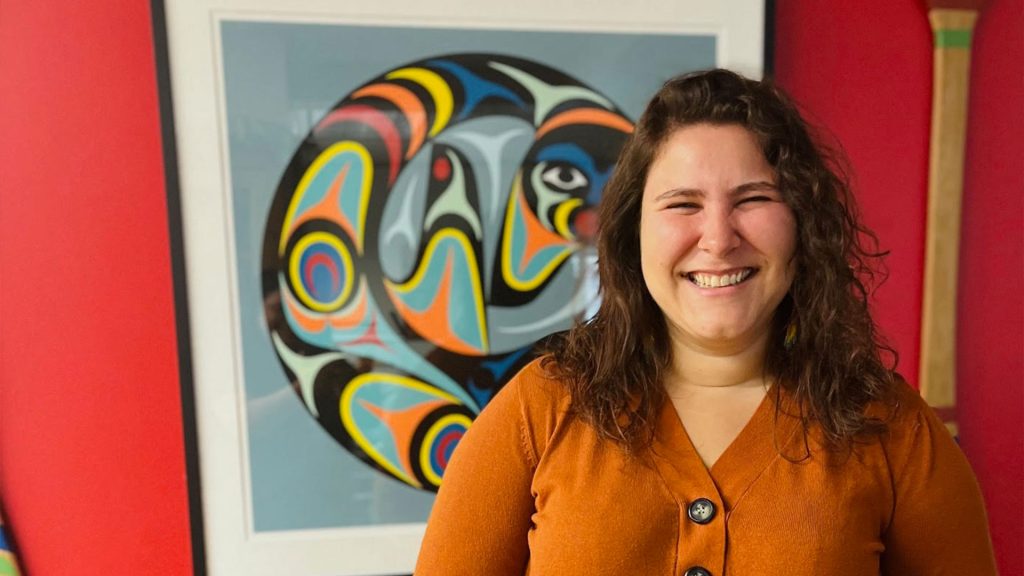
‘Indigenous people across the country and across the world have always talked about how they know the best for their children, and they do,’ said Jessica Knutson, a social worker who was involved in the child protection system as a teenager. Photo courtesy of Jessica Knutson.
Content note: This story mentions residential schools in Canada
Indigenous Peoples are reclaiming their right to take care of their children after at least 500 years of colonization.
The transition to taking back jurisdiction — the power to make legal decisions — over their children is a move full of hope, but also fraught with concerns about inadequate funding and offloading responsibility from federal and provincial governments to Indigenous nations.
“The reason [children are a top priority for First Nations people] is that children are the keepers of the possible. They’re the keepers of our tradition. They’re the keepers of our peoples,” said Cindy Blackstock, a noted activist for Indigenous children’s rights who is a member of the Gitksan First Nation and executive director of the First Nations Child and Family Caring Society of Canada.
“If you don’t pay attention to the children, then really, you’re losing that. You’re losing your culture, you’re losing everything.”
Children grow up into parents and grandparents, she noted.
“There’s an understanding that you
have to treat them well, because… everything that happens to them will
ripple forward to generations that we’ll never know,” Blackstock said.
“We have a responsibility to put
them first. They are even more important than the Elders. The Elders are
important because they teach the children, but the children are the
most important.”
Indigenous people ‘know the best for their children’
Colonization continues to strongly influence the landscape of child services in British Columbia and has for generations.
For at least 500 years,
Indigenous Peoples in the land now known as Canada have been fighting
racist approaches and policies imposed through colonization, as reported in 2015 by the Truth and Reconciliation Commission.
The Indigenous Peoples of this land, over centuries, lost their children to colonial, assimilationist practices like residential schools, day schools and boarding schools, the ‘60s Scoop and more recently, the so-called child welfare system.
Jessica Knutson, who was involved in the system growing up, has been working as a social worker for the past six years.
Knutson, 30, is also part of the National Council of Youth in Care Advocates, a group that advocates for greater and more equitable support for youth in and aging out of care. Her grandmother was Cree, from Treaty 4 territory in Saskatchewan.
Knutson says Indigenous jurisdiction over children should never have been in question and the history caused harm to Indigenous Peoples that will take decades to remedy.
“Indigenous people across the country
and across the world have always talked about how they know the best
for their children, and they do,” Knutson said.
“The hundreds of years of
attempted genocide of Indigenous Peoples here has definitely impacted
the ability to do that, but it’s amazing the work that communities are
doing, even without the monetary and other support that they should be
getting from the federal government.”
At least 4,100 Indigenous children died or went missing in residential schools, which the TRC called a cultural genocide.
Conditions were horrific,
including physical and sexual abuse, unsanitary living spaces causing
rapid spread of diseases, and inadequate food causing malnutrition. The
children were removed from their parents and their cultures and they
were not allowed to speak their own language at the schools.
Although residential schools were phased out by the late 1990s, Indigenous children are still being removed from their homes. The ‘60s Scoop saw an increase in the number of Indigenous children put into government care, a practice that continues today.
Check out Spotlight: Child Welfare
The intergenerational trauma of divided families contributes to a vast overrepresentation of Indigenous children placed in government care.
It also contributes to the high rates of disappearances, murders and violence experienced by Indigenous women, as reported by the National Inquiry into Missing and Murdered Indigenous Women and Girls.
Traditionally, Indigenous Peoples saw the care of a child as the responsibility of an extended family. When problems arose, the extended family would come together to support the child and try to come to a consensus decision to solve the problem, the 1992 report Liberating our Children says.
The colonial way — separating children from their parents — was different and harsh.
“Your child protection laws have devastated our cultures and our family life. This must come to an end,” the 1992 report said
‘You have to do something different’
Today in British Columbia, 67.5 per cent of children in government care are Indigenous, while Indigenous people only make up 5.9 per cent of the overall population.
The Canadian 2016 Census found that Indigenous children represent more than half of children in government care in Canada, despite accounting for only 7.7 per cent of the overall population of children.
Blackstock won a landmark
decision at the Canadian Human Rights Tribunal in 2016, which found that
the federal government discriminated against First Nations children
living on reserves, particularly in terms of funding.
“A First Nations child is 17 times more likely to be removed from their family than a non-Indigenous child is, and it’s due to those factors at the ground, the poverty, the poor housing, the multigenerational trauma, the addiction, domestic violence, those are the drivers,” Blackstock said.
The TRC, which is approaching its 10-year anniversary and whose leader, Murray Sinclair, died in November 2024, released the TRC’s 2015 Calls to Action that start with five child recommendations for improving child services in Canada.
Those include a call for child
welfare legislation to “affirm the right of Aboriginal governments to
establish and maintain their own child-welfare agencies.”
Poor outcomes for children raised in
foster care are the reason change is needed, said Jennifer Charlesworth,
B.C.’s representative for children and youth.
Charlesworth, who is not Indigenous, has been in the role since
2018. Her office is mandated with advocating for children and youth,
monitoring services for them and conducting reviews and investigations
into critical injuries and deaths of children receiving government
services.
The primary reason for Indigenous
children being taken into government care is poverty and once they are
in care, their mental and physical health suffers, as does their
educational achievement and even their sense of hope for the future, she
said.
“Indigenous children spend more
time in care than non-Indigenous children. They are often disconnected
from their culture, from their family and community. We know that that
has an impact on their sense of belonging, and their sense of identity,”
Charlesworth said.
“When you see poor outcomes and the
perpetuation of harm, you have to do something different. Indigenous
people in their strength and resilience have advocated for changes in
their role in child welfare and are resuming their rightful place as
carers and protectors of their children.”
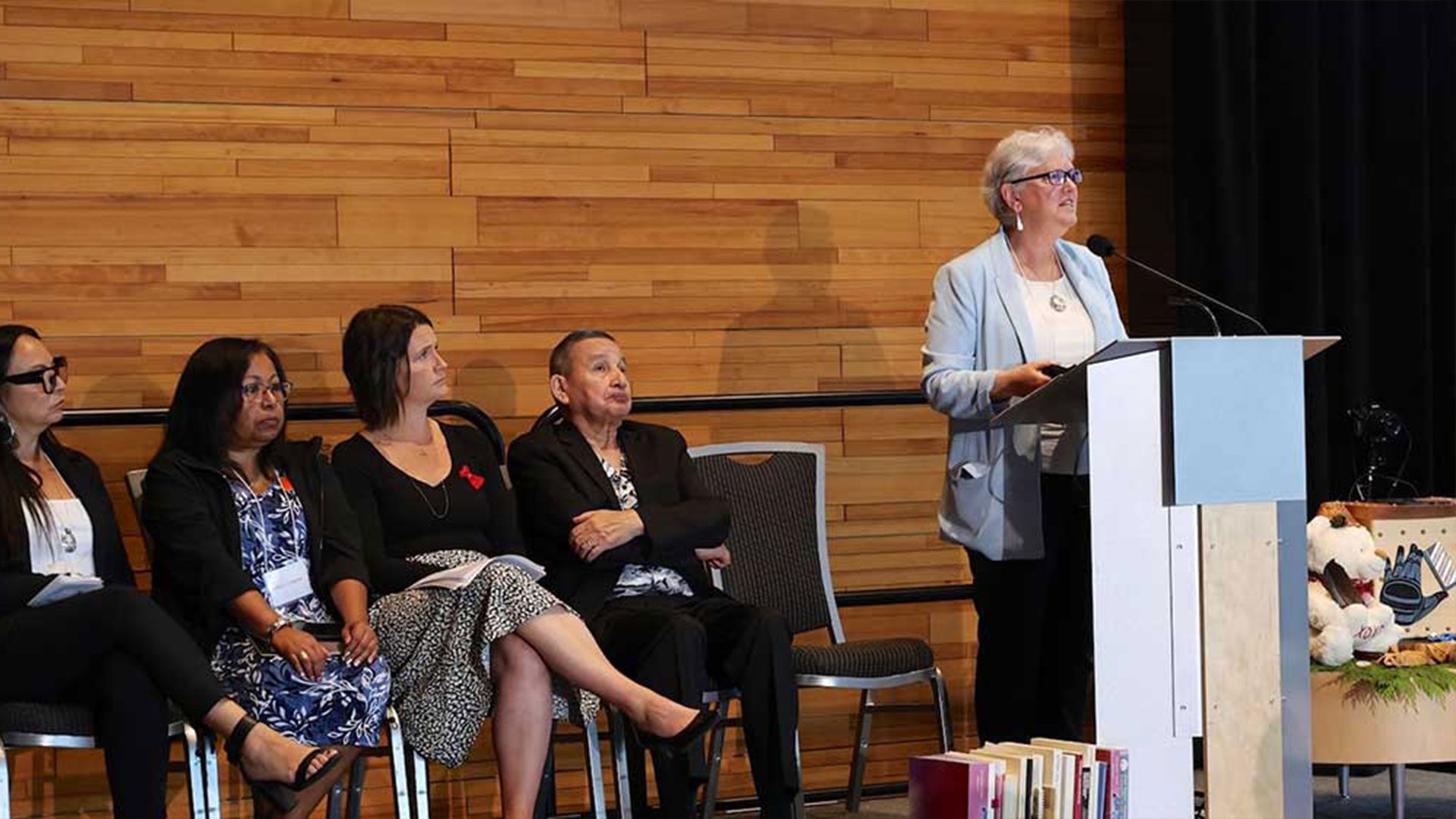
Jennifer Charlesworth (far right), B.C.’s representative for children and youth, presents the ‘Don’t Look Away’ report
on July 16, 2024. Onstage from left are Mary Teegee, Cheryl Casimer,
Grace Lore and Grand Chief Stewart Phillip of the Union of B.C. Indian
Chiefs. Photo submitted.
‘We need to take care of our own children’
The multigenerational trauma created by colonialism, residential schools, the ‘60s Scoop and the overrepresentation of Indigenous children in the child services system is evident around us. It’s evident in the statistics that show the overrepresentation of Indigenous people among the unhoused population, among the deaths from poisoned drugs and in the criminal justice system.
“This is why it’s so important. We need to take care of our own children because the current system doesn’t work,” regional Chief Terry Teegee told more than 1,000 Indigenous leaders, Elders and caregivers who gathered in late October for the Our Children, Our Way conference in Vancouver.
In 2019, the federal government passed Bill C-92, An Act Respecting First Nations, Inuit and Métis Children, Youth and Families, which affirmed jurisdiction over their children.
“When you get boiled right down to it, for a person on the street, [jurisdiction] is the ability to make decisions for your own kids,” Blackstock said.
Knutson says the return to Indigenous jurisdiction is needed.
“Children and women are the heart of community,” she said. “It’s so important and really significant that nations are able to use their own protocols to be able to care for their children, because Indigenous nations need to be making the decisions for their own children, and that looks different for each nation.”
As of Jan. 17, 2025, 86 Indigenous governing bodies representing over 110 Indigenous communities have submitted 66 notices to exercise jurisdiction over child and family services, and 42 requests to enter co-ordination agreement discussions pursuant to section 20 of the Act.
Twelve Indigenous child and family services have come into force, and 11 co-ordination agreements have been signed, according to Indigenous Services Canada.
Co-ordination agreements are
a transitional way to exercise jurisdiction over child services that
can include the Indigenous nation and the provincial government, each
having specific roles and responsibilities, with the best interest of
the child as the focus.
The United Nations Declaration on the Rights of Indigenous Peoples also recognizes the right of Indigenous families and communities to be responsible for the upbringing and well-being of their children.
“Responsibilities
for raising children are core aspects of the right to self-government,”
said Hadley Friedland, an expert in Indigenous law and professor in the
faculty of law at the University of Alberta, at the Our Children, Our
Way conference.
“This is also obvious based on how the Crown attempted to destroy Indigenous families through assimilation policies.”
British Columbia introduced its Declaration on the Rights of Indigenous Peoples Act in 2019, establishing UNDRIP as the basis for provincial reconciliation. It also amended its Child, Family and Community Service Act by passing Bill 38, which strengthens Indigenous community’s ability to resume authority over child and family services.
The first steps forward
In 2023, the Federal Court of Canada approved a $23.24-billion settlement to
compensate First Nations children and families who were harmed by
discriminatory underfunding of the First Nations Child and Family
Services program.
In addition, a 10-year,
$47.8-billion settlement agreement to reform First Nations Child and
Family services going forward was presented in July 2024.
The Assembly of First Nations Chiefs rejected that deal in October, saying the funding was inadequate, the governance structures lacked transparency and were not accountable to First Nations, that it contained a weak dispute resolution process and that committing to the settlement for 10 years would leave no way to negotiate further, the organization Our Children, Our Way said in a news release.
“Our leaders have rejected this draft agreement because they know what is at stake: our children. This was not a good agreement: we have to do better for our children,” said Mary Teegee, chair of the Our Children Our Way Society.
Blackstock said there were fundamental problems with the agreement Chiefs rejected.
“It wasn’t really a vote against, it was a vote for good governance, stability and non-discrimination for kids, and to make sure that Canada was held accountable to the legal obligations it currently has to First Nations children,” Blackstock said.
“That $47.8 billion was advertised as being there, but under closer scrutiny, looking at the agreement, it really was a one-year funding deal that gave Canada wide discretion on the level of funding and the terms of funding over the next nine years. After nine years, there was nothing for these kids, nothing was guaranteed.”
There were also issues with governance in the rejected agreement, Blackstock said.
“The chiefs, if they had voted for it, that would be the last decision they would make on their children for nine years, on this funding approach, all of that would be ceded to a secret committee that had extensive liability protection but no accountability,” Blackstock said.
Nonetheless, Blackstock is hopeful for a better deal.
“This is a legal case. Canada has to
comply with that legal standard, stop discriminating and prevent it from
happening again,” Blackstock said.
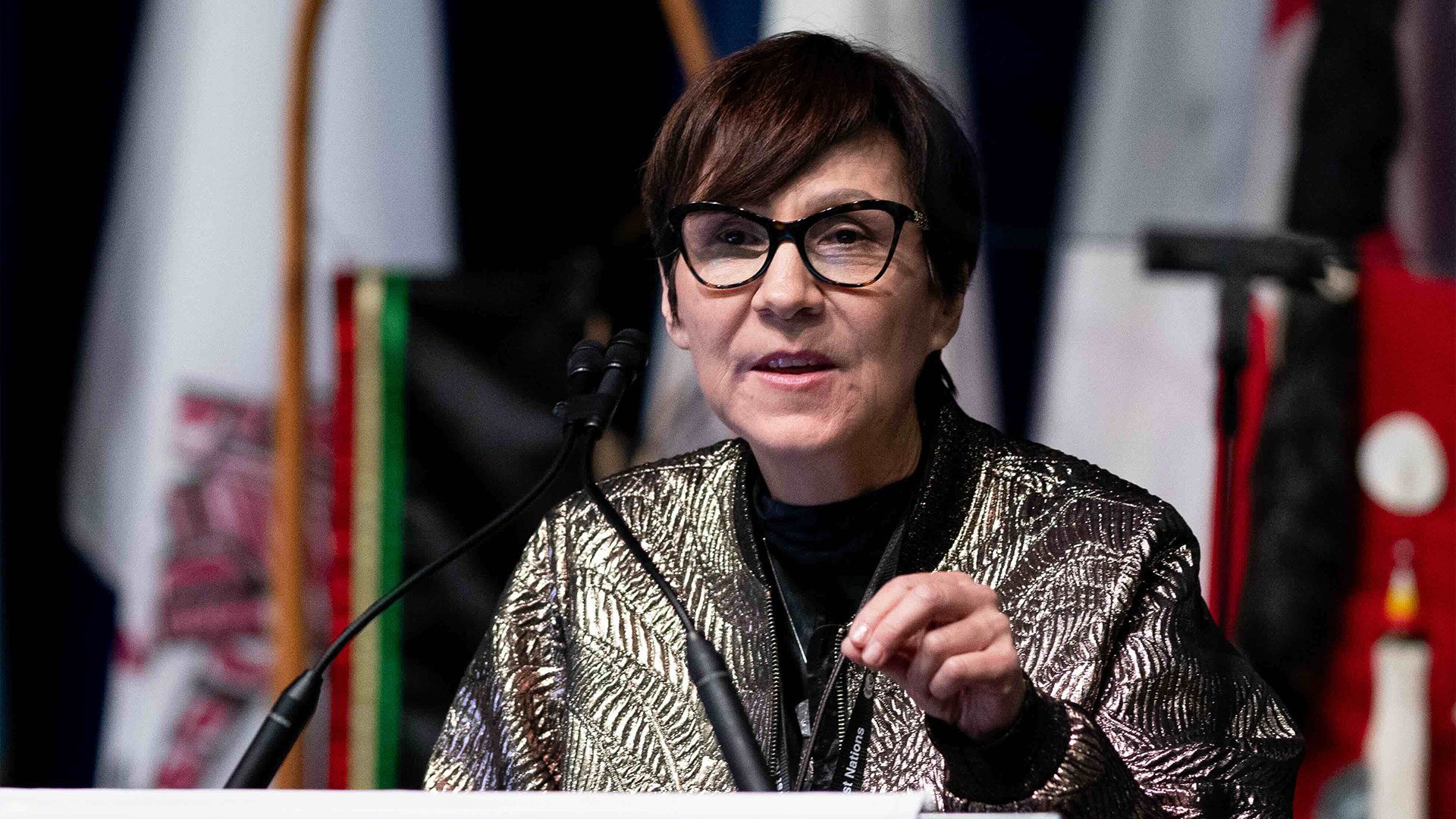
Executive director of First
Nations Child and Family Caring Society of Canada Cindy Blackstock
speaks on child services during the Assembly of First Nations Special
Chiefs Assembly in Ottawa on Dec. 4, 2024. Photo by Spencer Colby, The Canadian Press.
Transitions can cause ‘the greatest grief’
Another concern with the agreement the AFN Chiefs rejected was whether First Nations children who live off reserve would be covered by the deal. Under the current system, the federal government pays for on-reserve child services, while provincial governments are responsible for paying for off-reserve child services.
“That’s an Indian Act thing, that racist Indian Act that's been going on since Confederation, and the federal government will often weaponize that piece of legislation to try and limit its financial exposure, which is getting in the way of children and children's childhoods,” Blackstock said.
“What we would rather see, and what the Canadian Human Rights Tribunal has already ruled, is that the definition of a First Nations child is not based on some racist blood-quantum thing called the Indian Act. Instead, it’s the nation's recognition of its children on or off reserve.”
Transitional periods can be confusing and can produce the greatest grief, Charlesworth said. Her office would not have oversight over children, youth and families who are cared for by their own nations, for example, unless the nation forms an agreement to have her involved. However, she said she will be watching over the transition.
In July, Charlesworth released a report into the violent and disturbing death of an Indigenous boy in care, who was referred to as Colby.
Confusion over roles and
responsibilities during the transition to Indigenous jurisdiction may
have led to staff at B.C.’s Ministry of Children and Family Development
not doing due diligence in placing Colby and his siblings with his
mother’s cousin’s family, the report says.
$23-billion settlement for First Nations children announced by AFN and Caring Society
The Assembly of First Nations and the First Nations Child and Family Caring Society (FNCFS) said they have announced a revised final settlement agreement in a landmark child-welfare case.
The new proposal increases the federal government’s settlement spend to $23 billion — up from $20 billion — to compensate First Nations children and families who have experienced discrimination in the child welfare system.
“This compensation recognizes the serious harms First Nations, children, youth, and families suffered including unnecessary family separations and the denial of life saving and life wellness services,” said Cindy Blackstock, the executive director of FNCFS, in a release Monday.
The AFN, which represents more than 600 First Nations across Canada, has been working to negotiate a deal after the Canadian Human Rights Tribunal
in 2016 found that Canada discriminated against First Nations children
by paying less for child welfare services on-reserve compared to those
offered off-reserve.
OTTAWA — A First Nations child welfare advocate on Wednesday implored chiefs to ensure "no child is left behind" in a landmark $40-billion settlement agreement with the federal government.
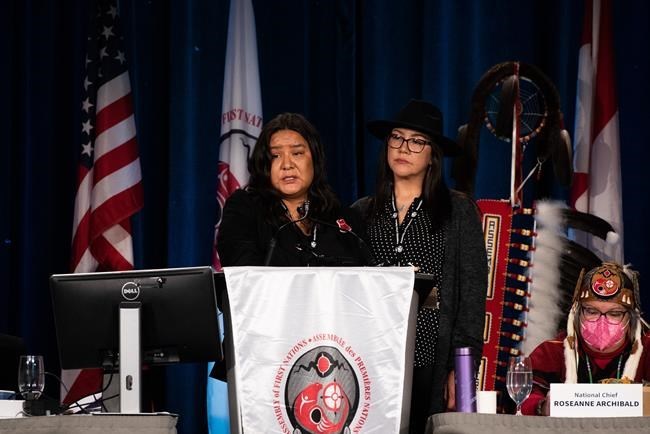
OTTAWA — A First Nations child welfare advocate on Wednesday implored chiefs to ensure "no child is left behind" in a landmark $40-billion settlement agreement with the federal government.
Cindy Blackstock delivered the message to an Assembly of First Nations gathering in Ottawa, after being invited to take the stage by Cindy Woodhouse, regional chief in Manitoba who helped negotiate the agreement, which had been thrown into question since being rejected by the Canadian Human Rights Tribunal.
The AFN, representing more than 600 First Nations across the country, had asked the tribunal to approve the settlement deal, which would see the government spend $20 billion to compensate families and children for systemic discrimination in the Indigenous child welfare system.It would also spend another $20 billion on making long-term reforms.
Blackstock, the executive director of the First Nations Caring Society who first lodged the complaint at the heart of the issue, raised concerns that the agreement wouldn't provide $40,000 in compensation to all eligible claimants, which is the amount the tribunal ruled they should get.
"We can make sure that in our First Nations canoe of justice, no child has to see their money go away and no child is left behind in justice," she said Wednesday.
"We are capable of that."
NY Times Coverage here
The Canadian government announced Tuesday that it had reached what it called the largest settlement in Canada’s history, paying $31.5 billion to fix the nation’s discriminatory child welfare system and compensate the Indigenous people harmed by it.
Agreement in principle/press release here
For those who were following this case, it involves the First Nations
Child and Family Caring Society, which is led by Cindy Blackstock. The
settlement attempts to reform Child and Family Services and address Jordan’s Principle. This is a major settlement and significant milestone for Native children and families in Canada.

Dear People who Care about First Nations kids, Tomorrow is my birthday and I am so honoured to share it with Orange Shirt day. I have a wish- please tag @JustinTrudeau - demand he stop fighting kids and survivors in court, obey the law and get to work on the TRC Calls to Action https://t.co/NWjnH0ADqb
— Cindy Blackstock (@cblackst) September 29, 2021
Thanks I hate it pic.twitter.com/zdX0aH1pBh
— Rob Taylor-Case (@robtaylorcase) September 30, 2021
*TW: readers may be triggered by the recount of Indian Residential Schools. To access a 24h National Crisis Line, call: 1-866-925-4419*
— Anishinabek Nation (@AnishNation) September 30, 2021
Today is #OrangeShirtDay. Take a moment to listen and learn from Shingwauk Residential School Survivor Charles Fox: https://t.co/2GMETply1O
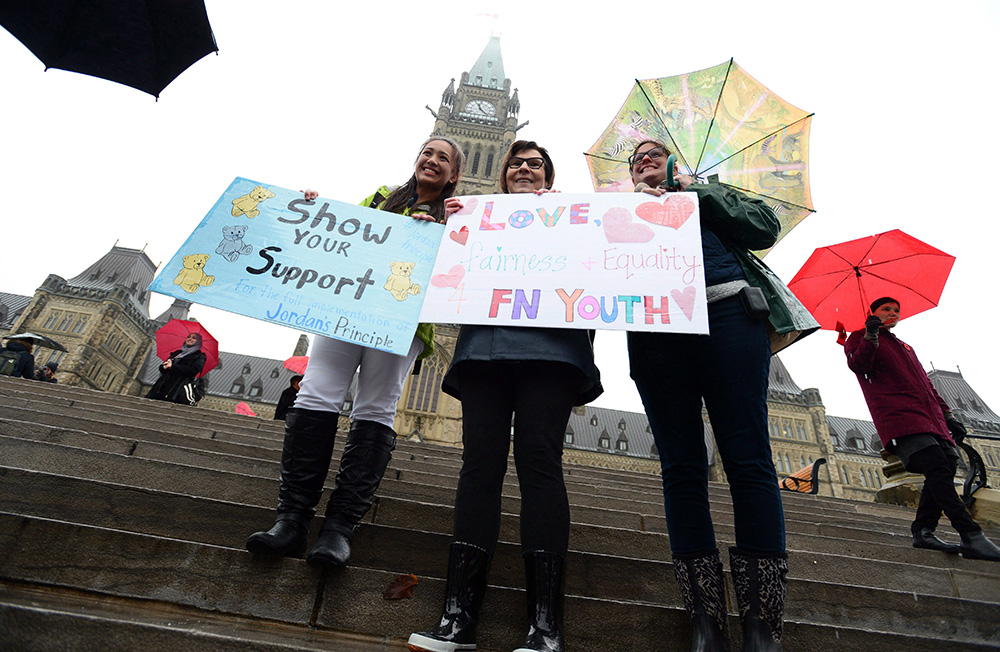
Cindy Blackstock doesn’t know why Liberal Leader Justin Trudeau lied about taking First Nations kids to court during the leaders’ debate last week. But Blackstock, the executive director of the First Nations Child and Family Caring Society, is “really sad” he did.
Especially when there is over 14 years of evidence — including court transcripts, news articles and 20 non-compliance orders from the Canadian Human Rights Tribunal — to the contrary.
“They have every legal right to litigate against our kids. I think it’s morally wrong — and it’s bad for the country — but they’ve chosen to do it,” said Blackstock of the government’s Federal Court case arguing against a tribunal ruling that First Nations children and families impacted by the child welfare system should be compensated.
“What they don’t have a right to do is then lie about it to protect themselves from accountability for their own behaviour.”
Blackstock would know: along with the Assembly of First Nations, her organization took the federal government to the Canadian Human Rights Tribunal in 2008 over its systemic underfunding of child welfre on reserves.
In 2016, the tribunal issued its ruling: the federal government had been knowingly underfunding services for 165,000 First Nations kids and their families for decades. The tribunal ordered the government to stop its discriminatory practices.
More than 50 per cent of children in government care in this country are Indigenous, despite representing fewer than 10 per cent of all children. The majority are First Nations children taken into care for “neglect,” which child welfare researchers say is another word for poverty.
In 2019, the tribunal declared the government must pay $40,000 — the maximum the tribunal can award — to every First Nations child removed from their family since 2006. Their guardians before the children were taken into care are entitled to $20,000.
The tribunal also awarded $40,000 to every First Nations child denied federal medical coverage between 2007 and 2017, citing Jordan’s Principle, a 2007 policy that governments should pay the medical bills of any First Nations child, on or off-reserve.
But two weeks before the 2019 election, government lawyers requested a judicial review of the compensation orders.
Hearings were held in Federal Court in June, less than a month after the Tk’emlúps te Secwe̓pemc Nation announced the rediscovery of 215 bodies on the grounds of the former Kamloops Indian Residential School.
The Federal Court’s ruling is expected at any time.
The government also took issue with the tribunal’s 2020 declaration that all children with Indian Act status; eligibility for status; or parents or guardians who have status, live on-reserve and whose First Nation acknowledges their membership — are covered by Jordan’s Principle.
The federal government argued before the court that only children with status under the Indian Act — a racist Canadian law that determines First Nations’ band membership — should be covered.
The Liberals have tried to respond to Canada’s child welfare crisis. In 2018 they released a six-point plan to reform child welfare, including implementing the tribunal’s ruling and working with Indigenous leaders to re-establish jurisdiction over child welfare.
In January 2020, the federal Act Respecting First Nations, Inuit and Métis Children, Youth and Families became law, starting the process to return jurisdiction to Indigenous communities. But it did not come with funding, and a year and a half later the federal government has yet to release a funding plan.
In B.C., a working group on child welfare and family services was established by the provincial and federal governments, the BC Assembly of First Nations, the Union of BC Indian Chiefs and the First Nations Summit.
Assembly Regional Chief Terry Teegee said that three of the 198 First Nations in the province are close to reclaiming their inherent jurisdiction over child welfare, though a federal funding commitment is needed.
“It’s always a work in progress, and I certainly know that a lot of these changes weren’t going to happen overnight,” Teegee said, adding the assembly is also waiting on provincial child-welfare jurisdiction legislation.
“We can’t let up. We need to continue on to allow our First Nations to take their rightful place in asserting their jurisdiction and their ability to express their sovereignty and self-determination in terms of children.”
The Splatsin of the Secwe̓pemc Nation is one of the three nations. It was close to signing a child welfare co-ordination agreement with the federal government before it was scrapped due to the election.
But despite how close they were, Splatsin Kukpi7 (Chief) Wayne Christian said the process has been frustrating, in part because the federal government has approached transferring child welfare jurisdiction like it is creating a new federal program.
“It’s beyond belief that you have a whole number of bureaucrats staffing up to offer this program,” he said.
No matter which party forms government, Christian said, the main stumbling block to re-establishing jurisdiction are the bureaucrats who have worked in the departments dedicated to Indigenous affairs for decades.
“They have a certain culture of how to operate with ‘the Indian problem’ and they’re still acting like Indian agents, except there’s a multitude of them now,” he said.
“It’s the bureaucracy that makes things happen, and they’re very slow to react to what we actually need to happen. They deny, delay and distract, that’s what they do.”

WARNING: This story contains distressing details
Cowessess First Nation in Saskatchewan is the first Indigenous group in Canada to ink an agreement with Ottawa for federal funding of locally controlled child welfare services since the Act Respecting First Nations, Inuit and Métis Children, Youth and Families came into force last year.
But Cowessess First Nation Chief Cadmus Delorme is already looking to the future.
"One day there will be no children in care," he said at a ceremony on the reserve marking the pact Tuesday.
"[I'm] 39 nine years old and I hope that happens in my lifetime. But we have a lot of work to do."

The act allows for First Nations to assume authority over local child welfare systems under so-called co-ordination agreements and paves the way for children in care to remain in their home communities.
Cowessess First Nation is the first Indigenous group in Canada to sign such an agreement. The deal also comes with $38 million in funding over the next two years to support the band's further implementation of its own child welfare system, which actually began operating in April.
"Across the country, we are working with other First Nations to reach similar agreements," said Prime Minister Justin Trudeau, who joined Delorme and Saskatchewan Premier Scott Moe for the ceremony.

As of last month, Indigenous Services Canada received requests from 38 bodies representing 100 Indigenous groups and communities who want to follow in the same footsteps as Cowessess First Nation, according to a news release.
Eighteen formal discussion groups focused on signing future agreements are now underway.
Trudeau did not cite a goal or timeline for finalizing those pacts.
Cowessess has not had decision-making power over children in care since it was stripped of it in 1951, according to a letter distributed by Delorme on Monday.
More than 80 per cent of children in care in Saskatchewan are Indigenous, according to a 2018 children's advocate report.
That began to change with 2019's passage An Act Respecting First Nations, Inuit and Métis Children, Youth and Families, federal legislation aimed at reducing the number of youth in care and allowing communities to create their own child-welfare systems.
Cowessess did that in 2020, when it asserted its inherent rights over its children and families.
While noting the recent discovery of 751 unmarked graves associated with the former Marieval Indian Residential School, Trudeau said his government has been working with Cowessess on the child welfare funding agreement for years.
Moe said it's no surprise Cowessess is the first Indigenous community in Canada to reach such an agreement.
"This is a progressive community [that] leads in so many other areas," he said.

The First Nation nation has opened a transition home for girls 14 and up.
Mia Buckles, chair of the Cowessess Youth Council, joined other speakers in linking the legacy of residential schools with the current situation of children in care.
"First Nations intergenerational trauma is very real," she said. "I recognize that in my life and others lives around me. It plays a huge role in why so many of our people end up in foster care, incarcerated, addicted and uneducated."

Buckles said the transition home, Chief Red Bear Children's Lodge, will work proactively to prevent children from ending up in care in the first place.
Cindy Blackstock, executive director of the First Nations Child & Family Caring Society of Canada, applauded Tuesday's agreement.
"The closer authorities are to the children, the better the outcomes are going to be, because they'll be able to see their needs and monitor those needs and respond to them over time and culturally appropriate ways," she said.

But Blackstock cautioned that federal funding is also needed to address the underlying socio-economic factors that land Indigenous children in care in the first place.
Those factors include poverty, housing, substance abuse and mental health issues related to residential school trauma, she said.
"Unless the federal government is also announcing sufficient funding for that, then what we'll have is a child welfare program — a quality one, culturally appropriate — sitting atop this raging fire of inequality that is going to disable the community from being able to realize the goals they wish to realize with these kids."
Support is available for anyone affected by
their experience at residential schools, and those who are triggered by
the latest reports.
A national Indian Residential School Crisis Line has been set up to provide support for former students and those affected. People can access emotional and crisis referral services by calling the 24-hour national crisis line: 1-866-925-4419.
continuing news...
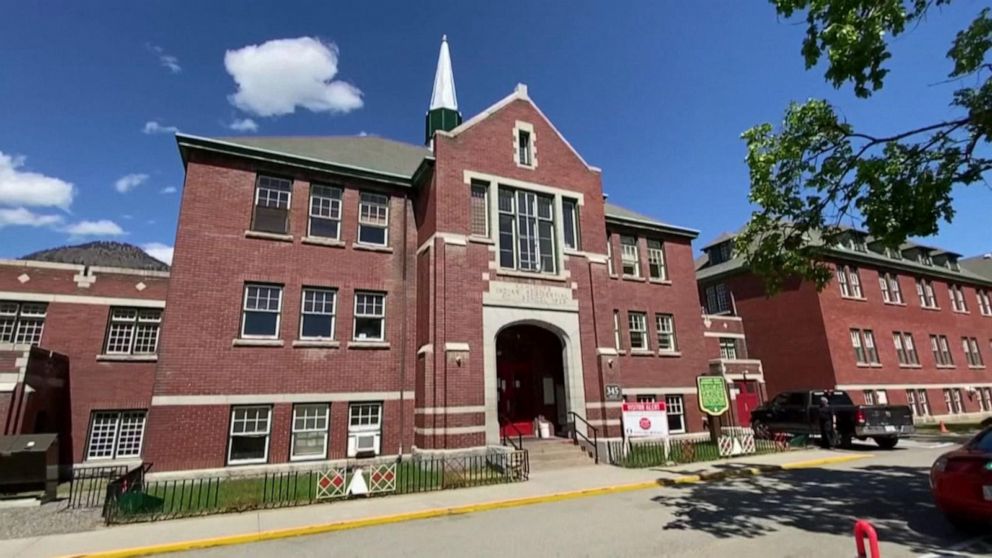 Canadian Prime Minister Justin Trudeau says it’s not an isolated incident that over 200 children were found buried at a former Indigenous residential school
READ: Canada: Bodies at Indigenous school not isolated incident

In 2009, the TRC asked the federal government to help fund investigating the location of gravesites where residential students are believed to be buried. The request was denied.
...She said she had visited schoolyard cemeteries across Canada in an attempt to find where missing children were buried. But the process of finding the unmarked graves was slow because the “TRC suffers from a chronic lack of funding.”
“That second step of doing the ground-penetrating radar is not something that we’re funded to do,” she told the media outlet. “There are approximately 140 schools on the list now. … There will be probably as many cemeteries as there are schools and in five years we just don’t have the time to do an in-depth investigation of each one of them.”
Cindy Blackstock, executive director of the First Nations Child & Family Caring Society, told Global News that the underfunding of Indigenous projects, like the missing Children Project, is repeated in history.
“They’re making a conscious choice that these kids are not worth the money,” she said. “Like these inequalities, like water, etc., like they were always complaining, ‘Oh, well, we don’t have the money,’ therefore, the default is, ‘We’re going to racially discriminate against children as fiscal policy.'”
Under the TRC, there are six proposals for the Missing Children Project.
 |
| Mary Ellen Turpel-Lafond on B.C.’s residential schools – May 29, 2021 |
According to the Crown-Indigenous Relations and Northern Affairs Canada website, the 2019 federal budget announced $33.8 million over three years to develop and maintain the National Residential School Student Death Register and help maintain an online registry of residential school cemeteries.
Morton argues more needs to be done to help Indigenous communities find the unmarked graves, as there may be many more sites across Canada.
The same survey techniques used in Kamloops — such as the use of ground-penetrating radar to detect bodies — are needed, she said, as well as funds to access archival research, like residential schools survivor stories and archives from the churches or provinces.
“The research components have a cost associated, but the actual physical work of searching the grounds itself would also have a cost component,” she said.
Last week it was discovered that they are forcibly putting in IUDs into Native kids under 10, this week they discovered 215 bodies of Native kids under a school. These are issues that are person to me and so many of us.
— Lucas Brown Eyes (@LucasBrownEyes) May 28, 2021
It's so dangerous just being a Native child.
the government of Canada 🇨🇦 covered up the death and murder of those 215 children in that government run school, a school only 60 km from where I grew up, if I was born one generation earlier I would have been forced into that school! My father was a residential school survivor
— Kanahus Manuel (@KanahusFreedom) May 28, 2021
The long history of discrimination against First Nations children Learn more about how Canada repeatedly chose to not act on solutions to stop the harm to, and deaths, of children and why it is still a problem. https://t.co/7CnMuImGyH
— Cindy Blackstock (@cblackst) May 28, 2021
We Need To Talk About Adoptee Suicide, Now | InterCountry Adoptee Voices (ICAV) #adopteevoices https://t.co/n4cEmyLGOH
— Trace kalala Hentz (@StonePony33) May 28, 2021
It would also be really beneficial if when suicide deaths are recorded, that the adoption status of the person is included in the data.
— Trace kalala Hentz (@StonePony33) May 28, 2021

The Spirit Bear Plan to End Inequalities in Public Services for First Nations Children, Youth and Families
Lecturer: Cindy Blackstock Executive Director, First Nations Child and Family Caring Society of Canada First Nations children and families living on reserve and in the Territories receive public services funded by the federal government, and since confederation, these services have fallen significantly short of what other Canadians receive.
This injustice needs to end and Spirit Bear's Plan will do just that.
A member of the Gitksan First Nation, Cindy Blackstock has 25 years of social work experience in child protection and Indigenous children’s rights. Her promotion of culturally based and evidence informed solutions has been recognized by the Nobel Women’s Initiative, the Aboriginal Achievement Foundation, Frontline Defenders and many others. An author of over 50 publications and a widely sought after public speaker, Cindy has collaborated with other Indigenous leaders to assist the United Nations Committee on the Rights of the Child in the development and adoption of a General Comment on the Rights of Indigenous children.

An important need for Amherst County’s Monacan Indian Nation
The Indian Child Welfare Act of 1978 gives federally-recognized tribes precedence in making determinations and placements in child welfare cases involving Indian children. It is vital that we support local tribes in engaging in the child welfare process. Children in foster care are much more likely to become involved in the juvenile justice system.
Unfortunately, research recently completed by the Annie E. Casey Foundation has shown that the number of Native American youth in juvenile detention centers has increased from May to August 2020. From March 1 to May 1, there was a decrease in the number of detained Native American children, while from May 1 to August 1 there was a 31% increase in the number of detained Native American children.
Tribes with newer federal recognition, such as the Monacan Indian Nation, have been unable, as of yet, to develop their own department of social services. This hinders the tribes’ ability to become involved in child welfare cases that could be determining the future of these native children. Our community needs to begin communicating with local tribes to determine if there are ways in which we can support them as they support their youth in need.
KATHRYN DURDEN, Lynchburg, Virginia
FOR TRIBES:
The BIA is seeking to renew the information collection conducted under 25 CFR 23, related to the Indian Child Welfare Act (ICWA). Agency Information Collection Activities; Indian Child Welfare Quarterly and Annual Report
https://www.govinfo.gov/content/pkg/FR-2020-11-24/pdf/2020-25976.pdf
GOOD NEWS
Breaking good news! The Canadian Human Rights Tribunal orders that First Nations children without status resident off reserve who are recognized by their Nations for the purposes of Jordan's Principle are eligible for services/products! 1/2 pic.twitter.com/mLulg1zZ8k
— Cindy Blackstock (@cblackst) November 25, 2020
 |
| Assembly of First Nations National Chief Perry Bellegarde, left, and Cindy Blackstock, head of the First Nation Child and Family Caring Society. The groups filed the original human rights complaint that led to Friday's ruling. (Canadian Press) |
"They knew better and did not do better resulting in tragedy for First Nations children, families and [First] Nations," said Blackstock in a statement.


Your History Class Was a F*cking Lie by Sean Sherman (Or: How the American Educational System Has Always Been a Racist Propaganda Program...





 Posts
All Comments
Posts
All Comments


