They Took Us Away

They Took Us Away
click image to see more and read more

it's free

click

How to Use this Blog

BOOZHOO! We've amassed tons of information and important history on this blog since 2010. If you have a keyword, use the search box below. Also check out the reference section above. If you have a question or need help searching, use the contact form at the bottom of the blog.


We want you to use BOOKSHOP to buy books! (the editor will earn a small amount of money or commission. (we thank you) (that is our disclaimer statement)

This is a blog. It is not a peer-reviewed journal, not a sponsored publication... WE DO NOT HAVE ADS or earn MONEY from this website. The ideas, news and thoughts posted are sourced… or written by the editor or contributors.

EMAIL ME: tracelara@pm.me (outlook email is gone) THANK YOU CHI MEGWETCH!

SEARCH

Showing posts with label Catholic Church. Show all posts

Monday, September 30, 2024

ADOPTION REALITY: Belgium Forced Adoptions


Taken from mother by nuns, victim finds solace in pope's Belgium visit

Pope Francis on Friday said he was "saddened" to learn about a little-known scandal that still troubles Belgium: the "forced adoption" of newborns taken from their mothers, with the complicity of nuns.

To Lieve Soens, who was listening in the audience, the pontiff's words meant a great deal.

The 50-year-old has been on a decades-long quest to find closure after she was torn from her mother at birth.

"I am very satisfied, it is a great start," she told AFP while travelling home from the royal residence in Brussels where Francis addressed political and civil society leaders as part of a three-day visit. 

"We are being recognised as victims and that is very important".

Soens was adopted by a Belgian couple in 1974, shortly after her birth in northern France to a woman who opted to remain anonymous under a system known as delivering "under X".

Fifty years later, she is still trying to understand how her biological mother- a teenager at the time- was taken by nuns from Lommel in Belgium to Dunkirk, more than 200 kilometres (120 miles) away, to deliver a baby she would never see again.

A first step was to try to track down her birth mother. With the help of a victim support group, she located her in Belgium's Dutch-speaking Flanders, where she herself lives.

But her offer to meet was turned down, in a letter sent via a lawyer.

"Maybe she is afraid," Soens told AFP in an interview at her home in the Flemish town of Kuurne earlier this week.

"After the birth, she was told the baby was dead, and she likely never told her new family about this pregnancy at the age of 16- it's just too hard," she said.

- Church 'apology' -

In 2023, the Flemish newspaper Het Laatste Nieuws published the hard-hitting testimony of multiple victims of forced adoption, including a mother whose newborn had been taken from her.

The paper's investigation estimated that Belgian nuns had been involved in around 30,000 such cases between 1945 and the 1980s.

Most of the births were in Belgium, but 3,000 to 4,000 pregnant women were taken to France, according to Binnenlands Geadopteerd, a support group for the victims of forced adoptions.

There, the "under X" system erases all filial link between mother and child.

Most cases involved young, unmarried women - some of them victims of rape or incest - whose parents wanted their pregnancy kept under wraps.

The parents would contact Church officials, who provided the link to families wishing to adopt.

"We see how the bitter fruit of wrongdoing and criminality was mixed in with what was unfortunately the prevailing view in all parts of society at that time," Pope Francis said in Brussels.

The Belgian conference of bishops has formally apologised on several occasions over the scandal - when it first erupted in 2015 and again last year.

It has said it would welcome an outside investigation to ensure full accountability, but none has so far taken place.

In her search for her roots, Soens had the support of her adoptive parents.

They were convinced, she says, that they were doing the right thing by taking in an unwanted baby.

They showed her documents from 1974 including her birth certificate mentioning her adoption and change of name, and a bill from the private clinic where she was born.

- 'Every day counts' -

After they passed away some 20 years ago, she ramped up her efforts.

"I don't want to hurt anyone, I just want the truth," she said, while acknowledging her "anger towards the Church, the nuns and the clinic" who all played a role.

On Friday Soens was among the guests for the pope's speech at Laeken palace, where he also reaffirmed that the Catholic Church must "seek forgiveness" for the scourge of child sexual abuse. 

At one point she and two fellow "adoptees" had hopes of an audience with the pope, but Church authorities chose to focus on bringing Francis face to face with a group of about 15 individuals who suffered clerical sex abuse as minors.

A poor decision in the view of Debby Mattys, who co-founded the Binnenlands Geadopteerd group and is pressing for access to clerical archives. 

"The Church can help us find solutions to bring birth parents together with the children who were taken from them," said the 57-year-old - herself a victim of forced adoption in the 1960s.

"It is truly urgent, because our parents are already getting old.  Every day counts."

SOURCE:  https://www.coastalbreezenews.com/news/national/taken-from-mother-by-nuns-victim-finds-solace-in-pope-belgium-visit/article_439e227b-c67d-5986-9efc-e3ca10c1d3b7.html

Friday, May 3, 2024

Who Will Bury the Dead? (2014)


Nominated for Best Documentary at The Native American Film Festival in San Francisco in 2017. 

Who Will Bury the Dead?  explores the experiences of the last Lakota Christian Clergy with 150 years of historical perspective. A powerful contemporary story of spiritual decolonization. Available on Amazon Prime. 

CloudHorse Media 

I asked my relative Ellowyn many years ago why there were churches in Pine Ridge, and she said they provided food and money. But not many people went to church.  - TLH

Friday, February 10, 2023

Jawbone found in possible unmarked residential school grave | "Six years old, I was imprisoned here"

 The landmark Truth and Reconciliation Commission (TRC) report, released in 2015, identified 3,200 confirmed deaths of children at residential schools but the number is believed to be higher. Not all deaths were properly recorded and the bodies of some of the children were never sent home. In some cases, grave markers were lost to time or removed.

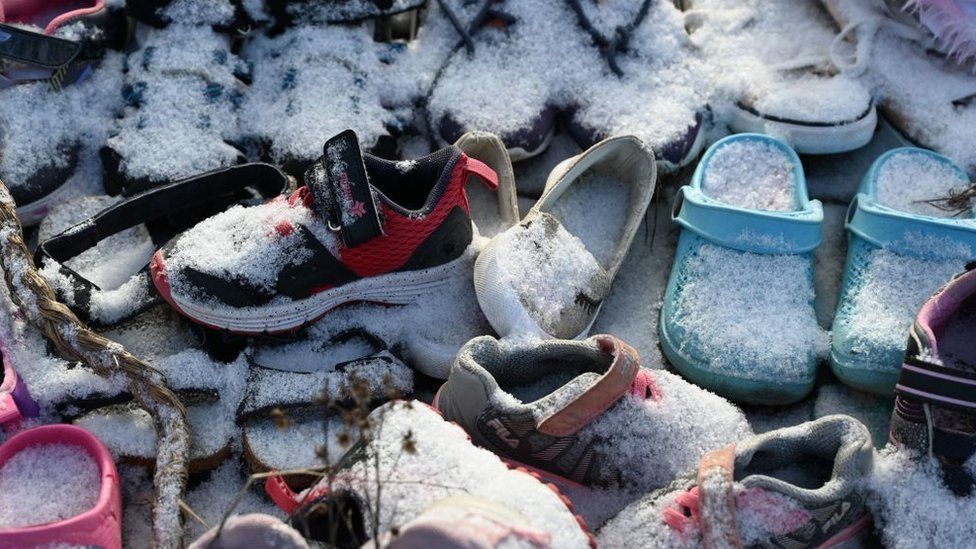
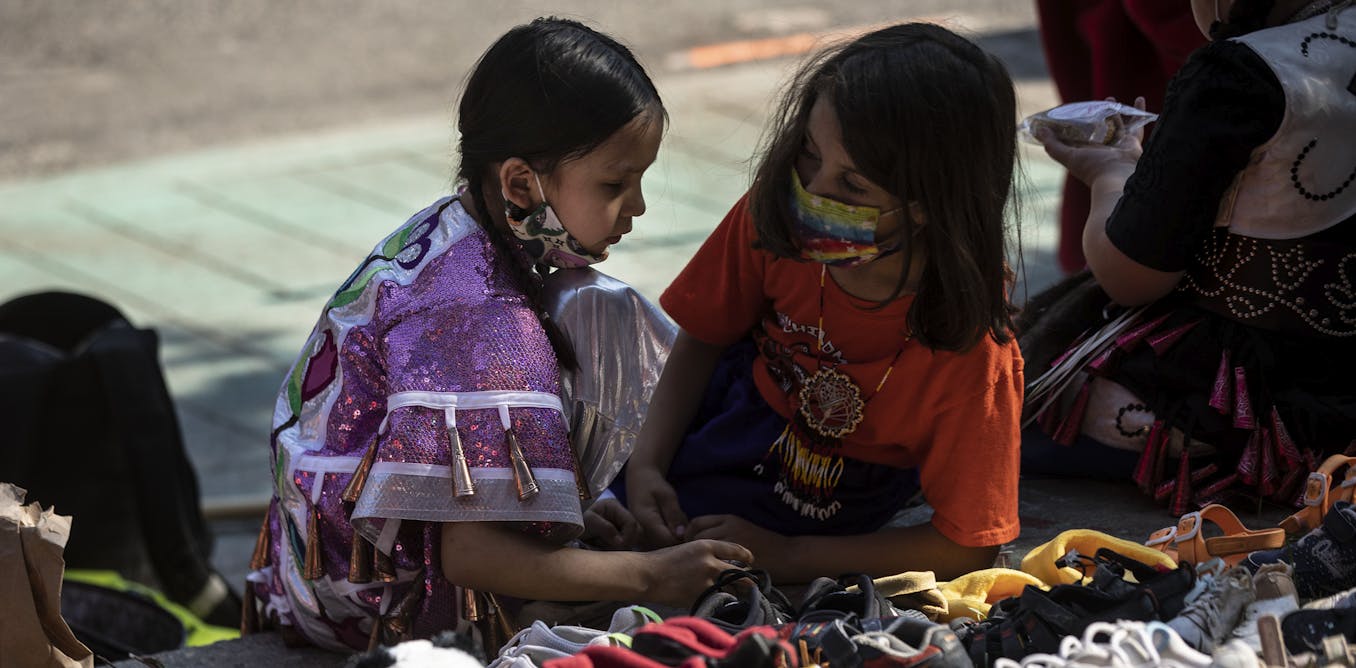
Children's shoes adorn a memorial for Saint-Marc-de-Figuery residential school student at the site of the former school near Amos, Canada, November 17, 2021Getty Images:  Children's shoes have come to be a symbol for the estimated thousands of children who died while attending residential school.

An indigenous nation in Canada said it has discovered evidence of possible unmarked graves on the grounds of a former residential school.

Star Blanket Cree Nation said a ground-penetrating radar had revealed the jawbone fragment of a small child and more than 2,000 "areas of interest".

Those are not yet confirmed to be evidence of human remains.

But the fragment "is physical proof of an unmarked grave", project lead Sheldon Poitras said on Thursday.

The discovery from the Star Blanket Cree Nation in Saskatchewan follows a wave of investigations into possible unmarked graves at the sites of former residential schools in Canada. Ground searches starting in the spring of 2021 have uncovered evidence of more than 1,100 such graves across the country.

Areas for this most recent search were identified after testimonials from elders and former students of the former Qu'Appelle Indian Residential School.

"It was unthinkable. It was profound. It was sad. It was hurtful," Star Blanket Chief Michael Starr said on Thursday of the discovery. "It made us very angry what had happened to our young people here."

These government-funded compulsory boarding schools were part of a policy meant to assimilate indigenous children and destroy indigenous cultures and languages.  Some 150,000 First Nations, Métis and Inuit children were taken from their families placed in these schools from the 19th Century into the 1970s.

Survivors had long testified about children who died at the schools, where students were often housed in poorly built, poorly heated, and unsanitary facilities.

The landmark Truth and Reconciliation Commission (TRC) report, released in 2015, identified 3,200 confirmed deaths of children at residential schools but the number is believed to be higher. Not all deaths were properly recorded and the bodies of some of the children were never sent home. In some cases, grave markers were lost to time or removed.

Investigators said they were considering options, including DNA testing, to confirm the findings of the radar at Qu'Appelle Indian Residential School. Some of the anomalies picked up by the search could be innocuous, things like stones or pieces of wood.

The jawbone was analysed by the Saskatchewan Coroners Services, who said it belonged to a child aged four to six and is approximately 125 years old - around the time the school was founded.

The Qu'Appelle Indian Residential School, in southern Saskatchewan, was one of the first residential schools to open in Canada and was run by the Roman Catholic Church from 1884 to 1973.  It was eventually closed in 1998.

Noel Starblanket, a former student at Qu'Appelle Indian Residential School wrote in a testimonial for the University of Regina that he was constantly "slapped on the side of the head" at the school. One teacher struck him in the face and broke his nose.

"My parents never hit me, my grandparents," he wrote. Before going to school "I didn't know what it meant to be hit, physically abused".

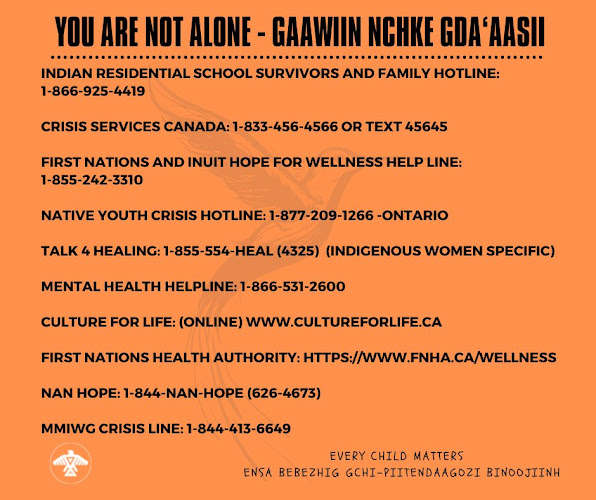
The Indian Residential Schools Resolution Health Support Program has a hotline to help residential school survivors and their relatives suffering trauma invoked by the recall of past abuse. The number is 1-866-925-4419.

More on this story


Wednesday, December 8, 2021

AFN postpones trip to meet Pope, plans to file complaint with UN

A trip that Indigenous leaders were supposed to take to Rome later this month for a meeting with the Pope has been postponed because of the pandemic, said RoseAnne Archibald, National Chief for the Assembly of First Nations, on Tuesday.

Leaders with the Assembly of First Nations (AFN) were scheduled to meet with Pope Francis on Dec. 20 to seek an apology for the Roman Catholic Church’s role in running residential schools. The Métis and Inuit were supposed to meet the Pope earlier that week.

Hundreds of unmarked graves were discovered earlier this year at former residential schools across the country. The schools — sponsored by the government and mostly run by the Catholic Church — were set up to assimilate Indigenous youth into Canadian culture by removing them from their families and communities. Many Indigenous children were abused and/or died at the schools.

In September, the Canadian Conference of Catholic Bishops apologized for “grave abuses that were committed by some members of (the) Catholic community” at the schools.

Archibald told First Nations leaders who’d gathered virtually for three days that the AFN has asked the church to: return diocese lands to Indigenous Peoples; increase the $30 million the church announced in September for long-term healing; and encourage the Pope to meet with Indigenous leaders on traditional lands when he visits Canada. The Pope has agreed to meet with Indigenous Peoples when he travels to Canada, but no date has been set for his visit.

Archibald went on to tell attendees that the AFN plans to hold the government to account for forcing Indigenous children to attend residential schools.

“We continue to call for accountability,” she said. “Someone must be charged for the deaths of our children. There must be examinations to determine if our children were murdered. Canada must be held to account, and they have to be held responsible for their genocidal laws and policies.”

Archibald said Canada shouldn’t be allowed to investigate itself, and that the AFN would be reaching out to the Special Rapporteur on the Rights of Indigenous Peoples to file a human-rights complaint, and to pursue remedies “for the victims of genocide.”

“We need to know the truth before we can walk the road to reconciliation,” she said.

SOURCE

Monday, December 6, 2021

‘Give us the records’: New head of NCTR says VATICAN needs to hand over school documents

 VIDEO

archive photo TRC

The confirmation of unmarked graves at the sites of former residential schools has led to a global awakening on the effects of the harmful policy says the executive director of the National Centre for Truth and Reconciliation (NCTR.)

Stephanie Scott, who has been with the NCTR since 2016, had only been in her new leadership position for a little over two months when 215 remains were located in unmarked graves on the former site of the Kamloops Indian Residential School.

Scott remembers being in bed when the texts started rolling in about the news. Despite being aware of the existence of the graves, “it was still horrendous news to get.”

The NCTR will not be part of a delegation heading to the Vatican to meet with Pope Francis – but if she was going her message would be “give us the records.” The Catholic church ran 65 residential schools.

She says negotiations with the church for over one thousand boxes of documents have been going on for years. The NCTR has been given access to five of those boxes.

As for the apology by the Pope, on Canadian soil, Scott says it would be wonderful to see the Pope “in a pipe ceremony, acknowledging our  peoples and cultures and the harms that took place and really understanding what they tried to destroy and how important that is for our people to continue on the path of reconciliation.” SOURCE


Read More: 

‘We are not going to forget that history’: Kukpi7 says there is much work to do at former Kamloops school 

Kamloops: Stories of Survival 


Tuesday, August 10, 2021

Outrage at Catholic Church's use of millions meant for residential school survivors

'I don't think there's any excuse for this,' said Crown-Indigenous Relations Minister Carolyn Bennett

Melissa Parkyn, a worker with the Saskatoon Indian and Metis Friendship Centre, said residential school survivors 'feel like they know they're not respected and listened to.' (Jason Warick/CBC)

WARNING: This story contains distressing details.

The revelation that the Roman Catholic Church spent millions of dollars earmarked for residential school survivors on lawyers and unapproved loans has drawn harsh condemnation from the federal minister of Crown-Indigenous Relations. 

"I don't think there's any excuse for this. I have heard from Catholics coast to coast to coast that they want their church to do better," said Minister Carolyn Bennett in a statement in July.

As part of the landmark 2005 Indian Residential Schools Settlement Agreement, the Roman Catholic Church agreed to make a $29-million payment to programs directly benefitting survivors.

Instead, documents obtained by CBC News show the church spent at least some of the money on other expenses.

That includes $2.7 million on lawyers, $1.8 million on unapproved loans and $2.3 million on administration, while $8.4 million was credited as money paid for previous lawsuits.

Those who work with residential school survivors say the Catholic Church should be ashamed of its actions.  

Documents show the Catholic Church spent money meant for residential school survivors on other expenses. (CBC)

They say the money could've done a lot to assist those who still suffer from a federally operated system that the Truth and Reconciliation Commission described as a structured plan to "regulate Aboriginal life."

"I feel like they're not being responsible for these survivors. These survivors feel like they know they're not respected and listened to," said Melissa Parkyn, a support worker with the Saskatoon Indian and Métis Friendship Centre.

'We hope there is some type of investigation'

The Anglican, United and Presbyterian churches — all of which were part of the 2005 settlement — paid the full amounts agreed to years ago.  

The Canadian Conference of Catholic Bishops declined a request for an interview. They noted the organization was not a party to the settlement. Individual dioceses and orders created a corporation to oversee the deal.

In an email, an official says they are committed to engaging and listening. 

Chief Bobby Cameron of the Federation of Sovereign Indigenous Nations said he feels angry and disappointed with the Catholic Church. 

Cameron says the money needs to be paid immediately and called on the federal government to intercede. 

"Obviously, we hope there is some type of investigation, and right away. Do it now. Don't wait six months to find every excuse in the book to delay or prolong an investigation," he told CBC News in a video call on Tuesday. 

In her statement, Bennett did not commit to an investigation.

Instead, she said those who were part of the Indian Residential Schools Settlement Agreement had a "moral responsibility" to support healing and closure and fulfill their commitments. 

"Canadians are expecting us all to meaningfully engage in reconciliation, recognize the ongoing intergenerational trauma and support healing for survivors, families and communities," Bennett said. 

$25M fundraising came up short

The Catholic Church never had to justify its use of the money, despite a 2015 legal challenge by the federal government.

On the eve of the 2015 hearing on the matter, Saskatchewan Court of Queen's Bench Justice Neil Gabrielson approved the church's buyout proposal, and the case was closed.

The $29 million cash payment was in addition to a failed $25 million fundraising campaign that was meant to benefit survivors.

As reported by CBC News, that fundraising campaign only brought in $3.9 million. Instead, the church was allowed to meet its financial obligation with "in-kind services." 

As part of the 2015 lawsuit, a Catholic Church accountant testified that $25 million worth of services were provided "even though he has not audited these records and accounts, has no basis on which to value these service

, and relies only on minutes of meetings" supplied by Catholic officials.

Catholic bishops in Saskatchewan, Calgary and Toronto announced earlier this month that they would restart efforts to fulfill the $25-million fundraising pledge. 

In her statement to CBC News, Bennett said she was encouraged by that decision. 

Cameron had a simple message to the Catholic Church. 

"Do what's right," he said.

Monday, August 9, 2021

Canadian priest banned after downplaying residential school abuse

Father Rheal Forest also blamed the media for spreading ‘fake news’ about the physical abuse of Indigenous children.

People from the Mosakahiken Cree Nation hug in front of a makeshift memorial at the former Kamloops Indian Residential School in Kamloops, British Columbia, Canada [File: Cole Burston/AFP]

Father Rheal Forest made the comments on July 10 during a sermon in St Emile Roman Catholic Church in Winnipeg where he was reportedly filling in for the church’s regular pastor.

“If they wanted extra money, from the money that was given to them, they had to lie sometimes – lie that they were abused sexually and, oop, another $50,000,” Forest said, according to the Canadian Broadcasting Corp (CBC).

“It’s kind of hard if you’re poor not to lie,” he reportedly said.

The CBC reported that after Forest’s remarks drew widespread outrage, the Archdiocese of St Boniface removed the videos from St Emile’s Facebook page and revoked his rights to preach publicly.

“His words have deeply, deeply hurt people,” Archbishop of St Boniface Albert LeGatt said in a video published on Facebook on Thursday.

“I completely disavow his words and the attitudes and thinking and approaches and culture behind those words,” he said.

Starting in 1831 and as recently as 1996, Canada’s residential school system forcibly separated Indigenous children from their families, subjecting them to malnourishment and physical and sexual abuse in what the country’s Truth and Reconciliation Commission in 2015 called “cultural genocide”.

Since May, hundreds of unmarked graves of children have been discovered.

Survivors who spoke with Canadian and international media recalled perpetual hunger and haunting loneliness, with schools run under the threat and frequent use of force.

 
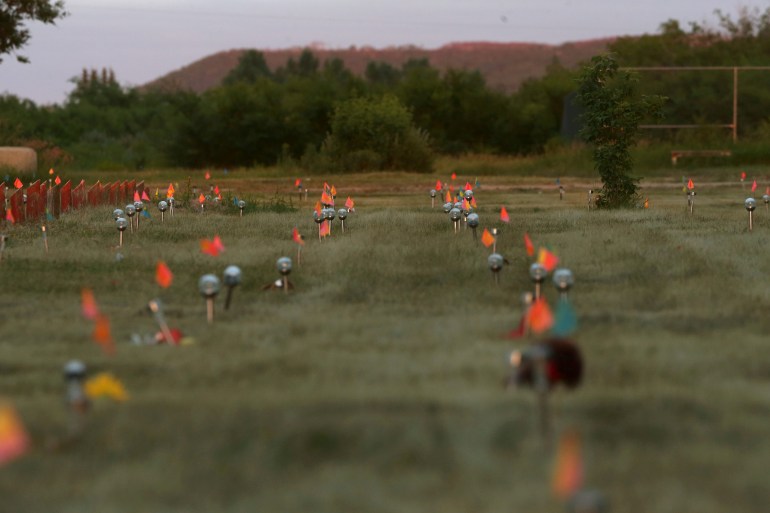
Recently installed solar lights marking burial sites on Cowessess First Nation, where a search had found 751 unmarked graves from the former Marieval Residential School near Grayson, Saskatchewan, Canada [File: Shannon VanRaes/Reuters]

Kyle Mason, an Indigenous activist in Winnipeg and the son of a residential school survivor told CBC in an interview published on Friday that he was “saddened and disgusted” by the priest’s comments.

“I was really sad to hear that somebody in his type of position could still hold these kind of views after everything that’s been said and done,” he said.

“Survivors had to endure unspeakable horrors, tragedies, and that attempted genocide on cultures and language,” he said. “So it is absolutely disgusting that you would just label them as lying to get more money.”

In a video published by CBC, Forest blamed the media for spreading “fake news” about residential schools.

“This is the evil, the evil of media. Media makes people believe so many things. Fake news,” Forest said.

The discovery of the graves has rocked Canada, prompting searches elsewhere and forcing Canadians to confront their country’s genocidal treatment of Indigenous peoples.

While the Canadian government and some Canadian bishops have apologised, no pope has, despite the significant role the Catholic Church played in the largely church-run schools.


Friday, July 9, 2021

Grave Digger Bishop and Architect of some Residential Schools (Canada)

 (written by historian Raymond Huel, Professor of history, University of Lethbridge, Alberta.)

Original title:  Mgr. Émile Legal, OMI, [1897-1920]. (OB3272 - Oblate Collection at the PAA)

Source: Link

LEGAL, ÉMILE-JOSEPH, Roman Catholic priest, Oblate of Mary Immaculate, and bishop; b. 9 Oct. 1849 in Saint-Jean-de-Boiseau, France, son of Julien Legal and Perrine David, millers; d. 10 March 1920 in Edmonton.

Émile-J. Legal studied at the petit and grand séminaires in Nantes, the Collège de Machecoul, and the Université de France. He was ordained on 29 June 1874 and served in the diocese of Nantes prior to entering the Oblate noviciate in Nancy in 1879. As a result of restrictive state legislation governing religious orders, he was sent to Lachine, Que., where he completed his probationary year and made his perpetual vows on 24 Sept. 1880. Before being posted to the Canadian northwest, he served in Plattsburgh, N.Y., Montreal, and Buffalo, N.Y., where he studied English.

Legal arrived in St Albert (Alta) in August 1881 and was sent to minister to the Peigan in October. He spent the winter of 1881–82 on the Peigan Indian Reserve and visited other Blackfoot camps in the summer months in addition to ministering to the needs of Catholics in nearby Fort Macleod. In 1886 Legal opened a small school on the Peigan reserve and, two years later, he organized missions among the Blood. In 1889 he founded Saint-François-Xavier mission at Stand Off on the Blood Indian Reserve. He succeeded in having the Department of Indian Affairs build a hospital there in 1893 and confided its administration to the Grey Nuns of Nicolet, Que.

In the mid 1890s the health of Bishop Vital-Justin Grandin* of St Albert was causing concern among the clergy of the diocese, who believed that the appointment of a coadjutor was crucial. Legal’s candidacy had been suggested earlier by Father Albert Lacombe. On 29 March 1897 Legal was named titular bishop of Pogla and coadjutor of St Albert. He received the news of his nomination on 6 May, shortly after having personally buried a young resident of the Blood reserve, and thus the influential La Croix (Paris) referred to him as “the grave-digger bishop.” He was consecrated in St Albert on 17 June 1897 and chose as his episcopal motto Nos autem in nomine Domini (“As for us, we speak in the name of the Lord”). The Blackfoot named him Sspomitapi, meaning “he who sits on high.” Upon the death of Grandin on 3 June 1902, Legal became bishop of St Albert; he was made archbishop of Edmonton on 30 Nov. 1912.

As both missionary and prelate, Legal demonstrated remarkable intellectual and creative talents. He designed and constructed many buildings while serving in the Blood and Peigan missions. As bishop, he drew plans for numerous churches and carefully scrutinized those that were submitted by parish priests. He designed residential schools at Brocket, Stand Off, Blackfoot Crossing, and Saint-Paul-des-Métis (St Paul). He also marked out construction sites, purchased materials, and obtained the necessary authorizations to build. His plans for the cathedral in St Albert combined Gothic, neo-Roman, neo-Baroque, and Moorish styles. Construction began in 1902 but Legal had to modify his design to reduce costs in view of local economic conditions. With the creation of the archdiocese of Edmonton in 1912 and the subsequent transfer of the episcopal seat to that city in 1917, a cathedral in St Albert was no longer necessary and Legal turned his attention to constructing one in Edmonton.

Legal’s creative activities found expression as well in numerous studies of the traditions and customs of the Blackfoot and their language, including articles published in Les Missions catholiques (Lyon), the Catholic encyclopedia (New York), and the Bulletin of the Société de Géographie de Paris. He also collaborated with Lacombe in the preparation of a Blackfoot, Blood, and Peigan vocabulary. In addition, he undertook geological studies and corresponded with the Smithsonian Institution. He was awarded an lld honoris causa by the University of Alberta in 1915.

Upon being named coadjutor in 1897, Legal had assumed responsibility for the expansion of the diocese of St Albert, especially the creation of new parishes and institutions to serve a rapidly growing immigrant population. These activities he later recalled in Short sketches of the history of the Catholic churches and missions in central Alberta. As bishop, Legal also concerned himself with the status of Catholic schools in his diocese and he communicated with federal and territorial officials. 

In 1904, prior to the creation of the provinces of Alberta and Saskatchewan, he was asked by the apostolic delegate, Donato Sbarretti y Tazza, to prepare a draft clause for the Autonomy Bills safeguarding the principle of denominational schools in the new jurisdictions. Legal felt that the compromise clause negotiated between the apostolic delegate and Prime Minister Sir Wilfrid Laurier was inadequate: although it conferred separate-school privileges on the religious minority in any district, it did not define precisely the school system that was to be established. Nevertheless, since the apostolic delegate approved of it, Legal believed that it had to be upheld. In February 1905 Legal was interviewed for the newspaper United Canada (Ottawa). He expressed his hope that separate schools would be maintained and that Catholics would take action to support them. The published version, however, indicated that Legal was satisfied with the educational clause of the bills, and this allegation outraged other members of the hierarchy such as Archbishop Adélard Langevin of St Boniface. Undoubtedly the bishops did not appreciate Legal giving an interview to a non-Catholic paper on such a delicate issue. They were, moreover, anxious to present a united front.

In the last years of Legal’s life his fellow French-speaking prelates were concerned over his succession. With the appointment of an English-speaking bishop, John Thomas McNally*, in Calgary in 1913 and the creation of the archdiocese of Winnipeg out of the archdiocese of St Boniface in 1915, ethnic rivalries had become a matter of fact in western episcopal nominations. Despite his declining health – he was a diabetic – Legal had not secured the appointment of a coadjutor and, in 1920, there were fears that Rome rather than the bishop himself would choose a successor or that it would appoint an English-speaking auxiliary. Legal died on 10 March 1920 and both French- and English-speaking factions of the hierarchy made representations to Rome on behalf of appropriate candidates. The appointment of Henry Joseph O’Leary* as archbishop of Edmonton in September seriously undermined the domination of the French element in the western sees.

WRITTEN BY Raymond Huel

Legal’s compilation of Short sketches of the history of the Catholic churches and missions in central Alberta was published in Winnipeg around 1914. Archival material concerning the subject is found in the collections of the Arch. Deschâtelets, Oblats de Marie-Immaculée (Ottawa), the Arch. Générales des Oblats de Marie-Immaculée (Rome), the Arch. des Oblats de Marie-Immaculée (Montreal), the Arch. de la Prov. Grandin (St Albert, Alta), and the Arch. of the Oblates of Mary Immaculate, Prov. of Alberta-Saskatchewan, held at the PAA.

Gilles Cadrin, “Émile Legal: de l’architecture des missions à l’architecture monumentale,” in Western Oblate Studies 2: proceedings of the second symposium on the history of the Oblates in western and northern Canada . . . , ed. R. [-J.-A.] Huel with Guy Lacombe (Lewiston, N.Y., 1992), 237–19. Gaston Carrière, Dictionnaire biographique des oblats de Marie-lmmaculée au Canada (4v., Ottawa, 1976-89). R.[-J.-A.] Huel, “The Irish French conflict in Catholic episcopal nominations: the western sees and the struggle for domination within the church,” CCHA, Study sessions, 42 (1975): 51–70. 

BIOGRAPHY

Wednesday, July 7, 2021

Indian Boarding School Survivors Take Action at Cathedral of Saint Paul


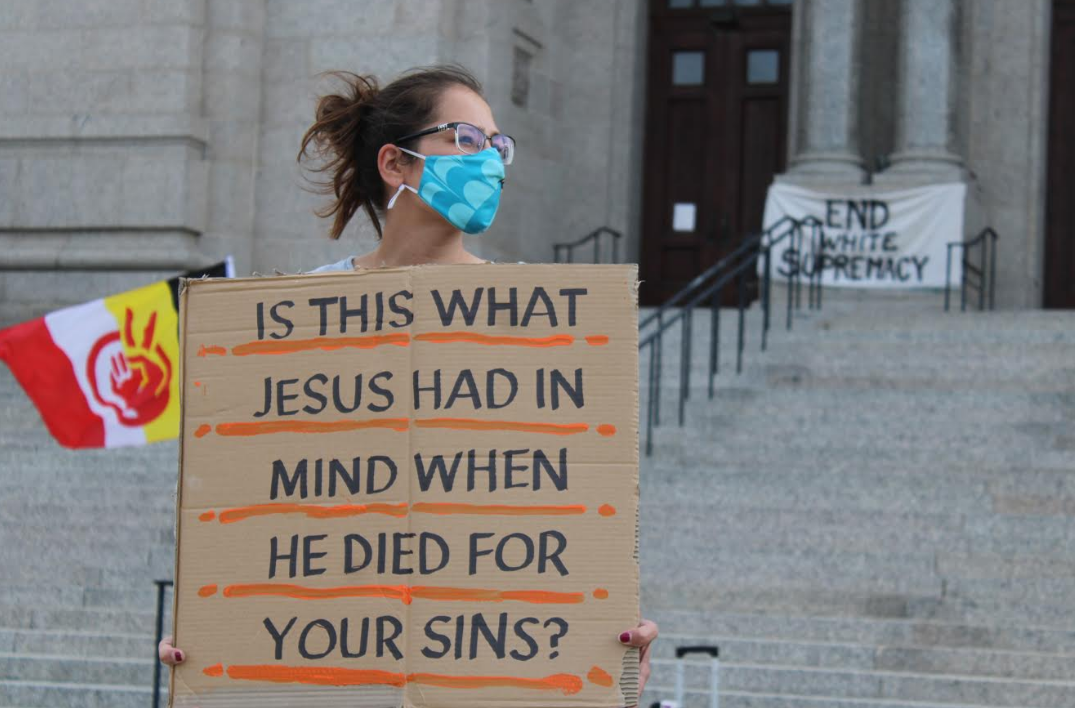
A demonstrator holds a sign at the steps of the Cathedral of Saint Paul on July 1, 2021. (Photo/Darren Thompson)


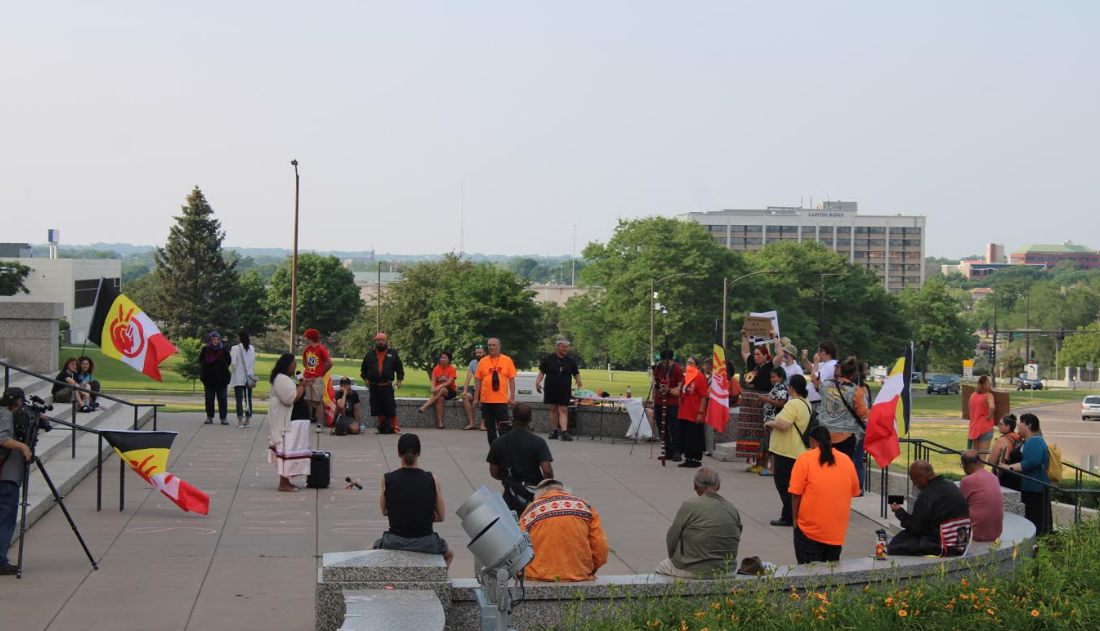
SAINT PAUL, Minn. — The American Indian Movement (AIM) Twin Cities chapter held a press conference and protest on Thursday outside the Cathedral of Saint Paul in the Saint Paul, Minn,

The event brought several dozen people from around the Twin Cities to protest the recent discoveries of more than 1,000 children found in an unmarked graves at various residential schools in Canada. 

“My name is Michael Anthony, after the Saint Michael and Saint Anthony,” AIM Twin Cities Chairman Mike Forcia said at the press conference. “The church must acknowledge its participation in the genocide of our people.”

Last year, Native News Online reported that Forcia was charged and convicted last year for the toppling of the Christopher Columbus at the Minnesota State Capitol grounds. 

Organizers posted American Indian Movement flags, sang on the drum, and addressed the history of boarding schools and its complicated relationship with the Catholic church. Demonstrators held signs in traffic that read "Search Every School!” and “From Canada to the USA, Honor Native Treaties.” 

Demonstrators host a press conference at the steps of the Cathedral of Saint Paul in St. Paul, Minnesota on July 1, 2021. (Photo/Darren Thompson)

A confrontation between tourists of the Cathedral and a demonstrator erupted into an argument over the land the church is built on. Shortly after, a fight broke out between a man who claimed he attended church at the Cathedral and a participant in the demonstration. 

The demonstration was held in conjunction with Cancel Canada Day, where tens of thousands of people demonstrated and marched throughout towns and cities in Canada. On day normally celebrated by Canadians for their country’s confederation on July 1, statues of Queen Victoria and Queen Elizabeth II were toppled. Thousands protested from coast to coast over the mass graves of Indigenous children being discovered at residential boarding schools that were operated for decades by the Canadian federal government and Catholic churches. 

“As more stories break of the bodies of over one thousand children being recovered from mass graves at boarding school sites in Canada, I find myself holding my eight-year-old daughter close each night,” Minnesota Lieutenant Governor Peggy Flanagan said to Native News Online. “These children never got to go home to their parents and their communities who loved them. They endured physical and sexual abuse, and their childhoods were stolen under the guise of ‘Kill the Indian, and save the man.’”

“Kill the Indian, and save the man” was the ethos instilled by General Richard H. Pratt—founder of the Carlisle Indian Industrial School in Pennsylvania, which established a model for other Indian boarding schools. It's goal was to strip American Indian children of their culture in order to "Americanize" them. At the Carlisle Indian School and at other Indian boarding schools, American Indian children were strictly forbidden to speak their tribal languages or practice their spirituality. Their clothing was burned and replaced with military drab, and long hair was cut and styled in Euro-American fashion. 

For American Indians, the boarding school left a lasting distrust of the entire U.S. education system. According to the National School Boards Association, Native American students performed two to three grade levels below their white peers in reading and math. They were two times more likely to drop out of school than their white peers, according to a study conducted by National Caucus of Native American State Legislators.

“This is not ancient history or a Canadian issue; our parents and grandparents in Minnesota and across the United States attended these institutions, but too many people do not know about this painful chapter in our history,” Flanagan added. 

Recently, at the National Congress of American Indians’ Mid Year Conference, Secretary of Interior Debra Haaland announced that she established the Federal Indian Boarding School Initiative, which is tasked with identifying past boarding schools throughout the country and investigating possible burial sites, then identifying those buried and returning the remains to their rightful tribes. A report from the initiative is due to Secretary Haaland on April 1, 2022.

“It is time to tell the whole truth about our history, and it is time to take action to ensure that Native children and people are safe, valued, and protected in their communities now and in the future,” Flanagan said.  SOURCE

Tuesday, June 29, 2021

Intergenerational Trauma | Hitler | Whitewashing our history | Churches Burning

 Woke to the Truth

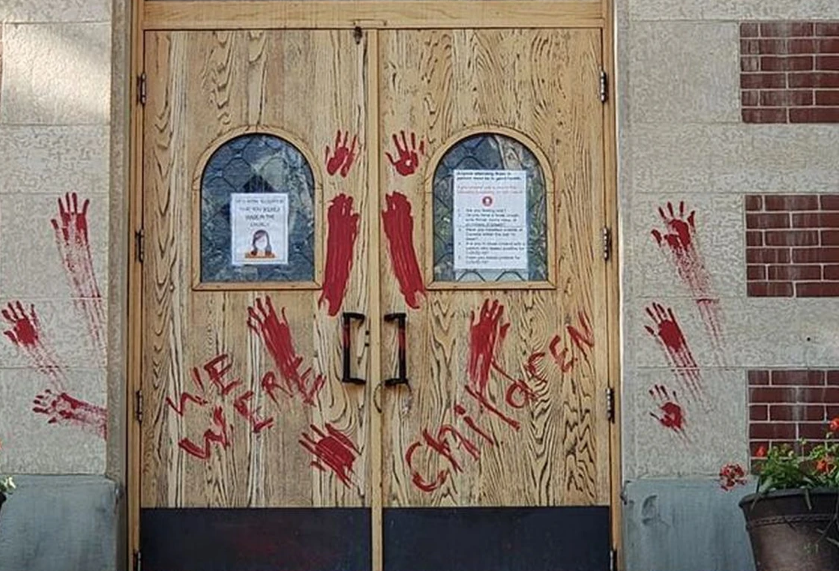
The doors of a Catholic church in Canada were marked with red paint on June 24 after the announcement from Cowessess First Nation that up to 751 unmarked graves graves had been identified near the former Marieval Residential School. (Photo/Facebook – Donna Heimbecker)


While the emerging stories about Indian residential school cemeteries in Canada are shocking to many, they are not to many Native Americans and First Nation citizens. 

When I wrote my master’s thesis for my first master’s degree in public administration 30 years ago in 1991, it was focused on federal Indian policy. It focused all of the Indian policy periods throughout U.S. history. 

Included in the various periods was the Indian boarding school era. It was by far the hardest part of my thesis. Because I was interested in understanding this fully, I read all kinds of accounts of the experience lived from individuals who were part of this dark chapter in history. It took me two and a half years to write my thesis because it was heartbreaking to delve deep into the boarding school experience.

One of the most psychologically challenging accounts to read was how the missionaries used wooden blocks to stop Indian children from speaking their language. Some of the Indian boys and girls were told their parents had died so they wouldn’t try to escape the boarding school. When these children tried to mourn their parents because they believed they had died, the missionaries prohibited them from exercising their traditional funeral rituals.

Many American Indian boarding schools have their own cemeteries. Could you imagine sending your child off to a boarding school today if they had a graveyard in the backyard? 

For all of those counterculture people or those who claim that critical race theory should not be taught, they are on the side of whitewashing American history. In psychology and sociology there is a term called cognitive dissonance. Those terms as well as the concept of collective denial, is why we don’t learn about these facts in American history.

Most aspects of American Indian history are not taught in schools. Certainly, the Indian boarding school era is not part of the curriculum.

Did you know U.S. Japanese internment camps were modeled after the first Indian reservation experience?

Did you know that germ warfare and ethnocide was born in American Indian history?

Did you know the concept of Indian blood quantum, the amount of Indian blood you have, initially a system the federal government placed on tribes in an effort to limit their citizenship, was created to under count and eventually eradicate the American Indian population?

Did you know that Hitler modeled the Jewish concentration camps after the American practice of concentrating American Indians onto a reservation and introducing disease by gifting Tribes with smallpox infected blankets?

Each of these experiences of genocide at the hands of the American government over the generations explains what is called historical and intergenerational trauma. This explains in large part why tribal governments are sometimes openly hostile towards their own people. It also explains why American Indians have the worst of the worst statistical outcomes on every dimension. This includes the lowest high school graduation rate, the highest rates of suicide, the highest rates of drug and alcohol addiction, the highest rates of unemployment. 

Whitewashing our history and these facts is intended to suggest there is something inferior about American Indians. That we are intellectually inferior to other races. Early scholars in anthropology wrote about our ancestors as if they were less than human and not civilized. We didn’t even have the right to vote until 1924. We were the last of Americans to be granted this right. Our religious practices were illegal until 1978. Our children were stolen from our families until the Indian Child Welfare Act was passed in 1978. Even today—in certain states and jurisdictions—Indian children are still stolen from their families.

None of this is intended to blame anyone who is alive today. But we all have a duty to understand the facts, our history, and how this impacts us today. One important reason is so that we don’t repeat history. Immigrant children locked in cages and disconnected from their parents is the same as the Indian boarding school experience. The atrocity of separating a child from their family is inexcusable and unforgivable. No matter who is president or who locked up these children, it is really no different than the Indian boarding school experience. Those who argue cancel culture would have you believe this is no big deal. Again, if we don’t know our own history, we are doomed to repeat it.

So while I am grateful that the world is becoming “woke” to the experience of Indian children being slaughtered, beaten to death, or driven to suicide based on a broken heart at these boarding schools, we have known this for some time but we’re just unwilling to look more closely. 

I appreciate Secretary Deb Haaland’s commitment to go back and examine these boarding schools to get an account of how many Indian children were murdered at the hands of the American government. It is my hope that this will lead to repatriation of the remains of these children back to the respective families and tribes.

Finally, the concept of critical race theory is not about blaming anyone. It’s about understanding the truth and looking for explanations for why certain populations have the worst of the worst statistical outcomes. 

As documented in the U.S. Commission on Civil Rights Broken Promises report, American Indians have the worst of the worst statistical outcomes. 

Aaron A. Payment is Tribal Chairperson of the Sault Ste. Marie Tribe of Chippewa Indians. Payment holds a doctorate degree in education, a master’s in education specialist, a master’s in education administration and a master’s in public administration. He also serves as the 1st Vice President of the National Congress of American Indians, President of the Midwest Alliance of Sovereign Tribes, and President of the United Tribes of Michigan.

+++

After Graves Were Discovered at Residential Schools in Canada, Catholic Churches are Burning Down

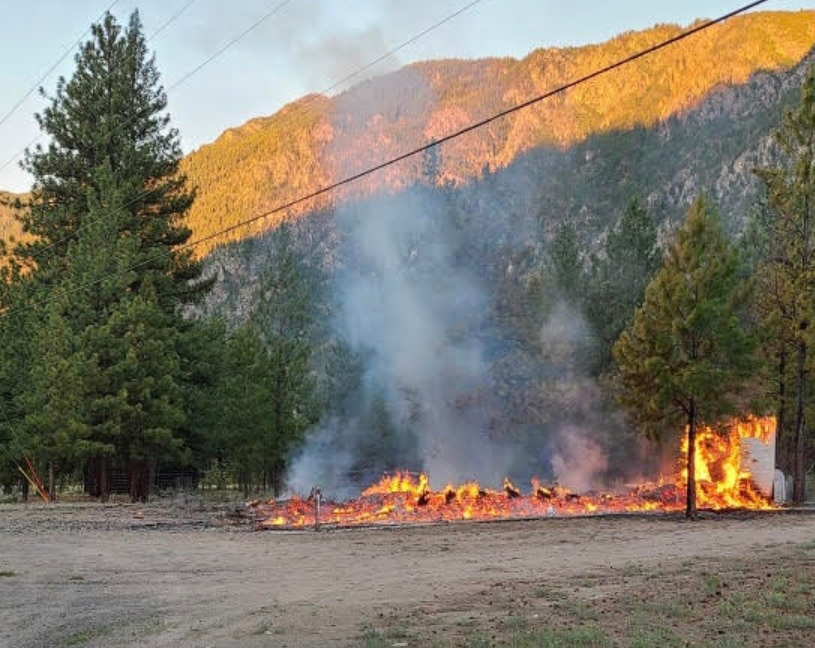
The remains of the Chopaka Church on Lower Similkameen land on Saturday morning. (Photo/Courtesy of Chief Keith Crow) 

BRITISH COLUMBIA, Canada — Two more Catholic churches burned down in western Canada early Saturday. The churches were located near Indigenous communities at St. Ann’s Church and Chopaka Church, which are located within an hour of each other in British Columbia.

Want more Native News? Get the free daily newsletter today.
In All This Darkness, Taking Back Our Stolen Children Can Offer Hope


Wednesday, June 23, 2021

Quebec government, Catholic oblates still haven't delivered key residential school records #TRC


As First Nations in Quebec plan possible searches of former residential school sites, documents that could help that process have still not been turned over by the Quebec government and the Missionary Oblates of Mary Immaculate.

"Recent events have definitely given some urgency to the situation," he said, adding the oblates seem willing to work on releasing more records and that a meeting has already been set up.

"I expect there will be some movement on this very shortly."

WARNING: DISTRESSING CONTENT: Quebec government, Catholic oblates still haven't delivered key residential school records | CBC News


The central repository of oblate records on Quebec's residential schools is the Archives Deschâtelets in Richelieu, about 35 kilometres east of Montreal.
Students and staff of the Fort George Roman Catholic Indian Residential School, Fort George Que., Aug. 8, 1948. (National Centre for Truth and Reconciliation / Deschatelets-NDC Archives )

Saturday, June 12, 2021

A Present Reality with a History

 OPINION: White violence not a historical truth: it’s a reality with a history

Although slavery was abolished and much progress has been made for the First Nations and all minority groups in these countries, the ideology of white supremacy and the danger of white violence are still very much with us today

 News Service |

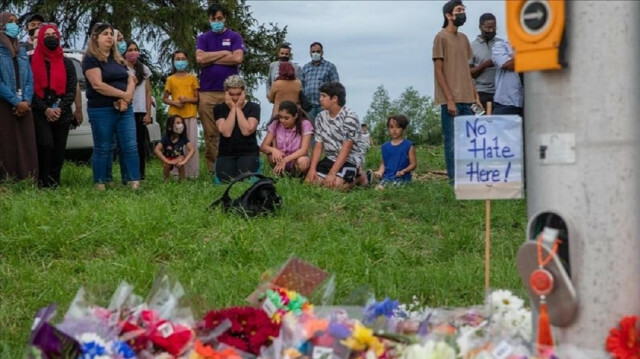
Just a few days ago, a white man killed a Muslim family in Ontario Canada. Though widely reported as a singular incident not connected to any other recent or historical acts of violence, it was in fact the latest in a long series of ideologically-driven white supremacist violence. The most immediate connection that springs to mind, also from Canada, is the horrifying discovery of an unmarked mass grave in which are buried at least 215 indigenous children who had perished at the hands of white supremacists.

The remains of these 215 children were discovered at a site that used to house Canada’s biggest residential school for indigenous children. It was run by the Catholic Church from the 1890s through the 1970s, until the federal government shut it down. These latest reports on the mass graves are part of a twenty-year effort by Tk’emlups te Secwepemc First Nations people in order to find the missing children in many of the unmarked mass graves at former school sites such as Kamloops. Between 1883 and 1996, around 150,000 children passed through the Canadian version of this system, which was eventually abolished. Thousands of unaccounted-for children have yet to be found. They were never seen again by their families. When pressed for answers, the schools would tell families that their children had died, run away or simply disappeared, and they would generally refuse to return the body in case of death.

The brand of hatred that has motivated white people to assault Muslims in New Zealand, the United Kingdom, the United States, and Europe is intimately connected to the ideology that created the “Indian boarding school system” in the US and Canada. Indian boarding schools were part of America’s and Canada’s so-called “civilizing mission”. They were the quintessential example of how white supremacy had been at the heart of both of these countries since the earliest days of their founding, rather than being a marginal, radical, and fringe ideology. European settlers wanted to civilize these “savages”, seeing their own Anglo-Saxon Christian culture as vastly superior to the many different tribal languages and cultural practices that the indigenous peoples had.

Richard Henry Pratt, an American general, had captured a group of indigenous men as prisoners of war. He taught them how to speak, read and write English, dressed them in military uniforms and trained them to do labor. He photographed the results of this assimilation experiment and presented them to the federal government. This is how he was able to secure funding for the first Indian American boarding school, set up to “kill the Indian and save the man,” as Pratt called it. The schools quickly spread across the US and other colonial countries like Australia, New Zealand, and, of course, Canada.

With the aid of Christian missionaries, the Canadian and American governments forcibly removed thousands of indigenous children from their families and made them attend these schools, where speaking indigenous languages and their cultural traditions and spiritual practices were prohibited. Children who did not comply with the rules were subjected to physical, emotional and sexual abuse, as well as violence. According to some eyewitness accounts, priests, for example, would rape students, and when they got pregnant and gave birth, the babies would be killed, in some cases brutally by being burned in furnaces.

Indigenous children were forced to cut their braids, a very important part of their culture. Their names were changed. As punishment for speaking in their native language, some were forced to wash their mouths with soap, as if to imply that their mother tongues were dirty.

Tuesday, June 8, 2021

Indigenous lawyer: Investigate discovery of 215 children’s graves in Kamloops as a crime against humanity

Author:   Acting Dean and Associate Professor, Law, University of Windsor

Two young children sit next to shoes left in front of a statue of Egerton Ryerson, who was instrumental in the design and implementation of the Indian Residential School System. THE CANADIAN PRESS/Chris Young

As I reflect on the recent and horrific news about the discovery of the bodies of 215 children at the former site of Kamloops Indian Residential School, I am reminded about the resiliency of our people.

But the uncovering of the remains of children must be investigated as a crime against humanity. All entities involved in residential schools — including different levels and branches of the Canadian government and various denominations of churches — must be charged with genocide and tried at the International Criminal Court.

Like others who have been speaking out, I want the ground-penetrating radar that was used at Kamloops Indian Residential School to be used at all other former residential school sites.

What happened to Indigenous children is genocide, and the legacy of that continues through denial and inaction.

Aftermath of genocide

Nehiyaw (Cree) legal scholar Tamara Starblanket argues that Canada must be held accountable for crimes of genocide.

The National Inquiry on Missing and Murdered Indigenous Women and Girls (MMIWG) produced a supplementary report dedicated to the issue of Canada’s genocide. Its most powerful statement reads:

Legally speaking, this genocide consists of a composite wrongful act that triggers the responsibility of the Canadian state under international law. Canada has breached its international obligations through a series of actions and omissions taken as a whole, and this breach will persist as long as genocidal acts continue to occur and destructive policies are maintained. Under international law, Canada has a duty to redress the harm it caused and to provide restitution, compensation and satisfaction to Indigenous peoples.

I have watched and felt the aftermath of this genocide. I’ve felt it all my life and I know my parents and grandparents felt it too. My grandmother went to a residential school and didn’t talk about it until she was sick and dying. She told my aunt that she saw a child being buried beside the laneway to the Mohawk Institute, also known as the Mush Hole, in Brantford, Ont.

This pain and trauma has been passed down from generation to generation.

The Mohawk Institute is one of the last standing Indian Residential Schools in Canada. It has since been turned into the Woodland Cultural Centre.

Resiliency and survival

As a lawyer working with Sunchild Law, I represented residential school survivors at their Independent Assessment Process (IAP) hearings. The IAP was established to resolve claims of serious physical, sexual or emotional abuse suffered at Indian Residential Schools.


Read more: Residential school survivors' stories and experiences must be remembered as class action settlement finishes


While advocating for survivors, I found this process not only difficult as an Indigenous lawyer and intergenerational survivor, but as someone who had to witness the re-traumatization of survivors. I also saw and felt their amazing strength as they persevered through this process.

As a professor of law at the University of Windsor, I am grateful our students have been able to learn Indigenous Legal Orders from Indigenous faculty with specializations in Haudenosaunee, Nêhiyaw and Anishinaabe laws.

We have done a lot at the University of Windsor Faculty of Law to implement the Truth and Reconciliation Commission’s Call to Action 28 — which calls upon “law schools in Canada to require all law students to take a course in Aboriginal people and the law.” We’ve done more than establish one course and in fact have established an Indigenous Law Stream Certificate. It’s not nearly enough, but it is a start.

Indigenous peoples’ connection to our lands, communities and peoples have enabled resilience. Our ceremonies and the strength of our Indigenous laws are strong; we are still here with our languages, songs and healing ceremonies.

The strength of the Tk’emlúps te Secwépemc peoples was seen with healing ceremonies, songs and dances to respect and honour the spirits of the 215 children.

‘Ohero:kon Under the Husk’ by Katsitsionni Fox shows young Mohawk women who are on a spiritual, emotional and physical journey to womanhood through their traditional rites of passage.

Ongoing genocide

I’ve seen and felt the strength of our people to recover and heal from the impacts of genocidal, colonial laws and policy — like The Indian Act and the ‘60s Scoop — that have been happening for decades. These feelings of pain and trauma are not new.

They are consistently and persistently triggered every time a survivor speaks out, when one of our women goes missing or is found murdered, when our people are targeted for being Indigenous, for protecting their lands and territories or when we’re violated in any way.

The MMIWG final report goes on to say:

But first and foremost, Canada’s violation of one of the most fundamental rules of international law necessitates an obligation of cessation: Canada must put an end to its perennial pattern of violence against and oppression of Indigenous peoples.

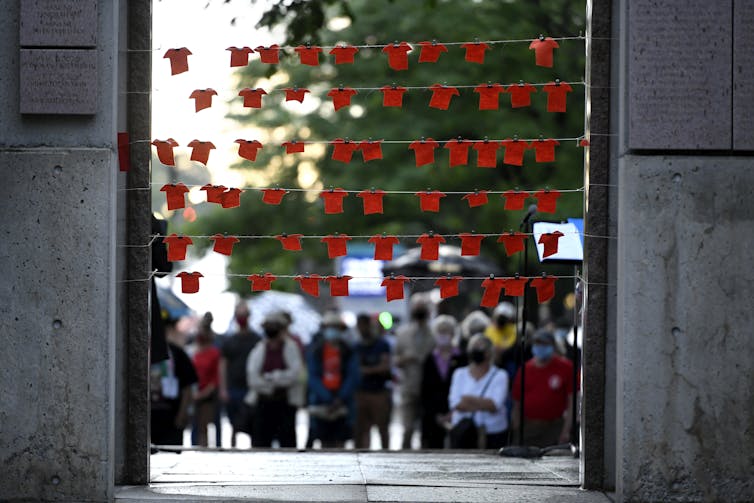
Orange fabric cut in the shape of shirts are pinned to string at the Human Rights Monument in Ottawa. They're strung across like clothes on a clothes line as people stand blurred in the background.
Orange fabric cut in the shape of shirts are pinned to string at the Human Rights Monument in Ottawa, during a vigil to honour the 215 children whose remains were found at the grounds of the former Kamloops Indian Residential School. THE CANADIAN PRESS/Justin Tang

Investigating crimes against humanity

Canada’s genocidal laws and policies are not historic: the Indian Act still exists today as one of the most racist and sexist pieces of legislation in the world. At one point, it dictated that every Indigenous child must attend a residential school.

The discovery of the remains of Indigenous children must be investigated as a crime against humanity and further investigation must happen at other former residential school sites. The perpetrators must be held accountable so that genocide will stop and healing and reconciliation can occur.

I urge all Canadians to care, learn, listen, respect and unlearn the lies that have been told. I wish for all Canadians who are unaware of this genocide to learn the truth and accept that they’ve benefited from Canada’s genocidal policies and laws that have tried to erase us from existence.

Our children and survivors have to be celebrated, honoured and respected.

Byron Louis, Chief of the Okanagan Indian Band in British Columbia, posted on LinkedIn a message that should stay with all of us:

“Do not lower your head and cry, hold your head up in praise and honour them and most importantly support them. This is what they rightfully deserve in their service to our People. They need our praise not pity!”

If you are an Indian Residential School survivor, or have been affected by the residential school system and need help, you can contact the 24-hour Indian Residential Schools Crisis Line: 1-866-925-4419


Happy Visitors!

WRITTEN BY HUMANS!

WRITTEN BY HUMANS!

Blog Archive

Featured Post

Your History Class Was a F*cking Lie | #NOMOAR

  Your History Class Was a F*cking Lie by Sean Sherman (Or: How the American Educational System Has Always Been a Racist Propaganda Program...


Native Circles

Native Circles
click logo for podcasts!

Most READ Posts

Bookshop

You are not alone

You are not alone

To Veronica Brown

Veronica, we adult adoptees are thinking of you today and every day. We will be here when you need us. Your journey in the adopted life has begun, nothing can revoke that now, the damage cannot be undone. Be courageous, you have what no adoptee before you has had; a strong group of adult adoptees who know your story, who are behind you and will always be so.

Diane Tells His Name


click photo

Lost Birds on Al Jazeera Fault Lines

Lost Birds on Al Jazeera Fault Lines
click to read and listen about Trace, Diane, Julie and Suzie

NO MORE STOLEN SISTERS

NO MORE STOLEN SISTERS
click image

ADOPTION TRUTH

As the single largest unregulated industry in the United States, adoption is viewed as a benevolent action that results in the formation of “forever families.”
The truth is that it is a very lucrative business with a known sales pitch. With profits last estimated at over $1.44 billion dollars a year, mothers who consider adoption for their babies need to be very aware that all of this promotion clouds the facts and only though independent research can they get an accurate account of what life might be like for both them and their child after signing the adoption paperwork.

Original Birth Certificate Map in the USA

Google Followers