


October 26th, 2023
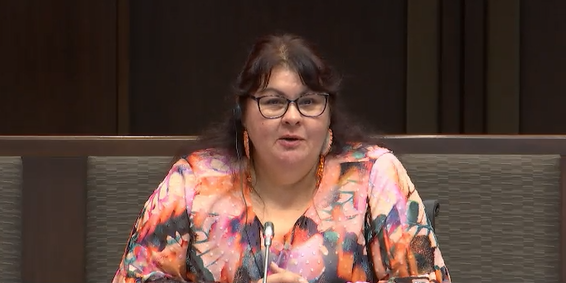
Saskatchewan Treaty Commissioner Mary Musqua-Culbertson didn’t mince words when she spoke to members of the Senate Committee on Indigenous Peoples Oct. 25 about the difficulty in accessing Catholic Church records for Indigenous residential schools.
Not only has her office come up against barriers in trying to acquire student records for four of the former Indian residential schools in the Prince Albert diocese, but staff had to sign a non-disclosure agreement (NDA) for 21 years in order to access the diocese records they were told were housed at St. Paul University in Ottawa. However, she says, Prince Albert diocese records were never found there.
“Who specifically asks for a 21-year NDA? Who within their organization needs to die within that 21 years that is being protected?” asked Musqua-Culbertson, a lawyer who added that 21 years is not a usual timeframe.
“There is still people who are responsible for sexual abuse and deaths that are still alive that are still out there and they’re walking about within our institutions and in churches and in religious organizations. I do believe that religious organizations are there to protect religious organizations and the people within them,” she said.
Musqua-Culbertson drew the connection between persons of interest (POI) who were named by survivors during the Independent Assessment Process (IAP). The IAP was used as part of the Indian Residential Schools Settlement Agreement (IRSSA), signed in 2006. Through the IAP, survivors had to recount how they were sexually or physically abused in order to receive compensation beyond what the base common experience payment was.
Musqua-Culbertson served as legal counsel during the IAP.
“So you have these vast lists of POIs. Where is that database? Could that be a database? Because POIs are still protected…Those are people who were named as abusers,” she said.
She also pointed out that the IAP records will be destroyed unless survivors state otherwise.
Musqua-Culbertson recounted numerous incidents where the diocese gave her staff difficulties as they tried to access residential school records, including promising to release records and then reneging on those promises.
“When we come back up against this (many) barriers when it comes to the graves of missing children, it’s very disheartening,” she said.
The Office of the Treaty Commissioner of Saskatchewan officially built its library and archives in 2020, although documents began to be collected in 1989. In the past few years, the office has started to collect documents and church records relating to the four Indian residential schools of Delmas (west of Thunderchild First Nation), St. Anthony’s (Onion Lake Cree Nation), Beauval (English River La Plonge Reserve) and St. Michael’s (Beardy’s and Okemasis and One Arrow First Nations).
Raymond Frogner, head archivist for the National Centre for Truth and Reconciliation (NCTR), also recounted the frustrations involved with working with the Catholic Church. Centre researchers are combing through the oblate records housed at Société historique de Saint-Boniface (Manitoba) and Deschâtelets-NDC Archives (Quebec).
“We….are currently funding researchers to go into their archive, go through their records and tell them what records they have that they’ve been holding for decades. Tell them which ones are actually relevant to residential schools…They’re also asking us to pay for the digitization of those records because they aren’t digitized,” said Frogner.
“We all know the Catholic Church did not pay the compensation that they originally were assigned to pay up for the IRSSA.”
Four churches were signatories to the settlement agreement. While the Anglican, United, and Presbyterian churches have paid their agreed-upon negotiated amounts, the Catholic Church has fallen well short.
Frogner said that the archive at the NCTR held approximately four million records largely focused on the daily administration and operation of the schools.
“There is not a single one of the 141 schools that were part of IRSS agreement …that has a complete set of admission records, discharge records or quarterly returns. This is because, partly, the quality of record keeping was abysmal, to put it lightly,” he said.








 Posts

