They Took Us Away

They Took Us Away
click image to see more and read more

it's free

click

How to Use this Blog

BOOZHOO! We've amassed tons of information and important history on this blog since 2010. If you have a keyword, use the search box below. Also check out the reference section above. If you have a question or need help searching, use the contact form at the bottom of the blog.


We want you to use BOOKSHOP to buy books! (the editor will earn a small amount of money or commission. (we thank you) (that is our disclaimer statement)

This is a blog. It is not a peer-reviewed journal, not a sponsored publication... WE DO NOT HAVE ADS or earn MONEY from this website. The ideas, news and thoughts posted are sourced… or written by the editor or contributors.

EMAIL ME: tracelara@pm.me (outlook email is gone) THANK YOU CHI MEGWETCH!

SEARCH

Showing posts with label Kamloops band of the Shuswap. Show all posts

Thursday, July 7, 2022

Blood Money : Indigenous foundation returns $500K to Catholic nuns involved in Kamloops residential school

The Verna J. Kirkness Foundation has severed ties with Sisters of St. Ann

The main administrative building of the Kamloops Indian Residential School is pictured in 1970. (Department of Citizenship and Immigration- Information Division / Library and Archives Canada)

WARNING: This story contains distressing details.

A foundation that provides university scholarships to Indigenous students across Canada has severed its ties with a group of Victoria-based Catholic nuns by returning a $500,000 donation.

The Verna J. Kirkness Education Foundation announced this week that it had decided to give back the endowment, received in December 2017, to the Sisters of St. Ann, a Catholic order whose nuns taught at the former Kamloops Indian Residential School.

Board chair Tony Williams says the foundation launched a year-long investigation into the Sisters of St. Ann after the discovery of 215 suspected unmarked graves near the residential school last May. 

Williams says the foundation met with the Catholic group during the investigation and asked for specifics about the abuses that occurred at the residential school, but the request went unanswered. 

"We want to know there's a more complete acknowledgement that these [residential] schools were very bad places, that there was a lot of harm done here, a lot of children who didn't survive, there wasn't a proper education provided," he said.

"It was setting up an entire generation of Indigenous people for failure and to be marginalized in society."

Sisters of St. Ann's involvement in residential school

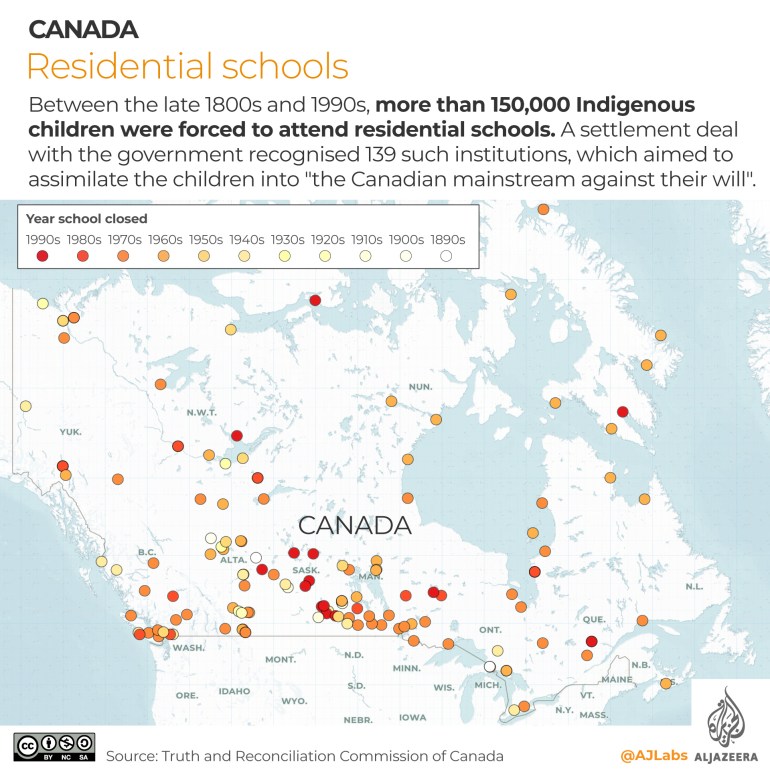
The Sisters of St. Ann is an order of Roman Catholic nuns founded in Quebec in 1850. In 1890, nuns from the order began teaching at the Kamloops Indian Residential School, one of more than 100 residential schools across Canada.

The children were removed from their families and not allowed to speak their own languages. Many were sexually, physically or psychologically abused, a situation described by the Truth and Reconciliation Commission as cultural genocide.

During the opening prayer for the foundation's announcement, Secwépemc elder Evelyn Camille said she had initially been excited to go to the Kamloops Indian Residential School at the age of six, but the experience quickly turned ugly.

"They used cattle trucks to bring the students here," Camille said. "When we walked through the door and into the dormitory, they stripped us and poured coal oil over us — because we were lousy savages."

Secwépemc elder Evelyn Camille, shown in a photo from 2015, says she and other children at the former Kamloops Indian Residential School were stripped and had coal oil poured on them. (CBC)

The residential school was permanently closed in 1977. From 2008 to 2015, the Sisters of St. Ann participated in the Truth and Reconciliation Commission hearings on Indian residential schools.

The group, now composed of only 23 nuns, has been selling their assets and giving away millions of dollars for causes that align with their values. 

Tough decision

The foundation's board secretary, DeDe DeRose, says it was a tough decision to cut ties with the nuns and return a generous gift, but the foundation doesn't want its integrity questioned due to a donation from a group that was historically involved in cultural genocide.

"Now we can say we don't have that money anymore, and we're going to work as hard as ever to ensure that Indigenous children continue to have the opportunities that they deserve to at least be equal to all children in Canada and opportunities to be involved in post-secondary education," DeRose said.

Verna J. Kirkness Education Foundation board secretary DeDe DeRose says the organization is returning the endowment to avoid any questions about its integrity. (Verna J. Kirkness Education Foundation)

The foundation, established in 2008 in Cochrane, Alta., says its mission is to address the under-representation of First Nations, Métis and Inuit students in Canadian universities by providing scholarships to Indigenous students. It partners with B.C. universities including UBC, Kwantlen Polytechnic University and University of Victoria.

In an emailed statement to CBC News, Sisters of St. Ann executive director Angela Hudson says her group is saddened by the foundation's decision to return the donation, which she says will be redirected to another organization that also works to create a brighter future for Indigenous people.

Hudson says her group has committed to handing over its residential school records to the Royal B.C. Museum as part of its reconciliation efforts.

"Reconciliation is achieved by listening and learning with humility, and it is always our preference to engage constructively with our critics, while working together towards common goals," she wrote.


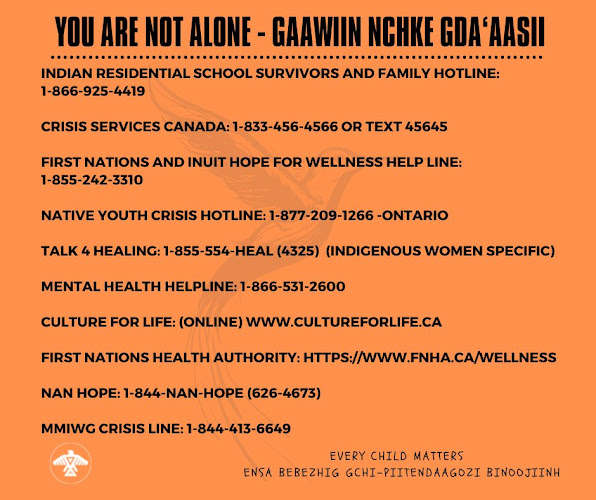
Support is available for anyone affected by their experience at residential schools, and those who are triggered by the latest reports.

A national Indian Residential School Crisis Line has been set up to provide support for former students and those affected. People can access emotional and crisis referral services by calling the 24-hour national crisis line: 1-866-925-4419.

Tuesday, June 14, 2022

One Year after Kamloops Discovery of Unmarked Graves

Q&A: One year after Kamloops, push for answers continues

Al Jazeera speaks to Stephanie Scott about search for ‘full truth’ of unmarked graves at Canada’s residential schools.

Flowers and tributes are laid out in front of Kamloops Indian Residential School
Flowers and tributes are left at the Kamloops Indian Residential School, where the remains of 215 Indigenous children were discovered in May of last year [File: Nicholas Rausch/AFP]

Warning: The story below contains details of residential schools that may be upsetting. Canada’s Indian Residential School Survivors and Family Crisis Line is available 24 hours a day at 1-866-925-4419.

Canada – A year ago this week, Tk’emlups te Secwepemc First Nation announced that “an unthinkable loss that was spoken about but never documented” had been confirmed.


Friday, February 4, 2022

Fifth Estate

Records contain school narrative for Kamloops Indian Residential School

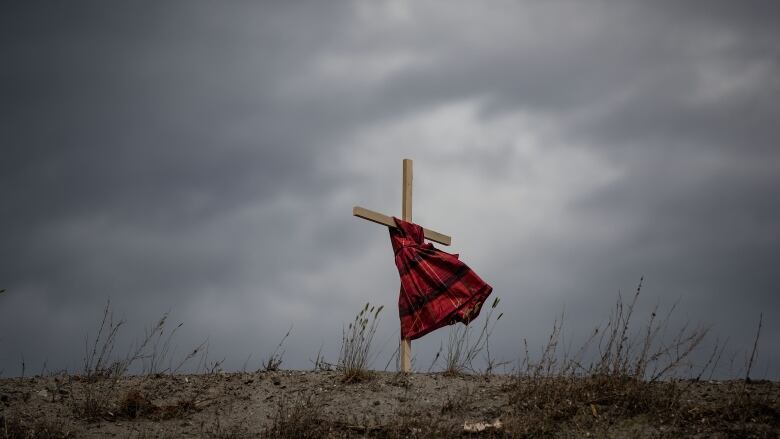
A child's dress hangs on a cross near the former Kamloops Indian Residential School. (Canadian Press/Darryl Dyck)

The leadership of Tk'emlúps te Secwépemc hopes to identify and locate missing children believed to be buried in unmarked graves near the former Kamloops Indian Residential School (IRS) with the help of previously undisclosed documents set for release by the federal government.

The federal government plans to transfer more than 875,000 records through a recently signed agreement with the National Centre for Truth and Reconciliation (NCTR), the archival repository for all of the material collected by the Truth and Reconciliation Commission.

Those files include the school "narrative" for Kamloops IRS, which summarizes the institution's history, including its administration, attendance record, key events and reports of abuse.

"We have to find answers," Tk'emlúps te Secwépemc Kukpi7 (Chief) Rosanne Casimir told CBC News.

"Access to the records means not having to re-traumatize ... residential school survivors to pinpoint information about who attended KIRS and who could possibly be in the unmarked graves."

Tk'emlúps te Secwépemc sent shockwaves around the world last May when it announced the preliminary findings from ground penetrating radar scans — 215 suspected graves of children near the site of Kamloops IRS.

Now, the community and residential school survivors are waiting for their chance to review these records for the first time, which could help piece together what happened at Canada's largest residential school. KEEP READING


 PLEASE WATCH

The Fifth Estate shows how a B.C. First Nation is dealing with the traumatic discovery of what are assumed to be the graves of children near a former residential school, as it tries to lead the way for other communities coping with a similar tragic history. 45:35

Monday, July 12, 2021

Chief Louis of Kamloops


EN:UNDEF:public_image_official_caption Chief Louis Clexlixqen

Source: Link

CLEXLIXQEN, LOUIS (Xlexxle’xken, Klicktickkun, Tlihtlihen, Hatakun, Little Louis, Petit Louis), HBC employee, farmer, and Shuswap chief; b. 1828 at Tk’emlul’pe7 (Kamloops, B.C.); m. first Eugenie, and they had two daughters; m. secondly Marie, widow of Abraham Larue, who had six children; d. 12 April 1915 in Kamloops.

As a young man, Little Louis occasionally worked for the Hudson’s Bay Company. He is mentioned in the journals of Thompson’s River Post (Kamloops) as an express rider, guide, and trader. A horse owner as early as 1855, he had begun farming by 1863, when he first traded potatoes to the HBC; in 1874 he threshed 16 tons of grain. In 1877, when the Indian reserve commission [see Gilbert Malcolm Sproat] took an inventory of farm stock and equipment, he appears as one of the wealthiest members of the Kamloops band of the Shuswap (an Interior Salish tribe). He owned 30 horses, 25 cattle, 30 pigs, and 50 hens.

Louis had become chief of the Kamloops band about 1852 and would serve as hereditary chief (a classification made by the Department of Indian Affairs) until his death. He converted to Roman Catholicism in the early 1860s and about 1866 he became a church chief (an appointment within the village council system instituted by Oblate missionaries). That year Oblate priest Pierre Richard commended him for cooperating in the enforcement of church precepts. 

In 1872 Father Florimond Gendre reported that Louis had raised the money to build a church on the Kamloops Reserve. Louis consistently supported education: he had encouraged Shuswap children to attend the residential school at the Okanagan mission in the late 1860s, assisted the Oblates in establishing a day-school on the Kamloops Reserve in 1880, and initiated the residential school built there in 1890. It was likely his influence that allowed the Oblates to assume control of it in 1893. 

Louis learned to write the Chinook Jargon in shorthand from Father Jean-Marie-Raphaël Le Jeune* and was taken to Rome to display his abilities to the pope. As church chief, he presided over the village council under the assumptive authority of the church. The relationship, however, was not always smooth. In a series of letters between 1873 and 1877 to Oblate superior Bishop Louis-Joseph d’Herbomez*, Father Charles Grandidier had noted the poor example Louis set by his fondness for drinking, gambling, and horse-racing, and by his irresponsibility in performing church duties. Fearful of violence, Grandidier was also alarmed at Louis’s persistent role in the native agitation surrounding land claims.

Shuswap and other interior Indians had accepted reserves in 1861 but in 1866 saw them cut in size by Joseph William Trutch*, chief commissioner of lands and works for British Columbia. This reduction, combined with gold-mining, immigration to the Kamloops district, and diminished access to grazing lands, caused significant dissatisfaction. Although Louis was responsive to the opportunities which these changes offered, he was also constantly vigilant, one of a handful of interior chiefs, among them Johnnie Chilleheetsa of Douglas Lake and Basil Dick of Bonaparte, who would persistently attempt to protect the interests of their bands. 

The first recorded meeting of protest by the Shuswap was held on 16 Nov. 1873 at the Bonaparte Reserve. For the next four years Louis was unflagging in his efforts to forge a confederacy or, if necessary, a military alliance of the Shuswap, Thompson River, and Okanagan tribes to obtain justice on the land issue. In 1876 Grandidier, who warned of “a plot between the Similkameen, Okanagan, and Shuswap to put all to blood and fire” if the question was not resolved, identified Louis as a leading provocateur. Louis had the opportunity to lay his case before Governor General Lord Dufferin [Blackwood*] in September 1876 when he visited Kamloops. The next summer the Indian reserve commission met with him and other band members and agreed to enlarge their reserve to meet the band’s requirements for stock raising and farming. Thereafter, to support their claim of title, Louis represented the interior Indians in Ottawa on numerous occasions and was part of a delegation sent to present the case to Queen Victoria. He was active in the establishment in 1909 of the Interior Tribes of British Columbia, which petitioned Prime Minister Sir Wilfrid Laurier on the matter at Kamloops the following year, and he signed the organization’s petition of 10 May 1911 to Minister of the Interior Frank Oliver*. Because the royal commission on Indian affairs for the province of British Columbia refused to discuss the issue of title in its hearings in 1913 [see James Andrew Joseph McKenna], Louis focused his testimony on the inviolability of the reserve boundaries established in 1877.

Louis was a highly public figure in both the Indian and the white communities of Kamloops. He enjoyed racing and parading his well-bred horses, participating in sporting events, and meeting, in full equestrian display, visiting dignitaries. Louis died in 1915 and was buried on his reserve in the cemetery of St Joseph’s Church. In a display of respect not often accorded native leaders, the Kamloops Standard described him as “a man of keen intelligence, [who was] very diplomatic in all business connected with the interests of his people.”

Written by Duane Thomson

[Details concerning the Kamloops band were provided by Dr Marianne Boelscher Ignace, a linguist fluent in the Shuswap language and married to a Shuswap native.  d.t.]

Arch. Deschâtelets, Oblats de Marie-Immaculée (Ottawa), records of the Oblate missions in British Columbia (mfm. at Univ. of B.C. Library, Vancouver). BCARS, A/B/20/K12; A/C/20/K12. Kamloops Museum and Arch. (Kamloops, B.C.), Mary Balf, “Chief Louis of Kamloops” (1971). NA, RG 31, C1, 1881, 1891, Kamloops (mfm. in Okanagan Univ. College Library, Kelowna, B.C.). Union of British Columbia Indian Chiefs (Vancouver), “Evidence submitted to the royal commission on Indian affairs for the province of British Columbia” (typescript, [1913–16]; photocopy in Okanagan Univ. College Library), Kamloops, 28 Oct. 1913. Kamloops Standard, 12 April 1915. Kenneth Favrholdt, Kamloops, meeting of the waters: an illustrated history (Burlington, Ont., 1989).

BIOGRAPHY 


Happy Visitors!

WRITTEN BY HUMANS!

WRITTEN BY HUMANS!

Blog Archive

Featured Post

Your History Class Was a F*cking Lie | #NOMOAR

  Your History Class Was a F*cking Lie by Sean Sherman (Or: How the American Educational System Has Always Been a Racist Propaganda Program...


Native Circles

Native Circles
click logo for podcasts!

Most READ Posts

Bookshop

You are not alone

You are not alone

To Veronica Brown

Veronica, we adult adoptees are thinking of you today and every day. We will be here when you need us. Your journey in the adopted life has begun, nothing can revoke that now, the damage cannot be undone. Be courageous, you have what no adoptee before you has had; a strong group of adult adoptees who know your story, who are behind you and will always be so.

Diane Tells His Name


click photo

Lost Birds on Al Jazeera Fault Lines

Lost Birds on Al Jazeera Fault Lines
click to read and listen about Trace, Diane, Julie and Suzie

NO MORE STOLEN SISTERS

NO MORE STOLEN SISTERS
click image

ADOPTION TRUTH

As the single largest unregulated industry in the United States, adoption is viewed as a benevolent action that results in the formation of “forever families.”
The truth is that it is a very lucrative business with a known sales pitch. With profits last estimated at over $1.44 billion dollars a year, mothers who consider adoption for their babies need to be very aware that all of this promotion clouds the facts and only though independent research can they get an accurate account of what life might be like for both them and their child after signing the adoption paperwork.

Original Birth Certificate Map in the USA

Google Followers