They Took Us Away

They Took Us Away
click image to see more and read more

it's free

click

How to Use this Blog

BOOZHOO! We've amassed tons of information and important history on this blog since 2010. If you have a keyword, use the search box below. Also check out the reference section above. If you have a question or need help searching, use the contact form at the bottom of the blog.


We want you to use BOOKSHOP to buy books! (the editor will earn a small amount of money or commission. (we thank you) (that is our disclaimer statement)

This is a blog. It is not a peer-reviewed journal, not a sponsored publication... WE DO NOT HAVE ADS or earn MONEY from this website. The ideas, news and thoughts posted are sourced… or written by the editor or contributors.

EMAIL ME: tracelara@pm.me (outlook email is gone) THANK YOU CHI MEGWETCH!

SEARCH

Showing posts with label Cowessess First Nation. Show all posts

Sunday, August 8, 2021

Lower Kootenay Band says remains of 182 human beings found in unmarked graves near residential school

  • An archival photo of the Kootenay Indian Residential School. Indian Residential School History and Dialogue Centre

A third large gravesite has been found near a residential school in Canada in just over a month. The Lower Kootenay Band says that a search using ground-penetrating radar has located the remains of 182 people.

They were in unmarked graves south of the former St. Eugene's Mission Residential School near Cranbrook.

Some of the graves were as shallow as three to four feet.

"It is believed that the remains of these 182 souls are from the member Bands of the ktunaxa nation, neighbouring First Nations communities, and the community of aqam," the band said in a statement.

According to the Indian Residential School History and Dialogue Centre at the University of British Columbia, the first Kootenay or St. Eugene's residential school opened in 1890. It was replaced in 1912.

The school was operated through much of its history by the Missionary Oblates of Mary Immaculate. It is a missionary congregation of the Catholic Church founded in 1816 by a French priest, Saint Eugène de Mazenod.

"An Indian Agent reported in 1935 that, as a result of poor food, overwork, and sickness, he had to force parents to send their children to the school," the IRSHDC states on its website. "Despite a change in the principal, school attendance and runaways were ongoing problems. There were also recurring outbreaks of influenza, mumps, measles, chicken pox, and tuberculosis."

The federal government took over operations of the residence in 1969 before closing it the following year.

The IRSHDC states that the students came from the following home communities: St. Mary's; Lower Kootenay; Tobacco Plains; Lower Similkameen; Similkameen; Okanagan; Inkamoop / Inkammoep / Inkameep; Termission; Creston; Vernon; Enderby; Comox; Little Shuswap; Upper Nicola; Spallumchene / Spallumcheon / Sallumchene; North Thompson; Lake Similk.; Neskainlith; Tsartlip; Osoyoos; Penticton; Columbia Lake; Shuswap; Tsartlip; Westbank; Athelmer; Cranbrook; Kamloops; Cardston and Seabird Island.

One of the former principals, Rev. G.P. Dunlop, left in 1958 to become the head of the Kamloops Indian Residential School, which was also run by the Missionary Oblates of Mary Immaculate.

On May 27, Kukpi7 (Chief) Rosanne Casimir of the Tk’emlúps te Secwépemc Nation disclosed that the remains of 215 Indigenous children had been found on the grounds of the former Kamloops school in unmarked graves.

Casimir said at the time that these deaths were "undocumented."  It's not known when the bodies were buried.

That was followed on June 24 by Cowessess First Nation Chief Cadmus Delorme's revelation that 751 unmarked graves were found near the former Marieval Indian Residential School in Saskatchewan. It was also operated by the Catholic Church.

In the Cranbrook area, local First Nations have converted the former residential school into the St. Eugene Golf Resort & Casino, which includes a 125-room hotel.

"The beautiful Spanish-colonial-styled Resort you see today was once the St. Eugene Mission, a residential school for First Nations youth," the website states. "Today, we employ approximately 250 people and have become an entertainment destination for people across North America. The owners and associates at St. Eugene Golf Resort & Casino are proudly devoted to sharing our First Nations culture as well as the history of our magnificent Resort."

**

B.C. statement about federal Truth and Reconciliation Day to be held on September 30

B.C. Indigenous Relations and Reconciliation Minister Murray Rankin and Finance Minister Selina Robinson released this statement about federal Truth and Reconciliation Day to be held on September 30:

"Over the last two months Canadians have been coming to terms with what survivors of residential schools have always known. Indigenous peoples are bringing to light the true history of this country and the atrocities of the residential school system.

We share the grief, the pain and the outrage, and understand that we have a painful but necessary road ahead of us to walk together, to right wrongs, and to support Indigenous communities who are carrying this ongoing burden with strength, resilience, and leadership. The need has never been greater to listen and to learn about B.C.'s colonial history and to seek truth, justice, and reconciliation. As government, we have an important role in this process, and we know that non-Indigenous British Columbians throughout the province want to play an active part in this critical work.

In June, the federal government announced September 30 as a new annual statutory day to commemorate the history and ongoing trauma caused by residential schools and to honour those who were lost and the survivors, families and communities who continue to grieve.

In recent years, September 30 has been known as Orange Shirt Day, so called because of the residential school experiences of the campaign's founder, Phyllis Webstad. It is a day when we honour the children who suffered in the residential school system, and many residential school survivors and supporters have advocated for this to become a national day of commemoration, to respond to one of the Truth and Reconciliation Commission's Calls to Action.

Over the coming months, the province will work with Indigenous leaders, organizations and communities on the best and most respectful ways to mark Truth and Reconciliation Day here in B.C., followed by engagement with business and labour stakeholders for their perspectives on how the national day is commemorated in future years.

The national holiday will be observed this September 30 by federal employees and workers in federally regulated workplaces. We have advised provincial public-sector employers to honour this day and in recognition of the obligations in the vast majority of collective agreements. Many public services will remain open but may be operating at reduced levels. However, most schools, post-secondary institutions, some health sector workplaces, and Crown corporations will be closed.

Our government is calling on all of us who deliver services to the public to use this opportunity to consider what each of us can do as individuals to advance reconciliation with Indigenous peoples and to recommit to understanding the truth of our shared history, to accept and learn from it and in doing so, help to create a better, more inclusive British Columbia."


Wednesday, July 7, 2021

'One day there will be no children in care,' says Cowessess Chief after historic child welfare deal inked

 Agreement signed in ceremony on Saskatchewan First Nation Tuesday

Cowessess First Nation Chief Cadmus Delorme said he hopes to see the day when there are no local children in care. (Matthew Howard/CBC)

WARNING: This story contains distressing details

Cowessess First Nation in Saskatchewan is the first Indigenous group in Canada to ink an agreement with Ottawa for federal funding of locally controlled child welfare services since the Act Respecting First Nations, Inuit and Métis Children, Youth and Families came into force last year. 

But Cowessess First Nation Chief Cadmus Delorme is already looking to the future. 

"One day there will be no children in care," he said at a ceremony on the reserve marking the pact Tuesday. 

"[I'm] 39 nine years old and I hope that happens in my lifetime. But we have a lot of work to do."

WATCH | 'We are gaining control,' Cowessess First Nation Chief Cadmus Delorme says: 

Work to be done on healing and growing for Cowessess First Nation

Chief Cadmus Delorme shared his hopes for the future of Cowessess First Nation, but stated that the community would need to 'roll up our sleeves' to turn hope into reality.

The act allows for First Nations to assume authority over local child welfare systems under so-called co-ordination agreements and paves the way for children in care to remain in their home communities. 

Cowessess First Nation is the first Indigenous group in Canada to sign such an agreement. The deal also comes with $38 million in funding over the next two years to support the band's further implementation of its own child welfare system, which actually began operating in April. 

"Across the country, we are working with other First Nations to reach similar agreements," said Prime Minister Justin Trudeau, who joined Delorme and Saskatchewan Premier Scott Moe for the ceremony.

WATCH | Justin Trudeau signs local child welfare pact with Cowessess First Nation: 

Trudeau signs child welfare agreement with Cowessess First Nation

VIDEO: Prime Minister Justin Trudeau visited Cowessess in southeastern Saskatchewan on Tuesday.

As of last month, Indigenous Services Canada received requests from 38 bodies representing 100 Indigenous groups and communities who want to follow in the same footsteps as Cowessess First Nation, according to a news release

Eighteen formal discussion groups focused on signing future agreements are now underway.

Trudeau did not cite a goal or timeline for finalizing those pacts.

'Intergenerational trauma is very real'

Cowessess has not had decision-making power over children in care since it was stripped of it in 1951, according to a letter distributed by Delorme on Monday. 

More than 80 per cent of children in care in Saskatchewan are Indigenous, according to a 2018 children's advocate report

That began to change with 2019's passage An Act Respecting First Nations, Inuit and Métis Children, Youth and Families, federal legislation aimed at reducing the number of youth in care and allowing communities to create their own child-welfare systems. 

Cowessess did that in 2020, when it asserted its inherent rights over its children and families. 

While noting the recent discovery of 751 unmarked graves associated with the former Marieval Indian Residential School, Trudeau said his government has been working with Cowessess on the child welfare funding agreement for years.

Moe said it's no surprise Cowessess is the first Indigenous community in Canada to reach such an agreement. 

"This is a progressive community [that] leads in so many other areas," he said.

Saskatchewan Premier Scott Moe lauded Cowessess for its progressiveness. (CBC)

The First Nation nation has opened a transition home for girls 14 and up.

Mia Buckles, chair of the Cowessess Youth Council, joined other speakers in linking the legacy of residential schools with the current situation of children in care. 

"First Nations intergenerational trauma is very real," she said. "I recognize that in my life and others lives around me. It plays a huge role in why so many of our people end up in foster care, incarcerated, addicted and uneducated."

Mia Buckles, the chair of the Cowessess Youth Council, said a local transition home will help efforts to reduce the number of children in care. (CBC)

Buckles said the transition home, Chief Red Bear Children's Lodge, will work proactively to prevent children from ending up in care in the first place. 

Funding to address root causes also needed: advocate

Cindy Blackstock, executive director of the First Nations Child & Family Caring Society of Canada, applauded Tuesday's agreement.

"The closer authorities are to the children, the better the outcomes are going to be, because they'll be able to see their needs and monitor those needs and respond to them over time and culturally appropriate ways," she said.

Advocate Cindy Blackstock says Ottawa also needs to fund efforts to address the reasons Indigenous children wind up in care. (CBC)

But Blackstock cautioned that federal funding is also needed to address the underlying socio-economic factors that land Indigenous children in care in the first place.

Those factors include poverty, housing, substance abuse and mental health issues related to residential school trauma, she said. 

"Unless the federal government is also announcing sufficient funding for that, then what we'll have is a child welfare program — a quality one, culturally appropriate — sitting atop this raging fire of inequality that is going to disable the community from being able to realize the goals they wish to realize with these kids."


Support is available for anyone affected by their experience at residential schools, and those who are triggered by the latest reports.

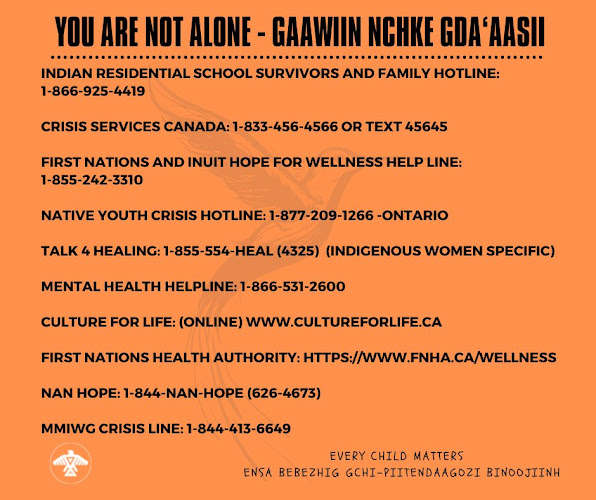
A national Indian Residential School Crisis Line has been set up to provide support for former students and those affected. People can access emotional and crisis referral services by calling the 24-hour national crisis line: 1-866-925-4419.

Monday, June 28, 2021

Saskatoon: People of today have inherited the aftermath #TRC

Chief Delorme says ‘reset’ needed on reconciliation journey

Chief Delorme says 'reset' needed on reconciliation journey
Marking the Graves (Cowessess First Nation/Submitted)


Cowessess First Nation Chief Cadmus Delorme was not expecting the number of unmarked graves on the former Marieval Indian Residential School site to be as high as 751.

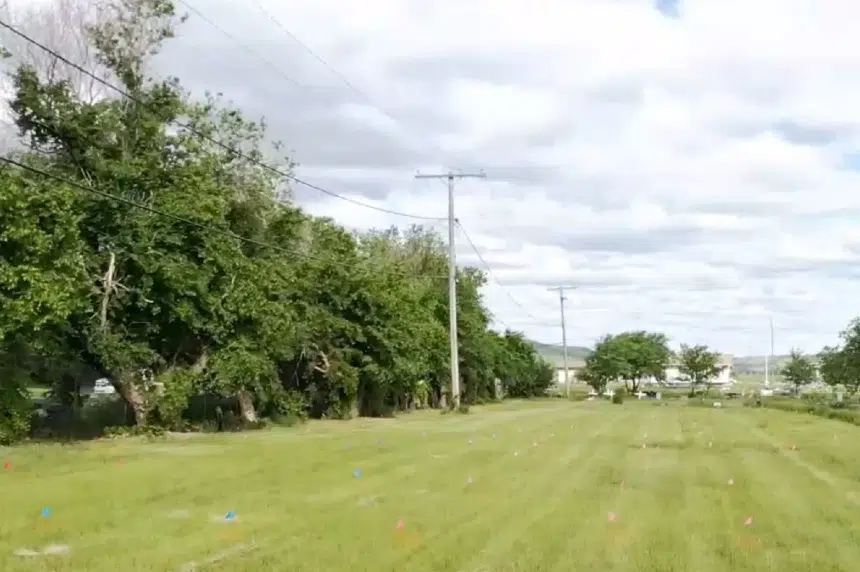
The search involved the use of ground-penetrating radar. Flags mark the positions of the once-concealed burial plots.

Delorme told Gormley on Friday morning that when the search began, technicians brought just 200 flags, running out on the first day.

“We’re like, ‘What are we getting into here? What is the reality of this?’ And by the end of the week, it got very emotional, very heavy,” Delorme said.

At first glance, the burial ground appears to be an empty field. Delorme recalled running through the area as a child. “Just kids being kids,” he said. But it was known that the graves were beneath their feet. Oral stories told of their existence.

“We were always told, ‘Walk on the path, walk on the path,’ ” he said.

Delorme said the Oblates arrived in 1886.  (Catholic Missionary Oblates of Mary Immaculate) That location was the gravesite for the Roman Catholic Church, so there were non-Indigenous people buried there as well. The Marieval Indian Residential School opened in 1898.

He said the search started June 2 on the east side of the field, going west.

“We were doing two metre by two metre the first day, and then we were like, ‘Oh, maybe we should do one metre by one metre,’ ” Delorme said.

That’s when the flags were planted and it became apparent there were children buried.

“OK, so one metre by one metre, that means that there’s not full adults here,” Delorme said.

In 1970, the burial ground became a community cemetery, no longer under control of the Oblates and priests, Delorme said. Grave markers from that point on are there today.

“So that’s why it’s somewhat challenging to talk about because it is the community gravesite today. We honour that,” he said. “But there was almost 80 years where the priests had a say, who did and who didn’t belong in that gravesite.”

Delorme’s advice for people to play a role in reconciliation is a mental “reset.”

“There is real anger and pain amongst many of my people. And that anger and pain is there because of the ignorance and the accidental racism and it just triggers,” he said.

He said Indigenous people are “trying to get out of this dependence state,” while also focusing on political sovereignty and cultural rejuvenation.

When asked about those who wish to “cancel” Canada Day, Delorme said he was “in no capacity to tell anybody what they should or should not celebrate.”

Delorme said while the fruits of colonialism like the residential school system, Indian Act, and ’60s Scoop were created in the past, people of today have inherited the aftermath.

“We must accept the good and what we inherited,” he said.

He challenged people to read the Calls to Action by the Truth and Reconciliation Commission, share them, and act on any of them that “click with you.”

“We’ve got some work to do,” he said, “and if we all just grab a little bit of it, this country would and will be the greatest in the world.”

SOURCE 

**

Orange Shirt Day happens every year on September 30th.


With the recent spike in interest for Orange Shirt Day events the team is designing special programming for both primary grades and ages 13+.
Save the Evidence is a campaign to raise awareness and support for the restoration of the former Mohawk Institute Residential School, and to develop the building into an Interpreted Historic Site and Educational Resource


In order to lock in a spot and date for your class or corporation, visit: website.


Happy Visitors!

WRITTEN BY HUMANS!

WRITTEN BY HUMANS!

Blog Archive

Featured Post

Your History Class Was a F*cking Lie | #NOMOAR

  Your History Class Was a F*cking Lie by Sean Sherman (Or: How the American Educational System Has Always Been a Racist Propaganda Program...


Native Circles

Native Circles
click logo for podcasts!

Most READ Posts

Bookshop

You are not alone

You are not alone

To Veronica Brown

Veronica, we adult adoptees are thinking of you today and every day. We will be here when you need us. Your journey in the adopted life has begun, nothing can revoke that now, the damage cannot be undone. Be courageous, you have what no adoptee before you has had; a strong group of adult adoptees who know your story, who are behind you and will always be so.

Diane Tells His Name


click photo

Lost Birds on Al Jazeera Fault Lines

Lost Birds on Al Jazeera Fault Lines
click to read and listen about Trace, Diane, Julie and Suzie

NO MORE STOLEN SISTERS

NO MORE STOLEN SISTERS
click image

ADOPTION TRUTH

As the single largest unregulated industry in the United States, adoption is viewed as a benevolent action that results in the formation of “forever families.”
The truth is that it is a very lucrative business with a known sales pitch. With profits last estimated at over $1.44 billion dollars a year, mothers who consider adoption for their babies need to be very aware that all of this promotion clouds the facts and only though independent research can they get an accurate account of what life might be like for both them and their child after signing the adoption paperwork.

Original Birth Certificate Map in the USA

Google Followers