They Took Us Away

They Took Us Away
click image to see more and read more

it's free

click

How to Use this Blog

BOOZHOO! We've amassed tons of information and important history on this blog since 2010. If you have a keyword, use the search box below. Also check out the reference section above. If you have a question or need help searching, use the contact form at the bottom of the blog.


We want you to use BOOKSHOP to buy books! (the editor will earn a small amount of money or commission. (we thank you) (that is our disclaimer statement)

This is a blog. It is not a peer-reviewed journal, not a sponsored publication... WE DO NOT HAVE ADS or earn MONEY from this website. The ideas, news and thoughts posted are sourced… or written by the editor or contributors.

EMAIL ME: tracelara@pm.me (outlook email is gone) THANK YOU CHI MEGWETCH!

SEARCH

Showing posts with label Navajo adoptee. Show all posts

Friday, March 28, 2025

One little Indian girl: Two mothers, two worlds


Local resident recounts adoption from Navajo Tribe, reconnecting with roots

BY SHEILA HARRIS sheilaharrisads@gmail.com

“Sometimes I feel like a fake Indian,” said Margie Sterling, of rural Exeter.

A member of the Navajo Nation, Margie was adopted by a caucasian couple in June of 1958, just shy of her 5th birthday.  She believes she is one of the first children who was allowed to be adopted from the tribe.

“Navajoland,” the nation’s reservation, encompasses over 27,000 square miles of land across portions of New Mexico, Arizona and Utah.  With over 400,000 tribal members, the Navajo Nation is the largest of 574 federally-recognized indigenous tribes in the U.S., achieving that status in 2020, after surpassing the membership of the Cherokee Nation.

At 70, Margie still has difficulty believing the story of her adoption, one she learned of only 20 years ago.

She remembers, as a child, how excited she was when making the trip from a foster home in Albuquerque, N.M., to the Stones Prairie community, west of Purdy, to live with her adoptive parents, Edgar “Red” and Virginia Sterling.  The Sterlings did not disappoint.

Virginia and her mother had a room prepared, one decked in pink-and-white gingham, with furniture painted a pearly pink: a fairy-tale world for 4-year-old Margie.

When the Sterlings discovered they were unable to have children of their own, they began checking into the possibility of adoption in early 1957. Because Virginia’s father was of Native American descent, she set her heart on adopting a Navajo girl, and wrote a letter of inquiry about the possibility to the Navaho (or “Navajo”) Mission in St. Michaels, Ariz.

KEEP READING: https://www.cassville-democrat.com/2025/03/26/one-little-indian-girl-two-mothers-two-worlds/ 

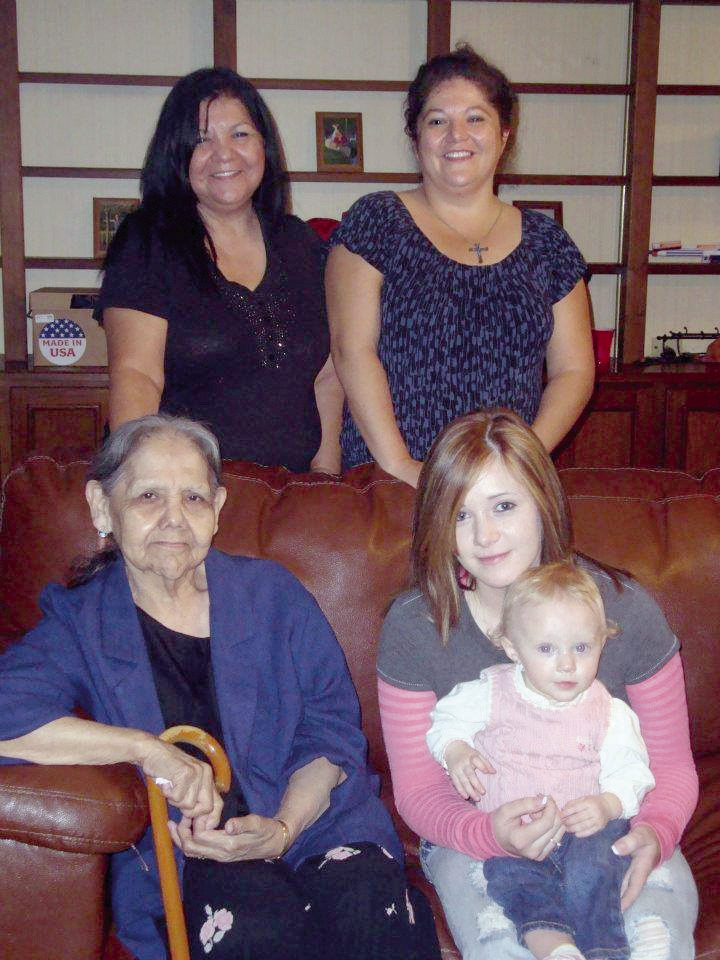
Margie Sterling, back left, stands with her daughter, Theresa Schafer, in Sterling’s prized five-generation photo.  At front left is Sterling’s birth mother, Margaret Lopez, seated next to Sterling’s granddaughter, Jamie Lynn Stokes, who is holding Sterling’s great-granddaughter, Maddison. Contributed photo


Tuesday, July 9, 2024

Fiction: Lost Birds

👉 What We're Reading: Lost Birds (fiction)


Anne Hillerman's "Lost Birds," the ninth in her series, weaves together the search for a missing Navajo woman and a Diné woman's quest for her roots.

By Molly Boyle

"Lost Birds" by Anne Hillerman intertwines two searches on the Navajo Nation. Photograph by Inga Hendrickson.

AT THE OUTSET of Lost Birds (Harper), Anne Hillerman’s gripping ninth novel in the Leaphorn, Chee, and Manuelito series, a man rings up retired detective-turned-private-eye Joe Leaphorn for help.  As Cecil Bowleg begins to explain that his wife has gone missing from the Navajo Nation, a sudden explosion on the line interrupts the call.  Meanwhile, Leaphorn’s also searching for the biological parents of a DinĂ© woman who was adopted by a bilagáana (Anglo) family.  How’s it all going to come together with the help of Off.  Bernadette Manuelito and Lt. Jim Chee?  Read on.  According to Hillerman, the plot is inspired by the recently upheld Indian Child Welfare Act (ICWA), designed to protect Native children from removal from their communities.

Monday, November 6, 2023

Adoptee Assistance: Navajoland

Navajo Nation expedites membership verification for Indian Child Welfare Act

Navajo Nation President Buu Nygren signed a memorandum of agreement to streamline the process of determining whether a Native child is actually Navajo on Oct. 30, 2023. Navajo Nation Attorney General Ethel Branch, and Debbie Nez-Manuel, director of the Navajo Division of Human Resources, also signed.

The Navajo Nation has developed a streamlined process to determine whether a Native child who may be adopted is actually Navajo.

The Indian Child Welfare Act was passed in 1978 to establish basic requirements to protect Native American children from removal from their homes and communities.

If a child is determined to be a tribal member, the ICWA then triggers legal protections and the right of the Navajo Nation to intervene.

However, the process to verify tribal membership can take several months.

Tribal officials say this new agreement will significantly shorten the time to determine membership by improving coordination and the sharing of records between Navajo Nation divisions and the offices that work with children in custody, adoption or foster cases.

Caseworkers will then be able to determine if ICWA applies in a matter of weeks, which will allow the Navajo government to intervene sooner.

President Buu Nygren signed off on the memorandum of agreement October 30, 2023.

READ

https://blog.americanindianadoptees.com/2023/09/how-to-enroll-if-you-are-navajo.html

Wednesday, September 20, 2023

How to Enroll if You are Navajo

Are you Navajo? an adoptee? FIRST fill this out:  https://www.signnow.com/fill-and-sign-pdf-form/58512-navajo-nation-cib

...

Liquidlibrary/Getty Images

(2017) According to the census, the Navajo Nation consists of over 330,000 enrolled tribal members across Utah, Colorado, Arizona and New Mexico, making it the second-largest tribal population in the United States, after the Cherokee Nation. Because membership criteria varies from tribe to tribe, there are no hard-and-fast, uniform membership requirements, though generally a person must be at least 1/4 Navajo and able to provide proof of Navajo ancestry.

While the following steps come recommended by the Navajo Nation's Washington Office, contacting the office directly should be the first step on your journey.

Gather vital records about your family in order to conduct a trace of your Navajo ancestry. These records include the names of ancestors, their dates of birth, marriages and deaths, the places they lived, their brothers and sisters, and their tribal affiliation.

Reach out to the National Archives and Records Administration and the U.S. Department of the Interiors Division of Tribal Government Services to help locate documents and establish a line of Navajo ancestry.

A Certificate of Degree of Indian Blood (CDIB) from the Bureau of Indian Affairs may help expedite the process. To get one, fill out and send the BIA's request form along with a certified copy of your birth certificate and copies of your parents' and grandparents' birth or death certificates.

Determine whether your ancestors are on an official tribal roll or census (the original list of tribal members listed in the Navajo constitution) by contacting the National Archives and Records Administration or the Tribal Enrollment branch of the Bureau of Indian Affairs.

Contact the tribe directly once you have acquired the proper documents in order to find out if they have records of your ancestors. Likewise, membership will only be given by contacting the Navajo Nation as detailed membership criteria are set forth in the Navajo tribal constitution. 

You can find contact information at https://www.navajo-nsn.gov/, or reach the Navajo Nation's Washington Office at (928) 871-6386 or at info@nnwo.org.

How to Find a Roll Number on the Dawes Roll


If you are an adoptee, let them know when you call. Give them all the information you have available, like your birthdate and state where you were born, and the state where you were adopted. Let them help you with a court order to unseal your records using ICWA. - Trace 


Monday, November 21, 2022

My Navajo identity was taken from me

 SOURCE

Opinion: I’m a Jersey girl born into the Salt Clan. My Navajo identity was taken from me

Editor’s Note: Hilary C. Tompkins, a member of the Navajo Nation, served as the Solicitor of the US Department of the Interior during the Obama administration. She currently practices law in Washington, DC. The views expressed in this piece are her own. Read more opinion at CNN.

CNN  — 

My adoption papers said my mother was “very attractive” and that my “grandmother has some education and is considered to be an intelligent woman.” My father, who was listed as “Plains,” was described as having “hair with a slight tendency to wave.”

These small nuggets of information from my adoption papers were my only connection to my birth family. Only much later in life, as a young adult taking Native American studies at Dartmouth College, did I learn that I also had a legal connection with the Navajo Nation as a citizen of the Tribe.

Hilary Tompkins

I’m like many Native Americans who were placed in White families under the Department of the Interior’s Indian Adoption Project in the 1960s and 1970s.

As with the placements of Indian children in boarding schools, this program removed Native children from their Tribes without justification and assimilated them into mainstream America. When I met my birth family as a young adult, one of my aunts held me and cried, saying the last time she held me I was a baby and she had told the hospital officials that she and my extended family would take care of me, but to no avail. I was taken away and put up for adoption anyway.

Recognizing that the continued existence of Tribal Nations was at stake because of the loss of up to 35% of their children, Congress outlawed this practice in 1978 with the passage of the Indian Child Welfare Act (ICWA). At the time, placement with White families was estimated to be at 90%.

Earlier this month, the US Supreme Court held oral arguments in a closely watched case, Haaland v. Brackeen, to decide whether the Indian Child Welfare Act is unconstitutional because it favors the adoption of Native children by Native families.

The states of Texas, Louisiana and Indiana, along with non-Native parents seeking to adopt Native children, say that ICWA amounts to racial discrimination because it has nothing to do with the “ability of Indians to govern themselves.” They argue that the states and non-Native parents should be able to decide the placement of Native children free of consideration of their tribal status because there is no political interest of the Tribes at stake.

And opponents of the Indian Child Welfare Act even go a step further, saying that the law goes against the best interests of Native children by imposing standards that make it harder for them to be adopted into stable, loving homes.

As a Native person who was adopted into a White family before the implementation of ICWA, that’s not the way I see it. I can attest firsthand, as a citizen of both the United States and the Navajo Nation, that ICWA is not about race.

I grew up in southern New Jersey, but I always knew I was Navajo. Born in Zuni Pueblo, New Mexico, I was separated from my family with only a few papers as evidence of my Tribal status.

By all outward appearances, my life today gives the impression that the Indian Adoption Project was a success. I was placed in a family that loved me. I received an exemplary education. I live a comfortable, middle class life. I have enjoyed professional success, having served as Solicitor of the Department of the Interior, the third ranking position in the department – the very federal agency that set my course in life. Yet despite these blessings, the Indian Adoption Project left me adrift, a foreigner in my own country.

Upon my return to the Navajo Nation almost 30 years ago, my sense of loss was overwhelming. The Navajo Nation is a different world: Navajo is frequently spoken there and the laws and way of living are based on Navajo traditions. There is no separation of Navajo spirituality from Navajo sovereignty. One foundational principle is ke’ – kinship – which is rooted in a vast clan system. I didn’t know my clan and couldn’t speak the language. Nor did I understand the complex and traditional laws of Navajo society. The loss of my culture was not just personal, but political.

I tried to make up for my losses, learning some of the language, attending our traditional ceremonies and working for the Navajo Nation Department of Justice. But despite my best efforts, I couldn’t catch up. I can vote in our elections but I don’t understand the stump speeches. I can’t run for office as I am not a fluent Navajo speaker. I reconnected with my birth family, but I have never felt fully integrated into Navajo society.

ICWA recognized that in order to have functioning tribal governments, you need the next generation of tribal citizens to be part of tribal political society. Taking away Native children threatens tribes’ future because the loss of their kids jeopardizes Tribes’ ability to be political sovereign entities. The law gives a preference for placing a Native child with extended family members, members of its Tribe or members of another Tribe – a priority that can make it harder for a White family to adopt. It requires state courts to notify the Tribe about the child, and to have them indicate the preferred placement – or to say placement with a particular non-Native family is okay.

During oral arguments earlier this month, two of the justices indicated that they understood how high the stakes are for Tribal Nations. Justice Neil Gorsuch observed during oral arguments that in passing the law, Congress understood that ICWA is “essential to [the] self-preservation of Indian tribes.” And Justice Kagan recognized that “the political entity is itself being threatened because of the way decisions on the placement of children are being made.”

If ICWA had been in place when I was adopted, my Tribe would have been involved in my adoption. Navajo tribal authorities would have had a say in my adoption had I been adopted under the provisions of the law. I could have maintained a connection with my relatives – even if I had ended up with White parents. I still could have been adopted by a non-Native family, but my adoptive family might have been able to connect with my extended family or others, fostering a connection with my Tribe. But because I was placed for adoption prior to the existence of ICWA, I had to reclaim my connection with my Tribe all on my own.

My family and I eventually found each other by serendipity when I was living on the Navajo reservation. In middle age, I have come to accept who I am – a Jersey girl born into the Salt Clan. I have overcome the pain and loss. But I wouldn’t wish my experience on the children of Tribal citizens today. We cannot fail Native children again as we have failed them in the past.

Native children deserve the opportunity to be citizens of both the United States and Tribal Nations. I pray that they will not be the subject of another social experiment based on the decisions of government officials who haven’t walked in the shoes of the First Americans.

Tuesday, May 17, 2016

HELP us find Navajo adoptee Christopher Largo

We received this urgent message from Tina. If you know an adoptee born on Nov. 12. 1973/4 - or on January 12, 1974 -- please contact me immediately. [larahentz@yahoo.com]

His mom is very ill and just had cancer surgery. She has made a major effort to try and find her son (my brother) recently. She put him up for adoption through the Navajo Nation Social Service. 

My brother was adopted through the Navajo Nation Social Service. What information I received from my mom is as follows: He was born November 12, 1973/1974 at the Gallup Indian Hospital or on January 12, 1974 in Gallup, New Mexico.  My mom, Betty Jean Largo, named her son Christopher Largo. He was immediately adopted as soon as he was born.  Since he was adopted out through the Navajo Nation and in his 40's there was nothing Navajo Social Services office could do. 
My mom said she thought she gave birth on November 12, 1973/1974 but her aunt said she gave birth on January 12, 1974.  Anyway, my mom said everything was a blur. The days after she adopted, she tried to get her baby back but social service told her she couldn't do that.

If he has non-identifying information, his mother was born in 1949 and was age 24 when she had him. Both parents are Navajo.


Please share this message.

Happy Visitors!

WRITTEN BY HUMANS!

WRITTEN BY HUMANS!

Blog Archive

Featured Post

Your History Class Was a F*cking Lie | #NOMOAR

  Your History Class Was a F*cking Lie by Sean Sherman (Or: How the American Educational System Has Always Been a Racist Propaganda Program...


Native Circles

Native Circles
click logo for podcasts!

Most READ Posts

Bookshop

You are not alone

You are not alone

To Veronica Brown

Veronica, we adult adoptees are thinking of you today and every day. We will be here when you need us. Your journey in the adopted life has begun, nothing can revoke that now, the damage cannot be undone. Be courageous, you have what no adoptee before you has had; a strong group of adult adoptees who know your story, who are behind you and will always be so.

Diane Tells His Name


click photo

Lost Birds on Al Jazeera Fault Lines

Lost Birds on Al Jazeera Fault Lines
click to read and listen about Trace, Diane, Julie and Suzie

NO MORE STOLEN SISTERS

NO MORE STOLEN SISTERS
click image

ADOPTION TRUTH

As the single largest unregulated industry in the United States, adoption is viewed as a benevolent action that results in the formation of “forever families.”
The truth is that it is a very lucrative business with a known sales pitch. With profits last estimated at over $1.44 billion dollars a year, mothers who consider adoption for their babies need to be very aware that all of this promotion clouds the facts and only though independent research can they get an accurate account of what life might be like for both them and their child after signing the adoption paperwork.

Original Birth Certificate Map in the USA

Google Followers