They Took Us Away

They Took Us Away
click image to see more and read more

it's free

click

How to Use this Blog

BOOZHOO! We've amassed tons of information and important history on this blog since 2010. If you have a keyword, use the search box below. Also check out the reference section above. If you have a question or need help searching, use the contact form at the bottom of the blog.


We want you to use BOOKSHOP to buy books! (the editor will earn a small amount of money or commission. (we thank you) (that is our disclaimer statement)

This is a blog. It is not a peer-reviewed journal, not a sponsored publication... WE DO NOT HAVE ADS or earn MONEY from this website. The ideas, news and thoughts posted are sourced… or written by the editor or contributors.

EMAIL ME: tracelara@pm.me (outlook email is gone) THANK YOU CHI MEGWETCH!

SEARCH

Showing posts with label Death by Boarding School. Show all posts

Tuesday, January 30, 2024

Carlisle: Sending childen home to die


excerpt:

Mary Annette Pember
ICT

George Little Wound was gravely ill when he was sent home to Pine Ridge from the Carlisle Indian Industrial School in 1889, just three years after arriving at the notorious boarding school.

Little Wound, the son of Chief Little Wound, was among a group of three Pine Ridge students shipped home together with what the school physician described as “incipient consumption” and “scrofula,” a disfiguring infection of the skin and lymph nodes caused by the same bacteria as tuberculosis, according to Carlisle records.

All three appeared to survive their illness for some time after they returned to Pine Ridge, though Little Wound was never the same.  Forever weakened by the disease, he struggled to support himself and expressed disgust with his school experience.

“I went to [Carlisle] school to get a good education ... but I was greatly mistaken when I went to school,” he wrote in 1911, in a tersely worded survey he sent to Carlisle more than 20 years after returning home.

“I come home with sickness and do not know any thing.... and believe I may never get well from the sickness which I brought from the school,” he wrote. “I am in a miserable place and bad condition living in a one-room log home without floor where I am unable to help myself.”

Native populations across the country decreased by more than 100,000 during the early years of boarding schools, with about one third of the total Native population dying between 1860 and 1900, mostly from diseases such as tuberculosis.

KEEP READING

Tuesday, June 14, 2022

Healing, remembrance as former boarding school crumbles


sclark@record-eagle.com |  

MOUNT PLEASANT — Children ran along the grounds, playing on the former grounds of the Mount Pleasant Indian Industrial Boarding School.

Long braided hair, ribbon skirts, and the practice of Anishinaabek ceremony such as smudging would have not been allowed 88 years ago.

On the anniversary of the institution’s closure, more than 100 community members gathered to recognize the suffering, strength and resilience of the children through a day of memoriam and fellowship.

The Mount Pleasant Indian Industrial Boarding School operated for more than four decades starting in 1893, before its closure on June 6, 1934.

Now, seven crumbling buildings are all that physically remain of the institution which once kept thousands of Native American children.

Despite boarded windows and deteriorating brick, the structures remain standing, to give testimony of the legacy of the boarding schools felt deeply across Indian Country throughout generations.

Eleven-year old Harmony Wethington, a citizen of the Nottawaseppi Huron Band of Potawatomi, stood along the former girl’s dormitory.

She tiptoed on her white moccasins, and peeped through a window, hoping to catch a glance of the interior.

She could have been kept there prior to the passage of the Indian Child Welfare Act in 1978 — it wasn’t until then Native American parents gained the legal right to deny their children’s placement in off-reservation schools.

Wethington said it was her second year coming to the memoriam.

“It’s a sad experience, but I am here to remember my family and all other families,” Wethington said.

Her great-great grandparents attended MIIBS, and other families also went to other boarding schools in the U.S.

The culturally significant clothing Harmony donned proudly was made by her grandmother, Jennifer Wethington, who said coming to the grounds is a visual reminder of what their family overcame from boarding schools.

MIIBS was just one of over 497 federally funded institutions identified that operated under U.S policies for more than 150 years where children as young as 4 were forced from their families, prohibited from speaking their languages and often abused.

According the first volume of the Federal Indian Boarding School Initiative Investigative Report, these institutions used “militarized” tactics to assimilate Native American children in environments described as fostering “rampant physical, sexual, and emotional abuse; disease; malnourishment; overcrowding; and lack of health care.”

Many children never returned home, and the Interior Department said that, with further investigation, the number of known student deaths could climb to the thousands or even tens of thousands.

“Each of those children is a missing family member, a person who was not able to live out their purpose on this Earth because they lost their lives as part of this terrible system,” said Interior Secretary Deb Haaland, whose paternal grandparents were sent to boarding school for several years.

As previously reported, the U.S. documented five deaths of Indigenous children at MIIBS from 1893 to 1934.

But after the land was returned to the Saginaw Chippewa Indian Tribe of Michigan in 2010 by the state, volunteer researchers from the Ziibiwing Cultural center found evidence of 227 deaths attributed to MIIBS that were not reported in the school’s archives.

The search for the missing children remains underway, said Marcella Haden, SCIT Tribal Historical Preservation officer.

She said that plans under an amended deed agreement between the city of Mount Pleasant and the tribe will begin ground-penetrating radar on the land, but no exact date was given

Federal government used money from Indian Trust Funds to pay schools — even those run by religious organizations, the report stated.

While it doesn’t say how many were church-run. An earlier report by the National Native American Boarding School Healing Coalition found that more than 150 were, about half each by Catholic and Protestant groups.

Further details state the government provided funding and other support to religious boarding schools for Native children in the 19th and early 20th centuries to an extent that normally would have been prohibited under rules of separation between church and state.

The Interior Department report, quoted a 1969 Senate investigation, acknowledged that “federal policy toward the Indian was based on the desire to dispossess him of his land. Education policy was a function of our land policy.”

Churches had clout with the government as well, it adds, and were able to recommend people for appointments to federal positions on Native affairs.

“We do this because they couldn’t,” said Lacey Kinnart, citizen of the Sault Ste. Marie Tribe of Chippewa Indians and descendant of boarding school survivors.

Her grandmother and great-aunts attended Holy Childhood as children, and other family members attended MIIBS.

“It is important that we recognize the generational trauma but it’s also just as important to remember the generational resilience and wisdom,” Kinnart said.

Kinnart serves as the programs and operations coordinator for the Native American Boarding School Healing Coalition. It was her and her mother’s first year coming to the grounds.

“I’m humbled to be here among our community,” she said.

The day closed in front of the former boys dormitory, with traditional Anishinaabek jingle dress dancing, led by Punkin Shananaquet, citizen of the Match-e-be-nash-she-wish Band of Potawatomi Indians.

Shananaquet said the time was now to come together for the healing and protection of the future generations,

The Associated Press contributed to this report.

Sunday, August 15, 2021

How Native students fought back against abuse and assimilation at US boarding schools #TakeLand #LandBack

       
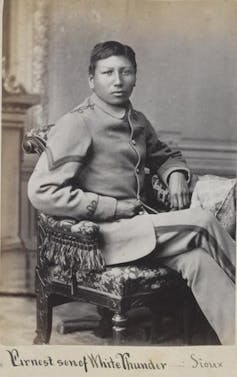
Portrait of Ernest Knocks Off. John N. Choate/Cumberland County Historical Society, CC BY-NC-SA

LINK

As Indigenous community members and archaeologists continue to discover unmarked graves of Indigenous children at the sites of Canadian residential schools, the United States is reckoning with its own history of off-reservation boarding schools.

In July 2021, nine Sicangu Lakota students who died at the Carlisle Indian Industrial School in Pennsylvania were disinterred and returned to their homelands at Whetstone Bay in South Dakota.

One of these young people was Ernest Knocks Off. Ernest, who came from the Sicangu Oyate or Burnt Thigh Nation, was among the first group of students to arrive at Carlisle, in 1879. He entered school at age 18 and attempted to run away soon after arriving. He ultimately went on a hunger strike and died of complications of diphtheria on Dec. 14, 1880.

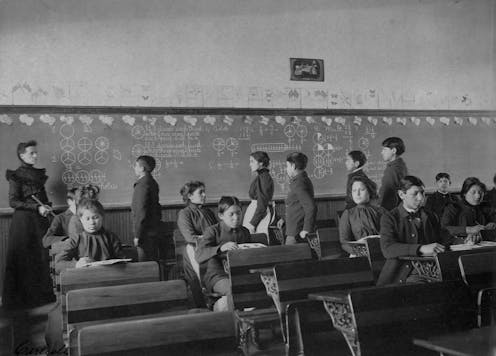
My new book “Writing Their Bodies: Restoring Rhetorical Relations at the Carlisle Indian School” explores how Indigenous children resisted English-only education at Carlisle, which became the prototype for both Indian schools across the U.S. and residential schools in Canada. Ernest Knocks Off was 18 when he arrived at the Carlisle boarding school in 1879. He was one of many young Native people who fought – in his case, to the death – to retain their language and culture.

Native American students at the Carlisle Indian School, circa 1899. Library of Congress/Corbis Historical Collection/VCG via Getty Images
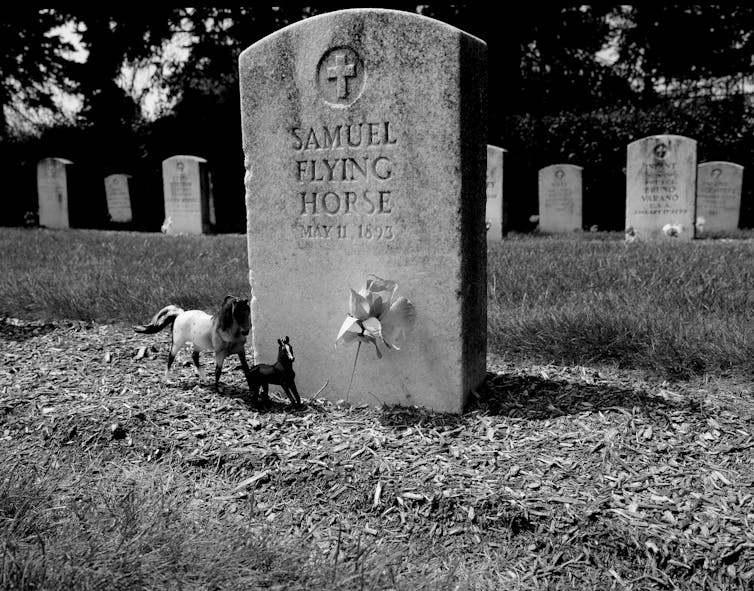
A tombstone of a young Oglala Lakota student buried at the old Carlisle Indian School cemetery. Andrew Lichtenstein/Corbis News Collection via Getty Images

Pratt and his supervisors at the Bureau of Indian Affairs hoped that they could break up tribes by disrupting the transmission of language and culture from one generation to the next. By destroying tribal identities, they hoped to take land in communally held reservations and guaranteed by treaties.

PLEASE READ: How Native students fought back against abuse and assimilation at US boarding schools


Here is a record from Carlisle:

Notice: Howard Slow Bull (age 18) goes to the institution in 1886, is sent to farmers in PA in 1888 and dies in 1893 at age 25. These are the mysteries we still need to solve... so their souls can rest...   These were not schools but DEATH CAMPS and these children were hostages.... Blog Editor

Saturday, November 16, 2019

Names of 2,800 children who died in residential schools documented in registry #TRC


Charlie Hunter was one of the children who never came home.

He died in October, 1974, days shy of his 14th birthday, after he fell through ice while attending St. Anne’s Residential School in Fort Albany, Ont., his sister Joyce Hunter said on Monday after his name appeared on a registry of deceased Indigenous children.

“Those are stories and those are lived experiences,” Ms. Hunter said. “They matter.”

The list of Indigenous children who died in Canada’s residential school system

The National Residential School Student Death Register – 2,800 names presented publicly for the first time on a scarlet banner at the Canadian Museum of History in Gatineau – is a permanent reminder of fatalities as a result of the government-funded education program that spanned more than 100 years and forcibly removed more than 150,000 Indigenous children from their families.

The National Residential School Student Death Register was presented publicly at the Canadian Museum of History in Gatineau by the Truth and Reconciliation Commission...

READ: Names of 2,800 children who died in residential schools documented in registry

Monday, October 22, 2018

Where are they buried?


Thousands of Canada’s indigenous children died in church-run boarding schools

Armed with everything from school attendance records to drones, researchers across Canada are racing to shed light on a bleak part of the country’s history: How many indigenous children died at residential schools, and where are their unmarked graves? From 1883 to 1998, nearly 150,000 indigenous children were forcibly separated from their families and sent to the government-funded, church-run boarding schools in an attempt to assimilate them. Once there, they were frequently neglected and abused. What happened at the schools was akin to “cultural genocide,” concluded a 2015 report from Canada’s Truth and Reconciliation Commission. It also found that at least 3,200 students died at residential schools over those 115 years — a much higher rate than for students elsewhere in Canada — though the commission contended that the number was probably much higher and merited further investigation.

The religious organizations that operated the schools — the Anglican Church of Canada, Presbyterian Church in Canada, United Church of Canada, Jesuits of English Canada and some Catholic groups — in 2015 expressed regret for the “well-documented” abuses. The Catholic Church has never offered an official apology, something that Trudeau and others have repeatedly called for.

READ: Thousands of Canada’s indigenous children died in church-run boarding schools. Where are they buried? - The Washington Post

Thursday, January 23, 2014

Death by Boarding School

New Scholarship by Ann Piccard

Ann Piccard has published Death by Boarding School: “The Last Acceptable Racism” and the United States’ Genocide of Native Americans, 49 Gonz. L. Rev. 137 (2014).

A summary:
There is a special kind of racism in this country against Native Americans, and it is the “last acceptable racism.” The author of that poignantly accurate description of most Americans’ attitudes towards Native Americans, who is both a Native American and a Jew, noted,
Not that long ago, white administrators of Indian boarding schools told our children that the “Indian in you shall die.” This kind of treatment and forced thinking has a lasting generational effect. It can be difficult to break through that type of programming.  Many of our people, however, have shaken off these forced ideological shackles to speak the truth and demand long overdue respect. Our voice is getting louder.
Our words are being said with more frequency and emphasis. But people need to hear us. Societal racism should no longer be an ad hoc affair, which is routinely accepted when directed against a certain group. It should be universally condemned. Perpetuating past wrongs and dehumanizing concepts hurts everyone.
This last acceptable racism is rarely mentioned in the U.S. However, one day in a very small town in northern Minnesota, in an area that has been economically depressed ever since the decline of the taconite and iron ore mining industry several decades ago, I watched two Native American men park a pickup truck in front of the local pawn shop.
I could tell the young men were Native Americans only because of the Bois Forte Band license plate on their truck; other than that, they looked, sounded, and acted like most of the other men in that rural north woods town. Upon reflection, of course, I realized that their skin was slightly darker than most residents of the town; I also began to notice that I did not see dark-skinned people working or shopping in any of the town’s stores. My eye was untrained, a fact that I attribute to my upbringing in the Deep South,6 where I was in a small minority of white children who were raised by our parents to see and to protest (and refuse to accept) the prevailing racism toward African-Americans. The subtle differences in appearances between the Native Americans and the “whites” in Minnesota had gone unnoticed by my Southern eyes. But as we watched the young men take their chain saws into the pawnshop that day, my husband remarked that men in northern Minnesota who hock their chain saws must be in pretty bad shape, because how could they survive, let alone make a living, without such tools?

Archive photo

Happy Visitors!

WRITTEN BY HUMANS!

WRITTEN BY HUMANS!

Blog Archive

Featured Post

Your History Class Was a F*cking Lie | #NOMOAR

  Your History Class Was a F*cking Lie by Sean Sherman (Or: How the American Educational System Has Always Been a Racist Propaganda Program...


Native Circles

Native Circles
click logo for podcasts!

Most READ Posts

Bookshop

You are not alone

You are not alone

To Veronica Brown

Veronica, we adult adoptees are thinking of you today and every day. We will be here when you need us. Your journey in the adopted life has begun, nothing can revoke that now, the damage cannot be undone. Be courageous, you have what no adoptee before you has had; a strong group of adult adoptees who know your story, who are behind you and will always be so.

Diane Tells His Name


click photo

Lost Birds on Al Jazeera Fault Lines

Lost Birds on Al Jazeera Fault Lines
click to read and listen about Trace, Diane, Julie and Suzie

NO MORE STOLEN SISTERS

NO MORE STOLEN SISTERS
click image

ADOPTION TRUTH

As the single largest unregulated industry in the United States, adoption is viewed as a benevolent action that results in the formation of “forever families.”
The truth is that it is a very lucrative business with a known sales pitch. With profits last estimated at over $1.44 billion dollars a year, mothers who consider adoption for their babies need to be very aware that all of this promotion clouds the facts and only though independent research can they get an accurate account of what life might be like for both them and their child after signing the adoption paperwork.

Original Birth Certificate Map in the USA

Google Followers