BOOZHOO! We've amassed tons of information and important history on this blog since 2010. If you have a keyword, use the search box below. Also check out the reference section above. If you have a question or need help searching, use the contact form at the bottom of the blog.
We want you to use BOOKSHOP to buy books! (the editor will earn a small amount of money or commission. (we thank you) (that is our disclaimer statement)
This is a blog. It is not a peer-reviewed journal, not a sponsored publication... WE DO NOT HAVE ADS or earn MONEY from this website. The ideas, news and thoughts posted are sourced… or written by the editor or contributors.
EMAIL ME: tracelara@pm.me (outlook email is gone)
THANK YOU CHI MEGWETCH!
SEARCH
Showing posts with label boarding school survivor. Show all posts
Showing posts with label boarding school survivor. Show all posts
Webinar on the U.S. Truth & Healing Commission Bill on 9.27.23
The National Native American Boarding School Healing Coalition (NABS) hosted a virtual conversation on the Truth and Healing Commission on Indian Boarding School Policies Act (S. 1723).
NABS is joined by U.S. Congresswoman Sharice Davids (Ho-Chunk) and a guest panel featuring Sterlin Harjo (Seminole/Muscogee), Dallas Goldtooth (Lower Sioux Dakota Nation), Mato Wahuyi (Oglala Lakota), and Georgeanne Growingthunder (Fort Peck Assiniboine and Sioux Tribes).
Learn how you can advocate for the U.S. Truth and Healing Commission Bill.
We have a right to know the truth of what happened in Indian boarding schools in the United States.
Over the course of a century, hundreds of thousands of our
children were taken or coerced away from our families and Tribes and
forced to attend government-sanctioned Indian boarding schools. These
schools were tools of assimilation and cultural genocide, resulting in
the loss of language and culture and the permanent separation of
children from their families. To date, there has never been an
accounting of:
the number of children forced to attend these schools;
the number of children who were abused, died, or went missing while at these schools; and
the long-term impacts on the children and the families of children forced to attend Indian boarding schools.
We have a limited amount of time to hear directly from survivors and
record their stories. A Congressional Commission is needed to locate and
analyze the records from the 523 known Indian boarding schools that
operated in the U.S. A Commission would also bring together boarding
school survivors with a broad cross-section of tribal representatives
and experts in education, health, and children and families to fully
express and understand the impacts of this federal policy of Indian
child removal.
He was determined to change his life, so he rode a bike from Moncton to Nanaimo
After 20 years living in Eastern Canada,
Chris Aubichon is returning to Vancouver Island to finish his education,
which he stopped pursuing at the age of 12. “This is part two of my
life."
Chris
Aubichon’s two elder daughters and sister Jenn were waiting to welcome
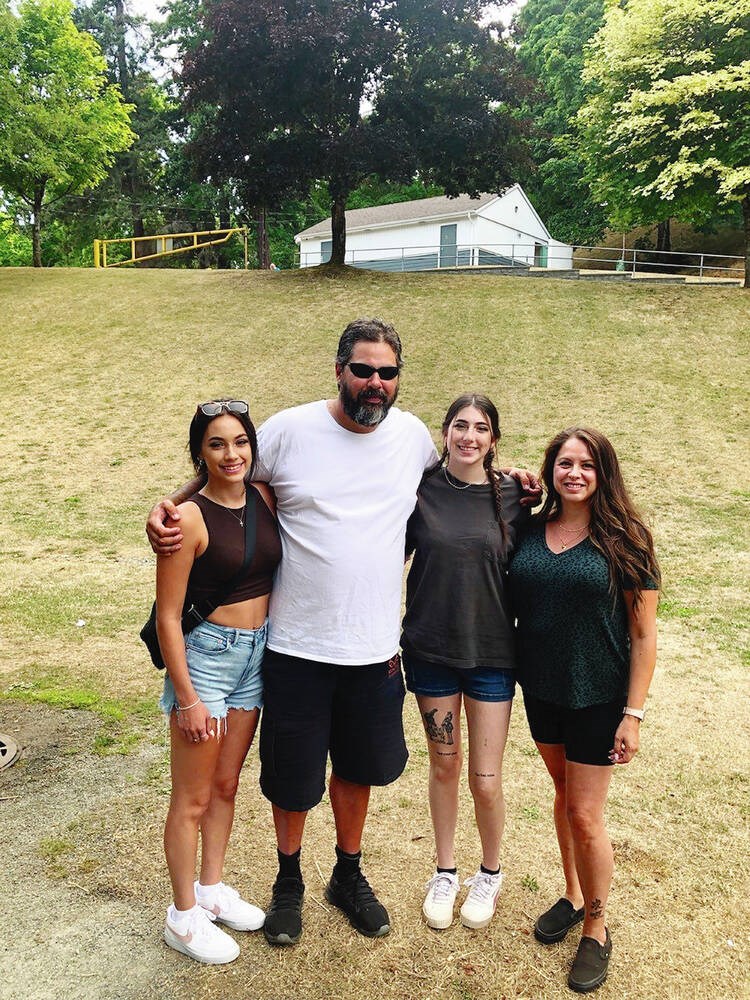
him at Bowen Park. From left, Nevaeh, Chris, Selenia, and Jenn. VIA JENN
AUBICHON
Chris Aubichon has spent the past three months cycling across
the country in a bid to raise awareness of post-foster-care life and
men’s mental health — and to begin a second chapter of his own life.
The 44-year-old father of three reached the finish line at Bowen Park
in Nanaimo on Friday evening, where he was greeted by a cheering group
of supporters.
After 20 years living in Eastern Canada, he’s returning to finish his education, which he stopped pursuing at the age of 12.
“This is part two of my life,” he said.
Aubichon, born in Prince George and raised in Nanaimo, is of mixed
Indigenous and Metís heritage; he was a ward of the court from the age
of six to 18.
His mother, who is of Tla’amin descent, was raised by a white Catholic family and was part of the Sixties Scoop.
“She had her own demons,” he said, adding that her mother was born in a residential school.
His grandmother died of a drug overdose in Vancouver’s Downtown Eastside after leaving residential school, he said.
Aubichon said he has overcome his substance abuse and addiction
issues, stemming from his upbringing, which involved experiences of
sexual abuse in group homes.
But his mental health remains a persistent challenge, one that has cost him jobs, relationships, and housing.
“It doesn’t matter how badly you want to get up and go to work. You’re not getting up,” he said.
It’s part of the reason why he chose to bike back to Nanaimo.
“If I jumped on a plane and flew across the country, I’m going to be
the same man that got there that left, and that man isn’t going to find
success,” he said.
But someone who’s able to bike across most of Canada?
“The man that can do that can surely be successful at school,” he said.
On May 11, Aubichon found a mountain bike that could hold his
320-pound frame, loaded it up with camping gear and started pedalling.
He didn’t even inform his family until he was halfway to Fredericton.
His sister Jenn, initially skeptical of the whole ordeal, had only
one request: that he document his journey, both the highs and the lows.
Aubichon agreed, even though he thought that no one would care. But
his journey would be followed by thousands on social media, and even
catch the eye of government ministers.
The initial days were the hardest, a constant fight against severe
cramps, back spasms, and shoulder pains resulting from a life of
smoking, drinking and neglect, he said.
“Physically, I was only making it 15 or 20 kilometres a day,” he
said. “I could pedal for maybe 15 seconds and I would have to stop, and
my legs would cramp up.”
But the real battle was in the mind, he said.
Aubichon has bipolar disorder, depression, and chemically-induced
anxiety disorder, which has cost him jobs, relationships, and housing.
“There were days where I’m just riding down the roads and just literally crying,” he said.
But bit by bit, the gears felt lighter on his feet, and every day he
would ride further until he was travelling 120 kilometres per day.
That’s not to say there weren’t other challenges.
Wildfires in Northern Ontario dogged his steps. Vicious headwinds and
sweltering weather accompanied much of his journey through Western
Canada.
The Rockies were brutal, and he was forced to detour from the Coquihalla due to yet another wildfire, near Merritt.
Twice, he was thrown off his bike in northern Ontario by the
buffeting winds of camping vehicles passing him with only 12 inches of
clearance.
On the western outskirts of Winnipeg, his bike was stolen outside of a Tim Hortons.
But an emotional dispatch on social media went viral and people donated money to replace his gear and supplies.
There were many such instances of kindness on his journey, he said,
adding that an older man in North Bay, Ont. slipped him $50 without
knowing that Aubichon was starving that day and couldn’t afford to eat.
People have invited him into homes, waited on the sides of a highway for hours just to encourage him on his journey, he said.
“I’m still a big man, but I’m in great shape,” he said, adding that
he’s probably lost 50 pounds since he started. “I have a clarity that
I’ve never had in my life, and mentally I feel stronger than I ever
have.”
Aubichon now wants to help others through a bike support group and
advocate for better supports for youth aging out of care, who are
overrepresented in homeless populations.
Many people living in tents right now are former wards of the state, sent out to fend for themselves at an early age, he said.
“A lot of what they're dealing with is not their fault.”
As the public now decries the unmarked graves of Indigenous children
of residential and boarding schools, many Native families are thinking,
“We know. Finally, they’re paying attention!” After all the work that
many Native communities and intellectuals/activists have been doing,
people are noticing and condemning, unlike any time before, the terror
and nightmare that Native families have been living with for
generations. Secretary of Interior Deb Haaland, a boarding school
descendant, recently announced the Federal Indian Boarding School Truth
Initiative, which offers hope to affected communities, but also raises
questions about the methods and approaches of this inquiry. Stories are
surging on the outcry and accusations about boarding schools, sometimes
without listening to the Native survivors, families, and communities
that have already been speaking out and seeking truth, healing, and
reconciliation in their own ways. For many that have experienced the
horrors of boarding school first-hand, and to their children, these
conversations trigger trauma.
Farina King and Marsha Small are two Native American scholars and
descendants of boarding school survivors who are dedicated to serving
their peoples by amplifying the voices of those who attended Indian
boarding schools.
In her work, King addresses how Diné identity has changed among
boarding school students through the twentieth century, and she
addresses the physical affronts, illness, abuse, and punishment, and as
well as survivor skills and creativity that students used to overcome
their challenges at boarding schools.
Marsha Small, or O tata’veenova’e (Northern Cheyenne/Tsististah), has
used geo-referencing systems such as ground penetrating radar (GPR) and
geospatial information systems (GIS) to locate unknown and unmarked
burial sites of the Chemawa Indian School Cemetery.
Listen to Farina
King and Sarah Newcomb talk with Marsha Small for the Native Circles podcast.
We are part of a growing collaboration who address the
intergenerational impacts of what historian David Wallace Adams defined
as “education for extinction,” or schooling set to eradicate Indigenous
sovereignty and being in the empire of the United States. We call for
the Indigenizing of truth seeking and telling on the histories of
boarding schools. Healing derives from self-determination and
community-based approaches that center on living Indigenous communities
and boarding school survivors and their families. The National Native
American Boarding School Healing Coalition (NABS) has spearheaded this
movement for truth and healing in the United States (https://boardingschoolhealing.org/).
As early as 1928, the Meriam Report uncovered many of the harms of
Indian boarding schools, such that the federal government increasingly
redirected their attention towards public schools for Native children.
However, some boarding schools have remained open into the twenty-first
century, though they have changed many of their most nefarious policies,
many even embracing the teaching of Native American cultures and
languages. Yet, struggles over educational sovereignty ensues as Native
youth fight to protect their right to life and water at home.
The One Mind Youth Movement are Cheyenne River Sioux young leaders
who are fighting to sustain Indigenous “outreach, community, and
education” (https://www.omym.org/).
Some Indigenous youth are fighting to wear ancestral regalia at their
graduations such as Christian Titman of the Pit River Tribe who sued his
school district in California for not allowing him to wear an eagle
feather in his graduation cap in 2015.
The Navajo Nation is an example of one tribal nation that is
attempting to reaffirm their authority over the education in public
schools on their reservation.
Boarding school histories trigger guilt, both in those involved, as
well as those looking on. Many now ask, what more could we have done to
save the lives of these children?
King once asked her Diné father why he never taught her Diné bizaad,
Navajo language, and he told her, “You never asked.” But she knows other
Diné parents who no longer talk to their children in Navajo, and they
openly admit that they thought that their language would hurt their
prospects in the future. The schools drilled in them that Indigenous
languages and cultures were impediments and vestiges of a losing and
dying people. They believed that the trajectory of their children
excluded Indigenous values, including sovereignty and peoplehood for
which many of their ancestors sacrificed their lives. A relentless
ailment that burdens the survivors of boarding schools and their
posterity is the paradox that we will either forever belong to a race of
victims, or we can reject our Indigeneity and side with “the winning
team.” History is often framed as a game of winners and losers, but
there are never winners in such histories of violence and rupture.
Indian boarding school truth-seekers must seek healing and recognize
our Indigenous ancestors made the most of a difficult situation. They
survived with the hope that their descendants would someday thrive.
Uncovering buried truths will reopen the wounds that never fully healed,
and the healing will be painful. This is not a process that can be
rushed, or ripped apart, and it must involve those who are affected by
the legacies of Indian boarding schools. Each grave uncovered represents
a missing child, a stolen ancestor, and a family that never came to be. -Farina King, Ph.D.
A memorial is seen outside the Residential School in Kamloops, British Columbia, on June 13.
Recent
reports have prompted me to recall the Truth and Reconciliation
Commission meetings I attended with a Canadian friend in Edmonton,
Alberta, in March 2014. The commission's purpose was to bring light to
the dark history of Canadian residential schools, which were modeled
after similar schools for Native children in the United States.
Perhaps
the fear that we in America will discover similar unmarked graves of
Native children who died in the boarding schools we forced them to
attend will lead us to seek the truth and attempt reconciliation, as our
Canadian neighbors have done.
What would a truth and reconciliation commission achieve? What did it achieve in Canada? Why would we venture on such a path?
On a
practical and immediate level, the meetings held across Canada awakened
people. It awakened me, the outsider looking in, feeling shame and
remorse.
The meetings gave voice to those harmed by the residential schools. One account remains vivid:
A
First Nations man described how he lived with his tightly knit extended
family of nomadic hunters and harvesters. One day when he was eight or
nine a boat came upriver to where they were camped; Indian agents came
ashore and an argument ensued. He was wrenched away from his parents,
who were screaming in disbelief, and forced onto the boat. As the boat
pulled away the last thing he saw was his parents waving their arms. It
was the last time he saw them.
When
he arrived at the school they cut off his hair and burned his
traditional clothes, and fed him food he found repulsive. He could not
speak English and no one could speak his language. He slept in a large
room among strangers. He was physically punished for doing things wrong
he didn't even understand. He had no idea why he was there and why such
terrible things were happening to him. Eventually, as he learned
English, he was taught that his beloved grandparents from whom "he had
never heard a bad word" worked for the devil. Yet he missed his family
more than he could express.
He
described sexual abuse, corporal punishment and bullying. When he left
the school as a teenager he fit nowhere. He had lost his native culture
and language, which he had learned to be ashamed of. But he didn't fit
into white society, which for him was racist. Like many he fell victim
to alcohol and drugs.
His story was one of many.
The
second purpose of the meeting was apology. A representative from the
Catholic Church, which had administered most of the schools, read a
letter that began: "We, the Bishops of Alberta and the Northwest
Territories, apologize to those who experienced sexual and physical
abuse in residential schools under Catholic Administration … also we
apologize for participating in governmental policies that separated
children from their parents and that suppressed their cultures."
Representatives
of the provincial and national governments addressed the audience: "We
apologize. Nothing we can say can make this past go away. We may have
thought we were doing good, but we were doing something terribly wrong.
Hopefully by saying this we can begin a process of healing."
Later,
Frank Oberle, Minister of Aboriginal Relations wrote: "Residential
schools will always be among the great wrongs of Canadian history. An
example of the profound harm that we are capable of when inequality,
paternalism and racism prevail over our sense of common humanity."
The
third purpose was concrete change. The most important may have been
mandating that the unvarnished history of the residential schools become
part of the K-12 curriculum across Canada. The commission also produced
four lengthy documents that contained the results from their research
and public hearings, free and easily available on the web. The overview
is found in "Honouring the Truth, Reconciling for the Future: Summary of
the Final Report of the Truth and Reconciliation Commission of Canada,"
easily searchable.
These
reports remind us what humane societies do: they study their missteps,
even evils such as slavery and cultural genocide. They admit to
wrongdoings and invite those who were harmed to speak. The most powerful
speak humbly and ask for forgiveness. Finally, humane and honest
societies rewrite their history when new knowledge and new awareness
comes to the surface. They do it in the open, in a dialogue where all
are invited to speak.
I'd
be thrilled if some of the Americans riled up about "critical race
theory" would read these Canadian documents and think about what it
really means to face up to our past, make amends and move forward.
Douglas Harper, of Forest Lake, is professor emeritus of sociology, Duquesne University.
**
Residential schools: How the U.S. and Canada share a troubling history
U.S. Secretary of the Interior Deb Haaland says she wept when she heard news from Canada about what are believed to be unmarked burial sites of children's remains near a former residential school.
The news made Haaland think of her own Pueblo ancestors such as her
grandmother, who as a girl was taken from her family, put on a train and
placed in the American version of a residential school for five years.
After crying, Haaland took action. The New Mexico politician now leads
the federal department that ran U.S. assimilation schools — she's the
first Indigenous person to do so. And she's launched an investigation
into their legacy.
In a memo last
month to the Department of the Interior, she said the news from Canada
should prompt a reflection on what Americans refer to as native boarding
schools. She requested a report by next year on the schools, their
cemeteries and on the possibility of finding unidentified remains.
It's only fitting that movements to assess the legacy of assimilation
schools in both Canada and the U.S. should occur simultaneously. That's
because they've been intertwined from the start. That point was made
several years ago in Canada's Truth and Reconciliation Commission report.
An architect of Canada's residential schools policy, in an 1879 paper, looked at boarding schools just established in the U.S. and urged Canada
to create similar ones. On the basis of that paper from Nicholas Davin,
Canada's federal government opened three such schools, starting in 1883
in the future province of Saskatchewan.
Both countries
borrowed ideas from reformatories being constructed in Europe for
children of the urban poor, said the Truth and Reconciliation report.
Haaland's great-grandfather was taken to the institution that most
influenced Canada's program: the now-defunct Carlisle Indian Industrial
School in Pennsylvania. The founder of that school, army officer Richard
Pratt, infamously voiced the
philosophy behind his program: "Kill the Indian [in him] … and save the
man," meaning Indigenous Peoples should be assimilated, not
exterminated.
Final funding for Woodland Cultural Centre from Canada and
Ontario Government helps complete Phase 3 of the restoration project.
“Our
government stands shoulder to shoulder with Indigenous partners as we
support community-directed work to identify and commemorate Indigenous
Residential School sites across the province. Today’s investment in the
Woodland Cultural Centre is critical to the important work being done by
Six Nations of the Grand River to build a national resource to support
public education and centre for healing for the community.” – The Honourable Greg Rickford, Ontario’s Minister of Indigenous Affairs
“It was a good day to know that the site of the former Mohawk
Institute Indian Residential School will receive the funding necessary
to restore the building and will house the history and stories of the
“Mushhole” school children. Having the site designated as a National
Heritage Site is significant to this history as well.” – Roberta Hill,
Mohawk Institute Residential School Survivor
Tom McMahon is former general counsel of
the Truth and Reconciliation Commission, former executive secretary of
the Manitoba Aboriginal Justice Inquiry and former senior counsel at
Elections Canada.
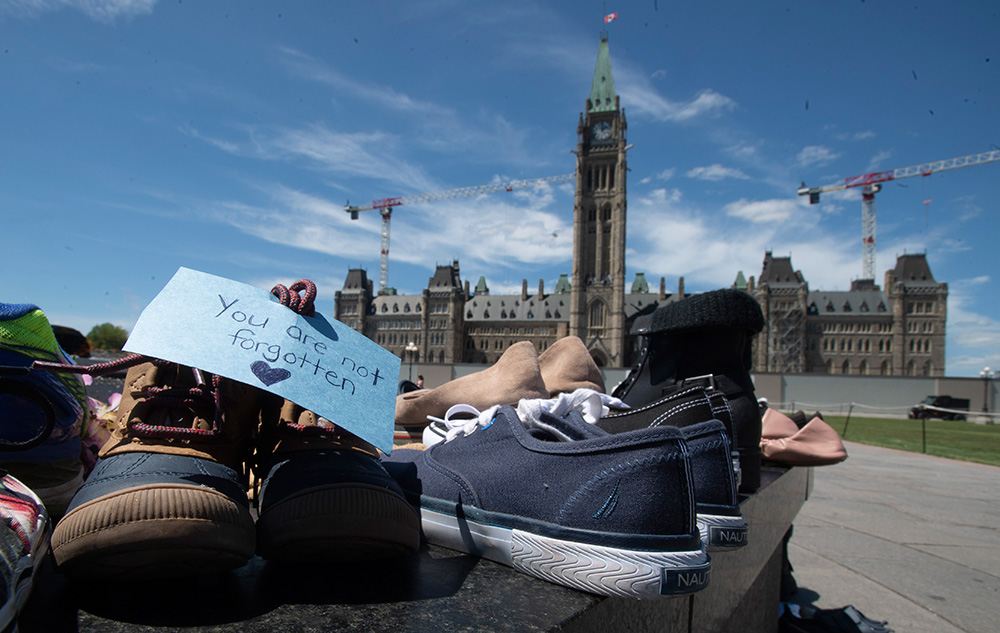
Shoes placed near Parliament Hill in
recognition of the discovery of children’s remains at the former
Kamloops Indian Residential School. Why are there still no public
monuments honouring these children, as the Truth and Reconciliation
Commission has called for?
Photo by Adrian Wyld, the Canadian Press.
As we all struggle with the
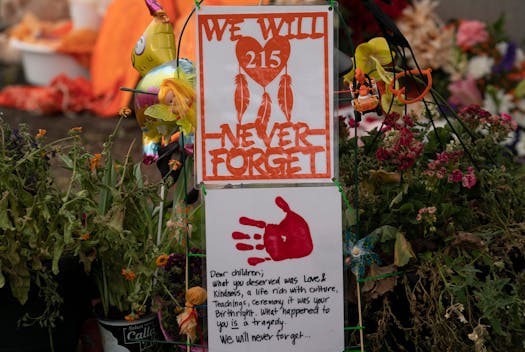
news of 215 Indigenous children found in a Kamloops graveyard, many are
demanding that the Canadian government finally implement the Truth and
Reconciliation Commission’s 94 Calls to Action.
I was general legal counsel to the TRC and previously executive
secretary to the Manitoba Aboriginal Justice Inquiry, both under the
direction of Murray Sinclair and the other commissioners.
A
young girl prays at her bedside at a boarding school. A new book by an
Ojibwe author tells the stories life for American Indian children in
boarding schools designed to purge their language and culture.
Denise Lajimodiere's interest in the Indian boarding school experience began with the stories of her parents.
"Mama
was made to kneel on a broomstick for not speaking English, locked in
closets for not speaking English,” she said. “They would pee their pants
and then the nuns would take them out [of the closet] and beat them for
peeing their pants.”
Lajimodiere is Ojibwe, and a member of the
Turtle Mountain Band of Chippewa in North Dakota. She was an educator
for 44 years, working as an elementary school teacher and principal
before ending her career recently as as an associate professor of
educational leadership at North Dakota State University in Fargo.
Her
parents were separated from their families and sent to federal
government-run boarding schools as children. Thousands of Native
children met the same fate during the boarding school era, which
scholars estimate lasted from the late 1800s to well into the middle of
the 20th century.
Denise Lajimodiere's grandfather Benjamin an his sister Martha, circa 1898.
Denise Lajimodiere for MPR NewsThe
children were sent to the schools to be purged of their Native
cultures, languages and spiritual practices — forced to learn
English, and often abused.
The experiences of those children, now
with children and grandchildren of their own, have left a deep scar on
many in the generations that came after them.
“Papa was beaten with a belt. He saw one of his fellow students die from a beating at the school,” she said.
Her
parents rarely talked about their boarding school experience. She only
was able to coax stories from her father in the last years of his life.
“Papa
said, 'I just couldn't learn that language,'“ she said, “so they put
lye soap in his mouth and the kids would get blisters."
Lajimodiere
believed her parents’ boarding school abuse was a reason for the family
dysfunction she grew up with, so she began a decade-long quest to
understand it, interviewing people who went through the experience.
"It's
a journey I had to go on to forgive my dad for the way we were
raised, for his temper, his verbal abuse and for the beatings,” she
said. “So, it was a long journey to understand why my father was the way
he was."
What she found was a trove of stories closely guarded
for decades by those who lived them. She tells those stories in their
own words in her new book, “Stringing Rosaries.” She collected the
stories using strict academic research protocols, but the listening was
intensely personal.
Many
of the former boarding school residents she interviewed prefaced their
stories by telling Lajimodiere, “'I've never told anybody my story. I've
never told my kids. I've never told my grandkids. I had to think about
these stories all my life about what happened to me. I don't want my
kids to have to think about it or know about it,’” she said.
Denise Lajimodiere, author of “Stringing Rosaries.”
Amber Mattson | Courtesy of Dreamcatcher Photography
For most people, Lajimodiere promised anonymity before they would share with her the stories.
She recalls one elderly woman who refused to even let family know she was being interviewed for the book.
"She
became very quiet, even though it was a huge house, and no one was in
the house,” recalled Lajimodiere. “She started whispering about being
sexually abused and she said, 'I don't know why I'm telling you. I have
not told anybody.' Almost every survivor in the book experienced sexual
abuse, or they witnessed it."
Lajimodiere found that, while the
stories people told her were often infused with painful and traumatic
memories, that pain was not universal. Some people recalled their time
at a boarding school fondly. But Lajimodiere says even those people
— who said they preferred the school experience to alcoholism, abuse or
hunger they experienced at home — shared stories of abuse in the
boarding schools.
As she traveled the country doing research on
boarding schools and collecting stories, Lajimodiere said she would
often find herself sitting in her car, sobbing, after an interview.
She
realizes now that she was experiencing the collective intergenerational
trauma of losing language, culture and identity. Her parents both spoke
their native languages, Ojibwe and Cree, before they went to boarding
school.
"My father never spoke Cree again; that was completely
beaten out of him,” said Lajimodiere. “So, now, at my age, I'm trying to
relearn Ojibwe. Ojibwe is the language of our ceremonies — and our
ceremonies have come back very strong."
Lajimodiere
thinks connecting with traditional ceremony and culture is helping
Native Americans across the country recover from the generational impact
of the boarding school era.
She asked people she interviewed what it would take to heal from the trauma they experienced.
“Some
of the people in the book say an apology would be a recognition of what
the government did to us. Others have said, 'Boarding schools destroyed
my childhood; I'll never get that back, so an apology would mean
nothing,’" she said.
“Many of them said [what would be healing
would be] a return to tribal spirituality and to the languages, our
traditions and our ceremonies," she said.
Lajimodiere felt
compelled to share the stories because many who attended boarding
schools in the first half of the 1900s are now elderly and dying.
She's clear that she doesn't want the stories to elicit pity. She wants understanding.
“I
want the world to know that part of why we are the way we are,” she
said, “with high alcoholism, high diabetes and a lot of other health
issues, one of the overarching reasons is the boarding school era.”
Walter Littlemoon attended a federal Indian boarding school in South Dakota sixty years ago. The mission of many of these schools in 1950, was still to “kill the Indian and save the man.” The children were not allowed to be Indians – to speak their language or express their culture or native identity in any way at the risk of being severely beaten, humiliated or abused. What effects did these actions cause?
Many Indians, like Walter, lived with this unresolved trauma into adulthood, acting it out through alcoholism and domestic violence. At age 58, Walter decided to write and publish his memoirs as a way to explain his past abusive behaviors to his estranged children. But dealing with the memories of his boarding school days nearly put an end to it.
“The Thick Dark Fog” tells the story of how Walter confronted the “thick dark fog” of his past so that he could renew himself and his community.
Reynaldo Morales, the documentary maker, sent this link to the excellent documentary on Henry Roe Cloud, the first American Indian to graduate from Yale in Connecticut and also a co-author of the Meriam Report. Henry was a member of the Ho-Chunk Nation. Ned Blackhawk at Yale helped to make Henry the face of American Indian alumni at Yale. Click here for documentary
This is a hero of mine. Henry is Thunder Clan, a true leader. Please watch this movie....Trace
Kim Wheeler was adopted during the Sixties Scoop and fought to find her way back to her culture My name is Kim Wheeler but some know me as...
Bookshop
You are not alone
To Veronica Brown
Veronica, we adult adoptees are thinking of you today and every day. We will be here when you need us. Your journey in the adopted life has begun, nothing can revoke that now, the damage cannot be undone. Be courageous, you have what no adoptee before you has had; a strong group of adult adoptees who know your story, who are behind you and will always be so.
Diane Tells His Name
click photo
Lost Birds on Al Jazeera Fault Lines
click to read and listen about Trace, Diane, Julie and Suzie
NO MORE STOLEN SISTERS
click image
We conclude this series & continue the conversation by naming that adoption is genocide. This naming refers to the process of genocide that breaks kinship ties through adoption & other forms of family separation & policing 🧵#NAAM2022#AdoptionIsTraumaAND#AdopteeTwitter#FFY 1/6 pic.twitter.com/46v0mWISZ1
As the single largest unregulated industry in the United States, adoption is viewed as a benevolent action that results in the formation of “forever families.” The truth is that it is a very lucrative business with a known sales pitch. With profits last estimated at over $1.44 billion dollars a year, mothers who consider adoption for their babies need to be very aware that all of this promotion clouds the facts and only though independent research can they get an accurate account of what life might be like for both them and their child after signing the adoption paperwork.






 “Our
government stands shoulder to shoulder with Indigenous partners as we
support community-directed work to identify and commemorate Indigenous
Residential School sites across the province. Today’s investment in the
Woodland Cultural Centre is critical to the important work being done by
Six Nations of the Grand River to build a national resource to support
public education and centre for healing for the community.” – The Honourable Greg Rickford, Ontario’s Minister of Indigenous Affairs
“Our
government stands shoulder to shoulder with Indigenous partners as we
support community-directed work to identify and commemorate Indigenous
Residential School sites across the province. Today’s investment in the
Woodland Cultural Centre is critical to the important work being done by
Six Nations of the Grand River to build a national resource to support
public education and centre for healing for the community.” – The Honourable Greg Rickford, Ontario’s Minister of Indigenous Affairs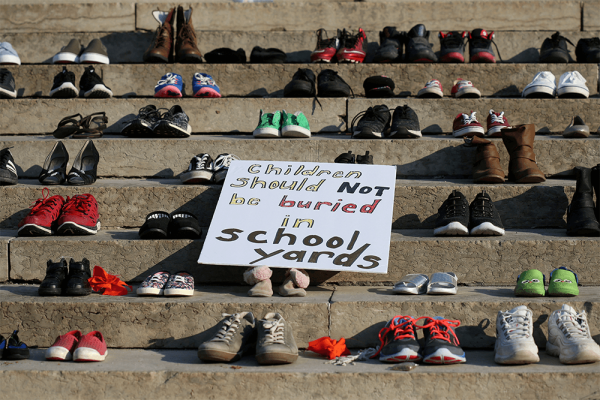







 Posts
Posts

