BOOZHOO! We've amassed tons of information and important history on this blog since 2010. If you have a keyword, use the search box below. Also check out the reference section above. If you have a question or need help searching, use the contact form at the bottom of the blog.
We want you to use BOOKSHOP to buy books! (the editor will earn a small amount of money or commission. (we thank you) (that is our disclaimer statement)
This is a blog. It is not a peer-reviewed journal, not a sponsored publication... WE DO NOT HAVE ADS or earn MONEY from this website. The ideas, news and thoughts posted are sourced… or written by the editor or contributors.
EMAIL ME: tracelara@pm.me (outlook email is gone)
THANK YOU CHI MEGWETCH!
The Numbers That Explain Why Your Grandchildren Will Be Fighting Wars Over Water (But With Robots)
Over
the next four years, they’re planning to build more than 12,000 data
centers in the United States. Currently there are 5,500. They’re going
to MORE THAN DOUBLE them in four years. Total investment: $5.2 trillion.
Protesters rally against STAMP data center plan during Hochul visit in Buffalo
The demonstration called for a moratorium on new data center development across the state.
Tommy Gallagher (WGRZ) May 22, 2026
BUFFALO, N.Y. — Environmental activists, local organizations, and
members of the Tonawanda Seneca Nation gathered outside the Buffalo
Irish Center to protest proposed data center development in New York
State.
Specifically, they targeted plans for the STAMP site in Genesee
County while Gov. Kathy Hochul attended a fundraiser inside on Thursday
evening.
The demonstration, organized by several local groups and
environmental advocates, called for a moratorium on new data center
development across the state. Protesters focused their concerns on the
proposed project at the Genesee County STAMP site.
Although Hochul did not directly address demonstrators outside the
event, she discussed the Genesee County STAMP plant earlier in the day,
saying New York has some long-term interest in data centers, but only
with certain standards.
Stream Data Centers, the company behind the proposed project, says
the development would create 125 permanent jobs at the STAMP site and
approximately 1,200 construction jobs during the buildout.
According to Honor the Earth, there are currently at least 106 proposed
data center projects near or on Native lands. In western New York, a
proposed $19.46 billion data center project would sit
adjacent to the Tonawanda Seneca Nation’s territory, threatening an old
forest that tribal citizens use for hunting, fishing, and gathering
traditional medicine.
STOP DATA SURVEILLANCE CENTERS
The Underground Blueprint to Destroy the Tech Bro Plan to Enslave the Planet With AI Data Centers by 🐺The Wise Wolf
OR: How a Broke Hobojournalist With No Car Weaponized a Zero-Budget Strategy to Kill the Coming AI Dystopia Before It Starts
Step one: Corporation identifies land it wants. (”That subdivision would make a great server farm!”)
Step
two: Corporation identifies local politicians who appear purchasable.
(This step is easier than you’d think. Most politicians advertise their
availability through campaign finance disclosures.)
Step three:
Campaign contributions flow. (Legally! It’s all very legal! Just
structured donations that definitely don’t constitute bribery because
we’ve defined bribery in a way that excludes all the ways rich people
buy politicians.)
Step four: Local politicians create or gain
control of a “development authority” or similar governmental body.
(Every state has slightly different names but they all do the same
thing: provide legal cover for theft.)
Step five: Corporate
executives or their proxies sit on that authority. (Just like how
Pfizer’s VP George Milne sat on New London’s development board. Totally
normal. No conflict of interest here. Just government officials who
happen to work for the corporation benefiting from the government
decisions they’re making.)
Step six: The authority declares the
project serves “economic development” and therefore provides “public
benefit.” (Jobs! Tax revenue! Economic growth! Never mind that a Costco
also provides all those things.)
Step seven: Eminent domain gets
deployed. (This is the part where armed government agents show up to
inform you that your family home of 30 years now belongs to people who
own more money than your town’s entire assessed property value.)
Step
eight: Properties get seized. (The government takes your house. You get
“fair market value” which is determined by the government. You cannot
negotiate. You cannot refuse. You leave or they arrest you.)
Step
nine: Land transfers to the corporation. (Usually for $1 or some other
nominal fee because why pay market rates when you’ve captured the
government.)
Step ten: Corporation gets massive tax exemptions for
10 to 20 years. (Because obviously a multi-billion-dollar data center
needs tax breaks. How else will the investors afford their fourth
vacation homes?)
Step eleven: The public pays for all the
infrastructure upgrades. (New roads to the facility? Public expense.
Upgraded power lines? Public expense. Water infrastructure? Public
expense. The corporation pays for none of this.)
Step twelve:
Corporation keeps all the profits. (Shocking twist: the economic
benefits that supposedly justified the taking don’t actually benefit the
public whose property and tax dollars funded everything.)
BIFF (Buffalo International Film Festival Premier)
Ku Stevens (17) is the
solo runner at his high school with no coach. Living on the Yerington
Paiute reservation in Northwest Nevada, he is driven by his ambition to
run for his dream school, the University of Oregon.
As Ku trains, unreconciled
emotions unearth the memory of his great-grandfather, Frank Quinn. At 8
years old, Frank ran 50 miles across the desert to escape an Indian
boarding school. Frank’s story becomes interwoven with Ku’s journey to
run a collegiate qualifying time.
This coming-of-age
documentary is told from Ku's perspective as he struggles to navigate
his dream of becoming a collegiate athlete as the memory of his great
grandfather's escape from an Indian boarding school begins to connect
past, present, and future.
Will Ku outrun his history or will he learn to run in parallel with it to achieve his dreams?
Clear
Sky October 16, 4 PM North Park Theatre
Director Michael Del Monte in attendance. Given up for adoption the day he was born, Shawn’s life spirals into addiction as he struggles with a broken connection to his Anishinaabe culture and a deep resentment toward the mother who abandoned him. Through intense psychedelic therapy and the relentless
grind of distance running, CLEAR SKY follows Shawn’s fight to save his life, culminating in a cross-country road trip to confront the person he resents most: his mother. Filmed over three years, this intimate story bridges ancient traditions and modern science. Hailed by Derek Cianfrance (Blue Valentine) as 'a cinematic masterpiece,' CLEAR SKY is an unflinching portrait of one man’s journey to heal and find his place in the world.
A vivid ode to land and an intimate, inspiring portrait of an Indigenous Elder’s final year as he fights to reclaim his homeland, scarred by the largest contaminated site in the Southern Hemisphere. Banjima Elder Maitland Parker calls his yurlu (homeland) in
the Pilbara region of Western Australia “poison country”; this haunting truth is etched into his body as he lives with terminal mesothelioma, an aggressive cancer resulting from asbestos exposure. Six decades prior, the Wittenoom mines left behind more than
three million tonnes of waste rock laced with deadly asbestos fibres, turning 46,840 hectares of Banjima Country – an area eight times the size of Manhattan – into a toxic exclusion zone. Today, Aboriginal communities in Western Australia have the world’s
highest mortality rate from mesothelioma. Yurlu | Country follows Maitland as he confronts government inaction and corporate greed in the hope of allowing his people to reconnect with and heal their ancestral lands. This powerful documentary bears witness
to Australia’s very own – albeit largely unknown – Chernobyl-style disaster. Braiding imagery of beautiful yet contaminated terrain with poignant interviews and damning archival footage, the film stands as a testament to First Nations resilience amid ongoing
dispossession, and is a rousing call to action to redress the cultural, environmental and physical wounds caused by colonisation and industry.
New York is discriminating against a school district that refuses to get rid of its Native American chief mascot
and could face a Justice Department investigation or risk losing
federal funding, President Donald Trump’s top education official said
Friday.
“The
Trump Administration will not stand idly by as state leaders attempt to
eliminate the history and culture of Native American tribes,” the
former longtime CEO of World Wrestling Entertainment said.
McMahon
said her department will give the state 10 days to sign an agreement
rescinding its Native American mascot ban and apologizing to Native
Americans for having discriminated against them and attempted to “erase”
their history.
New York Gov. Kathy Hochul presented perhaps the strongest worded
government apology to date for her state’s role in operating an Indian
boarding school from 1875 to 1957.
“Today, on behalf of the State of New York, I apologize to the Seneca
Nation of Indians – and the survivors and descendants from all Nations –
who attended the Thomas Indian School,” Hochul said. “We cannot change
the horrors of the past, but I recommit to the truth, justice,
reconciliation, accountability, and healing that are so essential to
move forward together.”
By Trace Hentz (who still doesn't have a simple piece of paper called her original birth certificate but will apply in 2024 in Minnesota) What is #ASimplePieceOfPaper? Your Original Birth Certificate - the real one with real names and dates.
I have been researching adoption for 20+ years as a journalist and
started my own search for my identity at age 22 - a very long time ago
(as an adoptee).
Can anyone tell me why it has taken years and years for any progress on
open adoption files and letting an adoptee have their original birth
certificate and the name of their parent(s)??
It's a simple piece of paper.
We have to start somewhere. Read this:
SYRACUSE, N.Y. — In a groundbreaking move, the American Indian Law Alliance (AILA) on AUGUST 22 2023, announced its partnership with the National Institute for Law and Justice (NILJ) to intensify efforts in solving cases involving missing and murdered Indigenous Relatives (MMIR).
Since its inception in 1989, AILA has championed the causes of
Indigenous nations, communities, and organizations, tirelessly
advocating for sovereignty, human rights, and social justice. Their
profound expertise in these realms will synergize with the capabilities
of NILJ, which was established in 2021.
NILJ’s primary mission is to provide investigative support—at no
cost—for victims and their families, enabling them to present their
individual cases for expert review by decorated retired NYPD homicide
detectives and a network of forensic and investigation specialists. This
includes current and cold MMIR cases, ensuring justice and closure are
achievable for all, irrespective of financial barriers.
“What sets NILJ apart from other organizations is that they are
committed and are passionate about doing the work of bringing our
relatives home and investigating these cases,” said Gaeñ hia uh, Betty
Lyons (Onondaga Nation, Snipe Clan), Executive Director of American Indian Law Alliance. “In their retirement, these dedicated men are choosing to bring some sense of closure to these mourning families.”
Detective Mark Pucci, Founder and CEO of NILJ added, “This
partnership with AILA is pivotal in our dedication to reach and help
Indigenous families who otherwise might not know about our
organization.”
Together, NILJ and AILA will address the MMIR crisis and bring
resolution to families whose loved ones are missing and/or murdered.
Their efforts will spotlight the struggles of Indigenous communities and
advocate for legislative and policy changes at the national level.
The organizations invite public engagement, urging policymakers,
stakeholders, and the community at large to rally behind this crucial
mission.
To submit a case for review, family members whose loved ones are missing or have been murdered are encouraged to visit https://nilj.org/contact-us or call 1-833-FIND-ME.
AILA and NILJ are passionate about working together to help support
the families of Missing and Murdered Indigenous Women, Girls, 2Spirit
folks, and all Indigenous Relations coming home.
“The Two Row Wampum belt treaty reminds us that we are traveling down
this river of life side-by-side with one another,” added Betty Lyons.
“Let’s work together to reunite families.”
About AILA: The American
Indian Law Alliance (AILA), established in 1989, as an Indigenous,
non-profit, non-partisan organization. AILA collaborates with Indigenous
nations, communities, and organizations to advocate for sovereignty,
human rights, and social justice, steadfastly championing the rights and
needs of Indigenous peoples throughout Turtle Island. For more
information, visit https://aila.ngo/.
About NILJ: Founded in 2022, the National
Institute for Law and Justice (NILJ) offers victims, their families, and
loved ones the opportunity to present their missing persons and
homicide cases—at no cost—for expert review, bridging financial gaps and
ensuring professional investigations. The nonprofit organization is
committed to unveiling the truth, serving justice, and providing closure
to all affected parties. For more information, visit https://nilj.org.
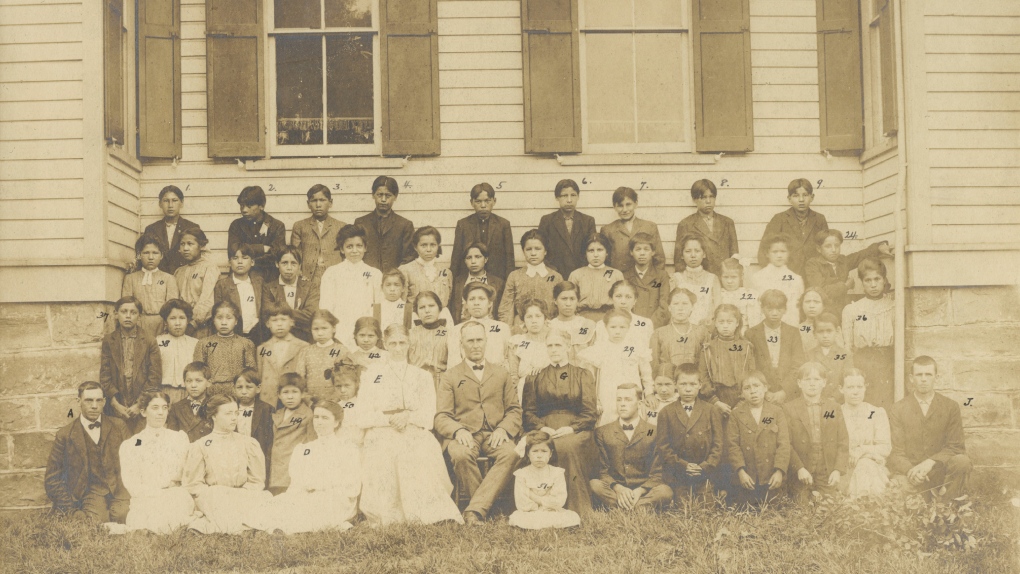
In
this photo taken in 1906, provided by the Quaker and Special
Collections at Haverford College, teachers and students gather for a
portrait at Tunesassa School in Tunesassa, New York. THE CANADIAN
PRESS/AP, Quaker and Special Collections, Haverford College
OTTAWA --
A coalition advocating for Indigenous Peoples forced to attend boarding
schools in the United States is planning to digitize 20,000 archival
pages related to schools that were operated by the Quakers.
Outside of Native Nations, most people aren't even aware these schools
were an integral part of history and U.S. federal Indian policy, said
Samuel Torres, the deputy CEO of the Native American Boarding School
Healing Coalition.
He and his team are trying to change that, drawing inspiration -- and
lessons learned -- from Canada's Truth and Reconciliation Commission and
the National Centre for Truth and Reconciliation.
Haudenosaunee boarding school survivors seek justice
Kanentiio, whose name means “handsome pine,” describes life at an Indian boarding school, also known as a residential school, in the 1960s.
The first such facility, Carlisle Indian Industrial School, was founded
in the 1870s by military Capt. Richard Pratt. It was a way to
assimilate Native American children into “white” society and, in Pratt’s words, “kill the Indian to save the man.”
“The intent was to extinguish us as
Aboriginal people and destroy whatever sense of self-worth we had, and I
can say that they succeeded to a large degree,” Kanentiio said. “They killed our spirit. They killed us.”
Many students sent to these schools went missing. Last month, 215
children’s remains were discovered in British Columbia at one of nearly
500 boarding schools in Canada and the U.S.
The discovery has sparked renewed calls for justice from Indigenous
communities and for further investigations — forensic and archeological —
into more residential schools.
“It’s
high time that this American country recognizes the great value and
resource in its indigenous populations and celebrates and promotes and
supports,” said Michael Galban, curator at the Seneca Art and Culture Center at Ganondagan State Historic Site.
Last year, Democrats in the U.S. Senate introduced a bill that would
create a Truth and Healing Commission, which would investigate and
document past injustices of what they call the federal government’s
cultural genocide. So far, the bill has not progressed in any fashion.
Undoing this magnitude of injustice would take multiple long-term solutions, Galban said, starting with policy changes.
“It would involve language restoration,” he said. “It would involve environmental restorations. It would involve, in some cases, restoring people to their original homelands.”
It would also mean recording oral histories of survivors’ experiences.
“Every day, we’re losing the stories from the survivors as they age out and pass away,” he said. “Hopefully they’re sharing their stories with their families.”
Survivors’ stories Galban’s grandmother, Evelyn Evans Galban, was a residential school survivor.
In the 1920s, she was taken from her home in California and sent to
the Stewart Indian School in Nevada, where Galban said she experienced
abuse.
“The idea was that you could strip these
Indian children of their culture and their ideologies and create a new
cheap labor class that certain areas of the country could exploit,” Galban said.
During the school year, she was taught how to fold laundry, set
tables and make beds, he said. During school breaks, she couldn’t go
home.
“During the summers, these schools would
hire out the students under the guise that they would be learning how to
live amongst the whites,” Galban said. “But really, they were being farmed out to hotels and resorts to be their domestic labor.”
She attempted to run away multiple times. On one occasion, she was caught “in the middle of the winter. They took away her shoes and basically whipped her back to school with no shoes on,” Galban said.
Finally, with the help of a cousin, she managed to run away to Montana, Galban said.
No choice Indian boarding schools were compulsory at the time. It
would be another 12 years before the Indian Child Welfare Act of 1978
would give Native American parents the legal right to refuse their
children’s placement in these kinds of schools off reservations.
Until then, Native leadership and families were essentially held hostage by the federal governments of the U.S. and Canada.
“If there was ever, whether it be by
leadership or families, any action to stop or take their children
(back), they were often persecuted and arrested and faced problems for
that as well,” said Mohawk Grandchief Abram Benedict.
In 1966, Kanentiio was 11 years old when police and social services
took him from the St. Regis Mohawk Reserve near Ottawa, Canada, and sent
him nearly 350 miles west to the Mohawk Institute in Brantford,
Ontario.
He’s now one of about 40 remaining Mohawk survivors.
At the school, Kanentiio said the abuse came not just from staff but
also from older students who he said were encouraged to discipline the
younger students.
After a few years, he managed to escape — first by way of expulsion: He and his classmates were non-compliant, troublemakers.
“Our rude behavior was our survival,” Kanentiio said. “We couldn’t just simply be compliant. We had to fight, physically if necessary, to stop these things from happening.”
Still, when he was expelled, he wasn’t sent back to the reservation.
He was put into foster care and bounced around from one home to the
next until he eventually managed to run away back home, he said.
More than 50 years later, Kanentiio wishes he could confront those
personally responsible for the brutal treatment, abuse, and for ripping
families apart.
“It’s a terrible thing to walk around believing that you’re not truly a human being or a complete human being,” he said. “Something deep and wonderful has been lost. And that’s the terror of this thing.”
In
1919, Cornell pioneered the first degree-granting program in the country
for women called “Domestic Economics.” Its aim was to apply scientific
principles to domestic tasks deemed “Mothercraft” — such as making
meals, cleaning and ironing, household budgeting, and raising children.
Female coeds — five or six at a time — lived together in on-campus
“Homemaking Apartments” and collectively mothered the practice babies.
Ranging
in age from three weeks to a few months old, babies were loaned to the
college for a year. The contracts between the orphanages and Cornell
stated the babies “could be returned at any time if there was
dissatisfaction on the part of the college.”
Their
birth names and identities were erased, and they were fatted and raised
by a rotating lineup of up to six practice mothers at a time. The
co-eds’ work was divided into six parts, including the job of mother and
assistant mother.
Domecon
babies were highly sought-after for adoption. Adoptive parents were
convinced that because the babies were being raised in ideal conditions
and by scientific methods it would ensure a smooth family transition. A
1923 newspaper article titled “Coeds at Cornell Mother Real, Live
Practice Babies” referred to the babies as “super children.”
The
program ran through 1954. In all, 119 children were raised in this
manner and adopted, and Dickie Domecon was the first. Most grew up with
no knowledge of having been abandoned or surrendered, or having been a
Domecon baby.
South Carolina court drops contempt charge against Dusten Brown Dusten Brown and the Cherokee Nation rea...
Bookshop
You are not alone
To Veronica Brown
Veronica, we adult adoptees are thinking of you today and every day. We will be here when you need us. Your journey in the adopted life has begun, nothing can revoke that now, the damage cannot be undone. Be courageous, you have what no adoptee before you has had; a strong group of adult adoptees who know your story, who are behind you and will always be so.
Diane Tells His Name
click photo
Lost Birds on Al Jazeera Fault Lines
click to read and listen about Trace, Diane, Julie and Suzie
NO MORE STOLEN SISTERS
click image
We conclude this series & continue the conversation by naming that adoption is genocide. This naming refers to the process of genocide that breaks kinship ties through adoption & other forms of family separation & policing 🧵#NAAM2022#AdoptionIsTraumaAND#AdopteeTwitter#FFY 1/6 pic.twitter.com/46v0mWISZ1
As the single largest unregulated industry in the United States, adoption is viewed as a benevolent action that results in the formation of “forever families.” The truth is that it is a very lucrative business with a known sales pitch. With profits last estimated at over $1.44 billion dollars a year, mothers who consider adoption for their babies need to be very aware that all of this promotion clouds the facts and only though independent research can they get an accurate account of what life might be like for both them and their child after signing the adoption paperwork.