They Took Us Away

They Took Us Away
click image to see more and read more

it's free

click

How to Use this Blog

BOOZHOO! We've amassed tons of information and important history on this blog since 2010. If you have a keyword, use the search box below. Also check out the reference section above. If you have a question or need help searching, use the contact form at the bottom of the blog.


We want you to use BOOKSHOP to buy books! (the editor will earn a small amount of money or commission. (we thank you) (that is our disclaimer statement)

This is a blog. It is not a peer-reviewed journal, not a sponsored publication... WE DO NOT HAVE ADS or earn MONEY from this website. The ideas, news and thoughts posted are sourced… or written by the editor or contributors.

EMAIL ME: tracelara@pm.me (outlook email is gone) THANK YOU CHI MEGWETCH!

SEARCH

Showing posts with label The Sixties Scoop Peer Support Line. Show all posts

Monday, September 5, 2022

“He didn’t want revenge; he wanted justice, you know”

Son of ’60s Scoop survivor fighting for father’s status under Indian Act

Aaron GreyCloud hopes to raise awareness about the challenge of seeking status after being placed in care decades ago.


Aaron GreyCloud II holds a black and white photo of his grandparents, Barbara and David Flamming, and declares they are Cree First Nations people from Saskatchewan.

He can see it in their faces. But that’s not what the federal government says.

Three years after his father, Aaron GreyCloud, died in 2016, Aaron II applied for compensation on his behalf from the $875-million Sixties Scoop Settlement agreement.

His father was one of 25,000 to 35,000 First Nations, Inuit, Métis and non-status First Nations children “scooped” from their families and communities between Jan. 1, 1951 and Dec. 31, 1991, and placed with non-Indigenous caregivers. The bulk of the apprehensions occurred in the 1960s.

A group of survivors filed a class-action lawsuit for the loss of cultural identities, and the government settled in 2018 agreeing to pay eligible survivors $25,000 each, and put up $50 million for a ’60s Scoop healing foundation.

Aaron GreyCloud II holds a photo of his paternal grandparents. 
Photo: Lee Wilson/APTN News

“I was looking at the lawsuit they had – the ’60s scoop lawsuit – and I was like, ‘Man, my dad wanted that, but he died before he got that,’ so I was like, ‘I’m going to do that for him’,” Aaron II said.

But Aaron II said the application was rejected because his father was not registered with the government as a First Nations person, also known as being recognized as having status under the Indian Act.

And Métis and non-status First Nations survivors are excluded from the settlement agreement.

The rejection letter gave Aaron II, who lives in Kitimat, B.C., 45 days to provide more information.

“It was so easy for them to write him down as Caucasian and whitewash him,” Aaron II said, “yet it is difficult to undo what they have done.”

Grandparents Barbara and David Flamming in an undated family photo. Courtesy Aaron GreyCloud II

Aaron II said he filed a Freedom of Information request for his father’s adoption records in the province of B.C. The records he shared with APTN News show his father listed as “Indian” and “caucasian”.

The son sent the documents to Indigenous Services Canada (ISC) in Ottawa.

The department confirmed it is working on the file, but it’s not looking good.

Based on a search using the records provided, ISC said it was not possible to identify his father as a person who had ever been registered as an Indian.

Aaron was placed in foster care in Vancouver in the mid-1950s, his son said.

Aaron GreyCloud died in 2016, before he could prove he was 
a status First Nations person in the eyes of the government. 
Photo courtesy Aaron GreyCloud II

But it was another policy that eliminated Aaron’s lack of status.

His mother lost her status rights when she married someone without status.

It wasn’t until 2017 when that inequality was corrected in the Indian Act through Bill S-3.

But Barbara Flamming had already died.

Then Bill C31 in 2019 allowed women who had previously lost their status to regain it, as well as their children’s status.

Aaron GreyCloud holds his son, Aaron GreyCloud II, in this 
undated family photo. Courtesy Aaron GreyCloud II

ISC said restored status applies to everyone, including those in foster care in Canada.

“Bill S-3 addresses the known sex-based inequities in the registration provisions of the Indian Act and it applies to individuals in every province, regardless of whether they are in care,” ISC said in a statement.

“Bill S-3 also addressed cases of unknown or unstated paternity, allowing the Registrar to assess all forms of evidence for a child’s ancestry and to make every reasonable inference in favour of the applicant.”

Aaron II said the fight was a significant frustration for his father before he passed away.

He said it will be sad to see his father regain his status without being here to witness it.

“Even if they do accept his application, I regret he is not here to accept it, to be able to revel in it a bit, to be able to feel the victory.”

Aaron II said he is just hoping to get justice for his father and other ’60 Scoop survivors facing similar circumstances.

“He didn’t want revenge; he wanted justice, you know,” the son said. “That echoed through my life.

“At times, I was so frustrated with this process at having my history taken from me. As a young man, I do remember wanting revenge and my dad sitting me down and telling me that’s not the path. ‘You know that’s not going to bring the change we need’.”

Meanwhile, the spokesperson for ISC said the department is working with the settlement claims administrator to improve the process.

“Canada worked closely with the third-party administrator Collectiva to support the administration of the Sixties Scoop Settlement Agreement,” said an emailed statement.

“A key part of this support was to update protocols, processes and systems related to the registration process, with the understanding that these improvements would benefit all individuals seeking registration under the Indian Act, including those impacted by the Sixties Scoop.”

The spokesperson encouraged anyone who thinks they are eligible for status to apply.

Tuesday, March 13, 2018

National database for First Nations adoptees | #60s Scoop Peer Support Line #NISCW

reblog: March 2018


60s Scoop


Eleanore Sunchild, a Cree lawyer who specializes in Aboriginal law and has represented Sixties Scoop adoptees, says, "a lot of times, they were so young they don't remember their family, they don't know what community they come from or even what tribe they belong to."

Sunchild says that loss of Indigenous identity coupled with separation from family is often devastating.

"The whole loss of being raised in a different home and not exactly knowing why, why they were removed — there's something wrong with them? Or was there something wrong with their family? And in a lot of instances it was just because of the policy that was in place at the time," she said.
Kicknosway says some people don't necessarily want to return to their communities.
She says they "only want to know they belong somewhere" and "have validation that they were alive" and that maybe someone missed them when they were taken away.
Author and Sixties Scoop survivor Raven Sinclair, an associate professor of social work at the University of Regina, has written extensively on the subject. She is in the midst of a five-year study with the aim of creating a national database of adoptees.
Her goal is to create a network that can provide practical, long-term support similar to what is available to some of the people affected by the residential school system.
Eleanore Sunchild
Cree lawyer Eleanore Sunchild, who represents survivors of the Sixties Scoop, says it's hard for adoptees to track down their biological families because many of them were so young when they were taken that they don't remember any details about their relatives or their community. (Connie Walker/CBC News)


"An adoptee you know here in town could call up a therapist who's been approved by us ... and get some help," she said. "For some, it's been a lifetime of abuse, so it's going to take a long time for them to recover."


NOT WORKING:  NISCW has set up a toll-free number to help adoptees searching for family connections and to provide peer support.


Happy Visitors!

WRITTEN BY HUMANS!

WRITTEN BY HUMANS!

Blog Archive

Featured Post

Your History Class Was a F*cking Lie | #NOMOAR

  Your History Class Was a F*cking Lie by Sean Sherman (Or: How the American Educational System Has Always Been a Racist Propaganda Program...


Native Circles

Native Circles
click logo for podcasts!

Most READ Posts

Bookshop

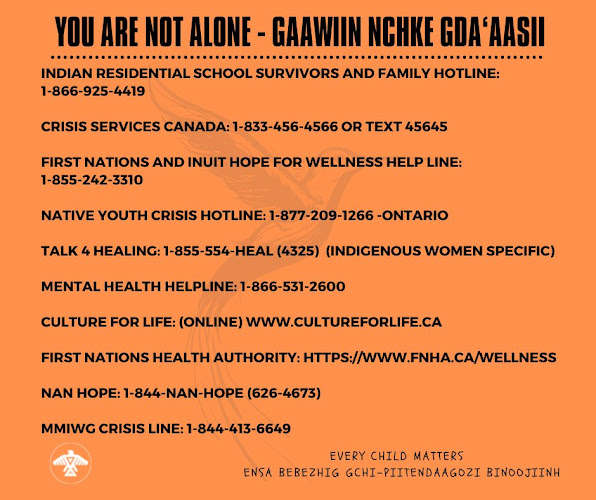
You are not alone

You are not alone

To Veronica Brown

Veronica, we adult adoptees are thinking of you today and every day. We will be here when you need us. Your journey in the adopted life has begun, nothing can revoke that now, the damage cannot be undone. Be courageous, you have what no adoptee before you has had; a strong group of adult adoptees who know your story, who are behind you and will always be so.

Diane Tells His Name


click photo

Lost Birds on Al Jazeera Fault Lines

Lost Birds on Al Jazeera Fault Lines
click to read and listen about Trace, Diane, Julie and Suzie

NO MORE STOLEN SISTERS

NO MORE STOLEN SISTERS
click image

ADOPTION TRUTH

As the single largest unregulated industry in the United States, adoption is viewed as a benevolent action that results in the formation of “forever families.”
The truth is that it is a very lucrative business with a known sales pitch. With profits last estimated at over $1.44 billion dollars a year, mothers who consider adoption for their babies need to be very aware that all of this promotion clouds the facts and only though independent research can they get an accurate account of what life might be like for both them and their child after signing the adoption paperwork.

Original Birth Certificate Map in the USA

Google Followers