It's an incredible series... Rebecca should WIN every award out there for this type of journalism! Megwetch! Thank you Sister!

 First America
Merciless Indian Savages | Episode 1 Rebecca Nagle View All Episodes
First America
Merciless Indian Savages | Episode 1 Rebecca Nagle View All Episodes Native people have been written out of the American story."
Without us, you don’t know what happened.
We’ve all been told the American Revolution was fought over taxation and representation. But that’s not what the Declaration of Independence says. According to our founders, in their own words, what they were most upset about was Native Americans. How did we all miss that? Rebecca sits down with historian Ned Blackhawk (Western Shoshone) to talk about how hunger for Indigenous land drove the Revolution. Welcome to First America, the true story of how the United States came to be, and how our current political moment was 250 years in the making.
CLICK: https://lnk.to/FirstAmerica
Don’t know whose land you live on? Look it up here!
Resources:
– Dig into more of Ned Blackhawk’s scholarship here
Have you ever heard that icebreaker–if you had to pick one superpower, would you fly or be invisible? I always pick the power of flight. I already know what it’s like to be invisible. In this country, it is not a form of power.
Once, I was at a grassroots social justice convening in Florida. On a break while people made small talk, a white woman came up to me and said, “I thought we killed all of you.” As in, she thought Native Americans were extinct like the woolly mammoth. It is a bewildering stereotype to encounter. The stereotype that you no longer exist. 82% of adults in the U.S. cannot think of a single, living, famous Native person. 98% cannot name two.
When you scroll through your phone, read the news, or watch TV, statistically, it is very unlikely you will see a Native person. Of the 2,336 regular characters on TV from 1987 to 2009, only two were Native. A recurring character on Northern Exposure. And a contestant on the reality show Survivor.
On the rare occasion Native people are portrayed in the media, we live in the past. In one study, researchers typed “Native American” and “American Indian” into the Google image search bar. 95% of the results were “antiquated portraits.” Once, someone told me that, even though she didn’t believe that I was Native, she knew that my ancestors were. Conveniently for a country built on our land, all of the real Indians are dead and gone.
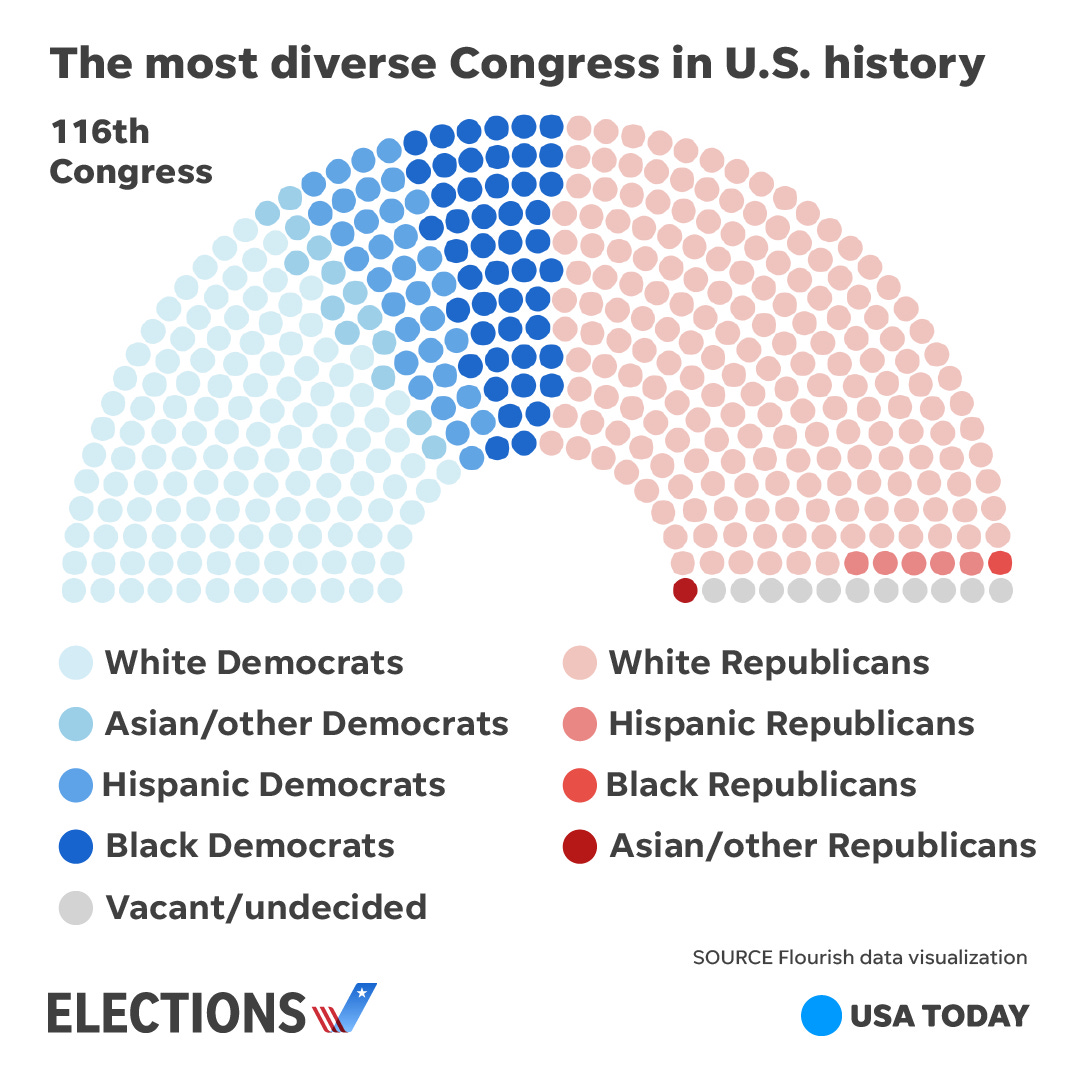
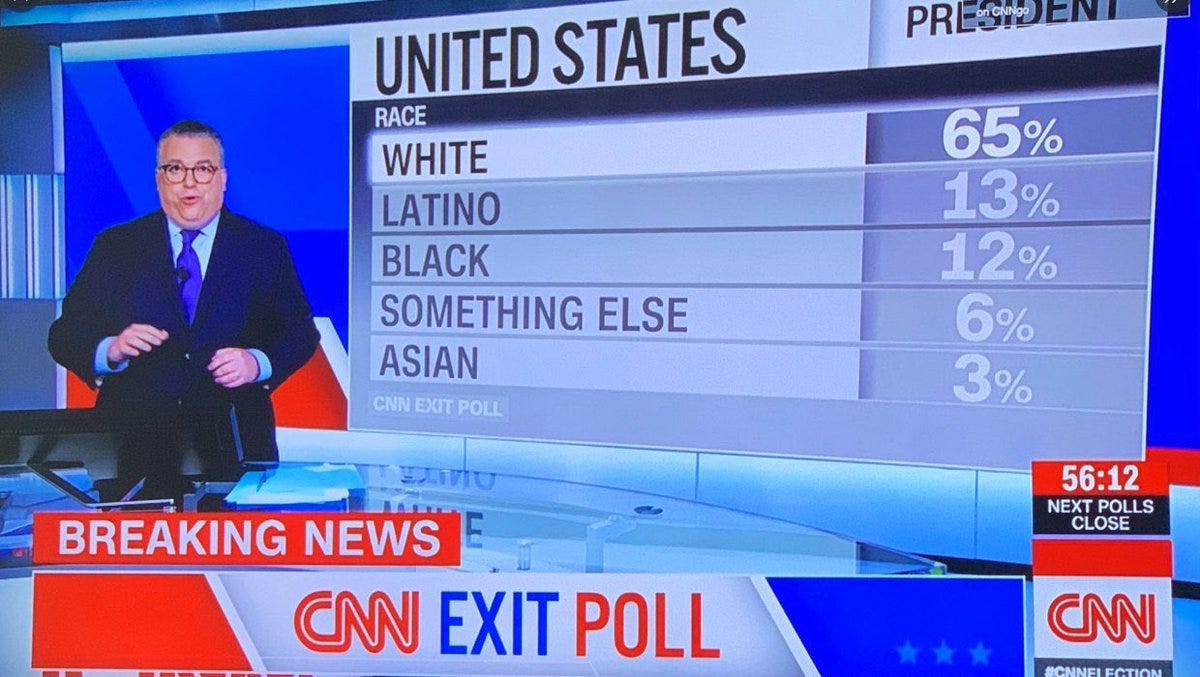
In 2018, U.S. voters elected the most diverse Congress in our country’s history. For the occasion, USA Today made an infographic. The 116th Congress included two Native women–the first ever elected to the body. In their infographic, USA Today put the Native representatives in the “other” category. In the 2020 election, Native voters helped Biden win the swing state of Arizona. On election night, CNN published an exit poll capturing how people voted in the state. On it, Native voters were called “something else.”
Native people are not simply left out of the story. We are written out.
We don’t learn about most people through direct social interactions, but from things like movies and the internet. I have never been to France, but I have an idea in my head that French people like wine and cheese. When a group is negatively represented, that can lead to stereotypes and prejudice, like the idea that women are bad at math. What Native people face is different. The media, pop culture, and school curriculum do not just represent us poorly. It represents almost never. Our existence is erased from the public eye. Americans don’t think about our absence. They don’t think about us at all.
This erasure harms Native folks. Our near-total absence from the media Americans consume creates a stubborn prejudice in the minds of non-Natives. Over time, they see us as less real and even less human. Research has found that less exposure to contemporary Native people correlates with more prejudice against us and less support for tribal sovereignty. One study found that the more contemporary Native people were omitted, the more participants agreed that the U.S. should nullify all treaties, eliminate all reservations, and abolish tribes’ right to self-govern. It is active erasure.

Originally published by The 19th
Rebecca Nagle has turned the false history of Native American communities she received as a child into a career of truth-driven storytelling.
A writer, journalist and author, Nagle is the host of the documentary podcast “This Land” and author of the novel “By the Fire We Carry.”
Born in Joplin, Missouri, 38-year-old Nagle spent much of her youth in Tulsa, Oklahoma, and Oklahoma City with her Cherokee family members. She recalls Native history scarcely being addressed throughout her education.
"I remember making ships out of popsicle sticks to celebrate Columbus Day and asking questions that went unanswered. I definitely think my education was lacking when it came to that stuff in public school," she said.
Her understanding of her family history and culture was primarily taught through her grandmother.
“Growing up, I learned a lot from my grandma. She made sure that we understood that we knew who our family was,” she said. “And then, of course, as an adult you sort of test what your family members told you about your family.”
Her family’s portrayal of their forebears was mostly heroic, focused on how her “Cherokee ancestors sacrificed their lives for the sake of the Cherokee Nation.” Though she recognizes that her family’s history has more detail and nuance, she has kept their overarching pride and sacrifice close to her.
This passion for history fuels much of Nagle’s work as a writer and journalist. Over its two seasons, her podcast, “This Land,” reflects her will to dive into research and highlight the very stories that were avoided throughout her childhood.
The first season leads the audience through the case of Patrick Murphy, a citizen of the Muscogee Nation who was sentenced to death for the murder of George Jacobs in 1999. Murphy’s case took an unexpected turn when his attorney challenged his conviction by arguing that he could not be prosecuted by the state of Oklahoma but instead must be tried by the Muscogee Nation. Murphy was ultimately convicted for murder and sentenced to life in prison by the federal court.
Season two continues the work of purposeful storytelling by detailing the Haaland v. Brackeen Supreme Court case, which challenged the constitutionality of the Indian Child Welfare Act’s restrictions on Native children being adopted by non-Native parents. The high court affirmed the constitutionality of the act in 2023.
Nagle describes the work she produced on her podcast as a push that led her to writing her novel, “By the Fire We Carry.”
“We made the first season, and I then kept wanting to follow this story and follow those threads, and I felt like I had more to tell and more research to do,” she said.
“By the Fire We Carry” invites readers through the fight for rightful ownership of Native lands. Deep diving into U.S. history, Nagle highlights the ways in which Native people were forcibly removed from their homes on lands that are now recognized as property of eastern Oklahoma. The history she details provides context to the Murphy case, which she recognizes as a modern-day portrayal of the generations-long battle for Native grounds.
Exploring how the past has influenced the present and using that knowledge to increase visibility and awareness is a primary reason she has continued to amplify Native stories in her journalism career.
“When you look out in the news media, there just isn’t enough Native representation, and I think that that creates this prevailing ignorance in U.S. society about Native people and our tribes and the law,” Nagle said.
“That ignorance is a really big barrier for progress, and I think that impedes us having better policy in place. That’s one thing that I’m very passionate about: pushing back against that erasure and having Native stories in the mainstream,” she continued.
But she said it can be tricky to get editors to view these stories as newsworthy.
“It’s almost like if you were writing about women’s reproductive health and your editor didn’t know what abortion was and that’s their starting point,” she said.
“People who are used to having a [high] level of knowledge and expertise have a hard time when they’re confronted with this situation where their ignorance is kind of daunting. I think some people can have a hard time admitting that.”
Today, Nagle can be found working on an essay series with other Native writers and historians about the history of colonization and genocide against Indigenous people undermining democracy in the United States.
“You can tell some big lies about tribes and about Native people, and people will believe it because they don’t know that much. I think when you look at history, I can tie every oppressive policy against Native people to the lies that were told to justify it,” Nagle said. “I think so much of history informs our present day and I think we can’t understand one without the other.”
06/19/2023
Last week, in a surprising 7-2 decision, the U.S. Supreme Court fully upheld the Indian Child Welfare Act in Brackeen v. Haaland. We break down the full opinion of the court and their various reasons for siding in support of the 1978 law that was passed at a time when nearly a third of indigenous children were separated from their family.
We are joined for reaction to the Brackeen ruling by three women close to the case:
-Kate Fort of Michigan State University, one of the foremost experts on ICWA in this country, who assisted with the tribes’ preparation for the Supreme Court oral arguments
-Chrissi Ross Nimmo, deputy attorney general for Cherokee Nation, one of the the tribes that officially was party to the case
-Rebecca Nagle, journalist and architect of the podcast This Land, whose second season focused on the Brackeen case.
Guest Interview
Kate Fort is director of clinics at Michigan State University College of Law, including the Indian Law Clinic
Chrissi Ross Nimmo is the deputy attorney general for Cherokee Nation.
Rebecca Nagle is an award-winning journalist and host of the podcast This Land.


Reading Room
Indian Child Welfare Act Stands, Native Families Empowered
https://bit.ly/3PjEV3L
The Imprint’s continuing coverage of Brackeen v. Haaland, 2018-2023
https://bit.ly/3ttyzTy
Opinion in Brackeen v. Haaland
https://bit.ly/3PhDGCa
Imprint Reporting by Nancy Marie Spears
https://imprintnews.org/author/nancy-marie-spears
 |
| The plaintiffs, Brackeens, assert ICWA is an unconstitutional law |
By Trace L Hentz, blog editor and adoptee
Am I worried about the ICWA case? Yes. Very.
I am worried that the "Supreme" Court has shown no respect for our inherent sovereign rights. Just look at history. This case could rescind the Indian Child Welfare Act of 1978. I worry the impact on adoptees now and future Native adoptees. (ICWA allows adoptees to open their adoption records.) We are called The Stolen Generation and Sixties Scoop for good reason.
We lost our sovereignty when we were adopted out to white families. We lost everything - language, culture, land, family, ceremonies and our tribal stories. (Some of us lost our sanity too!) Swimming pools, college degrees, and white families in fancy houses, cannot replace this.
Sadly, I do not think these Justices actually know what our loss means!
Many years ago in Wisconsin, two tribal chiefs gave talks to new congresspeople on Sovereignty 101- I interviewed them about it and then wrote an article in News from Indian Country. They explained it used to be feds (the federal government) that dealt with tribes and the feds were keenly aware of sovereign tribal rights and history. Both chiefs said state lawmakers were not as understanding. There was also high turn-over in states and many new congressmen don't know state or federal history, even how tribes signed numerous treaties.
The Department of WAR (who authorized killing Indians) morphed eventually into the Department of the Interior.


As Rebecca Nagle explained: "A host of federal statutes—including on land rights, water rights, health care, gaming, criminal and civil jurisdiction, and tribal self-governance—treat Native Americans differently based on this political classification. In this light, I fear that the Brackeen lawsuit is the first in a row of dominoes—if the Court strikes down ICWA, everything else could soon go with it."
"Under federal law, tribes and tribal citizens are not a racial group, but a political one. Accordingly, ICWA applies only to Native children who either are enrolled in a federally recognized tribe or are eligible based on a given tribe’s citizenship requirements," Nagle said.
And this:
This cultural difference — that a family’s fitness is determined by its wealth, and that those concerns should outweigh a child’s connection to their family and heritage — is essentially why the Indian Child Welfare Act was created in 1978. The law recognizes the history of federal policy aimed at breaking up Native families and mandates that, whenever possible, Native families should remain together.
Sarah Kastelic, the executive director of the National Indian Child Welfare Association, said that ICWA acknowledges important familial and tribal bonds that have long been disregarded, and that Native ways — such as extended families living under the same roof — have often been used to show unfitness in child welfare proceedings. “No matter the picket fences and swimming pools and things, most of the time, kids want to be with their families,” she said.
READ: The Native adoption case that could dismantle the Indian Child Welfare Act, explained - Vox


I was chatting with Prof. Lorianne Updike Toler (Northern Illinois), and she mentioned some thoughts of hers on this subject, based on her recent University of Chicago Law Review article, The Missing Indian Affairs Clause. I encouraged her to write up a blog post, and she kindly passed along the following:
In the November 9th oral argument for Haaland v. Brackeen, which challenges the constitutionality of the Indian Child Welfare Act, Justice Amy Coney Barret's question about the impact of overruling Congress' plenary power over tribes underscores a centuries-old confusion about federal Indian Affairs.
It's not just the Court that is confused. Former Volokh Conspiracy posts on point reveal the deep academic fissures over the historical context of the Indian Commerce Clause. Unknown to the Court and most of academe is the root cause of all the confusion: that the Constitutional Convention initially forgot (and then later intentionally excluded) the Articles of Confederation's Indian Affairs Clause in the Constitution.
As I detail in this University of Chicago Law Review article, Pennsylvanian comparative constitutionalist James Wilson, tasked by the five-member Committee of Detail to draft the Constitution, initially checked off "Indian Affairs" to include as a Congressional power, but then failed to get the power into his final draft. He was not the only one to forget. Although the Convention had commissioned the Committee to include all the Congressional powers in the Articles of Confederation (where Indian Affairs featured), Edmund Randolph also forgot to include the power in his initial sketch of the Constitution. Odd, considering a Cherokee chief had met with him that summer in Philadelphia and he was then directly concerned with settler-tribe disputes on Virginia's frontier as the state's governor. It was John Rutledge, the South Carolinian chair of the committee, who remembered, scrawling the power in the margin of Randolph's sketch. Yet he later forgot this power in combing through Wilson's final draft, and it was reported out of the Committee sans (without mentioning) Indian Affairs.
But James Madison remembered. It was he who suggested Indian Affairs be inserted back into the Constitution. This time, the Committee of Detail intentionally excluded the Clause, instead inserting "Tribes" into the Commerce Clause. No one objected. This despite that at least three Convention members had just spent their ten-day break (for the Committee of Detail to meet) fulfilling their congressional duties in New York. There, impending tribal wars in Virginia and Georgia's Creek disputes were discussed. Presumably, the Convention thought Congress' previous powers under the Article's Indian Affairs were addressed by the Indian Commerce Clause and other provisions of the Constitution—such as the power to declare war and peace and the president's shared Treaty Power.
What does this mean for the Constitution? Put simply, Congress has no Indian Affairs power, and therefore no plenary power. Early assertion of this power was justified under the tripartite powers of Indian Commerce, War and Treaty Powers. But Congress halted tribal treaty-making long ago. If it wants to re-assert power over tribes beyond the Commerce Clause, the President needs to begin treating with tribes again.And what of any residual power? As I propose in my article linked above, the residue reverts to the sovereign tribes. Tribal sovereignty is to tribes what federalism is to the states. Powers not reserved by the Constitution to Congress and the President revert to the tribes.
This would mean that Congress lacked constitutional power to pass ICWA, however well-intentioned. ICWA was adopted in an attempt to prevent Native American erasure by allowing the community to intervene in adoption and foster cases to ensure tribal children are raised in Native American families. ICWA grants the child's tribe exclusive jurisdiction over custody proceedings and other intervention privileges. Further, it establishes placement preferences first in favor of any family members, then the tribe, and then any Native American families regardless of tribal membership.
Unless related to its Indian Commerce power (and heaven forbid if we have arrived at treating adoption of babies and children as commerce), Congress has no power over Native American adoptions. On this basis, ICWA might be unconstitutional wholesale. However, to the extent ICWA respects tribal sovereignty and refers cases to the child's tribe, it may be constitutional under a structural reading of the Constitution: The combined intratextual references to tribes as the constitutional unit of recognition— "tribes" under the Commerce Clause and the presumption that Indians are not taxed under Art I. sec. 2 of the Constitution—together with the parallel analog of federalism vis-à-vis states may permit Congress to proactively proscribe federal and state deference to tribal power. But as Congress has no plenary power over tribes and Native Americans as a people, it cannot specify adoption placement or other preferences. The Court should so rule in Brackeen.
👇👇👇This gives me hope:

read:
(to be continued)
The Supreme Court is hearing a case that could dismantle the Indian Child Welfare Act, also known as ICWA. The law was passed in 1978 to combat a history of forced family separation in the United States and prevent the removal of Native children from their communities. But now, in Haaland v. Brackeen, ICWA could be completely overturned.
In the
third episode of Dissent, host Jordan Smith is joined by Rebecca Nagle,
a journalist, citizen of the Cherokee Nation, and host of the podcast
“This Land.” Smith and Nagle break down the case and its broad
implications for laws based on tribes’ political relationship with the
U.S. government. INTERCEPT
Rebecca Nagle is INCREDIBLE! We love her! #ProudtoProtectICWA
Nov 27, 2022 | MSNBC
The Supreme Court is hearing arguments in a high-stakes case about indigenous children and culture. On the surface, the case known as Brackeen v. Haaland revolves around a dispute over whether a non-native family can adopt a native baby. At the heart of the case is the Indian Child Welfare Act, a law passed in 1978 that says if a state determines a Native child must be legally removed from their home, they must be placed with an American Indian family or, if possible, a member of the child’s extended family or tribe. Non-native families and states are challenging the constitutionality of ICWA, arguing it discriminates on the basis of race. But the case could have implications that extend far beyond that - potentially upending Native sovereignty altogether. “A lot of laws flow from this special nation-to-nation relationship between tribes and the US federal government,” says Cherokee Nation journalist Rebecca Nagle. “And the fear is that because the plaintiffs are making such broad and sweeping arguments in Brackeen, (if the court strikes down ICWA) they could turn all of that – literally centuries of laws – on their head.”

Rebecca Nagle is a journalist based in Tahlequah, Oklahoma. Her podcast, This Land, won the American Mosaic Journalism Prize in 2020.
Every generation of Americans has seen an effort to undermine Indigenous sovereignty. The latest attempt heads to the Supreme Court tomorrow.
In the sprawling federal lawsuit Haaland v. Brackeen, a handful of white foster parents, among other plaintiffs, are asking the Supreme Court to overturn a law called the Indian Child Welfare Act. ICWA was created in 1978 to prevent family separation in Native communities. When the law passed, about a third of Native children had been removed from their families. But in the lawsuit, far more than the future of Native children is at stake.
When a Native child is up for adoption, ICWA prioritizes placing that child first with relatives, then other members of their tribe, and then other Native families. These placement preferences, the non-Native foster parents claim, give them “fourth-tier status.” Their pro bono lawyer Matthew McGill told the Fifth Circuit that this was all because “they are not and cannot be, because of their race, Indian families.” (Notably, in two of the three underlying custody cases, the non-Native foster parents won custody—when blood relatives also wanted to raise the children.) Citing the equal-protection clause of the Fourteenth Amendment, the plaintiffs claim that ICWA violates their constitutional rights by discriminating against them.
What makes the case tricky is that many people in the United States think of Native Americans as a racial group. But that is not how American law works. Under federal law, tribes and tribal citizens are not a racial group, but a political one. Accordingly, ICWA applies only to Native children who either are enrolled in a federally recognized tribe or are eligible based on a given tribe’s citizenship requirements. Just as certain laws apply to me because I am a citizen of the United States or a resident of Oklahoma, certain laws apply to me because I’m a citizen of the Cherokee Nation. Those laws flow from the treaties signed between my sovereign Indigenous nation and the United States, established through the same constitutional process the U.S. uses to sign treaties with Britain or Japan.
A host of federal statutes—including on land rights, water rights, health care, gaming, criminal and civil jurisdiction, and tribal self-governance—treat Native Americans differently based on this political classification. In this light, I fear that the Brackeen lawsuit is the first in a row of dominoes—if the Court strikes down ICWA, everything else could soon go with it.
If ICWA is unconstitutional because it is based on race, then what of the clinic where I get my health care that serves only tribal citizens? If ICWA discriminates against non-Native foster parents, what of gaming regulations that allow tribes to operate casinos where non-Native casino developers can’t? What “racial group” in the United States has their own police forces, courts, elections, governments, and lands, as tribes do? The possible shift is radical. The U.S. has been passing laws that treat tribes and tribal citizens differently from non-Native citizens since the founding of the republic. If that is unconstitutional, the entire legal structure defending the legal rights of Indigenous nations could crumble.
Listen Here. (REALLY GOOD!)


Your History Class Was a F*cking Lie by Sean Sherman (Or: How the American Educational System Has Always Been a Racist Propaganda Program...






 Posts
All Comments
Posts
All Comments