


Inside the fight for Indigenous jurisdiction over child services in Canada
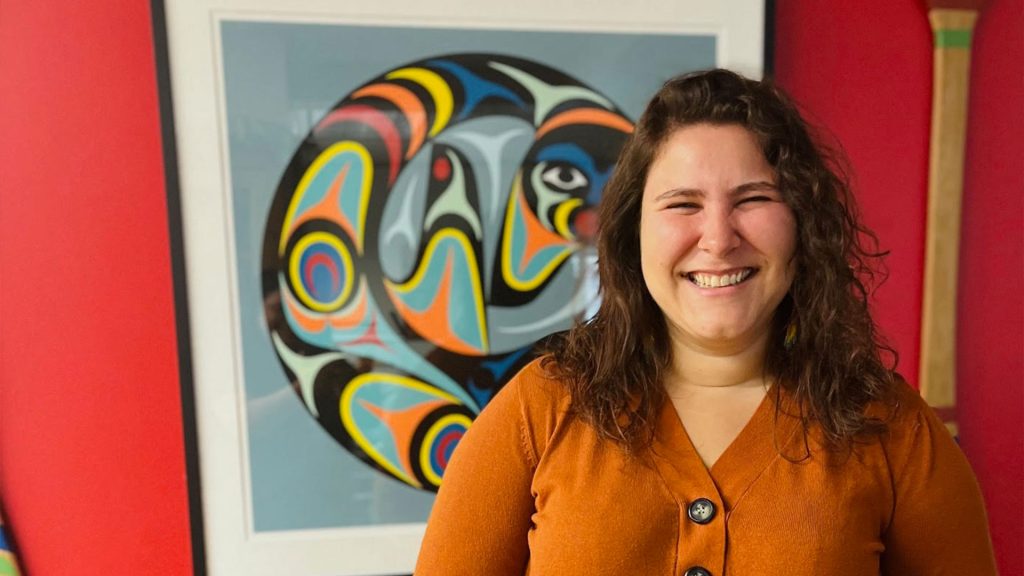
‘Indigenous people across the country and across the world have always talked about how they know the best for their children, and they do,’ said Jessica Knutson, a social worker who was involved in the child protection system as a teenager. Photo courtesy of Jessica Knutson.
Content note: This story mentions residential schools in Canada
Indigenous Peoples are reclaiming their right to take care of their children after at least 500 years of colonization.
The transition to taking back jurisdiction — the power to make legal decisions — over their children is a move full of hope, but also fraught with concerns about inadequate funding and offloading responsibility from federal and provincial governments to Indigenous nations.
“The reason [children are a top priority for First Nations people] is that children are the keepers of the possible. They’re the keepers of our tradition. They’re the keepers of our peoples,” said Cindy Blackstock, a noted activist for Indigenous children’s rights who is a member of the Gitksan First Nation and executive director of the First Nations Child and Family Caring Society of Canada.
“If you don’t pay attention to the children, then really, you’re losing that. You’re losing your culture, you’re losing everything.”
Children grow up into parents and grandparents, she noted.
“There’s an understanding that you
have to treat them well, because… everything that happens to them will
ripple forward to generations that we’ll never know,” Blackstock said.
“We have a responsibility to put
them first. They are even more important than the Elders. The Elders are
important because they teach the children, but the children are the
most important.”
Indigenous people ‘know the best for their children’
Colonization continues to strongly influence the landscape of child services in British Columbia and has for generations.
For at least 500 years,
Indigenous Peoples in the land now known as Canada have been fighting
racist approaches and policies imposed through colonization, as reported in 2015 by the Truth and Reconciliation Commission.
The Indigenous Peoples of this land, over centuries, lost their children to colonial, assimilationist practices like residential schools, day schools and boarding schools, the ‘60s Scoop and more recently, the so-called child welfare system.
Jessica Knutson, who was involved in the system growing up, has been working as a social worker for the past six years.
Knutson, 30, is also part of the National Council of Youth in Care Advocates, a group that advocates for greater and more equitable support for youth in and aging out of care. Her grandmother was Cree, from Treaty 4 territory in Saskatchewan.
Knutson says Indigenous jurisdiction over children should never have been in question and the history caused harm to Indigenous Peoples that will take decades to remedy.
“Indigenous people across the country
and across the world have always talked about how they know the best
for their children, and they do,” Knutson said.
“The hundreds of years of
attempted genocide of Indigenous Peoples here has definitely impacted
the ability to do that, but it’s amazing the work that communities are
doing, even without the monetary and other support that they should be
getting from the federal government.”
At least 4,100 Indigenous children died or went missing in residential schools, which the TRC called a cultural genocide.
Conditions were horrific,
including physical and sexual abuse, unsanitary living spaces causing
rapid spread of diseases, and inadequate food causing malnutrition. The
children were removed from their parents and their cultures and they
were not allowed to speak their own language at the schools.
Although residential schools were phased out by the late 1990s, Indigenous children are still being removed from their homes. The ‘60s Scoop saw an increase in the number of Indigenous children put into government care, a practice that continues today.
Check out Spotlight: Child Welfare
The intergenerational trauma of divided families contributes to a vast overrepresentation of Indigenous children placed in government care.
It also contributes to the high rates of disappearances, murders and violence experienced by Indigenous women, as reported by the National Inquiry into Missing and Murdered Indigenous Women and Girls.
Traditionally, Indigenous Peoples saw the care of a child as the responsibility of an extended family. When problems arose, the extended family would come together to support the child and try to come to a consensus decision to solve the problem, the 1992 report Liberating our Children says.
The colonial way — separating children from their parents — was different and harsh.
“Your child protection laws have devastated our cultures and our family life. This must come to an end,” the 1992 report said
‘You have to do something different’
Today in British Columbia, 67.5 per cent of children in government care are Indigenous, while Indigenous people only make up 5.9 per cent of the overall population.
The Canadian 2016 Census found that Indigenous children represent more than half of children in government care in Canada, despite accounting for only 7.7 per cent of the overall population of children.
Blackstock won a landmark
decision at the Canadian Human Rights Tribunal in 2016, which found that
the federal government discriminated against First Nations children
living on reserves, particularly in terms of funding.
“A First Nations child is 17 times more likely to be removed from their family than a non-Indigenous child is, and it’s due to those factors at the ground, the poverty, the poor housing, the multigenerational trauma, the addiction, domestic violence, those are the drivers,” Blackstock said.
The TRC, which is approaching its 10-year anniversary and whose leader, Murray Sinclair, died in November 2024, released the TRC’s 2015 Calls to Action that start with five child recommendations for improving child services in Canada.
Those include a call for child
welfare legislation to “affirm the right of Aboriginal governments to
establish and maintain their own child-welfare agencies.”
Poor outcomes for children raised in
foster care are the reason change is needed, said Jennifer Charlesworth,
B.C.’s representative for children and youth.
Charlesworth, who is not Indigenous, has been in the role since
2018. Her office is mandated with advocating for children and youth,
monitoring services for them and conducting reviews and investigations
into critical injuries and deaths of children receiving government
services.
The primary reason for Indigenous
children being taken into government care is poverty and once they are
in care, their mental and physical health suffers, as does their
educational achievement and even their sense of hope for the future, she
said.
“Indigenous children spend more
time in care than non-Indigenous children. They are often disconnected
from their culture, from their family and community. We know that that
has an impact on their sense of belonging, and their sense of identity,”
Charlesworth said.
“When you see poor outcomes and the
perpetuation of harm, you have to do something different. Indigenous
people in their strength and resilience have advocated for changes in
their role in child welfare and are resuming their rightful place as
carers and protectors of their children.”
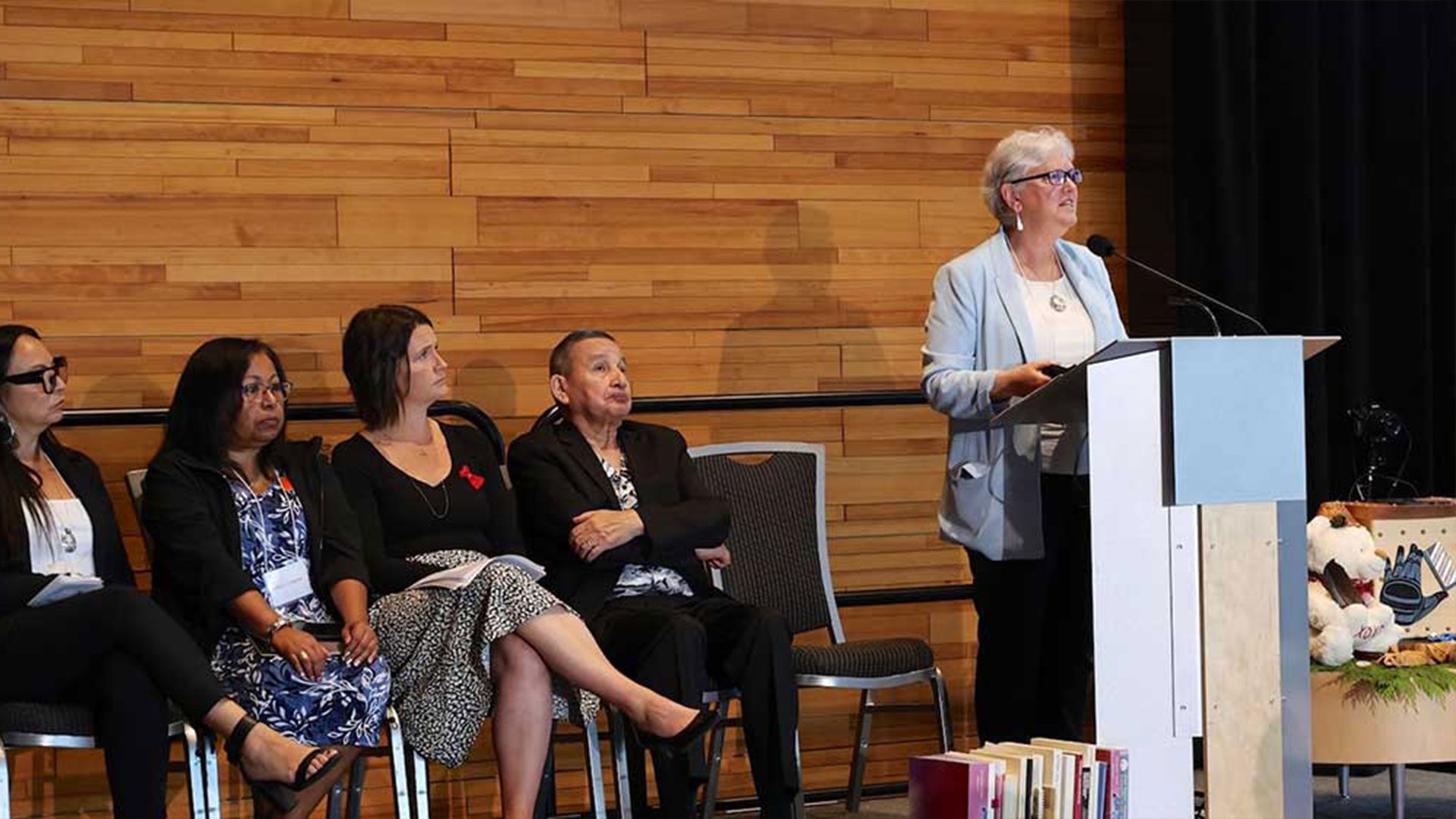
Jennifer Charlesworth (far right), B.C.’s representative for children and youth, presents the ‘Don’t Look Away’ report
on July 16, 2024. Onstage from left are Mary Teegee, Cheryl Casimer,
Grace Lore and Grand Chief Stewart Phillip of the Union of B.C. Indian
Chiefs. Photo submitted.
‘We need to take care of our own children’
The multigenerational trauma created by colonialism, residential schools, the ‘60s Scoop and the overrepresentation of Indigenous children in the child services system is evident around us. It’s evident in the statistics that show the overrepresentation of Indigenous people among the unhoused population, among the deaths from poisoned drugs and in the criminal justice system.
“This is why it’s so important. We need to take care of our own children because the current system doesn’t work,” regional Chief Terry Teegee told more than 1,000 Indigenous leaders, Elders and caregivers who gathered in late October for the Our Children, Our Way conference in Vancouver.
In 2019, the federal government passed Bill C-92, An Act Respecting First Nations, Inuit and Métis Children, Youth and Families, which affirmed jurisdiction over their children.
“When you get boiled right down to it, for a person on the street, [jurisdiction] is the ability to make decisions for your own kids,” Blackstock said.
Knutson says the return to Indigenous jurisdiction is needed.
“Children and women are the heart of community,” she said. “It’s so important and really significant that nations are able to use their own protocols to be able to care for their children, because Indigenous nations need to be making the decisions for their own children, and that looks different for each nation.”
As of Jan. 17, 2025, 86 Indigenous governing bodies representing over 110 Indigenous communities have submitted 66 notices to exercise jurisdiction over child and family services, and 42 requests to enter co-ordination agreement discussions pursuant to section 20 of the Act.
Twelve Indigenous child and family services have come into force, and 11 co-ordination agreements have been signed, according to Indigenous Services Canada.
Co-ordination agreements are
a transitional way to exercise jurisdiction over child services that
can include the Indigenous nation and the provincial government, each
having specific roles and responsibilities, with the best interest of
the child as the focus.
The United Nations Declaration on the Rights of Indigenous Peoples also recognizes the right of Indigenous families and communities to be responsible for the upbringing and well-being of their children.
“Responsibilities
for raising children are core aspects of the right to self-government,”
said Hadley Friedland, an expert in Indigenous law and professor in the
faculty of law at the University of Alberta, at the Our Children, Our
Way conference.
“This is also obvious based on how the Crown attempted to destroy Indigenous families through assimilation policies.”
British Columbia introduced its Declaration on the Rights of Indigenous Peoples Act in 2019, establishing UNDRIP as the basis for provincial reconciliation. It also amended its Child, Family and Community Service Act by passing Bill 38, which strengthens Indigenous community’s ability to resume authority over child and family services.
The first steps forward
In 2023, the Federal Court of Canada approved a $23.24-billion settlement to
compensate First Nations children and families who were harmed by
discriminatory underfunding of the First Nations Child and Family
Services program.
In addition, a 10-year,
$47.8-billion settlement agreement to reform First Nations Child and
Family services going forward was presented in July 2024.
The Assembly of First Nations Chiefs rejected that deal in October, saying the funding was inadequate, the governance structures lacked transparency and were not accountable to First Nations, that it contained a weak dispute resolution process and that committing to the settlement for 10 years would leave no way to negotiate further, the organization Our Children, Our Way said in a news release.
“Our leaders have rejected this draft agreement because they know what is at stake: our children. This was not a good agreement: we have to do better for our children,” said Mary Teegee, chair of the Our Children Our Way Society.
Blackstock said there were fundamental problems with the agreement Chiefs rejected.
“It wasn’t really a vote against, it was a vote for good governance, stability and non-discrimination for kids, and to make sure that Canada was held accountable to the legal obligations it currently has to First Nations children,” Blackstock said.
“That $47.8 billion was advertised as being there, but under closer scrutiny, looking at the agreement, it really was a one-year funding deal that gave Canada wide discretion on the level of funding and the terms of funding over the next nine years. After nine years, there was nothing for these kids, nothing was guaranteed.”
There were also issues with governance in the rejected agreement, Blackstock said.
“The chiefs, if they had voted for it, that would be the last decision they would make on their children for nine years, on this funding approach, all of that would be ceded to a secret committee that had extensive liability protection but no accountability,” Blackstock said.
Nonetheless, Blackstock is hopeful for a better deal.
“This is a legal case. Canada has to
comply with that legal standard, stop discriminating and prevent it from
happening again,” Blackstock said.
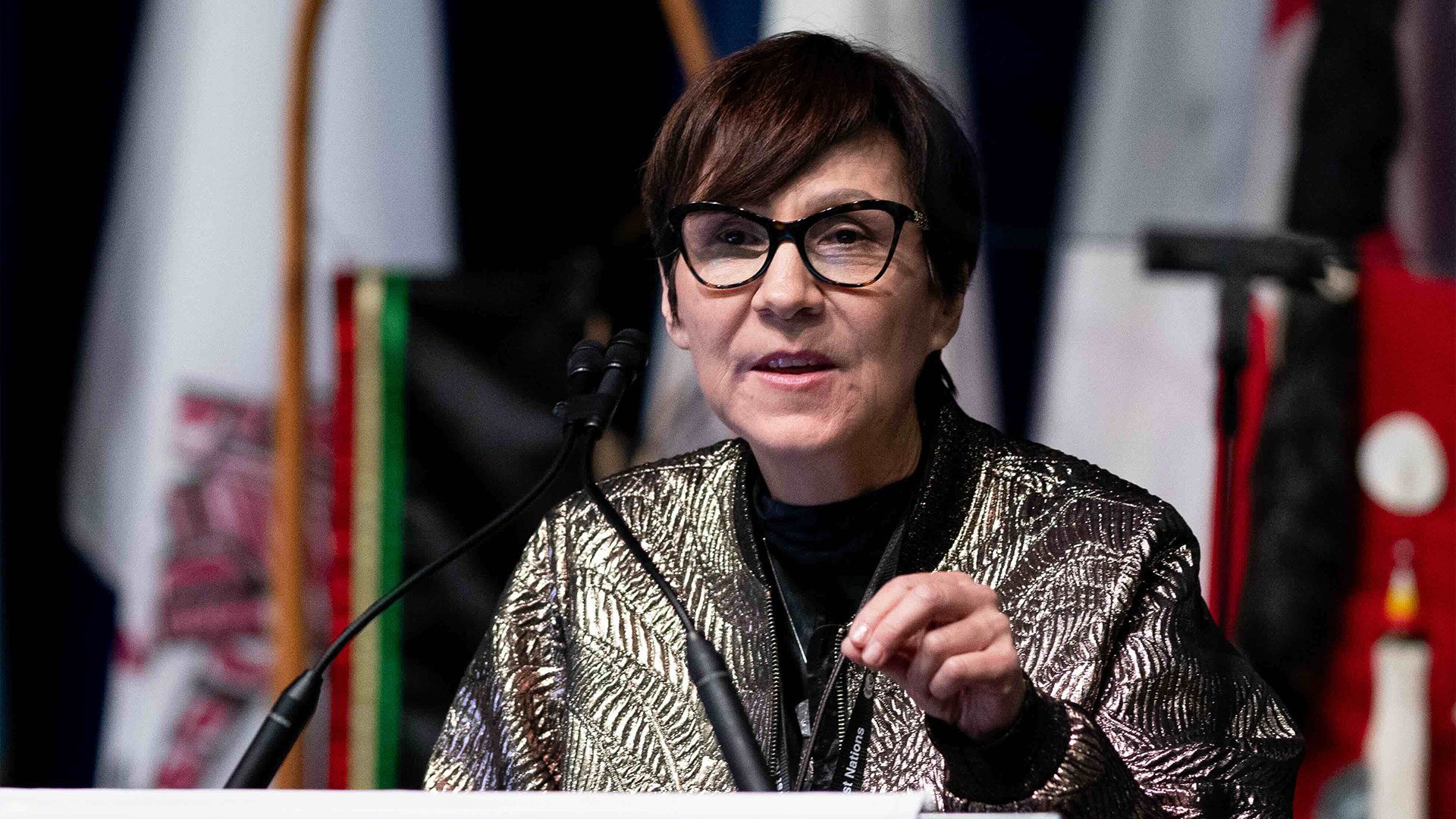
Executive director of First
Nations Child and Family Caring Society of Canada Cindy Blackstock
speaks on child services during the Assembly of First Nations Special
Chiefs Assembly in Ottawa on Dec. 4, 2024. Photo by Spencer Colby, The Canadian Press.
Transitions can cause ‘the greatest grief’
Another concern with the agreement the AFN Chiefs rejected was whether First Nations children who live off reserve would be covered by the deal. Under the current system, the federal government pays for on-reserve child services, while provincial governments are responsible for paying for off-reserve child services.
“That’s an Indian Act thing, that racist Indian Act that's been going on since Confederation, and the federal government will often weaponize that piece of legislation to try and limit its financial exposure, which is getting in the way of children and children's childhoods,” Blackstock said.
“What we would rather see, and what the Canadian Human Rights Tribunal has already ruled, is that the definition of a First Nations child is not based on some racist blood-quantum thing called the Indian Act. Instead, it’s the nation's recognition of its children on or off reserve.”
Transitional periods can be confusing and can produce the greatest grief, Charlesworth said. Her office would not have oversight over children, youth and families who are cared for by their own nations, for example, unless the nation forms an agreement to have her involved. However, she said she will be watching over the transition.
In July, Charlesworth released a report into the violent and disturbing death of an Indigenous boy in care, who was referred to as Colby.
Confusion over roles and
responsibilities during the transition to Indigenous jurisdiction may
have led to staff at B.C.’s Ministry of Children and Family Development
not doing due diligence in placing Colby and his siblings with his
mother’s cousin’s family, the report says.







 Posts
Posts


