They Took Us Away

They Took Us Away
click image to see more and read more

it's free

click

How to Use this Blog

BOOZHOO! We've amassed tons of information and important history on this blog since 2010. If you have a keyword, use the search box below. Also check out the reference section above. If you have a question or need help searching, use the contact form at the bottom of the blog.


We want you to use BOOKSHOP to buy books! (the editor will earn a small amount of money or commission. (we thank you) (that is our disclaimer statement)

This is a blog. It is not a peer-reviewed journal, not a sponsored publication... WE DO NOT HAVE ADS or earn MONEY from this website. The ideas, news and thoughts posted are sourced… or written by the editor or contributors.

EMAIL ME: tracelara@pm.me (outlook email is gone) THANK YOU CHI MEGWETCH!

SEARCH

Showing posts with label Nancy Marie Spears. Show all posts

Saturday, August 23, 2025

‘Sisters in the Wind’

Indigenous Author Centers Foster Youth in Upcoming Thriller
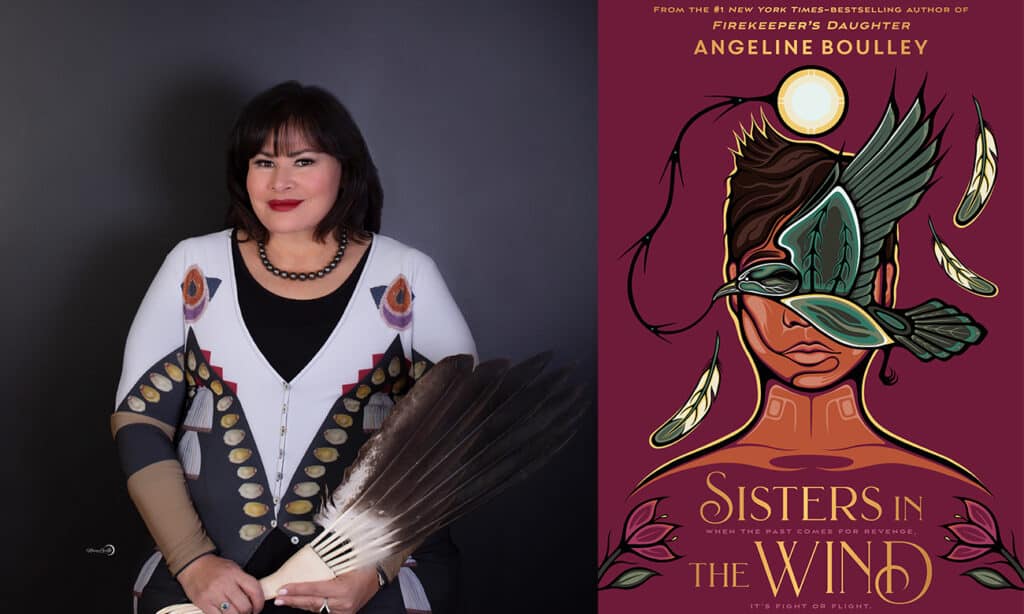
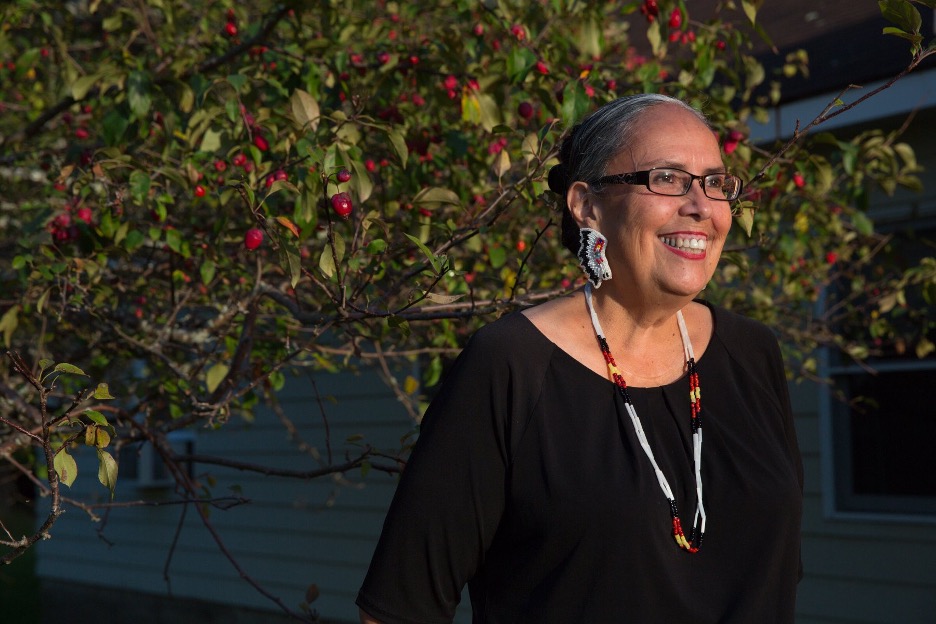
Angeline Boulley’s third novel, “Sisters in the Wind” chronicles an Ojibwe teen girl’s experience in foster care. Provided photos.

“Native families are like onions,” fiction author Angeline Boulley writes in her latest novel about Indigenous families caught up in the child welfare system. 

They are “rough-looking on the outside,” she goes on. “People want to peel the outer layers and toss them away, as if they have no value. But each layer is protecting the next, down to its innermost core. That green center, where the onion is sweetest, that’s the Native child. Surrounded by layers of family and community.”

Boulley’s third book, “Sisters in the Wind,” offers a rare Indigenous-centric glimpse into the failings of the country’s child welfare system. The young adult novel, set to publish next month, is meant to show what can happen when a federal law meant to ensure that Indigenous families remain intact is not followed, and how a child’s life can be improved when it is, the Michigan author said in a recent interview.

The thriller follows Lucy Smith, an Ojibwe teen who is running for her life, away from traumatic figures she encountered while growing up in foster care. As an adult she navigates a difficult childhood spent in various placements before finding family and healing. 

Publisher’s Weekly called the book a devastating, gripping tale “that serves as a searing critique of the ways that systems can fail vulnerable youth.”

At points in the novel, Boulley’s protagonist experiences dehumanizing moments common to foster youth everywhere, including when she is forced to carry her belongings in a trash bag during a move to a new home. 

Recently, states including New York and Texas have prohibited child welfare agencies from doling out trash bags, and now require them to provide proper suitcases to children. Such laws, “need to be everywhere,’’ Boulley said, adding that she believes making foster youth use garbage bags sends the clear message, “that they themselves are trash.’’  

An insight into Angeline Boulley’s creative process: Color-coded spreadsheets detail characters’ lives and her cat, Pietro, comforts her. Provided photo.

As an adult, Smith eventually goes to work as a research intern for a company that trains child welfare professionals on the workings of the Indian Child Welfare Act. The 1978 federal law, known as ICWA, requires state foster care agencies to take extra steps to ensure Indigenous families stay together. The fictional company in the novel is based on real work Indigenous people are doing to preserve families and tribal communities in Boulley’s home state of Michigan, she said.  

In the case of the novel’s protagonist, ICWA was not followed as she moved through the foster care system. In one bleak scene, a social worker tells Smith that identifying as Indigenous will only muddle her situation.

“It complicates everything,’’ Smith is told. “Just say you’re Mexican.”

Later, Smith comes to believe that the abusive situations she endured in non-Native foster homes never would have happened had she been placed with tribal relatives. 

Boulley, a member of the Sault Ste. Marie Tribe of Chippewa, hopes a particular message in her novel will reach child welfare professionals who might read it:  

“When ICWA is followed correctly, it works,” Boulley said. “The issues that arise primarily come when social services and court personnel don’t understand the law. They continue with assumptions and misconceptions, and that ends up complicating children’s lives.’’

Boulley was never in foster care herself. But she and her siblings grew up spending summers visiting the Sault Ste. Marie reservation in Michigan where she knew several young relatives being raised by kin outside of the foster care system. 

“Growing up, I didn’t think it was anything unusual to have cousins that were raised by my grandma,” Boulley said. “That was just normal.”

Her work on “Sisters in the Wind’’ began years ago, but she felt an urgency to complete it following recent legal challenges to ICWA. In a United States Supreme Court case two years ago, multiple states and three foster families argued that the federal statute was unconstitutional and interfered with a non-Indigenous couple’s right to adopt an Native child. 

A Supreme Court ruling upheld the law in June 2023. But, Boulley said, “We know it’s not the final assault on tribal sovereignty.’’

SOURCE:  https://imprintnews.org/top-stories/indigenous-author-centers-foster-youth-in-upcoming-thriller/265041

Thursday, June 19, 2025

Federal Government ‘Stuck Tribes With a Bill’ for Indian Boarding Schools, Lawsuit Alleges

Navajo students after entering the Carlisle Indian School in 1882. Photo courtesy of the Carlisle Indian School Digital Resource Center.

A year ago, the Department of the Interior concluded a first-ever accounting of the toll that Indian boarding schools inflicted on Indigenous people in this country over centuries.  Nearly a thousand Alaska Native, Native Hawaiian and Native American children were buried in 74 marked or unmarked gravesites across 65 school sites. 

Another number also stood out: the $23.3 billion the U.S. government spent on a system of forced assimilation that subjected tens of thousands of children to torture and abuse — the bulk of which was at times paid for out of Native Nations’ trust funds from the sale of Indigenous lands.

In the wake of these revelations, a class-action lawsuit filed by the Washoe Tribe and the Wichita and Affiliated Tribes alleges the $23.3 billion “barely scratches the surface” of the total losses to Indigenous communities imposed by the federal boarding school program between 1871 and 1969. 

They say the tally does not account for funds generated by forced child labor, money removed from Native Nations’ trust accounts and the resulting economic harm of extracting children from their families and tribes.

The lawsuit, filed May 22 in a Pennsylvania U.S. District Court, calls on the federal government to show its receipts by preserving and publishing “all documents related to the Boarding School Program on an openly accessible electronic database,” as well as all documents used to prepare the Interior Department’s July 2024 investigative report  “until a full accounting is provided and authenticated.”

An attorney representing the tribe describes this accounting as a key step toward economic justice for tribes.

“The United States forcibly separated Native children from their parents, and systematically sought to erase their cultural identity, killing, torturing, starving, and sexually assaulting many in the process and doing untold damage to generations,” the plaintiffs allege in their 68-page complaint. “And it made the Native Nations put up the money to pay for it all.”

Navajo students before and after entering the Carlisle Indian School in 1882. Photos courtesy of the Carlisle Indian School Digital Resource Center.

The Department of the Interior, the Bureau of Indian Affairs and the Bureau of Indian Education are named as defendants. They have 30 days from the time of filing to respond to the complaint or seek a continuance. 

Agency spokespeople said they could not comment on pending litigation, but in a statement noted a broader obligation to tribes.

“The Department of the Interior and Bureau of Indian Affairs remain committed to our trust responsibilities of protecting tribal treaty rights, lands, assets, and resources,” it said, “in addition to its duty to carry out the mandates of federal law with respect to American Indian and Alaska Native tribes and villages.” 

Plaintiffs in the Pennsylvania case represent the thousands of students across 574 federally recognized tribes whose children were forced to attend boarding schools designed to strip them of their culture and language. 

One of those children was a Wichita boy, Oscar Stephens, who is named in the suit. In 1905, the 10-year-old was playing by a creek near his home when he was taken by federal agents. He spoke two words of English at the time: “yes” and “no.” 

Oscar was initially sent to Oklahoma’s Riverside Indian School. Three years later, on Sept. 10, 1908, he was enrolled at the Carlisle Indian Industrial School in Pennsylvania, weighing 94 pounds with “numerous scars,” the complaint reads. 

Oscar’s student file notes he was routinely sent on forced “outings” — a euphemism at the time for children sent away from school to perform free labor. 

“His head was shaved, and he was beaten for speaking his native tongue, the only language he knew,”  court documents state. “Over the years as a young teenager he was routinely placed with families to do servile work — his file described him being sent to do housework for a family at the age of 14 — and routinely ran away.”

Akin to apprenticeships or indentured servitude, the “outing system” was formalized by Richard Pratt, who opened the first federal boarding school in Carlisle, Pennsylvania, a half-hour drive from Harrisburg, where the class-action was filed. 

The lawsuit describes “outings” like the ones Oscar was sent on as central to the boarding schools’ mission. Indigenous children were relocated from schools to farms and non-Native homes to perform manual labor — earnings they often never saw that helped sustain the system of servitude.

In an 1895 letter to the Commissioner of Indian Affairs in Washington, Pratt said the practice “brings the Indian youth directly in contact with good, wholesome, civilized life, and they absorb it rapidly, and it absorbs them, and they become a part of it.”


Chicago-based attorney Adam Levitt is part of the legal team that represents the tribes suing on behalf of boarding school students like Oscar. 

He said there are many unique aspects of the suit brought by the Wichita and Affiliated Tribes in Oklahoma and the Washoe Tribe in the Lake Tahoe region of Nevada and California. 

Adam Levitt

Though they are asking for an accounting of boarding school spending, they are not yet demanding funds be returned to tribes. 

“We need to know where the money went,” Levitt told The Imprint. “So this is not a reparations case, or a damages case. Whether money will at some point change hands stands to be seen.”

He described the early-stage case as long overdue, and the first-ever attempt to request such an accounting from the federal government. 

In a 2023 ruling in the Brackeen v. Haaland case that unsuccessfully challenged the constitutionality of the 1978 Indian Child Welfare Act, U.S. Supreme Court Justice Neil Gorsuch discussed the relevance of such an accounting. 

“The United States stuck tribes with a bill for the Boarding School Program,” Gorsuch wrote, “at points, as much as 95% of the funding for Indian boarding schools came from ‘Indian trust fund monies,’ raised by selling Indian land.” 

The plaintiffs acknowledged the work it will require to document  and itemize boarding school expenses but noted “that such an accounting may be hard is no excuse.”

“The suffering so long inflicted cannot be undone,” the complaint reads. “But the law does not turn an uncaring eye toward historic wrongs. Justice demands a remedy. That remedy begins with an accounting.”


👇SUBSCRIBE TO IMPRINT.

https://imprintnews.org/subscribe 

Thursday, March 20, 2025

Indigenous People To Receive Payouts for Surviving Canada Child Welfare System, but Larger Systemic Reforms Remain Stalled


By

Starting March 10, Indigenous people who went through Canada’s child welfare system can apply for compensation for harms caused to them.

Approximately 300,000 Indigenous children and families who went through Canada’s child welfare system can apply for compensation for harms the system caused them. 

The Canadian press reports that $23 billion in payouts under a historic class-action settlement will take six to 12 months to process. Those taken as children between 1991 and 2022 from “reserves” and the northwestern territory of Yukon are eligible to submit claims, as are their caregiving parents and grandparents.

The Assembly of First Nations is helping citizens apply through its Get Ready campaign, announced in a press release earlier.  The national advocacy organization for Indigenous communities across Canada will educate and guide First Nations claimants to avoid scams and receive the assistance they need during the application and claims processing period.

“While no amount of money can make up for the harms done by Canada’s racist child welfare system, March 10 will be a historic turning point to address these past wrongs,” National Chief Woodhouse Nepinak stated. “The $23 billion compensation settlement is an important recognition of the heroic representative plaintiffs and everyone who took part in the long process of negotiations that brought us to this point.”


The pending payouts stem from a 2007 class-action lawsuit over the discriminatory treatment of First Nations children and families. The Canadian Human Rights Tribunal, an independent administrative body that hears complaints about discrimination, ruled on the matter in 2016. That ruling declared that families in Yukon and in reserves — the equivalent of a reservation in the U.S. — did not receive the same level of child and family services provided to other Canadians.

Yet as the claims process moves forward, a far larger and more systemic reform sought on behalf of Indigenous children and families remains stalled. 

A $47.8 billion payment to the First Nations Child and Family Services Program was initially approved last year, following an agreement between First Nations leaders and the Canadian government. The funding package designed to address the overrepresentation of First Nations children in Canada’s child welfare system would have covered a range of services to prevent child neglect and abuse and improve outcomes for young adults leaving the system. The agreement would have secured funding for 10 years, and addressed particularly high costs to deliver services in rural communities.

But in October, before the terms were finalized, First Nations leaders voted down the $47.8 billion settlement offer, amid complaints that it lacked transparency and accountability, among other concerns. 

Cindy Blackstock, executive director of the First Nations Child and Family Caring Society which has been a party to the case for years, said the deal reached last year would have been too “secretive” and unreliable.  Indigenous leaders “want to make sure the money is secure, and stops the discrimination now and forever,” Blackstock said.

Some Indigenous leaders are now seeking to renegotiate the deal, although there is an ongoing dispute over whether parties such as the Caring Society should be involved. 


Meanwhile, national politics in Canada may have introduced an additional unknown. 

Prime Minister Justin Trudeau — whose government presided over last year’s settlement agreement with First Nations that has since been rejected — has resigned, causing concerns over whether a new conservative government would honor future agreements. 

In December, the Assembly of First Nations revealed the results of a legal review it commissioned, warning that the $47.8 billion reform deal could be upended by a future government.

That worries Danielle Cranmer, citizen of the Acjachemen Nation and a clinical therapist and licensed social worker. She has been closely watching the child welfare lawsuits in Canada since many of her clients are from First Nations families.

“The Assembly of First Nations and other Indigenous governance bodies have every reason to scrutinize the potential ramifications of a government change,” Cranmer said. “If the current administration loses power, a new government could claim they are not bound by this agreement, further delaying or dismantling crucial child welfare reforms.”

Cranmer said ensuring long-term commitments to reforms are essential to addressing harms of the past and helping First Nations people heal. She’ll continue monitoring how the current case unfolds, in light of historic patterns. “This underscores the precarious nature of agreements made between Indigenous nations and settler governments — particularly when they hinge on political administrations that may not honor past commitments,” Cranmer said.

Blackstock, who is Gitksan First Nation and has decades of social work experience, agreed.

“That’s why it was so important to protect against a change of government by having these legal orders, instead of moving over to this final settlement agreement that didn’t hold Canada accountable and gave them such wide discretion,” she said. “Under an adverse government, that would put at risk a lot of the gains we’ve made for First Nations’ kids.”

Can anything be said with certainty about what lies ahead?

“The short answer is, we don’t know,” Blackstock said. “But what we do know is that the legal orders are binding on whatever political party is in the government.”


For more information on all classes under the settlement, visit www.fnchildclaims.ca.


Thursday, February 13, 2025

‘Ambiguous Loss’ — A Team of Researchers is Learning From Indigenous Women Whose Children Were Adopted

Illustration by Christine Ongjoco.

Hoping to offer a rare in-depth look into how placing children for adoption impacts the lives of Indigenous birth mothers, a group of researchers is continuing efforts to document the experiences of American Indian and Alaska Native women. 

Their study, believed to be the first of its kind, focuses on mental health and grief. The research is being carried out in stages and has already surfaced several themes, including “ambiguous loss” — “a stressful and traumatizing’’ event that occurs when there is “no verification, closure, rituals for support, or resolution.’’

A small sample of Indigenous birth mothers informed the study’s initial findings, originally published in a 2022 peer-reviewed article in the Family Process journal. Now, researchers intend to expand their work by surveying a larger number of Indigenous mothers and further examining the roles of culture and history. Participants are being recruited online, and through word of mouth and flyers being distributed throughout rural and urban Indigenous communities. 

Understanding the systemic challenges that lead to Indigenous women’s children being placed for adoption might ultimately help inform future child welfare and adoption practices, said Sicangu Lakota elder Sandy White Hawk, lead investigator. Such insights might also lead to a better understanding of the specific support Native birth mothers need during and after an adoption, researchers said. 

 “It is my hope that it will motivate policy change on child removal — that child welfare will begin to focus on family healing rather than child removal,” White Hawk said.

Sandy White Hawk. Provided photo.

White Hawk’s interest comes from a personal place — she was adopted at 18 months old.  She is the founder and director of the Minnetonka-based First Nations Repatriation Institute, which helps Indigenous people impacted by adoption or foster care reconnect with their families and identities. 

For the study’s initial phase, her team interviewed eight women from Minnesota, Washington, New Mexico, North Dakota, Alaska, Oregon and Wisconsin. Researchers acknowledged the small sample size but said the interviews yielded “rich data’’ nonetheless.

Researcher Ashley Landers said previous studies involving the impact of foster care and adoption on birth mothers have mainly centered on the lives of white mothers.

“I don’t think it’s by chance that no Native birth mothers were included in birth parent research prior to this,” said Landers, an associate professor in the Department of Human Sciences at Ohio State University. “Their part of the story has been largely omitted — Native birth fathers have also been omitted, and the larger Native family impact is oftentimes not part of adoption research.”

History weighs heavily on the experiences of Indigenous birth mothers, making them “distinct from other races as they have been disproportionately exposed to systemic practices of forced child removal,’’ White Hawk’s team posited in the 2022 published article.  Culprits include U.S. policies that coerced parents into relinquishing their children to boarding schools, and the Indian Adoption Project — a federally funded effort in the mid-20th century to force the assimilation of Native American children into white families. 

Also harmful, they wrote, is the ongoing disproportionate removal of Native children from their parents through the country’s child welfare systems.

Taking this broader cultural context into account is crucial to understanding how adoption impacts the well-being of Native women, whose grief may be complicated by intergenerational trauma, researchers wrote. Two of the original study participants grew up in foster care, and one is a descendant of boarding school survivors.

Ashley Landers. Provided photo.

In all, the eight study participants were between the ages of 33 and 77 at the time of the survey.  Each had experienced separation from a child through adoption or foster care between 1959 and 2010.

Wednesday, October 16, 2024

First-ever Oral Histories of Indian Boarding School Survivors, Collected with Care

By

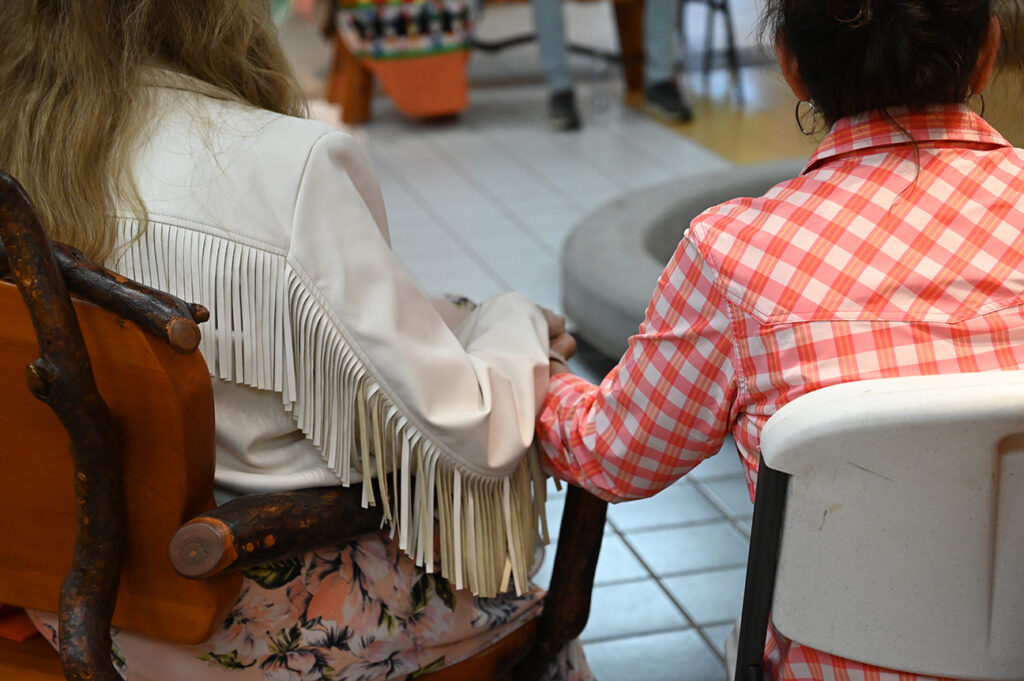
Two people hold hands at the oral history project site visit in Harbor Springs, Michigan. Provided photo.

They’ve come from the Turtle Mountain Band of Chippewa. From the Ojibwe and Inupiaq. Smoke rises from bundles of sweetgrass, cedar and sage as they tell their stories of surviving Indian boarding schools. 

For some, the recounting is not new.  They bring weathered black-and-white family photos to honor relatives lost.  Others, until now, have never disclosed their still-raw childhood trauma. 

Across the country, a group of traveling Indigenous oral historians are there to listen, and to record these vital first-person narratives.  They are part of an ongoing collaboration between the National Native American Boarding School Healing Coalition and the U.S. Department of the Interior.  The goal is to more fully document the systemic abuse endured by generations of Indigenous people under the government’s attempts at forced assimilation that began in the 1800s and lasted for over a century.

Ramona Klein, a 77-year-old from North Dakota shared a particularly harrowing memory with the historians, tribal officials and spiritual leaders who gathered in Bismarck, North Dakota in June to support the survivors. 

She remembered a “big, green bus.” It carried Klein and her five siblings away from their sobbing mother and the Turtle Mountain Band of Chippewa Indians to the militaristic Fort Totten Indian Boarding School.   When the children arrived in 1954, she said, they met a matron who meted out beatings with a wooden paddle that school staff called “the board of education.”

The first-of-its-kind oral history project, underway since March, receives and archives these memories. Three historians and a team of an additional 10 to 12 people have so far visited Indigenous communities in Oklahoma, Alaska, Minnesota, North Dakota, Montana and Michigan, and will continue their work through 2026. 

Their holistic approach recognizes that painful narratives cannot be collected without caring for the people who experienced the trauma. 

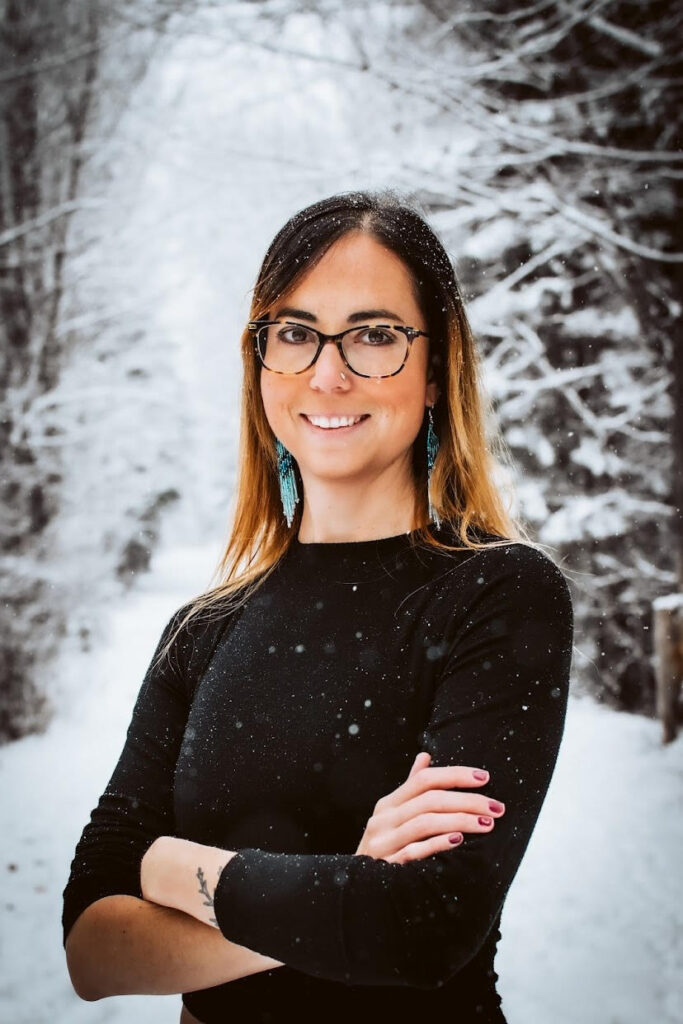
Charlee Brissette, is a Sault Ste. Marie Tribe of Chippewa Indians tribal member and a descendant of boarding school survivors. She works as the oral historian team lead. Provided photo.

“Many times people feel a sense of lightness after sharing their story,” said Charlee Brissette, a Sault Ste. Marie Tribe of Chippewa Indians tribal member and oral history project team lead. “But everybody’s story is unique, and when it comes to talking about abuse, sometimes they don’t always feel light in that moment.”

In each location, video interviews begin and end in a circle, in accordance with Indigenous practices. Interviewees share in spaces made sacred. An altar set up at each site offers traditional medicine set in an abalone shell alongside eagle and crow feathers. Participants are provided native food reflective of each region — smoked salmon and moose in Alaska and smoked trout in Michigan. Powwow songs, deerskin drumming and other performances are provided by artists including Salish Spirit Canoe Family, Osage Tribal Singers, and the Alaska Native Heritage Dancers. 

Indigenous psychologists stand by onsite, ready to suggest a pause for water or nourishment, or some time to decompress at the beading table. 

“I don’t know if I would have felt that same sense of healing in the absence of those things,” said James LaBelle. He recounted his time at two Bureau of Indian Affairs schools during his interview in Anchorage, Alaska, in May. “It would have been a stark, cold interview.”

Thursday, August 1, 2024

Government Releases Stunning New Tally of the Historical Harms of Indian Boarding Schools

The Interior Department has concluded an unprecedented yearslong review finding nearly 1,000 children died, separated from their tribes and families, with many buried across hundreds of institutions created for ‘forced assimilation.’ 

First-of-its-kind Survey Examines Trauma and Healing Among Indigenous Survivors of Family Separation
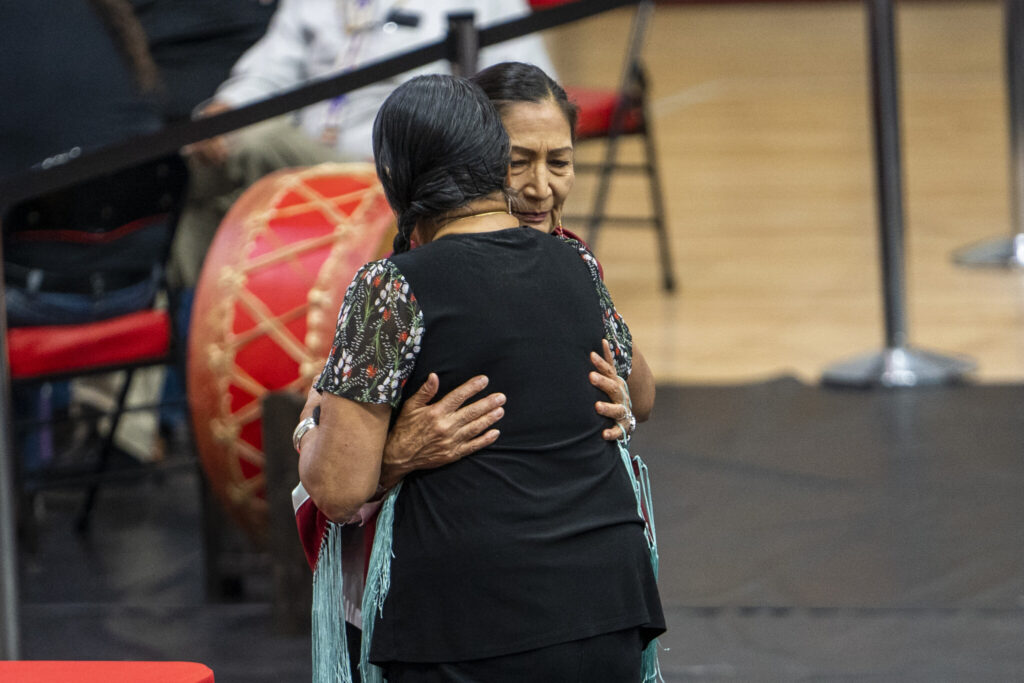
Interior Secretary Deb Haaland embraced boarding school survivor Delores Twohatched at the first stop on the “Road to Healing” tour in July 2022, Photo by Nick Oxford.

The federal government has concluded a comprehensive inquiry into one of the American continent’s darkest and most tragic episodes: The more than century-long tactics to forcefully assimilate Native American children separated from their families and tribes into hundreds of so-called Indian boarding schools.

In a rare and sweeping admission, the federal agency that oversaw that network is now calling for a formal national apology to the descendants of those who died or suffered rampant abuse and trauma in this system.

The 105-page volume announced Tuesday builds on information the Interior Department uncovered in May 2022 as part of its Federal Indian Boarding School Initiative. It significantly increased the number of student deaths to nearly 1,000, and tallied and detailed the federal dollars going into federally-run and church-operated schools and burial sites. The department also confirmed the massive public investment and priority the young United States once placed on this human toll: More than $23 billion from taxpayers in today’s dollars and more than 150 treaties with tribes baked the schools into the national infrastructure.

“The most important thing is that our work to tell the truth about the Federal Indian boarding school system be paired with action,” Assistant Secretary of the Interior Bryan Newland, a citizen of the Bay Mills Indian Community, noted in the report. “As we have learned over the past three years, these institutions are not just part of our past. Their legacy reaches us today, and is reflected in the wounds people continue to experience in communities across the United States.”

These volumes — and the Interior Department’s oral history project — represent the first-ever comprehensive attempt by the federal government to recognize and document the experiences of survivors as well as tracking the impact of generations of genocidal policies against Indigenous children and their families.

In the process of publishing these two volumes in the last two years, Interior Department staff and contractors painstakingly sifted through approximately 103 million pages of U.S. government records and met with Indigenous leaders and government officials to compile the findings. Interior Secretary Deb Haaland, through her “Road to Healing” tour that began in Anadarko, Oklahoma, participated in listening sessions with hundreds of boarding school survivors at 12 locations across the country. The experiences of some of those individuals are included in this second volume. 

Many of the employees who worked on the project were Indigenous, said Sec. Haaland, the first Indigenous woman in a U.S. cabinet and a member of the Laguna Pueblo tribe. It’s a dramatic contrast to the way the agency operated for nearly two centuries: as an anti-Indigenous driving force in advancing these policies.

The report notes that “Indian education” was a treaty right, and a priority in the relations between tribes and the U.S. government — as evidenced by the 100-plus treaties that “explicitly include Federal Indian boarding schools or general Indian education provisions.”

“I am immensely proud of the hundreds of Interior employees — many of them Indigenous — who gave of their time and themselves to ensure that this investigation was thoroughly completed to provide an accurate and honest picture,” said Sec. Haaland. “The Road to Healing does not end with this report — it is just beginning.”

The final report builds on findings in the first report, released in 2022, adding to the nation’s understanding of the federal policies of the Indian boarding school system. The initial findings accounted for 500 child deaths across 19 schools, while the updated list of boarding schools now includes 417 institutions across 37 then-territories or states. 

The children’s death tally has doubled.

Nearly 1,000 children — 973 Alaska Native, Native Hawaiian and Native American children buried in 74 marked or unmarked gravesites across 65 different school sites — died while attending schools operated by the federal government. 

And the total does not include children who died whose records weren’t available or who attended “Indian day schools, sanitariums, asylums, orphanages, stand-alone dormitories, and Indian boarding schools operated by religious institutions and organizations that received no U.S. Government support.”

The atrocities occurring within school walls range from abusive to culturally genocidal, with matrons, priests and other school employees using various methods to erase the cultures and identities of tribal children.

In Alaska, children were given a number that was haphazardly written on everything they owned — that is, all the non-cultural items they were allowed to keep.

The Anaktuvuk Pass Eskimo from Central Alaska “came in after we did, they had all their parka, their caribou pads,” an Alaska Native participant, who spoke to Haaland during her stop in that state, said in the report. “They came in, they stripped them down, put all their clothes, the food they bring in, dry caribou, salmon, and stuff like that, they put it all on the side. I think I probably cried when they took all their clothes down there and burned them in the furnace, all the beautiful, beautiful parkas and everything.” 

Another Alaska participant described being forced to eat Western processed foods. “We all got violently ill because our bodies couldn’t process changing our diet over from our traditional Native foods. And we had vomiting, we had diarrhea, we had both and we were often punished for soiling our pants or clothing or bedding and we got beaten for that.”

Federal Government Set to Release its Next Report on Indian Boarding School Survivors
Assistant Secretary for Indian Affairs Bryan Newland listening with Secretary of The Interior Deb Haaland in 2022 at Riverside Indian School in Oklahoma. Photo by Nick Oxford.

Friday, December 29, 2023

Top Stories of 2023: Indigenous Rights Upheld

A selection of The Imprint’s most impactful stories from the past year

Native leaders said the high court’s decision to uphold ICWA “will be felt across generations.” Photo by Rosemary Stephens.

In 2018, the future of the Indian Child Welfare Act was put in jeopardy by a case that would come to be known as Brackeen v. Haaland. A federal district court judge ruled that the 45-year-old law known as ICWA was unconstitutional in its entirety. As the case progressed, many supporters of the law — which is designed to maintain the bonds between Native children and their families and tribes — feared that the U.S. Supreme Court would gut or erase ICWA.

This June, the court did the opposite in a 7-2 ruling that strongly affirmed the Indian Child Welfare Act’s constitutionality.

“The bottom line is that we reject all of petitioners’ challenges to the statute, some on the merits and others for lack of standing,” wrote Justice Amy Coney Barrett.

The Imprint’s five years of coverage on the Brackeen case includes Nancy Marie Spears’ reporting on the arguments considered by the Supreme Court and the prayers and protests outside that day.  And check out The Imprint Weekly Podcast episode from the week after the court’s decision for more insight from several leading experts on ICWA and tribal law.

But Spears’ reporting in 2023 went well beyond the Supreme Court case.  She profiled the Indigenous practices that ICWA is meant to protect, such as the My Two Aunties program developed by a group of tribes in Southern California.  Her recent three-part series, Born of History, explores the ways in which the colonization of the past, and the present constraints of federal funding, make it difficult for many tribes to make full use of ICWA’s protections. 

SOURCE:

https://imprintnews.org/best-of-2023/top-stories-2023-indigenous-rights-upheld/246657


Happy Visitors!

WRITTEN BY HUMANS!

WRITTEN BY HUMANS!

Blog Archive

Featured Post

Your History Class Was a F*cking Lie | #NOMOAR

  Your History Class Was a F*cking Lie by Sean Sherman (Or: How the American Educational System Has Always Been a Racist Propaganda Program...


Native Circles

Native Circles
click logo for podcasts!

Most READ Posts

Bookshop

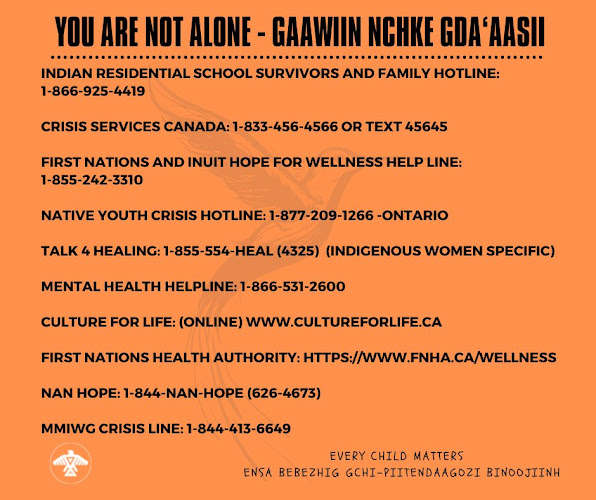
You are not alone

You are not alone

To Veronica Brown

Veronica, we adult adoptees are thinking of you today and every day. We will be here when you need us. Your journey in the adopted life has begun, nothing can revoke that now, the damage cannot be undone. Be courageous, you have what no adoptee before you has had; a strong group of adult adoptees who know your story, who are behind you and will always be so.

Diane Tells His Name


click photo

Lost Birds on Al Jazeera Fault Lines

Lost Birds on Al Jazeera Fault Lines
click to read and listen about Trace, Diane, Julie and Suzie

NO MORE STOLEN SISTERS

NO MORE STOLEN SISTERS
click image

ADOPTION TRUTH

As the single largest unregulated industry in the United States, adoption is viewed as a benevolent action that results in the formation of “forever families.”
The truth is that it is a very lucrative business with a known sales pitch. With profits last estimated at over $1.44 billion dollars a year, mothers who consider adoption for their babies need to be very aware that all of this promotion clouds the facts and only though independent research can they get an accurate account of what life might be like for both them and their child after signing the adoption paperwork.

Original Birth Certificate Map in the USA

Google Followers