


LISTEN: https://revealnews.org/podcast/native-adoption-utah-politician-northern-cheyenne/

LISTEN: https://revealnews.org/podcast/native-adoption-utah-politician-northern-cheyenne/
PORTLAND, OR – Recently, the National Indian Child Welfare Association’s (NICWA) Protect ICWA Campaign released ICWA 2050, a 25-year strategy to strengthen the Indian Child Welfare Act (ICWA) and tribal child welfare. Honoring the 46th anniversary of ICWA, ICWA 2050 casts a vision that recognizes and upholds the critical role that tribal nations play in protecting Native children, helping families in tribal child welfare systems and assisting states as they implement ICWA.
ICWA 2050 outlines a uniting vision spanning decades and sectors. It represents a holistic vision and approach to changing the interrelated systems that protect Native kids for generations to come. Achieving that vision will require work across and within many sectors, from the courtroom to the newsroom. Each goal has a powerful impact on the cultural fabric we are weaving back together to create nurturing networks for Native children, including:
“ICWA 2050 is a collective effort guided by Indian Country, including tribal leadership across all regions of the United States and the technical expertise of tribal child welfare directors,” said Sarah Kastelic, National Indian Child Welfare Association Executive Director. “We are inspired by the collaboration and shared vision that shaped this effort. ICWA 2050 represents a commitment to one generation of work that can change the trajectory of many generations of Native children.”
“ICWA 2050 not only fortifies protections for Native children today, but also builds a path for generations to come, ensuring that our children remain grounded in their cultures and communities,” said Larry Wright, Jr., National Congress of American Indians Executive Director. “This forward-looking strategy reflects the strength of tribal sovereignty and collaboration across Indian Country, empowering tribal nations to lead in defining the future of child welfare for Native families. The National Congress of American Indians and its members are proud to support and join this vision, rooted in the resilience and self-determination of our communities.”
“ICWA 2050 offers a powerful vision to strengthen and protect ICWA, ensuring that Native children remain deeply connected to their cultures and Nations,” said Kim Mettler, Association on American Indian Affairs Next Generations Director. “By supporting ICWA 2050, we help affirm and protect the fundamental human rights of every Native child – to family, cultural identity, freedom from forced assimilation, and the right to self-determination. ICWA 2050 is an investment in our shared future.”
👇

Known as an independent-minded Republican for much of his tenure as governor, Burgum has since embraced Trump's hardline rhetoric and MAGA Republicanism. Trump included Burgum on his final short list as vice president before picking JD Vance.
Burgum's second term as governor ends next month when Gov.-elect Kelly Armstrong, a GOP congressman, is sworn in.
Born and raised in the tiny farm town of Arthur, North Dakota, with a population of 328, Burgum in 1983 mortgaged farmland he inherited from his family to invest in Fargo-based Great Plains Software. He became the company's president the next year, and by 2001 sold the company to Microsoft for $1.1 billion. At Microsoft, Burgum worked as senior vice president through 2007.
Today, Burgum has a net worth of more than $100 million, according to Forbes magazine. Burgum is the founder of Kilbourne Group, a Fargo-based real estate firm, and is co-founder of Arthur Ventures, a software venture capital firm based in Minneapolis. He is also board chairman of Atlassian and SuccessFactors.
As governor, Burgum took steps to improve relations with the state's native tribes. That includes signing legislation codifying the federal Indian Child Welfare Act to give preference to Native American families in the adoption of native children.

|
|
|
|
🎧 Other places to listen: Apple Podcasts, Spotify, iHeartRadio, Pandora, or wherever you get your podcasts.
Read: ‘People Say, You Sold Your Baby’ (The Cut)
Read: Forever Home (Mother Jones)
Listen: Adoptive Couple v. Baby Girl (Radiolab)
Listen: This Land podcast
Navajo Nation expedites membership verification for Indian Child Welfare Act

The Indian Child Welfare Act was passed in 1978 to establish basic requirements to protect Native American children from removal from their homes and communities.
If a child is determined to be a tribal member, the ICWA then triggers legal protections and the right of the Navajo Nation to intervene.
However, the process to verify tribal membership can take several months.
Tribal officials say this new agreement will significantly shorten the time to determine membership by improving coordination and the sharing of records between Navajo Nation divisions and the offices that work with children in custody, adoption or foster cases.
Caseworkers will then be able to determine if ICWA applies in a matter of weeks, which will allow the Navajo government to intervene sooner.
President Buu Nygren signed off on the memorandum of agreement October 30, 2023.
READ
https://blog.americanindianadoptees.com/2023/09/how-to-enroll-if-you-are-navajo.html
By Trace L Hentz (blog editor and adoptee)
Yesterday I was talking to my husband about an adoptee who is in another country and needs help to find her family and tribe. Her (amended) (fake) birth certificate is from Utah.
Utah is a closed record state. BAD NEWS. But Utah has an adoption registry: and she can register online, which is new. https://adoptionregistry.utah.gov/ - Their website says: The Utah Adoption Registry is a voluntary, mutual consent registry that helps adult adoptees born in Utah and their birth parents and blood related siblings reunite with one another.
There is a form to fill out: Register Now
Of course there is a fee: Check or Money Order made out to 'Vital Records'. New registration: $25. Update to Match Search information: $10.
She was adopted in Utah but could be born somewhere else. She sent me a copy of her fake OBC (the original birth certificate, amended after adoption) and it lists her adoptive parents as her birth parents.
She told me in an email her adoption was private, which means lawyers were involved, I guess. Why? Paperwork.
Until we reunite with our relatives, which many of us have done, Closed Adoption accomplished our erasure as sovereign citizens in our tribal nations.
 |
Who Are the Navajo People? - WorldAtlas worldatlas.com |
By Navajo Times | Sep 21, 2023 | News |
WINDOW ROCK – Child welfare services provided to by Arizona, New Mexico and Utah may soon be improved through the adoption of traditional Navajo teachings and knowledge if incorporated into their programs.
Officials with these states’ child welfare agencies were in Window Rock recently to discuss ways to expand the capacity of their existing partnership with the Navajo Nation.
The meeting sought ways to strengthen agreements between the Navajo Nation Division of Social Services and states to enhance services for Navajo children and families.
“My administration wants to encourage collaboration between child welfare agencies and to use the Diné Action Plan to help combat the challenges our Diné families and children face,” President Buu Nygren told state officials.
The Diné Action Plan is considered a living document that expresses Diné teachings. It was adopted by the 24th Navajo Nation Council in 2021. The plan was introduced in April 2018 as a blueprint to improve the quality of life throughout the Navajo Nation.
“Unfortunately, we are seeing inter-generational cycles that occur when a child is removed from his or her home,” said Thomas Cody, executive director of the Navajo Division of Social Services. “The increase of substance use, decrease of healthy parenting, and a decrease in teachings at home causes a decrease in spiritual connection.”
According to Cody, some Navajo services aid and provide services that focus on alleviating those generational challenges and traumas.
“Unfortunately, more is needed to combat these issues. This is why these collaborative partnerships are so important,” Cody said.
Although the Nation has the resources to treat those in need, it needed a plan to reflect Navajo values and principles of ntsáhákees (thinking), nahat’á, (planning), iiná (action) and sih hasin (reflection) that Navajos are familiar with through their traditional teaching.
The DAP was the result. It was designed to address public safety, violence, substance use disorder, suicide and missing and murdered Diné relatives on the Navajo Nation, said Cody.
According to the DAP, which references traditional Navajo teachings, in contemporary society Navajos face the “monsters” of the modern world.
“These include substance abuse, suicide and the various forms of violence that has come onto our people. With substance abuse, our people are attacked by the monster of addiction and lose their lives to chemicals that draw them into a trap of irresistible cravings where they are poisoned and die.
“With suicide, our Diné face the evil of hopelessness which results in the taking of one’s own life,” Cody said. “With violence, there are monsters of frustration and pain causing them to lash out on others. Finally, there are monsters outside Navajoland and within (which) take our people away from our families.”
The DAP states that the teachings of the Navajo deities, known to Navajos as the Holy People, “are embedded in our culture and traditions and the teachings provide us with the tools we need to defeat our modern monsters. The teachings have been given to us by our Diyin Dine’é (the Holy People).”
According to Navajo teachings, the seven monsters that have preyed upon the Navajo people from time immemorial are laziness, sleepiness, jealousy, hunger, poverty, lice and old age.
The DAP was established to maintain spiritual connection as the foundational component to self-identify and to our culture, said the president.
Nygren said the Diné Action Plan should be part of each state’s mental health programs because most Navajos would be familiar and comfortable with its concepts, and that would lead to better outcomes.
He said there is a need for a state-tribal cooperative approach because so many Navajos live off the Navajo Nation and use mental health care provided through neighboring state services.
“Mental health and wellness are so important, especially for our young people and elders,” he said. “By working together with our state partners, we can help ensure Navajos have access to culturally appropriate services no matter where they live.”
The COVID-19 pandemic highlighted longstanding mental health
challenges on the Navajo Nation. These include high rates of depression,
substance abuse and suicide.
Isolation during lockdowns exacerbated these issues for many Navajos.
The agreements will aim to address barriers of lack of transportation, shortage of Navajo-speaking providers, and the high cost of care.
Specific programs being discussed include the development of a mobile crisis unit, school-based telehealth services and funding for traditional healing.
BREAKING - I can confirm this video of Utah County Attorney David Leavitt, discussing his "strategy" to adopt a Native American infant, was submitted into evidence in 2020 as part of a Homeland Security human trafficking investigation.
— Adam Herbets (@AdamHerbets) June 28, 2022
My full investigation airs tonight. @FOX13 pic.twitter.com/wOhzO2HoVr
According to the video, David Leavitt says his "strategy" included boarding a plane to Montana to meet with the Northern Cheyenne Tribal President (unannounced) to discuss buffalo exports to Ukraine + eventually adoption.
— Adam Herbets (@AdamHerbets) June 28, 2022
"At that point, he was all ears." pic.twitter.com/0XQfjJKFYM
After the child's adoption, Tribal President Jace Killsback served time in prison for an unrelated case.
— Adam Herbets (@AdamHerbets) June 28, 2022
I spoke with him briefly on the phone. So far, he has chosen not to comment on the claims made by Leavitt. pic.twitter.com/SWnerCkwhT
The Indian Child Welfare Act, passed in 1978, was designed to protect Native American children from being removed from their families.
— Adam Herbets (@AdamHerbets) June 28, 2022
The child is Leavitt's foster-step-great niece. There is no blood relation, but ultimately it's up to the tribe to decide who is "family." pic.twitter.com/UREFw15fGm
FOX 13 Investigates dropped another bombshell involving a Homeland Security Investigation against Leavitt. Noel Engels, a former analyst with Homeland Security Investigations, told FOX 13 Investigates that his team had been investigating sexual allegations against Leavitt for several years. Engels said his team had received the video about Leavvit and added it to the case file investigation on Leavitt on suspicion of human trafficking. VIA
In 1992, the task force issued their report, Report of Utah State Task Force on Ritual Abuse, concluding that ritual abuse was occurring in Utah. The Jeffrey Epstein saga, as well as my work on The Finders cult, show that these types of organized sexual rings do exist. Whether or not there is an occult or ritualistic element is often harder to prove, and, perhaps, even a distraction from the very real abuse of children that is happening. -
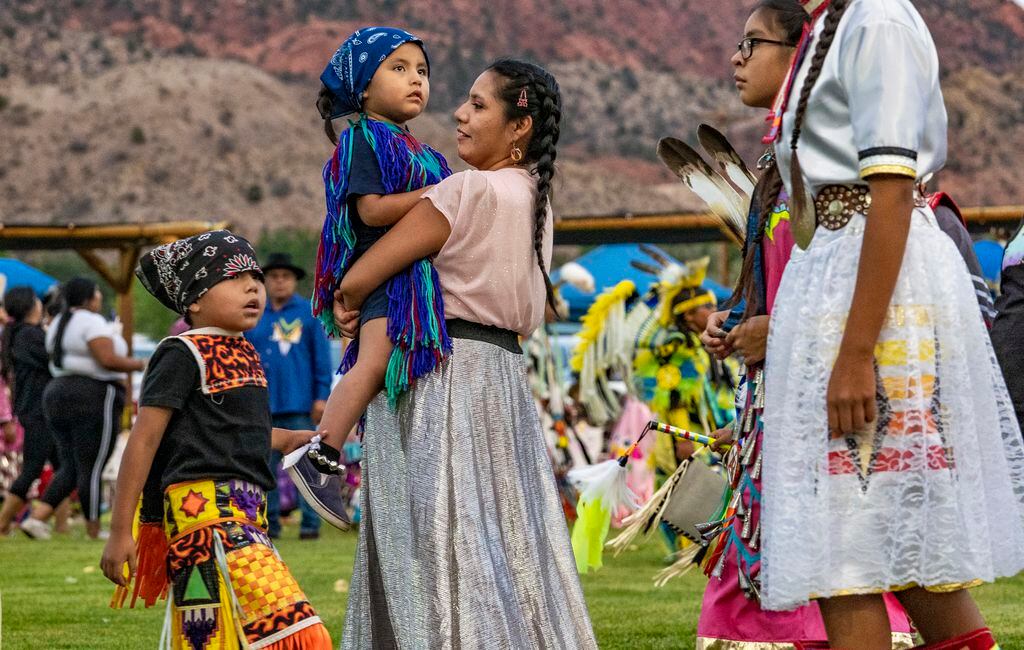
Men, women and children from Native American tribes throughout the West show their regalia during the Grand Entry at the 41st Annual Paiute Indian Tribe of Utah Restoration Gathering, Aug. 13, 2021 in Cedar City, Utah. (Leah Hogsten | The Salt Lake Tribune)
Utah continues to neglect Indigenous children and families, tribal community leaders and experts told members of the Senate Government Operations and Political Subdivisions on Monday, February 1, 2022.
Indigenous leaders hope the bill SB28 would fix some of the inequities which have plagued Indigenous residents of Utah for the last 126 years. The bill creates an Office of American Indian-Alaska Native Health and Family Services under the Utah Department of Health and Human Services to make sure that Indigenous children and families get protection when they enter the state’s child welfare system.
SB28 also moves the Indian Child Welfare Act Liaison and the American Indian-Alaskan Native Health Liaison from two different state agencies and brings both roles into the merging Utah Department of Health and Human Services. The merger is expected to take effect in July.
Supporters of the bill say the proposed merger streamlines how the government responds to Indigenous children and families when these children are taken by welfare agencies and also ensures that the Indian Child Welfare Act of 1978 is enforced. Also known as ICWA, the federal law governs the removal and placement of Native children to combat the high number of Indigenous children removed from their homes.
According to Utah Foster Care, there are about 100 American Indian/Alaska Native children in Utah’s foster care system at any time. There are fewer than 15 licensed American Indian/Alaska Native foster homes in the state for Indigenous children and families, says the nonprofit.
The bill “combats the excessive removal of Native American children from their homes and acknowledges the alarmingly high percentage of Indian families which are broken up by the removal of children,” Sen. Jani Iwamoto, D-Holliday, told The Tribune.
Paul Tsosie, legal counsel to the Confederated Tribes of the Goshute Reservation, said that SB28 also allows Utah to meet the burden of higher protections for Native families in the state, a burden he says is spelled out through the U.S. Constitution and the treaties between tribes and the federal government.
“The [Indian Child Welfare Act] specialist is crucial to help all parties correctly apply ICWA in the Utah State Court system,” Tsosie said.
The goal is to make sure that cultural sensitivity and Indigenous values are being taught to children who go to any home in the state, Tsosie added.
Rupert Steele, chairman of the Confederated Tribes of the Goshute Reservation, and Moroni Benally, a lobbyist for the Navajo Nation, and other tribes requested the Legislature pass the bill to protect the well-being, safety and health of the approximately 41,644 Indigenous children and families living in the state.
SOURCE
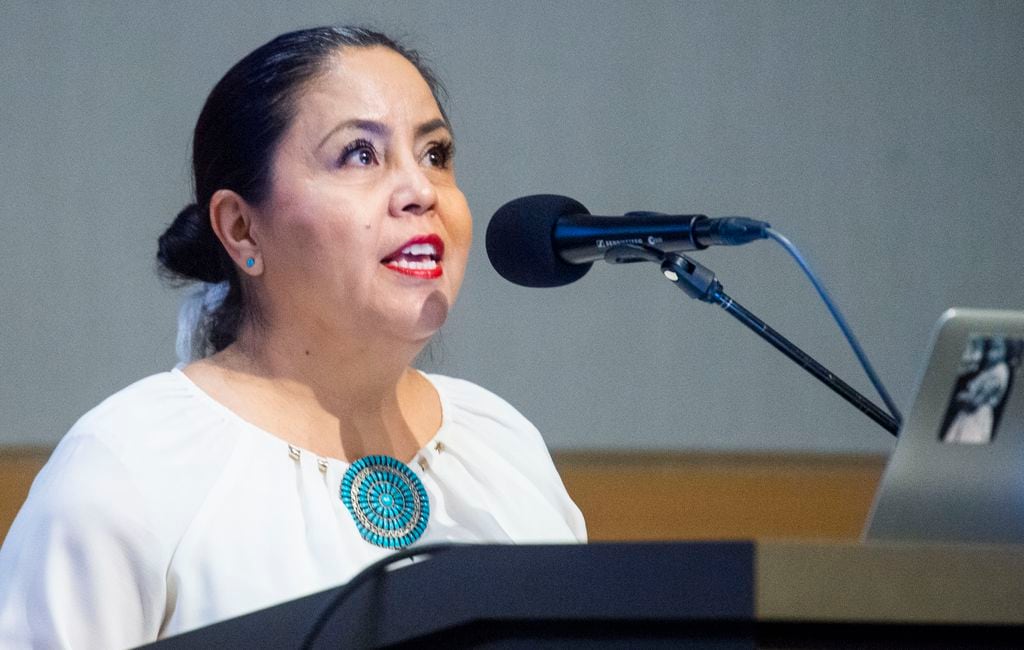 |
| (Rick Egan | The Salt Lake Tribune) Yolanda Francisco-Nez, Executive Director, Restoring Ancestral Winds, speaks about "Missing and Murdered Indigenous People in Utah" during a workshop at the Salt Lake City Library Auditorium, Monday, July 22, 2019. |
Since the discovery of Indigenous children at boarding schools in Canada and then the unverified findings of Paiute bodies at the Panguitch Boarding School, the nonprofit Restoring Ancestral Winds (RAW) began research on the association between Indigenous boarding schools and domestic violence across Utah’s Indigenous communities.
On a panel called “Utah Native American Boarding Schools and other Assimilation Projects on Native Children and Families” hosted by RAW, Indigenous organizers said the Indian Civilization Act of 1819 is a precursor to some of the domestic violence among Native Americans in Utah.
The Indian Civilization Act, or Civilization Fund Act of 1819, is a federal policy that encouraged the assimilation of Indigenous children via boarding schools. From that policy came the formation of Utah boarding schools in Aneth, Intermountain, Ouray, Uintah and Panguitch.
“We have known that there’s a connection between missing and murdered Indigenous women, girls and two-spirit with domestic violence,” said Yolanda Francisco, executive director for RAW. Two-spirit people identify as being both feminine and masculine in spirit. “We have to mention that domestic violence plays a role; it’s a precursor to going missing or murdered.”
While the correlation between domestic violence and Indigenous boarding school has not been well studied, Francisco says she knows that the discipline experienced among Indigenous children influences how they eventually parent.
“There is definitely a role that punishment plays in the life of an individual who survives the boarding school experience, particularly those who were victims of that abuse that occurred,” she said.
Children were subjected to harsh punishments in the schools, ranging from the forced cutting of their hair, which is considered an important part of tribal identity, to eating soap for speaking their language, and other physical, emotional and sexual abuse. The living conditions were also poor and kids died from tuberculosis, whooping cough, measles, the flu and smallpox.
Thursday’s panel featured speakers Davina Smith, who is Navajo (Diné), Denae Shanidiin, who is Diné and Korean, and Kalama Ku’ikahi, who is Diné and Native Hawaiian, who all shared their experiences of boarding schools — either as survivors or through the experience of their parents and grandparents.
“When I think about boarding and foster care children, they’re also considered underneath this umbrella of missing and murdered Indigenous peoples,” Shanidiin said. She hoped the panel would bring more awareness of the Paiute children who attended the Panguitch Boarding School and other Indigenous children at other schools.
Ku’ikahi made connections between the Indian Civilization Act and the early boarding schools in Utah, noting that Christian churches and missionaries influenced the policy.
For example, the Uintah Boarding School, or Ute Indian Boarding School, was established in 1881 by the Episcopal Mission, as was the Ouray Boarding School in 1885. The Panguitch school was Presbyterian.
The Church of Jesus Christ of Latter-day Saints’ Indian Student Placement Program, which operated from 1947 to 2000, took approximately 50,000 Native children from reservations and placed them in Latter-day Saint homes, he said.
Smith said the connections between domestic violence and boarding schools run deep in her family.
Recently, Smith ran over 360 miles from Bears Ears National Monument and Grand Staircase Escalante National Monument to bring awareness to Indigenous issues like boarding schools and missing and murdered Indigenous people.
“I know for me I had to end that generational trauma for my kids because I did not want them to go through that,” Smith said. “And it was also about me talking and opening up my traumas with my kids. Just recently, I was able to open up to my mother and talk about it.”
 |
| A single building stands on the grounds that once contained an Indigenous boarding school, Aug. 26, 2021, in Panguitch, Utah. There are six known boarding schools within Utah, with the largest one located near Brigham City. The school in Panguitch primarily housed Utah Paiutes and Kaibab Paiutes Native Americans and this school operated from 1904 to 1909. (Chris Caldwell/The Spectrum via AP) |
The Indian Student Placement Program was sponsored by The Church of Jesus Christ of Latter-day Saints and was run from 1947 to 2000. This program started in 1947 but didn’t get sponsored by the church until 1954, according to the church. The program had missionaries approach Native American families and offer to have their children move in with an LDS foster family during the school year and return for the summer.
A 1976 document from the church identifies the objective of the Indian Student Placement Program as “to provide Lamanite children with educational, spiritual, social, and cultural opportunities that would contribute to their leadership development.”
Lamanite is a term from the Book of Mormon which refers to a group of people that settled in the Americas from Israel but turned their back on the Gospel and were cursed with dark skin. The church believed it had a mandate to help the Lamanites and convert them.
The president of the LDS Church at the time that document was released was Spencer W. Kimball, a staunch advocate for LDS outreach to Native Americans who described this program as an “inspiration from the Lord.”
In total, the Indian Student Placement Program placed 50,000 Native American children in homes that were in good standing within the LDS church, as reported by the Atlantic. These kids had to be baptized before entering the program with some instances of the children having wet hair from their baptism when they were introduced to their host family.
In 2018, the LDS church settled a lawsuit with members of the Navajo Nation that alleged they were sexually abused while in this program. The terms of the settlement were confidential and included no admission of wrongdoing by the church.
This was just one of many Native American assimilation efforts that were taken in the 20th century. In total there were over 489 residential schools in the U.S. and Canada, with the last residential school on the continent being shut down in 1996, according to the Union of Ontario Indians.
Assimilation programs in the 20th century didn’t just target Native American children. Another main policy was called “termination” which was a policy meant to terminate federal recognition and supervision of Native American Tribes and take more of their land.
The U.S. enacted termination policies in 1953, removing Indigenous people from their land. The land was sold and the people were relocated into urban areas and were promised good jobs. However, when Native Americans were relocated to cities the work was often less than rewarding, many felt out of place, and the housing offered was often sub-par.
Termination policy was led by Utah Sen. Arthur Watkins, who sold this policy was a way to stop Native Americans from being “wards of the government.” In a 1957 article written by Watkins, he argued that termination policies should be enacted by the government “as rapidly as possible.”
In total, termination policies enacted across the country took somewhere between 1.3 million to 2.5 million acres of land from Native Americans and more than 12,000 people lost tribal affiliation.
This termination policy worked poorly, with around 50% of relocated Native Americans deciding to return to reservations. These policies were phased out during the ’60s and during the Civil Rights Movement. In 1968, President Lyndon B. Johnson signed the Indian Civil Rights Act which called for the end of termination and instead allows tribes to self-determine their futures.
 The Navajo Nation and Utah Governor signed an inter-governmental agreement Monday, Feb. 4, 2019, to strengthen and further protect the Indian Child Welfare Act for the benefit of Navajo children in the State of Utah. Nation President Jonathan Nez and Vice President Myron Lizer met with Governor Gary Herbert to make it official at the Utah State Capitol during the annual American Indian Caucus Day.
 |
| archival photo |

"After a Colorado father went through four years of legal battles to get custody of his daughter - who was put up for adoption without his consent - 9NEWS uncovered evidence of a system in Utah where agencies are coaching mothers to deceive fathers out of their parental rights.
Utah adoption lawyer Wes Hutchins says he has audio recordings as proof. The way some adoption agencies handle birth mothers Hutchins claims "is an invitation for birth mothers to lie, cheat and defraud birth fathers into thinking they don't have anything to worry about."
"The idea that the birth mother can travel from any state to Utah and be in Utah for two or three days and then give birth to a child and then leave the state with the sole purpose of cutting off the rights of the biological father has to stop," Hutchins said.


Your History Class Was a F*cking Lie by Sean Sherman (Or: How the American Educational System Has Always Been a Racist Propaganda Program...





 Posts
All Comments
Posts
All Comments


