They Took Us Away

They Took Us Away
click image to see more and read more

it's free

click

How to Use this Blog

BOOZHOO! We've amassed tons of information and important history on this blog since 2010. If you have a keyword, use the search box below. Also check out the reference section above. If you have a question or need help searching, use the contact form at the bottom of the blog.


We want you to use BOOKSHOP to buy books! (the editor will earn a small amount of money or commission. (we thank you) (that is our disclaimer statement)

This is a blog. It is not a peer-reviewed journal, not a sponsored publication... WE DO NOT HAVE ADS or earn MONEY from this website. The ideas, news and thoughts posted are sourced… or written by the editor or contributors.

EMAIL ME: tracelara@pm.me (outlook email is gone) THANK YOU CHI MEGWETCH!

SEARCH

Showing posts with label federally recognized tribes. Show all posts

Monday, March 30, 2026

Virginia’s tribal leaders discuss sovereignty and education at ‘Native Voices’ event

Panelists discussed educational initiatives, the maintenance of tribal heritage and the legal sovereignty of each of their tribes
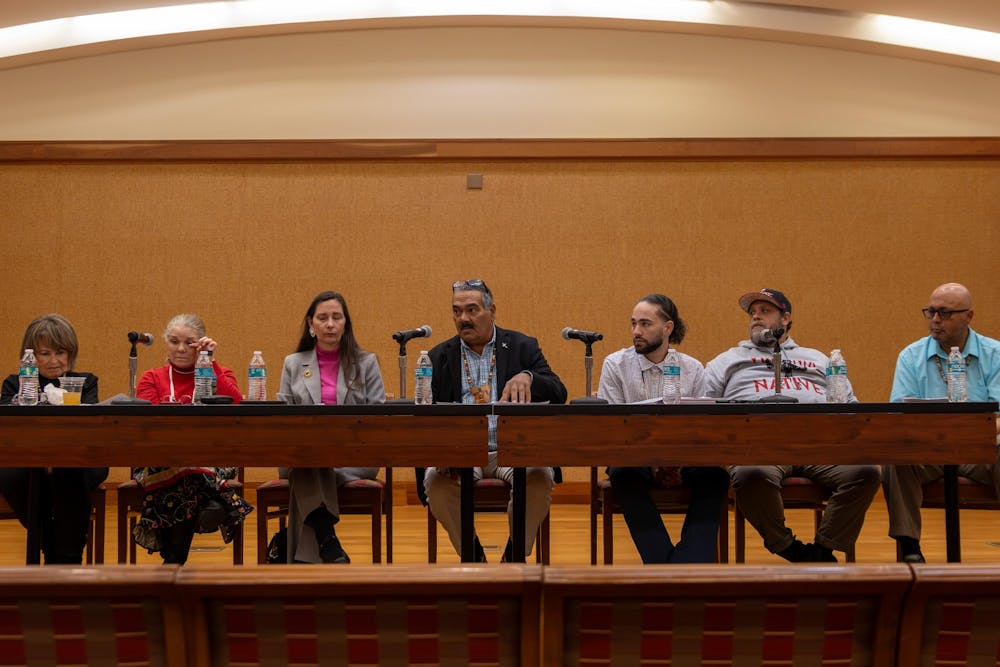
Native Voices event, photographed March 14, 2026.
Native Voices event, photographed March 14, 2026. Photo by Isabela Delgado | The Cavalier Daily

Representatives from Virginia’s federally recognized Tribal Nations gathered for a University-sponsored discussion Saturday on politics, policy and culture. At the event, hosted in the Albert & Shirley Small Special Collections Auditorium, the panel of seven tribal leaders discussed the process of gaining federal recognition for tribal nations, the significance of tribal voices in history and in education and the maintenance of tribal heritage.  

The event was co-sponsored by the University’s Native and Indigenous Relations Committee, the Office of the Vice Provost for Academic Outreach, University Tribal Liaison Kody Grant and Assistant English Prof. Sarah Richardson’s ENWR 2520, “Special Topics in Writing — Virginia’s Native Community” class. It featured representatives from the seven federally recognized Tribes across Virginia — The Chickahominy, Eastern Chickahominy, Monacan, Nansemond, Pamunkey, Rappahannock and Upper Mattaponi.

A major topic that the panel discussed was the sovereignty of each nation as individual, separate entities. In the Commonwealth of Virginia, there are seven tribal nations recognized at the federal level and 11 tribal nations recognized at the state level. The relationship between tribal nations and the federal government is, under the U.S. Constitution, a relationship between two sovereign nations

The panelists highlighted the importance of sovereignty and the need for better recognition and support from state and federal governments. Kerry Canaday, a member of the Chickahominy Indian Tribe, discussed the legal relationships of tribal nations and the federal government — he noted the federal government dictates how the tribe can spend their money, which limits their sovereignty as a nation. 

“[Legally], we’re on the same playing field as Israel, England [and] France,” Canaday said. “When the United States gives them money, they are not told how to spend it, but … we’re told how to spend it, and then we [have to] report back to the government how we spent it — did we spend it the way that they said to? Did we use it all?” 

Chief Frank Adams of the Upper Mattaponi Tribe also spoke about this topic extensively, describing the restrictions on the tribe’s funding and the ability to function independently. Adams explained that while the state of Virginia makes money through taxes, the tribe must have their own laws and businesses to remain funded. 

The tribal representatives further cited a recent decision in Caroline County by the Virginia Department of Environmental Quality to permit the drawing of water from the Rappahannock River and dumping of the wastewater into the Mattaponi River. The Rappahannock Tribal Nation has contended that the DEQ did not involve them in its decision and deliberation regarding reducing the negative impacts on Rappahannock land. 

Gerri Wade, a citizen of the Rappahannock Tribe, said that the DEQ has neglected to work with the Rappahannock people or consult them on the maintenance of the environment of their tribal lands. She noted that the DEQ is attempting to build a data center which is going to deplete the river of clean water. 

“You can’t replace river water, you can’t keep it clean with what they’re doing,” Wade said. “[The data center] will affect the fish and the wildlife, the ecosystem and everything.”

Irma Adams, a citizen of the Nansemond Tribe, also mentioned the significance of the environment to tribal nations. She discussed how the Nansemond Tribe took custody of the ancestral land of their nation in October 2022, and that the land was a “mess” when they gained possession because it had previously been the site of a concrete factory.

Adams said that the land was stripped, full of invasive species and had heavily polluted land and water. However, the tribe has now started restoring land by working with the Virginia Department of Forestry to plant trees. 

Panelists also touched on the conservation of tribal heritage and culture through education and awareness. The Virginia Tribal Education Consortium is a group with the goal to “support the academic achievement and career and technical education success of tribal citizens.”

Canaday, a CTE project director and VTEC Office Liaison, emphasized the significance of Native American representation in educational curriculum. Canaday is currently working on developing new Standards of Learning coursework — the K-12 educational guidelines of Virginia — that is intended to include better representation of Indigenous history. 

“Teachers are hungry to know about the accurate Virginia Indian history, and not … just written from one side, as history is always written in the eyes of the winners,” Canaday said. “[Our tribes] are still here [and] we still have our stories. We know what we were taught, and know what our people went through.” 

VTEC also serves to support education for first-generation students, offering direct financial assistance as well as aid in other ways. However, according to Canaday, they have had difficulties in obtaining grants to fund the education of students who are tribal members. As a result, many tribal citizens are focused on trying to garner more support for VTEC and its programs.  

First-year College student Katherine Rose, who was in attendance for the event, said that hearing directly from the representatives of the tribal nations was impactful and exposed the shortfalls of the relationship between the Virginia government and tribal nations. 

“Virginia has a lot more work to do in regards to what the state does for its tribal nations,” Rose said. “I hope that U.Va. can become a bigger part of that.”


NOTE: Some of these tribes have fought a hundred years for recognition.  As they state in this story, THEY ARE STILL HERE.... The government stalls and stalls... Trace

Wednesday, March 18, 2015

BIA Proposes Federal Rule (!) to Govern #ICWA Implementation (UPDATED)

Archive Photo

Press release here:
In keeping with President Obama’s commitment to supporting Indian families and building resilient, stable and thriving tribal communities, Assistant Secretary – Indian Affairs Kevin K. Washburn today announced that the Bureau of Indian Affairs (BIA) has published a proposed rule to govern the implementation of the Indian Child Welfare Act of 1978 (ICWA) by state courts and child welfare agencies. The proposed rule also includes changes to current regulations that govern notice to state agencies under ICWA.
“The Bureau of Indian Affairs’ proposed rule clarifies and strengthens implementation of the Act’s requirements in Indian child custody proceedings to ensure that Indian families and tribal communities do not face the unwarranted removal of their youngest and most vulnerable members,” Washburn said. “I want to thank all those who attended listening sessions and provided comments and recommendations for our updated guidelines. Their contributions helped inform this proposed rule, which seeks to protect Indian children and families. We look forward to receiving more comments and feedback throughout the rulemaking process.”
The Department will be conducting tribal consultations and public meetings on the proposed rule through May 2015 to facilitate input and comment on the proposed rule. Tribal consultations are open only to representatives of federally recognized Indian tribes. Public meetings are open to everyone.
The public and tribal hearings times and locations are listed on the press release. It looks like the first public one is in Portland during the NICWA conference. Written comments will be due 60 days after publication (3/20/15).

These are different from the recently released Guidelines in that they would be binding–not persuasive–authority. 

Pre-publication regulations here. 55 pages long. From the overview–
This proposed rule addresses ICWA implementation by State courts and child welfare agencies, including updating definitions, and replacing current notice provisions at 25 CFR 23.11 with a proposed new subpart I to 25 CFR part 23. The proposed new subpart also addresses other aspects of ICWA compliance by State courts and child welfare agencies including, but not limited to, other pretrial requirements, procedures for requesting transfer of an Indian child custody proceeding to tribal court,
adjudications of involuntary placements, adoptions, and termination of parental rights, voluntary proceedings, dispositions, and post-trial rights.
For example, the proposed rule clarifies ICWA applicability and codifies that there is no “Existing Indian Family Exception (EIF)” to ICWA. Since first identification of the EIF in 1982, the majority of State appellate courts that have considered the EIF have rejected it as contrary to the plain language of ICWA. Some State legislatures have also explicitly rejected the EIF within their State ICWA statutes. When Congress enacted ICWA, it intended that an “Indian child” was the threshold for application of ICWA.
The Department agrees with the States that have concluded that there is no existing Indian family exception to application of ICWA. The proposed rule also promotes the early identification of ICWA applicability. Such identifications will promote proper implementation of ICWA at an early stage, to prevent–as much as possible—delayed discoveries that ICWA applies
Federal Register site here.
**

The Federal Rule Making Process

Given yesterday’s announcement about the proposed ICWA rules, here is a quick and general guide to how a proposed rule becomes a part of the Code of Federal Regulations (CFR). Here is the Federal Register Tutorial: What it is and how to use it (you know you want to know the historical background of the Federal Register Act).
There is also a lot of information over at the Cornell Legal Information Institute’s Regulation Room on what federal rule making is, and what makes for effective comments.

Wednesday, July 31, 2013

Civil Right Complaint Filed in #BabyVeronica Dispute

Posted by Turtle Talk

Complaint here.
NCAI press release:
Federal Civil Rights Lawsuit Filed on Behalf of Veronica Brown
Statement of Support Issued by Tribal Governments and Leading Native American, Civil Rights, Child Welfare and Legal Advocates along with Arizona and New Mexico State Attorneys General to Stop Violation of “Baby Veronica’s” Civil Rights by South Carolina Courts
Washington, DC (July 31, 2013) - Today, the Native American Rights Fund filed a complaint in the United States District Court in South Carolina to protect the civil rights of Veronica Brown, a citizen of the Cherokee Nation who has been denied due process in the South Carolina courts. The filing comes after the South Carolina Supreme Court issued two controversial orders to the state’s family court on July 17 and 24, calling for the removal of Veronica from her father and a transfer her to the adoptive couple without a hearing of best interest.
The lawsuit was supported in a national statement released today by a broad coalition of civil rights, child welfare, adoption advocates, legal authorities, tribal governments, and Native American advocacy groups. These groups and individuals joined with the National Congress of American Indians, Native American Rights Fund, and National Indian Child Welfare Association in releasing the national statement of support for Veronica’s civil rights, and the rights of all children, to a hearing of best interest.
The litigation was filed on behalf of Veronica, by Angel Smith, an attorney appointed as counsel for the child by the courts of the Cherokee Nation, in U.S. District Court in South Carolina, and asks the Court to determine whether Veronica has a constitutionally protected right to a meaningful hearing in the state courts to determine what is in her best interests. Furthermore, the litigation asserts that Veronica, as an “Indian child” under the Indian Child Welfare Act, has a federally protected right to have the state courts fully consider and appropriately weigh her best interests as an Indian child. Daniel E. Martin, Jr., the judge for the family court system of South Carolina, is named as the defendant in the suit.
According to the filing, Veronica “doubtless has a liberty interest in remaining with her father and such an interest justifies at a minimum a plenary hearing on her current status, her relationships with others and her genuine need for stability… Despite the finding of the family court and the implicit assumption by the Supreme Court of South Carolina that [Veronica’s] best interest would be served by being with her father, two years later the court now determines, despite the passage of time and [Veronica’s] stage of development at age four, that her ‘best’ interests will now be served by being removed from him and given back to the adoptive couple. Again, this order is without any consideration to the present circumstances, psychological and emotional well-being, and future impact on [Veronica]. This is an arbitrary result, depriving [Veronica] of any opportunity to be heard on her own behalf, irrespective of the competing interests of the adult litigants in her young life.”
Broad National Support for the Litigation
Also today, on behalf of broad coalition of civil rights, child welfare, legal authorities, tribal governments and Native American advocacy groups, the National Congress of American Indians, along with the Native American Rights Fund and the National Indian Child Welfare Association released a national statement of support for Veronica’s civil rights to be upheld. The statement of support has been endorsed by a broad coalition of tribal governments, state and federal legal authorities including two state attorneys general – Arizona and New Mexico – civil rights institutions such as the Leadership Conference on Civil and Human Rights, child welfare and adoption organizations including the Child Welfare League of America, and leading national and regional Native advocacy organizations representing the interests of almost every tribe located within the United States (see full list below).
According to the letter:
[T]he rights promised to our children are being compromised in the courts of the State of South Carolina … The recent [South Carolina Supreme Court] ruling in the case denies the basic fundamental right of an almost four-year-old Indian child to a hearing of her ‘best interests’ before removing her from her biological father after almost two years of child-rearing, bonding and establishing a loving home environment. Plainly stated, this is a denial of Veronica’s human rights and constitutional rights to due process as a citizen of the United States.
The following organizations and individuals have signed on to the letter of support for the civil rights lawsuit being filed on behalf of Veronica: Read more of this post

Wednesday, November 23, 2011

Laws protect full-bloods

Some states have revised the Indian Child Welfare Act
Laws Protect Full-Bloods
To protect Indian children from adoption agencies, tribal leaders pushed for the much-needed Indian Child Welfare Act (ICWA), made law in 1978. Since its passage, full blood Indian children are supposed to be protected and kept in their tribal community.
But the Multi-Ethnic Placement Act of 1994, (amended by the Interethnic Adoption Provisions of 1996) decided: “If it turns out that a child is of mixed ancestry, including some Indian heritage, but is not an “Indian child” under ICWA, then the child’s placement is not subject to ICWA and the child is entitled to the MEPA-IEP protections against discriminatory placement decisions. If a caseworker has reason to know that a child may have some Indian heritage, it is essential to determine whether the child is a member of a federally recognized Indian tribe, or may be eligible for membership by virtue of being the biological child of a member. Delays in determining a child’s status as an “Indian child” can have the unfortunate consequence, years later, of disrupting stable placements with non-Indian foster or adoptive parents to rectify an earlier failure to abide by ICWA.”
I’m a mixed blood, meaning my blood was somehow tainted or ruined. The ax cuts both ways. Tribes might lose children if one parent was white and doesn’t disclose the child’s Indian ancestry. Some tribes exclude mixed bloods based on blood quantum. Some tribes dis-enroll members who move off their reservation.
Entire tribes were terminated by the 1950s, when the U.S. government ended its federal trusteeship of roughly three percent of the Native population through a process called termination. Of the 109 tribes and bands terminated, 62 were in Oregon and 41 were in California. Others were in Minnesota, Nebraska, Utah, and Wisconsin. (Many adoptions happened in those states, too, before the ICWA.)
Termination caused cultural, political and economic devastation for those tribes. Some did reestablish the trust relationship but for others, their lawsuits lasted years.
Lost Birds I’ve met want to find their families, even if not federally recognized. Mixed blood children now can certainly fall into these loopholes and disappear. Caseworkers might determine your Indian status based on how you look, which is ridiculous.
Really, it’s a mess. There are 250 tribes on a list of non-recognized tribes, with 150 of them petitioning for federal recognition. State-recognized tribes like the Abenaki in Vermont, who receive no federal benefits, are currently petitioning the federal government. The idea that a tribe doesn’t exist is troubling. If there are tribal members, there is a tribe.
Not long ago, Vermont decided to apologize for sterilizing Abenaki Indian women and children, after a deliberate attempt to make sure there would be no more Vermont Indians. Vermont’s apology took the form of teaching Abenaki tribal history in all its schools. For many years, the Abenaki were so afraid of the government militia called Roger’s Rangers; they did not teach their children the Abenaki culture, language or ceremony.
Some history I wish wasn’t true.

Happy Visitors!

WRITTEN BY HUMANS!

WRITTEN BY HUMANS!

Blog Archive

Featured Post

Your History Class Was a F*cking Lie | #NOMOAR

  Your History Class Was a F*cking Lie by Sean Sherman (Or: How the American Educational System Has Always Been a Racist Propaganda Program...


Native Circles

Native Circles
click logo for podcasts!

Most READ Posts

Bookshop

You are not alone

You are not alone

To Veronica Brown

Veronica, we adult adoptees are thinking of you today and every day. We will be here when you need us. Your journey in the adopted life has begun, nothing can revoke that now, the damage cannot be undone. Be courageous, you have what no adoptee before you has had; a strong group of adult adoptees who know your story, who are behind you and will always be so.

Diane Tells His Name


click photo

Lost Birds on Al Jazeera Fault Lines

Lost Birds on Al Jazeera Fault Lines
click to read and listen about Trace, Diane, Julie and Suzie

NO MORE STOLEN SISTERS

NO MORE STOLEN SISTERS
click image

ADOPTION TRUTH

As the single largest unregulated industry in the United States, adoption is viewed as a benevolent action that results in the formation of “forever families.”
The truth is that it is a very lucrative business with a known sales pitch. With profits last estimated at over $1.44 billion dollars a year, mothers who consider adoption for their babies need to be very aware that all of this promotion clouds the facts and only though independent research can they get an accurate account of what life might be like for both them and their child after signing the adoption paperwork.

Original Birth Certificate Map in the USA

Google Followers