They Took Us Away

They Took Us Away
click image to see more and read more

it's free

click

How to Use this Blog

BOOZHOO! We've amassed tons of information and important history on this blog since 2010. If you have a keyword, use the search box below. Also check out the reference section above. If you have a question or need help searching, use the contact form at the bottom of the blog.


We want you to use BOOKSHOP to buy books! (the editor will earn a small amount of money or commission. (we thank you) (that is our disclaimer statement)

This is a blog. It is not a peer-reviewed journal, not a sponsored publication... WE DO NOT HAVE ADS or earn MONEY from this website. The ideas, news and thoughts posted are sourced… or written by the editor or contributors.

EMAIL ME: tracelara@pm.me (outlook email is gone) THANK YOU CHI MEGWETCH!

SEARCH

Showing posts with label Montana ICWA. Show all posts

Tuesday, February 4, 2025

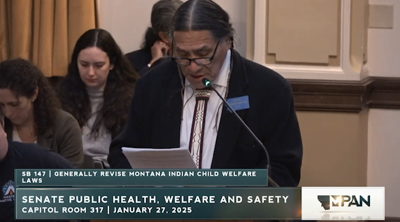
Montana Native American Caucus focuses on cultural preservation, ICWA

Montana Native American Caucus focuses on cultural preservation

The Montana Native American Caucus is focusing on preserving Native culture during the 2025 Legislative Session. Senator Jonathan Windy Boy shares that key priorities include strengthening the Montana Indian Child Welfare Act and enhancing Native language education. These efforts aim to ensure Native children stay connected to their heritage and support cultural preservation in schools.

HELENA, Mont. - The Montana Legislative Session for 2025 is underway, and the Montana Native American Caucus is actively working on their goals for the future. Senator Jonathan Windy Boy, a member of the caucus, shared insights into their priorities.

Windy Boy highlighted three key issues aimed at preserving Native culture for future generations. One of the main bills is to revise and strengthen the Montana Indian Child Welfare Act.  This act ensures that Native children adopted or placed under the care of non-Native parents have the opportunity to stay connected to their tribe's culture.

Another focus is the Indian Education for All program, which requires public school districts to teach both Native and non-Native students the history and culture of Native Americans.  Additionally, the Montana Indian Language Preservation Program supports efforts by Montana tribes partnering with school districts to preserve native languages.

Native American children in Montana are disproportionately represented in the foster care system.  According to the Montana Free Press, Native children in Montana were involved in foster care at an average rate of about 44 per 1,000, compared to about 9 per 1,000 white children.  The revised Montana Indian Child Welfare Act would require guardians to make concerted efforts to immerse children into their tribe's culture.

"A lot of the kids that are in the system, for the most part, this new language is going to afford those kids that are affiliated with the tribes they're connected with the opportunity to go home and participate in the local ceremonies and cultural activities that go on.  That they probably won't have access to," said a spokesperson.

Windy Boy emphasized the importance of teaching Native languages as part of the curriculum, similar to Spanish or French.  However, no such curriculum currently exists, making legislative support crucial.

"Native language teachers have to come up with a curriculum from scratch, because there isn't any curriculum that's developed.  That's why it's important to assist and try to support those class 7 teachers, to try and get a baseline of stuff so they can just kind of take it from there.  Fill in a lot of blanks, and try to get these basic instructional pieces together so they can implement them from there," he said.

Windy Boy noted that the three bills do not have a fiscal note attached, which could impact their budgeting. However, he remains confident that they will pass.

MORE: 

CSKT member and former Chairwoman Shelly Fyant (right) is one of 12 Native Americans in the Montana State Legislature.The Montana State House of Representatives convenes for the first day of the 2025 legislative session, which includes 10 new Native Americans in leadership positions.  

Top of Form

Bottom of Form

Twelve Native American representatives are sworn into the Montana Legislature, including three from Confederated Salish and Kootenai Tribes| Char-Koosta News 

HELENA — Three Confederated Salish and Kootenai Tribal members were sworn in at the 69th Montana Legislature: Shelly Fyant in the House and Shane Morigeau and Jacinda Morigeau in the Senate. Shelly and Jacinda, both Bitterroot Salish women, join retuning senator Shane Morigeau, in bringing unique perspectives to the legislative process.

The 2024 election brought 10 new Native American representatives to Montana’s state House and Senate, including Sen. Jonathan Windy Boy, Sen. Jacinda Morigeau, Rep. Thedis Crowe, Rep. Tyson Running Wolf, Rep. Frank Smith, Rep. Mike Fox, Rep. Jade Sooktis, Rep. Shelly Fyant, Rep. Donavon Hawk, and Rep. Sidney Fitzpatrick. Along with returning senators Susan Webber and Shane Morigeau, the total number of Native American legislators now stands at 12.

Together, they are part of legislative sessions that are foundational to the democratic process, where they help shape laws governing society and ensure equitable distribution of resources and rights.


READ MORE:

Saturday, February 24, 2024

Reunification and ICWA


READ HERE

montanafreepress.org

**

👉The Biden administration has introduced plans for new data collection on how well states comply with the Indian Child Welfare Act, potentially resolving part of a federal court challenge on the subject. 

The new proposed elements are “critical to being able to assess whether states are in compliance with the provisions of the ICWA,” Angelique Day, an associate professor at the University of Washington School of Social Work, told Youth Services Insider. “ICWA can only fully be realized as the gold standard for child welfare if we are following it according to legislative intent.”
 

Monday, January 8, 2024

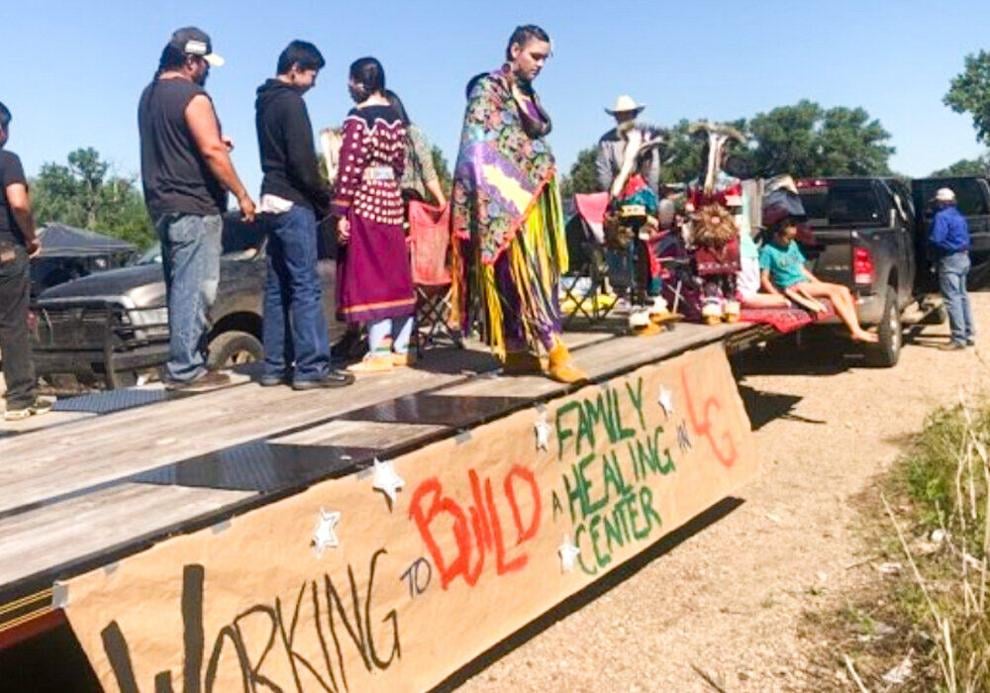
SOLUTIONS: Lodge Grass Healing Center

This 2019 photo shows Lodge Grass residents campaigning for the creation of a family healing center.  


Lodge Grass non-profit gets funding for family healing center: read

SEE : Historic photos from Montana's Native American boarding schools. 

A non-profit on the Crow Reservation just got a boon to its efforts to keep families in Lodge Grass intact and in good health. 

    The Mountain Shadow Association, based in Lodge Grass, received a six-figure grant toward the creation of a family healing center with the ambition of preventing trauma or addiction from leading to children being pulled from their homes and potentially off the reservation.

    “What we want is support for the whole family unit,” said Megkian Doyle, executive director for the Mountain Shadow Association. “What we want is for kids and their parents to be engaged in services for emotional and social support.”

    With a population of roughly 450, Lodge Grass is unique in being the only incorporated town on the reservation.  Located about 80 miles southeast of Billings, the Lodge Grass District of the Crow Reservation is home for about 2,000 people.  Over 90% of its population is Native American.

    Doyle, who earned a doctorate in education from Montana State University, came to Lodge Grass to teach at Lodge Grass High School.  She met her husband in town, a Crow man, and the two have since had five children.  After teaching for three years, she said, seeing the conditions in Lodge Grass inspired her to find a position to improve life for its residents.

    She moved to Bozeman with her family, where she and her husband got masters and doctorate degrees.  During that time, Doyle stayed in touch with her former students.  Talks with them evolved into discussions on how best to assist a town in which nearly half of the population lives beneath the poverty line.

    “I asked them, ‘If there’s anything you could do besides pray, what would you do?’” she said.

    In 2017, a coalition of Lodge Grass residents banded together to apply for a grant from the Raising Places Robert Wood Johnson Foundation, which gave them the resources to exhaustively study the factors contributing to the economic and health disparities in town.

    “It meant bringing in everyone, including people who are not normally asked for their opinion, like children,” Doyle said.

    The results were stark.  Nearly 90% of newborns in Lodge Grass are born to single mothers, roughly one in five of whom are teenagers, and about half of all children in Lodge Grass are raised by their grandparents.

    As recently as 2020, according to federal data, about 9% of the children in Montana were Native American. However, they made up 35% of the children in the state’s foster care system.

    Earlier this year, Gov. Greg Gianforte signed into law the Montana Indian Child Welfare Act, which gave Native American families legal preference in foster and adopting Indigenous children in the state.  The Montana legislation was modeled after the federal Indian Child Welfare Act of 1978, which was passed in response to Indigenous children being adopted and fostered outside of their respective tribes only to face physical and emotional abuse.

    Nationwide, Indigenous children are four times more likely to enter the foster care system than white children, according to the National Indian Child Welfare Association. Among the leading causes for Native American kids entering the foster care system in the respective states were allegations of neglect and substance abuse on the part of their parents.

    Separating a child from their family, Doyle said, can have long-term physiological effects, despite a child entering an ideal foster home. Per research published by the National Institute of Health, children separated from their families at an early age experienced higher rates of anxiety and depression and engaged in unhealthy coping behaviors like smoking and alcohol abuse.

    “We can have a great foster care system — we don’t — but even if we did it can still cause damage just by pulling a kid away from their home and their parents,” Doyle said.

    From that Lodge Grass coalition that applied from the Raising Places grant came the Mountain Shadow Association. Coming to the aid of children often means coming to the aid of parents, Doyle said. The non-profit currently assists parents in enrolling in treatment for addiction, but programs that allow them to bring their children along are a 19-hour drive away.

    The solution members of Mountain Shadow reached was the construction of a facility in Lodge Grass where whole families can get treatment without any separation. It’s called Káale’s Village; “káale” is the Crow word for grandmother.

    “We wanted to interrupt family separation on the spot before they would lose their kids,” Doyle said. “But we wanted to do it, obviously, in a safe and healthy way.”

    Mountain Shadow has the land for Káale’s Village, 13 acres in Lodge Grass. Now, thanks to a $750,000 grant from the Arthur M. Blank Family Foundation, the non-profit can start designing it. The center will be a single location for counseling and housing for two families. That space, Doyle said will be for children who need to be removed from their home in Lodge Grass to stay.

    “We want people to become functional in their own ecosystem,” Doyle said.

    Once the architectural designs are completed, Doyle said, the non-profit hopes to see Káale’s Village opened in two years.


Happy Visitors!

WRITTEN BY HUMANS!

WRITTEN BY HUMANS!

Blog Archive

Featured Post

Your History Class Was a F*cking Lie | #NOMOAR

  Your History Class Was a F*cking Lie by Sean Sherman (Or: How the American Educational System Has Always Been a Racist Propaganda Program...

Native Circles

Native Circles
click logo for podcasts!

Most READ Posts

Bookshop

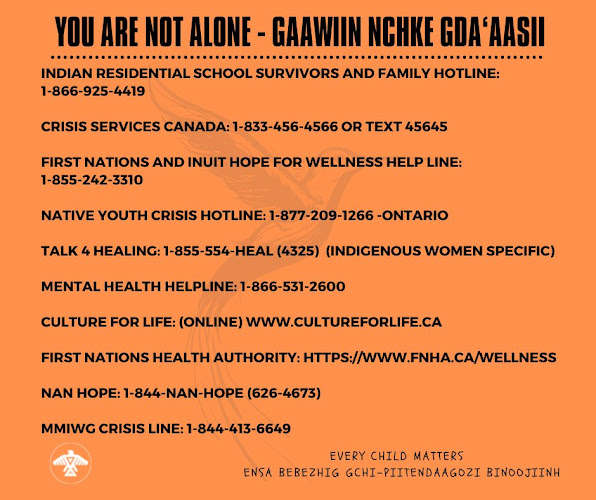
You are not alone

You are not alone

To Veronica Brown

Veronica, we adult adoptees are thinking of you today and every day. We will be here when you need us. Your journey in the adopted life has begun, nothing can revoke that now, the damage cannot be undone. Be courageous, you have what no adoptee before you has had; a strong group of adult adoptees who know your story, who are behind you and will always be so.

Diane Tells His Name


click photo

Lost Birds on Al Jazeera Fault Lines

Lost Birds on Al Jazeera Fault Lines
click to read and listen about Trace, Diane, Julie and Suzie

NO MORE STOLEN SISTERS

NO MORE STOLEN SISTERS
click image

ADOPTION TRUTH

As the single largest unregulated industry in the United States, adoption is viewed as a benevolent action that results in the formation of “forever families.”
The truth is that it is a very lucrative business with a known sales pitch. With profits last estimated at over $1.44 billion dollars a year, mothers who consider adoption for their babies need to be very aware that all of this promotion clouds the facts and only though independent research can they get an accurate account of what life might be like for both them and their child after signing the adoption paperwork.

Original Birth Certificate Map in the USA

Google Followers