BOOZHOO! We've amassed tons of information and important history on this blog since 2010. If you have a keyword, use the search box below. Also check out the reference section above. If you have a question or need help searching, use the contact form at the bottom of the blog.
We want you to use BOOKSHOP to buy books! (the editor will earn a small amount of money or commission. (we thank you) (that is our disclaimer statement)
This is a blog. It is not a peer-reviewed journal, not a sponsored publication... WE DO NOT HAVE ADS or earn MONEY from this website. The ideas, news and thoughts posted are sourced… or written by the editor or contributors.
EMAIL ME: tracelara@pm.me (outlook email is gone)
THANK YOU CHI MEGWETCH!
SAN CARLOS — More than a century and a half after losing his life during
military operations (uh, massacre) in the Pinal Mountains, a Pinal Apache child will finally
return home to the San Carlos Apache Reservation.
The National Museum of Health and
Medicine in Silver Spring, Maryland, has
officially published a Notice of Inventory Completion in the Federal Register. The notice, issued under the federal Native American Graves Protection and
Repatriation Act (NAGPRA), clears the final legal pathway for the child’s
remains to be returned to tribal leaders.
Historical
Records Document Tragic Timeline
According to federal inventory
records, the child — believed to have been under 12 years old — was killed in
July 1870 in Arizona’s Pinal Mountains. The death occurred during military
operations involving scout units serving under U.S. Army Lieutenant H.B.
Cushing of the 3rd Cavalry’s F Troop.
Historical documentation reveals
that the child’s partial cranium was transferred to the Army Medical Museum in
April 1872 by Acting Assistant Surgeon W.B. Dods via U.S. Army Surgeon C.
McCormick. The remains were held in federal institutional collections for 154
years.
Path
to Repatriation
Following formal consultations
required under federal law, officials established a definitive cultural
affiliation between the remains and the San Carlos Apache Tribe of the San
Carlos Reservation.
The publication of the federal
notice satisfies the statutory waiting period under NAGPRA, thereby legally
permitting the physical transfer of the remains on or after Aug. 3, 2026. The
repatriation will allow the San Carlos Apache Tribe to reclaim the child and
conduct traditional resting ceremonies according to tribal customs.
For Indigenous Nations across the
country, the repatriation process represents a vital effort to restore dignity,
heal multi-generational wounds, and honor ancestors whose graves and remains
were historically disturbed.
Sen. Schatz Presses Harvard Over Delayed Return of
Native Ancestors
The Peabody Museum of Archaeology
and Ethnology was founded in 1866. U.S. Sen. Brian Schatz pressed Harvard this
month to explain delays in returning Native ancestors and cultural items held
by the University. | By Barbara A. Sheehan
United States Senator Brian Schatz
(D-Hawaii) pressed Harvard earlier this month to explain why Native ancestors
and cultural items remain in its possession, renewing calls for the University
to speed up its repatriation efforts under a federal law requiring their
return.
In a June 8 letter to Harvard
President Alan M. Garber ’76, Schatz asked Harvard to provide updates on its
compliance with the Native American Graves Protection and Repatriation Act,
which requires federally funded museums and agencies to return Native American
human remains, funerary objects, sacred objects, and objects of cultural
patrimony to their descendants and affiliated tribes.
Harvard was one of 15 museums and
universities that received letters from Schatz, the vice chair of the Senate
Committee on Indian Affairs. The letters asked each institution to provide
updates on its NAGPRA compliance and detail barriers to repatriation.
“It shouldn’t take this long to
return Native remains to their communities,” Schatz said in a press release.
“Indigenous people have waited long enough. It’s time for these museums and
universities to stop the delays and finally do the right thing.”
In his letter to Harvard, Schatz
asked Garber to account for the University’s progress on repatriation,
including how many ancestors and cultural items have been returned and how many
still remain in Harvard’s collections.
He also pressed Garber on whether
Harvard had met its pledge to complete the “disposition of ancestors and their
associated funerary belongings” by 2025, and asked the University to explain
any new allegations of non-compliance since 2023.
Schatz’s letter also asked Harvard
to provide an update on a Department of the Interior investigation into the
Peabody Museum’s handling of the Woodbury
Collection, which includes hair clippings from roughly 700 Native American
children at U.S. Indian boarding schools in the 1930s.
He also asked when the University
applies the “preponderance of the evidence’’ standard, a legal threshold used
to decide whether a claim is more likely than not to be true. Under NAGPRA, the
standard can affect disputes over which tribe or Native Hawaiian organization
has the strongest claim to ancestors or cultural items.Bottom of Form
Schatz gave Garber 30 calendar days
to respond. A Harvard spokesperson did not respond to a request for comment.
The letter marks Schatz’s latest
effort to pressure Harvard and other institutions over what he has called slow
compliance with NAGPRA. In a 2024 speech
on the Senate floor, Schatz said that more
than 70 institutions still held nearly 58,000 Native ancestral remains. He
also singled out Harvard as having the third-largest collection of Native
ancestral remains and cultural items in the country.
“If you say you’re for equal
justice, for doing right by the people of all backgrounds, then act like it,” Schatz
said in the speech.
The other institutions that received
letters from Schatz include the Ohio History Connection, Illinois State Museum,
University of California, Berkeley, Indiana University, University of
Tennessee, Knoxville, University of Kentucky, University of Alabama, University
of Arizona, University of Florida, University of Missouri, University of
Oklahoma, Center for American Archeology, University of Texas at Austin, and
Milwaukee Public Museum.
In recent years, Harvard has taken
steps to accelerate its repatriation work, including creating a department
dedicated to NAGPRA at the Peabody and more than doubling its NAGPRA-dedicated
staff.
But the Peabody failed to meet its
2022 pledge to complete the disposition of all ancestors and associated
funerary belongings within three years.
As of Dec. 31, 2025, the Peabody had
repatriated 5,464 ancestors and more than 20,000 funerary belongings, according
to data on its website. Still, 2,482 ancestors remained in active consultation
with tribes, and another 2,161 were pending consultation — leaving 4,643
ancestors in the museum’s possession after the target deadline.
The Peabody has since extended its
timeline by two years. The museum’s
NAGPRA dashboard has yet to be updated with June figures, though Harvard has
previously said the dashboard would be updated twice a year, in June and
December.
Massachusetts Hall, the oldest surviving building at Harvard, is home to the offices of its president and provost.By Pavan V. Thakkar
Scholars
have spent years studying Harvard’s colonial-era land holdings in New
England. Now, undergraduate research on the University’s ownership of
Indigenous land in Maine is helping push the research forward.
Laura
C. Cleves ’28 and Christian D. Topinio ’27 traced Harvard’s financial
entanglements to a piece of land in southern Maine using archival
documents and interviews with members of the Penobscot Nation.
The
two found that an alumnus gifted the land to Harvard in 1678, though
the University did not touch the land until a century later. Harvard
sold the land in 1780, though members of the Penobscot and Abenaki
peoples lived there at the time.
English
settlers at the time, including the original donor of the land, assumed
that tribal leaders had agreed to hand over exclusive rights to the
land. The land was sold for $1,877 — the equivalent of $54,000 today —
though tribal leaders disputed any such agreement.
Alan
Niles, a lecturer in English who advised the research, said that sale
of the land allowed Harvard to use Indigenous land as an instrument of
financial gain.
History
professor Philip J. Deloria, another adviser of the research, said many
of Harvard’s land sales were tied to the Massachusetts government,
which used land to fund the University.
“Harvard was set up to be a college, not a colonial institution,” Deloria said. “It was not meant to colonize and town-found.”
History professor Philip J. Deloria in a 2019 portrait.By Ryan N. Gajarawala
“There’s
an important ethical question there,” Topinio said. “If we or other
researchers have found serious legacies of land expropriation and land
theft from Indigenous nations that have been unaddressed, there is an
ethical call to address that.”
Cleves
and Topinio’s work was conducted as part of the inaugural Caleb
Cheeshahteaumuck and Joel Iacoombs Fellowship, a summer fellowship open
to Harvard undergraduates interested in archival research on Indigenous
history.
The
summer work — conducted in partnership with the Harvard University
Native American Program, the FAS Inequality in America Initiative, and
the Build Learning through Inquiry in the Social Sciences program — is
an extension of the Harvard and Native Lands course, where students
produce original research on Harvard’s involvement with Indigenous land.
Deloria,
one of the advisers, started the Harvard and Native Lands course in
2022 and will return to its teaching staff for the first time next
spring. He said that the fellowship was an opportunity for students to
dive deeper into their research than the academic semester normally
allows.
The
summer gave Cleves and Topinio the opportunity not only to examine
Harvard’s archives, but also to travel to Maine and interview members of
the Penobscot Nation, Deloria said.
“It
was very, very valuable in terms of knowing what exactly community
research looks like,” said Topinio. “What values do they hold of the
land? How do they think through these issues of sovereignty? What does
it mean to take that land as part of your home?”
The
Legacy of Slavery report also began as an undergraduate research
seminar and later became a task force culminating in the report’s
release in 2022.
Deloria
pointed to regular meetings between University Provost John F. Manning
’82 and tribal leaders as a starting point for the collaborative work he
envisions for the field’s future.
“It's really, going forward, an opportunity for tribes and Harvard to produce knowledge together, in collaboration,” he said.
New England Public Media | By Nancy
Eve Cohen November 12, 2024
The Barre, Massachusetts, Museum Association
repatriated two 19th century headdresses to the Oglala
Sioux, a tribe in South Dakota, on
Monday. It was the second repatriation from the museum to the tribe in two years.
One of the bonnets is topped with a
feather, painted red — probably earned by a warrior wounded in battle,
according to Tribal Historic Preservation Officer Justin Pourier, who drove
from South Dakota to pick up the items. He viewed them for the first time this
week.
Pourier pointed out eagle talons and
porcupine quills, along with porcupine, white-tailed deer and horse hair on the
intricately designed warrior's headdress.
The second bonnet, with a train of
about 30 eagle feathers, most likely belonged to a chief, Pourier said. He said
each feather would have been earned by a chief for performing great deeds to
protect family and community.
Pourier said repatriating the
headdresses to the Pine Ridge Reservation will have a positive impact on young
people.
PHOTO: Nancy Eve Cohen/NEPM
Justin Pourier, the Oglala Sioux
tribal historic preservation officer from South Dakota, examines a 19th century
warrior's bonnet at the Barre, Massachusetts, Museum Association on November
11, 2024. The headdress is topped with a feather and painted red, symbolizing
the person who earned it was wounded in battle.
"It's returning the energy and
a prayer back to our kids to ... restore some hope in them. Because the
reservation life it's really ... a hard way of living," he said.
Pourier sang a chief's song and
prayed over the items as they were boxed up at the museum. He said he was very
grateful to the people at the museum.
"It really means a lot, from my
heart to everybody here, for doing what you guys do," Pourier said.
He gave a brief language lesson in
Lakota as he explained he really wanted to show his gratitude.
"'Pilamaya' is 'thank you.'
'Wopila' is a bigger thank-you. If you really want to put an exclamation point
on that, you say, 'Wopila tanka.' That's like a real big thank-you," he
said.
The museum acquired the headdresses
from Frank Root, a traveling showman, in the late 1800s, according to Aaron
Miller, a repatriation expert who has consulted with the museum.
Root also gave the museum items that
are believed to have been stolen off the bodies of Native people killed by the
U.S. Cavalry at Wounded Knee, South Dakota, in 1890. The museum repatriated 130
items from Wounded Knee to the tribe two years ago.
Pourier said when the items from the
massacre were shown during two ceremonies to tribal members in South Dakota, it
helped people.
"Seeing the grandmas and the
kids, the ones that are crying, shows me that the impact is helping them maybe
start to process that historical trauma, that intergenerational trauma, that we
carry," he said.
All of the items from the Barre
Museum are kept at the Oglala Lakota College in Kyle, South Dakota.
Elizabeth Martin, the clerk of the
Barre Museum Association, explained what returning the items this week meant to
her.
"It's a tiny reparation for a
great harm — the great harm that's been done to Indigenous people all around
the world by what we call civilization," she said.
Pourier said he'd like to have a
building on the reservation where young people can come and view the bonnets.
"For our young ones, boys and
girls, that are learning to do beadwork and quillwork, that they can look at
the designs that our tribes had, our families had, our wives had back
then," he said.
After visiting the Barre museum,
Pourier planned to visit Harvard University, where he was consulting about the
return of human remains of Native people and the hair clippings of Native
children who were at boarding schools. He said medicine men from the tribe
would join him.
Pourier said he expected to bring
back from Harvard a hammer and also a human skull, which would be buried.
Harvard’s
influence on this tragic story cannot be understated. It stands as a
symbol of the early stages of colonialism in America and has not fully
reckoned with this past. In October, Native alumni of Harvard Law School
called for the immediate return of more than previously announced 6,500
Native remains in a letter
to the president of the University, stating that the institution should
“dedicate the resources and place the priority on returning them to the
appropriate places and relatives. Not sometime, not soon, but now.”
As
with Harvard Medical School and Indigenous health, we believe Harvard
Law does not provide its law students an adequate education on Indian
law, even though the Supreme Court has decided an average of 2.6 federal Indian law cases per term since 1959. Three such Indian law cases are currently underway for the
2022-2023 term. The future of our Native Nations lies largely in the
hands of legal scholars who can graduate from top law schools like
Harvard without ever having to take an Indian law course or even hearing
the words “tribal sovereignty.”
We
do appreciate the Peabody's recent transparency, and celebrate the
announcement of Harvard University’s new president, but we hope to move
beyond apologies and toward action that addresses the erasure of Native
Americans and Alaska Natives at the University, and the burdens they
carry as a consequence. Whether it's the Peabody having Native
children’s hair or Harvard-trained Supreme Court justices deciding on
the Indian Child Welfare Act, the fate of future generations of our
tribal Nations — our Native children — remains bound up in Harvard's
history of colonialism and the legacies it leaves behind, legacies
Native students here feel every day.
Murals on the rear side of the abandoned Concho Indian Boarding School
in El Reno, Oklahoma, were painted by Steven Grounds of the Navajo and
Euchee tribes. (Photo by Mary Annette Pember / ICT)
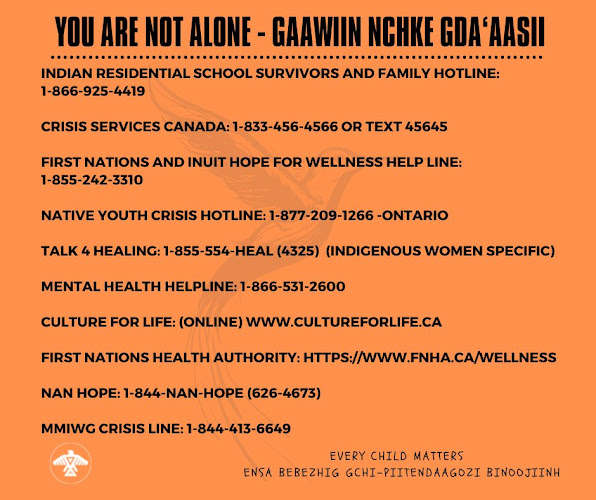
WARNING: This story has disturbing details about residential and boarding schools. If you are feeling triggered, here is a resource list for trauma responses from
the National Native American Boarding School Healing Coalition in the
US. The National Indian Residential School Crisis Hotline in Canada can
be reached at 1-866-925-4419.
Tucked in hundreds of envelopes is the hair cut from Native children
as they arrived at boarding schools. Hidden away for nearly 100 years in
the recesses of the Peabody Museum at Harvard University, the
collection of hair samples offers tangible evidence of the trauma of
assimilation.
According to the hygiene of the day, cropping hair was the surest way
to avoid lice among the crowded populations of children coerced to
attend the nation’s Indian boarding schools.
For boarding school survivors, however, the haircuts came to
symbolize the harsh introduction to the process of assimilation, a
gesture disregarding their culture and families wishes.
Denise Lajimodiere, Turtle Mountain Band of Chippewa, wept as she described her reaction to hearing about the museum’s findings.
Some of those sampled could still be alive today, Lajimodiere said.
The Peabody Museum recently discovered the box of human hair among
its holdings. Gathered nearly a century ago, the hair was taken by an
anthropologist from the heads of hundreds of Native children who
attended Indian boarding schools between 1930 and 1933.
Museum leaders released a public announcement on Nov. 10 about the findings.
“I imagine that many people, especially non-Natives, hardly gave it a
second thought,” said Jamie Azure, chairman of the Turtle Mountain Band
of Chippewa tribe.
“But for Native people hair represents cultural and spiritual
connections to family and place. Our hair is part of our strength.”
The United States is trailing Canada in addressing its history of government- and church-run Indian boarding schools.
Although the Department of the Interior under Secretary Deb Haaland’s leadership recently released the Federal Indian Boarding School Investigative Report,
there are currently no services or support for survivors in the U.S.
Haaland is the first Indigenous person in a presidential cabinet.
But more needs to be done.
“There’s no mental health support for our survivors in the U.S.
unlike in Canada,” Lajimodiere said. “How do we begin to heal when the
trauma doesn’t stop?”
‘A spiritual violation’
When children first arrived at boarding schools, authorities would
routinely cut their long hair into short, uniform styles, an experience
that has left many survivors as well as their descendants suffering from
negative physical and mental impacts, according to researchers.
Basil Braveheart, Oglala Lakota Nation, still vividly recalls the
shock of having his long hair cut more than 80 years ago, when he first
entered the Holy Rosary Indian Mission on the Pine Ridge reservation.
“They cut my hair, a spiritual violation,” Braveheart told ICT and Revealin
an earlier interview. “In our culture, only the maternal grandmother
had the right to cut our hair. When they let my hair fall to the floor
and stepped on it, I felt disrespected.”
No hair samples from Holy Rosary were among those discovered at the
Peabody Museum, and the names of those whose samples were discovered
have not been released. Holy Rosary has now been renamed Red Cloud
Indian School and is no longer a boarding school.
The Peabody Museum published an apology from Director Jane Pickering and a promise to return the hair to families and tribal nations.
The museum also created a website dedicated
to describing its process in addressing the hair samples, which were
originally collected by George Edward Woodbury, curator of the State
Historical Society of Colorado.
The acknowledgement section of the website reads, “It is impossible
to talk about hair taken from Indigenous people and its possession by
the Peabody Museum without acknowledging the ties between early
anthropological practices and colonialism, imperialism, and scientific
racism — the very same systems of dispossession and assimilation that
led to the establishment of Indian boarding schools.”
Woodbury and his wife Edna collected more than 1,500 samples of
Indigenous peoples’ hair between 1930 and 1933 from North and South
America as well as Asia and Oceania. They donated the collection to
Harvard in 1935.
A spokesperson for the museum told the The New York Times that
the collection has never been displayed. The samples include about 700
clippings of hair taken from students at Indian boarding schools and
have been stored in envelopes labeled with names, tribal affiliation and
locations of collection.
Although the museum has released information about tribal affiliation
and location, it has not yet published the names of the owners of the
hair.
According to its website, the museum has reached out to some tribal
leaders regarding the process of repatriation and is waiting for
feedback before releasing individuals’ names.
The Harvard University Native American Program wrote an email
offering emotional support to the school’s Native students the day
before the museum publicly announced information about the collection of
hair. According to the email, shared with ICT, “There are over 90
community members (students, staff and faculty) who have family names or
tribes associated with this list of relatives.”
In the only article published
from the research, “Differences Between Certain of the North American
Indian Tribes: As shown by a microscopical study of their head hair,”
Woodbury described texture and color differences among the samples and
noted “when these North American Indian hair specimens were compared
with Mongoloid and White (European) hair specimens it appears that the
Indian exhibits a stronger affinity toward the Mongoloid group.”
Regarding the scientific practice at the time the hair was collected,
the museum wrote, “Much of this work was carried out to support,
directly or indirectly, scientific racism.”
Descriptions and measurements of hair types were used to justify racial categories and hierarchies.
– George Edward Woodbury
NAGPRA regulations
Although several Native people contacted by ICT lauded Harvard for
its repatriation efforts as a good start, many were critical of the
process and questioned why the institution had waited so long to take
action.
“The website is a good starting point; it helps us understand a
little bit of the history of the researcher and the collection,” said
Meredith McCoy, Turtle Mountain Band of Chippewa tribe descendant and
assistant professor of American Studies and history at Carleton College
in Northfield, Minnesota.
“But there’s so much more we need to know; clearly the researcher had
an extensive network of boarding school employees willing to send him
samples of children’s hair without parental permission,” she said.
“This type of research is deeply unethical.”
Deborah Parker, Tulalip Tribes, executive director of the Native
American Boarding School Healing Coalition, believes that Harvard has
known about the Woodbury collection for a long time.
“I believe they’ve known about it for years but just didn’t know what to do about it,” she said.
It’s so sad that institutions like Harvard would hold onto and support this type of thing.
– Deborah Parker, Tulalip Tribes, executive director of the Native American Boarding School Healing Coalition
After the remains of 19 enslaved people of
African descent were discovered in the museum’s collection, Harvard
created a Steering Committee on Human Remains in University Museum
Collections in June 2021. A report by
the committee, leaked to media in June 2022, states that the school
holds the remains of nearly 7,000 Native Americans in its collections.
Although some of the remains fall under the Native American Graves Protection and Repatriation Act, known
as NAGPRA, Rachel Dane, spokesperson for Harvard, wrote in an email
to ICT that the hair in the Woodbury collection does not fall under the
federal regulation.
Shannon O’Loughlin, Choctaw, attorney and chief executive for the Association on American Indian Affairs, disagrees.
“Under NAGPRA regulations, human remains are defined as the remains
of a body of a person of Native American ancestry,” O’Loughlin said.
“Although the law doesn’t apply to portions of remains shed naturally
or freely given, children didn’t have agency to consent to the hair
collecting; they weren’t at boarding schools of their own free will.”
O’Loughlin also criticized Harvard’s stated intentions of
collaborating with tribes in determining how the collection will be
handled. She noted that a process is already in place under NAGPRA that
clearly outlines how institutions are to collaborate with tribes in
repatriating or transferring human remains and other cultural items to
appropriate parties.
“There is little transparency,” she said. “I don’t hear Harvard say
they are going to work with tribes and determine what tribes want to do.
Instead they announce they’re going to start a whole other process and
do it themselves.”
The Northern Arapaho Business Council issued a statement on Nov. 21
demanding that Harvard and the Peabody Museum return hair samples
improperly taken from Native children, including some from the Northern
Arapaho Tribe in Wyoming.
“It is impossible to undo atrocities committed against Native
children ripped away from their families as part of the federal
government’s forced boarding program,” the tribe said in a statement,
“but Peabody Museum can and must cease its role in this abuse by
returning to appropriate tribes any hair samples taken from these
children.”
The statement continued, “It’s long past time that museums,
universities and other institutions apologize for their objectification
of Native people and culture and return to rightful owners the sacred
artifacts stolen from Indian Country.”
Boarding schools as laboratories
In 2018, a
class-action lawsuit was filed in Canada on behalf of thousands of
Indigenous children used as research subjects between the 1930s and
1950s in that country’s Indian residential school system. The suit also
accused the government of “discriminatory and inadequate” medical care at Indian health institutions.
Ian Mosby, assistant professor at Toronto’s Ryerson University, has published research showing
numerous examples of Indigenous children being used as subjects of
experiments to test tuberculosis vaccines. Mosby also found that
government agencies conducted nutritional experiments in
which children were systematically starved in order to provide a
baseline reading in testing the impact of vitamin and mineral
supplements and enriched flours and milk. Dental services were also
withheld in some schools to provide test data.
The Canadian lawsuit also includes other medical experiments
performed on Indigenous populations without their consent, including skin grafting among the Inuit in the 1960s and 1970s, birth control and forced sterilization of women from the 1920s to the 1970s.
So far, there are only a handful of verified examples of similar
research and testing have been found on Native populations here in the
U.S.
In 1976, a Government Accountability Office investigation
found that Native children in government boarding schools were used as
subjects in researching trachoma, an eye disease, without parental
consent. The investigation, ordered by U.S. Sen. James Abourezk,
chairman of the Senate Committee on Indian Affairs, also showed that
more than 3,000 women were sterilized at Indian Health Service facilities without adequate consent.
As the investigation into U.S. boarding school history moves forward,
many predict that more examples of government sanctioned research and
experimentation will come to light.
Native people have long been the subject of research influenced by
colonialism, race-science or eugenics, including Samuel Morton’s
infamous 19th century Cranial Collection consisting of the skulls of around 1,300 people from around the world. According to the Smithsonian Magazine,
there are an estimated 500,000 Native American remains and nearly 1
million associated funerary objects currently held in U.S. museums.
“We weren’t considered to be human to white settlers,” said
Lajimodiere. “Our bodies were just part of the fauna, available for
exploitation.”
The museum shared information about the collection with leadership at
the Turtle Mountain Band of Chippewa, and Lajimodiere and Azure report
that they recognize several of the names listed among the Woodbury
collection.
“I can say that the museum has been extremely helpful and willing to
do whatever we feel is right to get the remains back to the family,”
Azure said. “There is a little bit of a silver lining to this; it’s
bringing people together to talk about not only the significance of the
hair but also finding a way to bring it back to the community in a good
way.”
Azure noted, however, that tribal leadership has been unprepared for
the mental health challenges associated with growing awareness about the
boarding school era.
“Some survivors have opted not to attend our events and commemorations,” Azure said. “They find it too triggering.”
Where are the resources?
The lack of mental health resources for boarding school survivors and their descendants continues to be a problem.
I wonder how many other institutions are digging around in their dark basements and will find similar things in the future.
– Denise Lajimodiere, Turtle Mountain Band of Chippewa
Parker, with the boarding school coalition, noted that although the
coalition can direct survivors toward mental health resources, there
aren’t nearly enough. She noted that according to a 2018 GAO study, the federal government allocates twice as much money per Medicaid recipient as it does for Indian Health Service patients.
“In Canada they have the residential school healing line; I think that’s something we need here as well,” she said.
Parker and the coalition are also pushing for passage of a federal boarding school truth and healing bill,
which would create a commission to investigate the history of schools
and provide trauma-informed resources for survivors and descendants.
“The government and institutions like Harvard should bear responsibility for the harm inflicted at boarding schools,” she said.
Stacey Montooth, Walker River Paiute Nation, executive director of the State of Nevada Indian Commission, agreed.
“How many times do we have to be traumatized by news like this?” she asked during an interview with ICT.
Montooth’s office is located in the Stewart Indian School Cultural Center and Museum in
Carson City, Nevada. The federal school operated from 1890 to 1980
serving children primarily from Nevada’s Great Basin tribes — Washoes,
Paiutes and Shoshones.
According to its website, the organization’s mission, which opened in
2020, is to tell the story of the thousands of American Indian children
who were educated at Stewart. The campus is also a hub for Native art,
lectures and other public programming and educational activities.
Montooth expressed surprise that Harvard did not reach out to the
center and museum about the collection of hair. Stewart Indian School is
listed among the collection locations and many of Nevada’s tribes are
among sources listed for the hair samples. She heard about the
collection from a colleague in another state.
“Harvard needs to open up their checkbook and not only pay for, but
help us identify, the very best psychologists, counselors and others who
are best equipped to help our people,” Montooth said.
ICT asked Harvard officials if the university had any plans to provide such funding or services.
“We do not have a comment,” was the reply.
This story was originally published by ICT. It is republished here with permission.
South Carolina court drops contempt charge against Dusten Brown Dusten Brown and the Cherokee Nation rea...
Bookshop
You are not alone
To Veronica Brown
Veronica, we adult adoptees are thinking of you today and every day. We will be here when you need us. Your journey in the adopted life has begun, nothing can revoke that now, the damage cannot be undone. Be courageous, you have what no adoptee before you has had; a strong group of adult adoptees who know your story, who are behind you and will always be so.
Diane Tells His Name
click photo
Lost Birds on Al Jazeera Fault Lines
click to read and listen about Trace, Diane, Julie and Suzie
NO MORE STOLEN SISTERS
click image
We conclude this series & continue the conversation by naming that adoption is genocide. This naming refers to the process of genocide that breaks kinship ties through adoption & other forms of family separation & policing 🧵#NAAM2022#AdoptionIsTraumaAND#AdopteeTwitter#FFY 1/6 pic.twitter.com/46v0mWISZ1
As the single largest unregulated industry in the United States, adoption is viewed as a benevolent action that results in the formation of “forever families.” The truth is that it is a very lucrative business with a known sales pitch. With profits last estimated at over $1.44 billion dollars a year, mothers who consider adoption for their babies need to be very aware that all of this promotion clouds the facts and only though independent research can they get an accurate account of what life might be like for both them and their child after signing the adoption paperwork.









 Posts
Posts

