They Took Us Away

They Took Us Away
click image to see more and read more

it's free

click

How to Use this Blog

BOOZHOO! We've amassed tons of information and important history on this blog since 2010. If you have a keyword, use the search box below. Also check out the reference section above. If you have a question or need help searching, use the contact form at the bottom of the blog.


We want you to use BOOKSHOP to buy books! (the editor will earn a small amount of money or commission. (we thank you) (that is our disclaimer statement)

This is a blog. It is not a peer-reviewed journal, not a sponsored publication... WE DO NOT HAVE ADS or earn MONEY from this website. The ideas, news and thoughts posted are sourced… or written by the editor or contributors.

EMAIL ME: tracelara@pm.me (outlook email is gone) THANK YOU CHI MEGWETCH!

SEARCH

Showing posts with label survivors. Show all posts

Friday, May 29, 2026

National Day of Action: Survivors, leaders call for continued funding of residential school investigations, healing in Winnipeg


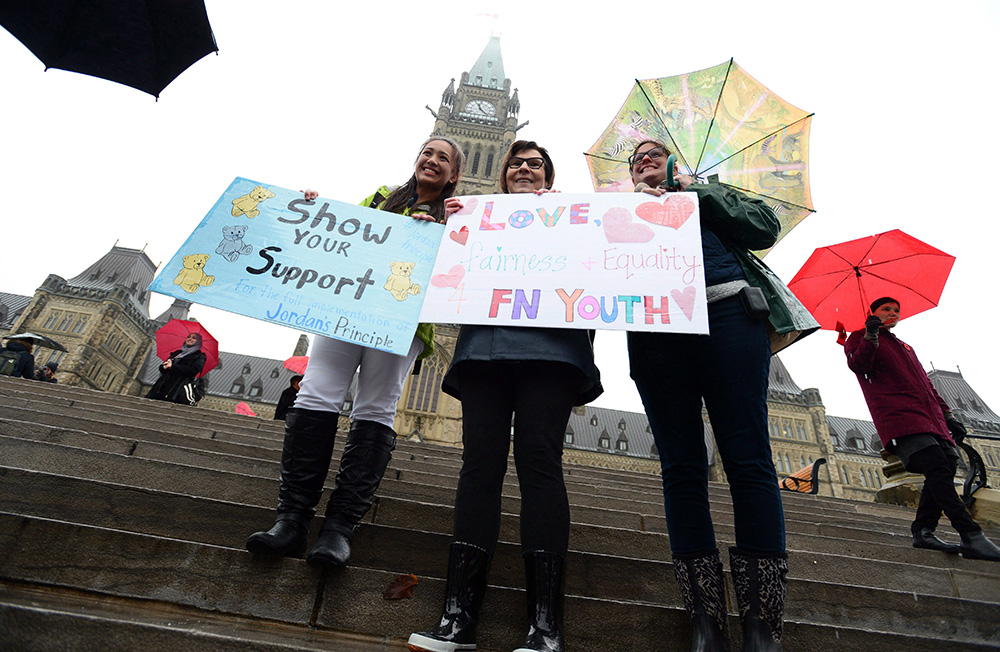
Sixties Scoop Survivors and Indigenous leaders marched through Winnipeg Wednesday calling on the federal government to ensure long-term support for residential school investigations, healing and community programs.

The march through downtown came on National Day of Action, five years after the discovery of 215 unmarked graves at the former Kamloops Residential School.

At Oodena Circle Survivors shared stories of residential schools, the Sixties Scoop, family separation, and the healing work still happening today.

“The pain did not end when the schools closed,” said Christina Kitchekesik, a residential school Survivor. “It lives in our families, it lives in our communities, and it lives in our spirits.”

Sixties Scoop Survivors and family members shared stories of residential schools and family separation in a Oodena circle on National Day for Action in Winnipeg on May 27, 2026 (CityNews)

Ava Halpin was eight years old in 1964 when she was taken from her family and sent to live with three different white families.

Halpin says programs supporting Survivors have helped many reconnect in a variety of ways.

“That is why we need to keep these programs going to help the survivors heal, to keep learning about who we are and stay connected, stay together,” Halpin said.

Ava Halpin speaks about her experience of being taken from her family in 1964 when she was an 8-year-old on National Day for Action in Winnipeg on May 27, 2026 (CityNews)

By late morning, hundreds walked from The Forks to the Manitoba Legislative Building where the focus shifted toward calls for continued federal funding tied to truth, healing, and investigations into children who never came home.

A national e-petition, sponsored in the House of Commons by Winnipeg MP Leah Gazan, calls for long-term support for Survivor healing, cultural supports, and community-led efforts connected to unmarked burial site investigations.

“We’ve been asking for answers from the federal government what is exactly happening with the funding and the services that we have been receiving as First Nations and our organizations, our communities, and we still have not received any commitment, and the messaging right now is that the funding is going to be sunsetting,” said Kyra Wilson, Grand Chief of Assembly of Manitoba Chiefs.

Thursday, April 9, 2026

Foundation aims to serve all Survivors of the Sixties Scoop


Webpage
The National Sixties Scoop Healing Foundation of Canada

Welcome to the National Sixties Scoop Healing Foundation of Canada – a new, independent organization, established through the National Sixties Scoop Settlement. Our mission is to accompany Survivors and their descendants along their healing journey by supporting cultural reclamation and reunification, holistic wellness services, advocacy, commemoration, and educational initiatives.
Our Survivor-led, volunteer board of directors was appointed in November 2020, with the mandate to make the Foundation a reality. We envision a future where Sixties Scoop Survivors are welcomed and become a community filled with healing and wellness. We envision a world that has deeper knowledge and empathy for Survivors’ experiences and histories.
Independent of government, the Foundation aims to serve all Survivors of the Sixties Scoop—Inuit, First Nations, Métis, status and non-status—in every region of Canada and beyond. We are in our early days and have much work to do in the months ahead to begin achieving the Foundation’s potential.
We invite you to join us and share your feedback as we grow: https://www.sixtiesscoophealingfoundation.ca/contact

Tuesday, August 1, 2023

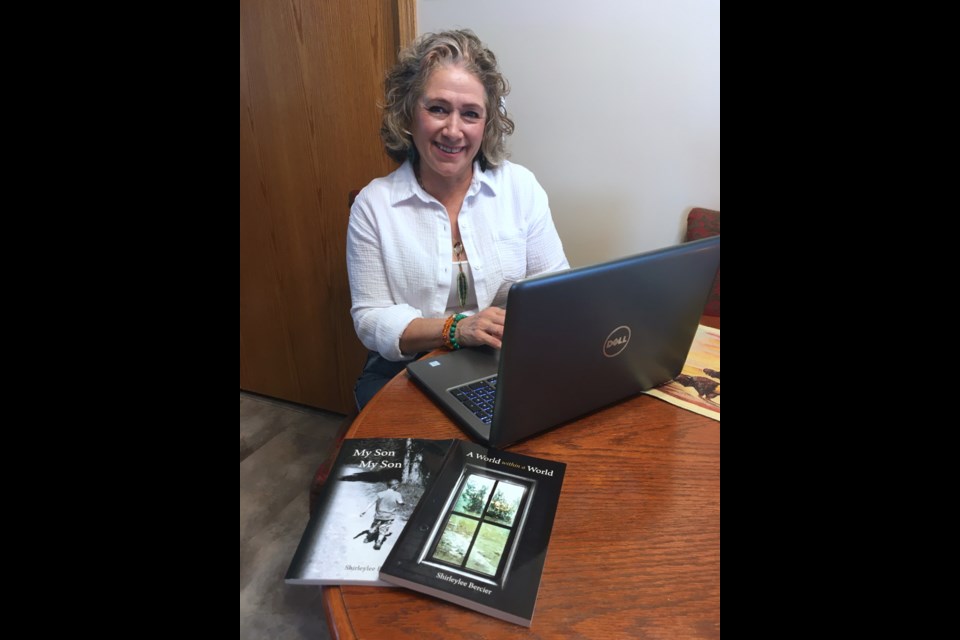
Sundre author’s book recounts her experience as Sixties Scoop survivor


A Sixties Scoop survivor who wrote an autobiography about her experience hopes that sharing her story will not only raise awareness but perhaps also embolden others with similar life experiences to embark on their own personal path of healing.

Shirleylee Shields, who moved to Sundre about a year ago, was taken away from her biological parents at the age of three and subsequently placed into the care of a foster family in a strict religious sect.

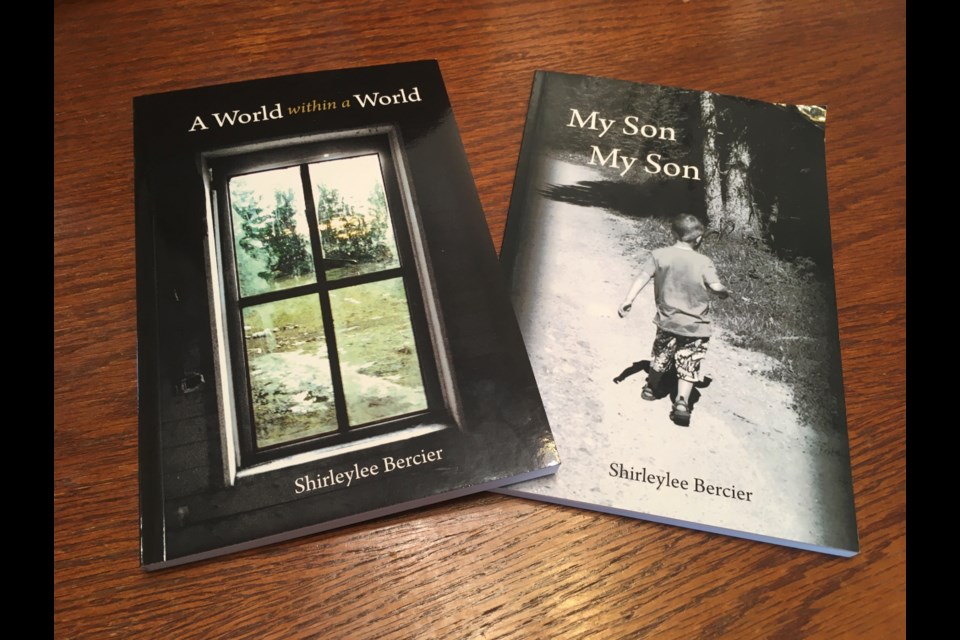
She recently offered a presentation at the Sundre Municipal Library to provide insight into her 2009 book, A World Within A World. She also penned a sequel called My Son My Son.

During a June 13 interview with the Albertan, the 58-year-old candidly recounted the long, difficult journey of self-discovery that ultimately led her to walk away from a fundamentalist life that was forced upon her and to reconnect with her family and heritage.

Sharing experience a liberating step

“There’s no more skeletons in the closet,” she said with a laugh in response to being asked how seeing her published story felt. “You have nothing to hide. It was the most freeing, cleansing thing to do, was to reveal and to bring all of this out and throw it on the table.”

At first, she confessed being “petrified” that nobody would even want to read her story. But A World Within A World is now on its fourth print run, while copies of My Son My Son are out of stock for now.

Born on May 1, 1965 in Benito – a small, rural Manitoba community just east of the border with Saskatchewan – Shields lived only briefly for three years with her six other biological siblings and parents, an English mom named Myrtle Harrington and a Métis dad called Herman Moses Bercier, at a home in the Roblin area south of where she was born.

“Me and my younger brother had been removed from the home and put into foster care and dad didn’t even know anything about it,” she said. “He came home (from working in the bush) and we were gone.”

Shields was fostered into a family that already had 10 children – making her a distant 11th – not far away from Roblin in a relatively remote rural community called Shortdale, Man., where her adoptive parents owned and worked a farm.

“They were part of the Mennonite society, but they were the Holdeman sector, which is the strictest of the Mennonite society,” she said. “There was no radio, no television, no higher education, no makeup, no jewelry; the list is endless. That’s where they dropped me off when I was three.

“It was all I knew, from three years old. You grow up with that environment, it’s just like a cult,” she said. “That’s why my book is called A World Within A World.”

Raised by her foster parents Benjamin and Tina Isaac, the couple eventually adopted her at age 10; a decision she would not find out until years later was actually Benjamin’s idea.


Strict religious upbringing

Amid a strict religious upbringing that demanded unquestioning conformity to rigid rules, Benjamin was among the few silver linings to be found.

“Even though he was a staunch believer and a member of the Holdeman Mennonite society – he loved me,” she said. “He is the only human that I knew growing up that loved me unconditionally; I did everything with my dad. He never hit me; he was the kindest soul that you could imagine.”

He even seemed to understand the internal struggle she faced on a daily basis.

“He knew,” she said. “Even when I was young – six or seven – I would look at him and I’d say, ‘I don’t belong here.’ And he’d say, ‘Well, for now, you do.’”

Expressing a deep respect born of affection for her adoptive father, she said, “I loved him and he loved me.”

Sometimes, she said he was even reprimanded.

“He’d be (temporarily) expelled from the church for associating with what they considered ‘worldly’ people; so, people of the town,” she said. “It blows your mind at the mentality that they are allowed to sit in judgment of every human being on this planet, but yet they will preach god’s love or whatever they want to believe Sunday morning. I mean, it’s just ludicrous.”

Yet she never developed a connection or relationship with Tina, who died in a vehicle collision in which only Benjamin and Shields survived; she was 15 at the time and subsequently sent away to live in Steinbach, Man. for 11 years.

But she does remember Tina as a “phenomenal gardener” who knew how to prepare a hearty meal.

“We were never hungry; we ate very well,” she said.

Wednesday, June 1, 2022

Showing Up in Support of Indigenous 2S+/LGBTQ+ Survivors for Pride Month


FROM:
 National Indigenous Women’s Resource Center, StrongHearts Native Helpline, Alaska Native Women’s Resource Center


This June, the National Indigenous Women’s Resource Center (NIWRC), StrongHearts Native Helpline (StrongHearts) and the Alaska Native Women’s Resource Center (AKNWRC) acknowledge, support and lift the voices of Native Two-Spirit, non-binary, lesbian, gay, bisexual, transgender, queer and/or questioning survivors of violence for Pride Month. As Indigenous nonprofit organizations, we strongly support the need to facilitate inclusive conversations about the identities intersecting across the Indigenous and 2S+/LGBTQ+ spectrum.

When NIWRC, StrongHearts, and ANWRC raise awareness on gender-based violence issues, we also recognize that our 2S+/LGBTQ+ relatives experience domestic violence and sexual violence at exceptionally high rates. Violence and abuse can happen to anyone. Across Indigenous cultures and communities, our traditional teachings uphold respect for all identities and celebrate diversity. As relatives, we must stand firmly against dangerous attitudes toward our 2S+/LGBTQ+ relatives and instead, use our Indigenous values and sacred teachings of love, respect and compassion to advocate for them. We see you. We support you. We honor your spirit.

For generations, Western culture has disparaged Indigenous religions and teachings about gender and sexuality, including the pre-existing traditional understanding that Two-Spirit individuals, embodying male and female spirits, are blessed by Creator. Colonialism and Western patriarchy threaten our relatives on the 2S+/LGBTQ+ spectrum with policy, violence and oppression across the United States. Within the 2S+/LGBTQ+ community, intimate partner violence occurs at a rate equal to or higher than that of the cis-heterosexual communityAmerican Indians, Alaska Natives, and Native Hawaiians in 2S+/LGBTQ+ communities face systemic discrimination, violence, and harassment at disproportional ratesAccording to the 2015 U.S. Transgender Survey (USTS), of all the respondents who experienced sexual assault, 65% were American Indian/Alaskan Natives.  Also, 73% of Native respondents experienced intimate partner violence, including physical violence, compared to 54% of the overall USTS respondents2S+/LGBTQ+ relatives also experience other forms of domestic violence and additional barriers to seeking help due to fear of discrimination or bias.

These statistics do not include the intergenerational and individual trauma our Indigenous relatives experience. There is a need for intergenerational efforts to recognize, reclaim and dismantle oppressive and systemic injustices toward 2S+/LGBTQ+ survivors.

Although there are incredible resources available for LGBTQ+ survivors, there is an urgent need for more culturally-tailored, inclusive programs and resources that offer support services for Indigenous 2S+/LGBTQ+ survivors. As family members and communities, we must collectively advocate for more inviting, safe, accessible and inclusive spaces for our 2S+/LGBTQ+ relatives. All members of our families, communities, and nations should feel safe, protected and supported to live free of violence and discrimination.

Tips for Family and Friends

·       Show up: Family members and friends of 2S+/LGBTQ+ relatives can create safe spaces simply by showing up, listening and acknowledging their relative’s experiences. Keeping “open minds and hearts” can positively impact Indigenous 2S+/LGBTQ+ survivors.

·       Believe survivors: Validate the feelings of 2S+/LGBTQ+ relatives, assuring them that the violence they experienced is not their fault and they are not alone. Offering support when a loved one is hurting, even in seemingly small ways, encourages connection and protects against isolation.

·       Celebrate sacred teachings: Learning more about Indigenous 2S+/LGBTQ+ communities–including their history of trauma and teachings about love, compassion, courage, and support–can help reverse the shame tied to Western norms about gender and sexual orientation. Return to traditional teachings that honor all identities and sexualities. 

Helpful Resources

Read

·       Toolkit: How Families and Friends Can Reconnect with Native Teachings and Create Healing Spaces with and for Native 2S+/LGBTQ Victim-Survivors of Domestic Violence

·       Summary: How Families and Friends Can Reconnect with Native Teachings and Create Healing Spaces with and for Native 2S+/LGBTQ Victim-Survivors of Domestic Violence

·       Restoration MagazineReconnecting with Indigenous Teachings to Create Healing Spaces with and for Native 2SLGBTQ Survivors of Violence

·       Two-Spirit Identity from StrongHearts Native Helpline

·       LGBTQ2S (Two-Spirit) Resources by the Southwest Indigenous Women’s Coalition

·       Two-Spirit People from the National Congress of American Indians

·       Two Spirits, One Heart, Five Genders from Indian Country Today

·       A Spotlight on Native LGBT from the National Congress of American Indians

Watch

·       Virtual Conversations With the Field 1 of 4 How Family and Friends Can Reconnect with Native Teachings & Create Healing Spaces With & For Native LGBTQ2S Relatives

·       Virtual Conversations With the Field 2 of 4 How Family and Friends Can Reconnect with Native Teachings & Create Healing Spaces With & For Native LGBTQ2S Relatives

·       Webinar: Mending the Rainbow: Working with the Native LGBT/Two-Spirit Community

·       Webinar: Understanding the Dynamics and Tactics of Intimate Partner Violence through the Lens of Indigenous Survivors

For Youth

·       Native Youth Sexual Health Network

·       It Gets Better Project

·       Indigenizing Love: A Toolkit for Native Youth to Build Inclusion PDF

·       A Guide to Being an Ally to Transgender and Nonbinary Youth by The Trevor Project

·       How Can I Make My Center An Affirming Place For People Who Identify As LGBTQ? by NRCDV

·       Setting The Stage: Strategies For Supporting LGBTIQ Survivors by Washington Coalition of Sexual AssaultPrograms

Get Help

·       StrongHearts Native Helpline call/text 1-844-7NATIVE (762-8483), or chat: strongheartshelpline.org. StrongHearts Native Helpline is a 24/7 domestic violence, dating and sexual violence helpline for American Indians and Alaska Natives, offering culturally appropriate support.

·       The Trevor Project call 1-866-488-7386, text 678678, or chat thetrevorproject.org/get-help. The Trevor Project has trained crisis counselors who understand the challenges LGBTQ young people face, available 24/7.


About StrongHearts Native Helpline

StrongHearts Native Helpline was created by and built to serve Indigenous communities across the United States. It is a culturally-appropriate, anonymous, confidential and free service dedicated to serving Native American and Alaska Native survivors and concerned family members and friends affected by domestic, dating and sexual violence. Advocates are available 24/7 by texting or calling 1-844-7NATIVE (1-844-762-8483) or via online chat at strongheartshelpline.org. Connect with knowledgeable advocates who can provide lifesaving tools and immediate support to enable survivors to find safety and live lives free of abuse. StrongHearts Native Helpline is a proud partner of the National Indigenous Women’s Resource Center and the National Domestic Violence Hotline.

About the National Indigenous Women’s Resource Center

The National Indigenous Women’s Resource Center, Inc. (NIWRC) is a Native-led nonprofit organization dedicated to ending violence against Native women and children. NIWRC provides national leadership in ending gender-based violence in Tribal communities by lifting the collective voices of grassroots advocates and offering culturally grounded resources, technical assistance and training, and policy development to strengthen Tribal sovereignty. niwrc.org

About the Alaska Native Women’s Resource Center

Organized in 2015, the Alaska Native Women’s Resource Center (AKNWRC) is a tribal nonprofit organization dedicated to ending violence against women with Alaska’s 229 tribes and allied organizations. AKNWRC board members and staff are Alaska Native women raised in Alaska Native Villages and have over 250 years of combined experience in tribal governments, nonprofit management, domestic violence, and sexual assault advocacy (both individual crisis and systems and grassroots social change advocacy at the local, statewide, regional, national and international levels), and other social services experience. AKNWRC’s philosophy is that violence against women is rooted in the colonization of indigenous nations and thus dedicated to strengthening local, tribal government’s responses through community organizing efforts advocating for the safety of women and children in their communities and homes against domestic and sexual abuse and violence. aknwrc.org


Wednesday, September 22, 2021

Canada knowingly underfunding services for 165,000 First Nations kids and their families for decades


Where They Stand: The Parties on Indigenous Child Welfare

It’s been five years since a tribunal ruled that Canada discriminates against First Nations kids. Advocates still await change.


Katie Hyslop 16 Sep 2021 | TheTyee.ca

Cindy Blackstock doesn’t know why Liberal Leader Justin Trudeau lied about taking First Nations kids to court during the leaders’ debate last week. But Blackstock, the executive director of the First Nations Child and Family Caring Society, is “really sad” he did.

Especially when there is over 14 years of evidence — including court transcripts, news articles and 20 non-compliance orders from the Canadian Human Rights Tribunal — to the contrary.

“They have every legal right to litigate against our kids. I think it’s morally wrong — and it’s bad for the country — but they’ve chosen to do it,” said Blackstock of the government’s Federal Court case arguing against a tribunal ruling that First Nations children and families impacted by the child welfare system should be compensated.

“What they don’t have a right to do is then lie about it to protect themselves from accountability for their own behaviour.”

Blackstock would know: along with the Assembly of First Nations, her organization took the federal government to the Canadian Human Rights Tribunal in 2008 over its systemic underfunding of child welfre on reserves.

In 2016, the tribunal issued its ruling: the federal government had been knowingly underfunding services for 165,000 First Nations kids and their families for decades. The tribunal ordered the government to stop its discriminatory practices.

More than 50 per cent of children in government care in this country are Indigenous, despite representing fewer than 10 per cent of all children. The majority are First Nations children taken into care for “neglect,” which child welfare researchers say is another word for poverty.

In 2019, the tribunal declared the government must pay $40,000 — the maximum the tribunal can award — to every First Nations child removed from their family since 2006. Their guardians before the children were taken into care are entitled to $20,000.

The tribunal also awarded $40,000 to every First Nations child denied federal medical coverage between 2007 and 2017, citing Jordan’s Principle, a 2007 policy that governments should pay the medical bills of any First Nations child, on or off-reserve.

But two weeks before the 2019 election, government lawyers requested a judicial review of the compensation orders.

Hearings were held in Federal Court in June, less than a month after the Tk’emlúps te Secwe̓pemc Nation announced the rediscovery of 215 bodies on the grounds of the former Kamloops Indian Residential School.

The Federal Court’s ruling is expected at any time.

The government also took issue with the tribunal’s 2020 declaration that all children with Indian Act status; eligibility for status; or parents or guardians who have status, live on-reserve and whose First Nation acknowledges their membership — are covered by Jordan’s Principle.

The federal government argued before the court that only children with status under the Indian Act — a racist Canadian law that determines First Nations’ band membership — should be covered.

The Liberals have tried to respond to Canada’s child welfare crisis. In 2018 they released a six-point plan to reform child welfare, including implementing the tribunal’s ruling and working with Indigenous leaders to re-establish jurisdiction over child welfare.

In January 2020, the federal Act Respecting First Nations, Inuit and Métis Children, Youth and Families became law, starting the process to return jurisdiction to Indigenous communities. But it did not come with funding, and a year and a half later the federal government has yet to release a funding plan.

In B.C., a working group on child welfare and family services was established by the provincial and federal governments, the BC Assembly of First Nations, the Union of BC Indian Chiefs and the First Nations Summit.

Assembly Regional Chief Terry Teegee said that three of the 198 First Nations in the province are close to reclaiming their inherent jurisdiction over child welfare, though a federal funding commitment is needed.

“It’s always a work in progress, and I certainly know that a lot of these changes weren’t going to happen overnight,” Teegee said, adding the assembly is also waiting on provincial child-welfare jurisdiction legislation.

“We can’t let up. We need to continue on to allow our First Nations to take their rightful place in asserting their jurisdiction and their ability to express their sovereignty and self-determination in terms of children.”

The Splatsin of the Secwe̓pemc Nation is one of the three nations. It was close to signing a child welfare co-ordination agreement with the federal government before it was scrapped due to the election.

But despite how close they were, Splatsin Kukpi7 (Chief) Wayne Christian said the process has been frustrating, in part because the federal government has approached transferring child welfare jurisdiction like it is creating a new federal program.

“It’s beyond belief that you have a whole number of bureaucrats staffing up to offer this program,” he said.

No matter which party forms government, Christian said, the main stumbling block to re-establishing jurisdiction are the bureaucrats who have worked in the departments dedicated to Indigenous affairs for decades.

“They have a certain culture of how to operate with ‘the Indian problem’ and they’re still acting like Indian agents, except there’s a multitude of them now,” he said.

“It’s the bureaucracy that makes things happen, and they’re very slow to react to what we actually need to happen. They deny, delay and distract, that’s what they do.”

READ MORE

Sunday, May 22, 2011

Intergenerational Trauma in Indian Country

Press Release
Historical Boarding School Healing Symposium provides
framework for moving forward
Boulder, Colo. – May 19, 2011 – More than 30 representatives from the Boarding School Healing Project, Native American Rights Fund, American Indian Law Clinic at the University of Colorado Law School, and Human Rights Clinic at the University of Wyoming and other organizations came together on May 14-15, 2011 to create a framework for healing from the abuses suffered by American Indian children as a result of the U.S. boarding school policy.
“This is a historical event, one that gives optimism that something is really going to happen,” said Don Coyhis of White Bison, Inc.
The goal of the two-day conference was to discuss and craft a national strategy to achieve both national recognition of and an apology for the wrongs visited upon individuals and communities of Indian Country by the U.S. boarding school policy. The strategy would also seek reparations to provide the framework for healing the wounds from these historic and enduring wrongs.
“Intergenerational trauma was a huge theme of the conference,” said Jill Tompkins, director of the American Indian Law Clinic at Colorado Law. “American Indian children forced into the boarding school system later on unintentionally imposed onto their children and their children’s children the scars of growing up without knowledge of their language and their culture, without affection and without a loving family support network.  When they finally returned to their tribal communities, they did not know who they were or where they fit anymore. “
Many point to the proliferation of alcoholism, drug abuse and suicide among Indians as evidence of the on-going effects of this period.
Although early in the planning stages, three key themes were expressed at the conference: acknowledgement, justice and healing.
Some of the ways expressed to achieve these themes included:
-          The desire and need for a meaningful apology
-          Support for language and cultural revitalization
-          The implementation of healing programs in each tribe, controlled locally so as to be significant and effective within each community
“All school children graduate knowing about slavery in the United States and its devastating effects on black people and the human toll of the Civil War,” said Coyhis. “No student should graduate high school without knowing about this period of American history and its devastating effects as well.”
The symposium participants agreed to formally establish the Boarding School Healing Coalition which will move forward with a plan for gathering support and implementing the results of the symposium.  This may include, but is not limited to: public education efforts, litigation, remedial legislation, and international policy advocacy.

Beginning about 1880 and continuing for nearly the next century, the U.S. government began to promote boarding schools for American Indian children, modeled on Colonel Richard Henry Pratt’s militaristic Carlisle Indian Industrial School in Pennsylvania, as a primary means to assimilate Indian children.   By 1902, 154 boarding schools housed 21,500 American Indian children. In some instances the U.S. government subcontracted the operation of these schools to churches.  Some of these children were held at the boarding schools from age 5 to 18, many never being allowed to return home to their parents or tribal communities.
They were generally forbidden to speak their native languages, taught Christianity instead of their native religions, and in numerous other ways forced to abandon their Indian identity and adopt European-American culture. They were taught to be ashamed of being Indian, of their culture and religions. Tragically, many cases of mental and sexual abuse have been documented.
Important participants at the Symposium were Chief Wilton (Willie) Littlechild and Marie Wilson, Commissioners of Canada’s Truth and Reconciliation Commission (TRC). Canada modeled its Indian Residential School system on the U.S. model. Thousands of individual and community lawsuits were brought against the Canadian government for abuses, particularly sexual abuse, inflicted on Aboriginal people.  The cases were eventually resolved in the Indian Residential School Settlement Agreement, the largest class action in Canadian history, in 2007.
The settlement provided for a payment to all former students who were held in federally supported residential schools, additional compensation for those that suffered sexual or serious physical abuse or other abuses. The Canadian government also made a contribution to the Aboriginal Healing Foundation to support commemoration projects and to establish the TRC. The TRC’s three-prong mission is:  to inform Canadians of what happened in the schools; to honor the lives of former students and their families; and, to create a permanent record of the Indian Residential School legacy. Although the Settlement has made some progress in bringing healing to residential school survivors, Chief Littlechild told the U.S. Symposium attendees, “You have a chance to do things better.”
To date, no U.S. Presidential apology or plan to provide redress for American Indian boarding school survivors has been proposed by the federal government. “The time to seek justice and healing for our ancestors and families who suffered the boarding school experience is long overdue, The establishment of the Boarding School Coalition and the development of a mutual shared vision for future action are critical steps forward,” said Tompkins.

[I am still reading "White Mother to a Dark Race" and making notes. Intergenerational Trauma affects Indian Country in so many ways- land loss, loss of children to residential boarding schools, massive adoption of Native children to non-Indians, and outright aggression toward Indian people by the American government. This press release and the seminars are a good sign of progress and healing... Trace]

Happy Visitors!

WRITTEN BY HUMANS!

WRITTEN BY HUMANS!

Blog Archive

Featured Post

Your History Class Was a F*cking Lie | #NOMOAR

  Your History Class Was a F*cking Lie by Sean Sherman (Or: How the American Educational System Has Always Been a Racist Propaganda Program...


Native Circles

Native Circles
click logo for podcasts!

Most READ Posts

Bookshop

You are not alone

You are not alone

To Veronica Brown

Veronica, we adult adoptees are thinking of you today and every day. We will be here when you need us. Your journey in the adopted life has begun, nothing can revoke that now, the damage cannot be undone. Be courageous, you have what no adoptee before you has had; a strong group of adult adoptees who know your story, who are behind you and will always be so.

Diane Tells His Name


click photo

Lost Birds on Al Jazeera Fault Lines

Lost Birds on Al Jazeera Fault Lines
click to read and listen about Trace, Diane, Julie and Suzie

NO MORE STOLEN SISTERS

NO MORE STOLEN SISTERS
click image

ADOPTION TRUTH

As the single largest unregulated industry in the United States, adoption is viewed as a benevolent action that results in the formation of “forever families.”
The truth is that it is a very lucrative business with a known sales pitch. With profits last estimated at over $1.44 billion dollars a year, mothers who consider adoption for their babies need to be very aware that all of this promotion clouds the facts and only though independent research can they get an accurate account of what life might be like for both them and their child after signing the adoption paperwork.

Original Birth Certificate Map in the USA

Google Followers