They Took Us Away

They Took Us Away
click image to see more and read more

it's free

click

How to Use this Blog

BOOZHOO! We've amassed tons of information and important history on this blog since 2010. If you have a keyword, use the search box below. Also check out the reference section above. If you have a question or need help searching, use the contact form at the bottom of the blog.


We want you to use BOOKSHOP to buy books! (the editor will earn a small amount of money or commission. (we thank you) (that is our disclaimer statement)

This is a blog. It is not a peer-reviewed journal, not a sponsored publication... WE DO NOT HAVE ADS or earn MONEY from this website. The ideas, news and thoughts posted are sourced… or written by the editor or contributors.

EMAIL ME: tracelara@pm.me (outlook email is gone) THANK YOU CHI MEGWETCH!

SEARCH

Showing posts with label Native American Heritage Month. Show all posts

Friday, November 21, 2025

US Senate Unanimously Recognizes November as National Native American Heritage Month

archive photo

11-19-2025

The U.S. Senate on Wednesday passed a bipartisan resolution recognizing November 2025 as National Native American Heritage Month, honoring the cultures, histories, and contributions of Native Americans to the United States.

The resolution, led by U.S. Sen. Lisa Murkowski (R-Alaska), chairman of the Senate Committee on Indian Affairs, and U.S. Sen. Brian Schatz (D-Hawai‘i), vice chairman, highlights the importance of preserving Indigenous traditions, strengthening government-to-government relationships with Tribal Nations, and reaffirming federal trust and treaty responsibilities.

MORE:  https://nativenewsonline.net/currents/us-senate-unanimously-recognizes-november-as-national-native-american-heritage-month

The full resolution can be read here. 

Saturday, November 15, 2025

An Act of Resilience (in two stories)


During Native American Heritage Month, our stories are a good time to reflect on who we are and how far we've come... 

For Native people, our very existence is an act of resilience. We descend from ancestors who endured policies designed to erase us — removal, forced assimilation, boarding schools and termination. Yet we’re still here. Our languages are being spoken again, our ceremonies practiced openly, and our children are growing up learning that being Native is a strength, not a burden. - Levi Rickert

READ:

 https://nativenewsonline.net/opinion/remembering-my-grandma-during-native-american-heritage-month 

The number of people in the United States who claim Native identity has exploded — increasing 85% in 10 years — though the number of people formally enrolled in Native American tribes has not.  Carrie Lowry-Schuettpelz weaves together the history of Native identity along with sharing her own perspective and those of other Indigenous people in her book, The Indian Card: Who Gets to Be Native in America.

Lowry-Schuettpelz was born and raised in Cedar Rapids, but is an enrolled member of the Lumbee Tribe of North Carolina. She discusses growing up in Iowa and identifying as a Native American. Also, how her work and her book led her to form the Native Policy Lab at the University of Iowa School of Planning and Public Affairs.

LISTEN:  

https://www.iowapublicradio.org/podcast/talk-of-iowa/2025-11-05/the-history-of-native-american-identity-unpacked-in-iowans-debut-book 


Thursday, November 13, 2025

Indigenous heritage is an ongoing story

November 12, 2025  By Vanessa Lillie

The author at the Great Swamp Massacre memorial in South Kingston, RI, 2025. (Courtesy Vanessa Lillie)

Five years ago, from the dark of my living room in Providence, I was surprised to see the action of HBO’s “Watchmen” open in a familiar but unexpected place: Tulsa, Oklahoma, about an hour from where I grew up.  It wasn’t superheroes and aliens, not yet, but instead a violent and harrowing recreation of real history: the 1921 Tulsa Race Massacre.  In the span of just 18 hours, 35 blocks of the affluent “Black Wall Street” community were leveled, killing as many as 300.  Even today, the search for mass graves continues.

My heart sank at my own ignorance.  I was shocked that these horrors happened just down the road from where I went to school, that the education I received did not include any mention of one the worst incidents of racial violence in the history of America.  Instead I was relying on an HBO adaptation of a dystopian graphic novel.

Being a citizen of the Cherokee Nation has long shaped how I see history.  My earliest memory of being Native is associated with my family cemetery, in Oklahoma.  Our ancestor, George Washington Walker, was on the Trail of Tears as a boy and built a new life in the northeast corner of the state.  I remember thinking, as I stood staring at his grave and the historical marker, how the reason we were in Oklahoma was because the government went back on their word. President Andrew Jackson ignored the Supreme Court and stole our land, while trying to erase our existence.  Even if some version of that was taught to me in school, I don’t remember any meaningful discussions about what was stolen or how the impact continues in communities today.
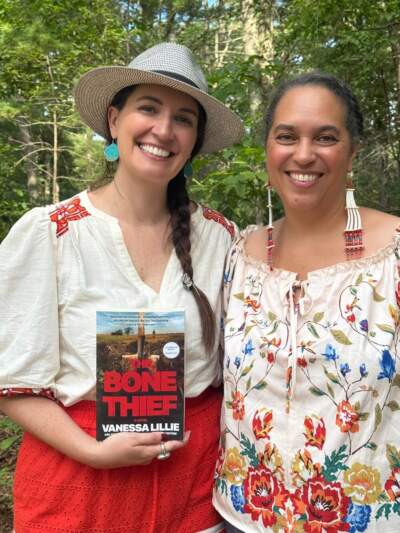
The author with Lorén Spears, executive director of the Tomaquag Museum, at the 350th August meeting and pow wow, in Charlestown, RI, 2025. (Courtesy Vanessa Lillie)


As I grew up, I sought to understand my family’s heritage and found it to be a reflection of the resiliency of the Cherokee Nation.  And as a writer, I realized how I could use story to share history and explore questions of colonization, both past and present. I’ve written seven novels, but it was only in the most recent that I learned how little I knew about the land and tribes in the smallest state I now call home.

Toward the end of King Phillip’s War (or, if you’d like to decolonialize the term, The War for New England), in December, 1675, English colonists attacked the winter homes of the Narragansett tribe. In what’s now known as the Great Swamp Massacre, at least 650 men, women and children were killed, and at least 300 were taken captive. It’s an echo of what President Jackson would later do to my own tribe: genocide perpetrated at the hands of men in power.

It wasn’t until recently, 2021, that the land was officially returned to the Narragansett tribe, having belonged to the Rhode Island Historical Society since 1906.  The grounds are open to the public, with small rocks, shells and feathers placed around the obelisk that stands sentry at the memorial where tribal members gather every year to remember.

While as Cherokee, we were forced out of our homelands, the Narragansett remained. One of my first summers in Rhode Island, I attended the Narragansett August Meeting and Pow Wow in Charlestown.  During the Grand Entry, I watched as many citizens of the tribe, dressed in regalia passed down generation to generation, entered to the sounds of drums and voices, often with the refrain, “we are still here.”  The Narragansett have been gathering there for over 350 years; it’s the oldest recorded pow wow in North America.

And yet, I’ve also spoken to young citizens of the tribe who were told in school that the Narragansett no longer exist, as if they’re extinct like the dinosaurs.  It’s a sentiment supported by hundreds of years of treating Indigenous remains and cultural items as trophies or objects to exploit.  When it comes to preserving and amplifying Indigenous culture, it’s not enough to understand history.  We must also ask: who’s doing the telling?

These are questions I often ask myself when I’m researching a plot or just enjoying a museum with my family.  Who’s creating the narrative on those small plaques near the objects in the museums we shuffle through? Or fund?  I know there are thousands of Indigenous remains on shelves across the country, from museums to academic institutions, despite federal laws meant to mandate their return.  They’re questions I explored in my research for my new book, “The Bone Thief,” using real examples from history: from Yale’s Skull & Bones club allegedly stealing, and hiding, the skull of Geronimo to the history of grave robbers in colonial America.

Even the language I used changed.  Thanks to guidance from the Tomaquag Museum, an Indigenous led museum telling first person histories, and leaders like Executive Director Lorén M. Spears, I’ve decolonized my language from “artifacts” to “belongings.”  Because these objects belong somewhere — to a place, a people — and they should be returned and shared by the people from which they originated.

While on book tour this month, I’ve been speaking at stores and events across New England, and I like to ask people to raise their hands if they’ve heard of the Great Swamp Massacre. Some crowds have more hands up than others, but it’s rarely more than half, and often a lot fewer.

Native American Heritage Month puts a well-deserved spotlight on books by Native American authors (including some of my own “must-reads”), and that’s a good thing. But it’s hardly something that can be highlighted, even honored, one month out of the year.

As for me, I hope by taking the real history of a place, and wrapping it in the page-turning plot of a thriller, I’m able to give people that same experience I had with “Watchmen”: not only shock, or even embarrassment, but a charge to go out and find the hidden truths of our homelands. Our heritage is an ongoing story. Our people are still telling it.

On Wednesday, Nov. 12, Vanessa Lillie spoke & signed copies of "The Bone Thief" at Authors on Stage at Wellesley College . and Brookline Booksmith 

SOURCE:  


Monday, November 18, 2024

America's Weekend Sport (content warning: redskins, racism)

LINK: https://www.dailykos.com/stories/2024/11/11/2285215/-Carter-Camp-s-Indian-Mascot-Essay-Mass-Racial-Taunting-America-s-Weekend-Sport


 Carter Camp gave me his permission (when he was alive) to repost his essay entitled “Mass Racial Taunting; America’s Weekend Sport” in the comments of "Stereotypical Elements (that) appear... in Athletic Contests" posted at Native American Netroots. I had mentioned that I wanted to cite the Shadow Report as an introduction, so here’s what the Consolidated Indigenous Shadow Report says about Indian Mascots on page 72.

Every Friday, Saturday, and Sunday (and Monday night) millions of Americans will scream and beg for my Indian people to be scalped, chopped, burned, tomahawked and murdered, by the Indians, Savages, Redskins, and Braves across the field.

KEEP READING:  https://www.dailykos.com/stories/2024/11/11/2285215/-Carter-Camp-s-Indian-Mascot-Essay-Mass-Racial-Taunting-America-s-Weekend-Sport

Saturday, November 16, 2024

WRONG Side of History


OPINION: 

Halito! Chim Achukma? (Hello, how are you?)

It’s Native American Heritage Month again. I would like to discuss something that’s been endeared to me for some time.  I seek transparency, and I do not desire to be offensive in any way, but I’m on deck, and it’s my turn to bat.

This concerns school curriculums and at least offering ‘Native American’ studies as an elective.

We seldom hear anything about Native American history, and after all, we are Oklahoma and home to 69 tribes who were displaced here in the 1800s. The Oklahoma History course in school only skims the surface of Native studies, and, after all, with its indigenous history, no other state compares to Oklahoma.

There’s been a sudden urgency to actualize how Native American history should be taught in our schools.  For a start, why not tell the truth instead of withholding, editing, and sanitizing it? In layman‘s terms, “tell it like it is.”.

We’re talking transparency here.  It’s necessary to open ‘Pandora’s box’ and discuss land theft (I call it ‘land grab’), government corruption, hundreds of broken treaties, rape, human trafficking, taking children from parents and sending them far away, and even scalping men, women, and children and collecting ‘bounties’ for scalps.

The prestigious yet dishonest Texas Rangers even murdered Mexican people scalped them, and sold scalps as being Indians.  Rangers called it glory, and they answered to nobody.

For many years, our history books have failed miserably regarding Indigenous history.  Three years ago, Kim and I were in West Point, New York, and I finally found an 8’ x 8’ section in the museum basement devoted to ‘Indian Wars,’ which referenced it as ‘Indian Uprising.’ I might also add that Native people should never be referred to as ‘renegades’ when referencing people who were fighting for their land, families, and the honor of being the true and quintessential Americans. Unfortunately, they have been... on the wrong side of history.

Such was the case when Indigenous people fought on what I call the ‘wrong side of history.’

Tuesday, November 5, 2024

Native American Heritage Month

NDN COLLECTIVE image


November 4, 2024 - President Joe Biden's Proclamation on National Native American Heritage Month, 2024.

During National Native American Heritage Month, we honor the history, rich cultures, and vast contributions of Native peoples.  We celebrate the hundreds of Tribal Nations that are ushering in a new era in our Nation-to-Nation relationships.  And we recommit to respecting Tribal sovereignty and self-determination and working in partnership with Tribal Nations to bring new prosperity and security to Native peoples.

     Indigenous peoples’ history in the United States is defined by strength, survival, and a deep commitment to and pride in their heritage, right to self-governance, and ways of life.  Native peoples have built and sustained powerful Tribal Nations, and the knowledge they developed still benefits us today.  However, our Nation’s failed policies of the past subjected generations of Native peoples to cruelty, violence, and intimidation.  The forced removal of Native peoples from their homes and ancestral homelands; attempts to assimilate entire generations; and stripping of Indigenous peoples of their identities, cultures, and traditions are some of the darkest chapters of our Nation’s history.  The trauma and turmoil fundamentally altered their communities.  As the first President to visit Indian Country in 10 years, I delivered a national apology for the unspeakable harms caused to Native peoples at Federal Indian Boarding Schools.

     Indigenous peoples have persisted and survived — a testament to their resilience and resolve.  Today, Native communities are leading the way forward and continuing to strengthen the fabric of the United States.  They have long served in the United States military and currently serve in the highest levels of government — including the Secretary of the Interior, Deb Haaland, America’s first Native American Cabinet secretary.  In every field and sector, Native peoples are pushing for progress and contributing to our shared prosperity.  

     Since I came into office, the Federal Government has made record investments in Tribal Nations.  Federal contracts with Native American-owned companies increased by over $8 billion from 2020 to 2023.  My American Rescue Plan made the largest direct Federal investment in Tribal Nations ever, helping vaccinate Tribal communities during the COVID-19 pandemic and keeping the economy going.  My Bipartisan Infrastructure Law made the single biggest investment in Tribal roads, bridges, water, high-speed internet, electricity, irrigation, environmental cleanup, and so much more.  My Inflation Reduction Act made the biggest investment in fighting climate change ever — including funding to help Tribal communities lead in the just transition to clean energy and ease the impact of droughts, wildfires, and rising sea levels, which threaten Native lives and precious homelands. 

     My Administration is also working to ensure that Native communities are safe and secure and have the resources they need to thrive.  I signed an Executive Order that improves the Federal response to the epidemic of missing and murdered Indigenous peoples.  When we reauthorized the Violence Against Women Act in 2022, we included historic provisions to reaffirm Tribal sovereignty and expand Tribal jurisdiction in cases where outside perpetrators harm members of their Nation.  And for the first time ever, my Administration also secured advance funding for the Indian Health Service so hospitals can plan ahead, order supplies, and hire doctors.  We have provided historic funding to Tribal communities to help fight the behavioral health crisis and taken significant steps to improve maternal health for Native American women, who are twice as likely to die from pregnancy-related complications as white women. 

     I have always believed that we must know the good, the bad, and the truth of who we are as a Nation — we must acknowledge our history so that we can begin to remember and heal.  That is why I became the first President to issue a formal apology for the Federal Indian Boarding School era, one of the most horrific chapters in our Nation’s history.  For 150 years, the Federal Government mandated the removal of Native children from their families and Tribes — and as a result, generations of Native children had their childhoods stolen and whole Tribal cultures were erased.  I am proud to formally end the silence surrounding this shameful era and I remain proud that my Administration defended the Indian Child Welfare Act in court, ensuring that our Nation respects Tribal sovereignty and protects Native children by helping Native families stay together and grow up with their languages and cultures.  And we are working to support Native American families and communities as they heal from the Federal Indian Boarding School era through the Department of the Interior’s Road to Healing initiative and by supporting Native language preservation and public safety initiatives.  

     My Administration has also worked with Tribal Nations to preserve, protect, and steward important ancestral Tribal lands and waters.  Through more than 200 co-stewardship and co-management agreements signed under my leadership, we are working side by side with Tribes to make decisions about how to manage the lands that are most precious to them.  And to date, I have protected and conserved more than 45 million acres of our Nation’s lands and waters.  That includes the Chumash Heritage National Marine Sanctuary, vast offshore waters off California’s coast and the first sanctuary to be proposed by Indigenous communities.  I have also established, expanded, and restored 11 national monuments, many containing sites considered sacred to Tribal Nations — from Bears Ears National Monument, Grand Staircase-Escalante National Monument, and Avi Kwa Ame National Monument to Baaj Nwaavjo I’tah Kukveni-Ancestral Footprints of the Grand Canyon National Monument, Berryessa Snow Mountain National Monument, and others.  

     During National Native American Heritage Month, we honor the heritage and contributions of Native peoples, and we work tirelessly to build a future grounded in dignity, respect, and partnership.  We remain committed to working with Native communities to write a new and better chapter in American history for Tribal Nations — one that honors the solemn promise the United States made to Tribal Nations, fulfills our Federal trust and treaty obligations, and works together to rebuild Tribal economies and institutions.  

     NOW, THEREFORE, I, JOSEPH R. BIDEN JR., President of the United States of America, by virtue of the authority vested in me by the Constitution and the laws of the United States, do hereby proclaim November 2024 as National Native American Heritage Month.  I urge all Americans, as well as their elected representatives at the Federal, State, and local levels, to observe this month with appropriate programs, ceremonies, and activities.  Also, I urge all Americans to celebrate November 29, 2024, as Native American Heritage Day.

     IN WITNESS WHEREOF, I have hereunto set my hand this thirty-first day of October, in the year of our Lord two thousand twenty-four, and of the Independence of the United States of America the two hundred and forty-ninth.

    JOSEPH R. BIDEN JR.
Source: Office of the White House

Friday, September 27, 2024

Tocabe ships frozen meals ‘anywhere in the lower 48’

Tocabe is an Osage-owned Indigenous restaurant and online store founded by Ben Jacobs, and this year they’ve released a line of ready-to-eat, elevated frozen meals. The ready-made meals are made with Indigenous-sourced ingredients

Tocabe launched its Indigenous marketplace this year, selling Native foods to the mainstream.  Microwaveable meals for adults and children are among the shippable products sourced from Native producers.  Tocabe also expects a spike in orders beginning with Indigenous People’s Day on Oct. 14 and continuing through Native American Heritage Month in November. 

Founder Ben Jacobs describes Tocabe’s Indigenous sourcing as “Native-first, local second,” meaning if a Native farmer or producer has a Native ingredient, Tocabe will source from them before relying on a local organic option.

“We source from Native producers growing and raising traditional foods, but also utilizing ingredients which have been introduced post-contact, as long as they are Native-produced,” added Katrina Salon, a representative for Tocabe.  For example, she said, “Wheat berries from Ramona Farms and olive oil from Seka Hills.” 

Tocabe created their Indigenous marketplace because they want Native food to be accessible.  Native food is not well understood, encountered or available, but Tocabe hopes to bring Native foods to everyone, Jacobs said. 

In addition to creating mainstream access to Indigenous foods, Jacobs also aims to support Indigenous economic development.  Tocabe does this by supporting the development of Native farmers, ranchers, and food producers who are building “an equitable, sustainable and innovative food system … benefitting American Indian communities.”

Tocabe’s Indigenous marketplace has products for sale from such ethical Native producers for customers to use in their own cooking – or, they can order ready-made meals in bulk bundles or individually. In a children’s line called Little Harvest, Tocabe has options like blue corn pancakes, spaghetti and bison meatballs and French toast.  In the adult line of meals, there are “elevated” options like iko’s green chili stew.

One Harvest Meal option is the “bison Sonora bowl,” which has a wheatberry and white tepary bean blended with roasted squash purée, nopales, zucchini and Navajo-grown pinto beans, with braised bison and a chili sauce.  Meal bundles include the “Best of Bison” bundle, with the bison Sonoran bowl alongside bison chili, bison posu, sausage posu, wild rice jambalaya and a “sausage sunset” – similar to the Sonoran, but with roasted yams, bison sausage and other variations in sauce and the type of beans.  

The meals do have some preservatives, Salon said, due to some of the ingredients they include in their ready-made meals.  But Tocabe does not add any additional artificial or synthetic preservatives, according to Salon.

The company has scaled-up their distribution and they’re ready to fill all the orders they’re expecting through the fall, said Salon.  From home cooks who want to source Indigenous ingredients for their Thanksgiving menus to busy professionals who want fast, nutritious options for dinner, Tocabe is hoping to be one of the options that comes to mind.

Their frozen Indigenous meals can be prepared with a microwave, in the oven, or by heating in a sauté pan after defrosting.  To give one of the ready-made meals a try – or to order Indigenous-sourced ingredients – visit https://shoptocabe.com/.    

STORY: https://osagenews.org/tocabe-ships-frozen-meals-anywhere-in-the-lower-48/?utm_source_platform=mailpoet

Friday, November 10, 2023

Welcome to Native Cinema Showcase


 It's so good to see new work and new films:

Native Cinema Showcase

National Museum of the American Indian, Washington, DC/USA

FREE November 17–24, 2023

https://americanindian.si.edu/events/?trumbaEmbed=view%3Devent%26eventid%3D170133924

(virtual)

 CLICK: https://americanindian.si.edu/native-cinema-showcase-2023/

The National Museum of the American Indian’s Native Cinema Showcase is an annual celebration of the best in Native film. This year’s theme highlights films of Indigenous perseverance that inspire, uplift, and triumph against adversity—stories that prevail against the judicial system, generational trauma, and cultural appropriation through love and complex relationships, self-worth, and humor. The showcase provides a unique forum for engagement with Native filmmakers from Indigenous communities throughout the Western Hemisphere and Arctic.  


All films available on demand:

Aitamaako'tamisskapi Natosi: Before the Sun

L'Inhumain

The Legend of Molly Johnson

Powerlands

Rosie

We Are Still Here

Connections Shorts Program

Future-Focused Shorts Program

Inside Out Shorts Program

Pacifika Shorts Program


This program is funded in part by the San Manuel Band of Mission Indians. Thanks!!

Tuesday, November 7, 2023

Challenges and Resilience (free zoom lecture)

Zoom (Cook County Higher Education) 300 West 3rd Street #57 , Duluth, Minnesota 55604

Thursday, November 2, 2023

Honor Our Ancestors And Remember Their Teachings


StrongHearts Honors Native American Heritage Month


(EAGAN, Minn., November 1, 2023) November is Native American Heritage Month when all Indigenous peoples are celebrated for their contributions to building the foundation of America. As the original people on this land, we call Turtle Island, we hold respect for all living things. We honor our ancestors by remembering their teachings, our culture, and traditions that have endured the test of time.

“Despite the efforts to terminate or assimilate us, we hold tightly to our culture and traditions that when practiced provides healing for our relatives, ” said CEO Lori Jump, StrongHearts Native Helpline. “We must continue to hold each other sacred as nations of sovereign people and with respect given to all living things.”

StrongHearts Native Helpline advocate training is steeped in Native American culture and traditions. Our support and advocacy are Native-centered, empowerment-based, and trauma-informed. We uplift our relatives, who are strong and resilient. During the month of November, we celebrate our ancestors, our teachers, and all of our relations today, tomorrow, and always.

StrongHearts Native Helpline serves all individuals who reach out for their services regardless of race, ethnicity, gender, gender identity, age, religion, national origin, sexual orientation, disability, or any other factor protected by local, state, or federal law. For support and advocacy, call or text 1-844-762-8483 or chat online at strongheartshelpline.org.

Tuesday, November 1, 2022

November is Adoption (beware) Awareness Month (#NAAM) AND Native American Heritage Month


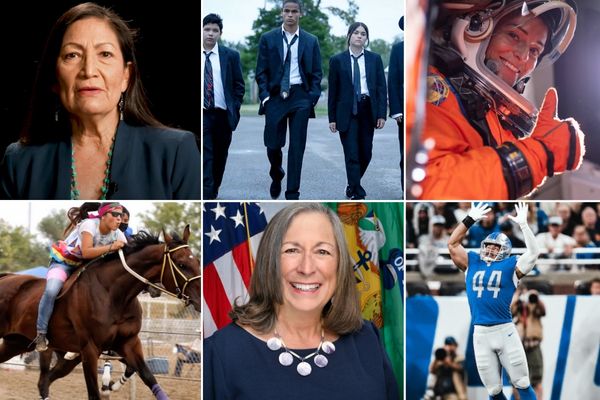
Top row (L-R): Interior Secretary Deb Haaland (Laguna Pueblo), the first Native American cabinet secretary; some of the young cast members of the breakout hit show “Reservation Dogs”; Marine Colonel Nicole Aunapu Mann (Round Valley Indian Tribes), the first Indigenous woman in space. Bottom row (L-R): An Indian relay rider in Buffalo, Wyoming; Chief Lynn Malerba (Mohegan Tribe), Treasurer of the United States; Detroit Lions rookie linebacker Malcolm Rodriguez (Cherokee).


A journalist asked me recently: What’s the one thing that mainstream media often get wrong about your community?

My answer was brief:  Unfortunately, the media still speaks about Native Americans in the past tense. 

The truth is: We are still here.

That’s part of the reason Native News Online was founded in 2011. Because the media often portrayed Native people in a negative light: high levels of alcoholism, poverty or as all being rich because of Indian casinos.

In our newsroom, we work to present a balanced and accurate portrayal of Native people living in contemporary times. We write about Native people as we are now, and the issues that actually matter to us. 

We report on — and occasionally celebrate — Native people who, in 2022, are reaching new heights in art, science, business, and public service.  

They’re not just doing great things in Indian Country.  They’re doing great things that affect the entire country — and well beyond our borders, as well. 

Throughout the month of November, Native News Online will highlight some of the Native Americans who have made “immeasurable contributions to the country’s progress,” as President Joe Biden noted in his proclamation about National Native American Heritage Month yesterday. We’ll share stories of Native Americans who have helped shape culture in Indian Country, the United States, and around the world.

We are still here, and our presence is growing.  

In advance of recognizing Native American Heritage Month, the U.S. Census Bureau released the following facts about American Indians and Alaska Natives:

3.7 million

The nation’s American Indian and Alaska Native population alone in 2020. This population group identifies as AI/AN only and does not identify with any other race.

10.1 million

The projected population of American Indian and Alaska Native alone or in combination with other race groups on July 1, 2060, about 2.5% of the projected total U.S. population.

324

The number of distinct, federally recognized American Indian reservations in 2022, including federal reservations and off-reservation trust land. 

574

The number of federally recognized Indian tribes in 2022.

120,944

The number of single-race American Indian and Alaska Native veterans of the U.S. Armed Forces in 2021.

We are still here.  We have been since time immemorial.  And we plan to be for generations to come. 

SOURCE


Tuesday, February 9, 2021

45 Years of Engaging Native Voices + How to be an ALLY


*only 0.4 % Of Primetime TV & Films have a native character


LINCOLN, Neb., Feb. 9, 2021 — This year, Vision Maker Media — founded in 1976 as the Native American Public Broadcasting Consortium — is celebrating 45 years of engaging Native voices in public media platforms.

“What began as a film archive to conserve and document Native American stories has, through the years, transformed into the nation’s public-media leader in content by and about America’s first people — Native Americans and Alaska Natives — for public broadcasting,” says Executive Director Francene Blythe-Lewis (Diné, Sisseton-Wahpeton, Eastern Cherokee).

With continuous support from the Corporation for Public Broadcasting and Nebraska Educational Telecommunications, Vision Maker Media’s mission empowering and engaging Native people to share their stories remains meaningful. Currently, Vision Maker Media has 28 projects in various stages of production and 34 films in public-media broadcasting, 5 of which were added in fiscal year 2020.

Vision Maker Media’s content reaches nearly 90 million Americans on public television series, including Independent Lens, POV, America ReFramed, American Masters and others.

 
NEWS from their website:


Monday, November 16, 2020

Wednesday, November 11, 2020

World Channel: ‘Blood Memory’ tells history of Native American adoption


World Channel in partnership with Vision Maker Media commemorates Native American Heritage Month and Veterans Day with films showcasing the rich culture and history of Native Americans highlighting documentaries like ‘Blood Memory’ Nov. 17 and ‘The Blessing’ Nov. 24.

More information about the film can be found at https://www.bloodmemorydoc.com/ and at www.worldchannel.org, where audiences can also find the line-up of films being shown as part of Native American Heritage Month. 

A trailer of the film is available at https://worldchannel.org/episode/arf-blood-memory/?asset_slug=arf-blood-memory-promo.

GOOD NEWS: World Channel: ‘Blood Memory’ tells history of Native American adoption | Navajo-Hopi Observer | Navajo & Hopi Nations, AZ


Are you searching? READ THIS: https://blog.americanindianadoptees.com/2020/07/what-can-adoptee-do-i-want-my-obc.html

Supaman - Let em go

Lyla June - All Nations Rise

Red Eagle - Song of Survival

Monday, November 25, 2019

Native American History is American History + taking on the myth of Thanksgiving

Growing up as a Diné woman, I was taught to carry on my cultural practices of reverence for land and place. I was molded by the beliefs, prayers, and encouragement of my parents and grandmothers, and was raised hearing stories of our creation—stories that relate us to the world around us. In my community, fall brings with it a full of appreciation of the harvest and new practices to welcome the colder months.

While this time is filled with reverence internally, outside of my community the fall season is also full of cringe-worthy debacles. Between the racist costumes that arise around Halloween, the offensive mascots that storm the field, and the continued perpetuation of the false history of Thanksgiving, this season is challenging as a Native person.

Since the 1990s, the federal government has declared November “Native American Heritage Month.”

This year, however, the White House made another tactical effort to malign Native communities and Nations, proclaiming November as “National American History and Founders Month.” The announcement centers colonizers and “founding fathers,” invisibilizing the Indigenous people whose land was taken and the millions of Indigenous lives lost since contact because of genocide. 

As Philip Deloria asks in his essay, “The Invention of Thanksgiving,” “how does one take on a myth?” At the USDAC we know that is not as simple as saying Indigenous peoples “are still here.” These times call on all of us to deconstruct the myths and falsehoods related to the “founding” of this country, and to work in active solidarity with Native communities. At the USDAC, we want to offer a few ways we might start:

Start Conversations + Take Action
  • Begin conversation around your turkey dinner this year. Use the USDAC’s #HonorNativeLand Toolkit to investigate whose land you’re gathering on and offer a land acknowledgment as a way of opening conversation. Discuss with your loved ones the history you learned or didn’t learn about Native peoples. Brainstorm together how can you move beyond acknowledgment and into allyship and action. Is there a commitment you can make together to learning more about the history of the Indigenous communities that have inhabited the land you occupy? Are there Indigenous-led organizations in your community that you can support?
  • Understand that 100% of the land this country is on is occupied Native land. All. Of. It. In the video “The ‘Indian Problem’” Suzan Harjo shares, “There was no land brought here, the land here was Native Nations’.” She shares the power of myths and falsehoods and how critical they are to the continual dispossession of Native Peoples of their land.
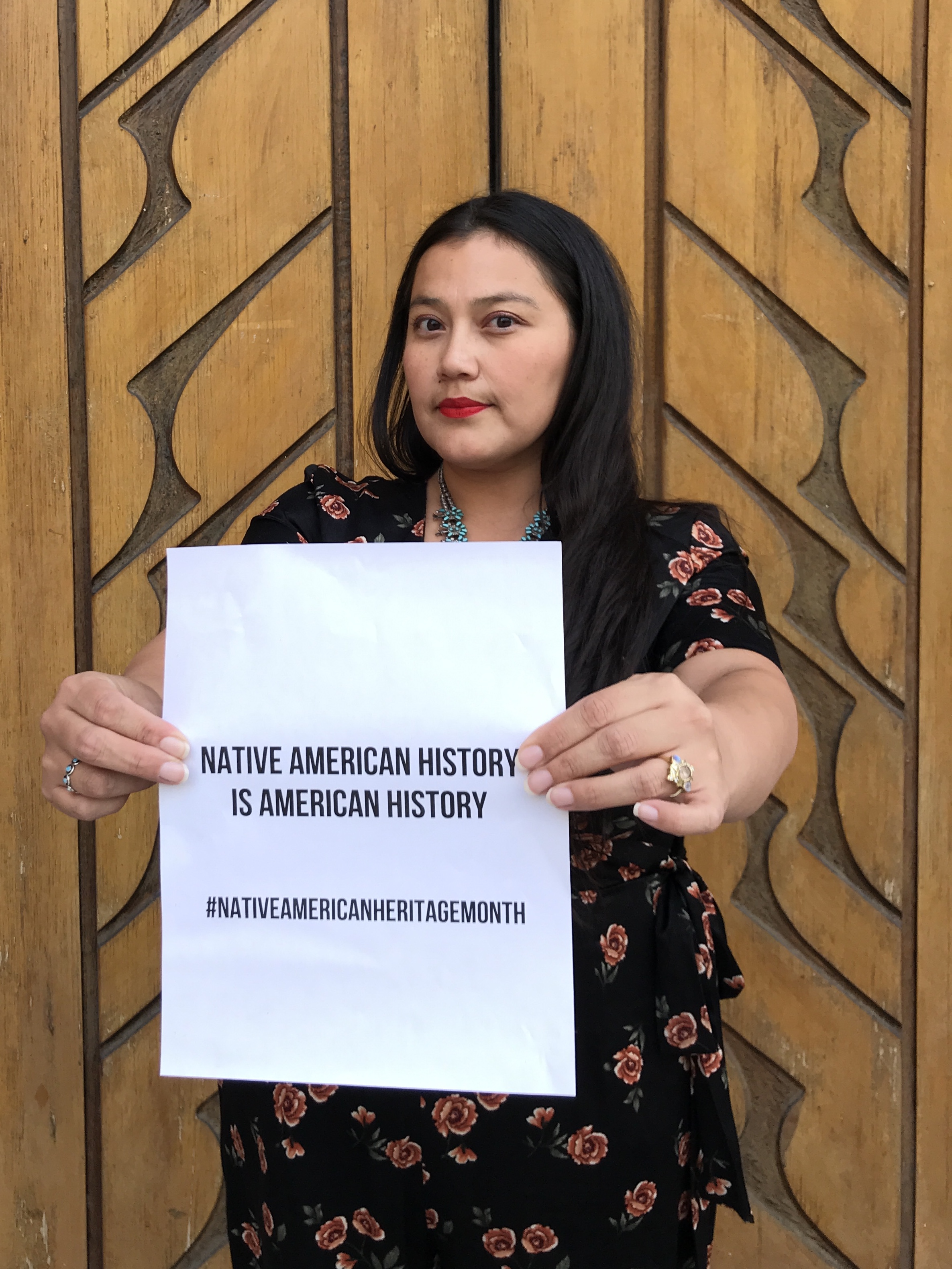
  • Join the movement to recognize Native American history as American History. This social media campaign is working to visually represent how there would be no American History without the Native American contributions, protection and stewardship of Turtle Island (the above photo of me is part of this campaign).
  • Read up! Here’s a great, annotated list of selections from the First Nations Development Institute.
  • Indigenous peoples and communities are on the frontlines of the protection of Earth Mother. USDAC, has been working to support Climate Strikes through the USDAC Bureau of Energy, Power, and Art. We feel strongly this intersection is one we will grow in the next year and encourage you to show up for the next Global Strike on Friday, November 29th.
When I dream of future worlds, I see one that includes and centers Indigenous peoples through a true telling of history, where Native sovereignty and culture is protected and Native land recognized and stewarded with respect. When you understand the history of this country and the treatment of my ancestors, you understand how truly radical this dream is.

Ahe'hee,
Jaclyn Roessel
USDAC Director of Decolonized Futures & Radical Dreams


Happy Visitors!

WRITTEN BY HUMANS!

WRITTEN BY HUMANS!

Blog Archive

Featured Post

Your History Class Was a F*cking Lie | #NOMOAR

  Your History Class Was a F*cking Lie by Sean Sherman (Or: How the American Educational System Has Always Been a Racist Propaganda Program...


Native Circles

Native Circles
click logo for podcasts!

Most READ Posts

Bookshop

You are not alone

You are not alone

To Veronica Brown

Veronica, we adult adoptees are thinking of you today and every day. We will be here when you need us. Your journey in the adopted life has begun, nothing can revoke that now, the damage cannot be undone. Be courageous, you have what no adoptee before you has had; a strong group of adult adoptees who know your story, who are behind you and will always be so.

Diane Tells His Name


click photo

Lost Birds on Al Jazeera Fault Lines

Lost Birds on Al Jazeera Fault Lines
click to read and listen about Trace, Diane, Julie and Suzie

NO MORE STOLEN SISTERS

NO MORE STOLEN SISTERS
click image

ADOPTION TRUTH

As the single largest unregulated industry in the United States, adoption is viewed as a benevolent action that results in the formation of “forever families.”
The truth is that it is a very lucrative business with a known sales pitch. With profits last estimated at over $1.44 billion dollars a year, mothers who consider adoption for their babies need to be very aware that all of this promotion clouds the facts and only though independent research can they get an accurate account of what life might be like for both them and their child after signing the adoption paperwork.

Original Birth Certificate Map in the USA

Google Followers