


LISTEN: https://revealnews.org/podcast/native-adoption-utah-politician-northern-cheyenne/

LISTEN: https://revealnews.org/podcast/native-adoption-utah-politician-northern-cheyenne/
By Leland P Morrill (Navajo adoptee and contributor to the book series Lost Children of the Indian Adoption Projects) posted in 2013
"Today's Child" started in June 1964 when Helen Allen - a veteran reporter for the Toronto Telegram - was questioned at the time by a skeptical Children's Aid Societies, but supported by Ontario's provincial government.
During its first few years, about 80% of the children featured in the column were adopted. Helen Allen in this National Television show states that she personally adopted 10,000 to 11,000 children. Who knows how many native and aboriginal children were adopted through her in Ontario, Canada?
Featured on this video are seven Ojibwe children, my adopted brothers and sisters, to a Mormon family who adopted 10 children.
I was a Navajo "undocumented adoptee" before we moved to Ontario, Canada.
Note on the video how many of my brothers and sisters are not white like our adopted parents.
What is Genocide? What constitutes Human Trafficking?
Native Children who are deemed adoptable because of the 3rd world conditions forced on them through the Reservation system (Concentration Camps) may be labelled under "neglect", by Departments of Social Services that blur the lines between neglect and impoverishment; thus creating the definition of "abused or neglected" to encompass those "whose environment is injurious to the child's welfare."
Genocide is the worst crime possible, undoubtedly the most serious crime that can be committed under international law.
The 1998 Rome Statute of the International Criminal Court (hereinafter the Statute) testifies to the fact that this is the most serious of the crimes within its jurisdiction. It places Genocide first, followed by Crimes against Humanity, War Crimes and the Crime of Aggression.
The crime of genocide is defined in Article 6 of the Statute in the following terms: [A]ny of the following acts committed with intent to destroy, in whole or in part, a national, ethnic, racial or religious group, as such: (a) Killing members of the group; (b) Causing serious bodily or mental harm to members of the group; (c) Deliberately inflicting on the group conditions of life calculated to bring about its physical destruction in whole or in part; (d) Imposing measures intended to prevent births within the group; (e) Forcibly transferring children of the group to another group.
United Nations defined genocide as the intentional "destruction of racial,
national, linguistic, religious or political groups," "with the purpose of destroying it in
whole or in part or of preventing its preservation or development,"either "causing the
death of members of a group or injuring their health or physical integrity" or interfering
with their biological reproduction or also "destroying the specific characteristics of the
group" through the "transfer of children."
This video is evidence. This is why ICWA and history matters. - Trace
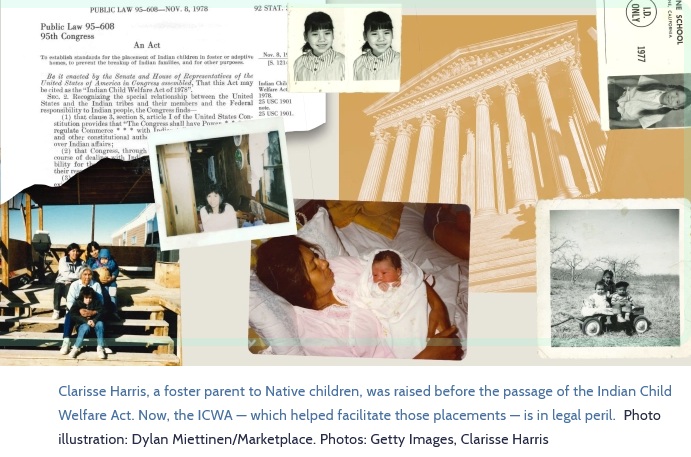 |
| Clarisse and Pat Harris are in their mid-70s. They live in a white house
on a hill in Ethete, Wyoming, with the seven children they’re raising. In the yard, there’s a chicken coop, a sweat lodge and a view of two
snow-capped mountain ranges: the Wind River to the west and the Owl
Creek to the north. STORY |

WYOMING: The Riverton Peace Mission’s online discussion about the Indian Child Welfare Act highlighted the experiences of two local Indigenous women who were fostered or adopted by non-Native families before the federal law was put into place.
Since 1978, ICWA has given Tribal nations “sole authority (to) determine what happens with children who belong to their Tribe,” RPM co-chair Chesie Lee explained at the beginning of the Thursday event.
But before the law was enacted, “large numbers of Native children were being separated from their parents (and) placed outside of their families and communities – even when fit and willing relatives were available,” according to the National Indian Child Welfare Association.
“Congressional testimony documented the devastating impact this was having upon Native children, families, and tribes,” the association says. “The intent of Congress under ICWA was to ‘protect the best interests of Indian children and to promote the stability and security of Indian tribes and families.'”
Both of the women who shared their stories Thursday said growing up in non-Native homes impacted their sense of identity.
“We didn’t know who we were,” said Clarisse Harris, a Northern Paiute from the Big Pine Reservation in California who has lived in Ethete for decades.
Harris and her younger siblings were sent to live with white foster parents when she was 10 years old, and she said their guardians did a good job making the children feel like “part of (the) family.”
“We did everything like everybody else,” Harris said, recalling 4H activities, long bus rides to school, family celebrations and trips throughout the region. “But that was not who we were. … We were Native Americans. And we should have been told that.”
The foster parents “didn’t try to change us,” Harris noted, and “we weren’t abused or anything,” so “compared to some people (we) had it pretty good.”
The “only thing” missing, she said, was “access” to information about their Tribe.
“No one in the home or in the community that we lived in ever talked about it,” she said. “We (didn’t have) anyone to say, you know, this is what you do, this is what your Tribe does, or anything like that.”
When she turned 18, Harris returned to live with her biological family, and over time she learned more about her Tribal community.
Now, she says she is able to “walk in two worlds.”
“I know both sides,” she said. “And I choose the Native side. I can make that choice. (And) that’s the way I raise my kids.”
Harris’ biological children are enrolled members of the Northern Arapaho Tribe, and before they became teenagers, the family decided they should move to the Wind River Reservation so they could be closer to the community there.
“(My kids) learned how to be Arapahos, and the language and the ways,” Harris said. “That was important. … It’s important that our people know where we’re from (and) who we are.”
She makes sure the same community connection is available for all of the Arapaho children she has fostered “on and off” for the past 40 years.
“The children that I have in my homes, they all know they’re enrolled Arapahos,” she said. “(They) know that they’re Native Americans.”
Those messages are re-emphasized in the local schools, which are “a lot” different now than they were when she first moved to Fremont County, Harris added.
“Everything is slowly changing to reflect Native American culture,” she said, referencing lessons on Indigenous languages, dress, dances and songs. “Forty years ago, they didn’t have that. (But) it’s the core of the schools now.”
Carol Harper of Riverton said she was “impressed” with Harris’ ability to “walk (in) two worlds” – a skill Harper has begun to develop later in life.
“I’m on my own journey now … to understand my Native roots and my heritage,” Harper said. “After all these years I’m really trying to define myself.”
Harper was born in Fremont County to a Native American and Hispanic woman who gave her up for adoption to a white family in Riverton when Harper was still an infant.
Her adopted parents allowed her to visit with her birth mother and other Native relatives on the reservation when she was a baby, Harper said, but when she got older, they decided it would be “too confusing” for her to maintain those relationships.
They did not take the same steps to shield her from the confusion she experienced as a Native American member of the Church of Jesus Christ of Latter-Day Saints, where she said she was “programmed to believe” that she was a Lamanite – a class of people defined in the Book of Mormon as “dark, filthy and loathsome.”
“That was very, very confusing for me,” Harper said.
She also had to contend with the fact that some of her adopted relatives were “very racist against Natives” and other minority groups – opinions that were handed down to her adopted mother “by default.”
“My mom had a hard time with me,” Harper said, describing multiple instances when her adopted mother physically and emotionally abused her in the home. “She would say she was going to beat the Indian out of me one way or another. (So) I just relented, and I conformed.”
Harper went to college at Brigham Young University, and she got married in the Salt Lake Temple to an LDS man who also was physically abusive.
She later divorced her husband and then left the LDS church.
Around that same time, Harper also received a call from her adopted mother, who “tearfully apologized for the abuse that she perpetrated throughout my childhood.”
“And I forgave her,” Harper said. “But I obviously haven’t forgotten about it.”
She explained that her childhood experiences, both at home and at church, had “devastating” and lasting impacts on her sense of self.
“That religion stole my identity,” Harper said. “I feel like I’m a baby again, trying to get my identity back with my Tribe.”
She’s also interested in learning more about her ancestors of Hispanic and Welsch descent, Harper said, prompting Harris to point out that every child in the foster or adoption system should have access to information about their biological background, no matter where they’re from.
“(They) have the right to know that,” Harris said, urging the guardians of Native children, in particular, to “take it upon” themselves to “provide that baby with what it needs to be a Native American,” regardless of the outcome of the ICWA case next year.
To learn more about ICWA, click here.

 |
| Ronald Rasband, a general authority of the Church of Jesus Christ of Latter-day Saints, speaks on Oct. 18, 2019, to The Arizona Republic Editorial Board. (Photo: Brady Klain/The Republic) |

“I know the inequality of children not being able to speak for themselves,” Morrill said. “Who’s going to speak for them?” Fifteen years would pass before Morrill himself saw the Navajo reservation again.During that time, Leland Morrill was one of about 2,000 Navajo children adopted annually by a Mormon family, according to the blog American Indian Adoptees. This was due to the Indian Adoption Project, a plan launched in 1958 by the BIA and the nonprofit Child Welfare League of America. The project paid states to remove American Indian children and place them in non-native or religious families to assimilate them into ‘conventional’ society. One goal was to give them opportunities the impoverished reservation could not provide for them, according to Reuters.
“I took some Native studies classes in college, but it felt really foreign to me,” Varenchik said. “I felt like it should have a deeper meaning, but it didn’t.”After finishing college at St. Mary’s, in Moraga, Calif., Varenchik moved to Los Angeles, which she knew had a large urban Indian population (the second largest in the U.S., according to Indian Country Today Media Network). She started work at United Indian American Involvement, a nonprofit providing service and support to American Indians in California, and began attending powwows. She even reconnected with her biological siblings on the reservation in Arizona.
“I’ve been in 17 foster homes from the ages 6-16. I was separated from one of my (biological) sisters who then got lost in the system. A social worker took her to a group home and my sister ran away. Four days later, her social worker killed herself so there was a disconnect (in information),” Javier said. “It took me 25 years to find my sister.”The task force efforts began two years ago, but members have yet to find a single foster family. They are collaborating with Los Angeles County, but Javier cites a lack of cultural awareness among officials as part of the problem. She gave the example of the county sending a non-native woman to an American Indian church sing to speak on the shortage of foster parents.
 |
| Leland was 48 at the time of this story. He lives in LA, CA. |
“In those days, if you were Native American, you had to be careful of the Mormon Church. Back then, the Mormons would take Indian babies, cut their hair and turn them into servants. In fact, they made a lot of money doing that until the Indian Child Welfare Act of 1972 put an end to it. It was very common for kids of a family to live with an aunt for six months or a year. Well, as soon as this would happen, the Mormon Church would come in and say this woman has abandoned her family. They would come in and cut their hair, not allow them to speak their native language anymore and, basically, sell them. It was a bit like slave trade. It was amazing they got away with it as long as they did.”READ THIS STORY

 |
Photo by Charles R. Savage/LDS Church History Collection
Daniel
D. MacArthur is seen here baptizing Paiute Indians in a stream near St.
George, Utah. Augustus P. Hardy is shown standing on the bank.
|


Your History Class Was a F*cking Lie by Sean Sherman (Or: How the American Educational System Has Always Been a Racist Propaganda Program...





 Posts
All Comments
Posts
All Comments


