They Took Us Away

They Took Us Away
click image to see more and read more

it's free

click

How to Use this Blog

BOOZHOO! We've amassed tons of information and important history on this blog since 2010. If you have a keyword, use the search box below. Also check out the reference section above. If you have a question or need help searching, use the contact form at the bottom of the blog.


We want you to use BOOKSHOP to buy books! (the editor will earn a small amount of money or commission. (we thank you) (that is our disclaimer statement)

This is a blog. It is not a peer-reviewed journal, not a sponsored publication... WE DO NOT HAVE ADS or earn MONEY from this website. The ideas, news and thoughts posted are sourced… or written by the editor or contributors.

EMAIL ME: tracelara@pm.me (outlook email is gone) THANK YOU CHI MEGWETCH!

SEARCH

Showing posts with label Canada’s Child Welfare Crisis. Show all posts

Wednesday, October 30, 2019

They Hid Him from Residential School, He Grew to Be Chief | The Tyee

[Editor’s note: This is the second of two parts. Find the first here.]

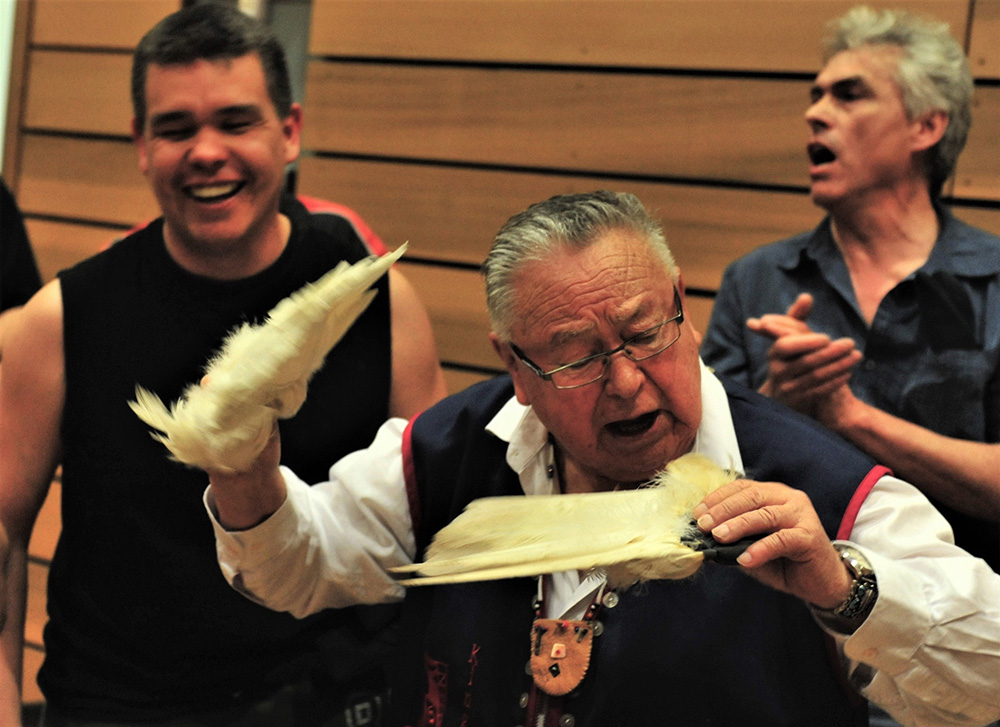
Chief Adam Dick was the boy who lived. He was the child in the bullrushes. Whether you prefer J.K. Rowling or the Bible, there are many legends across many cultures that tell of children hidden from malign forces intent on destroying a people and a way of life — heroes who must survive before re-emerging to continue the battle. On the west coast of B.C., Chief Adam Dick was destined to be that kind of warrior.
His chieftain name is Kwaxsistalla Wathl’thla. Kwaxsistalla means “The smoke from his big fire reaches around the world;” Wathl’thla means “the late.”  Chief Dick died of heart failure last year at age 89. He was a chieftain of the Kawadillikall Clan of the Dzawatainuk Tribe of the Kwakwaka’wakw First Nation, and took with him an unmatched knowledge of Kwakwaka’wakw music, culture and practice.
But before he died he succeeded in passing much of his knowledge along, and in the process helped transform our common understanding of life on the coast before Europeans arrived, and before the residential school system devastated Indigenous families.
“We would have lost the knowledge,” says Kim Recalma-Clutesi, also known as Ogwiloqwa of the Qualicum First Nation. “For six generations children in that area were removed to go to residential school. The only way to transmit that knowledge is to actually live there with the old people. He was the last contact with those really old teachings.”
If you picture the residential school system as a giant meteor, an obliterating force that wreaked havoc in First Nations communities across Canada, you might assume all was lost. But the impact did leave survivors. Adam Dick was one. It is no accident that young Adam, a descendant of clan chiefs, was spared. His deliverance was the collective act of his community.

GREAT READ: They Hid Him from Residential School, He Grew to Be Chief | The Tyee

Read the first in this two-part series here. 

Thursday, September 19, 2019

How differently the Canadian government engages with Tribal Nations

Somehow the final passage ("royal assent") of this bill in Canada slipped our attention back in June. Initially, we saw it referred to as a "Canadian ICWA", but it seems fair to say that it doesn't quite achieve that level of protection for Native children and families. If nothing else, it illustrates just how differently the Canadian government engages with the tribal nations within its borders compared to the U.S.. We want to add a large caveat, which is that none of us are experts on Canadian law or child welfare.
However, those that are put together a really helpful publication which is available here, and is well worth your read (it made us think about if ICWA would get passing grades):
From the Jurisdiction section of the report:
Why We Give the Bill a ‘D’ on this:
IN A HISTORIC FIRST FOR CANADA, the Bill purports to recognize Indigenous peoples’ inherent jurisdiction. For example, section 8(a) of the Bill affirms “the rights and jurisdiction of Indigenous peoples in relation to child and family services”. This positively worded language is also noted in the Bill’s introduction and summary. Similarly, section 18(1) states that the “inherent right of self-government recognized and affirmed by section 35 of the Constitution Act, 1982 includes jurisdiction in relation to child and family services, including legislative authority in relation to those services and authority to administer and enforce laws made under that legislative authority.” Section 18(2) affirms that this right includes the right to “provide for dispute resolution mechanisms.”
As there are no section 35 cases that recognize an inherent right of self-government for Indigenous Peoples or that have recognized an Aboriginal or Treaty right over child and family services law-making, this is a significant step forward.
This is not, however, a recognition of jurisdiction that removes all federal or provincial oversight, power or intervention. By recognizing jurisdiction over child and family services as a section 35 right, the federal government immediately re-asserts its power to unilaterally infringe or limit that right, a power upheld by court cases such as Sparrow. The legislation sets legal limits in terms of Indigenous laws being subject to Charter and Canadian Human Rights Act and the BIOC. It also sets practical limits in terms of the virtual necessity of negotiating coordination agreements with the federal and provincial governments, and in the glaring absence of any provisions for funding. At best, this could be interpreted as an acknowledgment of concurrent (or shared) jurisdiction, a matter on which Bill C-92 should be more clear.
***
Further, section 23 states Indigenous laws only authoritative if they can be applied in a way that “is not contrary to the best interests of the child.” As previously stated, Indigenous laws have upheld the best interests of Indigenous children for thousands of years. The concern about this limit is how the BIOC doctrine has been interpreted and applied by courts, non-Indigenous governments and decisions makers to apprehend Indigenous children and separate them from their families, communities and territories for the past 50 plus years.

Bill C-92, An Act Respecting First Nations, Inuit and Métis Children, Youth and Families

by Kate Fort

Sunday, December 2, 2018

First Nations Indigenous child and family services coming in early 2019

OTTAWA, Nov. 30, 2018 /CNW/ - Today, Indigenous Services Minister Jane Philpott, together with Assembly of First Nations National Chief Perry Bellegarde, Inuit Tapiriit Kanatami President Natan Obed, and Métis National Council President Clément Chartier, announced that the Government of Canada will introduce co-developed federal legislation on Indigenous child and family services in early 2019.

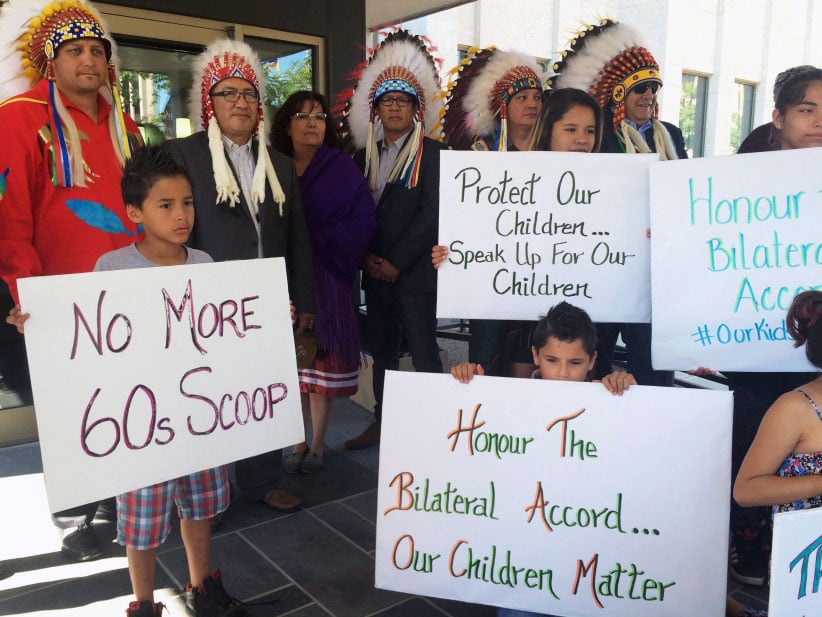
Indigenous children represent 52.2% of children in foster care in private homes in Canada. The over-representation of First Nations, Inuit and Métis Nation children in the child welfare system is a humanitarian crisis.
Indigenous children who have been in care face greater risks of adverse health outcomes, violence and incarceration.

This broad-based legislation will be inclusive of all Indigenous peoples while respecting a distinctions-based approach. The legislation would affirm inherent Aboriginal and Treaty rights as well as affirm principles consistent with the Calls to Action of the Truth and Reconciliation Commission, the United Nations Declaration on the Rights of Indigenous Peoples, and the United Nations Convention on the Rights of the Child.

READ: Government of Canada, with First Nations, Inuit and Métis Nation leaders, announce co-developed legislation will be introduced on Indigenous child and family services in early 2019 | Benzinga

Quick Facts
  • Indigenous children represent 52.2% of children in foster care in private homes in Canada but account for only 7.7% of the overall child population.
  • The first five Calls to Action by the Truth and Reconciliation Commission relate to child welfare.
  • Call to Action #4 calls "upon the federal government to enact Aboriginal child-welfare legislation that establishes national standards for Aboriginal child apprehension and custody cases and includes principles that:
        1. Affirm the right of Aboriginal governments to establish and maintain their own child-welfare agencies.
        2. Require all child-welfare agencies and courts to take the residential school legacy into account in their decision making.
        3. Establish, as an important priority, a requirement that placements of Aboriginal children into temporary and permanent care be culturally appropriate."
  • In 2016, the Canadian Human Rights Tribunal ruled that Canada's First Nations Child and Family Services Program was discriminatory and ordered Canada to immediately address the issue. The ruling prompted further discussion on the creation of federal legislation as a way to ensure better care for Indigenous children.
  • New federal legislation was also called for in an Interim Report by the National Advisory Committee on First Nations Child and Family Services, and in a resolution passed in May of 2018 by the Assembly of First Nations in support of the establishment of federal-enabling legislation for First Nations.
  • In January 2018, the federal government held a National Emergency Meeting on First Nation, Inuit, and Métis child and family services with representatives of the Indigenous peoples and nations, the Assembly of First Nations, the Inuit Tapiriit Kanatami and the Métis National Council, Indigenous service organizations, experts and practitioners, elders, grandmothers and youth with lived experience. At this meeting, the Government of Canada announced its commitment to Six Points of Action that included the potential for federal legislation, as called for in TRC Call to Action #4.
"For the larger part of Canada's history, Indigenous children have suffered as a result of racist and misogynistic colonial policies. As legislators, we have an obligation to do better for Indigenous children. We must support the development of policies that do not force an ultimatum between the well-being of children and their Indigenous identities."
Senator Marilou McPhedran, Senate of CanadaManitoba

Tuesday, September 19, 2017

The Surveillance of Cindy Blackstock

Surveillance. Turns out, we’ve invited it into our homes through digital assistants, connected toys and baby monitors.
LISTEN: I Spy With My Digital Eye

In this podcast episode, Dr. Cindy Blackstock who advocates for Native children in Canada is featured.
We have posted many articles on her on this blog.

READ:
Cindy Blackstock, Canada's Warrior for Children
CBC 8th Fire: Profile: Cindy Blackstock
Child Advocate Cindy Blackstock awarded damages
Government spies on advocate for Native children
Why is the federal government spying on Cindy Blackstock?
When does a life-long advocate for aboriginal children become an enemy of the state?
The answer, it would seem, is when you file a human rights complaint accusing your government of willfully underfunding child welfare services to First Nations children on reserves.
Accusing your government, in other words, of racial discrimination.
That’s what Blackstock, as executive director of the First Nations Child and Family Caring Society of Canada, did in 2007.

Monday, April 17, 2017

Canada’s Child Welfare Crisis in 2017

Op-Ed in Maclean’s About Canada’s Child Welfare Crisis

Here, by Pam Palmater. Canada’s numbers of Native children in care may be currently worse than pre-ICWA numbers in the United States (Task Force Four Report).
The increasing number of First Nations children being placed into foster care in Canada is nothing short of a crisis. Although Indigenous children make up only seven per cent of the population in Canada, they represent 48 per cent of all children in foster care. It is an astounding number until one examines these rates on a province-by-province basis. In Alberta, Manitoba and Saskatchewan, Indigenous children represent a shocking 73 per cent, 85 per cent and 87 per cent of all children in care respectively, according to the most recent Statistics Canada report. However, Manitoba reports that their numbers of Indigenous children in care are increasing and currently stands at 90 per cent, which represents one of the highest rates in the world. This isn’t much of a surprise given that one newborn is taken away from his or her mother every day in Manitoba as a matter of course—the vast majority being Indigenous. They are not the only provinces implicated as Indigenous children in Ontario are 168 per cent more likely to be taken into care than white children.

MORE: Prisons are the ‘new residential schools’

Happy Visitors!

WRITTEN BY HUMANS!

WRITTEN BY HUMANS!

Blog Archive

Featured Post

Your History Class Was a F*cking Lie | #NOMOAR

  Your History Class Was a F*cking Lie by Sean Sherman (Or: How the American Educational System Has Always Been a Racist Propaganda Program...


Native Circles

Native Circles
click logo for podcasts!

Most READ Posts

Bookshop

You are not alone

You are not alone

To Veronica Brown

Veronica, we adult adoptees are thinking of you today and every day. We will be here when you need us. Your journey in the adopted life has begun, nothing can revoke that now, the damage cannot be undone. Be courageous, you have what no adoptee before you has had; a strong group of adult adoptees who know your story, who are behind you and will always be so.

Diane Tells His Name


click photo

Lost Birds on Al Jazeera Fault Lines

Lost Birds on Al Jazeera Fault Lines
click to read and listen about Trace, Diane, Julie and Suzie

NO MORE STOLEN SISTERS

NO MORE STOLEN SISTERS
click image

ADOPTION TRUTH

As the single largest unregulated industry in the United States, adoption is viewed as a benevolent action that results in the formation of “forever families.”
The truth is that it is a very lucrative business with a known sales pitch. With profits last estimated at over $1.44 billion dollars a year, mothers who consider adoption for their babies need to be very aware that all of this promotion clouds the facts and only though independent research can they get an accurate account of what life might be like for both them and their child after signing the adoption paperwork.

Original Birth Certificate Map in the USA

Google Followers