



Hoping to offer a rare in-depth look into how placing children for adoption impacts the lives of Indigenous birth mothers, a group of researchers is continuing efforts to document the experiences of American Indian and Alaska Native women.
Their study, believed to be the first of its kind, focuses on mental health and grief. The research is being carried out in stages and has already surfaced several themes, including “ambiguous loss” — “a stressful and traumatizing’’ event that occurs when there is “no verification, closure, rituals for support, or resolution.’’
A small sample of Indigenous birth mothers informed the study’s initial findings, originally published in a 2022 peer-reviewed article in the Family Process journal. Now, researchers intend to expand their work by surveying a larger number of Indigenous mothers and further examining the roles of culture and history. Participants are being recruited online, and through word of mouth and flyers being distributed throughout rural and urban Indigenous communities.
Understanding the systemic challenges that lead to Indigenous women’s children being placed for adoption might ultimately help inform future child welfare and adoption practices, said Sicangu Lakota elder Sandy White Hawk, lead investigator. Such insights might also lead to a better understanding of the specific support Native birth mothers need during and after an adoption, researchers said.
“It is my hope that it will motivate policy change on child removal — that child welfare will begin to focus on family healing rather than child removal,” White Hawk said.
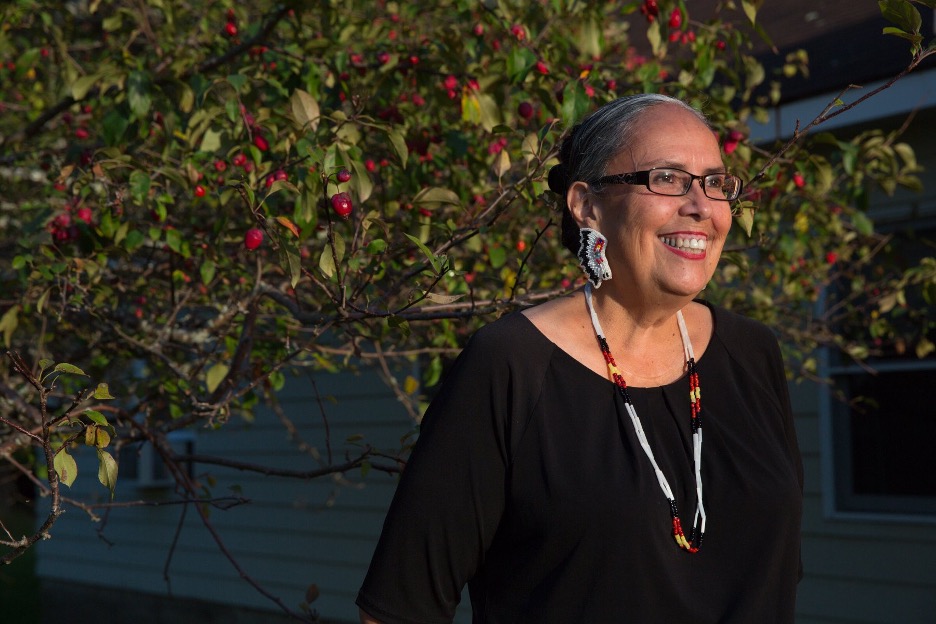
White Hawk’s interest comes from a personal place — she was adopted at 18 months old. She is the founder and director of the Minnetonka-based First Nations Repatriation Institute, which helps Indigenous people impacted by adoption or foster care reconnect with their families and identities.
For the study’s initial phase, her team interviewed eight women from Minnesota, Washington, New Mexico, North Dakota, Alaska, Oregon and Wisconsin. Researchers acknowledged the small sample size but said the interviews yielded “rich data’’ nonetheless.
Researcher Ashley Landers said previous studies involving the impact of foster care and adoption on birth mothers have mainly centered on the lives of white mothers.
“I don’t think it’s by chance that no Native birth mothers were included in birth parent research prior to this,” said Landers, an associate professor in the Department of Human Sciences at Ohio State University. “Their part of the story has been largely omitted — Native birth fathers have also been omitted, and the larger Native family impact is oftentimes not part of adoption research.”
History weighs heavily on the experiences of Indigenous birth mothers, making them “distinct from other races as they have been disproportionately exposed to systemic practices of forced child removal,’’ White Hawk’s team posited in the 2022 published article. Culprits include U.S. policies that coerced parents into relinquishing their children to boarding schools, and the Indian Adoption Project — a federally funded effort in the mid-20th century to force the assimilation of Native American children into white families.
Also harmful, they wrote, is the ongoing disproportionate removal of Native children from their parents through the country’s child welfare systems.
Taking this broader cultural context into account is crucial to understanding how adoption impacts the well-being of Native women, whose grief may be complicated by intergenerational trauma, researchers wrote. Two of the original study participants grew up in foster care, and one is a descendant of boarding school survivors.

In all, the eight study participants were between the ages of 33 and 77 at the time of the survey. Each had experienced separation from a child through adoption or foster care between 1959 and 2010.







 Posts
Posts

