They Took Us Away

They Took Us Away
click image to see more and read more

it's free

click

How to Use this Blog

BOOZHOO! We've amassed tons of information and important history on this blog since 2010. If you have a keyword, use the search box below. Also check out the reference section above. If you have a question or need help searching, use the contact form at the bottom of the blog.


We want you to use BOOKSHOP to buy books! (the editor will earn a small amount of money or commission. (we thank you) (that is our disclaimer statement)

This is a blog. It is not a peer-reviewed journal, not a sponsored publication... WE DO NOT HAVE ADS or earn MONEY from this website. The ideas, news and thoughts posted are sourced… or written by the editor or contributors.

EMAIL ME: tracelara@pm.me (outlook email is gone) THANK YOU CHI MEGWETCH!

SEARCH

Showing posts with label Canada's residential schools. Show all posts

Friday, April 18, 2025

Fox & the Tiny Demon explores themes of mental health, depression, and intergenerational trauma of residential schools


Animated film explores the strength found in the shadow of demons

Thursday, April 3rd, 2025 

“Qaq Wah Hell Cliff,” a still from Qaqsoss Naka Wahantuhsis by Tara Audibert.
 
By Odette Auger
Local Journalism Initiative Reporter
Windspeaker.com

Qaqsoss Naka Wahantuhsis (Fox & the Tiny Demon) is a new animated film directed by award winning animator, director and artist Tara Audibert, who has ties to Neqotkuk (Tobique First Nation) through her mother. 

The film addresses issues of mental health while preserving Indigenous culture and language.  It is the first animated feature film in Wolastoqey, an Algonquian language spoken by the Wolastoqiyik (Maliseet/Malecite) people.

The film is narrated by Audibert's great aunt Carole Polchies of Woodstock First Nation, who is one of the few remaining fluent Wolastoquey speakers. Audibert has used her aunt’s voice in other films to tell “Indigenous stories that I've heard all my life, and then I animated them.” Audibert has “grown up to appreciate the stories even more. You hear them over and over and over again, but these stories change every time you hear them, and depending on who’s listening, as well.”

Audibert takes the task of creating from Wolastoqey stories seriously.

“I question a lot, because I am taking these stories that are supposed to be passed down verbally, but I want to preserve them, and I want to share them,” she said.

“That's a part of how I can be a part of reconciliation. My family is willing to share, and I have the ability to share these a little bit wider.”

For this project, Audibert wrote the story and Polchies translated it and narrated as the storyteller of the film.

“Some of the words were too modern. She had to think of how to combine existing words to capture the meaning,” said Audibert. That’s when the work of her great-grandfather, Dr. Peter Lewis Paul, comes in. He was awarded the Order of Canada a few months before he passed in 1987 for his work to preserve the language, including writing a Wolastoquey dictionary.

Tara Audibert, MoxyFox Studio.

Finding ways to talk about mental health

Audibert was inspired by classic animated films such as Watership Down, which dealt with deeper subject matter.

“It's all about these animals and we're telling this story. There is the reality of the human world that's in there, but we're looking at it through the eyes of the animals,” she said of that film.

Audibert seeks to create a similarly impactful and meaningful experience for young audiences. The story of Fox & the Tiny Demon explores themes of mental health, depression, and the intergenerational trauma of residential schools. Audibert approaches these heavy topics through an animated, child-friendly lens that allows for open-ended discussion.

“Those are very heavy things. How do you talk to children about those things?” So Audibert created a story and a space where viewers can be curious about a character’s actions.

“Then you can have a conversation that's not based around my mental health or your mental health or a specific person's mental health. It's about the health of these characters. And it doesn't even have to be about mental health. ‘Why do you think they did that? Why do you think they did it’? There can be a conversation that doesn’t have to be so heavy.”

Audibert’s mom was a day school survivor, and the filmmaker reflects on the ongoing impacts. “It's so much to piece together, and I think that a lot of times it's hard to talk about these things. And how can we frame them?”

Finding a way to talk about the impacts was part of her idea behind the film, Audibert said.

“That it's continuing to persist because of the third, second, third generations that are still suffering, not knowing why your parents were unable to do things that are on the TV of a “normal family. I wanted to talk about what happens when you have mental illness. and you have to live with someone that has mental illness? And you don't have a choice when you're a kid. You just have to live with them until you don't. But can we talk about that in some way?”

Audibert sees artists as “the counterculture, the rebels. We're the ones that are supposed to stand up to everything that is questionable.”

By lifting up a mirror to society, people can see things from different perspectives, she said.

“I think that's what most artists are hoping to do, is just to impart a little bit and share, because I think many artists are on the outside looking in, or we're on whatever that outer edge is. And I think that's an important place to be, because that's where we're going. She said that once others reach the edge where artists are, artists expand beyond.

“And then once people get there and that's the norm, then artists have to move out further and see what's out there again and then show that back. There's no way to get to a better place without that extreme,” said Audibert.

“I think to be able to change people's minds is a large thing. And then the artist keeps going, keeps forward with the mirror reflecting back, and that's our job constantly.”

“Qaqsoss’ path,” still from Qaqsoss Naka Wahantuhsis, Tara Audibert
“Qaqsoss’ path,” a still from Qaqsoss Naka Wahantuhsis by Tara Audibert.

Storyteller first

Audibert knew she was an artist since she was two years old, and she chuckles about the early manifestations of that creative impulse.

“I got into trouble a lot,” from drawing on her wallpaper to figuring out how to draw characters from cartoons.

She paused the VCR and wrapped Saran Wrap over the TV.

“I got this brilliant idea. I'm going to put Saran Wrap over and I trace it, and then I can put it on paper and trace it off there, and I'll have a copy of what it looks like,” she said. “Little did I know that permanent marker goes through. There's a reason not to do that,” she laughed. “It went right on the actual TV. I got in a lot of trouble for trying to trace stuff from the Flintstones.”

Audibert keeps adults in mind as much as children when making her films.

“Why wouldn’t I want to make something that’s good for everyone?”

She recalls watching cartoons with her younger sister. She knows parents are watching alongside their young ones.

“I hope people will want to watch (Fox & the Tiny Demon) more than once because there's so many little things included in the backgrounds and in the meaning of it,” Audibert said. Similar to listening to the variations of her great aunt’s traditional stories, “Maybe each time they can find something new or different.”

The film was produced on a small indie budget with a minimal crew of 40, which is “unheard of in animation,” she said. Audibert is grateful for the dedicated team that connected deeply with the project's themes and went above and beyond.

“They gave far more than they were paid for. And everyone in the crew told me they found this story very meaningful to them personally.”

“And I was just kind of amazed because there it is, right there. That’s part of reconciliation,” said Audibert. She’s still looking for a distributor for Qaqsoss Naka Wahantuhsis, and the team is preparing to submit to film festivals in addition to having local screenings and the upcoming premiere in Miramichi, New Brunswick on April 19 at 2 p.m. at the Cineplex Miramichi.

Local Journalism Initiative Reporters are supported by a financial contribution made by the Government of Canada.
Tuesday, October 31, 2023

Senate Committee shocked by difficulties faced gathering residential school records from Catholic Church

 October 26th, 2023 

Saskatchewan Treaty Commissioner Mary Musqua-Culbertson
 
By Shari Narine | Local Journalism Initiative Reporter | Windspeaker.com

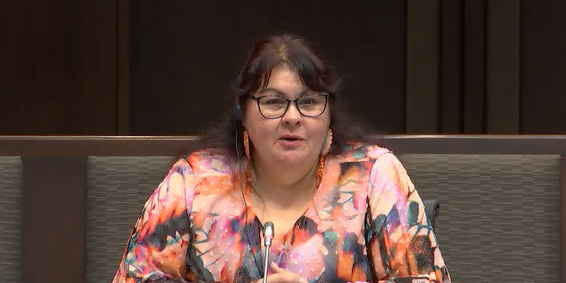
Saskatchewan Treaty Commissioner Mary Musqua-Culbertson didn’t mince words when she spoke to members of the Senate Committee on Indigenous Peoples Oct. 25 about the difficulty in accessing Catholic Church records for Indigenous residential schools.

Not only has her office come up against barriers in trying to acquire student records for four of the former Indian residential schools in the Prince Albert diocese, but staff had to sign a non-disclosure agreement (NDA) for 21 years in order to access the diocese records they were told were housed at St. Paul University in Ottawa. However, she says, Prince Albert diocese records were never found there.

“Who specifically asks for a 21-year NDA? Who within their organization needs to die within that 21 years that is being protected?” asked Musqua-Culbertson, a lawyer who added that 21 years is not a usual timeframe.

“There is still people who are responsible for sexual abuse and deaths that are still alive that are still out there and they’re walking about within our institutions and in churches and in religious organizations. I do believe that religious organizations are there to protect religious organizations and the people within them,” she said.

Musqua-Culbertson drew the connection between persons of interest (POI) who were named by survivors during the Independent Assessment Process (IAP). The IAP was used as part of the Indian Residential Schools Settlement Agreement (IRSSA), signed in 2006. Through the IAP, survivors had to recount how they were sexually or physically abused in order to receive compensation beyond what the base common experience payment was.

Musqua-Culbertson served as legal counsel during the IAP.

“So you have these vast lists of POIs. Where is that database? Could that be a database? Because POIs are still protected…Those are people who were named as abusers,” she said.

She also pointed out that the IAP records will be destroyed unless survivors state otherwise.

Musqua-Culbertson recounted numerous incidents where the diocese gave her staff difficulties as they tried to access residential school records, including promising to release records and then reneging on those promises.

“When we come back up against this (many) barriers when it comes to the graves of missing children, it’s very disheartening,” she said.

The Office of the Treaty Commissioner of Saskatchewan officially built its library and archives in 2020, although documents began to be collected in 1989. In the past few years, the office has started to collect documents and church records relating to the four Indian residential schools of Delmas (west of Thunderchild First Nation), St. Anthony’s (Onion Lake Cree Nation), Beauval (English River La Plonge Reserve) and St. Michael’s (Beardy’s and Okemasis and One Arrow First Nations).

Raymond Frogner, head archivist for the National Centre for Truth and Reconciliation (NCTR), also recounted the frustrations involved with working with the Catholic Church. Centre researchers are combing through the oblate records housed at Société historique de Saint-Boniface (Manitoba) and Deschâtelets-NDC Archives (Quebec).

“We….are currently funding researchers to go into their archive, go through their records and tell them what records they have that they’ve been holding for decades. Tell them which ones are actually relevant to residential schools…They’re also asking us to pay for the digitization of those records because they aren’t digitized,” said Frogner.

“We all know the Catholic Church did not pay the compensation that they originally were assigned to pay up for the IRSSA.”

Four churches were signatories to the settlement agreement.  While the Anglican, United, and Presbyterian churches have paid their agreed-upon negotiated amounts, the Catholic Church has fallen well short.

Frogner said that the archive at the NCTR held approximately four million records largely focused on the daily administration and operation of the schools.

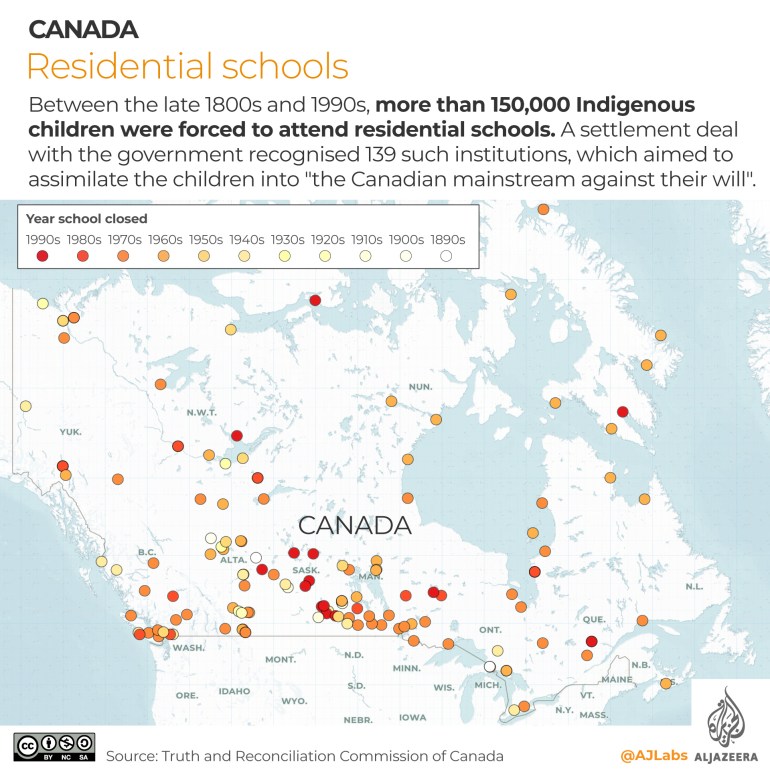
“There is not a single one of the 141 schools that were part of IRSS agreement …that has a complete set of admission records, discharge records or quarterly returns. This is because, partly, the quality of record keeping was abysmal, to put it lightly,” he said.

Saturday, December 3, 2022

Seeking justice for missing children and unmarked graves uncovers ‘larger’ concerns


Kimberly Murray says an impending bill making Indigenous policing an essential service could make the process of searching burial sites much safer for Indigenous communities.

In June, Murray was appointed the country’s independent special interlocutor for missing children, unmarked graves and burial sites.

For two years, Murray is taking on the heavy task of liaising with Indigenous communities to examine how Ottawa, provinces and territories protect and investigate these sites, with the aim of improving Canadian laws and making recommendations for a new federal legal framework.

Nearly five months into the job in October, Murray says some of those challenges are more sprawling than she first believed.

“The records are proving (to be) a larger concern than originally I thought,” she told the Star.

While obtaining and accessing residential school records held by churches and the federal government have long been considered a barrier to achieving reconciliation, Murray said the issue extends far beyond those entities.

She’s encountered cases of children sent to the schools, apprehended by municipal police for running away, entered into the court system and sent to reformatories, before being shuttled back to the institutions they first fled.

“This systemic interconnection of all these organizations and entities and institutions is much larger than I thought,” said Murray, of attempts to lay out a clear paper trail in each of those cases.

The role of special interlocutor was first announced last summer, after ground searches confirmed the existence of hundreds of unmarked graves at the sites of several former residential schools. At the time, the federal government earmarked $83 million, on top of other investments, to research and locate burial sites, and to commemorate children who died at the institutions.

Since then, Indigenous communities have grappled with how to go about conducting searches of their own.  As of September, 88 communities have received federal funding to begin that work, Murray said.

The former executive director of the Truth and Reconciliation Commission said the ongoing battle to access records — including those from local police services, hospitals and universities — is mirrored in the challenges accessing potential burial sites.

She referenced the recent example involving Sioux Valley Dakota Nation in southwestern Manitoba, whose radar survey at a campground in Brandon was stalled after the site’s owner blocked access to the area.

“There’s also issues with other sites that aren’t necessarily where the residential school was located, but was associated with a residential school, or we know that Indigenous children got sent to these places,” Murray said.

“Our legislation and our legal framework doesn’t adequately address those concerns.”

These are issues Murray raised at a meeting with federal, provincial and territorial ministers of justice two weeks ago, where she was able to discuss her mandate with government officials for the first time.

Murray said she hopes to conduct similar meetings with Indigenous relations ministers across the country as part of a wider effort to improve co-ordination between hundreds of Indigenous communities.

One of the topics raised in her discussion with justice ministers was enshrining Indigenous policing as an essential service — a topic Ottawa is hoping to address in the form of new legislation this year.

At present, Indigenous police services are funded through the First Nations and Inuit Policing Program, which was established in 1991. While costs are split between provinces, territories, and the federal government, police services are still regularly underfunded.

Ottawa had initially hoped to table legislation on the matter as early as this fall, a deadline that has now been pushed back to this winter. The legislation is expected to help reform the way Indigenous police services are funded, which would provide communities with full-time, culturally-sensitive services.

Murray said having a safe policing alternative is critical for communities wrestling with how to bring law enforcement into their searches.

Such police services could fundamentally change the way investigations are conducted, Murray said, including allowing families and survivors to actively take part in the process.

“I am always offended when I hear a Crown attorney or a police officer say, ‘Well, we have to protect the integrity of the investigation. To me, that’s very demeaning and disrespectful to the families and their communities because nobody wants to interfere with the integrity of the police investigation,” Murray said.

“That to me is a buzzword, a white people buzzword, for ‘Get out of our way.’”

Having legislation in place as quickly as possible would eradicate some of that mistrust, Murray said.

“(Indigenous police) weren’t the ones taking the kids when they ran away and bringing them back. They weren’t the ones that did the failed investigation when survivors were coming forward about sexual abuse,” Murray said. “If we have First Nations police services, trained, properly resourced, with the ability to do this investigation, that could be the solution.”

Friday, June 10, 2022

6 books on Canada's residential schools recommended by Duncan McCue and the Kuper Island podcast team


6 books on Canada's residential schools recommended by Duncan McCue and the Kuper Island podcast team

The new CBC Podcast series Kuper Island tells the story of four students: three who survived and one who didn't. They attended one of Canada's most notorious residential schools — where unsolved deaths, abuse and lies haunt the community and the survivors to this day.

Kuper Island is an eight-episode series hosted by journalist Duncan McCue. You can find it on CBC Listen or wherever you get your podcasts. 

To continue the conversation, Kuper Island host McCue and producers Martha Troian and Jodie Martinson connected with CBC Books to share some of the books that impacted them when reflecting on and researching the residential school system. 


LISTEN: Kuper Island

*

Missing Children and Unmarked Burials, vol. 4 by Truth and Reconciliation Commission of Canada

Missing Children and Unmarked Burials, vol. 4 document findings from The Final Report of the Truth and Reconciliation Commission of Canada. (McGill-Queen's University Press)


Indigenous-themed podcasts offer richness, diversity of First Nations, Inuit and Métis cultures

June is National Indigenous History Month and a time for learning about, appreciating and acknowledging the contributions of First Nations, Inuit and Métis peoples.CBC offers you a wide variety of Indigenous-themed podcasts, including the CBC Books podcast This Place, hosted by Rosanna Deerchild.

Wednesday, May 4, 2022

More than 200 boxes of records under scrutiny by Ottawa, courts for residential school connections

Crown-Indigenous Relations Minister Marc Miller says talks ongoing on disclosing of Justice Canada records

COVID Cda 20210616
Crown-Indigenous Relations Minister Marc Miller said his department continues to search for documents related to residential schools in Canada. (David Kawai/The Canadian Press)

More than 200 boxes of records are currently under separate court and internal federal reviews to determine their connection to residential schools after they were found in storage facilities within the last year, CBC News has learned.

The records were discovered in Yellowknife and Vancouver storage lockers, according to information provided to CBC News by a Crown-Indigenous Relations (CIRNA) official. 

As a court-appointed firm and federal officials sift through the records, CIRNA Minister Marc Miller said searches continue within his and other departments to find any documents related to the residential school era.

"The state they were found in is entirely unacceptable," Miller said in an interview with CBC News. 

"It is part of this process that I continue as the minister … That work isn't complete and is still ongoing — knowing any piece of information related to that time period can help in closure and getting an understanding of the truth."

The first batch of documents, 125 bankers boxes, was found in June 2021 by the owner of a storage facility in Yellowknife who was clearing out a unit once owned by a now-defunct survivor healing group called the Healing Drum. 

The owner contacted the territory's information commissioner, which then alerted the regional CIRNA office, said Andrew Fox, the Information and Privacy Commissioner for the Northwest Territories.

KEEP READING

Friday, February 25, 2022

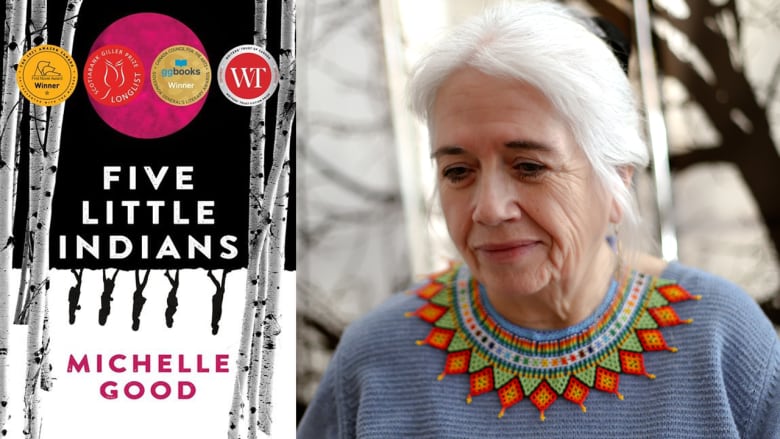
Michelle Good's Five Little Indians is a look at the legacy and trauma of Canada's residential school system


Christian Allaire is defending Five Little Indians by Michelle Good on Canada Reads 2022

Five Little Indians is a novel by Michelle Good. (HarperCollins, Silken Sellinger Photography)

WARNING: This story contains distressing details. 

Michelle Good is a writer, retired lawyer and a member of Red Pheasant Cree Nation in Saskatchewan. Her poems, short stories and essays have been published in magazines and anthologies across Canada. 

Good's debut novel Five Little Indians is a bestselling book that chronicles the quest of five residential school survivors — Kenny, Lucy, Clara, Howie and Maisie — to come to terms with their past and find a way forward. Released after years of detention, the five teens find their way to the seedy and foreign world of Downtown Eastside Vancouver, where they cling together, striving to find a place of safety and belonging in a world that doesn't want them.

Five Little Indians won the 2021 Amazon Canada First Novel Award and the 2020 Governor General's Literary Award for fiction. The novel has also been optioned by Prospero Pictures to be adapted to screen as a limited TV series

Five Little Indians will be championed by the journalist and author Christian Allaire on Canada Reads 2022.

Canada Reads will take place March 28-31. The debates will be hosted by Ali Hassan and will be broadcast on CBC Radio One, CBC TV, CBC Gem and on CBC Books.

In May 2021, the Tk'emlúps te Secwépemc First Nation in B.C., uncovered the remains of 215 children on the grounds of the former Kamloops Indian Residential School.

The news has had an emotional effect on Good, who is currently based in southern British Columbia. She spoke with Shelagh Rogers about why she wrote Five Little Indians — and why the legacy of Canada's residential school system stays with her.

Calls to action

"That first weekend after the Kamloops announcement was really rough. I told a friend of mine that I felt catatonic after that announcement. It's not because we didn't know. We did know. People have been talking about this for years and years. But there's never been any support to resolve this, to do what the band has done themselves. 

"But the thing that really, really bothers me — and it actually infuriates me and I try to stay away from being infuriated — is in 2015, when the Truth and Reconciliation report was issued, there are six calls to action, 71 through 76, that are up here under the heading of 'missing children and burial information.'

"Murray Sinclair and the other commissioners basically gave the federal government a roadmap for how to address this issue through those calls to action. They developed a budget to go with it. And the federal government said no.

I would bet you my bottom dollar, you're going to find one of these grave sites virtually at every residential school.

"So when I hear the prime minister speaking about how 'all children matter' and flying the flags at half mast, it's a lovely symbolic gesture. But it does nothing. What they need to be doing is providing the resources, the expertise and the support. 

"They need to protect these lands. I would bet you my bottom dollar, you're going to find these grave sites at virtually every residential school."

The half-life of trauma

"There was a reason that I chose to pick up the story upon the release of the characters, whether it's escape or when they age out or whatever. Through all of the work that's been done in the form of memoir, in the form of the Truth and Reconciliation report, I think that there is some understanding of the nature of the abuse that children suffered. 

"What was missing was how that trauma has a half-life that continues for generation upon generation upon generation. When people ask that question, 'Why can't they just get over it?' I've started to transpose that into another question, which is, 'What is it that they're asking us to forget and get over?'

We simply cannot forget 120 years of colonial brutality.

"It was 120 years of taking every school-aged child from our community — from their parents, grandparents, aunts, uncles, siblings. Are they asking us to forget that? And how could we? 

'It's had such an impact on the integrity of our cultural cohesion, which was the intent. So, no, we simply cannot forget 120 years of colonial brutality."

Creating community

"I went to the MFA program at UBC to write this book — but I had no idea what I was doing or what it was going to look like. It started with Kenny; it started with me writing about those first pages with that character. 

One of the impacts of this kind of abuse...is a real struggle to maintain meaningful relationships in your life.

"I immediately realized that I needed more characters because to be able to express the scope, the range of injury that was suffered by kids, I needed more than one person. There were so many forms of abuse: abuse that was specific to young girls, and abuse that was specific to young boys. 

"One of the impacts is a real struggle to maintain meaningful relationships in your life. So that was another thing that I wanted to demonstrate through the relationships between the characters. But the other thing is that when you have five characters, you have a community. And that's what these kids were to each other.

"They created a community for each other."

This week the Governor General's award for literary fiction was given to Michelle Good for her debut novel about residential school survivors. Breakaway guest host Peter Tardif talks with her about the book and the recent discovery in Kamloops, B.C. 9:30

What stays with me

"The characters from the novel have been in my life for many years. They came to feel like my kids, as though they were my children. I still find myself reaching for them in my mind. 

"Many, many survivors have reached out to me and given me some very strong and supportive feedback. They've told me that they could see themselves in these stories and that they were grateful to have these stories out in the world — for the same purpose that I have in putting them out in the world. 

The characters from the novel have been in my life for many years...I still find myself reaching for them in my mind.

"That, more than anything, is really, really satisfying."


Support is available to anyone affected by their experience at residential schools and to those who are triggered by the latest reports.

A national Indian Residential School Crisis Line has been set up to provide support to former students and those affected. People can access emotional and crisis referral services by calling the 24-hour national crisis line: 1-866-925-4419.

Friday, February 4, 2022

Williams Lake First Nation unveils findings

 Canada: Indigenous community finds 93 potential unmarked graves

Williams Lake First Nation unveils findings of preliminary search at former ‘residential school’ known for abuse.

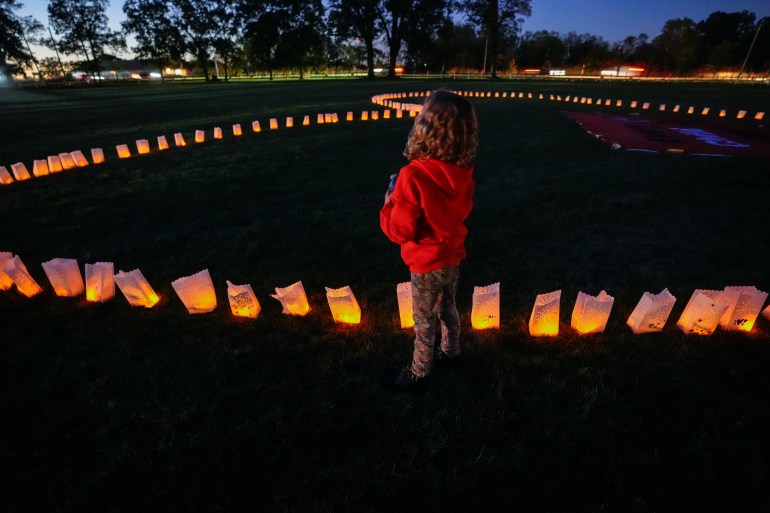
A child stands next to candles representing unmarked Indigenous child graves
A child stands next to candles during a vigil on Canada's first National Day for Truth and Reconciliation, in Ohsweken, Ontario, Canada [File: Carlos Osorio/Reuters]

Canada – An Indigenous community in Canada’s western province of British Columbia has found dozens of potential unmarked graves on the grounds of a former residential school, the latest such discovery over the past year.

Williams Lake First Nation announced on Monday that preliminary results of the first phase of a geophysical search at St Joseph Mission Residential School uncovered 93 “reflections” – believed to be unmarked gravesites.

“Ninety-three is our number,” Chief Willie Sellars told reporters.

KEEP READING


Fifth Estate

Records contain school narrative for Kamloops Indian Residential School

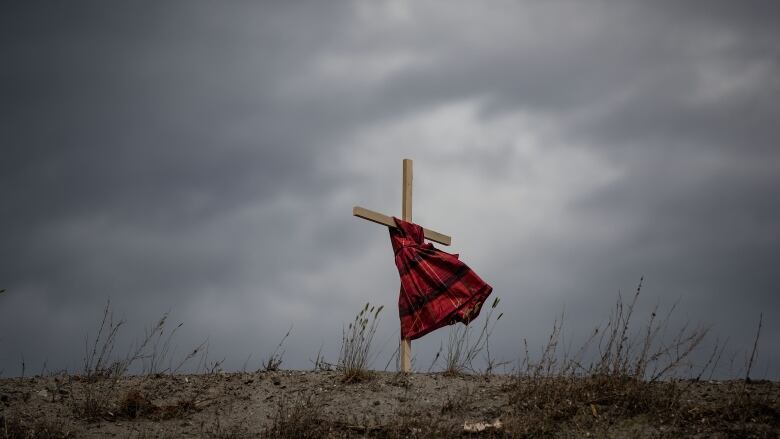
A child's dress hangs on a cross near the former Kamloops Indian Residential School. (Canadian Press/Darryl Dyck)

The leadership of Tk'emlúps te Secwépemc hopes to identify and locate missing children believed to be buried in unmarked graves near the former Kamloops Indian Residential School (IRS) with the help of previously undisclosed documents set for release by the federal government.

The federal government plans to transfer more than 875,000 records through a recently signed agreement with the National Centre for Truth and Reconciliation (NCTR), the archival repository for all of the material collected by the Truth and Reconciliation Commission.

Those files include the school "narrative" for Kamloops IRS, which summarizes the institution's history, including its administration, attendance record, key events and reports of abuse.

"We have to find answers," Tk'emlúps te Secwépemc Kukpi7 (Chief) Rosanne Casimir told CBC News.

"Access to the records means not having to re-traumatize ... residential school survivors to pinpoint information about who attended KIRS and who could possibly be in the unmarked graves."

Tk'emlúps te Secwépemc sent shockwaves around the world last May when it announced the preliminary findings from ground penetrating radar scans — 215 suspected graves of children near the site of Kamloops IRS.

Now, the community and residential school survivors are waiting for their chance to review these records for the first time, which could help piece together what happened at Canada's largest residential school. KEEP READING


 PLEASE WATCH

The Fifth Estate shows how a B.C. First Nation is dealing with the traumatic discovery of what are assumed to be the graves of children near a former residential school, as it tries to lead the way for other communities coping with a similar tragic history. 45:35

Monday, January 17, 2022

Records Could Shed Light on Canada Residential Schools for Indigenous Children, Settlements


 READ

Canada's Truth and Reconciliation Commission said in 2015 that it had identified about 3,200 deaths of indigenous children at the school... 

WATCH:

Canada’s Indigenous Services Minister discusses deals to settle child welfare claims

The federal government, First Nations organizations and class-action lawyers announced details of two agreements in principle that, if ratified, could end a nearly 15-year-old legal battle over the racist underfunding of child welfare services on reserves and in the Yukon. Indigenous Services Minister Patty Hajdu joins APTN National News to talk about the deal. 


Largest settlement in Canadian history: Feds release details of $40B deal

 SOURCE


The federal government has unveiled its $40-billion agreement in principle to provide compensation to First Nations children and their families harmed by an underfunded child welfare system and establish long-term reform.

As a result of the largest class action lawsuit in Canadian history, Ottawa will provide $20 billion to children on reserve and in the Yukon who were unnecessarily removed from their homes between April 1, 1991 and March 31, 2022. This extends to their parents and caregivers. Compensation will also be provided to those impacted by the narrow definition of Jordan’s Principle between Dec. 12, 2007 and Nov. 2, 2017.

Children who didn’t receive essential public services between April 1, 1991 and Dec. 11, 2007 will also be eligible for financial reparation.

The second half of the funding will go towards reform of the First Nations Child and Family Services Program, to be spread out over five years.

Approximately $20 billion will support young First Nations adults transitioning out of the child welfare system, as well as bolster prevention mechanisms to keep children at home, in their communities – work that’s expected to start in April, 2022.

KEEP READING 

**

Indigenous child welfare settlement leaves out Sixties Scoop survivors: advocate

Reaction to $40B settlement not all positive
A settlement that may become the largest ever in the history of Canada is raising concern among some over the specific date of April 1, 1991 being the cut-off point for Indigenous people to be eligible for compensation. Mark Neufeld reports.

By Mark Neufeld

Summary

  • Ottawa secured agreements in principle to compensate First Nations children harmed by its underfunding of child welfare
  • If the $40 billion agreement is approved, it would represent the largest settlement in Canadian history
  • But an advocate says the cut-off dates for the potential settlement excludes Sixties Scoop survivors

While welcoming an agreement in principle to compensate children harmed by Canada’s underfunding of child welfare, an Indigenous organization says it also excludes many Indigenous people – specifically Sixties Scoop survivors.

The federal Liberal government says of the $40 billion earmarked to be spent on the matter, $20 billion will pay for compensation and the other $20 billion will be spent on reforming the system over five years.

It says First Nations children living on reserve and in the Yukon who were removed from their homes between April 1, 1991, and Mar. 21, 2022, are set to be compensated, along with their parents and caregivers.

If the agreement is approved, it would represent the largest settlement in Canadian history.

But not everyone agrees with the cut-off dates for the potential settlement.

“I feel like they could have expanded it a little bit more to include those of us taken before 1991 and those of us taken off reserve,” said Katherine Legrange, the director of 60s Scoop Legacy of Canada.

“I think overall it’s a good thing, I just wish they had consulted with Sixties Scoop survivors and our families to include us if possible.”


RELATED:


The Sixties Scoop is when an estimated 20,000 Indigenous children were taken from their families and placed in non-Indigenous homes over a period of about three decades.

The Canadian government maintained it was acting in the best interests of the children.

Some survivors remain displaced and disconnected from families and their home communities to this day.

For First Nations children and families that are included in the settlement, Legrange cautions there could be a reopening of old wounds and relived traumas over the historical harms done to them.

She believes the guidance of First Nations elders and caregivers will be needed to prevent more pain as people come forward in the settlement.

“We need to, as Indigenous people, need to lead what that looks like,” said Legrange. “Have an advisory committee and figure out what’s the best way. How do we do this while mitigating the risks and harm to people?”


Sunday, October 10, 2021

Joe Buffalo short documentary: Indigenous People's Day

 WATCH NOW

Joe Buffalo, Indigenous Canadian Skateboarder Who Survived Ugly Residential School System

Skateboarder Joe Buffalo
NewYorker.com/Luminus Films
'Joe Buffalo' director Amar Chebib
Director Amar Chebib Luminus Films

It’s a curious fact that some of the most notable documentaries of recent years have revolved, in one or another, around skateboarding.

Minding the Gap, the 2018 documentary by Bing Liu, earned an Academy Award nomination for its story of Liu and two friends who gravitate towards skateboarding as an escape from difficult upbringings. Learning to Skateboard in a Warzone (If You’re a Girl), director Carol Dysinger’s 2020 film on a skateboarding school in Afghanistan that caters to girls, won the Oscar for Best Documentary Short Subject.

Skateboarding plays a central role in Joe Buffalo, a short documentary directed by Amar Chebib that’s a contender for Oscar consideration this year. The film centers on the eponymous Joe Buffalo, who was born to a family of Samson Cree heritage on the plains of Alberta, Canada. As a kid he saw a cousin pull off tricks on a board and became hooked himself.

Joe Buffalo
Joe Buffalo NewYorker.com/Luminus Films

“For me, skateboarding was definitely like a savior, given the circumstances of me growing up,” Buffalo says in the film, “having to deal with the cards I was dealt.”

The cards had to do with being raised in a country that dedicated resources to eradicating indigenous culture. At the age of 11, Buffalo was taken from his family and sent away to a residential school, an education system for indigenous children that persisted in Canada from the 1600s until the late 1990s. The system’s purpose was to reeducate children from a Christian point of view.

“They were boarding schools set up by the government and run by the church to destroy my people,” Buffalo says in voiceover in the film. “Kill the Indian and save the child.”

An estimated 150,000 First Nation, Inuit and Métis children were sent to the schools across the centuries.

“During the years that the system was in place, children were forcibly removed from their homes,” according to the Canadian government, “and, at school, were often subjected to harsh discipline, malnutrition and starvation, poor healthcare, physical, emotional, and sexual abuse, neglect, and the deliberate suppression of their cultures and languages.”

Once free of the schools, Buffalo resumed his skateboarding, reaching a skill level that set him up to go pro. But the trauma of the residential schools had produced psychic injuries. And when he did get the chance to become a professional, he felt unworthy—low self-esteem having been drilled into him. He spent much of his 30s coping with alcoholism and drug addiction, interrupted by bouts of incarceration.

The documentary follows its subject’s journey to sobriety and to fulfill his dream of turning pro. Chebib, a Syrian-Canadian, grew up skateboarding in the Middle East and met Buffalo back in 2005 in Montreal’s skateboarding scene. They reconnected more recently in Vancouver, where both now live, and the documentary project was born.

The New Yorker has released the film on its website in time for Indigenous People’s Day (the holiday still celebrated in some places as Columbus Day). Joe Buffalo has won numerous awards, including the audience award at SXSW and audience and jury awards at the Regard film festival in Saguenay, Québec and the Calgary Underground Film Festival.

American skateboarding legend Tony Hawk has joined the film as an executive producer. Hawk sent a message to Deadline about his support for the documentary, noting, “Joe Buffalo is an inspiring story of skateboarding as a means of escaping the trauma of the infamous Indian Residential School system.”

The residential schools were not only a Canadian phenomenon. The U.S. had its own system of Native American boarding schools, particularly in the American West, that served a similar purpose as their Canadian counterparts. They suppressed indigenous customs, language, tribal names, in favor of an assimilationist and Christian ideology.

There has been no Truth and Reconciliation Commission in the United States, but Canada formed one to interrogate the “paternalistic and racist foundations of the residential school system.” But the wounds run deep. In May, the latest mass grave was uncovered on the site of an Indian Residential School, this one in British Columbia. It contained the bodies of 215 children who were students at the school.

**

NEW YORKER story:

Growing up on the central Alberta plains, Joe Buffalo viewed his Samson Cree heritage as a source of pride: he could trace his bloodline, on his mother’s side, to Chief Poundmaker, a revered nineteenth-century Cree leader. At age eleven, he encountered a demoralizing reality of First Nations life. Like his parents and grandparents before him, he was shipped from his reserve to a residential school, one of many boarding institutions set up by the Canadian government to, as one early founder said, “kill the Indian in” indigenous children through Christian reëducation. First in Edmonton and then in Lebret, Saskatchewan, Buffalo endured stretches of up to a year away from his family and long days of assimilationist indoctrination. At night, he shared a living space with more than two hundred classmates stacked in bunk beds. He speaks about the experience in “Joe Buffalo,” a documentary short directed by Amar Chebib: “I could hear spirits in the walls from the dark history there. . . . It definitely fucked me up.”

Wednesday, September 22, 2021

Wawa to mark the National Day for Truth and Reconciliation #OrangeShirtDay

from unlearn.com

Wawa, Ontario | September 30th – Orange Shirt Day has been recognized by the Federal Government as the National Day for Truth and Reconciliation, a new statutory holiday. The Truth and Reconciliation Call to Action #80 states that the federal government will work with Indigenous people to establish a statutory day to “honour Survivors, their families, and communities, and ensure that public commemoration of the history and legacy of residential schools remains a vital component of the reconciliation process”. There are 94 Calls to Action.

In Wawa, the Town Hall and all municipal facilities will be closed and staff is encouraged to continue to expand their education as part of their individual reconciliation efforts.

Municipal Council notes that anyone who is interested in developing a better understanding can visit the Truth and Reconciliation Commission of Canada’s website, or use the Libby App to access digital books by Indigenous authors, such as “21 Things You May Not Know About the Indian Act” by Robert P.C. Joseph.

Other books that residents may find educating are:

  • Clearing the Plains – James Daschuk
  • The Inconvenient Indian – Thomas King
  • Seven Fallen Feathers: Racism, Death, and Hard Truths in a Northern City – Tanya Talaga

Residents may wish to visit these two websites:

  • Orange Shirt Day (www.orangeshirtday.org). Orange Shirt Day originates from the story of Phyllis Webstad from the Stswecem’c Xgat’tem First Nation. In 1973, on her first day at St. Joseph’s Residential School in Williams Lake, BC, Phyllis’s shiny new orange shirt was stripped from her, never to be seen again. 40 years later, on September 30th, 2013, Phyllis spoke publicly for the first time about her experience, and thus began the Orange Shirt Day movement.
  • National Centre for Truth and Reconciliation (https://nctr.ca). From September 27th to October 1st the NCTR will provide historical workshops, exclusive video content, and activities for students — all supported by artistic and cultural performances by First Nations, Métis, and Inuit artists.

A new broadcast special, National Day for Truth and Reconciliation, in partnership with APTN, CBC/Radio-Canada, Insight Productions and Canadian Heritage. In recognition of the new federal statutory holiday, also known as Orange Shirt Day, this unique one-hour, commercial-free primetime special honours the stories and perspectives of Indigenous Peoples affected by the tragedies of the residential school system in Canada, with musical tributes and ceremonies in Indigenous communities across the land. National Day for Truth and Reconciliation will broadcast and stream live Thursday, September 30 at 8 p.m. ET on APTN, CBC, CBC Gem, ICI TÉLÉ and ICI TOU.TV.

Additionally, the Wawa Goose Monument will be illuminated in orange on September 30th, to honour survivors of residential schools, along with their families and communities.

“Council has prioritized relationship building with our Indigenous neighbours,” said Mayor Rody. “We will continue to work with local Indigenous leaders to best determine how we can support their efforts and find opportunities to learn and highlight the First Nation roots of the community. Thank you to municipal staff for having the orange lights illuminating the Wawa Goose in honour and recognition of the residential school survivors and their families on September 30th. This is only a small part of recognition, and we have much more work to do.”

In June, the federal government passed legislation recognizing Sept. 30 as a federal holiday, a paid day off for federal workers and employees in federally regulated workplaces. On Sept. 9, the Ontario government confirmed that the day will not be a holiday for the province.

SOURCE

Thursday, September 2, 2021

Former residential school child-care workers say they wish the school had never existed...

Nancy Dyson and Dan Rubenstein worked at St. Michael's Indian Residential School on Vancouver Island in 1970 as child-care workers. They say after speaking out about neglect and abuse at the school to federal authorities they were fired the next day.

Saturday, July 17, 2021

Indigenous chief to Trudeau: Turn over residential school records

Experts say the graves at Kamloops Indian Residential School are only the beginning.

Tk'emlups te Secwepemc Chief Rosanne Casimir speaks ahead of the release of findings on 215 unmarked graves discovered at Kamloops Indian Residential School in Kamloops, British Columbia, Canada, July 15, 2021 [Jennifer Gauthier/Reuters]
Tk’emlúps te Secwépemc First Nation Chief Rosanne Casimir on Thursday called on Prime Minister Justin Trudeau and the Mission Oblates of Mary Immaculate to open their student attendance records “immediately and fully” so her community can identify the hundreds of children buried on the grounds of the Kamloops Indian Residential School.

Casimir said her community’s search has only just begun, and she asked the provincial and federal governments to contribute funding and resources to help her community continue the investigation, and protect children’s remains.

“To the Prime Minister of Canada Justin Trudeau, we’re still waiting for you to reach out to us to acknowledge the latest truths from the Kamloops Indian Residential School. I look forward to a fulsome conversation where we can finalise the details of the federal government providing the needed support as well as access to our student records,” said Casimir at a news conference in Kamloops, British Columbia.

From the late 1800s until 1996, Canada forced 150,000 Indigenous children to attend assimilation institutions called “residential schools”, where they were forbidden from practising their culture or speaking their language. Many were physically and sexually abused, and thousands are believed to have died.

In May, Tk’emlúps te Secwépemc was the first in the country to release a preliminary discovery of 215 Indigenous children buried in unmarked graves at the Kamloops Indian Residential School that were found using ground-penetrating radar.

In recent months, other First Nations have used the same technology to search residential school sites, bringing the total number of Indigenous graves to more than 1,000 — many of which were not included in historical records, or had headstones removed.

Searching for graves

On Thursday, experts said only two acres (0.8 hectares) of the 160-acre (65-hectare) residential school site have been searched with ground-penetrating radar. Sarah Beaulieu, the radar specialist who participated in the search, said she further analysed the probable grave sites and concluded that there are approximately 200 likely graves — not 215 as first reported.

“With ground-penetrating radar, we can never say definitively that they are human remains until you excavate,” she said. “They have multiple signatures that present like burials, but because of that we need to say that they are probable until one excavates.”

Beaulieu said survivors led the search because they knew there were graves at the site, adding that archaeologists found a juvenile tooth near the site in the late 1990s or early 2000s, and a tourist found a child’s rib bone in the same area in the 2000s.

She said it was likely the graves contained children’s remains. “The majority of the anomalies were between 0.7 and 0.8 metres (27.5 and 31.5 inches) below the surface, which is fairly shallow, and it fits with the knowledge keepers’ descriptions of children having to dig graves, for one. It also fits with when you have a juvenile burial, because they are smaller in length, they typically are not dug as deeply.”

Beaulieu said no graves have been excavated yet. It is not clear when or if an excavation will happen.

“We are here today because of Indian Residential School survivors and intergenerational survivors who were unrelenting in carrying those painful truths about missing children forward,” Casimir said. She said survivors witnessed abuse and were required to dig graves, and it is because they spoke their truth that her community can verify where children are buried.

The Truth and Reconciliation Commission (TRC), a years-long process documenting survivors’ stories, confirmed 4,100 children who died in the institutions – from abuse, neglect, disease, fire, and from exposure after running away.

But the full scope of how many children died, and the causes of their deaths, is still unknown. According to the TRC, it was not until 1935 that the government adopted a formal policy on how to report and investigate deaths at the institutions. The commission found that, for half of the recorded deaths, the government did not include the cause of death.

More than 7,000 survivors of the institutions testified before the TRC. In its final report (PDF), the commission concluded the practice was cultural genocide, and that Canada had “set out to destroy the political and social institutions” of Indigenous people with a goal of seizing land.

According to the UN, the policy of forced assimilation institutions was popular all over the world — in Canada, the United States, Latin America, Australia, New Zealand, Asia, Russia, Scandinavia and East Africa — because it was cheaper than waging war against Indigenous people.

Survivors’ stories

During the news conference, survivors of the Kamloops institution shared their stories.

Mona Jules said her 13-year-old sister became sick and passed away at the Kamloops institution, but her parents were not notified until after her death. “They wanted to know, why wasn’t she taken to a doctor, to the hospital? It was right across the bridge,” she said. “There were no answers.”

Residential school survivor Mona Jules takes part in a presentation of the findings on 215 unmarked graves discovered at Kamloops Indian Residential School in Kamloops, British Columbia, Canada, July 15, 2021 [Jennifer Gauthier/Reuters]

Jules said she and other children were beaten for speaking their Indigenous language. She is still fluent and has spent her life teaching it to anyone who wants to learn.

“I’ve spent years trying to revive what that school has snuffed out. And it’s working — we have many of our young people who speak it and they’re running language departments, having meetings in the language, speaking it to one another. I still work with them, when I can, and I’ll continue to do that for as long as I can.”

Source: Al Jazeera
 

What will a US probe into Indigenous boarding schools uncover?

Government to study troubled legacy of forced assimilation policies. 13 Jul 2021


Happy Visitors!

WRITTEN BY HUMANS!

WRITTEN BY HUMANS!

Blog Archive

Featured Post

Your History Class Was a F*cking Lie | #NOMOAR

  Your History Class Was a F*cking Lie by Sean Sherman (Or: How the American Educational System Has Always Been a Racist Propaganda Program...


Native Circles

Native Circles
click logo for podcasts!

Most READ Posts

Bookshop

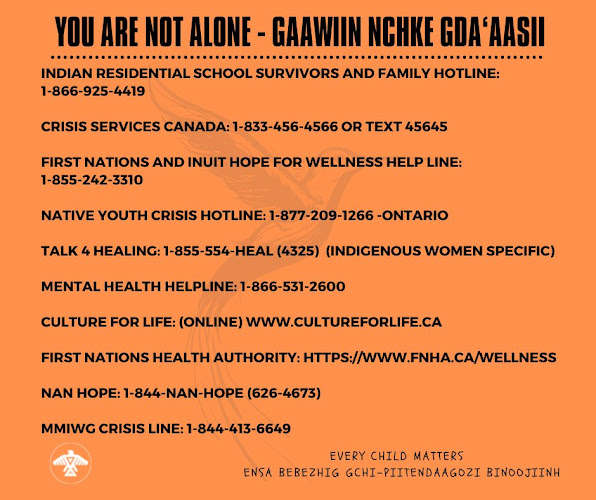
You are not alone

You are not alone

To Veronica Brown

Veronica, we adult adoptees are thinking of you today and every day. We will be here when you need us. Your journey in the adopted life has begun, nothing can revoke that now, the damage cannot be undone. Be courageous, you have what no adoptee before you has had; a strong group of adult adoptees who know your story, who are behind you and will always be so.

Diane Tells His Name


click photo

Lost Birds on Al Jazeera Fault Lines

Lost Birds on Al Jazeera Fault Lines
click to read and listen about Trace, Diane, Julie and Suzie

NO MORE STOLEN SISTERS

NO MORE STOLEN SISTERS
click image

ADOPTION TRUTH

As the single largest unregulated industry in the United States, adoption is viewed as a benevolent action that results in the formation of “forever families.”
The truth is that it is a very lucrative business with a known sales pitch. With profits last estimated at over $1.44 billion dollars a year, mothers who consider adoption for their babies need to be very aware that all of this promotion clouds the facts and only though independent research can they get an accurate account of what life might be like for both them and their child after signing the adoption paperwork.

Original Birth Certificate Map in the USA

Google Followers