Where They Stand: The Parties on Indigenous Child Welfare
It’s been five years since a tribunal ruled that Canada discriminates against First Nations kids. Advocates still await change.
Cindy Blackstock doesn’t know why Liberal Leader Justin Trudeau lied about taking First Nations kids to court during the leaders’ debate last week. But Blackstock, the executive director of the First Nations Child and Family Caring Society, is “really sad” he did.
Especially when there is over 14 years of evidence
— including court transcripts, news articles and 20 non-compliance
orders from the Canadian Human Rights Tribunal — to the contrary.
“They have every legal right to litigate
against our kids. I think it’s morally wrong — and it’s bad for the
country — but they’ve chosen to do it,” said Blackstock of the
government’s Federal Court case arguing against a tribunal ruling that
First Nations children and families impacted by the child welfare system
should be compensated.
“What they don’t have a right to do is then lie about it to protect themselves from accountability for their own behaviour.”
Blackstock would know:
along with the Assembly of First Nations, her organization took the
federal government to the Canadian Human Rights Tribunal in 2008 over
its systemic underfunding of child welfre on reserves.
In 2016, the tribunal issued its ruling:
the federal government had been knowingly underfunding services for
165,000 First Nations kids and their families for decades. The tribunal ordered the government to stop its discriminatory practices.
More than 50 per cent
of children in government care in this country are Indigenous, despite
representing fewer than 10 per cent of all children. The majority are
First Nations children taken into care for “neglect,” which child
welfare researchers say is another word for poverty.
In 2019, the tribunal declared
the government must pay $40,000 — the maximum the tribunal can award —
to every First Nations child removed from their family since 2006. Their
guardians before the children were taken into care are entitled to
$20,000.
The tribunal also awarded $40,000 to every
First Nations child denied federal medical coverage between 2007 and
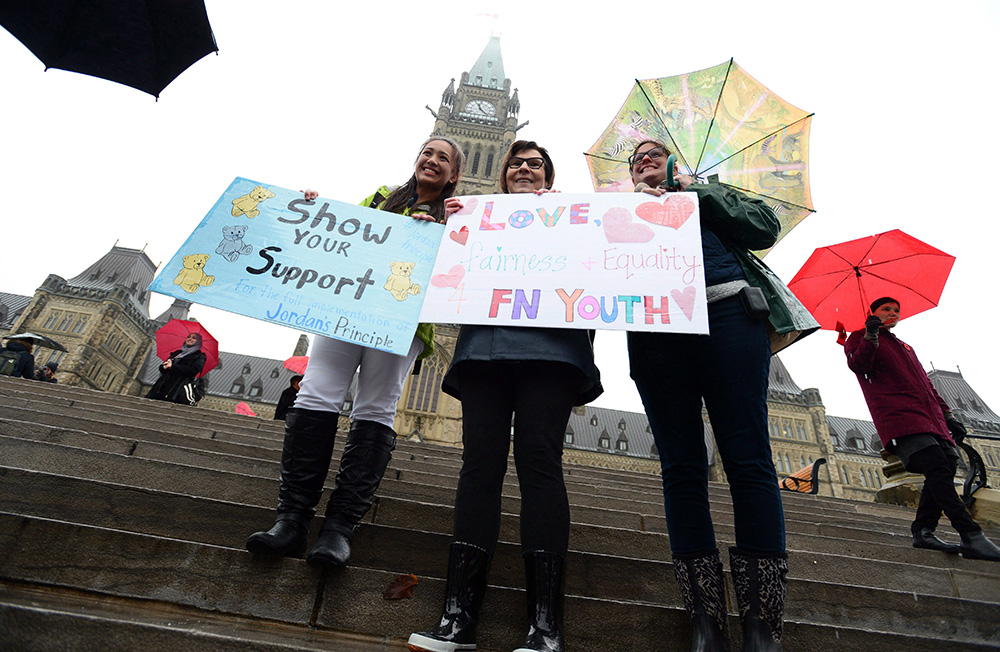
2017, citing Jordan’s Principle, a 2007 policy that governments should
pay the medical bills of any First Nations child, on or off-reserve.
But two weeks before the 2019 election, government lawyers requested a judicial review of the compensation orders.
Hearings were held in Federal Court in June, less than a month
after the Tk’emlúps te Secwe̓pemc Nation announced the rediscovery of
215 bodies on the grounds of the former Kamloops Indian Residential
School.
The Federal Court’s ruling is expected at any time.
The government also took issue with the tribunal’s 2020 declaration
that all children with Indian Act status; eligibility for status; or
parents or guardians who have status, live on-reserve and whose First
Nation acknowledges their membership — are covered by Jordan’s
Principle.
The federal government argued before the
court that only children with status under the Indian Act — a racist
Canadian law that determines First Nations’ band membership — should be
covered.
The Liberals have tried to respond to Canada’s child welfare crisis. In 2018 they released a six-point plan
to reform child welfare, including implementing the tribunal’s ruling
and working with Indigenous leaders to re-establish jurisdiction over
child welfare.
In January 2020, the federal Act Respecting
First Nations, Inuit and Métis Children, Youth and Families became law,
starting the process to return jurisdiction to Indigenous communities.
But it did not come with funding, and a year and a half later the
federal government has yet to release a funding plan.
In B.C., a working group on child welfare and family services was established
by the provincial and federal governments, the BC Assembly of First
Nations, the Union of BC Indian Chiefs and the First Nations Summit.
Assembly Regional Chief Terry Teegee said
that three of the 198 First Nations in the province are close to
reclaiming their inherent jurisdiction over child welfare, though a
federal funding commitment is needed.
“It’s always a work in progress, and I
certainly know that a lot of these changes weren’t going to happen
overnight,” Teegee said, adding the assembly is also waiting on
provincial child-welfare jurisdiction legislation.
“We can’t let up. We need to continue on to
allow our First Nations to take their rightful place in asserting their
jurisdiction and their ability to express their sovereignty and
self-determination in terms of children.”
The Splatsin of the Secwe̓pemc Nation is
one of the three nations. It was close to signing a child welfare
co-ordination agreement with the federal government before it was
scrapped due to the election.
But despite how close they were, Splatsin
Kukpi7 (Chief) Wayne Christian said the process has been frustrating, in
part because the federal government has approached transferring child
welfare jurisdiction like it is creating a new federal program.
“It’s beyond belief that you have a whole number of bureaucrats staffing up to offer this program,” he said.
No matter which party forms government,
Christian said, the main stumbling block to re-establishing jurisdiction
are the bureaucrats who have worked in the departments dedicated to
Indigenous affairs for decades.
“They have a certain culture of how to
operate with ‘the Indian problem’ and they’re still acting like Indian
agents, except there’s a multitude of them now,” he said.
“It’s the bureaucracy that makes things
happen, and they’re very slow to react to what we actually need to
happen. They deny, delay and distract, that’s what they do.”
READ MORE











 Posts
Posts

