They Took Us Away

They Took Us Away
click image to see more and read more

it's free

click

How to Use this Blog

BOOZHOO! We've amassed tons of information and important history on this blog since 2010. If you have a keyword, use the search box below. Also check out the reference section above. If you have a question or need help searching, use the contact form at the bottom of the blog.


We want you to use BOOKSHOP to buy books! (the editor will earn a small amount of money or commission. (we thank you) (that is our disclaimer statement)

This is a blog. It is not a peer-reviewed journal, not a sponsored publication... WE DO NOT HAVE ADS or earn MONEY from this website. The ideas, news and thoughts posted are sourced… or written by the editor or contributors.

EMAIL ME: tracelara@pm.me (outlook email is gone) THANK YOU CHI MEGWETCH!

SEARCH

Showing posts with label Aboriginal Child Welfare. Show all posts

Wednesday, July 7, 2021

'One day there will be no children in care,' says Cowessess Chief after historic child welfare deal inked

 Agreement signed in ceremony on Saskatchewan First Nation Tuesday

Cowessess First Nation Chief Cadmus Delorme said he hopes to see the day when there are no local children in care. (Matthew Howard/CBC)

WARNING: This story contains distressing details

Cowessess First Nation in Saskatchewan is the first Indigenous group in Canada to ink an agreement with Ottawa for federal funding of locally controlled child welfare services since the Act Respecting First Nations, Inuit and Métis Children, Youth and Families came into force last year. 

But Cowessess First Nation Chief Cadmus Delorme is already looking to the future. 

"One day there will be no children in care," he said at a ceremony on the reserve marking the pact Tuesday. 

"[I'm] 39 nine years old and I hope that happens in my lifetime. But we have a lot of work to do."

WATCH | 'We are gaining control,' Cowessess First Nation Chief Cadmus Delorme says: 

Work to be done on healing and growing for Cowessess First Nation

Chief Cadmus Delorme shared his hopes for the future of Cowessess First Nation, but stated that the community would need to 'roll up our sleeves' to turn hope into reality.

The act allows for First Nations to assume authority over local child welfare systems under so-called co-ordination agreements and paves the way for children in care to remain in their home communities. 

Cowessess First Nation is the first Indigenous group in Canada to sign such an agreement. The deal also comes with $38 million in funding over the next two years to support the band's further implementation of its own child welfare system, which actually began operating in April. 

"Across the country, we are working with other First Nations to reach similar agreements," said Prime Minister Justin Trudeau, who joined Delorme and Saskatchewan Premier Scott Moe for the ceremony.

WATCH | Justin Trudeau signs local child welfare pact with Cowessess First Nation: 

Trudeau signs child welfare agreement with Cowessess First Nation

VIDEO: Prime Minister Justin Trudeau visited Cowessess in southeastern Saskatchewan on Tuesday.

As of last month, Indigenous Services Canada received requests from 38 bodies representing 100 Indigenous groups and communities who want to follow in the same footsteps as Cowessess First Nation, according to a news release

Eighteen formal discussion groups focused on signing future agreements are now underway.

Trudeau did not cite a goal or timeline for finalizing those pacts.

'Intergenerational trauma is very real'

Cowessess has not had decision-making power over children in care since it was stripped of it in 1951, according to a letter distributed by Delorme on Monday. 

More than 80 per cent of children in care in Saskatchewan are Indigenous, according to a 2018 children's advocate report

That began to change with 2019's passage An Act Respecting First Nations, Inuit and Métis Children, Youth and Families, federal legislation aimed at reducing the number of youth in care and allowing communities to create their own child-welfare systems. 

Cowessess did that in 2020, when it asserted its inherent rights over its children and families. 

While noting the recent discovery of 751 unmarked graves associated with the former Marieval Indian Residential School, Trudeau said his government has been working with Cowessess on the child welfare funding agreement for years.

Moe said it's no surprise Cowessess is the first Indigenous community in Canada to reach such an agreement. 

"This is a progressive community [that] leads in so many other areas," he said.

Saskatchewan Premier Scott Moe lauded Cowessess for its progressiveness. (CBC)

The First Nation nation has opened a transition home for girls 14 and up.

Mia Buckles, chair of the Cowessess Youth Council, joined other speakers in linking the legacy of residential schools with the current situation of children in care. 

"First Nations intergenerational trauma is very real," she said. "I recognize that in my life and others lives around me. It plays a huge role in why so many of our people end up in foster care, incarcerated, addicted and uneducated."

Mia Buckles, the chair of the Cowessess Youth Council, said a local transition home will help efforts to reduce the number of children in care. (CBC)

Buckles said the transition home, Chief Red Bear Children's Lodge, will work proactively to prevent children from ending up in care in the first place. 

Funding to address root causes also needed: advocate

Cindy Blackstock, executive director of the First Nations Child & Family Caring Society of Canada, applauded Tuesday's agreement.

"The closer authorities are to the children, the better the outcomes are going to be, because they'll be able to see their needs and monitor those needs and respond to them over time and culturally appropriate ways," she said.

Advocate Cindy Blackstock says Ottawa also needs to fund efforts to address the reasons Indigenous children wind up in care. (CBC)

But Blackstock cautioned that federal funding is also needed to address the underlying socio-economic factors that land Indigenous children in care in the first place.

Those factors include poverty, housing, substance abuse and mental health issues related to residential school trauma, she said. 

"Unless the federal government is also announcing sufficient funding for that, then what we'll have is a child welfare program — a quality one, culturally appropriate — sitting atop this raging fire of inequality that is going to disable the community from being able to realize the goals they wish to realize with these kids."


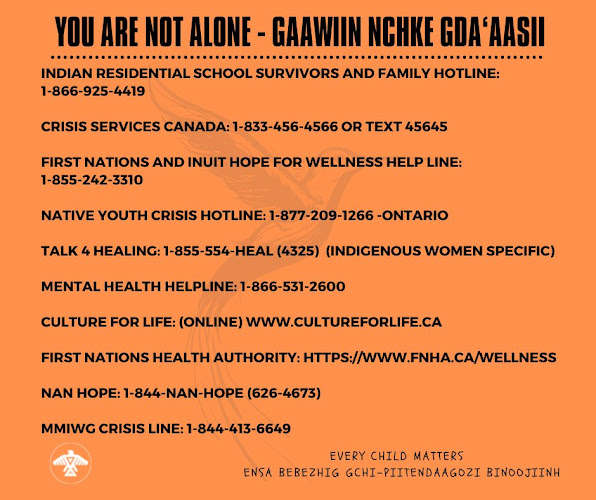
Support is available for anyone affected by their experience at residential schools, and those who are triggered by the latest reports.

A national Indian Residential School Crisis Line has been set up to provide support for former students and those affected. People can access emotional and crisis referral services by calling the 24-hour national crisis line: 1-866-925-4419.

Saturday, April 14, 2018

Too many black, Indigenous kids in Ontario child-welfare system, report finds


Called Interrupted Childhoods: Over-representation of Indigenous and black children in Ontario child welfare, the report calls on child welfare authorities to examine whether they are engaging in practices that might violate human rights rules.The Ontario Association of Children's Aid Societies said it was undertaking initiatives to address the issues.
"Historical and current child welfare practices have resulted in over-representation of Indigenous children in child welfare," Mary Ballantyne, the association's CEO, said in a release. "Those practices have also led to cultural genocide for the Indigenous people of Ontario."Ballantyne also said the over-representation of African-Canadian children was unacceptable.
Source: Too many black, Indigenous kids in Ontario child-welfare system, report finds | CBC News

Thursday, October 15, 2015

BC Premier’s office site of native protest over child welfare

 Splatsin Chief Wayne Christian and Chief Stewart Phillip of the B.C. Indian Chief's Union speak to a small crowd of protesters Tuesday outside B.C. Premier Christy Clark's office in West Kelowna. Contributed/ Global Okanagan
Splatsin Chief Wayne Christian and Chief Stewart Phillip of the B.C. Indian Chief’s Union speak to a small crowd of protesters Tuesday outside B.C. Premier Christy Clark’s office in West Kelowna.
Contributed/ Global Okanagan


, Global News, Oct 13, 2015

WEST KELOWNA, B.C. – Protesters gathered at Premier Christy Clark’s constituency office Tuesday afternoon in support of aboriginal child welfare rights.

About 50 members of Okanagan aboriginal communities, including the Splatsin Nation from Enderby, chanted and drummed at the protest. They are concerned about the province taking care of their children instead of being care for by First Nations.

The Splatsin Indian Band and Chief Wayne Christian are suing the B.C. government, looking to have their right to self-govern their social welfare enforced by the courts. The B.C. government granted aboriginal communities jurisdiction over their own child welfare on this date in 1980.

Christian says their agreement has not been fulfilled.

“The grandparents and parents, aunts and uncles don’t have “a legal right” to the child, that’s what the minister says,” says Christian. “No. Our system is different than yours. They have a right to be there for that child.”

“Their system is not working,” says Christian of the B.C. Ministry of Children and Family Development, which operates on a $1.39 billion annual budget. “It’s failing our children and families miserably and they’ve got to change what they’re doing.”

Christian says more than half of B.C. foster children are aboriginal, but First Nations communities receive no funding to manage social welfare as they see fit.

“It’s going to be enough when we can take care of our own, bottom line,” he says. “It’s not about money. People think it’s about money. It’s the ability to look after our own laws and our own processes.”

The B.C. government has yet to file a response to the Splatsin lawsuit filed in B.C. Supreme Court in Vancouver on Tuesday.

Christian says they are planning province-wide protests in November.
http://globalnews.ca/news/2275302/premiers-office-site-of-native-protest-over-child-welfare/

Friday, October 9, 2015

Closing the Circle

British Columbia cannot continue to do child and family welfare on the cheap.

The B.C. Liberal government has failed to prioritize proper funding for services and supports for vulnerable children and their families for the last decade.
Budget numbers speak for themselves. Since 2008, Ministry for Children and Family Development (MCFD) funding has been cut by $44 million, before inflation.
In 2004/05, spending per capita on child, youth, and family services in B.C. was $360. Today, it’s $287 – a cut of more than one-fifth – even as the consumer price index rose by 17.3% during the same period.

Yet B.C. is experiencing increasing demand for child, youth, and family services.

Every year, MCFD provides services to around 155,000 children and youth and their families—or about 17% of BC’s population under age 18. The province’s child and youth population is projected to grow by an estimated 27,000 over the next five years.

The complexity of support needs required continues to increase because of persistent high childhood poverty, increased diagnoses of complex physical and mental health disorders for at-risk children and youth, and the unfortunate over-representation of Aboriginal youth in B.C.’s social welfare system.

Solution: Increase funding to child, youth and family services in the short and long term to address staffing and other concerns

At minimum and in the short term, government should restore $44 million in MCFD funding cut between 2008/09 and 2013/14, and adjust this amount for inflation.

Tell Christy Clark to Choose Children Read the report

Wednesday, October 7, 2015

REPARATIONS: US should follow Canada’s lead, reckon with its own destructive legacy


Canada confronts ‘cultural genocide’ against aboriginal people

June 16, 2015 | Al Jazeera America

On May 31 the Truth and Reconciliation Commission of Canada (TRC) released a summary of its report on the history and legacy of the nation’s residential schools. The report concluded that Canada’s aboriginal policy, designed “to eliminate aboriginal governments … and cause aboriginal peoples to cease to exist as distinct legal, social, cultural, religious and racial entities in Canada,” has caused unspeakable and enduring suffering that amounts to “cultural genocide.”

The U.S. also had a shameful program of residential schools for its Native American children, often operated by churches with government funding. A reckoning for the destructive legacy of forced assimilation is long overdue. It’s time for the U.S. to follow Canada’s lead in establishing a truth and reconciliation commission and acknowledge the havoc its policies have wrought.

Canada’s legacy

Started in the 1880s, the schools were funded by Canadian government but run primarily by churches. An estimated 150,000 aboriginal children attended the residential schools during their century-long tenure. But the goal was never to educate the children. Instead, the schools were designed to destroy aboriginal culture by removing children from reservations and severing ties with parents and communities, in order to inculcate ‘civilized’ and Christian values. The last residential school closed in 1998, but the aftereffects continue to exact a devastating toll today. This is true not only for those haunted by their stay at the schools but for the entire community of aboriginals whose culture and systems of government were targeted for annihilation.

Many of the 80,000 survivors recounted their harrowing tales of forced separation from their communities and brutal physical, sexual and psychological abuse to the Commission. And the TRC found that more than 3,000 aboriginal children perished in the in residential schools from abuse, neglect and illness. Justice Murray Sinclair, chair of the TRC, estimated that the figure could be far higher, since shoddy record keeping obscured the Commission’s final accounting.

The TRC was formed as part of the 2006 Indian Residential Schools Settlement Agreement, in the largest class-action lawsuit in Canadian history. In 2008, Prime Minister Stephen Harper acknowledged and apologized for the harm caused by Canada’s residential schools. But he has refused to commit to implementing the Commission’s 94 recommendations, including provisions for health, education, justice and commemoration. Canada cannot simply close this sordid chapter and move on. Instead, it must enact policies and programs that would ensure aboriginal communities have the support, tools and resources to heal and thrive.
The grave injustices of North American residential schools and their aftermath are clear. But seeking and speaking the truth is only the beginning of a long process of reconciliation.

Kill the Indian in him, and save the man,” Richard Pratt, a U.S. Army officer who pioneered the concept of off-reservation boarding schools opined in an oft-quoted 1892 speech. At the time, Pratt’s goal of cultural rather than physical genocide, though despicable, was less extreme for its time than that of others who advocated for the outright extermination of the nation’s native people.

But, as in Canada, the U.S. schools served their intended purpose of demolishing Native American traditions and history. Thousands of children died from abuse, neglect and malnutrition. Others were harshly punished for residual ties to their culture or spirituality. And the schools often pushed boys toward manual labor and girls to domestic service. As a 2009 United Nations report concluded, instead of working toward full integration “the training prepared Native children to be assimilated into the bottom of the socio-economic ladder,” where many continue to struggle.

The historical trauma inflicted on parents can haunt subsequent generations. Researchers found stress hormone adaptations in the children of Holocaust survivors, perhaps caused in utero, that may predispose them to ill health. And the effect is not limited to environmental factors: it may actually be woven into DNA. This trauma may partly explain the social ills that continue to plague Native communities both in the U.S. and Canada, including high rates of addiction, mental illness, domestic and sexual violence, family disintegration and poor physical health. Reservations in the U.S. experience suicide epidemics, and though the reasons are not clear, there is agreement that one of the factors is “the legacy of federally funded boarding schools that forcibly removed generations of Native American children from their homes,” according to The New York Times.

Need for reparations

The U.S. has made some efforts to end its history of forced assimilation.  For example, in 1978 Congress passed the Indian Child Welfare Act to keep Native American children with their families or communities. But nearly 40 years later, the law has failed to meet its mark, and Native American children are still being fostered and adopted into communities that fail to reflect their cultural heritage. Last month a commission in Maine found that the state placed five times as many Native American children in foster care as non-native children. Maine is hardly alone: In 2013, advocates in Nebraska linked a spike in the number of the state’s Native American children in foster care to the legacy of boarding schools. And placement of children within their communities for fostering and adoption is hampered in part by lack of appropriate homes.

That shortage, which reflects the damage inflicted by governmental policy, reinforces the need for comprehensive reparations to heal and rebuild damaged communities. The specifics of a reparations package must be crafted and embraced by Native American groups. It would likely include individual and collective restitution, restoration and truth telling.

The grave injustices of North American residential schools and their aftermath are clear. But seeking and speaking the truth is only the beginning of a long process of reconciliation. Both Canada and the U.S. must commit to atoning for the schools’ horrors by expending political capital and economic resources to help Native communities truly recover.


Lauren Carasik is a clinical professor of law and the director of the international human rights clinic at the Western New England University School of Law. 

Sunday, October 4, 2015

CBC 8th Fire: Profile: Cindy Blackstock

Advocate for Aboriginal Children:

CindyBlackstock_400b.jpgAs a child in rural, northern BC, Cindy Blackstock came to understand that "there were two things you did not want to be; a Communist, (though I was never sure what that was), or an Indian."

Her mother was of European descent, her father Gitxsan First Nation. "It just felt like the world was a lot colder if you were perceived as being a First Nations person, and that there was a cap on what you could do with your life. "

Blackstock defied those limitations. She is the Executive Director of First Nations Child and Family Caring Society of Canada.
For more than two decades she has been one of the country's most committed activists for First Nations children.

"We have never had more First Nations children in child welfare care than we do at this moment " she says.

"In provinces like Alberta, 65% of the kids in that province are First Nations who are in child welfare care, even though they represent well under 10% of the population. In B.C. 53%. So if you take those two provinces alone, we're talking about 11,000 First Nations children living in foster care," Blackstock says.

"We too often think neglect is a failure of the parents. It assumes you have all the resources to parent and you're just not doing it. Well, there's another form of neglect when you are on a reserve and you have no water, no hydro. You're paying $23.99 for a jar of Cheese Whiz at the store. And you have under-funded child welfare and you have under-funded education. And you're doing what you can as a parent. "

Blackstock has been recognized with many awards, including an Aboriginal Achievement Award for her work.
Watch in interview with Cindy Blackstock.

Saturday, August 8, 2015

Child Advocate Cindy Blackstock awarded damages


Cindy Blackstock awarded $20,000 in human rights ruling against Harper Government


Ottawa Canada – June 2015 –  SOURCE

Dr. Cindy Blackstock, an Aboriginal child welfare advocate and President of the First Nations Child and Family Caring Society, has been vindicated by a recent ruling from the Canadian Human Rights Tribunal, which found that a federal government official "retaliated" against her for advocating views that are contrary to those of the Harper Government.

The Tribunal has ordered the Department of Aboriginal Affairs to pay $20,000 to Dr. Blackstock for pain and suffering due to the behaviour of David McArthur, a senior government bureaucrat and former special assistant to then-Minister of Aboriginal Affairs Chuck Strahl. The dispute stems from a 2009 incident in which Mr. McArthur barred Dr. Blackstock from a gathering with First Nations chiefs from Ontario. Blackstock has also been the subject of federal government surveillance due to advocacy for First Nations children's rights.

"I was shocked when I realized that in a democracy such as Canada our federal government thinks it is right to violate the privacy of citizens who have a view that is different from theirs," Blackstock said in an interview. "By simply working towards a more fair and just Canada for all children, it seems that the federal government targeted me as a person of concern. We have to ask ourselves 'who else is being targeted and for what purpose?'"

For years, Dr. Blackstock has been a central figure in a long-standing battle with the federal government over aboriginal child welfare. She plans to donate the money that she has been awarded to various children's charities.

The First Nations Child and Family Caring Society (FNCFCS) is the only national organization serving Aboriginal children and families in Canada. As national partners, UFCW Canada and FNCFCS are actively collaborating on projects to advance equality, diversity, education, and social and economic justice for First Nations children, youth, and families.

Wednesday, August 27, 2014

Momentum builds for gathering of aboriginal adoptees

Gathering for people who were adopted or lived in foster care as children

CBC News Posted: Aug 21, 2014
Lesley Parlane
Lesley Parlane, one of the organizers of an upcoming gathering for aboriginal adoptees was in Regina to talk about the event. (CBC)


An upcoming gathering of aboriginal people who were adopted or lived in foster care as children is gathering momentum as organizers visited Regina to talk about their plans.
The event, set for Ottawa, is called the Indigenous Adoptee Gathering 2014 and takes place Sept. 20 to 21.
One of the organizers of the event is Lesley Parlane, who was adopted as a small child.
Parlane says the idea for the gathering arose when she and other friends, who were also adopted, discovered they had many things in common because of that background and felt that sharing their experiences and providing support could be valuable.
She said she wishes such a community was available to her, as she was growing up.
"It would have been good to get together with people like me," Parlane said. "My experience wasn't bad but it wasn't good either, but everybody had a different experience but where do you go with that?"
The gathering will offer a variety of healing circles, workshops, and talks by people who have also been adopted.
Parlane explained that she learned much about her own history - and family connections - when, as an 18-year-old applying to get her Status Indian documents, she was contacted by a Saskatchewan First Nation and told they had various records relating to her adoption and news that she had a number of sisters who had been looking to find her.
It was a lot of information to process all at once, Parlane said and it took several years for her to feel comfortable delving into her family history. Now she says, she has been visiting family on the Standing Buffalo First Nation on a regular basis for the past three years.
She is hoping the upcoming gathering will help others who may be facing similar situations.
The Ottawa event has enough room for 80 participants and is just over half full.

More information about the event is available on a Facebook page and online, through this link.

Saturday, November 30, 2013

Private eyes to hunt for residential school abusers

The federal government intends to hire private investigators to track down the alleged perpetrators of residential school abuse.

A First Nations woman cheers while taking part in the Walk for Reconciliation in Vancouver, B.C., on Sunday September 22, 2013. Thousands of people attended the walk that wrapped up a week Truth and Reconciliation Commission of Canada events in the city. From the 19th century until the 1970s, more than 150,000 aboriginal children were required to attend state-funded Christian schools in an attempt to assimilate them into Canadian society. They were prohibited from speaking their languages or participating in cultural practices. The commission was created as part of a $5 billion class action settlement in 2006 - the largest in Canadian history - between the government, churches and 90,000 surviving students.
Darryl Dyck / The Canadian Press
A First Nations woman cheers while taking part in the Walk for Reconciliation in Vancouver, B.C., on Sunday September 22, 2013. Thousands of people attended the walk that wrapped up a week Truth and Reconciliation Commission of Canada events in the city. From the 19th century until the 1970s, more than 150,000 aboriginal children were required to attend state-funded Christian schools in an attempt to assimilate them into Canadian society. They were prohibited from speaking their languages or participating in cultural practices. The commission was created as part of a $5 billion class action settlement in 2006 - the largest in Canadian history - between the government, churches and 90,000 surviving students.

OTTAWA—The Canadian government intends to hire private investigators to track down alleged perpetrators of abuse in the Indian residential school system.

Aboriginal Affairs and Northern Development Canada is seeking private eyes to track down as many as 1,000 clergy members, former residential school staff, and students alleged to have abused Aboriginal children in the residential school system.

The goal is to give the alleged perpetrators an opportunity to participate in a court-ordered adjudication process known as the Independent Assessment Process (IAP), which helps residential school survivors settle claims for the abuse they endured.

Once located, the former residential school employees will be given the chance to voluntarily participate in the IAP.

“Canada is obligated to make an effort to locate and contact persons named as alleged perpetrators in claims filed in the (IAP),” wrote Andrea Richer, spokeswoman for Aboriginal Affairs Minister Bernard Valcourt, on Thursday.

Richer emphasized that participation is voluntary.

“It is the choice of the alleged perpetrator to participate or not in the IAP process.”

The federal government is required to locate the alleged perpetrators under a settlement agreement reached with Aboriginal groups in 2006. The hunt will take investigators from Nova Scotia to British Columbia and throughout Canada’s North.

Investigators will be asked to locate between 800 and 1,000 of the alleged perpetrators in the first year of a potential four-year contract. Once their targets have been located, investigators will turn over contact information to Aboriginal Affairs. In the event those named in survivors’ claims have died, investigators will be asked to provide proof.

Related stories

It’s not the first time the federal government has deployed private investigators to attempt to locate those named by residential school survivors, but the numbers suggest there are many Ottawa has yet to find.

It’s been estimated that 150,000 children were wrenched from their family homes and put into the federally-funded, church-run residential school system between the 1870s and the 1990s.
Approximately 13,000 former students took legal action against churches and the government for the emotional, physical and sexual abuse, as well as the underpinning systematic racism, they endured in the residential school system.

In June 2008, Prime Minister Stephen Harper stood in the House of Commons to formally apologize for the government’s role in perpetuating the school system.

“To the approximately 80,000 living former students and all family members and communities, the Government of Canada now recognizes that it was wrong to forcibly remove children from their homes, and we apologize for having done this,” Harper said.

“The burden of this experience has been on your shoulders for far too long. The burden is properly ours as a government, and as a country. There is no place in Canada for the attitudes that inspired the Indian residential schools system to ever again prevail.”

The apology was the high-water mark for relationship between First Nations and the Conservative government. That relationship is now strained on a myriad of fronts, spectacularly demonstrated by 2012’s Idle No More protests across the country.

First Nations have also pressed, to no avail, for a commission into missing and murdered aboriginal women. Many, including the Assembly of First Nations, have also lined up to oppose federal plans for new education standards on reserves. AFN Chief Sean Atleo has likened the planned First Nations Education Act to an intrusion into First Nations affairs akin to the residential school system.
The government has also been criticized — most recently by a report from Auditor General Michael Ferguson — for not cooperating with the Truth and Reconciliation Commission, mandated to compile a complete historical record of the residential school system’s legacy.

“Are whoever the contract winner is going to have access to documents identifying some of these perpetrators? These are documents that the Truth and Reconciliation has to go to court to get,” said Jean Crowder, MP for Nanaimo-Cowichan and the New Democrat’s Aboriginal Affairs critic. “Are they going to have a broad access to documents? Are they going to get more than the TRC gets, because the TRC is fighting to get documents that the government won’t cough up?”

The department has budgeted $521,980 for the first year of the contract spanning from the award to March 31, 2015. An optional second year has been budgeted at $383,000, for a total of $904,980.
Two further optional years have been planned, meaning the search could potentially continue until 2018.

Friday, June 21, 2013

First Nations Poverty epidemic

Aboriginal peoples are a growing percentage of Canada's population, but the poverty rate for children is being called 'staggering.' (Darryl Dyck/Canadian Press)

New Report, Half of First Nations Children Live in Poverty

by Victoria Sweet
Half of status First Nations children in Canada live in poverty, a troubling figure that jumps to nearly two-thirds in Saskatchewan and Manitoba, says a newly released report.
"The poverty rate is staggering. A 50 per-cent poverty rate is unlike any other poverty rate for any other disadvantaged group in the country, by a long shot the worst," said David Macdonald, a senior economist at the Canadian Centre for Policy Alternatives and co-author of the report.
The study released late Tuesday by the Canadian Centre for Policy Alternatives and Save the Children Canada found that the poverty rate of status First Nations children living on reserves was triple that of non-indigenous children.
Article here.
Poverty rates among status First Nations children are consistently higher across the country.
Co-author Daniel Wilson cautions that for many of them, "the depth of the poverty … is actually greater than the numbers themselves tell you."
"Imagine any typical First Nations child living on a reserve," said Wilson, a former diplomat and policy consultant on indigenous issues. "They're waking up in an overcrowded home that may have asbestos, probably has mould, is likely in need of major repair, that does not have drinking water and they have no school to go to."

About 426,000 indigenous children live in Canada, with most residing in Saskatchewan, Manitoba, Alberta, B.C. and Ontario. The indigenous population is one of the fastest growing in Canada. 


Thursday, October 18, 2012

Dr. Phil’s Hollywood-ized Adoption Propaganda

By Trace L Hentz (formerly DeMeyer)


Watching clips of today’s episode (10-18-12) of Dr. Phil, watching those teary adoptive parents show their anger, outrage and despair over losing their babies because of some (ridiculous) (unjust) Indian Child Welfare Act, I knew right away this was going to be a one-sided show touting the benefits of adoption, even if they had a few Indian experts on the show, too.
Dr. Phil was obviously not allowing enough time to teach about ICWA and the wholesale removal of Indian Children in Canada and America, ethnic cleansing via non-Indian adoptions, or explaining why Indian children are called Stolen Generations.


Until I wrote my memoir, I couldn’t find much information in one place and had to dig pretty deep. That’s another reason why I wrote two books hoping it will counter such ignorance and this Hollywood-ized adoption propaganda that still dominates TV.
As I watched, it was obvious how young adoptees being Indian citizens didn’t really matter to the non-Indians parents who adopted them.  All they really cared about is keeping them.


If these Americans had any knowledge of the Indian Child Welfare Act, the testimony of Indian leaders in 1976, or the history of America’s neglect of Indians (poverty, starvation and concentration camps called Indian reservations), and the legal theft of thousands of children, maybe then we’d stand a chance going on TV or entering the public courts. Maybe then America might catch a glimpse what 100+ years of theft of tribal children looks like.
Facing down teary adoptive parents who expect praise, not condemnation, we Indians are very familiar with their race-based judgments. Indians went direct to the Senate to get ICWA.  Indians won’t win any debates on public TV in three-minute segments. Our history on this topic alone could fill several library collections.


Can you see how not telling prospective parents about ICWA is working out in 2012?  Can you see how the lack of Indian history can fuel ignorance and inflame racism in America? Can you see how adoption-propaganda still sells the public on how these nice white people only want to raise (and save) these poor little Indian kids? 

Doesn't anyone realize children do not choose to be taken from their natural parents and tribe?
Oh - they also rolled out how some of these kids are part-Indians. There is no such thing as part-Indian. Which part, a foot? A finger? Blood is blood. That is the “racist construct” Indians hear all the time - blood this, blood that. It’s getting old….


Had these adopters ever met an adult Indian? Not likely. It’s like these adopters believe there is nothing greater than being American. In their minds, it's better to adopt these Indian kids and transform them into Americans? Really? (I was thinking of Tim Wise and his lectures on white privilege.)
The tribal judge/lawyer stated 30% of all children were removed and abducted. Dr. Phil, no expert on Indian history, jumped on the word “abducted” and quickly joins with the chorus of adopters with “what’s in the best interest of the child" and allow these nice people to keep their kids - and how it’s actually selfish for a tribe to want to keep their own citizens. (This show was not good for my blood pressure.)


Indian Children adopted as infants will not be able to explain the importance of blood, culture and connecting with their tribal relatives. As they grow up and see they are different in their white neighborhoods, and feel like they don’t belong there, then the truth will really matter. It will matter when the child meets other Indians and doesn’t know who he or she is or which tribe or clan.
Knowing who you are matters. Ask anyone in my new anthology “Two Worlds.” Ask them how much they wanted to find their first families and tribes.

Dr. Phil, are you ready to meet some adult American Indian adoptees?

[Join the boycott of Dr. Phil on Facebook: (They hope to get 1,000 LIKES)https://www.facebook.com/BoycottTheAntiNativeAmericanDrPhilShow]

Friday, September 2, 2011

NEW REPORT: Child welfare statistics eye-opening (Canada)

Windspeaker photo
Windspeaker
By Jennifer Ashawasegai Birchbark Writer  - TORONTO
Volume:  29  Issue:  6  Year:  2011

Ontario wants to improve its child welfare services for Aboriginal children. So, the Ontario Ministry of Children and Youth Services hired former Anishinabek Nation Grand Council John Beaucage as Aboriginal advisor to the minister of children and youth.
In his capacity as advisor, Beaucage wrote a report on Aboriginal child welfare in the province.
Beaucage said that through his research he found “more and more money is being spent on child and family services, but the success is not growing at all, and it really begs a different way of looking at things.”
He said his report addresses that and also serves as a tool to provide different ideas for the ministry and in respect to Aboriginal children.

The report is entitled: Children First, The Aboriginal Advisor’s Report on the status of Aboriginal Child Welfare in Ontario. Beaucage spent a lot of time speaking with community members, frontline workers and officials involved in child welfare in the province.
In the introduction of the report, Beaucage notes his surprise at the issues he came across during his research.
“I knew there were issues, but some of the data was eye opening: for one, there are a disproportionate number of Aboriginal children in the child welfare system.”
Data from the Statistics Canada 2006 Census indicates Aboriginal people make up about two per cent of the provincial population. But, Beaucage says, in the child welfare system, it’s estimated Aboriginal children make up 10 per cent of those in care, and some estimates are even higher at 20 per cent.
The system has many effects on Aboriginal children who end up in foster care.
“Children are being fostered out and in many instances to non-Native homes, and being taken out of their community, and so they’re losing touch with their family, culture, language and once again, it’s a process of assimilation, to assimilate a Native child into the greater society,” Beaucage said.
"That leaves holes in a person’s psyche. Young people are just losing touch.
“We saw it with the 60’s scoop, and also with residential schools that when the children are being taken away from their home environment, having their language torn away from them, and their culture torn away, there’s something that’s missing and they spend the rest of their lives looking for it.”
Because of that, Beacage said social issues arise from those situations, such as addictions.
The report includes a long list of recommendations to try to prevent social issues and loss of culture.
Beaucage strongly recommends culture as a base for Aboriginal children in care, and he says, “we should start seeing more Native people on the boards of Children’s Aid Societies and look at ways for Aboriginal organizations to take control of the child protection asset within their regions.”
There are 14 major recommendations in the report, from implementing Jordan’s Principle, to prevention strategies, to First Nation jurisdiction over child welfare matters and implementing customary care practices.
Laurel Broten, minster for Children and Youth Services in Ontario, has committed herself to bettering service to Aboriginal children and families. Broten supports the report from Beaucage, saying that the ministry has already made investments over the past year.
“In the child welfare sector, we’ve been ensuring that we are able to support the unique needs of Aboriginal children. We’ve provided $124 million to the six Aboriginal child welfare agencies in the province each year.”
To address the rate of Aboriginal children going into non-Native homes, Beaucage recommends that CAS use a different system of rating to utilize extended family customary care practices. “The rating system currently rates a household based upon an urban non-Native way of doing things, and it messes up the way things are done culturally. In the report, I suggest there be a totally different way of looking at a household and doing it by way of culture.”
Also included among the recommendations is a call for government to re-institute the band representative program to ensure families have a liaison between the courts and the CAS.
Urban families are not forgotten. Beaucage recommends that a task force for urban Aboriginal children be created to “review the state of Aboriginal children in care and off reserve and make specific recommendations on their best interests.”
It’s hoped the report will continue to gather steam, as an election is around the bend. Broten is also hoping for re-election in her Etobicoke-Lakeshore riding.
“The ministry is examining all of the recommendations and how it can build upon many of the inter-ministerial collaborations that we have in place as we seek to move forward. It’s certainly an active file and folks are very much absorbing the very thoughtful recommendations from the report and we’ll be asking Ontarians on Oct. 6 to be able to continue this important work.”

SOURCE: http://www.ammsa.com/publications/windspeaker/child-welfare-statistic-eye-opening-says-beaucage

Wednesday, August 3, 2011

First Nations Children Still Taken from Parents (CANADA 2011)

powwows.com photo contest
John Beaucage has given the heartbreak he sees around him a name: the Millennium Scoop.

The First Nations leader was recently hired by the Ontario government to look into aboriginal child welfare and what he found -- not just in Ontario, but across the country -- was despair.

After decades of wrestling with the impact of the residential school system -- and then with the "Sixties Scoop" that placed so many aboriginal children in non-aboriginal homes -- First Nations are now facing another tragedy of lost children in the new millennium.

There are more First Nations children in care right now than at the height of the residential school system. That system was a national disgrace that prompted Prime Minister Stephen Harper to apologize for its catastrophic impact on natives.

Instead of being at home with their parents, brothers and sisters, tens of thousands of First Nations children are in foster homes, staying with distant relatives or living in institutions.

"It's a culmination of decades worth of social ills," Beaucage says.

A disheartening mix of poverty, addiction, history and politics has conspired to separate First Nations children from their parents.

Researchers aren't certain how many native kids are no longer living with their parents. A major study in 2005 pegged the number at 27,500. Since then, provincial and federal data as well as empirical reports suggest the numbers have risen.

That's easily double the size of the cohort forced away from their homes and into residential schools during the late 1940s and 50s -- a brutal period of Canada's history that still haunts First Nations families.

There's no question native children dominate the child welfare system.

Former auditor general Sheila Fraser estimated First Nations children were eight times more likely to be in care than other Canadian kids. She pointed out that in British Columbia, of all the children in care, about half are aboriginal -- even though aboriginals are only about eight per cent of the population.

Beaucage's report says aboriginal people make up about two per cent of the population, but between 10 to 20 per cent of the children in care.

"Given the data I've had a chance to see, if anything, it's an underestimation," said Nico Trocme, director of McGill University's Centre for Research on Children and Families.

"It's getting harder to be a parent in these communities."

Jeremy Meawasige is on the cusp of becoming the next child in that pile of statistics.

The 16-year-old Mi'kmaq from the Pictou Landing First Nation in Nova Scotia has myriad challenges: autism, cerebral palsy, hydrocephalus and a tendency to hurt himself.

But his latest affliction comes courtesy of inter-jurisdictional squabbling.

Ever since his mother had a double stroke last year and was no longer able to give her son the support he needed, she has had to rely on government funded social services.

But with each level of government pointing to the other for support, and his mother turning to band generosity in the meantime, Jeremy is now poised to be sent to an institution far from the only home he has ever known.

"They did an assessment on us, and say Jeremy is at the level where he should be institutionalized. I told them, over my dead body," said mother Maurina Beadle.

"I'm the only person he will eat for. If you put him in an institution, that's it."

But with no one willing to provide long-term funding that would cover the costs of supporting Beadle and Jeremy on reserve, authorities want to send him to an institution outside the province.

His supporters say it's a classic case of what has become known as Jordan's Principle.

"Jordan" was Jordan River Anderson, a Cree boy from Manitoba who died in hospital at the age of five as he waited for federal and provincial governments to agree how to pay for his care.

Ottawa and provincial governments have vowed not to let such a thing happen again. They say a child in need of services will receive the services immediately, and the governments will work out the payment scheme later.

But Jeremy's mother argues that if her son were off-reserve, he would be entitled to far more funding and services than he is receiving now -- funding and services that would enable her to keep Jeremy at home where he belongs.

"I've decided I'm going to fight for that," she says.

She has launched a formal court challenge, one that echoes a broader dispute taking place at the Federal Court of Canada.

In that case, the First Nations Child and Family Caring Society of Canada, along with the Assembly of First Nations and the Canadian Human Rights Commission, are arguing the discrepancy in funding for child welfare services on reserves versus off reserves constitutes discrimination.

Ottawa contends it's not fair to compare the two.

Cindy Blackstock, executive director of the caring society, says she sees case after case of First Nations children in trouble being sent routinely into care because that's where the funding is instead of trying to help families deal with their problems.

As the lawyers duke it out, laments Beadle, "Jeremy regresses."

It would be myopic, however, to blame only jurisdictional wrangling and funding discrepancies for the high rates of First Nations children in care.

Expert after expert recognizes that family dysfunction is more broadly rooted in poverty, poor health and the oppressive legacy of the residential school system that robbed the parents of first-hand knowledge of how to raise a family.

"The simplest reason why, the most important reason why, is that these children are living in communities where families are facing enormous hardships," says McGill's Trocme. "The supports to bring up kids just aren't there."

A child at risk often comes from a home that is over-crowded, with up to four people to a sparse room. The home may not have clean drinking water. It may have mould or boarded-up windows as the house falls into disrepair.

The parents are often not there, or not paying attention.

Instead, they're in their own cycle of trouble, often related to addictions. Or they have not developed the social skills or parenting skills they need to deal with a precarious situation.

In the fridge, there might be some pop or processed food, but little fresh produce.

At school, there would be reading and writing. But not much in the way of library books or gym equipment or things to do after school.

In remote communities, the volunteer network that the urban poor rely on, such as the Salvation Army, shelters or food banks, is virtually non-existent.

In some cases, the child at risk is the victim of violence or abuse. More often than not, when the child welfare system steps in, it's because of neglect.

Neglect, however, "is not trivial," Trocme warns. Studies have shown that neglected children have the hardest time moving beyond their troubles, as their cognitive development becomes impaired.

"They have the absolute worst outcomes," Trocme says.

Still, the Millennium Scoop is not the Sixties Scoop, when children were removed from their homes and adopted by families far from the reserve. There was little discussion then about what would happen to a child once he or she was taken into care.

There is now a recognition that assimilation is not an option, says Beaucage, and there is some attempt to plan for family reunification.

Troubled children are increasingly being removed from their homes, but about half the time, they are placed in other First Nations homes, says Trocme. About 90 per cent of them eventually wind up back home at some point, perhaps as an adult, he says. So the family ties are not being broken as in the past.

"Families don't disappear when you remove a child," he says.

The number of First Nations children in the child welfare system is rising. But slowly funding is also on the rise and so is discussion and innovation about how to help them, he said.

In mainstream society, the number of children in care dropped suddenly in the 1970s. That's when child welfare agencies switched their focus. Instead of removing children from their home as a first resort, they devoted resources to prevention and help for troubled families.

The same approach wasn't applied toward First Nations, Trocme says, but that is changing.

The federal government has added a new layer of child-welfare funding directed toward prevention. It is also funding a growing number of child welfare agencies run by First Nations themselves.

Many First Nations complain that their other child services are so broke that the prevention dollars are sucked away by other more immediate needs.

But Ottawa points to some success in Alberta, where it invested $98 million over five years for its new approach.

The number of children in the care of First Nations agencies in that province has now stabilized, or even edged down slightly, federal documents show.

Not every province has such a program quite yet, although Ottawa hopes to achieve that by next year.

The federal numbers don't take into account the children who are in the hands of provincial agencies. And there are pervasive reports of widespread disillusionment and despair at the local level, says Beaucage.

But there are signs at senior levels of government of creative thinking and a willingness to allow First Nations a stronger hand in child welfare, he says.

"There's a fair bit of flexibility and open-mindedness at the top level," he said.

"We're going to have to measure our success in decades and generations."

http://www.cbc.ca/news/politics/story/2011/08/02/pol-first-nations-kids.html

From the cause: First Nations & Aboriginal Rights

America has its own story which you will read in the new anthology "Two Worlds'...the book is available on every e-reader and at amazon.com.. Trace


Happy Visitors!

WRITTEN BY HUMANS!

WRITTEN BY HUMANS!

Blog Archive

Featured Post

Your History Class Was a F*cking Lie | #NOMOAR

  Your History Class Was a F*cking Lie by Sean Sherman (Or: How the American Educational System Has Always Been a Racist Propaganda Program...


Native Circles

Native Circles
click logo for podcasts!

Most READ Posts

Bookshop

You are not alone

You are not alone

To Veronica Brown

Veronica, we adult adoptees are thinking of you today and every day. We will be here when you need us. Your journey in the adopted life has begun, nothing can revoke that now, the damage cannot be undone. Be courageous, you have what no adoptee before you has had; a strong group of adult adoptees who know your story, who are behind you and will always be so.

Diane Tells His Name


click photo

Lost Birds on Al Jazeera Fault Lines

Lost Birds on Al Jazeera Fault Lines
click to read and listen about Trace, Diane, Julie and Suzie

NO MORE STOLEN SISTERS

NO MORE STOLEN SISTERS
click image

ADOPTION TRUTH

As the single largest unregulated industry in the United States, adoption is viewed as a benevolent action that results in the formation of “forever families.”
The truth is that it is a very lucrative business with a known sales pitch. With profits last estimated at over $1.44 billion dollars a year, mothers who consider adoption for their babies need to be very aware that all of this promotion clouds the facts and only though independent research can they get an accurate account of what life might be like for both them and their child after signing the adoption paperwork.

Original Birth Certificate Map in the USA

Google Followers