They Took Us Away

They Took Us Away
click image to see more and read more

it's free

click

How to Use this Blog

BOOZHOO! We've amassed tons of information and important history on this blog since 2010. If you have a keyword, use the search box below. Also check out the reference section above. If you have a question or need help searching, use the contact form at the bottom of the blog.


We want you to use BOOKSHOP to buy books! (the editor will earn a small amount of money or commission. (we thank you) (that is our disclaimer statement)

This is a blog. It is not a peer-reviewed journal, not a sponsored publication... WE DO NOT HAVE ADS or earn MONEY from this website. The ideas, news and thoughts posted are sourced… or written by the editor or contributors.

EMAIL ME: tracelara@pm.me (outlook email is gone) THANK YOU CHI MEGWETCH!

SEARCH

Showing posts with label Alberta. Show all posts

Sunday, August 9, 2026

I Really Believe in Paying it Forward


Scott Olsen organized Indigenous Books for Indigenous Kids, with the hopes of getting books from Indigenous authors into the hands of Indigenous students at the high school he teaches at. (Submitted by Scott Olsen - image credit)

A high school teacher in greater Edmonton is making sure Indigenous students at his school are seeing themselves reflected on the page. 

Scott Olsen, a member of Saddle Lake Cree Nation who was raised in Edmonton, launched Indigenous Books for Indigenous Kids after waking up one Sunday morning with a simple thought. 

"Man, I think I could do more," he said. 

Olsen is a writer and teacher at Memorial Composite High School just outside of Edmonton, attended by students from nearby Paul First Nation. He started reaching out to Indigenous authors for donated books to give away to students.

He said the idea was inspired in part by his mother, a Sixties Scoop survivor who was raised in a German household away from her community and didn't discover Indigenous authors until later in life.

Indigenous authors donated around 350 books to give away to students. (Submitted by Scott Olsen)

"She was contemplating with me, 'I wonder if a teacher did that for me when I was younger, what my life would have turned out like?'" said Olsen. 

For both of them, books by Indigenous authors offered something they hadn't found growing up.

"The characters are much closer to who I am than some of the stories you have to read in high school English," he said.

Olsen built relationships with Indigenous writers through the Audible Indigenous Writers' Circle, where authors such as Richard Van Camp and Chelsea Vowel were mentors.

(Submitted by Scott Olsen)

When he reached out to authors in the spring for book donations, the response was almost immediate. 

"It was, 'Yeah, what's the address?'" said Olsen.

By April, about 350 books arrived. Olsen laid them out in the school's music room and invited Indigenous students to take whatever interested them.

Some students hesitantly picked up a single book, while others left carrying armfuls, he said.

Olsen added one student returned to tell him they had read only one of the books they brought home, but their mother had read them all. 

A thank-you note from a student for the books. (Submitted by Scott Olsen)

"The effects felt more residual," he said.

"As time passed, more of them started reading the books. It really was quite nice how they enjoyed them."

Olsen himself dropped out of high school but later "became the teacher that I wish I had."

He returned to school, completing his high school diploma, then earned a bachelor's and then a master's degree in education, and is now pursuing a master's in Fine Arts through the University of British Columbia.  

He credits Indigenous authors and books with helping repair his relationship with the education system. 

Response from authors

Olsen said his book drive was only possible through supportive responses from across the Indigenous writing world.

Stephanie Sinclair, publisher of McClelland & Stewart, part of Penguin Random House Canada, is Cree and Ojibway from Peguis First Nation in Manitoba.

She said Olsen approached her looking for copies of anthologies she co-edited with her sister, Sara Sinclair. 

Eager to support, she said she went beyond the request to rally colleagues from her publishing house to contribute. 

(oralhistory.columbia.edu, Tundra Books, Penguin Random House)

"I found it inspiring and heartening and really moving to know that there are Indigenous youth who can now have access to free books and find themselves on those pages," said Sinclair.

Author Shane Hawk, who is Cheyenne and Arapaho from Oklahoma, co-edited the best-selling Indigenous horror anthology Never Whistle at Night

Hawk, who grew up in California, said he didn't hesitate when Olsen reached out. 

"We're both high school teachers and I knew how important getting books to [students] would be," said Hawk. 

(Submitted by Shane Hawk)

Despite spending around US $500 on shipping fees and tariffs, Hawk donated 25 signed copies of the anthology.

"I really believe in paying it forward," said Hawk.

He hopes the books will inspire more than a love of reading. 

"Maybe they think, 'Hey, this is a short story. This is 4,000 words. I could try to do this,'" he said.

"Maybe they get their start."

Author and editor Shane Hawk, donated 25 signed copies of his Indigenous horror anthology, Never Whistle at Night. (Submitted by Scott Olsen)

Olsen now wants to expand the project beyond his school. 

He's applying for grants in hopes of donating 1,200 books next year while continuing to call on Indigenous authors for support.

"Who would have thought waking up on Sunday and thinking this up would have sparked so much?" said Olsen. 

LINK: https://ca.news.yahoo.com/cree-teacher-built-network-indigenous-080000853.html 

Tuesday, June 23, 2026

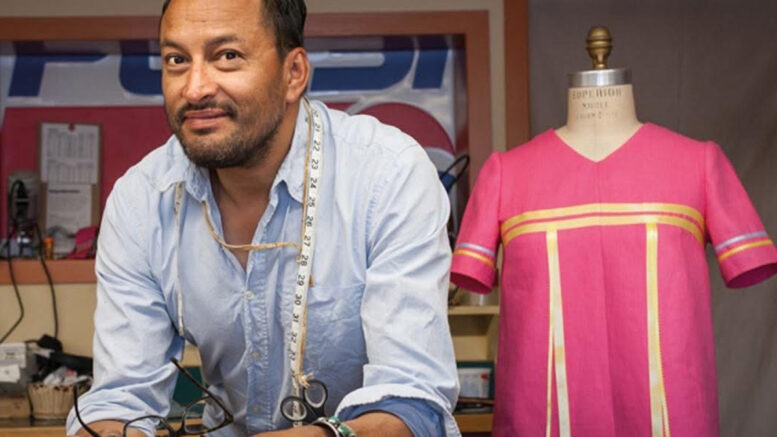
From Scooped Childhood to Couture

(60s Scoop Adoptee) D’Arcy J. Moses on Survival, Fashion, and Rebuilding in a Changing Industry

Fashion designer D'Arcy Moses reflects on his journey and his vision for the future.

By Chevi Rabbit, Local Journalism Initiative Reporter

(ANNews) – For D’Arcy J. Moses, fashion has never simply been about clothing.

It became a path back to identity, a form of ceremony, and ultimately a way to rebuild a life shaped by separation, loss, and resilience.

Born Dene and impacted by the Sixties Scoop, Moses was taken from his family as an infant and raised by a non-Indigenous family on a farm outside Camrose, Alberta.

“I’m a ’60s Scooper,” he says. “I was adopted out as an infant. The church took me away from my mother, and I was raised by non-Native people on a farm in Alberta.”

Growing up disconnected from his culture, he found himself drawn to another world – one found in the glossy pages of fashion magazines. “My mother used to have Harper’s Bazaar and Vogue magazines, and I was enamoured by them,” he recalls. “High fashion – haute couture – that’s what first really sparked my interest.”

Those magazines offered a glimpse of possibility. By his mid-teens, Moses understood that creativity would define his future. “I knew from a young age that I was creative, but I didn’t realize until my mid-teens that I wanted to get into clothing design.”

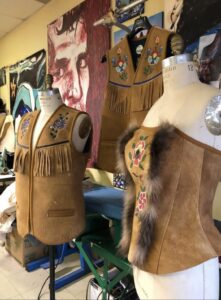
Current fashion designs by D’Arcy Moses.

Years later, after moving to Vancouver and Toronto, that childhood fascination began to take shape professionally. Along the way, Indigenous Elders recognized his talent and introduced him to the art of regalia making. “In my early twenties I was in Vancouver. I had some Elders take me under their wings and introduce me to regalia making.”

While refining his craft, Moses worked relentlessly to support himself. “I worked two or three jobs at a time – waiting tables, working in a sawmill, a lumber mill of all things. And in the evenings and weekends, I would just create.”

That persistence eventually paid off. “I had a few lucky breaks,” he says. “One of them was the Toronto Festival of Fashion, and the next day one of my garments ended up on the cover of The Globe and Mail, which was really big news at the time.”

Thursday, December 12, 2024

Otipemisiwak Métis Government to Advocate for Alberta Métis in Sixties Scoop Hearing

December 10, 2024 (Edmonton, AB) – A class action aiming to hold Canada accountable for the harms it inflicted on Métis and non-status Indian children in the Sixties Scoop is currently before the courts. From December 9-12, the Otipemisiwak Métis Government will participate as an intervener in the summary judgment hearing in Varley et al v. The Attorney General of Canada (“Varley Action”). The Otipemisiwak Métis Government is seeking justice for the many Métis children taken from their parents, families, and communities in this heinous act of cultural genocide.

“This week marks a pivotal moment in our ongoing journey toward justice for Métis Citizens who—through no fault of their own—were victims of Canada’s deliberate efforts to erase their identity as Indigenous people,” said Andrea Sandmaier, President of the Otipemisiwak Métis Government. “While we remain hopeful that the Court will recognize Canada’s responsibility for its actions—taking our children, disrupting our families, and stripping us of our ability to pass down our language, traditions, and culture—we know that true justice extends beyond addressing the harm done to individual victims. Our government is committed to holding Canada accountable for the profound damage inflicted on the Métis Nation within Alberta as a collective. We will continue to work tirelessly to ensure our future generations are rooted in the richness of our Métis heritage.”

Brooke Bramfield, Secretary of Children and Family Services for the Otipemisiwak Métis Government, added, “the Sixties Scoop tore children away from the heart of their Métis identity, leaving scars that continue to affect families and communities today. As a government, we continue to seek accountability as we work to ensure that future generations of Métis children never experience the same erasure of their culture, language, and heritage.”

The Varley Action was brought in the wake of the 2018 Sixties Scoop settlement, which excluded Métis and non-status Indian victims from the compensation Canada promised victims.  The summary judgment motion will address whether Canada had a responsibility to protect Métis and non-status Indian children who were taken from their families in the Sixties Scoop, and if Canada had a special obligation to act in the best interests of those children. Canada, for its part, denies responsibility and argues that the victims’ claims are out of time because the limitation period has lapsed.

LINK:  https://albertametis.com/news/otipemisiwak-metis-government-to-advocate-for-alberta-metis-in-sixties-scoop-hearing/

Thursday, November 28, 2024

1949 MOVIE: Canadian Pacific | Randolph Scott

Canadian Pacific - A surveyor for the Canadian Pacific Railroad must fight fur trappers who oppose the building of the railroad by stirring up Indian rebellion.

Tuesday, November 5, 2024

How one survivor of Canada's residential schools reclaimed her identity - Al Jazeera


LONG FORM STORY: 

https://www.aljazeera.com/features/longform/2024/11/3/how-one-survivor-of-canadas-residential-schools-reclaimed-her-identity 

Martha is a survivor of Canada’s Indigenous residential school system and the Sixties Scoop. From the 1870s to the 1990s, Canada operated a system of church and state-run residential schools that forcibly separated hundreds of thousands of Indigenous children from their families, communities and cultures with the intention of erasing Indigenous languages, spiritual practices and identities. Abuse was rife at these schools and thousands of children did not survive them.

The Sixties Scoop was an extension of the residential school system and ran from the late 1950s through the 80s. During this period, thousands of Indigenous children across Canada were forcibly removed from their families by child welfare services and placed into non-Indigenous foster homes or adoptive families, often far from their home communities.  Part of a broader government policy aimed at assimilating Indigenous peoples into mainstream Canadian society, authorities typically justified these removals by citing poverty, poor living conditions, or perceived neglect.

Martha was 10 years old when she was taken.


Friday, July 26, 2024

Intergenerational trauma plays large role in Indigenous addictions problems | Blood Tribe’s declaration of a State of Emergency


Officials with the Blood Tribe say one of the biggest contributing factors in the opioid crisis is the intergenerational trauma Indigenous people face. Herald file photo

By Lethbridge Herald on July 10, 2024.

https://lethbridgeherald.com/news/lethbridge-news/2024/07/10/intergenerational-trauma-plays-large-role-in-indigenous-addictions-problems/

Editor’s note: This is the first of a three-part series that looks at the opioid crisis in southern Alberta through an Indigenous lens.

Alexandra Noad – LETHBRIDGE HERALD – Local Journalism Initiative Reporter

In April 2023 the Blood Tribe declared a State of Emergency due to opioids.

According to Alberta’s Opioid Response Surveillance Report: First Nations People in Alberta, published in June 2021, First Nations people represented 22 percent of all opioid poisoning deaths in the first six months of 2020.  Which was an increase from 14 per cent in 2016.

While many may have the perception drug abuse only happens in city limits, the Blood Tribe’s declaration of a State of Emergency would prove otherwise.

Leslie Wells, Blood Tribe’s opioid response coordinator, says the opioid response started back in 2014. She says one of the biggest contributing factors to the opioid crisis is the intergenerational trauma Indigenous people face.

“There’s just like a lot of things that contribute to this crisis. But it is here and because even though Kainai is considered the largest First Nations in Canada, that has historical trauma, has really kind of wiped out and caused us to go into crisis not just with opioids but traumas and everything like that,” said Wells.

When someone goes through trauma, it can effect many generations because it not only affects how the person reacts to dealing with the traumatic event but studies have been done which suggest trauma can affect how the body reads DNA, which is then passed on through generations.

Many Indigenous peoples’ trauma stemmed from residential schools and the Sixties Scoop which caused many Indigenous people to be isolated from their culture.

Charles Weaselhead, former Blood Tribe chief and  Treaty 7 grand chief, says the intergenerational trauma caused by the residential school system has played major factors in addictions.

“The intergenerational trauma came to the forefront and people started speaking out with regards to the mental health and addiction and the impact that residential school had on huge number of people over that period,” said Weaselhead.

Travis Coleman, fire chief and director of Emergency Services for the Blood Tribe says education on intergenerational trauma is crucial to understanding the opioid crisis.

“I don’t think most people know the severity of the childhood trauma and residential schools on First Nations and Aboriginal people. We see it out here because I work out here and I just don’t think people are educated enough to understand the results of the residential schools and childhood trauma, everything that they had experienced over the years,” said Coleman.

https://lethbridgeherald.com/news/lethbridge-news/2024/07/10/intergenerational-trauma-plays-large-role-in-indigenous-addictions-problems/


Wednesday, September 20, 2023

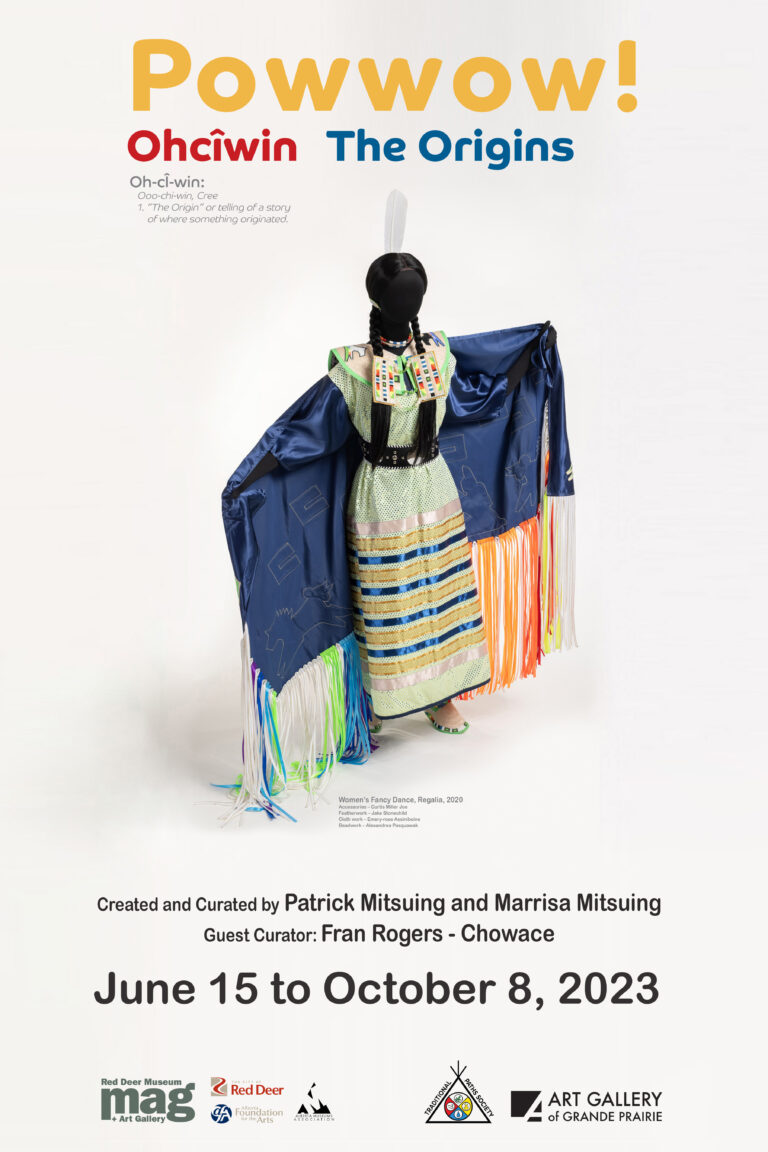
Ohcîwin the Origins


Powwow! Ohcîwin the Origins 3D Interactive Online Exhibition

Interactive Self-Guided Tour

Powwow! Ohcîwin* The Origins features 7 powwow dance styles, with full Regalia and craft work.  Curators and creators, Patrick Mitsuing and Marrisa Mitsuing, have gathered the stories, worked with the Artisans, and carefully built the Regalia for this exhibition organized by the Red Deer Museum + Art Gallery.  Working with a diverse team of Indigenous Artists from Western Canada and the US they assembled each of the individual dance regalia on display.  During the 2019 and 2020 Powwow season, they met with knowledge keepers across North America to record the origin stories of the dances they perform.

The dances on display are : Men’s Traditional, Men’s Fancy, Men’s Chicken, Men’s Grass, Women’s Traditional, Women’s Fancy and Women’s Jingle.

Guest curator of the exhibition, Fran- Rogers Chowace, focus is to create visual space for the local powwow dancers and Woodland Cree history and people of this region to shine; featuring the Traditional Paths’ Society dancers and local elders/knowledge keepers.

Exhibition organized and toured by the Red Deer Museum + Art Gallery (MAG, Red Deer, AB). The MAG acknowledges the generous funding support provided by the City of Red Deer, Alberta Foundation for the Arts, Alberta Museums Association, Waskasoo Museum Foundation and Marguerite Lerouge Watson.

 * Ohcîwin is a Cree word meaning “The Origin” or telling of a story where something originated.

TravelMag.com has listed Powwow! Ohcîwin the Origins one of 10 Exhibitions to Visit in Alberta this Summer.


Thursday, August 31, 2023

ALBERTA: Province announces additional support MMIWG


Officials with the Alberta government say grant applications are now open for communities and organizations working to address the violence, safety and economic security of Indigenous women, girls and 2S+ people.

Alberta’s government say it is committed to ensuring Indigenous women, girls and two spirit plus (2S+) people have a future that is safe, secure and respected.  Officials say the Community Support Fund provides grants for community-based, Indigenous-led initiatives that address violence and increase safety and economic security for these groups.

According to the government, the fund will support $4 million in grants each year. Recipients can receive a maximum of $200,000 towards their initiatives. The fund is expected to provide immediate support for healing, preventing violence and addressing the crisis of missing and murdered Indigenous women, girls and 2S+ people, complementing the long-term work of the Premier’s Council on Missing and Murdered Indigenous Women and Girls.

“As the Premier’s Council advances collaborative work with the Government of Alberta, this dedicated ongoing funding is important for Indigenous-led projects to support Indigenous women, girls and 2S+peoples. I commend the province for taking the initiative on this grant program,” adds Rachelle Venne, chair, Premier’s Council on Missing and Murdered Indigenous Women. 

“The Community Support Fund is creating projects and initiatives for Indigenous and non-Indigenous community organizations to create a safer, more supportive community for Indigenous women, girls and two spirit people. This funding will foster healing, awareness and hope among this vibrant and key demographic.,” notes LeeAnne Ireland, executive director, Urban Society for Aboriginal Youth.

 The call for applications will close on Oct. 6. 

Alberta government quick facts 

First Nations, Métis and Inuit women face significantly higher rates of violence throughout their lifetimes than all other women in Canada. 

In Alberta, Indigenous women are seven times more likely to be murdered, three times more likely to experience sexual assault, and twice as likely to be assaulted compared with non-Indigenous women. 

 In 2021, Alberta had the second-highest reports of homicide for Indigenous people behind Saskatchewan. 


SOURCE

Wednesday, January 25, 2023

Report: Evidence of genocide found under CA residential school


National Native News January 25, 2023

Indigenous investigators in Alberta say they’ve found evidence of genocide at the site of a former Indian residential school.

As Dan Karpenchuk reports, they’ve released a preliminary document into missing children and unmarked graves at the former Blue Quills Residential School.

The Aciniwyn Opaspiw Society says its investigators have uncovered physical and documented evidence – and their report includes allegations that a so-called disciplinarian who worked at the school from 1935 to 1942 was seen killing Indigenous children.

The society said information came from intergenerational survivors whose parents witnessed the homicides.

The accused died in 1968.

Leah Redcrow of the society also says many children died after they were forced to drink unpasteurized milk contaminated with bovine tuberculosis.

Redcrow says it was deliberate because school administrators were not dying and they didn’t eat the same food as the children.

Redcrow says ground penetrating radar was used on the site last autumn.

“When it was accidentally excavated, the excavator found a bunch of little skeletons piled on top of each other, and actually the GPR also confirmed that it’s only (eight inches) below the surface of the ground. We don’t know exactly how many children are in the mass grave yet, but we do plan to excavate the mass grave as our investigation progresses."

Redcrow says work is still underway to determine how many children disappeared. She says her group is actively investigating the deaths of at least 200 residential school children who never returned home.

Over the past year, hundreds of unmarked graves have been discovered at former residential school sites in British Columbia and Saskatchewan, the government-funded, church run schools.

The schools were operated across Canada from the late 1800’s to the late 1900’s.

About 150,000 Native children were taken from their families and forced to attend the schools.

Thousands were abused. Many died.

Tuesday, March 1, 2022

Ground-penetrating radar, special drone used to find graves at Grouard Mission site

Kapawe'no First Nation said Tuesday that ground-penetrating radar and a specialized drone were used to find evidence of 169 potential graves at the former Grouard Mission site. This file photograph shows Bishop Émile Grouard with school children, circa 1924. (Submitted by the Catholic Archdiocese of Grouard-McLennan)
The residential school, also known as St. Bernard Mission School, was opened by the Roman Catholic Church in 1894 and ran until 1961.

Thursday, October 12, 2017

Evidence 1935 | Hopi Prisoners on the Rock


Sadly, this was taking place across North America. 
One group of 19 Hopi men were sent to the U.S. military prison on Alcatraz when they refused to give up their children.

READ:

Hopi Prisoners on the Rock


Hopi Indians on Alcatraz Island, courtesy nps.gov
 I wrote about this in my memoir ONE SMALL SACRIFICE.... Trace

Thursday, May 14, 2015

Alberta adoptee finds biological family online after nearly 4 decades

(Charlene’s sister Priscilla Giesbrecht, Charlene Whitford and sister Crystal Whitford.)


An Edmonton woman who was adopted at age three found her biological family using social media.
In less than 24 hours after posting a photo of herself on Facebook posing with a poster of handwritten information about her birth mother, Charlene Whitford, 41, was reconnected to her family.
She said that she was overwhelmed with the quick response and that her post was shared over 12,000 times.
A cousin of Whitford’s first saw the post on Facebook and added her as a friend, who then put her in touch with her extended family.
Whitford’s birth mother’s sister then called her and told her that her mother Margret Whitford had died 28 years ago.
“As much as I wanted to and I hoped and I was looking forward to meeting her,” said Whitford.  “I did break down when I was told that she was not with us anymore.”
She also was told that her birth father had also died.
Despite learning of the loss of her birth parents Whitford discovered that she has a large extended family including nine brothers and sisters.
They were all adopted out as well.
“So, it’s kind of like a bittersweet story,” said Whitford about reuniting with her family.


“I just had so many emotions overcome me that I ended up crying right then and there.” Charlene Whitford


Just 10 days after she first made the Facebook post, Whitford met some of her family members, including three of her sisters in Edmonton.
“It was very overwhelming,” she said.
At the meeting, one of her aunt’s brought a picture of her birth mother and showed it to her.
“I just had so many emotions overcome me that I ended up crying right then and there. Just looking at the picture of her I could finally see a mirror image of myself.”
Whitford said she grew up in a loving German family, speaks German and identifies with that culture.
Her legal last name is Schmidt, however she changed her last name on Facebook to her birth mother’s Whitford to make it easier for her biological family to find her.
Whitford said her adoptive mother has been very supportive of her reuniting with her biological family.
“When I came and told her before I went to meet them all, she was so happy for me, she had a big smile,” said Whitford of her mother’s reaction to the news. “She was almost in tears herself. She said ‘I’m so happy for you.”
She learned that her birth mother Margaret was Cree from the Saddlelake Cree Nation north of Edmonton and Whitford is looking forward to getting in touch with her Indigenous roots.
“It’s been great. I’m going to my first pow wow in June in Saddlelake. I’m looking forward to it. It’s already circulating up there that I’m coming.”
To sum up the experience and witnessing first-hand the power of social media Whitford believes finding her family that way was meant to be.
“It’s absolutely amazing and it was divine timing! Everything happens for a reason and I couldn’t be happier right now.”
She is still looking to find two of her siblings, a brother and sister and plans to again use social media with hopes of locating them.

SOURCE

Happy Visitors!

WRITTEN BY HUMANS!

WRITTEN BY HUMANS!

Blog Archive

Featured Post

Your History Class Was a F*cking Lie | #NOMOAR

  Your History Class Was a F*cking Lie by Sean Sherman (Or: How the American Educational System Has Always Been a Racist Propaganda Program...


Native Circles

Native Circles
click logo for podcasts!

Most READ Posts

Bookshop

You are not alone

You are not alone

To Veronica Brown

Veronica, we adult adoptees are thinking of you today and every day. We will be here when you need us. Your journey in the adopted life has begun, nothing can revoke that now, the damage cannot be undone. Be courageous, you have what no adoptee before you has had; a strong group of adult adoptees who know your story, who are behind you and will always be so.

Diane Tells His Name


click photo

Lost Birds on Al Jazeera Fault Lines

Lost Birds on Al Jazeera Fault Lines
click to read and listen about Trace, Diane, Julie and Suzie

NO MORE STOLEN SISTERS

NO MORE STOLEN SISTERS
click image

ADOPTION TRUTH

As the single largest unregulated industry in the United States, adoption is viewed as a benevolent action that results in the formation of “forever families.”
The truth is that it is a very lucrative business with a known sales pitch. With profits last estimated at over $1.44 billion dollars a year, mothers who consider adoption for their babies need to be very aware that all of this promotion clouds the facts and only though independent research can they get an accurate account of what life might be like for both them and their child after signing the adoption paperwork.

Original Birth Certificate Map in the USA

Google Followers