They Took Us Away

They Took Us Away
click image to see more and read more

it's free

click

How to Use this Blog

BOOZHOO! We've amassed tons of information and important history on this blog since 2010. If you have a keyword, use the search box below. Also check out the reference section above. If you have a question or need help searching, use the contact form at the bottom of the blog.


We want you to use BOOKSHOP to buy books! (the editor will earn a small amount of money or commission. (we thank you) (that is our disclaimer statement)

This is a blog. It is not a peer-reviewed journal, not a sponsored publication... WE DO NOT HAVE ADS or earn MONEY from this website. The ideas, news and thoughts posted are sourced… or written by the editor or contributors.

EMAIL ME: tracelara@pm.me (outlook email is gone) THANK YOU CHI MEGWETCH!

SEARCH

Showing posts with label new book. Show all posts

Friday, April 3, 2026

What is a Western?

 Who does the western movie serve?

Read:

Liza Black’s Picturing Indians: Native Americans in Film, 1941–1960 (University of Nebraska Press, 2020)

Watch:

Escape from Fort Bravo (1953), featuring Diné (Navajo) extras and filmed in Arizona.

The Far Horizons (1955), featuring Shoshone extras and filmed in Wyoming.

Drum Beat (1954), featuring Apache extras and filmed in Arizona.

Warpath (1951), featuring Apsáalooke (Crow) extras and filmed in Montana.

The Return of Navajo Boy (2000) is an internationally acclaimed documentary that reunited a Navajo family and triggered a federal investigation into uranium contamination.  ADOPTION

Basketball or Nothing (2019) is a Netflix original series that follows the Chinle High basketball team in Arizona's Navajo Nation on a quest to win a state championship and bring pride to their isolated community.

Drunktown’s Finest (2014) features three young Navajos—an adopted Christian girl, a rebellious father-to-be, and a promiscuous trans woman—strive amid the hardships of life in Gallup, New Mexico, and the Navajo Nation.

Reel Injun: On the Trail of the Hollywood Indian (2009) traces the evolution of cinema's depiction of Native people from the silent film era to today, with clips from hundreds of classic and recent Hollywood movies, and candid interviews with celebrated Native and non-Native film celebrities, activists, film critics, and historians.


LINK:

https://theautry.org/explore/blog/picturing-indians-native-americans-film-1941-1960 


Wednesday, December 17, 2025

Unearthing truths: The TRC's impact on Indigenous writing

'Colonialism tried to take away our culture': Chyana Marie Sage on the anniversary of the TRC

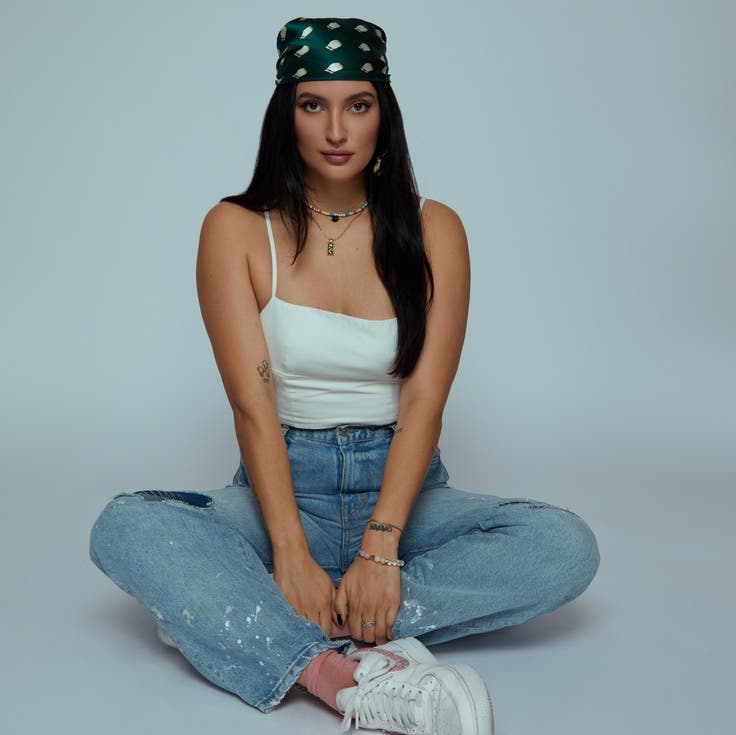
A woman with long dark hair against a pink background.
Chyana Marie Sage is the author of Soft As Bones, a memoir about intergenerational trauma. (Anneka Bunnag)

Reflecting on the 10th anniversary of the Truth and Reconciliation Commission (TRC), Chyana Marie Sage said its legacy is the buried history it has unearthed.

The Cree, Salish and Métis writer's recently released memoir, Soft As Bones, is her own quest to better understand the childhood trauma and abuse that scarred her family, and its roots to colonialism, she says.

It's also a tapestry of poetry, history, Cree language, traditional ceremony and folklore that delves into her experiences, and those of her family, with compassion and strength.

Overall, it serves as something of a journey of hope for the Edmonton author — a tale of overcoming generations of trauma to reach new heights.

'Sharing their truths'

Sage's journalism has appeared in the Toronto Star, Huff Post and the New Quarterly. She holds an MFA in creative nonfiction from Columbia University in New York, where she taught as an adjunct professor.

"I think Indigenous creatives have really responded to [the TRC] by sharing their truths. Step one is the acknowledgement of what happened here in Canada. You see that with a ton of memoirs having come out in the last decade," said Sage, noting works by authors such as Jesse Thistle, Terese Marie Mailhot and Julian Brave Noisecat.

She said these writers are unearthing and critiquing the colonial systems, which not only caused intergenerational trauma but also severed the passing of knowledge.

"There was a period of reflection from residential school and Sixties Scoop survivors," she added, "[but] we're now moving into this space where writers are talking about how those systems are impacting the generation of today."

Over the past 10 years, Indigenous writers have endeavoured to honour the TRC calls to action by uncovering the lasting impacts of colonial systems.

Sage said the impact of this can still be seen in the disproportionate number of Indigenous people who are homeless or incarcerated.

While writing Soft as Bones, the most important thing was "to show how everything is interconnected," says Sage.

Even though she was not in residential school herself, her grandfather was a Sixties Scoop survivor, and this impacted how he parented his own son, Sage's father, who — as the book details — was sexually abused and later abused Sage's older sister.

The original wound

The things that happened in her family while Sage was growing up caused her immense grief and confusion, she says. Her book was an attempt to understand and process her own experiences and search for the "original wound."

"Soft as Bones became this living archive and my family story became this microcosm, really, one small piece of this mosaic that makes up the Indigenous experience in Canada."

While writing about the harm that the colonial structures caused to her family, Sage said she also had another realization.

Sage says writing the book also made her realize that while colonialism tried to take away Indigenous identity, culture and ceremony, those things are all rooted in healing. "So the very thing that they tried to take away is the thing that is giving us our spirit back." 

 My family story became this microcosm, really, one small piece of this mosaic that makes up the Indigenous experience in Canada.

- Chyana Marie Sage

Thursday, November 13, 2025

Indigenous heritage is an ongoing story

November 12, 2025  By Vanessa Lillie

The author at the Great Swamp Massacre memorial in South Kingston, RI, 2025. (Courtesy Vanessa Lillie)

Five years ago, from the dark of my living room in Providence, I was surprised to see the action of HBO’s “Watchmen” open in a familiar but unexpected place: Tulsa, Oklahoma, about an hour from where I grew up.  It wasn’t superheroes and aliens, not yet, but instead a violent and harrowing recreation of real history: the 1921 Tulsa Race Massacre.  In the span of just 18 hours, 35 blocks of the affluent “Black Wall Street” community were leveled, killing as many as 300.  Even today, the search for mass graves continues.

My heart sank at my own ignorance.  I was shocked that these horrors happened just down the road from where I went to school, that the education I received did not include any mention of one the worst incidents of racial violence in the history of America.  Instead I was relying on an HBO adaptation of a dystopian graphic novel.

Being a citizen of the Cherokee Nation has long shaped how I see history.  My earliest memory of being Native is associated with my family cemetery, in Oklahoma.  Our ancestor, George Washington Walker, was on the Trail of Tears as a boy and built a new life in the northeast corner of the state.  I remember thinking, as I stood staring at his grave and the historical marker, how the reason we were in Oklahoma was because the government went back on their word. President Andrew Jackson ignored the Supreme Court and stole our land, while trying to erase our existence.  Even if some version of that was taught to me in school, I don’t remember any meaningful discussions about what was stolen or how the impact continues in communities today.
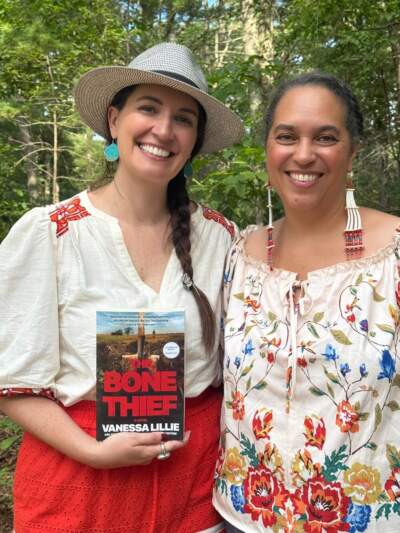
The author with Lorén Spears, executive director of the Tomaquag Museum, at the 350th August meeting and pow wow, in Charlestown, RI, 2025. (Courtesy Vanessa Lillie)


As I grew up, I sought to understand my family’s heritage and found it to be a reflection of the resiliency of the Cherokee Nation.  And as a writer, I realized how I could use story to share history and explore questions of colonization, both past and present. I’ve written seven novels, but it was only in the most recent that I learned how little I knew about the land and tribes in the smallest state I now call home.

Toward the end of King Phillip’s War (or, if you’d like to decolonialize the term, The War for New England), in December, 1675, English colonists attacked the winter homes of the Narragansett tribe. In what’s now known as the Great Swamp Massacre, at least 650 men, women and children were killed, and at least 300 were taken captive. It’s an echo of what President Jackson would later do to my own tribe: genocide perpetrated at the hands of men in power.

It wasn’t until recently, 2021, that the land was officially returned to the Narragansett tribe, having belonged to the Rhode Island Historical Society since 1906.  The grounds are open to the public, with small rocks, shells and feathers placed around the obelisk that stands sentry at the memorial where tribal members gather every year to remember.

While as Cherokee, we were forced out of our homelands, the Narragansett remained. One of my first summers in Rhode Island, I attended the Narragansett August Meeting and Pow Wow in Charlestown.  During the Grand Entry, I watched as many citizens of the tribe, dressed in regalia passed down generation to generation, entered to the sounds of drums and voices, often with the refrain, “we are still here.”  The Narragansett have been gathering there for over 350 years; it’s the oldest recorded pow wow in North America.

And yet, I’ve also spoken to young citizens of the tribe who were told in school that the Narragansett no longer exist, as if they’re extinct like the dinosaurs.  It’s a sentiment supported by hundreds of years of treating Indigenous remains and cultural items as trophies or objects to exploit.  When it comes to preserving and amplifying Indigenous culture, it’s not enough to understand history.  We must also ask: who’s doing the telling?

These are questions I often ask myself when I’m researching a plot or just enjoying a museum with my family.  Who’s creating the narrative on those small plaques near the objects in the museums we shuffle through? Or fund?  I know there are thousands of Indigenous remains on shelves across the country, from museums to academic institutions, despite federal laws meant to mandate their return.  They’re questions I explored in my research for my new book, “The Bone Thief,” using real examples from history: from Yale’s Skull & Bones club allegedly stealing, and hiding, the skull of Geronimo to the history of grave robbers in colonial America.

Even the language I used changed.  Thanks to guidance from the Tomaquag Museum, an Indigenous led museum telling first person histories, and leaders like Executive Director Lorén M. Spears, I’ve decolonized my language from “artifacts” to “belongings.”  Because these objects belong somewhere — to a place, a people — and they should be returned and shared by the people from which they originated.

While on book tour this month, I’ve been speaking at stores and events across New England, and I like to ask people to raise their hands if they’ve heard of the Great Swamp Massacre. Some crowds have more hands up than others, but it’s rarely more than half, and often a lot fewer.

Native American Heritage Month puts a well-deserved spotlight on books by Native American authors (including some of my own “must-reads”), and that’s a good thing. But it’s hardly something that can be highlighted, even honored, one month out of the year.

As for me, I hope by taking the real history of a place, and wrapping it in the page-turning plot of a thriller, I’m able to give people that same experience I had with “Watchmen”: not only shock, or even embarrassment, but a charge to go out and find the hidden truths of our homelands. Our heritage is an ongoing story. Our people are still telling it.

On Wednesday, Nov. 12, Vanessa Lillie spoke & signed copies of "The Bone Thief" at Authors on Stage at Wellesley College . and Brookline Booksmith 

SOURCE:  


Saturday, August 23, 2025

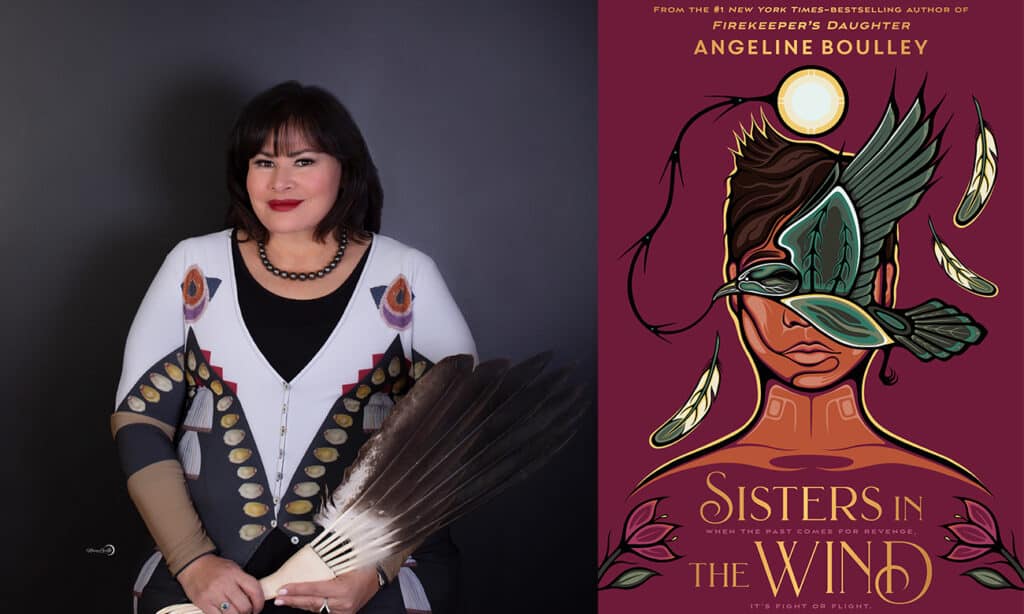
‘Sisters in the Wind’

Indigenous Author Centers Foster Youth in Upcoming Thriller

Angeline Boulley’s third novel, “Sisters in the Wind” chronicles an Ojibwe teen girl’s experience in foster care. Provided photos.

“Native families are like onions,” fiction author Angeline Boulley writes in her latest novel about Indigenous families caught up in the child welfare system. 

They are “rough-looking on the outside,” she goes on. “People want to peel the outer layers and toss them away, as if they have no value. But each layer is protecting the next, down to its innermost core. That green center, where the onion is sweetest, that’s the Native child. Surrounded by layers of family and community.”

Boulley’s third book, “Sisters in the Wind,” offers a rare Indigenous-centric glimpse into the failings of the country’s child welfare system. The young adult novel, set to publish next month, is meant to show what can happen when a federal law meant to ensure that Indigenous families remain intact is not followed, and how a child’s life can be improved when it is, the Michigan author said in a recent interview.

The thriller follows Lucy Smith, an Ojibwe teen who is running for her life, away from traumatic figures she encountered while growing up in foster care. As an adult she navigates a difficult childhood spent in various placements before finding family and healing. 

Publisher’s Weekly called the book a devastating, gripping tale “that serves as a searing critique of the ways that systems can fail vulnerable youth.”

At points in the novel, Boulley’s protagonist experiences dehumanizing moments common to foster youth everywhere, including when she is forced to carry her belongings in a trash bag during a move to a new home. 

Recently, states including New York and Texas have prohibited child welfare agencies from doling out trash bags, and now require them to provide proper suitcases to children. Such laws, “need to be everywhere,’’ Boulley said, adding that she believes making foster youth use garbage bags sends the clear message, “that they themselves are trash.’’  

An insight into Angeline Boulley’s creative process: Color-coded spreadsheets detail characters’ lives and her cat, Pietro, comforts her. Provided photo.

As an adult, Smith eventually goes to work as a research intern for a company that trains child welfare professionals on the workings of the Indian Child Welfare Act. The 1978 federal law, known as ICWA, requires state foster care agencies to take extra steps to ensure Indigenous families stay together. The fictional company in the novel is based on real work Indigenous people are doing to preserve families and tribal communities in Boulley’s home state of Michigan, she said.  

In the case of the novel’s protagonist, ICWA was not followed as she moved through the foster care system. In one bleak scene, a social worker tells Smith that identifying as Indigenous will only muddle her situation.

“It complicates everything,’’ Smith is told. “Just say you’re Mexican.”

Later, Smith comes to believe that the abusive situations she endured in non-Native foster homes never would have happened had she been placed with tribal relatives. 

Boulley, a member of the Sault Ste. Marie Tribe of Chippewa, hopes a particular message in her novel will reach child welfare professionals who might read it:  

“When ICWA is followed correctly, it works,” Boulley said. “The issues that arise primarily come when social services and court personnel don’t understand the law. They continue with assumptions and misconceptions, and that ends up complicating children’s lives.’’

Boulley was never in foster care herself. But she and her siblings grew up spending summers visiting the Sault Ste. Marie reservation in Michigan where she knew several young relatives being raised by kin outside of the foster care system. 

“Growing up, I didn’t think it was anything unusual to have cousins that were raised by my grandma,” Boulley said. “That was just normal.”

Her work on “Sisters in the Wind’’ began years ago, but she felt an urgency to complete it following recent legal challenges to ICWA. In a United States Supreme Court case two years ago, multiple states and three foster families argued that the federal statute was unconstitutional and interfered with a non-Indigenous couple’s right to adopt an Native child. 

A Supreme Court ruling upheld the law in June 2023. But, Boulley said, “We know it’s not the final assault on tribal sovereignty.’’

SOURCE:  https://imprintnews.org/top-stories/indigenous-author-centers-foster-youth-in-upcoming-thriller/265041

Tuesday, July 22, 2025

Finding Your Ancestors in the Archives

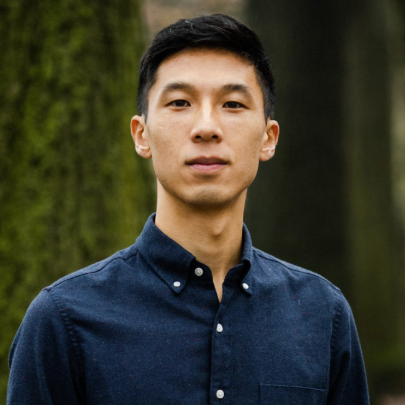
Author Joseph Lee. (Photo/Aslan Chalom)
PHOTO: Author Joseph Lee. (Photo/Aslan Chalom)

By Shaun Griswold | Yahoo News

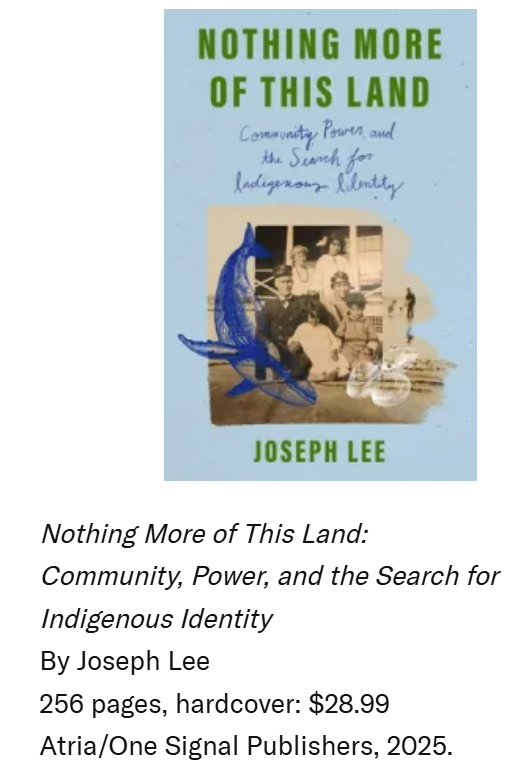
Summer memories of running with cousins in Zuni mud — all the weekends I spent at my Auntie Paula’s home on the Zuni Pueblo — return as I read Joseph Lee’s book Nothing More of This Land: Community, Power, and the Search for Indigenous Identity


A mixture of memoir, reportage and commentary, it documents Lee’s family history, describing how land and ancestry forged strong links to his Aquinnah Wampanoag home on Martha’s Vineyard. Lee’s stories echoed my own rez dirt memories, layers of loving Indigenous relationships with foundations deeper than any historical record.

: Your book demonstrates how you and your family live as Indigenous people on colonized land. Can you introduce those experiences?

[Editor's Note: This column originally appeared in "High Country News. Used with permission. All rights reserved.]

Lee spoke with High Country News before his book’s July 15 release. 

This conversation has been edited for length and clarity. 

High Country News: Your book demonstrates how you and your family live as Indigenous people on colonized land. Can you introduce those experiences?

Joseph Lee: I’m a Wampanoag, and my family and my tribe is from Martha’s Vineyard. It’s a small island in the Northeast, known for being this fancy vacation place where presidents and movie stars go. I grew up spending summers at my grandparents’ house, and that was the original framing for the book: How I thought about being Indigenous and being Wampanoag was filtered through the experience of how people see Martha’s Vineyard, along with how people see Wampanoag people and Native folks in the Northeast: We were there when the pilgrims came, Mayflower, the first Thanksgiving, all of that. 

That confused me, because what I was being told about being Indigenous didn’t really match up with the way I was experiencing it personally. I went to tribal summer camp, I went to our cranberry festival harvest. I did all these things, and none of it aligned with this version of stereotypical Nativeness, the disappeared Native gone in the past.

I was trying to make sense of the way that we’ve lived and the choices that we’ve made, and what is this going to look like in the future?

keep reading👇 

Wednesday, May 21, 2025

This Indigenous Author Maps The Pain Of Generational Trauma — And The Journey To Healing

“The core of our culture that existed before colonization is actually the thing that’s allowing us to heal from colonization,” says author Chyana Marie Sage. 
"I believe that in order to process and heal from something, we have to confront the dark thing that haunts us," says author Chyana Marie Sage.
Photo: Anneka Bunnag 

“Soft As Bones,” Sage’s debut project that drops on May 27, is a prose-driven exploration of generational trauma that stems from the systemic breakdown of her own family unit largely due to the Sixties Scoop, an era during which Canadian child welfare policies allowed for the forceful removal thousands of Native children from their families (they were rehomed to white households).

Her storytelling, in a format she calls a “braided spiral” because of its interwoven cultural mythology and tendency to loop back to the central plot, is both poignant and whimsical.  It’s with this balance that Sage, who has previously written for HuffPost, is able to confront the agonizing and multilayered betrayal by her father — and create a new space for her family to heal.

Throughout the book, especially in the passages of vibrantly detailed folklore and magic realism, there is a levity of spirit that reflects the type of Indigenous resilience that comes with time and reflection.  Sage’s message, as we come to understand toward the end, is that the wealth of community is powerful enough to rebuild what’s been torn down in the past.  And the concept of “returning home” is more about releasing pain and trusting our agency than anything else.

KEEP READING:  https://www.huffpost.com/entry/chyana-marie-sage-memoir-soft-as-bones_n_682b7327e4b095274facef05

Thursday, January 9, 2025

UC Professor’s Book Debut Explores Darker Outcomes of Adoption

January 7, 2025

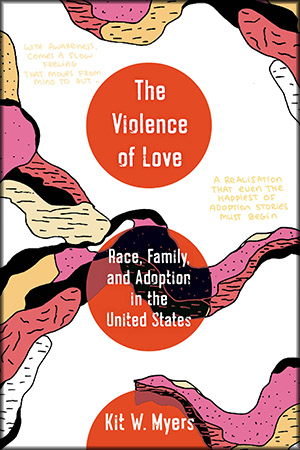
In his book debut, a UC Merced professor challenges the common narrative that adoption is mainly an act of love that benefits the adoptees, adoptive parents and birth parents, especially in cases that cross racial lines and national borders.

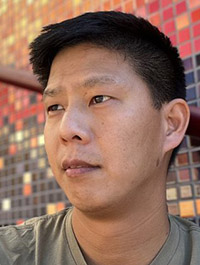
Kit Myers, a faculty member in the Department of History & Critical Race and Ethnic Studies , analyzed the adoption of Asian, Black and Native American children by White families for “The Violence of Love: Race, Family, and Adoption in the United States” (University of California Press).  In the book, Myers says race has been positioned to mark certain homes, families and nations as better sources than others for love, freedom and positive futures for the adoptees.

The word “violence” refers not only to physical harm but also to forms of erasure and displacement in transnational or transracial adoptions. For example, the process of forming a new family can require removing or obscuring elements of the adoptee's history. These erasures are potentially traumatic, even when done with the perceived positive intention of creating new family bonds.

“The Violence of Love” confronts this discomforting reality and rethinks theories of family to offer more extensive understandings of love, kinship and care.

Myers, a professor at UC Mered since 2016, said his book relates to broader research interests on the study of race as a social, relational and intersectional category of difference and power.

LINK: https://news.ucmerced.edu/content/uc-professor%E2%80%99s-book-debut-explores-darker-outcomes-adoption

Saturday, January 9, 2016

Zebras and Giraffes: Finding where we fit in

By Trace L Hentz

I am now collecting stories by adoptees for a new book STOLEN GENERATIONS. It will be the third in a series of anthologies written by First Nations and Native American adoptees. Some were placed in non-Indian homes because of The Indian Adoption Projects (New York state had its own Indian Program) and the other larger project called ARENA.

These projects include adopting out Native children from Canada and the USA. 
======================================================================


First Nations Adoptees 60s Scoop

By the numbers

20,000

Estimated number of aboriginal children taken from their families during the Sixties Scoop in Canada


Source: Canadian government/National Household Survey
 =======================================================================
Canadian adoptees in the 60s Scoop have had more press coverage than here in the US and class action lawsuits have done much to promote the cultural genocide that adoption caused in Canada.

Peter d'Errico wrote a review of our first book TWO WORLDS: Lost Children of the Indian Adoption Projects for Indian Country Today newspaper... He gets it. He knows what happened in the US.  His book review is very good, so I am sharing the review again. LINK

As I read adoptee stories, I get it. I am an adoptee, too. I think of how hard it is to fit in a family that is not your own so I wrote this down today:


I want you to image a little baby zebra is adopted by a family of giraffes. The giraffe family care for him as he grows up. The zebra felt loved by his new family, but as he grew bigger, he noticed he wasn't in the right place. These were not his people. And he wondered what happened to his own zebra family.

No matter how much love we were given, or not given as young adoptees, we figure out eventually we are not "home" and we wish to know where home is, and where our family is? and what happened?... No matter what our adoptive parents tell us or not tell us, we deserve to know the truth and we need to meet relatives and our first families to help us feel better and heal.

And adoptees need answers.  No one knows how many Native adoptees there are in the US. The governments of Canada and the US sought to destroy our connection to our tribes and families with these projects by adopting out babies and young children to non-Indians. The governments sought to erase us from tribal rolls. Our birth certificate was amended and lists our parents as the ones who adopted us.

How do we find a way to feel "home" again? We Search! We go into Reunion! Reunification means finding out who we truly are...

Sharing Stories helps adoptees to go full circle.  Sharing Stories help adoptees know they are not alone.

If you are interested in writing a story about your adoptee journey and reunion, please email me: larahentz@yahoo.com.  If you need help searching, email me too!

 =======================================================
In case you missed this news article about the 60s Scoop, read HERE.  


This is one of the amazing 60s Scoop Adoptees!


Cole Burston/Toronto Star

Colleen Cardinal

Colleen Cardinal still remembers her first emotion at her last foster home: Fear. Now 42, Cardinal is Plains Cree from Saddle Lake Cree Nation, Alberta, but grew up in a non-indigenous home in Sault Ste. Marie, Ont., along with her two sisters. All three girls endured physical and sexual abuse and were treated like “second-class citizens” in their own home, Cardinal says.
The family’s biological children were given butter and white bread, while Cardinal and her sisters were given margarine and brown bread. The family used a bathroom indoors while the three aboriginal girls used an outhouse. “I remember waking my sisters up in the middle of the nighttime because I had to go pee, and I was scared to go outside by myself — in my flimsy little nightie, putting on my winter jacket and freezing,” Cardinal recalls.

Thursday, December 31, 2015

NEW BOOK: For Stolen Generations


We are planning a new anthology in 2016.  This one will include updates and essays from adoptees in the previous books Two Worlds and Called Home and new adoptees as well. (Those anthologies are sold on Amazon and in some bookstores.)

If you are a Native American/First Nation adoptee, please email me: larahentz@yahoo.com.
The deadline for essays in Jan. 15.
Contributors are paid in copies of the new anthology and you own the rights to your story 100%.
Send this message to adoptees who may be interested, too.
We are called the Stolen Generation for a reason. It happened.
Mitakuye Oyasin...
Trace
new edition 2017


Happy Visitors!

WRITTEN BY HUMANS!

WRITTEN BY HUMANS!

Blog Archive

Featured Post

Your History Class Was a F*cking Lie | #NOMOAR

  Your History Class Was a F*cking Lie by Sean Sherman (Or: How the American Educational System Has Always Been a Racist Propaganda Program...


Native Circles

Native Circles
click logo for podcasts!

Most READ Posts

Bookshop

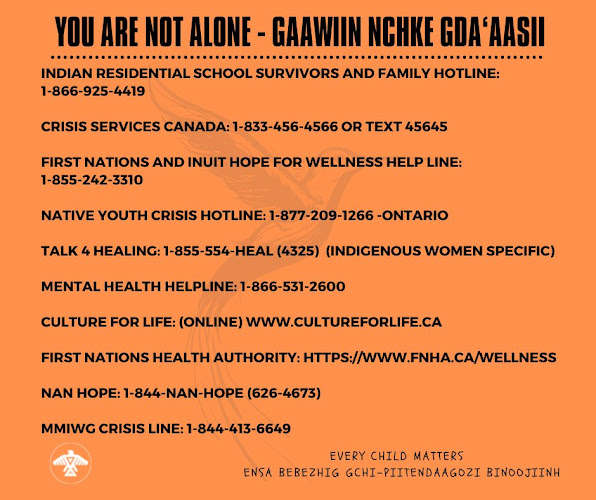
You are not alone

You are not alone

To Veronica Brown

Veronica, we adult adoptees are thinking of you today and every day. We will be here when you need us. Your journey in the adopted life has begun, nothing can revoke that now, the damage cannot be undone. Be courageous, you have what no adoptee before you has had; a strong group of adult adoptees who know your story, who are behind you and will always be so.

Diane Tells His Name


click photo

Lost Birds on Al Jazeera Fault Lines

Lost Birds on Al Jazeera Fault Lines
click to read and listen about Trace, Diane, Julie and Suzie

NO MORE STOLEN SISTERS

NO MORE STOLEN SISTERS
click image

ADOPTION TRUTH

As the single largest unregulated industry in the United States, adoption is viewed as a benevolent action that results in the formation of “forever families.”
The truth is that it is a very lucrative business with a known sales pitch. With profits last estimated at over $1.44 billion dollars a year, mothers who consider adoption for their babies need to be very aware that all of this promotion clouds the facts and only though independent research can they get an accurate account of what life might be like for both them and their child after signing the adoption paperwork.

Original Birth Certificate Map in the USA

Google Followers