They Took Us Away

They Took Us Away
click image to see more and read more

it's free

click

How to Use this Blog

BOOZHOO! We've amassed tons of information and important history on this blog since 2010. If you have a keyword, use the search box below. Also check out the reference section above. If you have a question or need help searching, use the contact form at the bottom of the blog.


We want you to use BOOKSHOP to buy books! (the editor will earn a small amount of money or commission. (we thank you) (that is our disclaimer statement)

This is a blog. It is not a peer-reviewed journal, not a sponsored publication... WE DO NOT HAVE ADS or earn MONEY from this website. The ideas, news and thoughts posted are sourced… or written by the editor or contributors.

EMAIL ME: tracelara@pm.me (outlook email is gone) THANK YOU CHI MEGWETCH!

SEARCH

Showing posts with label adoption history. Show all posts

Thursday, May 23, 2024

History: OPERATION BABYLIFT

Heartbreak and hope - The Vietnamese children of Operation Babylift and their battle to find birth parents and their identity

Almost 50 years ago, thousands of children were removed from Vietnam to be adopted around the world, including Scotland.  Their story is now explored in a new play, Precious Cargo...

​Andy Yearley still vividly remembers the journey he made from the Isle of Lewis to Vietnam 20 years ago.  Travelling with a film crew from Mac TV in Stornoway, he had what he calls “the most unforgettable, vivid and surreal week of my entire life”.

Born in 1973, Yearley was one of thousands of young Vietnamese children evacuated from the country as the Vietnam war finally ended, culminating in a huge, US-led initiative in April 1975 called Operation Babylift.  The children, many transported on military aircraft, were adopted by families in the USA, Australia and across Europe. Yearley’s Vietnamese name is Nguyen Tang; adopted by a Scottish couple, he grew up as Andy in a small, seaside village on Lewis, knowing virtually nothing about his biological family.  The aim of that 2004 journey was to try and find them.

“A normal tourist visiting Vietnam finds stimulation overload, but in my case it was my first time seeing the country of my birth, potentially finding blood family, surrounded by a Gaelic TV crew, and escorted by a high up official from the Vietnamese government,” recalls Yearley. “Surreal was a total understatement.”
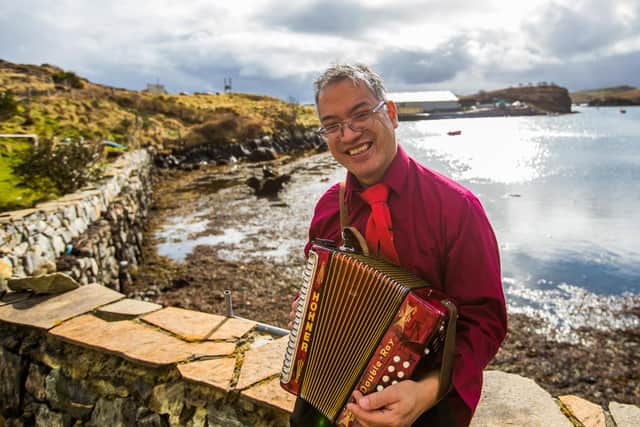
Yearley is a professional musician who has performed at Celtic Connections, HebCelt, and other high profile Scottish events, as well as teaching music to children. In Saigon, he remembers visiting a music shop where the shopkeeper talked at him for half an hour in Vietnamese. Not understanding a word, Yearley eventually decided to respond in Gaelic, just to see what would happen. “I said something along the lines of "Ciomair a tha thu? Tha mi duillich, a bheil Gaelic agad?" (how are you, sorry do you speak Gaelic?). The look on her face!”

Yearley never found any members of his Vietnamese family, but thanks to orphanage staff he was at least able to identify and visit the street where he had been found as a baby, next to a dead woman thought to have been his mother. “It was 5am and the street was buzzing with activity. To a lot of folk, their first known location is a hospital bed, or a birthing pool. Here I was at mine – a bustling, beautiful street with overgrown foliage everywhere, children, cats and dogs running wild, and a barely discernible old train track running through it. I quite like the fact that this last day was not filmed. It was a very personal moment.”

Two decades later, Yearley is one of the creators of Precious Cargo, a new theatre show coinciding with the 50th anniversary of Operation Babylift. Developed in Uig on the Isle of Lewis, Precious Cargo is now set for a full Edinburgh Fringe run at Summerhall following its debut performance at An Lanntair in Stornoway at the beginning of July.

Wednesday, February 12, 2020

What does history tell us about adoption

By Trace Hentz (Blog Editor and adoptee)

The Dakota expression for child, wakan injan, can be translated as “they too are sacred,” according to Glenn Drapeau, Ihanktonwan Dakota and a member of the Elk Soldier Society on the Yankton Sioux Reservation in South Dakota.

“To us, children are as pure as the holy, moving energy of the universe,” he says, “and we treat them that way.”

What does history tell us about adoption? Most telling is the timeline of adoption history: https://pages.uoregon.edu/adoption/timeline.html

Can you see the curve American Adoption took to become a profitable industry after seeing that timeline?  Do you notice how some states stepped in and made laws? Can you see the influence of the religions and their judgements of single parents? What role did poverty and racism play? Can you see how secrecy and laws protects the industry and the people who adopt?

Twenty years I've studied adoption in my own investigations and I think 20 years later... adoption is not about child care at all but has morphed into child trafficking, a response to an infertility epidemic, lawyers and judges, billions of dollars, propaganda and bad history.

Supply and demand requires: Where do you find an available baby for an infertile couple in America?

What was born of this curve in 20 years: there are camps. The two most common camps for adoptees are "be grateful" and "the activist."

Not everyone wants to hear adoptees in any camp. I simply cannot believe the adoption debate has gone on as long as it has.

If adoption hurts anyone, then it should be abolished. Period.

When you see how adoption was used against Native people, then it was a criminal act. (This was important to document in the four-part book series LOST CHILDREN OF THE INDIAN ADOPTION PROJECTS: see the books in the sidebar of this blog)

My adoptive parents were miserable people, very sick. I cannot begin to calculate the source of their behaviors but their infertility and religion resulted in my being adopted by them through Catholic Charities and then abused by both of them.

If there had been careful awareness by the adoption industry's social workers prior...maybe it would not have happened. But the social workers never returned.

Who would create a system for children that would not check on adopted children?

Child trafficking via adoption is profitable. That seems to be why it won't go away.

I'm not bitter because that was the system and how it was created. But when you see the harm, and the trauma and the lifelong issues for the child in a closed adoption, how does adoption exist in any form?

Caring for children who are true orphans, without any biological family is so rare, a community could step in and care for the orphan.  It would not require a bureaucracy to do that. The decision could be made by tribal leaders. If you are a member of a tribe, the entire tribe is your family. Kinship care always worked for children who had lost their parents.

I was not an orphan. I had two biological parents who were in their 20s. Relatives told me later they could have and would have raised me.

But someone created a system that didn't allow that, and instead the adoption industry chose strangers to raise me.

I was born before the Indian Child Welfare Act was passed in 1978. I do not have my Original Birth Certificate.

I will never stop fighting for Native children. They deserve our protection.

Read my earlier post: What Being Adopted Cost Me.

Toni Morrison says that “facts can exist without human intelligence, but truth cannot.”

Wednesday, January 9, 2019

BITTERROOT: Adoption Didn't Solve the Indian Problem


Adoption didn’t solve the “Indian Problem.” Its weight simply shifted to our small shoulders. No one told us “we” represented “them.” We had to find that out for ourselves. Some of us are still looking. Bitterroot is a roadmap. - Susan Harness
An author recounts how 1960s policies ripped apart families and communities, including her own.

MUST READ: Adoption didn’t solve the ‘Indian Problem’ — High Country News

See her other posts on this blog... HERE
 HERE

Susan Devan Harness, author of Bitterroot: A Salish Memoir of Transracial Adoption is a member of the Confederated Salish Kootenai Tribes, a writer lecturer and cultural anthropologist living in Fort Collins, Colorado.
10-16-2019
This past weekend Bitterroot: A Salish Memoir of Transracial Adoption took home two awards at the High Plains Book Festival:  Creative Nonfiction and Indigenous Writer.  I am so honored to be among so many really great authors.

Thank you goes to the readers and staff of the High Plains Book Festival, the University of Nebraska Press for their seeing the value of this project, my advisers Kate Browne and John Calderazzo, the overwhelming support from friends and family and the many voices who contributed to this work.

It is humbling.

All my best,
Susan
Susan Harness, M.A.

STOLEN GENERATIONS

Wednesday, March 21, 2018

Finding Cleo: CBC podcast solves decades-old mystery of Saskatchewan girl lost in Sixties Scoop (UPDATED)


Siblings separated in Sixties Scoop had been searching for sister for decades when they turned to CBC for help


A patchwork of information suggested Cleo Semaganis Nicotine had been killed decades ago while trying to make her way back to Saskatchewan from her adoptive family in the U.S., but no one knew for sure what happened until CBC News began looking into the case.

NEW EPISODES AVAILABLE: MORE

LISTEN: Finding Cleo: CBC podcast solves decades-old mystery of Saskatchewan girl lost in Sixties Scoop - CBC News | Indigenous

Monday, June 24, 2013

ARENA: what came after the Indian Adoption Projects

Source: U.S. Children's Bureau, Child-Welfare Exhibits:  Types and Preparation, Miscellaneous Series, No. 4, Bureau Publication No. 14 (Washington DC: Government Printing Office, 1915).
Beginning in 1916, the U.S. Children's Bureau brought its baby-week campaign to thousands of cities, towns, and rural communities across the United States. The photograph above was taken during a baby-week celebration on an Indian reservation.
 

1958

Child Welfare League of America published Standards of Adoption Service (revised in 1968, 1973, 1978, 1988, 2000); Indian Adoption Project began.
 
The Adoption Resource Exchange of North America (ARENA), founded in 1966, was the immediate successor to the Indian Adoption Project. ARENA was the first national adoption resource exchange devoted to finding homes for hard-to-place children. It continued the practice of placing Native American children with white adoptive parents for a number of years in the early 1970s. (It's estimated some 20,000 children were removed from their First Nations families and sent to non-Native parents in the US.)
 
1966The National Adoption Resource Exchange, later renamed the Adoption Resource Exchange of North America (ARENA), was established as an outgrowth of the Indian Adoption Project.
 
Quote: ARNOLD LYSLO, DIRECTOR, INDIAN ADOPTION PROJECT 12/1962
Indian children have certain rights which are theirs by birthright. That is, they have rights of tribal enrollment if they meet the requirements for enrollment set up by the tribe. As tribal members they have the right to share in all the assets of the tribe which are distributed on a per capita basis. The actual as well as anticipated benefits of an Indian child adopted through our Project are furnished by the Secretary of Interior. The Secretary of Interior, through the superintendent of the Indian agency where the child is enrolled, has the right to approve or disapprove of any plan made for the distribution of funds belonging to an Indian child.
 
[Even though Lyslo said we have rights, we are still taken from our tribes and placed in non-Indian families - which is part and parcel of a genocide program. And maybe those non-Indian parents adopted us for the money we could earn as tribal members...Poverty was often cited as the reason for removal - so who caused the poverty?? - we know the answer... Trace]
 
 
It’s estimated that 18,000-20,000 First Nation, Inuit and Metis children were adopted or fostered to non-native homes from the 1960′s to the early 1980s. This came to be known as the 60′s scoop. Coleen Rajotte reports from Winnipeg about a Cree man returning home to Manitoba after 39 years away, and a young boy who benefited from new strategies in adoption to ensure that Aboriginal kids stay within their communities.

http://www.cbc.ca/doczone/8thfire/2012/01/hidden-colonial-legacy-the-60s-scoop.html


1978

Indian Child Welfare Act passed by Congress...

Happy Visitors!

WRITTEN BY HUMANS!

WRITTEN BY HUMANS!

Blog Archive

Featured Post

Your History Class Was a F*cking Lie | #NOMOAR

  Your History Class Was a F*cking Lie by Sean Sherman (Or: How the American Educational System Has Always Been a Racist Propaganda Program...


Native Circles

Native Circles
click logo for podcasts!

Most READ Posts

Bookshop

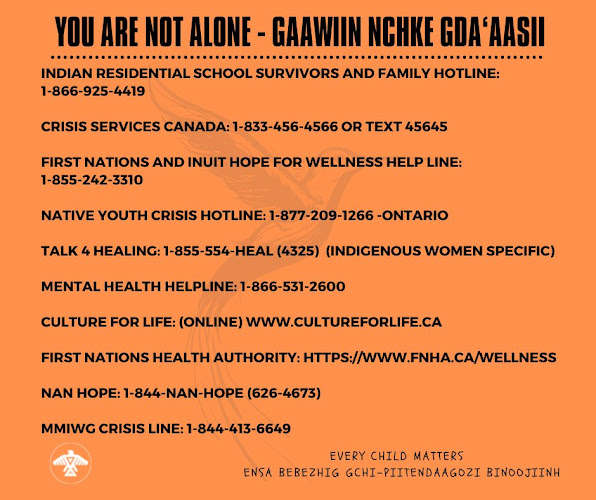
You are not alone

You are not alone

To Veronica Brown

Veronica, we adult adoptees are thinking of you today and every day. We will be here when you need us. Your journey in the adopted life has begun, nothing can revoke that now, the damage cannot be undone. Be courageous, you have what no adoptee before you has had; a strong group of adult adoptees who know your story, who are behind you and will always be so.

Diane Tells His Name


click photo

Lost Birds on Al Jazeera Fault Lines

Lost Birds on Al Jazeera Fault Lines
click to read and listen about Trace, Diane, Julie and Suzie

NO MORE STOLEN SISTERS

NO MORE STOLEN SISTERS
click image

ADOPTION TRUTH

As the single largest unregulated industry in the United States, adoption is viewed as a benevolent action that results in the formation of “forever families.”
The truth is that it is a very lucrative business with a known sales pitch. With profits last estimated at over $1.44 billion dollars a year, mothers who consider adoption for their babies need to be very aware that all of this promotion clouds the facts and only though independent research can they get an accurate account of what life might be like for both them and their child after signing the adoption paperwork.

Original Birth Certificate Map in the USA

Google Followers