


The nonpartisan Uniform Law Commission — which drafts and promotes the enactment of consistent state laws — proposes an update for ICWA, the federal statute passed in 1978 to protect tribal children and families.
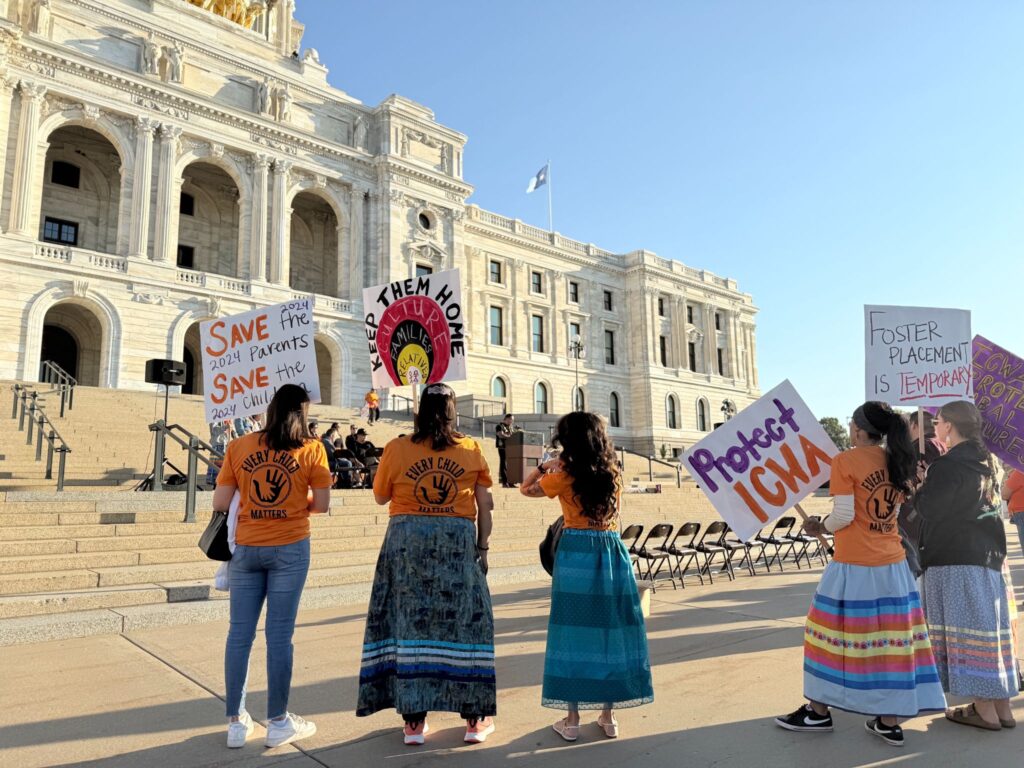
After years of study, the nonpartisan commission that proposes model state laws has released recommendations for updating and clarifying the Indian Child Welfare Act.
Since ICWA was enacted in 1978 to better protect tribal families in child welfare cases, compliance has been inconsistent nationwide, and Native American children continue to be overrepresented in the foster care system.
Seventeen states, however, have strengthened ICWA provisions by passing their own laws.
The commission’s draft Uniform State Indian Child Welfare Act, released July 15, is designed as a template for states that have not passed local ICWA laws, and details best practices. If enacted by state legislatures, the proposed rules would strengthen requirements that social workers make “active efforts” to prevent family separation, such as prioritizing tribal kin for out-of-home placements and providing Indigenous parents more opportunities to reunite with children before their parental rights are terminated. It would also ensure that parental abuse or neglect findings are not solely based on “community or family poverty.”
Though it is nonbinding unless states enact the model law, the uniform state ICWA proposal is more expansive and detailed than the federal law. It offers clearer guidance on cultural competency, including addressing language barriers in child welfare proceedings. It also clarifies that tribal law should carry the same weight as state law.
“Differences in how states interpret and implement ICWA have created a patchwork of requirements that can hinder effective advocacy.”
— Domingo DeGrazia, ICWA attorney for the Pascua Yaqui Tribe
👇
The consistency proposed by the commission would make a positive difference, said Domingo DeGrazia, ICWA supervising attorney for the Pascua Yaqui Tribe.“Today, tribes face significant challenges when their children become involved in child welfare proceedings outside their home states,” the citizen of the Eastern Band of Cherokee Indians said. “Differences in how states interpret and implement ICWA have created a patchwork of requirements that can hinder effective advocacy.”
One state has taken notice. In Arizona, a judicial committee is already evaluating a potential state ICWA law, and a spokesperson for Arizona’s Department of Child Safety said “the committee will likely incorporate the finalized Uniform State ICWA into its ongoing discussions and continue its work accordingly.”
“There was a lot of bridge-building that had to take place in real time — how to meaningfully engage with tribal leaders, what it means to interact with tribal law. all of those were very new lessons for the Uniform Law Commission.”
— Lauren van Schilfgaarde, UCLA School of Law
The Uniform Law Commission, a nonprofit established in 1892, is composed of lawyers, legislators, law professors and judges from each U.S. state and territory. Tribal leaders and child welfare professionals were also involved in drafting the uniform act.
Lauren van Schilfgaarde, a Cochiti Pueblo tribal member and assistant professor at the University of California, Los Angeles School of Law, was one of three advisors for the model law. She said it’s the first time the commission has worked with tribes on child welfare topics.
“There was a lot of bridge-building that had to take place in real time — how to meaningfully engage with tribal leaders, what it means to interact with tribal law. All of those were very new lessons for the Uniform Law Commission,” van Schilfgaarde said. “In many ways, it was predictably clumsy, but in others, it was inspiring. There was a sense of eagerness to learn, and enthusiasm about doing that, that holds real potential for the future.”
The model law is supported by the National Congress of American Indians, as well as tribal leaders from California, Michigan, Colorado and Washington.
Early in the drafting process, the National Indian Child Welfare Association noted that consultation with tribal leaders could have been better, and expressed concern over how a uniform law “might impact existing state ICWA laws,” especially if “unfriendly” amendments are proposed by lawmakers. The association also pointed to a key omission: As with the federal ICWA law, the model legislation does not address protections for tribal youth in juvenile justice cases.
In a June resolution, the Swinomish Indian Tribal Community stressed the importance of including sovereign nations in the legislation-drafting process: “To the greatest extent possible a Uniform State Indian Child Welfare Act should incorporate tribal input, tribal collaboration, and broad child welfare expertise, and should, wherever possible, provide a higher standard of protection to tribal children and families than the federal ICWA’s minimum standards.”
The uniform law’s final approved language, with commentary from tribes that’s viewable online, will be released publicly in October.







 Posts
Posts


No comments:
Post a Comment
Please: Share your reaction, your thoughts, and your opinions. Be passionate, be unapologetic. Offensive remarks will not be published. We are getting more and more spam. Comments will be monitored.
Use the comment form at the bottom of this website which is private and sent direct to Trace.