BOOZHOO! We've amassed tons of information and important history on this blog since 2010. If you have a keyword, use the search box below. Also check out the reference section above. If you have a question or need help searching, use the contact form at the bottom of the blog.
We want you to use BOOKSHOP to buy books! (the editor will earn a small amount of money or commission. (we thank you) (that is our disclaimer statement)
This is a blog. It is not a peer-reviewed journal, not a sponsored publication... WE DO NOT HAVE ADS or earn MONEY from this website. The ideas, news and thoughts posted are sourced… or written by the editor or contributors.
EMAIL ME: tracelara@pm.me (outlook email is gone)
THANK YOU CHI MEGWETCH!
Donald
Neconie, 84, Kiowa, testifed on Saturday, July 9, 2022, as part of the
U.S. Interior Secretary Deb Haaland's Road to Healing tour of the
brutality he suffered while attending Riverside Indian School in
Anadarko, Oklahoma, in the 1940s. Haaland, Laguna Pueblo and the first
Indigenous person to sit in a presidential cabinet, kicked off the
yearlong tour in Anadarko to hear testimony from survivors and
descendants of Indian boarding schools. (Photo by Mary Annette
Pember/ICT)
Road to Healing: Deb Haaland pledges boarding school truths will be uncovered
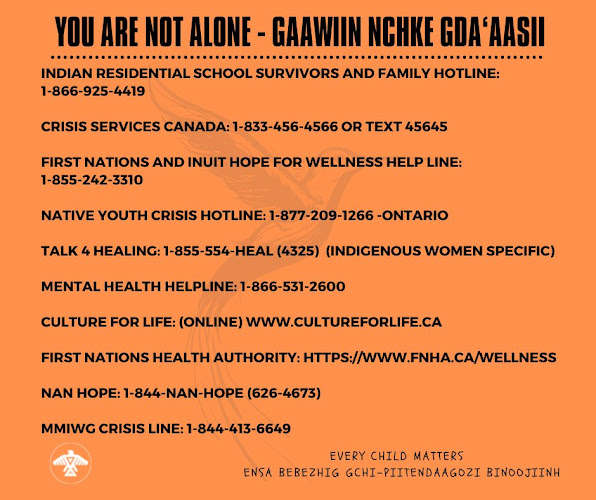
WARNING: This story has disturbing details about residential and boarding schools. If you are feeling triggered, here is a resource list for trauma responses
from the National Native American Boarding School Healing Coalition in
the US. The National Indian Residential School Crisis Hotline in Canada
can be reached at 1-866-925-4419.
ANADARKO, Oklahoma — A journey like no other began at last Saturday for survivors of U.S. Indian boarding schools.
Young
and old, descendants and survivors, crowded into the gymnasium of
Riverside Indian School in Anadarko, Oklahoma, to share their
experiences as the kickoff to U.S. Interior Secretary Deb Haaland’s Road
to Healing tour.
Until now, former boarding school students were
largely ignored, forced to survive brutality and separation from
family, culture and language, and deal with childhood traumas as best
they could.
Finally, the world is listening.
“I still feel that pain,” said Donald Neconie, 84, Kiowa, who attended Riverside school in the 1940s.
Neconie,
a former U.S. Marine, described physical and sexual abuse at the hands
of school employees. School leaders knew of the abuse but did nothing to
stop it, he said.
“You couldn’t cry or tell anyone, because if
you did, you knew it would be worse,” he said. “I will never forgive
this school for what they did to me.”
St. Michaels was a residential school where generations of Indigenous children were abused. https://t.co/4qpnZ89uWf— Ruth H. Robertson (Red Road Woman) (@Ruth_HHopkins) July 7, 2022
He was still working with First Nations people in 2019 in Edmonton at Sacred Heart of the First People’s church. 😠
— Covid is airborne (@Shanon04098546) July 7, 2022
In response to our reporting, the Oblates say they now plan to open an investigation into him. According to their policy, they could refer him to secular authorities.
To date, Gauthier has not been criminally charged in relation to abuse at St. Michael's.
There is so much more to this story. The people accused of these crimes were part of a much larger system. And the damage it caused still reverberates today.
To understand what happened at St. Michael's — and schools like it — listen to Stolen.https://t.co/8sAiNAokbw
BREAKING - I can confirm this video of Utah County Attorney David Leavitt, discussing his "strategy" to adopt a Native American infant, was submitted into evidence in 2020 as part of a Homeland Security human trafficking investigation.
According to the video, David Leavitt says his "strategy" included boarding a plane to Montana to meet with the Northern Cheyenne Tribal President (unannounced) to discuss buffalo exports to Ukraine + eventually adoption.
The Indian Child Welfare Act, passed in 1978, was designed to protect Native American children from being removed from their families.
The child is Leavitt's foster-step-great niece. There is no blood relation, but ultimately it's up to the tribe to decide who is "family." pic.twitter.com/UREFw15fGm
FOX 13 Investigates dropped another bombshell involving a Homeland
Security Investigation against Leavitt. Noel Engels, a former analyst
with Homeland Security Investigations, told FOX 13 Investigates that his
team had been investigating sexual allegations against Leavitt for
several years. Engels said his team had received the video about Leavvit
and added it to the case file investigation on Leavitt on suspicion of
human trafficking. VIA
In 1992, the task force issued their report, Report of Utah State Task Force on Ritual Abuse, concluding that ritual abuse was occurring in Utah. The Jeffrey Epstein saga, as well as my work on The Finders cult,
show that these types of organized sexual rings do exist. Whether or
not there is an occult or ritualistic element is often harder to prove,
and, perhaps, even a distraction from the very real abuse of children
that is happening. - AuthorDerrick Broze
The main administrative building of the Kamloops Indian Residential School is pictured in 1970. (Department of Citizenship and Immigration- Information Division / Library and Archives Canada)
WARNING: This story contains distressing details.
A
foundation that provides university scholarships to Indigenous students
across Canada has severed its ties with a group of Victoria-based
Catholic nuns by returning a $500,000 donation.
The Verna J.
Kirkness Education Foundation announced this week that it had decided to
give back the endowment, received in December 2017, to the Sisters of
St. Ann, a Catholic order whose nuns taught at the former Kamloops
Indian Residential School.
Board chair Tony Williams says the
foundation launched a year-long investigation into the Sisters of St.
Ann after the discovery of 215 suspected unmarked graves near the
residential school last May.
Williams says the foundation met
with the Catholic group during the investigation and asked for specifics
about the abuses that occurred at the residential school, but the
request went unanswered.
"We
want to know there's a more complete acknowledgement that these
[residential] schools were very bad places, that there was a lot of harm
done here, a lot of children who didn't survive, there wasn't a proper
education provided," he said.
"It was setting up an entire generation of Indigenous people for failure and to be marginalized in society."
Sisters of St. Ann's involvement in residential school
The
Sisters of St. Ann is an order of Roman Catholic nuns founded in Quebec
in 1850. In 1890, nuns from the order began teaching at the Kamloops
Indian Residential School, one of more than 100 residential schools
across Canada.
The children were removed from their families and
not allowed to speak their own languages. Many were sexually, physically
or psychologically abused, a situation described by the Truth and
Reconciliation Commission as cultural genocide.
During
the opening prayer for the foundation's announcement, Secwépemc elder
Evelyn Camille said she had initially been excited to go to the Kamloops
Indian Residential School at the age of six, but the experience quickly
turned ugly.
"They used cattle trucks to bring the students
here," Camille said. "When we walked through the door and into the
dormitory, they stripped us and poured coal oil over us — because we
were lousy savages."
Secwépemc
elder Evelyn Camille, shown in a photo from 2015, says she and other
children at the former Kamloops Indian Residential School were stripped
and had coal oil poured on them. (CBC)
The
residential school was permanently closed in 1977. From 2008 to 2015,
the Sisters of St. Ann participated in the Truth and Reconciliation
Commission hearings on Indian residential schools.
The group, now
composed of only 23 nuns, has been selling their assets and giving away
millions of dollars for causes that align with their values.
Tough decision
The
foundation's board secretary, DeDe DeRose, says it was a tough decision
to cut ties with the nuns and return a generous gift, but the
foundation doesn't want its integrity questioned due to a donation from a
group that was historically involved in cultural genocide.
"Now
we can say we don't have that money anymore, and we're going to work as
hard as ever to ensure that Indigenous children continue to have the
opportunities that they deserve to at least be equal to all children in
Canada and opportunities to be involved in post-secondary education,"
DeRose said.
Verna
J. Kirkness Education Foundation board secretary DeDe DeRose says the
organization is returning the endowment to avoid any questions about its
integrity. (Verna J. Kirkness Education Foundation)
The foundation, established in 2008 in Cochrane,
Alta., says its mission is to address the under-representation of First
Nations, Métis and Inuit students in Canadian universities by providing
scholarships to Indigenous students. It partners with B.C. universities
including UBC, Kwantlen Polytechnic University and University of
Victoria.
In
an emailed statement to CBC News, Sisters of St. Ann executive director
Angela Hudson says her group is saddened by the foundation's decision
to return the donation, which she says will be redirected to another
organization that also works to create a brighter future for Indigenous
people.
"Reconciliation
is achieved by listening and learning with humility, and it is always
our preference to engage constructively with our critics, while working
together towards common goals," she wrote.
Support is
available for anyone affected by their experience at residential
schools, and those who are triggered by the latest reports.
A
national Indian Residential School Crisis Line has been set up to
provide support for former students and those affected. People can
access emotional and crisis referral services by calling the 24-hour
national crisis line: 1-866-925-4419.
The
Indian Child Welfare Act pushes for Native children to be adopted by
Native families. With its constitutionality challenged, tribal
sovereignty hangs in the balance.
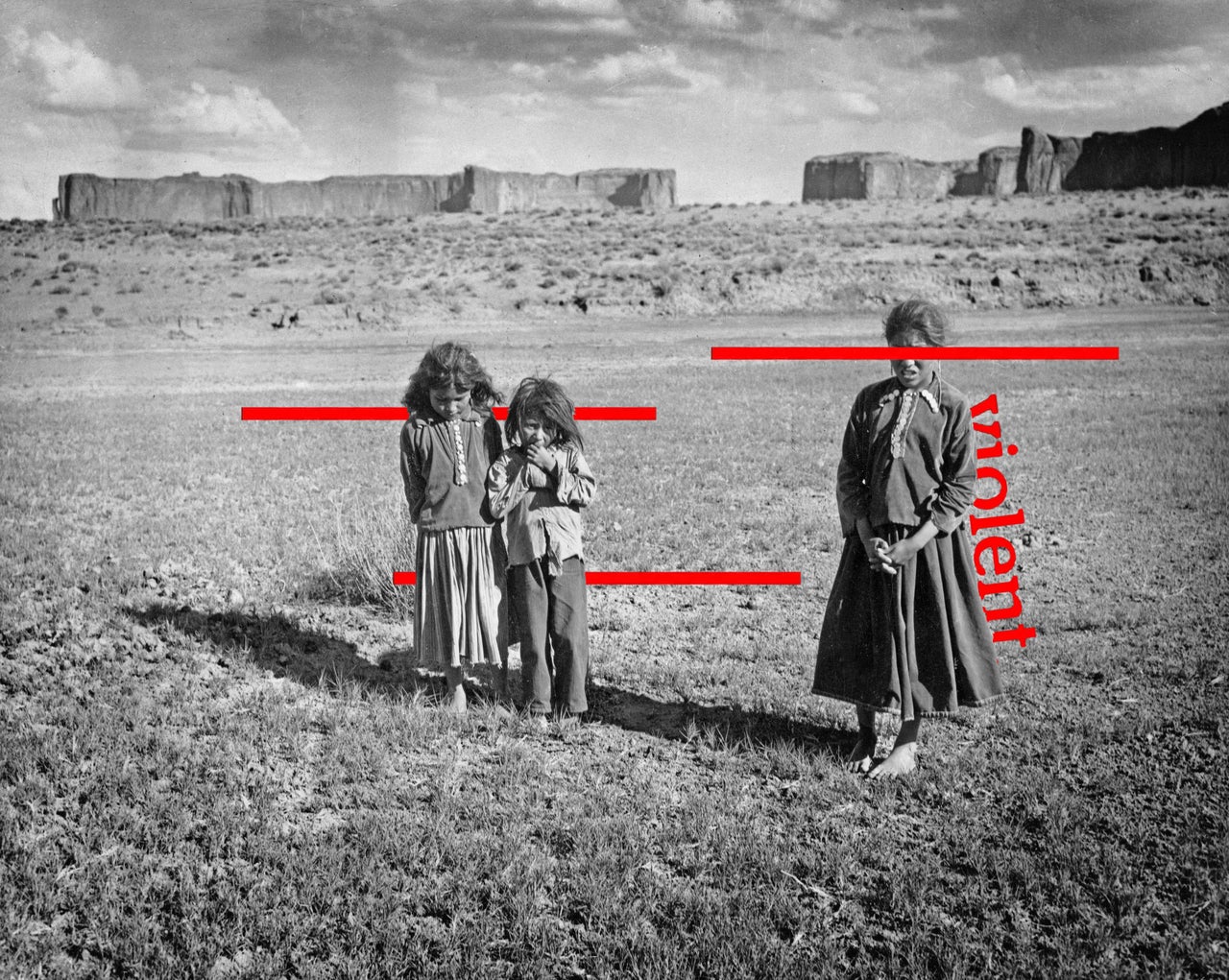
Three
Navajo children, dressed in traditional clothing, stand barefoot in the
grass against the rugged landscape of an unspecified Navajo
reservation, United States, circa 1935.
Illustration: HuffPost; Photos: FPG via Getty Images
In
order to keep us from building power to be free and liberated, the
strategy is simple: Keep us poor, keep us ignorant, keep us divided and
keep us sick.
This game plan likely sounds familiar to many of you, because
it is the living legacy of the white supremacy and oppression baked
into the social, economic and political systems of the United States.
The same strategy used on Native people has been used on Black, brown,
Asian and Pacific Islander communities, immigrants, refugees and
undocumented folks, and other intersectional identities who, like us,
remain targets.
In the highest court of the land, the Indian Child Welfare Act is expected to be debated later this year in Brackeen v. Haaland, in
what many in the field of federal Indian law are describing as the
largest threat to Indian Country and sovereignty in centuries.
When it was passed in 1978, ICWA was landmark legislation,
setting unprecedented protections to address the assimilationist
policies that led to state child welfare and private adoption agencies
systematically removing almost a third of all American Indian and Alaska
Native children from their homes. (Yes, almost a third; you read that
correctly.) Eighty-five percent
of those children were placed in non-Indian homes. ICWA’s
constitutionality is now being challenged in a lawsuit brought by Texas,
Indiana, Louisiana and various individual plaintiffs. It is the first
time a state has sued the federal government over ICWA’s
constitutionality.
If ICWA is overturned, a “slew of laws that rest on a centuries-long precedent of tribal sovereignty could be in jeopardy,”
as a recent Politico piece put it. Those who support the attack on ICWA
would love for all of us to believe that the debate in the Supreme
Court over Indian identity is about the protection of Native children.
They’d like us to believe that they have the best interests of Indian
children at heart. Just like boarding schools
were a tactic to demolish the foundation of tribes, assimilate us and
destroy any obligation the federal government had to us, the push to
overturn ICWA has the same aim ― except this time, the mission is much
more insidious.
Scholars
and journalists investigating the issues have made it clear that this
is part of a plan to build and reclaim conservative power across the
United States. All of our futures are at stake, because at the heart of this case are Gibson Dunn, the Goldwater Institute and the Bradley Foundation
― the same set of political players and funders that have brought
forward policies that attack our democracy, LGBTQ rights, and the teaching of Juneteenth, Black history and critical race theory, and are among those who defended the Keystone XL pipeline.
But,
you might be wondering, how could a child welfare case threaten to
topple tribal sovereignty? And what’s behind it? In short, it’s the same
thing that threatens us all: a small group of people hoarding resources
and power to ensure they keep their unearned privilege ― aka white
supremacy.
Following the overturning of Roe v. Wade, the U.S. Supreme Court has
decided to further strip us of our rights — this absolutely must stop.
One
of the acts on their chopping block is the Indian Child Welfare Act
(1978). This act protects indigenous children from being taken away,
such as they were during the Sixties Scoop, and helps maintain tribal
sovereignty (which is the law of the land and codified in the
Constitution).
According to the Genocide Convention, the forced
removal of children from one group to another group is an act of
genocide. The Sixties Scoop was genocide.
To not protect the ICWA would be a continuation of the genocide it was (at least) intended to stop.
For the last three centuries, government agents across the country
have been responsible for forcibly removing Native children from their
homes and putting them up for adoption or in foster care. Native
children enter the Child Welfare System at rates nineteen times
those of non-Native children. The Indian Child Welfare Act (1978), a
federal law erected to curtail this unconscionable phenomenon and
protect Native children, is currently being challenged in the Supreme Court.
The Allotment Act (1887–1934) and Blood Quantum
Instead of forced assimilation or removal, the General Allotment
(Dawes) Act aimed to break up Native communities by targeting their
geographic autonomy. The statute parceled up previously communal
Indian lands and allocated it to individual tribal members. Then it
opened “surplus land” to settler homesteading. The government
institutionalized a policy called “blood quantum,”
in this case requiring Natives to “prove one-fourth Indian blood in a
given group” in order to inherit their families’ land. This system, in
turn, set Natives up to eventually breed themselves out of existence
through intermarriage, which would ultimately relieve the government of
upholding treaty promises. Although the Dawes Act was replaced by the
Indian Reorganization Act in 1934, blood quantum continues to be widely
used to determine citizenship– and how blood quantum is used
varies from tribe to tribe. In many cases, blood quantum has the
continued effect of shrinking enrollment, burdening and complicating Native identity and relationships, and, in the company of dogs and horses, reducing Natives to our blood measurements.
Eugenics (1900s–present)
Advocated by “public health” professionals throughout the
twentieth century, eugenics practices were ubiquitous across the United
States and Canada. From 1913 to 1957, the state of Vermont issued a
“eugenical-sociological” survey called the Vermont Commission on Country Life to
identify and exterminate the state’s “undesirables” to ensure a
“superior stock” of citizens for the state’s future. The commission
specifically targeted Abenaki people
resisting assimilation, along with African Americans, recent
immigrants, and paupers. The term “mental defectives” was broadly
applied to those that commissioners wanted to target. Fast-forwarding to
the 1970s, researchers brought to light ongoing projects of forced sterilization of southwestern Native women, performed by physicians and Indian Health Service workers. Eugenics has played a sustained role in American “public health” practice throughout the previous century, and cases of forced sterilization of Native women in North America continue today.
These are just a few of the state-sanctioned ethnic cleansing tactics that were erected to solve the “Indian Problem,” the unanticipated survival of Indigenous populations as American nation-building progressed, from which Adolf Hitler drew inspiration during the Third Reich (additional source). However difficult to face, this legacy cannot be divorced from today’s America.
The means of allyship—and dismantling culturally systemic
ignorance—starts with “passing the mic” to marginalized people, who know
our communities’ experiences, needs, and struggles better than anyone
else. But this opportunity only arises if activists make room for
Native experiences of America: our less patriotic accounts of America’s
history and legal system derive from centuries of hypocrisy, broken
treaties, and systematic genocidal policies. Confronting the
experiential gap between Natives and Americans will take determined
self-education, listening, absolute humility on behalf of settlers, and
vast improvements in institutional education.
But the need for effective activism is dire. Real, organized change
requires allyship and the recognition that ignorance is a privilege. It
requires those who consider themselves dedicated to justice to
question the accuracy of their own education, read and listen to
thinkers, artists, and activists from marginalized communities, and
accept every opportunity to pass the mic. Finally, it requires that
Americans let go of the elements of American culture that silence and
erase the marginalized, even if those elements have been treasured.
Melody Walker Brook gives an incredibly powerful and touching insight into rebirth of the Abenaki Elnu tribe. Finding pride in each other and hope for the future, Melody weaves a beautiful talk about finding one's place in creation and community. Melody is an Abenaki educator, activist, and artist. She is a citizen of the Elnu Abenaki Band and currently serves as the chair of the Vermont Commission on Native American Affairs.
Growing up in Milwaukee, Wisconsin,
Kirby Metoxen knew that many of his family members had been removed from
their families in the Oneida Nation and sent to boarding schools. These
schools were founded and run by both the United States Government and
Christian churches. The purpose was forced assimilation: to strip Native
American children of their language, dress, food and rituals. It is
estimated that by 1926, around 83% of Native children were attending
these schools.
Pupils at the Carlisle Indian Industrial School in Pennsylvania, circa 1900.
As an adult Kirby was on a road trip
with friends to Pennsylvania from Wisconsin. While driving, he was
recounting the personal history of his family’s experience at one of
these schools in particular, the Carlisle School in Pennsylvania. On a
whim, they decided to take a detour and visit the school.
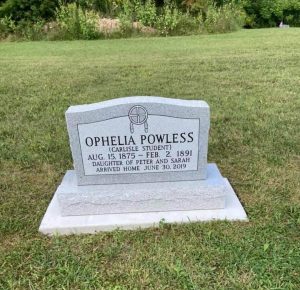
She is home now.
The Grave of Ophelia Powless at the Holy Apostles Cemetery in Oneida, WI. Courtesy of Rodger Patience.
Unbeknownst to Kirby, there were
Oneida children buried in a cemetery on the school grounds, now a
military base. This revelation led him on an unexpected journey to
return those children to the Oneida Nation once and for all.
Top Photo: Rodger Patience and Kirby Metoxen at their StoryCorps interview in Green Bay, Wisconsin on January 27, 2022.By Carl Romey for StoryCorps.
Hi everyone. Do you realize that this blog/website has been here since 2010?
It's even hard FOR ME to remember all that I wrote and posted.
There are hundreds of posts from/about the adoptee perspective. There were many adoptees who started writing in the 2000s, posting on blogs, some even writing books.
It was an avalanche but who was reading? Adoptees mostly. Social Workers/Academics, definitely.
Did it work?
Our intended target was the adoption industry and all the people who planned to adopt a baby. Apparently we failed. We thought people would realize that closed adoption (by strangers) causes harm, trauma, stress, injury and lifelong mental/emotional/physical health issues. We hoped that people would realize the word "adoption" actually means child trafficking,
We hoped that potential adoptive parents (PAPS) would reconsider adopting newborns/babies.
We made suggestions like KINSHIP ADOPTION and LEGAL GUARDIANSHIP instead of the archaic closed adoption system. If a child was a true orphan, with these options at least an adoptee would still have their identity intact. (Yes, there would still be trauma losing birth parents.)
There is also the HISTORY of the Indian Adoption Projects (genocide) HORROR show, as that truth leaked out -- out of that came the book series LOST CHILDREN OF THE INDIAN ADOPTION PROJECTS with Adoptee Voices and history - we had a platform to tell our story.
Here we are in 2022 - we are reentering a NEW dangerous time - some people are listening to adoptees but most are not. (Twitter apparently replaced the blogs. #AdopteeVoices is their hashtag. #FlipTheScript was also used.)
Adoption is touted the solution since Roe v. Wade was overturned.
Some are chanting "adopt adopt" - as if all we adoptees worked for since 2005 was ERASED - WIPED OUT!
But adoptees are not silent: we are still here like my friend Karen:
Unfortunately, it seems that some people think placating those anti-abortion, pro-adoption factions will somehow work in adoptees' favor. This sounds ridiculous to me. These factions created the culture of the Baby Scoop Era & want to return us there. +
Two states still have pending adoptee rights bills, though Rhode Island’s is now on the Governor’s desk. Massachusetts is again in familiar territory: stuck in the Senate. Details for all state bills: https://t.co/8elfiRWREHpic.twitter.com/UnMOFLsXHU
"We have the treaties, which have been in existence in promising this tribe since before the trail of tears, they would not be subject to state jurisdiction precisely because states were known to be their enemies." -Justice Gorsuch #CastroHuerta
Interior Sec. Deb Haaland vows to
continue to investigate U.S. Indian boarding schools and support healing
efforts for tribal communities impacted by intergenerational trauma
caused by the schools.
Many students faced physical, mental, spiritual and sexual abuse. And, many students did not make it back home.
Sec.
Haaland testified Wednesday before the U.S. Senate Committee on Indian
Affairs on the findings of her federal Indian boarding school
initiative, which she announced last June.
A
report released in May found there were 408 schools across the U.S.
from 1819 to 1969, and about 53 marked or unmarked burial sites
identified.
Boarding school policies focused on cultural assimilation, and the forced removal and relocation of Native children.
Sec.
Haaland says as the investigation continues, the next step is to gather
testimony, find support for healing, and resources for language and
culture initiatives.
“I
recently announced we will embark on the road to healing, a tour to hear
directly from survivors and descendants. A necessary part of this
journey will be to connect survivors and their families with mental
health support, create a permanent collection of oral histories. We know
this won’t be easy, but this is a history we must learn from if we are
to heal from this tragic era in our country.”
The hearing also focused on Indian boarding school legislation (S. 2907) to create a commission to help locate and analyze records, and hold culturally appropriate hearings.
Sandra
White Hawk, board president of the National Native American Boarding
School Healing Coalition, was among a panel of Native leaders to testify
in support of the legislation.
“It
will open up wounds, but in order for us to heal we need to air out
those wounds and replace them with the medicines that we have within our
ceremonies, our songs along with our mental health professionals that
can help us as well. Most importantly, what was taken from us our songs,
our lifeways that will bring the healing when our wounds are open from
that. There was an elder that was one of my teachers and he said we are
people that are well acquainted with grief. And, I’ve watched and seen
that as we’ve gone into communities and listened to experiences and
watched healing take place.”
Senators
on the Indian Affairs Committee, including chair Brian Schatz (D-HI),
vowed to continue to push the boarding school legislation forward and to
help find appropriations.
& Legislative Hearing to receive testimony on S. 2907
The U.S. Senate Committee on Indian Affairs will hold a hearing Wednesday on Indian boarding schools.
The
hearing will examine the Interior Department’s investigative report on
Indian boarding schools and the Truth and Healing Commission on Indian
Boarding School Policies Act (S. 2907).
Native leaders are scheduled to testify about the report, legislation and what action is needed next.
Advocates
have been calling for the Senate committee to hold a hearing on the
boarding school legislation and for the House version to be passed.
The Indian affairs committee hearing will be streamed online.
Abolish Adoption. As so many people have said, it's an atrocious state of affairs that children are taken into care because of issues in their families that are oft underscored by poverty & not enough help. Yet, foster care & adoption sector wants more help?! #adopteetwitterhttps://t.co/1o8nLoFW8e
Beginning August 1, 2022, Louisiana-born adopted people can apply for and have the right to obtain a copy of their own original birth records. pic.twitter.com/oeSlP9J9MD
Fialka Jack-Flesh had not yet taken her first steps in the world before she entered the foster care system.
Her mother, a residential school survivor, was unable to take care of her, and she was taken into care at just eight months old.
“I
was removed from my mom’s care originally because she grew up in
residential school and she was deemed very unsafe at the age that she
had me,” Jack-Flesh said. “She had me, I think, like seven years after
she showed up for residential school. So not that long.”
It has been 10 years since Jack-Flesh aged out of government care.
Sometimes, it seems as if it was just yesterday.
For Jack-Flesh, aging out of government care, she said, was jarring and devastating.
“It’s kind of like being thrown off a f–king cliff. If I’m going to be very honest with you guys.”
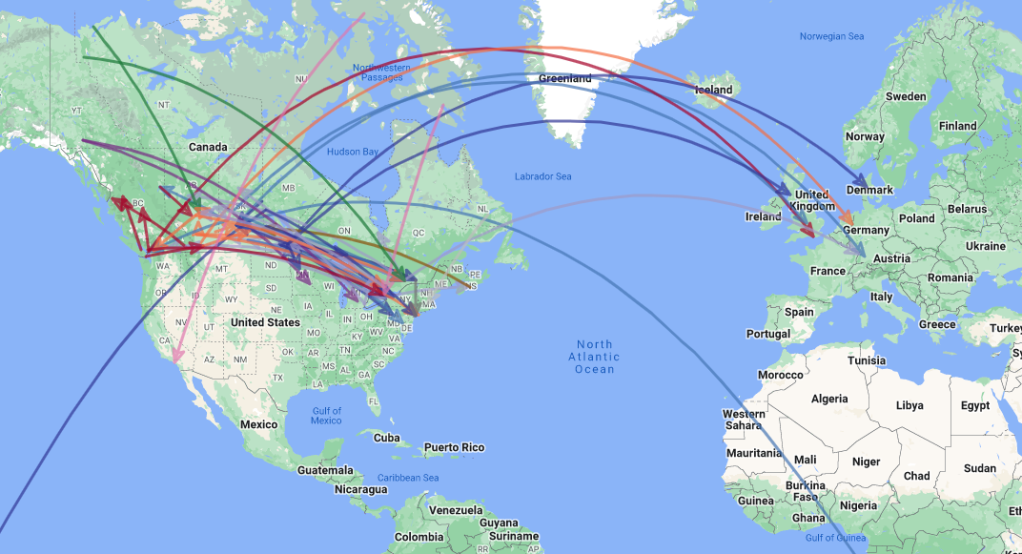
The Sixties Scoop Network’s open-source map tracking the diaspora of adopted Indigenous children.
Sixties Scoop Network
Documenting the dispersal of children has fallen to grassroots groups like the Sixties Scoop Network,
which has tried to map where Indigenous kids were “trafficked” as far
away as Denmark and New Zealand, said co-founder Colleen Cardinal.
Marylou Fonda was one of thousands of Indigenous children adopted by
non-Indigenous families in the '60s scoop. She says by the time she was
able to track down her birth family, her biological mother had passed
away.
Tobique First Nation Adopts Dedicated Child Welfare Act
Moncton, NB, Canada / 91.9 The Bend |Aaron Sousa | Jun 16, 2022
Wolastoqewiyik Neqotkuk (Tobique First Nation) made history
on June 8 after becoming the first Wolastoqey nation in the country to
ratify its own Child and Family Well-Being Act.
Similar to the federal government’s C-92, also known as the Act
respecting First Nations, Inuit and Métis children, youth and families,
it empowers Indigenous communities to take jurisdiction over child and
family services.
Neqotkuk First Nation Chief Ross Perley said this is a historic step
towards self-determination, adding that it will ensure kids and their
families can stay healthy, achieve their dreams and celebrate their
culture while living at home.
“We have talked for a long time about making our laws and taking
control over child welfare for our community, our families,” said Perley
in a news release.
“The Neqotkuk Child and Family Well-Being Act makes this goal a reality.”
The Wolastoqey nation noted this was a recommendation by the Truth
and Reconciliation Commission to help address the ongoing legacy of
Residential Schools and Indian Day Schools.
The new Neqotkuk Child and Family Well-Being Act introduces the following changes:
Recognizes the rights of the child
Exercises inherent right to make laws governing child welfare amongst Neqotkukiyik
Establishes Neqotkuk jurisdiction and definition of the best interest of the child
Unifies families through a proactive prevention-based child and family well-being model
Builds service models representative of Wolastoqiyik Neqotkuk
Replaces the Province of New Brunswick’s authority over child welfare matters in Neqotkuk
Neqotkuk First Nation has operated a child welfare agency, the
Tobique Child and Family Services Agency Inc., since 1985, delivering
services designed by federal and provincial governments.
The act will also allow the agency to design child welfare services.
“The New Brunswick Social Development department has been a solid and
reliable partner and we look forward to working productively with them
to implement this law and establish its support through provincial
institutions,” said Perley.
Retired priest, 92, charged after decade-long investigation into residential school sexual assault | Charge part of RCMP investigation into Fort Alexander Residential School
Arthur
Masse is shown here in this undated photo. Masse, now 92, is charged
with indecent assault against a 10-year-old girl who was a student at
the Fort Alexander residential school between 1968 and 1970. (Société historique de Saint-Boniface Archives)
WARNING: This story contains distressing details.
A
retired priest has been charged with indecent assault in connection
with a decade-long RCMP investigation into a Manitoba residential
school.
Retired Father Arthur Masse, 92, was charged in connection
with the sexual assault on a 10-year-old girl, who was a student at the
Fort Alexander residential school, northeast of Winnipeg.
The alleged assault occurred between 1968 and 1970, police said at a news conference Friday morning.
"The
victim in this case has endured a lot throughout the investigative
process and has stood firm in speaking out about what happened to her,"
RCMP spokesperson Sgt. Paul Manaigre said at a news conference on
Friday.
More than 80 investigators worked on the case, contacting more than 700
people across North America to search for witnesses and victims, and
obtaining 75 witness and victim statements.
“There are other prolific [Indian Residential School] abusers still
alive that also must be brought to justice,” Fontaine wrote on Twitter.
“This arrest proves it can be done.”
Fort Alexander Residential School operated
from 1905 to 1970 and was run by the Catholic Church. “From its early
years, the school had problems with runaways,” the Indian Residential
School History and Dialogue Centre at the University of British Columbia
says on its website.
MINN. (KTTC) – 24-year-old, Rachel Evangelisto was crowned Miss Minnesota at the Miss Minnesota Scholarship Org. Pageant on Friday evening.
Evangelisto participated in the pageant with 20 other women.
According
to her Miss Minnesota contestant bio page, she attended the University
of Minnesota - Morris, where she got a degree in Political Science with
an emphasis on Law.
Evangelisto works for the Indian Child Welfare Act (ICWA) Division of Minnesota where she is a Guardian ad Litem.
She is also a member of the Húŋkpapȟa Standing Rock Sioux tribe.
Evangelisto will represent Minnesota at the next Miss America pageant.
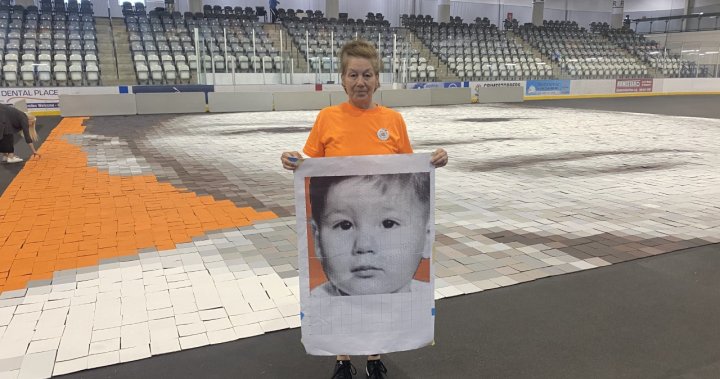
Students at Quispamsis Middle School used paperboard squares to
recreate a photo of Mindaver Lee, a survivor of the scoop in the 1960s.
Minda Burley has only one photo of herself as a baby.
“It was
published in the newspaper to adopt Metis’s child, and that’s how we
found our family to adopt my biological sister Joan and me,” Burley
said.
It was only recently that she discovered
that she was part of the scoop of the 1960s. During this period,
thousands of indigenous children were taken out of their homes and given
to non-indigenous families.
“We can’t see”: British Columbia scoop survivors in the 1960s want action in housing school calculations
Burley’s
photographs now show thousands of toddlers deprived of their culture,
shedding light on the shadows of Canadian history.
Her
story and the stories of many others related to the scoops of the 1960s
have been the focus of studying at Quispamsis Middle School in this
past grade.
On Friday, Grade 8 classes completed an art
installation project at QPlex, Quispamsis, New Brunswick, that recreates
Burley’s only toddler photo.
“It’s
about pulling out all my brothers and sisters and listening to their
stories and what they’ve experienced,” because much happened to them.
It’s much worse than what everyone really wants to know, “Burley said.
“This will make them feel better and hopefully bring out what happened to us and everyone in the 1960s scoop.” SOURCEMORE PHOTOS
The National Museum of the American Indian Launches Ancestors Know Who We Are
Contemporary Black-Indigenous women artists Rodslen Brown, Joelle
Joyner, Moira Pernambuco, Paige Pettibon, Monica Rickert-Bolter, and
Storme Webber are featured in this digital exhibition.
The show takes its title from a letterpress print by Storme Webber,
created as a response to being told she was not Black enough or Native
enough.
Moira Pernambuco, “Troy” (1995), black and white photograph (Mamiya 6x7 (medium format) camera). Pernambuco’s Black Boy Beautiful, Black Boy Vulnerable
is an ongoing photography series that presents a counter narrative to
frequent depictions of Black boys and men today, documenting their
private, quiet, and vulnerable sides.
The Smithsonian’s National Museum of the American Indian presents the new digital exhibition Ancestors Know Who We Are,
featuring works by six contemporary Black-Indigenous women artists that
address issues of race, gender, multiracial identity, and
intergenerational knowledge.
Rodslen Brown (Black/Cherokee Nation, 1960–2020), Joelle Joyner
(African American and Kauwets’a:ka [Meherrin] descent) Moira Pernambuco
(African and Amerindian [Wapishana]), Paige Pettibon (Black, Salish, and
White descent), Monica Rickert-Bolter (Prairie Band Potawatomi, Black,
and German), and Storme Webber (Alaskan Sugpiaq [Alutiiq] and Black
descent) are the artists in the show.
“The women featured in this exhibition powerfully tell their stories
through the art they created,” said Cynthia Chavez Lamar, director of
the National Museum of the American Indian.
“As a museum, it’s important we share the perspectives of Indigenous
women to provide insight into their diverse experiences through
exhibitions like this as well as our programs.”
In addition to the works of art, Ancestors Know Who We Are
also highlights artist interviews and writings from Black and
Black-Indigenous scholars in the fields of history, gender studies, art
history, and education, including Kyle T. Mays (Black/Saginaw Chippewa),
fari nzinga, Lilian Sparks Robinson (Black/Sicangu Lakota), and Amber
Starks (Black/Muscogee Creek). Often written in the first person, these
short essays address the exhibition’s themes.
“The exhibition moves beyond the idea of the ‘Native experience’ or
the ‘Black experience’ to highlight how gender and mixed-race identity
informs art and creative expression,” said curator Anya Montiel (Mexican
and Tohono O’odham descent). “These artists have unique perspectives
and voices that speak to our current moment as a nation.”
The show takes its title from a letterpress print by Storme Webber,
created as a response to being told she was not Black enough or Native
enough.
This project received support from the Smithsonian American Women’s History Initiative.
By Trace L Hentz (blog editor) It appears that Baby Deseray was placed by the same adoption lawyer Ray Godwin and the birthmother dealt wi...
Bookshop
You are not alone
To Veronica Brown
Veronica, we adult adoptees are thinking of you today and every day. We will be here when you need us. Your journey in the adopted life has begun, nothing can revoke that now, the damage cannot be undone. Be courageous, you have what no adoptee before you has had; a strong group of adult adoptees who know your story, who are behind you and will always be so.
Diane Tells His Name
click photo
Lost Birds on Al Jazeera Fault Lines
click to read and listen about Trace, Diane, Julie and Suzie
NO MORE STOLEN SISTERS
click image
We conclude this series & continue the conversation by naming that adoption is genocide. This naming refers to the process of genocide that breaks kinship ties through adoption & other forms of family separation & policing 🧵#NAAM2022#AdoptionIsTraumaAND#AdopteeTwitter#FFY 1/6 pic.twitter.com/46v0mWISZ1
As the single largest unregulated industry in the United States, adoption is viewed as a benevolent action that results in the formation of “forever families.” The truth is that it is a very lucrative business with a known sales pitch. With profits last estimated at over $1.44 billion dollars a year, mothers who consider adoption for their babies need to be very aware that all of this promotion clouds the facts and only though independent research can they get an accurate account of what life might be like for both them and their child after signing the adoption paperwork.










/cloudfront-us-east-1.images.arcpublishing.com/gray/7MJ2CJVPHRHXZGAVZLLZIOHFAA.jpg)







 Posts
Posts

