They Took Us Away

They Took Us Away
click image to see more and read more

it's free

click

How to Use this Blog

BOOZHOO! We've amassed tons of information and important history on this blog since 2010. If you have a keyword, use the search box below. Also check out the reference section above. If you have a question or need help searching, use the contact form at the bottom of the blog.


We want you to use BOOKSHOP to buy books! (the editor will earn a small amount of money or commission. (we thank you) (that is our disclaimer statement)

This is a blog. It is not a peer-reviewed journal, not a sponsored publication... WE DO NOT HAVE ADS or earn MONEY from this website. The ideas, news and thoughts posted are sourced… or written by the editor or contributors.

EMAIL ME: tracelara@pm.me (outlook email is gone) THANK YOU CHI MEGWETCH!

SEARCH

Saturday, September 9, 2023

Assimilation Vacation?


In the 1960s, Zepeda’s grandmother protected her from being taken away on an “assimilation vacation” in the San Francisco Bay Area, where children would “learn how other families live” and potentially be adopted away from their rightful families.  Zepeda and her siblings lived with a constant fear of being taken from their home, often being told by their grandmother: “You better behave because if you don’t, white people are going to take you away.”  It wasn’t until 1978 that the Indian Child Welfare Act prohibited the removal of Indigenous children from their families.

Further alienating Indigenous people from their roots was the repression of their spiritual beliefs and practices going back to the 1850s.  Until the American Indian Religious Freedom Act passed in 1978, many people practiced secretly while participating in mainstream religion.  For example, Zepeda’s great grandfather was a tribal medicine person, but also an altar boy for a Catholic priest.

Owning land contributes to economic and societal stability as well as long term wealth. While the United States government was obliged for many generations to honor treaties and debts with native tribes, the Termination Act of 1953 sought to disband tribes, sell their lands, and relocate American Indians. For Zepeda, this meant that she was no longer Indian and was not eligible to receive services from the Indian health clinic.  The policy also had long-term and devastating economic consequences for tribal communities who lost their land.

In 1983 with Hardwick v. United States Government, Zepeda was considered Indian once again. “We have reorganized and reestablished ourselves.” Now, she lives again on the land that had been her grandma’s.

Understanding Indigenous Communities to Support Their Health Needs

READ MORE

VIDEO:  http://placemattersoregon.com/ 

For thousands of years, the Klamath Tribes have had a deep physical and spiritual connection to southern Oregon. But in 1954, the U.S. government took over their tribal lands there. The trauma of losing their land, and the racism and discrimination they confronted in the years after, are at the root of health challenges that still affect tribal members at higher rates than other ethnic and racial groups in Oregon.  Monica YellowOwl, a prevention specialist for Klamath Tribal Health and Family Services, and other tribal members are working to restore their people’s connection to the land in order to improve their physical and mental health. “We don’t always want to be seen as the traumatized Indians. We want to be seen as resilient Indians, powerful people, connected to our homeland, practicing our traditions and our cultures,” Monica says. 

Place Matters Oregon is an effort of the Oregon Health Authority to get people talking about how place affects our health—as individuals and as a community. Check out the link above to explore more connections between place and health and join the conversation. 


Friday, September 8, 2023

Protecting Alaska Native Children — Connections to Culture and the Environment

Research scientist Heather Sauyaq Jean Gordon calls subsistence ‘a preventive and protective cultural practice for well-being.’

Ivan Encelewski, executive director at Ninilchik Traditional Council, fishes for salmon with a gillnet on the Kenai River in Alaska. Provided photo.

Research released on September 5th highlights an issue rarely discussed in the field of child welfare, but vital to the health and well-being of Indigenous children and families: their stewardship of the natural environment. 

The unique study focuses on many generations of the Alaska Native Ninilchik Village Tribe, and the harmful impacts of colonization and federal and state mismanagement of traditional homelands. Tribal members contributed to the research, conducted over 12 months in South Central Alaska.

“Subsistence is a critical part of Alaska Native cultures and that the ability to pass subsistence practices to children is an important protective factor for their well-being,” reads a policy brief outlining the findings.

The report is authored by Heather Sauyaq Jean Gordon, a research scientist with the nonprofit research and policy institute Child Trends. Gordon, 38, is Iñupiaq and an enrolled member of the Nome Eskimo Community. She defines Indigenous subsistence as reaching far beyond hunting, fishing, and gathering food. 

KEEP READING


HUNT FISH GATHER - that is a treaty right too in North America.

Thursday, September 7, 2023

The real battle was in the mind: Cyclist crosses Canada

 60s Scoop |  Michael John Lo

He was determined to change his life, so he rode a bike from Moncton to Nanaimo

After 20 years living in Eastern Canada, Chris Aubichon is returning to Vancouver Island to finish his education, which he stopped pursuing at the age of 12. “This is part two of my life."
web1_chris1
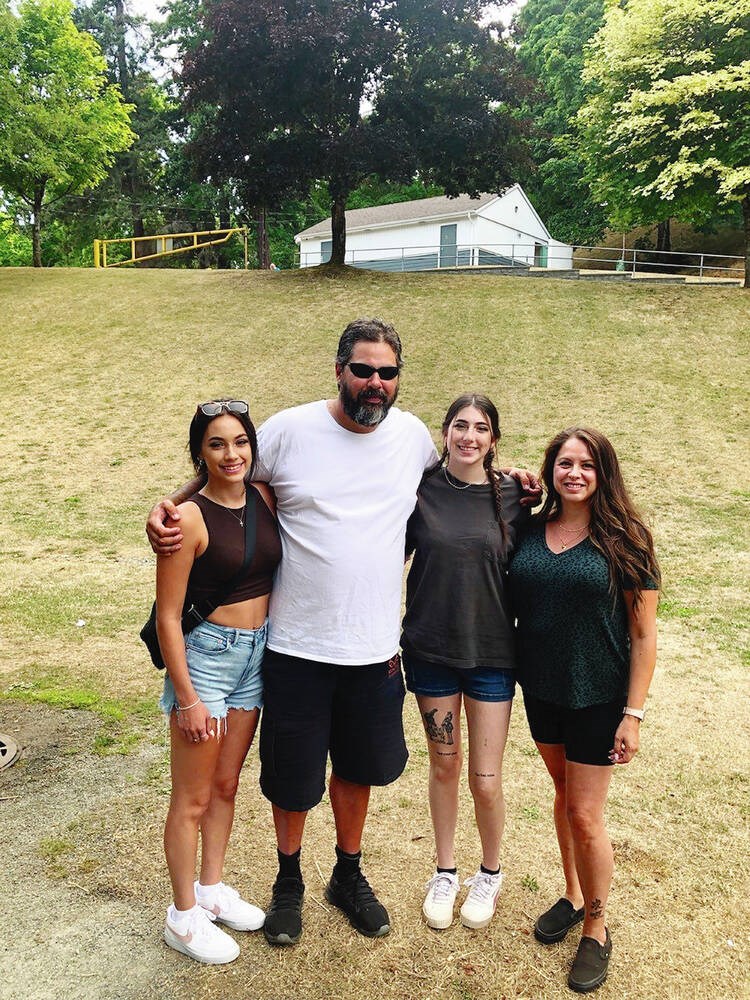
Chris Aubichon’s two elder daughters and sister Jenn were waiting to welcome him at Bowen Park. From left, Nevaeh, Chris, Selenia, and Jenn. VIA JENN AUBICHON

Chris Aubichon has spent the past three months cycling across the country in a bid to raise awareness of post-foster-care life and men’s mental health — and to begin a second chapter of his own life. 

The 44-year-old father of three reached the finish line at Bowen Park in Nanaimo on Friday evening, where he was greeted by a cheering group of supporters. 

After 20 years living in Eastern Canada, he’s returning to finish his education, which he stopped pursuing at the age of 12. 

“This is part two of my life,” he said. 

Aubichon, born in Prince George and raised in Nanaimo, is of mixed Indigenous and Metís heritage; he was a ward of the court from the age of six to 18. 

His mother, who is of Tla’amin descent, was raised by a white Catholic family and was part of the Sixties Scoop. 

“She had her own demons,” he said, adding that her mother was born in a residential school. 

His grandmother died of a drug overdose in Vancouver’s Downtown Eastside after leaving residential school, he said. 

Aubichon said he has overcome his substance abuse and addiction issues, stemming from his upbringing, which involved experiences of sexual abuse in group homes. 

But his mental health remains a persistent challenge, one that has cost him jobs, relationships, and housing. 

“It doesn’t matter how badly you want to get up and go to work. You’re not getting up,” he said. 

It’s part of the reason why he chose to bike back to Nanaimo. 

“If I jumped on a plane and flew across the country, I’m going to be the same man that got there that left, and that man isn’t going to find success,” he said. 

But someone who’s able to bike across most of Canada? 

“The man that can do that can surely be successful at school,” he said. 

On May 11, Aubichon found a mountain bike that could hold his 320-pound frame, loaded it up with camping gear and started pedalling. 

He didn’t even inform his family until he was halfway to Fredericton. 

His sister Jenn, initially skeptical of the whole ordeal, had only one request: that he document his journey, both the highs and the lows. 

Aubichon agreed, even though he thought that no one would care. But his journey would be followed by ­thousands on social media, and even catch the eye of government ministers. 

The initial days were the hardest, a constant fight against severe cramps, back spasms, and shoulder pains resulting from a life of smoking, drinking and neglect, he said. 

“Physically, I was only making it 15 or 20 kilometres a day,” he said. “I could pedal for maybe 15 seconds and I would have to stop, and my legs would cramp up.” 

But the real battle was in the mind, he said. 

Aubichon has bipolar disorder, depression, and chemically-induced anxiety disorder, which has cost him jobs, relationships, and housing. 

“There were days where I’m just riding down the roads and just literally crying,” he said. 

But bit by bit, the gears felt lighter on his feet, and every day he would ride further until he was travelling 120 kilometres per day. 

That’s not to say there weren’t other challenges. 

Wildfires in Northern Ontario dogged his steps. Vicious headwinds and sweltering weather accompanied much of his journey through Western Canada. 

The Rockies were brutal, and he was forced to detour from the Coquihalla due to yet another wildfire, near Merritt. 

Twice, he was thrown off his bike in northern Ontario by the buffeting winds of camping vehicles passing him with only 12 inches of clearance. 

On the western outskirts of Winnipeg, his bike was stolen outside of a Tim Hortons. 

But an emotional dispatch on social media went viral and people donated money to replace his gear and supplies. 

There were many such instances of kindness on his journey, he said, adding that an older man in North Bay, Ont. slipped him $50 without knowing that Aubichon was starving that day and couldn’t afford to eat. 

People have invited him into homes, waited on the sides of a highway for hours just to encourage him on his journey, he said. 

“I’m still a big man, but I’m in great shape,” he said, adding that he’s probably lost 50 pounds since he started. “I have a clarity that I’ve never had in my life, and mentally I feel stronger than I ever have.” 

Aubichon now wants to help others through a bike support group and advocate for better supports for youth aging out of care, who are overrepresented in homeless populations. 

Many people living in tents right now are former wards of the state, sent out to fend for themselves at an early age, he said. 

“A lot of what they're dealing with is not their fault.” 

SOURCE

Wednesday, September 6, 2023

Peter d'Errico Speaks at Parliament of the World's Religions (video)

 BLOG POST

'Christian discovery' and the legal entrapment of Indigenous Peoples


War against the children | NABS REPORT: US operated 523 boarding schools


The US government, Native American children and boarding schools

Holly Richardson 9/1/2023

There are now over 500 Native American boarding schools accounted for in the United States. Eight were in Utah

Teachers and students gather for a portrait at Tunesassa School in Tunesassa, New York, in 1906.

In this photo taken in 1906, provided by the Quaker and Special Collections at Haverford College, teachers and students gather for a portrait at Tunesassa School in Tunesassa, New York. The National Native American Boarding School Healing Coalition says it will digitize 20,000 archival pages related to Quaker-operated Indian boarding schools. The records will provide a better understanding of the conditions that children received at these schools.  IMAGE: Quaker and Special Collections, Haverford College via AP

“They went after our language, our culture, our family ties, our land. They succeeded on almost every level,” Ben Sherman told The New York Times. “Don’t try to tell me this isn’t genocide.”

Sherman, now 83 and a retired aerospace engineer, is also a member of the Oglala Sioux Tribe who spent four years in a Native American boarding school in South Dakota. Sherman believes that after the “shooting wars” by the United States government against Native Americans had subsided, the government was “not done with war, so the next phase involved war against the children.”

Enter Native American boarding schools.

‘Vast and entrenched’

“From small shacks in remote Alaskan outposts to refurbished military barracks in the Deep South to large institutions up and down both the West and East coasts,” Native American boarding schools took in children from across the country.

Incomplete records and scant government attention let the stories of these schools largely fade into oblivion. For many students of those schools and their families, the trauma “never went away.

Recently, however, more concerted efforts are being made to identify the schools and the children who went there, as well as those who never left. Last year, the Department of the Interior, under the leadership of Deb Haaland, released a report identifying 408 schools in 37 states, including 21 schools in Alaska and seven in Hawaii, from 1819 to 1969.

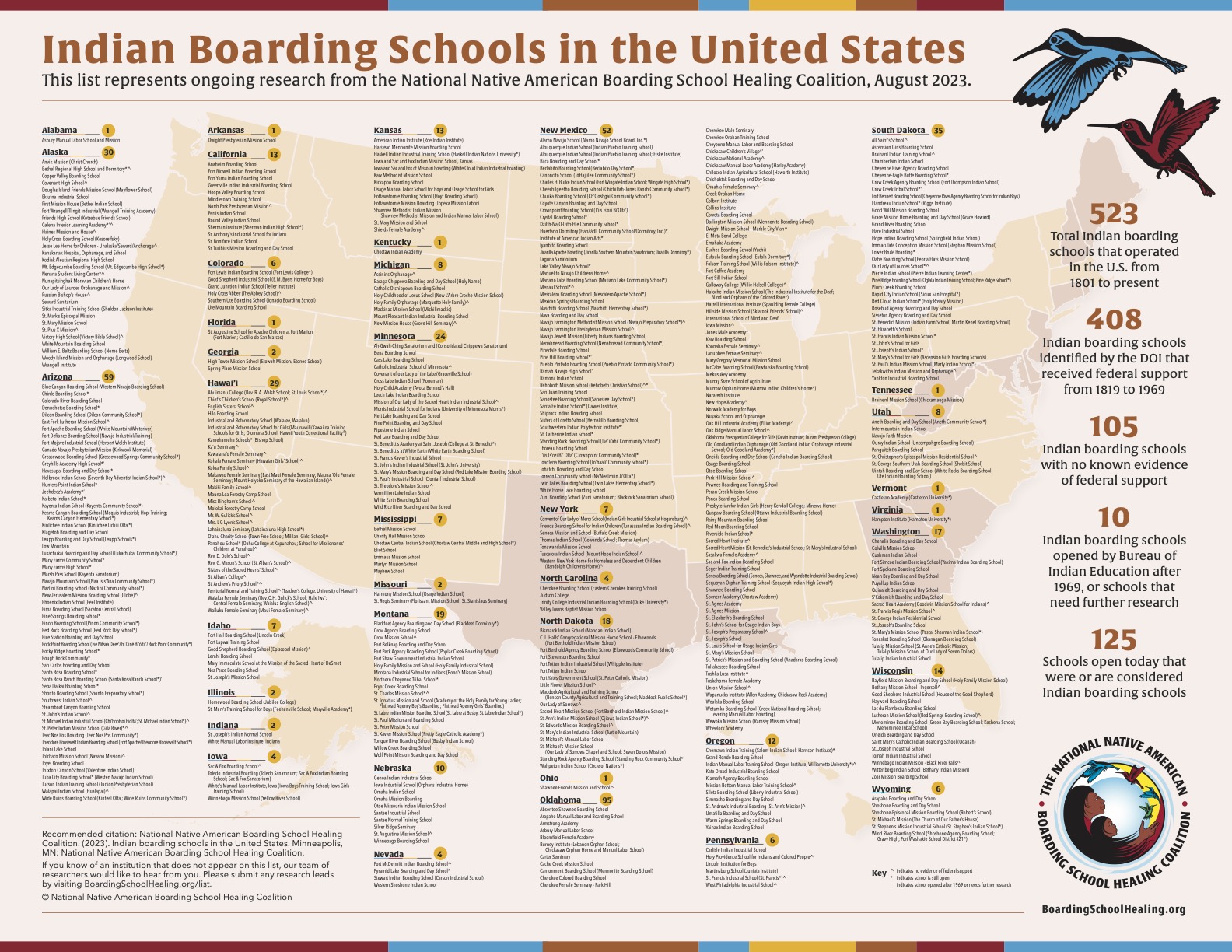
On Wednesday, the nonprofit National Native American Boarding School Healing Coalition announced that they had identified another 115 schools, bringing the total to 523 in 38 states. They identified one additional school in Utah, bringing this state’s total to 8. They found 22 more in Hawaii, bringing that state’s total to 29. They found even more in Oklahoma, the state with the most schools identified, now standing at 95.

Most of the additional schools did not receive federal funds, but were run by religious groups and churches, reports The Washington Post.  Many were Catholic, Presbyterian or Episcopalian, but also included small congregations of Quakers, Congregationalists and others.

Scattering the children

Richard Henry Pratt, a military officer who fought in the 1870s to forcibly remove multiple tribes from the Southern Plains, dreamt of abolishing all Native American reservations and “scattering the entire population of Native children across the country, with some 70,000 white families each taking in one Native American child,” reports The New York Times.

While he was not successful in bringing that vision to fruition, he started down that road by creating the Carlisle Indian Industrial School in Carlisle, Pennsylvania, in 1879. The school took in Native American children from as far away as Alaska and tried to “civilize” them. In 1892, Pratt delivered a speech at a convention, where he said,

A great general has said that the only good Indian is a dead one, and that high sanction of his destruction has been an enormous factor in promoting Indian massacres. In a sense, I agree with the sentiment, but only in this: that all the Indian there is in the race should be dead. Kill the Indian in him, and save the man.

Pratt then praised the benefits of slavery for Black people and said it was now the responsibility of the United States to “civilize” Native Americans.

The “civilizing” process, or “assimilation” was, as Pratt described by wanting to “Kill the Indian in him,” a brutal one. Children’s hair was cut off, their native apparel burned. They were dressed in Western apparel, their names changed and their religion changed. They were “hired out” to do menial jobs, with the schools retaining any fees received.

Moderating a panel at the Leonardo in Salt Lake City last year, Utah State University student Taylor “Cheii” Begay said, “This assimilation process, the boarding school era, it was a war tactic.”

“They tried to kill us”

For noncompliant students, punishment could border on torture. Being whipped with a cat-o’-nine tails, being paraded naked for other students to beat with belts, being thrown into walls, doused with fire hoses, having food withheld, being publicly humiliated and more. Sexual abuse was rampant, report both The New York Times and The Washington Post.

The New York Times reports that in 1891, the Grand Junction News printed an exchange between the superintendent of the Grand Junction Indian School in Colorado and the secretary of the Interior. The superintendent informed the secretary that one of the boys at the school could not fit his foot into the government-issued shoe because he had six toes. “What shall I do?” asked the superintendent? “Off with his toe!” came the reply. So, off came the toe.

Not every student counts their time at Native American boarding schools as traumatic. For some, it was not, including Cris Polk, from the Yakama Tribe of Washington, who told KSL earlier this year that those were the best four years of her life, and where she met her lifelong best friend.

Andy Merrick, chairman of the Omaha Tribe of Nebraska, met his wife at Intermountain Indian School. They celebrated their 43rd anniversary this year.

“I love this place. I love the mountains and the memories I have here,” Merrick said to KSL. “One of the best times of my life was out here in Utah.”

Truth and healing

Those with fond memories are the exception. By 1928, the Meriam report detailed how children were “malnourished, overworked and harshly disciplined.” Forty-one years later, in 1969, a U.S. Senate report reported on the failures of the system. That report spurred support for the Indian Self-Determination and Education Assistance Act in 1975 and then the Indian Child Welfare Act in 1978.

In June, the U.S. Supreme Court upheld a challenge to ICWA in a decision praised by tribes and Utah’s elected officials, including Lt. Governor Deidre Henderson. Supreme Court Justice Neil Gorsuch summed up the importance of ICWA, stating that it “secure(s) the right of Indian parents to raise their families as they please; the right of Indian Children to grow in their culture; and the right of Indian communities to resist fading into the twilight of history.”

When Deb Haaland was appointed the first Native American to head the Department of the Interior, she brought with her boarding school legacies. Her grandparents were stolen from their families as children and she grew up hearing their stories. Her great-grandfather was taken to the infamous Carlisle Indian School. She cried with her grandmother as her grandmother shared her loneliness and sadness at being separated from her family.

“Acknowledging these painful truths and gaining a full understanding of their impacts” will help heal painful “threads of trauma and injustice,” she wrote in 2021. Over the past year, she has been around the country on a “Road to Healing Tour.”

Last year’s report was one of two. The second report will focus on the number of children who died at the boarding schools. Investigators expect that number to be in the “thousands or tens of thousands.” With sparse records of the children, or even where the cemeteries are located, the final number is likely to remain unknown. At least one excavation in the United States this summer found no remains.

Holly Richardson is the editor of Utah Policy

**


NABS launches digital map with new research of 523 U.S. Indian boarding schools

We are honored to announce the release of new research findings and our first-ever interactive digital map of Indian boarding schools in the United States.

In 2020, NABS released a list of 367 Indian boarding schools, which at the time was the largest and most extensive list available to the public. Since then, there have been various efforts by the Department of the Interior (DOI) and religious institutions to identify their involvement in the establishment and operation of Indian boarding schools nationwide.

Our latest research identified a total of 523 Indian boarding schools in the United States. This is the largest known list to date, containing both federally operated boarding schools and church-run schools.

This latest research can be explored through a new interactive international map where people will be able to find information on all 523 known Indian boarding schools in the United States, alongside known Indian residential schools in Canada. This tool helps visualize the magnitude and deliberate effort to assimilate Indigenous peoples across North America.

523

Total Indian boarding schools that operated in the U.S. from 1801 to present

NABS hopes this new research and tool will inspire researchers, educators, and policymakers to gain a better understanding of the impact and scope of Indian boarding schools. Ultimately, we hope it will help survivors, descendants, and Tribal Nations in charting a pathway forward.

This project was made possible through a partnership with the National Centre for Truth and Reconciliation.

Read more about this work in The New York Times and Washington Post.


‘Oh my God. You’re my son’: B.C. mom reunited with son 50 years after Sixties Scoop

A DNA test and Facebook groups helped an Indigenous man taken from his parents finally find his biological family.

Warning: This story deals with sensitive subject matter. If you are experiencing emotional distress and want to talk, free counselling and crisis intervention services are available at 1-855-242-3310, or at www.hopeforwellness.ca.


Donald Fales had been waiting a lifetime to meet his birth parents after he was taken from them as a baby

Fales was among thousands of Indigenous children, who between the 1960s and 1980s, faced mass removal from their families into Canada’s child welfare system in what became known as the 'Sixties Scoop.'

A few years ago, a close acquaintance suggested Fales consider applying for the Sixties Scoop Settlement, which provided compensation for people who were separated by adoption from their biological parents, often done without the consent of their families or bands.

“Once I found out that I was part of that, it kind of flipped everything upside down that I knew about my adoption and just started moving forward with it all,” he says. 

Fales always knew something was missing in his life.

Since he was 16 years old, he has wondered who his biological parents were. At 50, he finally came face-to-face with his mother in a powerful reunion. 

“It was extremely emotional,” he says thinking back to the day. “I spent all my lifetime pretty much looking for these answers and waiting."

At just three months old, Fales was taken from his parents and put into foster care. 

“I never had that experience of watching your parents drive away or dropping you off and never coming back. I don’t remember any of that part of it,” he says. “So I’m lucky in that way."

Fales was adopted in Prince Rupert at about one year old and shortly after moved to Cowichan Valley on Vancouver Island. Legally, his adoptive mother had to go through the Supreme Court of Canada when he was six years old and he says this is how he uncovered his birth name.

“I knew I was from Kitkatla (Gitxaala Nation) because my mother registered me through Indian status at the time of birth,” Fales said. 

He had a starting point with his band and began connecting the dots by speaking to people and trying to make further family connections.  Fales chatted with people through Facebook groups, trying to find leads.  Ultimately, he decided to take a DNA test through Ancestry DNA which confirmed his relatives. 

His mother was from the Kitkatla Band, a small village located 45 kilometres southwest of Prince Rupert that can only be accessed by float plane or boat.  His father was from the Haisla Band located in Kitimat. 

Fales soon learned that at birth his given name had been Donald Albert Stewart — his middle and last names handed to him from his grandfather and father, respectively.

An emotional reunion with his mother

On New Year’s Day, Fales received the phone number of a woman who was possibly his mother. 

"I called her and just explained the story and the names that I had,” he says. “It was just pretty surreal.”

Fales remembers the woman responding with “Oh my god. You’re my son” — words he had spent most of his adult life searching and waiting to hear. 

“After I got off the phone with her. I just crumbled. I broke down,” he says. 

The pair kept chatting on the phone over the following days, sharing stories and planning a day to meet in person in February 2023.

An emotional video he filmed captures their heart-wrenching reunion.  Fales shared the video on social media, which has since been viewed more than 2.2 million times. 

“It was extremely emotional and just everything seems so surreal,” he recalls. “You wait a lifetime to make these connections and when you do make them, it doesn't seem real.”

When his mother opened her arms to hug him, she broke down. 

“I always wondered what happened to you my son,” he says. “It broke my heart to hear her say those words.”

Fales has four biological brothers and one sister. The mother, who lost all of her children during the Sixties Scoop period, has now reconnected with all of them, according to Fales.

Unfortunately, Fales's father died before the two got to be reunited.  

“It's just extremely emotional, extremely powerful, and a lifetime of emotions just kind of flooding out of you,” he says. 

Healing after all these years 

Fales has spent three years on a healing journey as a way to cope with learning that he was taken from his biological parents. 

“It took a little while to find a proper way to speak about it and deal with my feelings of knowing that I was taken from my family and not giving up,” he says. 

His journey of finding his biological parents has been long, but he says it’s been worth every step. He now lives in Edmonton, Alta., and is married with two children.

"I can see all the likenesses and see where some of the looks and everything comes from, so it's been pretty amazing,” he says. 

Both of his children have encouraged him to reconnect with his biological mother and other family members.

“They’ve always been pretty receptive with pushing me into looking a little bit more and being supportive of me,” he says. 

Fales has since travelled to meet his biological father’s family in Haisla and across Northern B.C. He travelled to where his father is buried in Kitimat, B.C., and says he has spent time learning about his culture.

“It was totally amazing to be welcomed in by everybody and learn about all the different cultures, different songs, dances. It was a huge part that just kind of filled my heart with everything that I was looking for,” Fales says.

He hopes that other people will hear his story and consider reaching out to find out about their own cultures.

“Don’t give up,” he says. “If it’s not finding biological parents, just connect with your culture.” 

He added that finding his parent's First Nation cultures have answered many questions.

“It's been a blessing to just have the reception that I've had to both my mother's side on my father's side of their communities, and as well as the support that I've got from my adoptive parents as well,” he says. 

If you were adopted and want to learn about your biological origins and cultural heritage, there is a way to obtain adoption records. For more information about eligibility and how to access adoption records in B.C., visit this website.

Vermont Truth and Reconciliation Commission holds first public meeting

 Lawmakers hear options for possible additions to the Vermont Statehouse.

Lawmakers hear options for possible additions to the Vermont Statehouse.(WCAX)

MONTPELIER, Vt. (WCAX) - Vermont’s Truth and Reconciliation Commission held its first public meeting Tuesday evening.

The state-funded commission was created in March to document how state laws and policies have discriminated against marginalized communities.

The goal is to seek ways to repair harm caused by the state.

A little over 25 members of the public attended the virtual meeting.

Commissioners introduced their new staff, and set out the goals for the meeting.

“We can all think of a different world where everybody is included, everybody feels safe and can be there best selves,” Melody Machin, a Truth and Reconciliation Commissioner said. ”And in order to do that, they have to address what’s come before that hasn’t been very conducive to that environment.”

Tuesday evening marked the first of its monthly meetings generating ideas about reconciliation.

FILM: Rustic Oracle

Rustic Oracle is the equally heart-wrenching and heartwarming MMIWG drama every Canadian needs to see | Sonia Boileau's moving film follows a mother and daughter coping with grief and reparing their relationship

Still frame from the film Rustic Oracle. Lake Delisle and McKenzie Deer Robinson holding dandelions.
Lake Delisle as Ivy (left) and McKenzie Deer Robinson as Heather in Rustic Oracle. (Nish Media)

This is part of a series of essays in response to our recent project CBC Arts Presents: The 50 Greatest Films Directed by Canadians. We asked writers to choose a Canadian-directed film that they believe should have been included — particularly ones that fill the representational gaps in Canada's film history — and tell us why it deserves to be there.

There has been an incredible boom of Indigenous filmmaking in Canada in the last decade; three of the five Indigenous films on CBC's list The 50 Greatest Films Directed by Canadians were debut feature films that were made in the last decade. (Jeff Barnaby's Rhymes for Young Ghouls would even make my list of the best films in the history of cinema.) But many of the films that have come out of this boom have struggled to find the audience they deserve, often for lack of a marketing budget.

There are many low-budget, lower-profile movies made by Indigenous filmmakers in the last few years that are must-watches — films like Zoe Leigh Hopkins' Run Woman Run (2021), Loretta Scott Todd's Monkey Beach (2020), and Kim O'Bomsawin's Call Me Human (2020). 

And there's no greater example of this than Sonia Bonspille Boileau's Rustic Oracle, an exemplary, heart-wrenching and heartwarming film that needs to be seen by every Canadian.

Rustic Oracle is the best fiction feature film I've seen that addresses the national tragedy of missing and murdered Indigenous women and girls (MMIWG). It's also a touching, sensitive story of a grieving family — a young Mohawk girl losing her innocence as she discovers the cruelty of the adult and settler world, and an estranged mother and daughter finding their way back to each other.

Set in the late 1990s, the film follows eight-year-old Ivy (Lake Delisle) and her mother Susan (Carmen Moore) as they head on a road trip in search of Ivy's 18-year-old sister Heather (McKenzie Deer Robinson), who disappeared without a trace. When the settler police service meets Susan with openly racist comments and indifference about solving the case, she has no choice but to look for her daughter herself, with Ivy in tow.

The film is told from Ivy's perspective as an adult (played by the great Devery Jacobs) looking back at her childhood and piecing together the meaning of her memories. As a child, Ivy is never fully privy to everything that's happening. As a child, she also doesn't understand everything she actually does see and hear. Important conversations are always happening in another room, usually when adults think she isn't listening — even though she often is.

Still frame from the film Rustic Oracle. Carmen Moore has a grave look on her face as she holds Lake Delisle.
Carmen Moore as Susan holding Lake Delisle as Ivy in Rustic Oracle. (Nish Media)

In an early scene in the film, we watch Ivy tiptoe out of her bedroom at night, having awoken to the sounds of adult voices in the kitchen: her mother's and a police officer's. She tentatively moves through the shadows to listen to what they're discussing in the harsh fluorescent light of the kitchen. It's a perfect metaphor for what happens to Ivy in the film: she leaves the safe spaces of childhood (her dark bedroom) where she is physically and metaphorically protected from the harsh realities of the adult world. And she does so when the adults aren't watching; they can't stop her, and she doesn't really want them to either. 

Boileau is incredibly attentive to blocking and framing; Ivy regularly crosses physical thresholds that also stand in for metaphorical ones. Throughout the film, the camera is close to Ivy; much of the time, Susan is at the back of the frame, as if unreachable, in another world from Ivy.

Susan's emotional distance is not for want of caring — it's because she cares too much. She's doing everything she can to keep her fear and anxieties about Heather's disappearance to herself. But it often means she's not attentive to Ivy's emotional needs, becoming standoffish and short. The film tracks the pair as they move closer and closer to one another in the frame, partly thanks to the forced proximity of sharing a car and a hotel room, which mirrors their slowly increasing emotional closeness. 

Still frame from the film Rustic Oracle. Lake Delisle smiles slightly as she looks out the window in the front seat of a car, with Carmen Moore focused intently ahead as she drives.
Lake Delisle as Ivy (left) and Carmen Moore as Susan in Rustic Oracle. (Nish Media)

Although Rustic Oracle deals with the aftermath of incredibly tragic and traumatic events, the film itself remains hopeful. Boileau makes time for a scene at a cafe where Ivy and Carmen play tic tac toe and end up in stitches, a reminder of the deep love between mother and daughter. We meet the community of women who support Ivy and Carmen on their journey, from Carmen's best friend in Ottawa, who gives Ivy affection when Susan can't, to a woman at the friendship centre in Montreal who aids their search.

And there's the narrative that bookends the film: an adult Ivy telling this story in voiceover for her daughter, also named Heather, who reminds her of her sister daily, and to whom Ivy gives the warmth that we watched Carmen learn to show.

Still frame from the film Rustic Oracle. Wide shot of Lake Deliscle riding her bike.
Lake Delisle as Ivy in Rustic Oracle. (Nish Media)

Rustic Oracle isn't strictly about the indifference of the settler world to Indigenous trauma, but it's baked into the film's grammar and structure. The road trip is only necessary because the police won't do their job. The people who provide Ivy and Carmen with support tend to be Indigenous people, not settlers, while Ivy's discovery of the cruel adult world coincides with a road trip off the reserve and into settler spaces.

The film is realistic about colonialism, but not confrontational, focusing instead on asking settler audiences to empathize with the characters. We feel their extremely justified frustrations with settler institutions and racism — but mostly, we're invested in their relationships. And with the final title card, the film encourages us to stay invested in the stories of missing and murdered Indigenous women.

Watch Rustic Oracle for free on CBC Gem.


Tuesday, September 5, 2023

N.B. artist Cyndi Nash shared her work with Fredericton public during museum residency

A woman wearing a peach-colour t-shirt stands next to a colourful painting of an Indigenous woman wearing a feathered headdress.
This painting is called 'The Warrior.' Cyndi Nash painted it one night after she suffered a painful stubbed toe. (Ann Paul/CBC)

This is part of a series called Ann's Eye, featuring the work of Ann Paul, a Wolastoqey content creator. You can see more Ann's Eye pieces by clicking here.

Ann Paul and Cyndi Nash share the same birthday.

"That's how we became kindred spirits," Paul said. 

For Paul, though, her connection to Nash, a Sixties Scoop survivor originally from St. Mary's First Nation, also known as Sitansisk Wolastoqiyik, deepens when looking at Nash's art.

While visiting Nash's artist-in-residence display at the New Brunswick Museum, Paul said the vibrant, playful colours reminded her of finding her inner child.

WATCH | Cyndi Nash's childhood was full of darkness, but now her life is full of colour 

Sixties scoop survivor helps New Brunswickers be creative


With her own bright, colourful paintings on display, artist Cyndi Nash was also helping people make their own art during her stint as artist-in-residence at the New Brunswick Museum.

"You'll walk up to a person that's on the journey of positivity, that journey of finding yourself and you'll see that aura around them, you'll see that beautiful, vibrant colour on a canvas," Paul said.

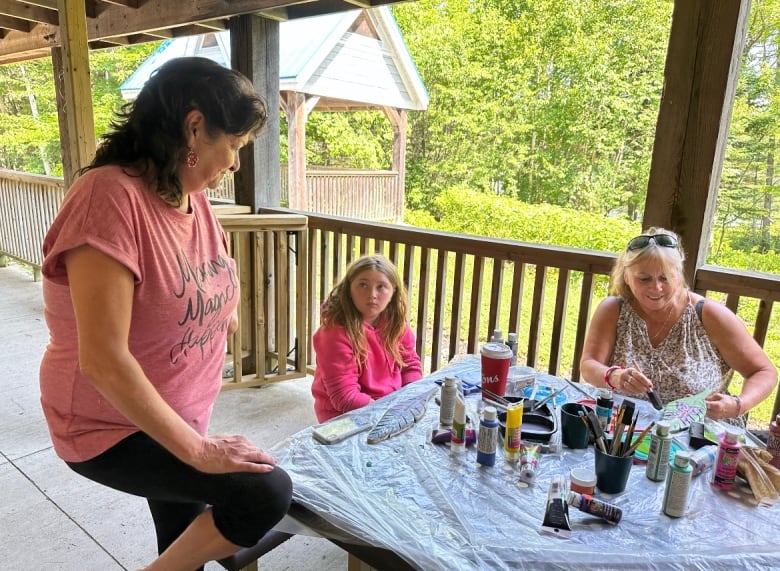
A woman wearing a peach-coloured shirt stands over a table where a woman and child sit. The table is covered in plastic tarp and painting supplies.
Ann Paul said Cyndi Nash encouraged visitors when they didn't think their art was good. 'Anything that’s coming from you and is a reflection of you is beautiful,' Nash would say. (Ann Paul/CBC)
Multiple, colourful paintings sit on a green bench.
Cyndi Nash's paintings help her connect to who she is, Paul said. (Ann Paul/CBC)
A collection of paintings hang on a white-brick wall.
Cyndi Nash's art on display at the Fredericton Region Museum (Griffin Jaeger (CBC))


Happy Visitors!

WRITTEN BY HUMANS!

WRITTEN BY HUMANS!

Blog Archive

Featured Post

Your History Class Was a F*cking Lie | #NOMOAR

  Your History Class Was a F*cking Lie by Sean Sherman (Or: How the American Educational System Has Always Been a Racist Propaganda Program...


Native Circles

Native Circles
click logo for podcasts!

Most READ Posts

Bookshop

You are not alone

You are not alone

To Veronica Brown

Veronica, we adult adoptees are thinking of you today and every day. We will be here when you need us. Your journey in the adopted life has begun, nothing can revoke that now, the damage cannot be undone. Be courageous, you have what no adoptee before you has had; a strong group of adult adoptees who know your story, who are behind you and will always be so.

Diane Tells His Name


click photo

Lost Birds on Al Jazeera Fault Lines

Lost Birds on Al Jazeera Fault Lines
click to read and listen about Trace, Diane, Julie and Suzie

NO MORE STOLEN SISTERS

NO MORE STOLEN SISTERS
click image

ADOPTION TRUTH

As the single largest unregulated industry in the United States, adoption is viewed as a benevolent action that results in the formation of “forever families.”
The truth is that it is a very lucrative business with a known sales pitch. With profits last estimated at over $1.44 billion dollars a year, mothers who consider adoption for their babies need to be very aware that all of this promotion clouds the facts and only though independent research can they get an accurate account of what life might be like for both them and their child after signing the adoption paperwork.

Original Birth Certificate Map in the USA

Google Followers