BOOZHOO! We've amassed tons of information and important history on this blog since 2010. If you have a keyword, use the search box below. Also check out the reference section above. If you have a question or need help searching, use the contact form at the bottom of the blog.
We want you to use BOOKSHOP to buy books! (the editor will earn a small amount of money or commission. (we thank you) (that is our disclaimer statement)
This is a blog. It is not a peer-reviewed journal, not a sponsored publication... WE DO NOT HAVE ADS or earn MONEY from this website. The ideas, news and thoughts posted are sourced… or written by the editor or contributors.
EMAIL ME: tracelara@pm.me (outlook email is gone)
THANK YOU CHI MEGWETCH!
NEW MEXICO: There was an increase in Native American children entering the
system—from 134 or 6.1 percent in 2019 to 147 or 7.4 percent in 2020.
The increase of Native children in the foster care system happened after
children’s biological or legal guardians have passed. Native American
families often live with several generations in one house, and we saw
that, tragically, many family members in one household would contract
COVID.
Those who refuse to acknowledge the trauma adoptees experience likely have never had to submit an empty page when attempting to complete "Family Tree" or "Life Timeline" assignments in school or write "N/A" in the Family Medical History section on forms at the doctor's office.
Skolt Sámi Heini Wesslin did not learn about her culture – now she hopes that truth and reconciliation process changes education
The recently founded Truth and Reconciliation Commission aims at
acknowledging and assessing the wrongs done against the Sámi in
Finland. Two Sámi tell now about their experiences and what they expect
of the Commission.
Yle Sapmi | November 30, 2021| By Inger-Elle Souninen
For Skolt Sámi Heini Wesslin, loss of language has been the
tough issue in her life, while Inari Sámi Rauni Mannermaa still feels
the burden of her days in a dormitory.
The stories and experiences of Wesslin and Mannermaa are
familiar to the Sámi. The old events that still cause pain for the next
generations would presently be considered serious violations. The
purpose of the Truth and Reconciliation Commission is to look at these
issues now.
After years of preparation, the historical Sámi Truth and
Reconciliation Commission has started its work. The objective is to
acknowledge and assess the wrongdoings that have been, and are still
being, done against the Sámi. In addition, the Commission also aims at
admitting and assessing the State’s assimilation policy and violations
of rights.
The report of the Commission is to be submitted by the end
of November 2023. Before that, the Commission has an enormous amount of
work to do. The variety of experiences and expectations equals the
number of people, but there is a common history behind them all.
Returned home when she got children
Heini Wesslin lives in the village of Sevettijärvi in the
northeastern part of Inari Municipality. There is a strong sense of
Skolt Sámi community in the village, and the local language and culture
play a central role in Wesslin’s everyday life. But this has not always
been the case.
When Wesslin was six, her family moved from her parent’s
home village Sevettijärvi to Utsjoki. Wesslin got her primary and
secondary education there. Although Utsjoki is in the Finnish Sámi Area,
it is not the home region of the Skolt Sámi. Thus Wesslin did not get
to learn about the Skolt Sámi and their culture at school.
Later, life and studies took Heini Wesslin to Helsinki,
Inari and Rovaniemi. Finally, twelve years ago, she returned to
Sevettijärvi. She moved there above all because she wanted to give her
children a sense of belonging from the very day they were born.
“Despite the fact that I’ve lived in Sápmi, I have not
lived in my own community. Therefore, it felt natural and important to
move here.”
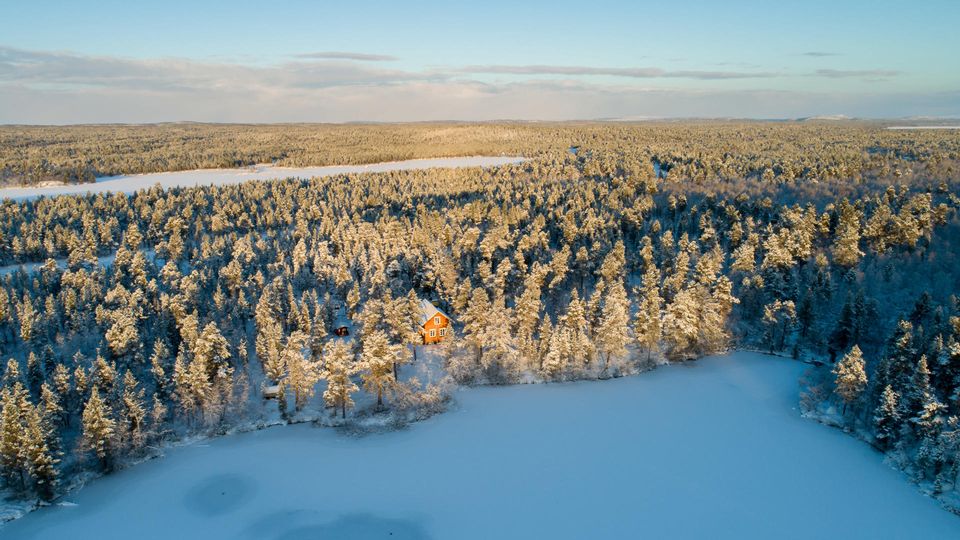
Heini Wesslin’s home is situated right on Lake Sevettijärvi. Photo: Vesa Toppari / Yle
The Skolt Sámi language has had a great impact on Heini
Wesslin’s choices in life. She did not learn her native language from
her mother, who believed that not knowing the language would make
Heini’s life easier. But Heini began to study the language as soon as it
was possible.
At first, speaking the language was difficult for Heini
Wesslin: she felt that she should already know the language. Today, she
accepts that she does not always speak correctly, but at least she uses
the language.
She speaks Sámi with her children. The children speak Skolt
Sámi also with their grandmother, but for Wesslin herself it does not
yet feel natural to speak the language with her mother.
“It’s extremely difficult to switch languages with certain people.”
Used handicraft to connection with culture
At present, Heini Wesslin knows the language and lives in a
community with a strong Skolt Sámi culture. However, she has sometimes
bad feelings about not having learned the language as a child.
“I’ve thought a few times that I could also be doing
something else in the evenings instead of conjugating Skolt Sámi verbs
via Teams.”
At first, Wesslin used doing Sámi handicraft, or duodji, to build up a connection to her culture.
“There’s also another language I speak: duodji.”
Many people know Heini Wesslin as a skilled craftmaker.
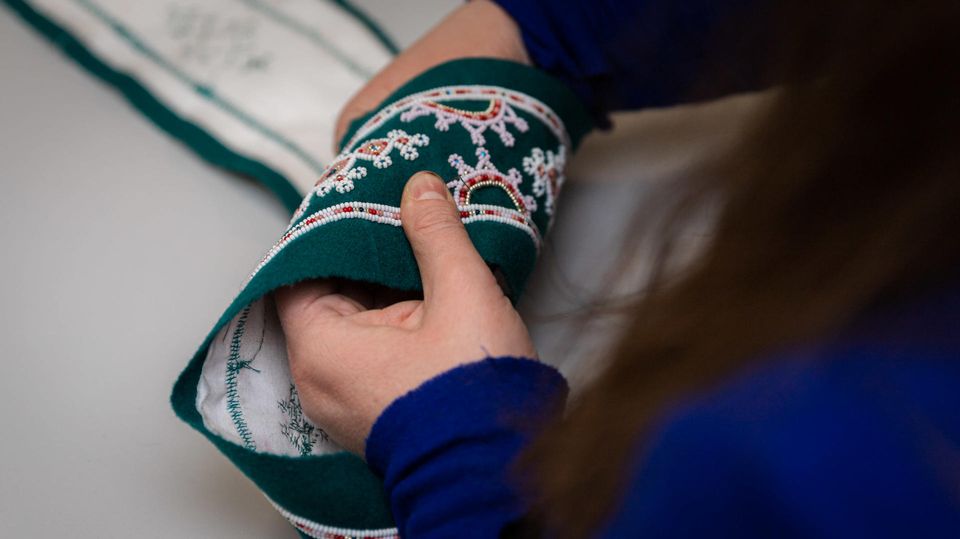
Beadwork is an important part of Skolt Sámi culture. Photo: Vesa Toppari
/ Yle
Wesslin began to wear the traditional Sámi clothing after
her secondary education. She had crafted the Skolt Sámi dress together
with her grandmother. Wearing Skolt Sámi clothing, finally, evoked many
feelings in her.
“It was an important thing. I didn’t have a very strong sense of belonging then. It took a while to feel part of the community.”
At present, she makes the clothes for both her children and
parents, helping them wear them. Wesslin’s parents belong to the
generation who had to stay in dormitories, so they never learned to wear
the traditional clothing. When Wesslin dressed her children in Skolt
Sámi clothing, her parents also dared to start wearing it.
Today, she is a carrier of culture – as a result of many
conscious choices. She did not get to learn about her culture at school,
but hopes that everyone will have the opportunity in future.
“The biggest problem is that we’re not allowed to learn
about ourselves. We learn the history and way of thinking of the
dominant culture.”
Wesslin believes that if the truth and reconciliation
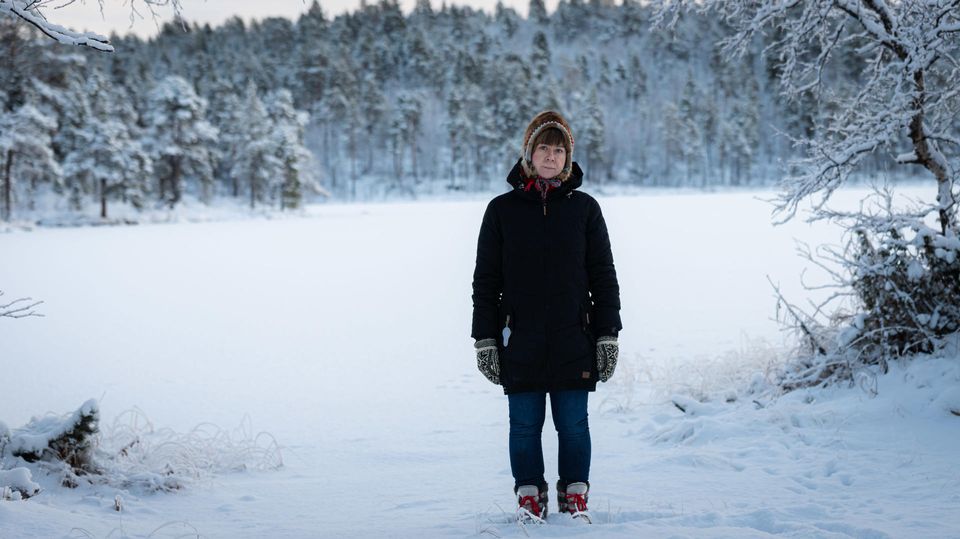
process is carried out properly, it will benefit everyone. Photo: Vesa
Toppari / Yle
The confirmation of unmarked graves at the sites of former
residential schools has led to a global awakening on the effects of the
harmful policy says the executive director of the National Centre for
Truth and Reconciliation (NCTR.)
Stephanie Scott, who has been with the NCTR since 2016, had only been
in her new leadership position for a little over two months when 215
remains were located in unmarked graves on the former site of the
Kamloops Indian Residential School.
Scott remembers being in bed when the texts started rolling in about
the news. Despite being aware of the existence of the graves, “it was
still horrendous news to get.”
The NCTR will not be part of a delegation heading to the Vatican to meet with Pope Francis – but if she was going her message would be “give us the records.” The Catholic church ran 65 residential schools.
She says negotiations with the church for over one thousand boxes of
documents have been going on for years. The NCTR has been given access
to five of those boxes.
As for the apology by the Pope, on Canadian soil, Scott says it would
be wonderful to see the Pope “in a pipe ceremony, acknowledging our
peoples and cultures and the harms that took place and really
understanding what they tried to destroy and how important that is for
our people to continue on the path of reconciliation.” SOURCE
Shannon
Varley, one of the lead plaintiffs in a Sixties Scoop class action
against the federal government, says she wants to be a voice for all
Métis and non-status Indian survivors. (Jessica Deer/The Eastern Door)
WARNING: This story contains distressing details.
A
co-lead plaintiff in a national class action on behalf of Métis and
non-status Indian survivors of the Sixties Scoop says she wants to be a
voice for all of them after hearing that some feel they won't have a say
in the legal proceeding.
"That is very good information for me to know," Shannon Varley said. "I want to try and help all these people."
The
Sixties Scoop refers to the Canadian practice — from the early 1950s
until the early 1990s — of taking children from Indigenous families and
placing them for adoption with non-Indigenous parents. Many of the
affected children lost their Indigenous identity and suffered mentally,
emotionally, spiritually and physically.
Varley said she grew up on a farm about 75 kilometres northeast of Regina, not realizing she was Indigenous or adopted.
She said she grew up in a very loving adoptive family and felt "totally included."
Varley
said she was 11 years old when her adoptive family told her that she
had been adopted through the Adopt Indian Métis (AIM) program when she
was an infant.
“They Took Us Away From Each Other”: Lost Inside America’s Shadow Foster System
Across the country, unregulated “shadow” foster care is severing
parents from children — who often wind up abandoned by the system
that’s supposed to protect them.
by Lizzie Presser, photography by Elinor Carucci for The New York Times
This story was co-published with The New York Times Magazine and is not subject to our Creative Commons license.
When a staph infection
killed Molly Cordell’s mother just before Halloween in 2015, Molly felt,
almost immediately, as if she were being shoved out of her own life. At
15, she and her sister, Heaven, who was a year younger, had no idea
where they would go. Their dad had been in and out of their lives for
most of their childhood. His grief, as their mother lay dying, sent him
spinning. It seemed to the girls that he was on too much meth, and
whenever he used, he got mean and crazy. Once, he made Heaven watch him
set their mom’s Chevy truck on fire. Their older brother, Isaiah, left
their home in the foothills of the Great Smoky Mountains when their mom
was still alive, and the teenage girls depended on each other. Molly was
deaf in her left ear, and her sister always asked others to speak
loudly for her. They shared the same group of friends, the same tanks
and capri pants. Although Molly had her own bedroom, she slept on the
couch in Heaven’s.
The girls moved in with
their grandmother, up the road from their wood-paneled house in Cherokee
County, North Carolina, a poor, sprawling region at the
southwesternmost edge of the state. Their dad lived in a camper in the
yard. Their grandmother, too, was trapped in an angry stage of mourning,
looking for someone to blame for her daughter’s death. She kept telling
Molly and Heaven that it was their fault — if only they’d taken better
care of their mom, she might be alive. Molly was starting to believe it.
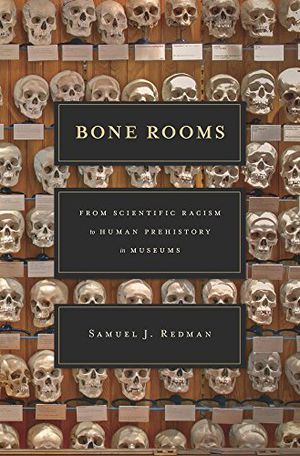
In the 2016 book ‘Bone Rooms: From Scientific Racism to Human Prehistory in Museums’, Samuel J Redman notes: “The campaign to preserve and collect was viewed as a race against time; bone empires benefited from this powerful sentiment by conceptualising indigenous and ancient bodies as a limited and scientifically valuable resource.”
The history of these collections is dramatic, occasionally punctuated
by unexpected twists. The story emerges from an ongoing competition to
establish the largest and most prestigious museums in cities across the
United States. At times driven by both ego and intellect, scientists
established a new field as they collected, their studies working to
shape ideas about race and what it means to be human. For scientists who
collected the dead, the desire to obtain remains for growing bone rooms
often suspended or displaced codes of ethical behavior. Museum
curators, as well as amateur collectors, competed and collaborated to
understand the body as a scientific object; at the same time, visitors
to museums that displayed bodies were continually enthralled, almost
surprised, by the humanity of ancient and recent bodies they found exhibited before them.
With
the music scene rising again after it was nearly extinguished by the
COVID-19 pandemic, M.I.S. looks forward to performing together more and
playing their debut album, “Kill the Man/Save the Indian.” (Jacob
Stepetin)
Jacob Tix̂lax̂ Stepetin remembers growing up in his aunties’ and uncles’ homes, listening to Metallica.
“Aang, Tix̂lax̂ asax̂takuq. Unangax̂ akuq. Akutanam ilan
angix̂takuq,” Stepetin introduces himself in Unangam Tunuu. “My name is
Jacob, or Tix̂lax̂, my Unangax̂ name. I’m from Akutan, which is a
village in the Aleutians on Akutan Island. That’s where I grew up most
of my childhood. So that’s home for me.”
Stepetin said heavy metal was popular when he was growing up in the Unangam village of about 100 people
“As a kid, that was just one of the types of music that I was
surrounded by, and I latched on to that,” he said. “I would spend a lot
of time at my cousin’s house and my older cousins were all into metal,
they all played Metallica, they all played instruments.”
Stepetin started his music journey at the age of 12 and has been
dialing in his metal riffs ever since. In 2014, he began playing music
with his college roommate, another Indigenous metalhead.
Together, they founded the Indigenous heavy metal group Merciless
Indian Savages. Stepetin plays lead guitar. The band’s music addresses a
lot of heavy topics, some that come from their own experiences. They
have song titles like “Pseudo Savior,” “Manifest Death” and “Kill the
Man/Save the Indian.”
The song titles grab your attention, but Stepetin said the point is to create an opportunity to talk about Indigenous issues.
“I think our lyrical content focuses a lot on things that make us
angry about the Indigenous experience,” Stepetin said. “I feel like you
could also write a lot of really positive music. But that’s the nature
of the genre. You know, we’re metalheads, we’re passionate about metal.
And so the nature of the genre isn’t really positive.”
Listen to this story:
Each song that the band writes highlights an aspect of the Indigenous
experience. But more specifically, Stepetin said, they want to call
attention to “the histories and systems that perpetuate colonization.”
“In the Declaration of Independence, it calls the Indigenous people of the land, ‘Merciless Indian Savages,’” said Stepetin.
He said that racist language in the Declaration was included in a list of wrongdoings the king of England had committed against the United States.
“And one of those bad things [it says] is, ‘He has brought on the
merciless Indian savages,’ and then says something about how they only
know about war and death, or killing or something like that,” Stepetin
said. “So it’s pretty brutal. And it’s obviously extremely racist, which
is not a surprise for something that was written in the 1700s.”
The statement in the Declaration of Independence that Stepetin is referring to is this:
“He has excited domestic Insurrections amongst us, and has endeavoured to bring on the inhabitants of our frontiers, themerciless Indian Savages, whose known rule of warfare, is an undistinguished destruction of all ages, sexes and conditions.”
According to Stepetin, their band name is an educational opportunity
to bring awareness to issues impacting Indigenous people of North
America.
“I don’t think we’re trying to embrace this name as if it’s a valid
description for who we are. It’s like an intentional misnomer,” he said.
After graduating college in 2019, Stepetin and his fellow band
members relocated to Tempe, Ariz., the ancestral homelands of the Akimel
O’odam people. With the music scene rising again after it was nearly
extinguished by the COVID-19 pandemic, M.I.S. looks forward to
performing together more and playing their debut album, “Kill the
Man/Save the Indian.”
M.I.S. band members include Corey Ashley (Diné) on vocals/rhythm
guitar, Jacob Stepetin (Unangax̂) on lead guitar, Ruben Dawahoya III
(Hopi/O’odham/Yaqui) on bass, and Joseph Manuel Jr. (Hopi/Akimel
O’odham) on drums.
M.I.S. played their second show earlier this month at the Navajo
Nation Metal Fest in Gallup, N.M. You can listen to M.I.S. on all major
streaming platforms or find more information on their website at mercilessndns.bandcamp.com.
Two
young girls share a mystical relationship with the nearby river — where
families have been known to drown baby girls — in “Step into the
River,” written and directed by Weijia Ma.
Editor's note: This story contains images some readers may find disturbing.
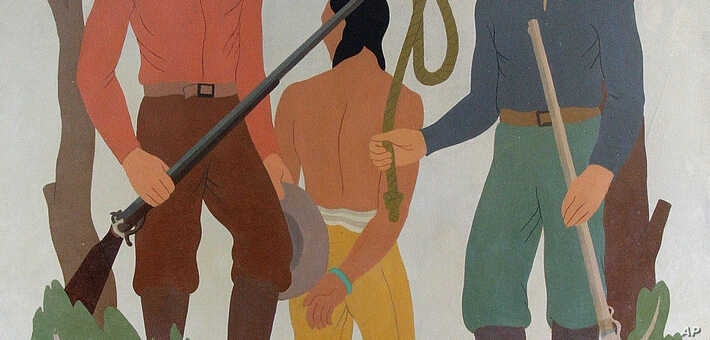
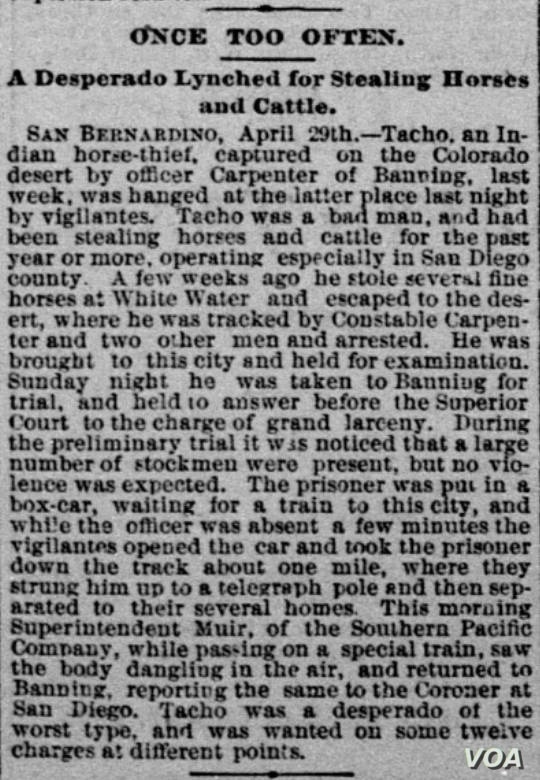
In 2018, the National Memorial for Peace and Justice in Montgomery, Alabama, opened to the public, paying tribute to thousands of African Americans who were lynched by white mobs from the close of the 19th century Civil War through the 1960s. While lynching is most commonly associated with blacks in the southern United States, little attention has been paid to the lynching of other minorities, among them, Native Americans.
In his 2011 book, the Roots of Rough Justice: Origins of American Lynching, Michael J. Pfeifer, history professor at the City University of New York’s (CUNY) John Jay College of Criminal Justice, describes lynching as “informal group murder.”
“The definition that I and many scholars have used stipulates that there has to be an illegally-obtained death perpetrated by a mob -- three or more persons -- and that the collected killing must be in service to justice, race or tradition,” he said.
It’s
not a secret that I love studying history; I believe it is a vital
discipline for understanding and transforming the world. And as shocking
and terrifying as human cruelty has been throughout recorded history,
it’s also heartening to observe, time and time again, the movements
opposing oppression that have always existed. This is also important to
remember if you are tempted to excuse the complicity of people in the
past by insisting that they were just products of their time. By
studying history, we also become more aware of our own responsibilities
and possibilities in the present.
A Legacy of Failure, Cruelty, and War
One
of these important historical moments in US history, when there were
multiple and large movements to either oppose or work for social
justice, followed the American Civil War.
Optimism that
Reconstruction would bring about true and lasting healing and change in a
nation ravaged and traumatized by the horrors of slavery and war, were
combined with optimism that there could be a change in the government’s
policies regarding Native peoples.
President Ulysses S. Grant and
the events that took place in his administration are a good example of
these trends. The Enforcement Acts of 1870 and 1871, for example, were
aimed at providing federal support to protect the rights of Black
Americans and oppose the Ku Klux Klan.
Under the direction of Attorney General Amos Ackerman, hundreds of
Klansmen were tried, often by Black juries, and imprisoned. Thousands
more received fines or warnings, or even fled to escape prosecution. As a
result, the KKK as a formal organization was in wreckage by 1872.
Optimism
that Reconstruction would bring about healing were combined with
optimism that there could be a change in the government’s policies
regarding Native peoples.
At
the same time, Grant wanted to find a different approach to US
relations with Native peoples. He worked closely with his longtime
friend and colleague, Ely S. Parker, and made Parker his Commissioner of
Indian Affairs. Parker, whose Native name was Donehogawa, was a member
of the Seneca nation and the first Indigenous person to hold the post of
Commissioner. Together, they developed policies that included providing
federal troops to protect reservation borders from settlers and that
ultimately would have provided a pathway to citizenship for Indigenous
people.
These plans were vehemently opposed and undermined, and
opponents eventually falsely accused Parker of embezzling money. He was
exonerated, but Congress stripped power from the office of Commissioner
of Indian Affairs, and Parker resigned in 1871.
Plans and relationships fell apart,
and Grant ended up waging war against the very people he had thought he
would protect, including “the Modoc War in 1873, the Red River War in
1874, and the Great Sioux War in 1876.”
By 1885, the year Grant
died, Donehogawa, once Grant’s enthusiastic colleague, described the
fate of Indigenous peoples in North America. Resisting the racist idea
that blamed Indigenous people for their troubles, he wrote:
“The
disabilities, disadvantages and wrongs do not result, however, either
primarily, consequently or ultimately from their tribal condition and
native inheritances, but solely, wholly and absolutely from the
unchristian treatment they have always received from Christian white
people … . The tenacity with which the remnants of this people have
adhered to their tribal organizations and religious traditions is all
that has saved them thus far from inevitable extinguishment.”
Grant’s
campaign slogan had been “Let us have peace,” and he seemed sincere in
his vision to reform federal Indian policies. So how did it happen that,
as Alysa Landry pointed out, “some of the worst massacres and grossest
injustices in history [occurred] while Ulysses S. Grant was in office”?
This is an important question to ask, if we want to avoid the kind of
pitfalls that kept others’ from true healing and change.
In
Grant’s case, central to his failures was “the development of millions
of acres of federal public lands” and “the private acquisition of land
by pioneers, spectators and railroad and mining companies,” made
possible by Grant’s approval of the Timber Culture, General Mining, and
Desert Lands Acts, which all expanded the land available to homesteaders
and settlers – at the expense of Native peoples. In the end, Grant’s
hopeful slogan, “Let us have peace,” was no match for the reality of
expansionism. In Landry’s words,
“Grant
realized that his expansionist goals required the removal of Indians
from desirable land. His Indian Peace Policy, designed to reform the
Indian Bureau and remove corrupt agents, also called for rigorous
agricultural training on reservations and established schools and
churches that would transform Indians into Christian citizens.”
You wouldn't tell a black person not to talk about racism. You wouldn't tell a gay person not to talk about gay rights. You would t tell a woman not to talk about feminism.
But Adoptees had just better not talk about adoption. 🤦🏻♀️ #NAAM#AdopteeVoices
— Benjamin Lundberg Torres Sánchez (they/them/elle) (@b_lts_) November 21, 2021
The knowing is the most important part for me.
Folks not separated from family sometimes lament their own harmful families when I talk about the significance of relationships with first family, not acknowledging that they have context to know & define their family relationships https://t.co/Yv1hmOk8pF
— Benjamin Lundberg Torres Sánchez (they/them/elle) (@b_lts_) November 23, 2021
Adoptee and adoption Twitter: After a long process of doing DNA tests and family tree research, I am meeting my birth father today for the first time in over 20 years. Any tips or advice? I don't feel too nervous, but I'm not really sure how much I should ask about.
As
hundreds enjoyed Saturday's Thanksgiving parade in Plymouth,
Massachusetts, a group of indigenous people protested the holiday
celebration.
"Why do we gather here today? Four hundred years
later, we join to raise our voices high that we are still here, we are
not conquered and we are not defeated," said Brian Weeden, chair of the
Mashpee Wampanoag Tribe.
"Plymouth is rich with history, but not the truth of the Indians," said Chief Ladybug of the Ponkapoag Praying Indians.
Since
1970, the Wampanoag Tribe has declared Thanksgiving a national day of
mourning for the loss of indigenous people's lives, culture and land.
"Our
presence here is a stark reminder of the true story of Thanksgiving
that differs so much from the fabled stories shared in classrooms,
history books and celebrations across this nation," Weeden said. "We
will never forget the atrocities that fell upon our people as a result
of their violent trespass."
To this day, the Wampanoag Tribe continues to fight with the federal government over land.
"Here we are about to celebrate Thanksgiving, and the fact that our
tribe is still fighting for what little bit of land we have — we own
half of 1% of our ancestral territory — and 400 years later, we don't
have much to be thankful for," Weeden said.
"Well, we can't change
the past, but we can change the future," Chief Ladybug said. "And the
way we change the future is to educate people and start understanding
that this is not a day of celebration. This is a day of mourning."
Tall Oak and fellow activists inaugurated in 1970 what Native
Americans across the country now call the Day of Mourning — held on
Thanksgiving to counter narratives that many say downplay the massacre
and subjugation of the Wampanoag and other Native Americans.
Today the spirit of the Day of Mourning is observed across Native America.
The
threat of death was part of life at the Kamloops Indian Residential
School. So why is it so hard to determine how many children died there?
By Jorge Barrera
June 13, 2021
WARNING: This story contains details some readers may find distressing.
During
a 1937 outbreak of measles at the Kamloops residential school, a nurse
gave student Mary Francois some Aspirin, mustard plasters and brandy
after the girl fell ill on May 3.
On
May 10, Mary was taken by car to the nearby Royal Inland Hospital. She
had been sick with pneumonia, two bacterial ear infections and inflamed
kidneys. That day, the school principal sent a letter to her parents —
but they never received it.
The
local Indian agent phoned them on the morning of May 13. But when the
parents arrived at the hospital that evening, it was too late.
Mary was dead from a blood clot in her brain.
Afterward,
Mary's father, the chief of the Adams Lake Band, which sits about 60
kilometres to the east, wrote a letter to the Indian agent.
"In
connection with the death of my daughter Mary, while attending Kamloops
Indian Residential School," read the letter from Chief Francois, "I
would request, as Chief of the Adams Lake Band, that in future, when a
child of the school is taken sick and requires hospital attention, that
the parents or guardian be notified at once."
The typewritten letter is signed with an "X."
The
information about Mary Francois's case is found in a death memorandum
from the Indian Affairs department (which does not, in fact, note her
age). Mary's record now lies in the holdings of the National Centre for
Truth and Reconciliation alongside 10 other death memorandums from 1935
to 1945, in a folder titled "Kamloops Residential School, Pupil Deaths."
The folder is twice stamped with the word "dormant."
An image of Mary Francois's death record, kept by the Indian
Affairs department. (National Centre for Truth and Reconciliation)
These memorandums are a reminder that the threat of death was part of life at the Kamloops Indian Residential School.
The institution has become a household word since Tk'emlúps te Secwépemc First Nation announced
the discovery of what are believed to be the unmarked burial sites of
children's remains adjacent to the former school's grounds.
The
death of students at Kamloops residential school was no secret among
the First Nations whose children were forced to go there. Finding out
how they died is a challenge, but the evidence that does exist reveals a
record characterized by the indifference of authorities, who saw the
children as a means to an end that had little to do with their
well-being.
CBC
News obtained historical records as well as an out-of-print book that,
along with the oral history of survivors, sheds light on the lives and
suffering of the students who attended the school.
An undated photo of the Kamloops residential school. (National Centre for Truth and Reconciliation)
Many causes of death
Survivor
testimony and historical records reveal how children died at the
institution throughout the years. Many fell to diseases like
tuberculosis and measles. Others drowned in the Thompson River, which
flowed nearby. Some, fleeing school, tried to hop trains and died.
Others died of suicide.
The
National Centre for Truth and Reconciliation, the repository of
residential school records gathered by the Truth and Reconciliation
Commission, found evidence for 51 fatalities at the institution. There
are likely more.
The
federal government purged three volumes of funeral records from
Kamloops residential school, according to listings of destroyed files
held by the National Archives of Canada. The Indian Affairs department
also destroyed three volumes of Indian agent reports, along with
quarterly "returns" for 1956 to 1961 — student lists that would include
deaths.
The memories of survivors fill in some of the gaps left by the reports.
Barbara
McNab-Larson, who attended the school from 1948 to 1950, often goes
down to a creek near her house in Skeetchestn First Nation. It's a place
teeming with life and scents that bring her back to the place before
her childhood was shattered.
"That was probably the safest time in my life," said McNab-Larson.
When
she was five, a cattle truck came to take her to Kamloops residential
school. "The first thing they did was take us down to the cleansing
room, where they cut off our hair," she said. "Then, they deloused us.
Then, they scrubbed us down with disinfectant like we were diseased
animals."
McNab-Larson returned home for the summer, but the next year, she said the school came to get her in an army truck.
WATCH | Barbara McNab-Larson talks about her time at the Kamloops residential school:
Remembering life in the Kamloops residential school
Not all were so lucky — to live and remember.
Seven
years before McNab entered the doors of Kamloops residential school, a
student named Florence Morgan became sick there. Her death memo notes
that it was at 6:30 a.m. on June 26, 1941; by 6:50 a.m., she was taken
to the Royal Inland Hospital. Florence died on June 28 from the viral
infection encephalitis, the memo says.
The
Indian agent reported that her body was returned by truck to her
parents on the Bonaparte First Nation, which sits 90 kilometres to the
east of the school.
The
viral infection that killed Florence was a common after-effect of
contracting measles. Outbreaks of measles coursed through the school
during this era.
One
of these outbreaks sickened nine-year-old Leslie Lewis. On Sept. 22,
1935, while Leslie was recovering, he suffered an epileptic attack. The
nurse at the school gave him three grams of luminal, an anti-seizure
medication. Leslie was put in a car and sent to the hospital at 9 a.m.
the next day.
The
doctor reported that Leslie seemed fine that morning, but the next day
he was dead, his memo says. The doctor reported that the measles
infection likely triggered the seizure.
An image of Leslie Lewis's death memo. (National Centre for Truth and Reconciliation)
The
Indian agent concluded the memo by commenting on the overcrowded
conditions at Kamloops residential school, where five dormitories
accommodated 285 students.
"During
an epidemic it is impossible to properly isolate the patients and
contacts," typed the Indian agent. "The need for separate quarters to
house sick children is evident."
'They still get nightmares about it'
It wasn't just disease. Some students were also driven to suicide.
"This
… young boy hung himself in the bathroom. You know, my brother's age
group," said Gerry Oleman, who attended Kamloops residential school from
about 1960 to 1968, in a recent interview with CBC. Oleman, who is from
St'át'imc First Nation in B.C.'s Interior but now lives in Brandon,
Man., said the students who witnessed it still can't shake the moment.
"Still
today they remember that. They still get nightmares about it," he said.
Oleman also mentioned other distraught students: "the runaways and
people jumping trains, getting killed jumping a train, you know,
freezing to death."
Suicide also haunts the stories of survivors gathered in the book Behind Closed Doors: Stories from the Kamloops Indian Residential School, which was published by the Secwepemc Cultural Society in 2001.
James
Charles, who attended from 1964 to 1978 and is featured in the book,
knew of three boys who died of suicide. "One suicide was over on the
swings beside the brown building," Charles says in Behind Closed Doors. "No one could figure out how that really took place, because it happened in broad daylight, blue sky out, sun was shining."
Charles
said there was another child who died on the bell rope and a third
found in the orchard. "I think remembering these suicides played a big
role in a lot of my anger that I had bottled up inside," Charles says.
According
to the book, some of the children who died attempting to escape on a
nearby train came from the Lillooet district, about 170 km west of the
school.
One
anecdote in the book, told by a survivor who signed their story
"Anonymous," said their older sister Nellie died at the school. She was
sick for months with hepatitis and yellow jaundice. No doctor came to
treat her and no one told her parents of her illness until after her
death.
"When
my father came to the school after hearing of the sad news, he beat the
principal and punched him down the stairs," says the survivor in the
book. "As much as I want the memories of my education years to be
positive, it just can't be."
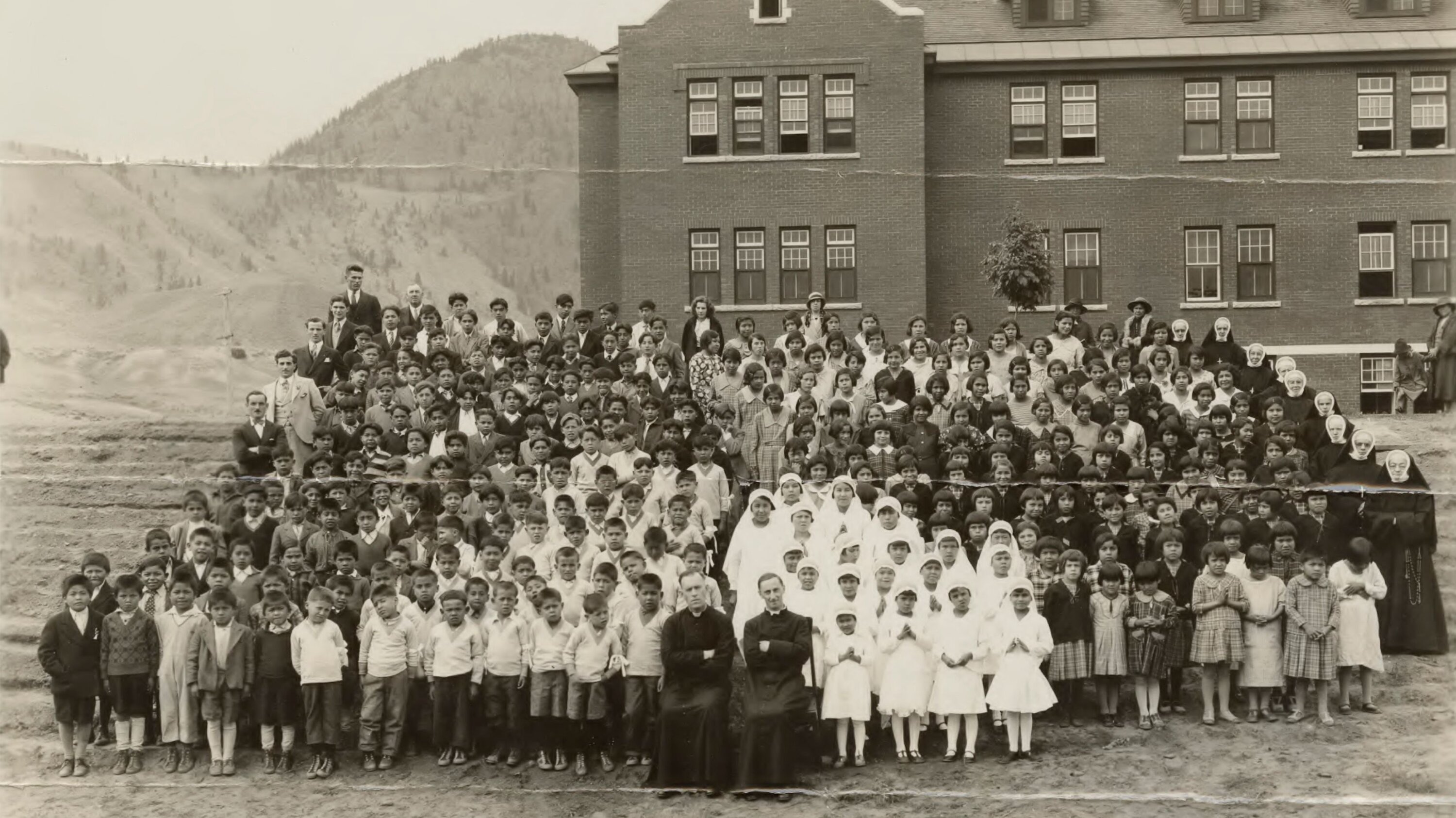
A photo from April 4, 1937, of students, administration and
teaching staff at Kamloops residential school. The photo is from the
Quebec archives of the Oblates of Mary Immaculate. (National Centre for
Truth and Reconciliation)
Another survivor in the book, Eddy Jules, spoke of abortions and a furnace.
"All
of us that were going to school would hear the clang, and we would say,
'Oh, that's so and so's friend, and they gave her an abortion,'" said
Jules, noting the strangeness of "fire in September or October or
November when it's not cold."
Retired
senator Murray Sinclair, who chaired the Truth and Reconciliation
Commission, said in a recent video statement that he also heard
testimony from survivors about this use for a furnace in residential
schools.
"Some
survivors talked about infants who were born to young girls at the
residential schools, infants who had been fathered by priests, were
taken away from them and deliberately killed — sometimes thrown into
furnaces, we were told," said Sinclair.
'We mourned these children'
Despite
all this evidence of death at the school, no record has yet surfaced of
a graveyard at the institution — no shred of paper, cross or stone
marks conveying who might lie beneath the earth.
Sister
Marie Zarowny, chair of the board for the Order of St. Anne's, which
provided teachers and nurses to the school, told CBC News a fire
destroyed the first 30 years of records from the institution. She said
that to her knowledge, no students were ever buried on the school
grounds.
She
said that if a child died at the Royal Inland Hospital, the body would
not be returned to the school. If a student did die at the school, the
body would be sent back to their home community for burial.
"We
mourned these children at the school. We had a ceremony for them, but
they were ... returned to their parents," said Zarowny.
She
said that students from Tk'emlúps te Secwépemc who died at the school
were buried in the community's cemetery. There are hints of another,
now-forgotten graveyard in the records, she said, but couldn't confirm
any aspect of this.
"I actually don't know if that reference comes from that school or from another school," she said.
As
a result of destroyed records, the true number of students who died at
residential school may never be known. The Truth and Reconciliation
Commission, which was created to delve into the long history of the
schools, concluded that at least 4,100 children died in these
institutions.
The Catholic Church has faced widespread calls to release all records related to residentials schools.
The
same uncertainty shadows the location of graveyards. Many children were
buried in unmarked graves, some of which are now lost to time.
One
institution that holds large pieces of this history in its archives is
the Catholic Church. Catholic entities ran roughly 75 per cent of
residential schools.
The
church has faced widespread calls, from Prime Minister Justin Trudeau
on down, to release all records related to residential schools, to
augment the incomplete government record.
Zarowny
said her order is sharing any relevant records with Tk'emlúps te
Secwépemc that could help aid in the quest to identify the suspected
remains on the Kamloops residential school grounds.
She
said the Sisters of St. Anne's turned over what they viewed as records
related to residential schools to the Truth and Reconciliation
Commission (TRC).
A photo from 1931, taken at the Kamloops residential school. (National Centre for Truth and Reconciliation)
But
the order has yet to sign off on the transfer of its records to the
National Centre for Truth and Reconciliation, said Stephanie Scott,
executive director of the institute.
"The
[Sisters of St. Anne's] remain unwilling to authorize disclosure of
[its] records currently in the possession of the government of Canada,"
said Scott, in a statement to CBC News.
Several
Catholic entities never turned over any records to the TRC. According
to an internal TRC document obtained by CBC News, 17 Catholic entities
failed to hand over any archival material to the commission.
"There
are a lot of records in church archives that we never got to go
through," Tom McMahon, the former general counsel for the TRC, told CBC.
McMahon
said the Catholic entities that did provide files made their own
determinations about what was deemed to be a "relevant" document to hand
over.
The
Oblates of Mary Immaculata, which ran Kamloops residential school,
turned over what it deemed to be relevant records to the TRC, according
to the internal TRC document.
McMahon
said the Catholic entities that did provide files made their own
determinations about what was deemed to be a "relevant" document. He
said the Catholic entities held onto records connected to church
functions and personnel files.
"When
you start talking about personnel records, they did not see that as
relevant to the children and education of the children," said McMahon.
"When
we talk about deaths of children, you want to think about the church
records, the baptism records, death records held by the church. The
church told us those records pertain to church activities and were not
relevant."
McMahon
said one of the potentially richest sources of survivor testimony is
held by the federal Justice Department in documents relating to roughly
4,000 civil actions filed by survivors against Canada and the various
churches that ran residential schools. He said most of those files were
never turned over to the TRC.
Survivors
and descendants have long spoken about unmarked graves and children who
never came home. Their calls made it to the House of Commons in 2007
and then-Indian Affairs minister Jim Prentice, who asked the interim
executive director of the Truth and Reconciliation Commission to begin
working on the issue.
According
to a 2008 memo obtained by CBC News, the TRC asked the research branch
of Indian Residential Schools Resolutions Canada, a federal agency
created to deal with a multitude of civil claims filed by survivors, to
conduct an internal records search for cemeteries.
Numerous
schools came back with no records of cemeteries, including Kamloops
residential school, according to a preliminary report.
John Milloy, one of the country's leading historians and author of A National Crime,
perhaps the seminal book on residential schools, said that may be
because Indian Affairs never prioritized residential school files.
When
government edicts forced the department to destroy records through
recycling — for example, as a result of a paper shortage during the
Second World War — such files were seen as expendable.
"An
awful lot of information which one could have had, to describe the
nature of the system, the treatment of the children… a lot of that
information was simply lost," said Milloy, who was involved with the
Royal Commission on Aboriginal Peoples and the Truth and Reconciliation
Commission.
Milloy
said the Indian Affairs department, which is now known as Indigenous
and Northern Affairs, is really a large real estate company, holding in
trust reserve lands across the country. It also determines who has the
right to live on this property, holding registries with status records
and band membership lists.
"So those are the records which are most critical to the department," said Milloy.
He
also said that the Canadian public has not properly understood the
rationale for the evolution of a residential school system under the
country's first prime minister, John A. Macdonald. The schools were a
means of nation-building and achieving state-security ends, he said.
"It
becomes pretty obvious that, as far as Macdonald and other senior
members of the Indian Affairs department [were concerned]… one of the
purposes of the schools was to hold the children hostage against the
good behaviour of their parents," said Milloy.
He
said the officials used children as bargaining chips to counter any
attempts by Indigenous nations from raising arms against the
still-fledgling state.
John Milloy, one of the country's leading historians and
author of A National Crime, considered one of the seminal books on
residential schools. (CBC News)
Milloy
provided CBC News with a pre-print academic paper he wrote that details
the strategy. The draft title is "Sir John A.'s Hostages." It states
that government and North-West Mounted Police officials were
increasingly concerned about a breakout in hostilities between the state
and armed Indigenous nations such as the Blackfoot in the Prairies,
just as Canada was building a railway to deliver goods and people — as
well as establish control over territory.
The
use of the schools to neutralize Indigenous resistance was put bluntly
by school inspector J. A. Mcrea in a 1886 letter to the Indian
commissioner: "It is unlikely that any Tribe or tribes would give
trouble of a serious nature to the Government whose members had children
completely under Government control."
At
the time, Canada wanted to avoid a repeat of the wars in the U.S. and
feared any new conflicts would eclipse the violence from the rebellion
led by Louis Riel in 1885, Milloy's research showed.
A
1879 report by Nicolas Flood Davin, which recommended the creation of
residential schools, followed a fact-finding mission to explore how the
Americans used similar institutions, the paper said.
"Davin
would have discovered this covert purpose for residential schools in
his conversations with Carl Schurtz, the U.S. Secretary of the Interior,
and Ezra Hayt, the Commissioner of Indian Affairs," said the paper.
"Certainly, for the Department, the resolution of the 'Indian problem,'
characterized so often as carrying the white man's burden of Christian
duty was, in fact, countering the perceived threat to state security and
social purity."
Milloy
said that "this is one of the reasons why the Kamloops school is
developed in the 1890s, because the situation in the area is tenuous for
the government … The schools are also very much part of the colonial
process … for the sake of the development of Canada."
The
schools used fear and violence — and fear of violence — to bend
generations of children under the cross and flag. Much remains hidden
from the record about the fate of thousands of children who attended
these institutions, but this history is carried by those who came home.
"'You
better behave. Don't get out of line, because there's a graveyard and
there's also the river.' Those were warnings that were given to us as
little, tiny children — five, six years old," said Barbara McNab-Larson
of her time at the Kamloops school.
"I
don't think you really grasp it at the time, but when your friends
disappear and they don't come back, even as a child, you know
something's wrong."
Support
is available for anyone affected by their experience at residential
schools and those who are triggered by the latest reports.
A
national Indian Residential School Crisis Line has been set up to
provide support for former students and those affected. People can
access emotional and crisis referral services by calling the 24-hour
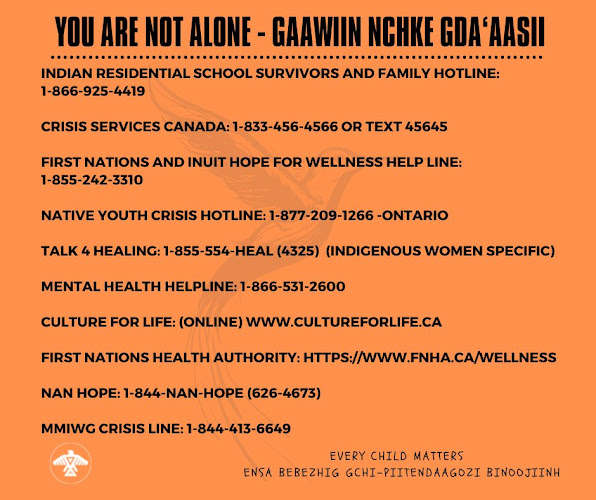
national crisis line: 1-866-925-4419.
Kim Wheeler was adopted during the Sixties Scoop and fought to find her way back to her culture My name is Kim Wheeler but some know me as...
Bookshop
You are not alone
To Veronica Brown
Veronica, we adult adoptees are thinking of you today and every day. We will be here when you need us. Your journey in the adopted life has begun, nothing can revoke that now, the damage cannot be undone. Be courageous, you have what no adoptee before you has had; a strong group of adult adoptees who know your story, who are behind you and will always be so.
Diane Tells His Name
click photo
Lost Birds on Al Jazeera Fault Lines
click to read and listen about Trace, Diane, Julie and Suzie
NO MORE STOLEN SISTERS
click image
We conclude this series & continue the conversation by naming that adoption is genocide. This naming refers to the process of genocide that breaks kinship ties through adoption & other forms of family separation & policing 🧵#NAAM2022#AdoptionIsTraumaAND#AdopteeTwitter#FFY 1/6 pic.twitter.com/46v0mWISZ1
As the single largest unregulated industry in the United States, adoption is viewed as a benevolent action that results in the formation of “forever families.” The truth is that it is a very lucrative business with a known sales pitch. With profits last estimated at over $1.44 billion dollars a year, mothers who consider adoption for their babies need to be very aware that all of this promotion clouds the facts and only though independent research can they get an accurate account of what life might be like for both them and their child after signing the adoption paperwork.


















 Posts
Posts

