BOOZHOO! We've amassed tons of information and important history on this blog since 2010. If you have a keyword, use the search box below. Also check out the reference section above. If you have a question or need help searching, use the contact form at the bottom of the blog.
We want you to use BOOKSHOP to buy books! (the editor will earn a small amount of money or commission. (we thank you) (that is our disclaimer statement)
This is a blog. It is not a peer-reviewed journal, not a sponsored publication... WE DO NOT HAVE ADS or earn MONEY from this website. The ideas, news and thoughts posted are sourced… or written by the editor or contributors.
EMAIL ME: tracelara@pm.me (outlook email is gone)
THANK YOU CHI MEGWETCH!
For
St. Boniface Archbishop Albert LeGatt, the Grandfather Rock is just a
“small symbol” of reconciliation — even if it stands over 1.5 metres
tall.
The
Grandfather Rock, so named by Indigenous people for how it contains
generational knowledge, ancient memories and a spirit, was unveiled June
20 in the Archdiocese of St. Boniface’s Heritage Park, across the
street from St. Boniface Cathedral in Winnipeg.
“I
hope it will indicate to Indigenous people this is a safe place and all
are welcome,” said LeGatt, adding it represents an “intertwining of
Christian faith and Indigenous spirituality, values and beliefs, a
weaving of the two together.”
Called
M’shoomis Asin in Ojibwe, the Grandfather Rock was donated to the
archdiocese by a parishioner five years ago. It is surrounded by a
symbolic see-through sweat lodge made out of rebar by local high school
students.
The
placement of the Grandfather Rock and sweat lodge in the Heritage Park
is a way for Roman Catholics to indicate they are taking seriously the
Calls to Action directed at the churches by the Truth and Reconciliation
Commission, LeGatt said.
“It
shows how we are playing a part on the long and rich journey of
reconciliation between First Nations people and non-Indigenous people,"
he said. “It is a way to understand and share our common values that are
truly essential for a unified humanity."
At
the same time, it’s a way to acknowledge “the inherent value and worth
of Indigenous spiritual values” and the Church’s acceptance of
Indigenous culture and spirituality, he said.
Elder
Clayton Sandy (adoptee) of the Sioux Valley Dakota First Nation worked with
LeGatt to create the installation. For him, the placement of the
Grandfather Rock and symbolic sweat lodge on property owned by the
archdiocese is significant since Indigenous spiritual practices like
sweat lodges were forbidden for many decades by the Roman Catholic
Church.
“Now
there is a representation of a sweat lodge on church grounds,” said
Sandy, whose parents and six siblings are residential school survivors
while he was a Sixties scoop child. It is, he said, a “symbol of healing
between Indigenous people and the Church . . . we have come a long
way.”
It
also shows that Roman Catholics and Indigenous people are making
progress in the journey of reconciliation, he said, adding “if we don’t
come together with open minds, nothing changes.”
Beside
the installation are two panels, one explaining the significance of the
Grandfather Rock is in English, French, Dakota and Ojibwe and the
other, in English and French, describing the role of sweat lodges in
Indigenous tradition and culture.
In
addition to the Grandfather Rock and symbolic sweat lodge, the Heritage
Park also contains information and statuary about the religious orders
who were instrumental in the development of Manitoba’s health,
educational and social service systems.
WALTHILL, Neb. (KTIV) -The Dr. Susan La Flesche Picotte Center held its open house Sunday afternoon.
Dr.
Picotte was the very first Native American physician and founded the
center back in 1913 as the first privately funded hospital on a Native
American reservation.
Over the years, it fell into disrepair, prompting community members to restore and preserve it.
One member, Gary Bowen, said it took many years and a lot of fundraising to restore the center to its former glory.
“It’s
a wonderful dream come true for all of us,” Bowen said. “We had
wonderful support from private foundations and government agencies and
individuals.”
The executive director
of the center, Elizabeth Lovejoy Brown, said Doctor Susan’s legacy
inspired her, and others, to make the center into a place of healing
once again.
“When I was a little girl,
I was told about Doctor Susan, and from that point on I said, I want to
do the same thing as her. I want to go to college and I want to come
back and give back to my tribe,” Brown said. “We want to fulfill and
carry on the legacy that she had made. For this hospital.”
The Picotte Center will feature health care services like a medical clinic and mental health support.
It
will also have an exhibit on Dr. Picotte’s life, and a makers space
where community members can access tools to create cultural pieces and
regalia.
A
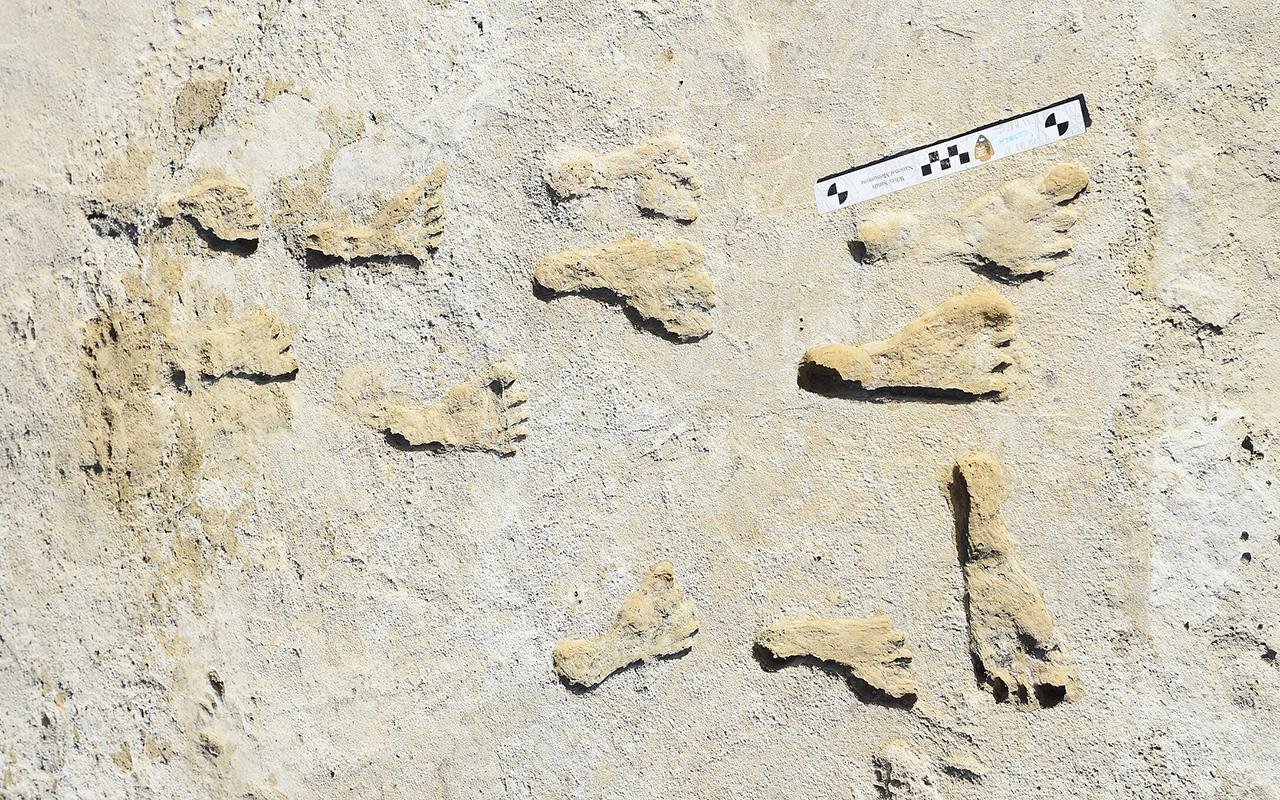
newly published study in Science Advances provides the strongest
evidence to date that ancient human tracks found at White Sands National
Park, New Mexico, are approximately 23,000 years old. If confirmed, the
find could dramatically change the history of human migration to North
America, placing humans on the continent during the Last Glacial
Maximum, thousands of years earlier than previously believed.
Some of the White Sands footprints. National Park Service (Public domain)
The
footprints, first reported in 2021, were excavated in 2019 by a team
from Bournemouth University in collaboration with the U.S. National Park
Service. Early radiocarbon dating of seeds and pollen found in
overlying and underlying sediment layers indicated an age between 21,000
and 23,000 years ago. However, these findings were challenged. Some
critics argued that using aquatic plants like Ruppia cirrhosa, which
absorb ancient carbon from water, could result in artificially old
dates.
To address these concerns, the new team, led by University of Arizona archaeologist and geologist Vance Holliday,
returned to the site in 2022 and 2023. Instead of dating the plant
material, they radiocarbon dated ancient lakebed mud. They sent the
samples to two independent laboratories, both of which reported the same
range of ages: 20,700 to 22,400 years ago.
Together, scientists
now have 55 radiocarbon dates on three types of materials—seeds, pollen,
and mud—all pointing to the same time period. “It’s a remarkably
consistent record,” Holliday said. “You get to the point where it’s really hard to explain all this away.”
The
footprints were found in streambeds which once flowed into an ancient
lake called Lake Otero, in a region now dominated by gypsum sand dunes.
Holliday first visited White Sands in 2012 and contributed geological
data that was utilized to date the tracks and made him a co-author of
the original and current study.
Doctoral
student Jason Windingstad, who worked with Holliday on the most recent
fieldwork, described seeing the prints as a profound moment. “It
basically contradicts everything that we’ve been taught about the
peopling of North America,” he said.
The discovery challenges the
long-standing Clovis-first theory, which held that humans arrived on the
continent around 13,000 years ago. While some scientists still question
the evidence—particularly the lack of tools or settlement—Holliday
argues that such artifacts
wouldn’t necessarily be present. “These people lived by their
artifacts, and they were far away from where they could get replacement
material,” he said. “They’re not just randomly dropping artifacts.”
With
multiple dating methods and separate lab confirmations now supporting
the timeline, the White Sands footprints offer compelling evidence that
humans came to the Americas far earlier than had been believed.
Publication:
Holliday, V. T., Windingstad, J. D., Bright, J., Phillips, B. G.,
Butler, J. B., Breslawski, R., & Bowman, J. E. (2025). Paleolake
geochronology supports Last Glacial Maximum (LGM) age for human tracks
at White Sands, New Mexico. Science Advances, 11(25), eadv4951. doi:10.1126/sciadv.adv4951
Celebrations happening amid pushback from First Nations communities over provincial legislation
Image | Jay Lomax, a Sixties Scoop survivor who was at the Na-Me-Res Powwow
celebration at Fort York, said Saturday's celebrations are a way to
connect with First Nations culture, and to heal. (CBC)
National
Indigenous Peoples Day was celebrated in Toronto Saturday with music,
dance and a sunrise ceremony outside city hall amid pushback from some
First Nations leaders over provincial laws that some say bypass
consultation with their communities.
The
holiday, first observed in 1996, is a day of recognition and
celebration of the cultures and contributions of the First Nations,
Inuit, and Métis Indigenous peoples of Canada.
Hundreds
of events are taking place around the country Saturday, and in Toronto,
festivities began with a sunrise ceremony outside city hall, with Mayor
Olivia Chow in attendance.
Grandmother
Kim Wheatley of Curve Lake First Nation led the proceedings, which
included prayers, greetings to the sun and giving thanks to the Earth.
"As
we walk the road of reconciliation, Canadians need to know we're still
here and we have something beautiful to offer and beautiful to share,"
she said at the ceremony.
Celebrations are continuing all day at the Na-Me-Res Powwow celebration at Fort York, which is in part sponsored by CBC.
Fort York, Indigenous Peoples Day : The Na-Me-Res Pow Wow started Friday evening and will run until 8 p.m. Saturday at Fort York in downtown Toronto. (CBC)
The
event began on Friday and is hosted by Na-Me-Res, a residence for
homeless Indigenous men in Toronto. Hundreds were in attendance Saturday
to take in traditional music and dance on the grassy field.
One of the dancers, Jay Lomax, said the celebrations are in part a way of healing, and connecting.
"I'm
here because I'm one of the Sixties Scoop survivors and I was raised
out here in Toronto. And I've been dancing since I got reconnected with
the culture in my 20s, doing ceremonies, connecting through the land,
connecting with our people, and that's what today is really all about."
Along
with music and dance, the powwow includes the Indigenous Arts Festival,
where culture is celebrated through crafts and cuisine.
Celebrations are going all day, with the powwow at Fort York continuing well into the evening.
Strained relations between province, First Nations
The
celebrations come as First Nations communities push back against new
provincial mining legislation that many say goes against the
government's duty to consult Indigenous peoples.
This
week, Premier Doug Ford apologized for comments he made, saying he has
treated First Nations "like gold" but they "keep coming hat in hand."
WATCH |
Ford's apology to First Nations chiefs: Ontario Premier Doug Ford apologized to First Nations chiefs
representing Ontario on Thursday. As CBC’s Mike Crawley explains, this
comes after the provincial government sparked anger amongst Indigenous
communities over Bill 5.
Ontario
Regional Chief Abram Benedict of the Chiefs of Ontario, which advocates
for all 133 First Nations in the province, told CBC News Network
Saturday that the comments were hurtful.
"What
we've been very clear with is that the rights holders need to be at the
table talking with the government about these bills, about a pathway
forward," he said. "[Ford has] acknowledged that, and I'm hoping that
our leadership can accept that apology, and look to a pathway forward
with the premier."
Speaking
about National Indigenous Peoples Day on the 10th anniversary of the
publication of the Truth and Reconciliation Commission's final report,
he said the holiday was in part a chance to reflect on what's been done
since the commission released its 94 calls to action.
"We've made tremendous strides, but there's a lot of work to do," he said.
I have followed the disturbing tribal dis-enrollment issue many years, first as a journalist and then as a concerned adoptee who is still without tribal membership.
First of all, since CONQUEST, the governments of Canada and the US had goals.
The inter-country ARENA program and the Indian Adoption Projects were clearly planned genocide, essentially kidnapping and trafficking in children, as an act of war on Indian families.
Other goals? Reduce the populations. Write bad treaties then break them. Steal more land. Move who is left on to concentration camps but call it a "reservation" or reserve. Remove children on those reserves to faraway places like the Carlisle Industrial Boarding School. Erase children permanently from tribal rolls. It's how the governments of
Canada and the US planned this. They kill us by military force then colonize remaining savages, then they upped the game to use paper genocide with bad or fake history, to where we are now: blood quantum sorcery.
They'll
keep us divided, a Third World stuck in poverty and fighting for scraps forever.
That was the plan.
Let me start over...
Adoptees want to go home, meet family and if possible, have a relationship with tribal relatives. We were dis-enrolled essentially and the fake papers we were given are not
real birth certificates, not tribal membership, and not land rights and treaty promises. (Yes, some adoptees found out they were enrolled before they were taken away.)
For an adoptee today, Tribal membership would be icing on the cake, and all of us absolutely deserve it!
Too many Tribal leaders are not
traditional, as I see it. I see Tribal leaders adapted to the white man rules too well. Clearly it's about money now, not us, and not our recovery.
Why? Do they not see we had no CHOICE as children adopted
out... It wasn't our fault. Is this also about money?
Are you kidding me?
Since 2004-5, I took the stance there was no awareness of the cultural genocide on Indigenous People since conquest. I also could see how too many adoptees were struggling to get their tribal membership. Too many cannot and do not approach their tribe without papers, or some kind of legal proof. Who do we call? Phone messages and requests for help go unanswered. One Native adoptee told me a judge refused her request for her adoption file in Utah, which is against federal law and what the Indian Child Welfare said is our right.
Sadly, Reserve Indians do not prioritize bringing STOLEN GENERATIONS back, and many do not know how many adoptees are out here, spread across North American and beyond.
Now tribes are disenrolling their own people? Casinos changed the landscape. Tribes are protecting their profits. Greed, as you know, is a disease.
As the governments planned this, it was to control tribal populations. And it worked.
Go READ:
"You're No Indian" Examines the Disenrollment Issue (documentary) (top photo)
More than a thousand people attend a candlelight vigil for Melissa and
Mark Hortman at the State Capitol building Wednesday. (Aaron
Lavinsky/The Minnesota Star Tribune)
“We wanted to sing her an honor song, a traveling song, to send her off
in a good way, for all she did for our nation and for all native people,
standing up for us, our sovereignty, and our treaty rights,” Strong
said. “She would not only just work on our behalf, but she would be a
part of our community. She came and participated in our community and
our culture and our ceremonies, and she was very empowering.”
very very bad news... poverty can do that... TRACE
U.S. government has overestimated Native American life expectancy, study finds
By Marcos Magaña, Los Angeles Times
The
ruins of an old church building and cemetery at the Taos Pueblo in New
Mexico, a living Native American community located at the base of the
Sangre de Cristo mountain range. Official U.S. records dramatically
underestimate mortality and life expectancy disparities for Native
Americans, according to a new, groundbreaking study published in the
Journal of the American Medical Association. (Dreamstime/TNS)
LOS
ANGELES — Official U.S. records dramatically underestimate mortality
and life expectancy disparities for Native Americans, according to a
new, groundbreaking study published in the Journal of the American
Medical Association.
The research, led by the
Boston University School of Public Health, provides compelling evidence
of a profound discrepancy between actual and officially reported
statistics on the health outcomes of American Indian and Alaska Native
(AI/AN) populations in the U.S.
The study,
novel in its approach, tracks mortality outcomes over time among
self-identified AI/AN individuals in a nationally representative cohort
known as the Mortality Disparities in American Communities.
The
researchers linked data from the U.S. Census Bureau’s 2008 American
Community Survey with official death certificates from the Centers for
Disease Control and Prevention’s National Vital Statistics System from
2008 through 2019, and found that the life expectancy of AI/AN
populations was 6.5 years lower than the national average. They then
compared this to data from the CDC’s WONDER database, and found that
their numbers were nearly three times greater than the gap reported by
the CDC.
Indeed, the study found that the life
expectancy for AI/AN individuals was just 72.7 years, comparable to
that of developing countries.
The researchers
also uncovered widespread racial misclassification. The study reports
that some 41% of AI/AN deaths were incorrectly classified in the CDC
WONDER database, predominantly misrecorded as “White.” These systemic
misclassifications drastically skewed official statistics, presenting
AI/AN mortality rates as only 5% higher than the national average. When
they adjusted the data to account for those misclassifications, the
researchers found that the actual rate was 42% higher than initially
reported.
The issue of racial
misclassification “is not new for us at all,” said Nanette Star,
director of policy and planning at the California Consortium for Urban
Indian Health. The recent tendency for journalists and politicians to
use umbrella terms like “Indigenous” rather than the more precise
“American Indian and Alaska Native” can obscure the unique needs,
histories and political identities of AI/AN communities, Star noted, and
contribute to their erasure in both data and public discourse. “That is
the word we use — erasure — and it really does result in that
invisibility in our health statistics,” she said.
Issues
related to racial misclassification in public records persist across
the entire life course for AI/AN individuals, from birth to early
childhood interventions to chronic disease and death. Star noted that in
California, especially in urban regions like Los Angeles, Native
individuals are frequently misidentified as Latino or multiracial, which
profoundly distorts public health data and masks the extent of health
disparities. “It really does mask the true scale of premature mortality
and health disparities among our communities,” Star said.
Further,
said Star, the lack of accurate data exacerbates health disparities.
“It really is a public health and justice issue,” she said. “If you
don’t have those numbers to support the targeted response, you don’t get
the funding for these interventions or even preventative measures.”
According
to U.S. Census data, California is home to the largest AI/AN population
in the United States. That means it has a unique opportunity to lead
the nation in addressing these systemic issues. With numerous federally
and state-recognized tribes, as well as substantial urban AI/AN
populations, California can prioritize collaborative and accurate public
health data collection and reporting.
Star
noted that current distortions are not always malicious but often stem
from a lack of training. She suggested that California implement
targeted training programs for those charged with recording this data,
including funeral directors, coroners, medical doctors and law
enforcement agents; allocate dedicated resources to improve the accuracy
of racial classification on vital records; and strengthen partnerships
with tribal leaders.
The study authors suggest
similar approaches, and there are numerous examples of successful cases
of Indigenous-led health partnerships seen across Canada and the U.S.
that have helped reduce health disparities among AI/AN communities that
could be used as a template.
These efforts
would not only help to move toward rectifying historical inaccuracies,
but also ensure that AI/AN communities receive equitable health
resources and policy attention.
“When AI/AN
people are misclassified in life and in death, it distorts public health
data and drives inequities even deeper,” said Star. “Accurate data
isn’t just about numbers — it’s about honoring lives, holding systems
accountable and making sure our communities are seen and served.”
Sisters
Lorraine Sinclair, left, and Cindy Munro attend an event marking 10
years since then Manitoba premier Greg Selinger apologized to survivors,
like them, of the Sixties Scoop. (Zubina Ahmed/CBC)
Survivors of an
infamous Canadian campaign to take Indigenous children from their
families are underscoring the need for more action on the 10-year
anniversary of the Manitoba's government formal apology for its role.
Lorraine
Sinclair and Cindy Munro are grateful they reunited. The sisters say
they're from a family of 11 children — nine of whom, including them,
were separated and adopted out during the Sixties Scoop.
"We're
learning about each other. Our other extended family and our other
brothers and sisters, we don't really know them," said Munro. "I don't
know who they are. That's not fair — that's not fair to my children, my
grandchildren, my siblings."
The sisters were among a group of
survivors and supporters at an event at St. John's Park in
north Winnipeg on Wednesday to mark a decade since then premier Greg
Selinger apologized to families caught in the Sixties Scoop.
The once
legal and systematic practice removed thousands of First Nation, Métis
and Inuit children from their birth families from the late 1950s into
the 1980s. Most were adopted out to non-Indigenous families in Canada
and abroad.
Nelda Goodman, a Menominee tribal
elder, remembers when her white friend, Miriam Horneff, bought a
ceremonial Big Drum on eBay from a former Boy Scout leader.
The
drum belonged to the Bad River Band of Lake Superior Chippewa. Horneff
wanted to return the drum to its original owners, so, with her will
executors, she met with Alton “Sonny” Smart of the related Lac du
Flambeau Chippewa tribe.
Smart
is a traditional helper — or “skapaewes” in Menominee — who can be
given the cultural authority from Bad River elders to transport it back
to its Wisconsin reservation.
After
Horneff died, Smart covered the drum with a blanket and returned it
with a private ceremony. However, Goodman said Horneff had a deep
fascination with cultural artifacts, and her estate sold off much of her
collection, which included other Native objects that were not
repatriated with such care.
Navajo
students after entering the Carlisle Indian School in 1882. Photo
courtesy of the Carlisle Indian School Digital Resource Center.
A year ago, the Department of the Interior
concluded a first-ever accounting of the toll that Indian boarding
schools inflicted on Indigenous people in this country over centuries. Nearly a thousand Alaska Native, Native Hawaiian and Native American
children were buried in 74 marked or unmarked gravesites across 65
school sites.
Another number also stood out: the $23.3 billion the U.S. government
spent on a system of forced assimilation that subjected tens of
thousands of children to torture and abuse — the bulk of which was at
times paid for out of Native Nations’ trust funds from the sale of
Indigenous lands.
In the wake of these revelations, a class-action lawsuit filed by the
Washoe Tribe and the Wichita and Affiliated Tribes alleges the $23.3
billion “barely scratches the surface” of the total losses to Indigenous
communities imposed by the federal boarding school program between 1871
and 1969.
They say the tally does not account for funds generated by forced
child labor, money removed from Native Nations’ trust accounts and the
resulting economic harm of extracting children from their families and
tribes.
The lawsuit, filed May 22 in a Pennsylvania U.S. District Court,
calls on the federal government to show its receipts by preserving and
publishing “all documents related to the Boarding School Program on an
openly accessible electronic database,” as well as all documents used to
prepare the Interior Department’s July 2024 investigative report “until a full accounting is provided and authenticated.”
An attorney representing the tribe describes this accounting as a key step toward economic justice for tribes.
“The United States forcibly separated Native children from their
parents, and systematically sought to erase their cultural identity,
killing, torturing, starving, and sexually assaulting many in the
process and doing untold damage to generations,” the plaintiffs allege
in their 68-page complaint. “And it made the Native Nations put up the
money to pay for it all.”
Navajo
students before and after entering the Carlisle Indian School in 1882.
Photos courtesy of the Carlisle Indian School Digital Resource Center.
The Department of the Interior, the Bureau of Indian Affairs and the
Bureau of Indian Education are named as defendants. They have 30 days
from the time of filing to respond to the complaint or seek a
continuance.
Agency spokespeople said they could not comment on pending litigation, but in a statement noted a broader obligation to tribes.
“The Department of the Interior and Bureau of Indian Affairs remain
committed to our trust responsibilities of protecting tribal treaty
rights, lands, assets, and resources,” it said, “in addition to its duty
to carry out the mandates of federal law with respect to American
Indian and Alaska Native tribes and villages.”
Plaintiffs in the Pennsylvania case represent the thousands of
students across 574 federally recognized tribes whose children were
forced to attend boarding schools designed to strip them of their
culture and language.
One of those children was a Wichita boy, Oscar Stephens, who is named
in the suit. In 1905, the 10-year-old was playing by a creek near his
home when he was taken by federal agents. He spoke two words of English
at the time: “yes” and “no.”
“The
United States stuck tribes with a bill for the Boarding School Program.
at points, as much as 95% of the funding for Indian boarding schools
came from ‘Indian trust fund monies.’ raised by selling Indian land.”
— U.S. Supreme Court Justice Neil Gorsuch
Oscar was initially sent to Oklahoma’s Riverside Indian School. Three
years later, on Sept. 10, 1908, he was enrolled at the Carlisle Indian
Industrial School in Pennsylvania, weighing 94 pounds with “numerous
scars,” the complaint reads.
Oscar’s student file
notes he was routinely sent on forced “outings” — a euphemism at the
time for children sent away from school to perform free labor.
“His head was shaved, and he was beaten for speaking his native
tongue, the only language he knew,” court documents state. “Over the
years as a young teenager he was routinely placed with families to do
servile work — his file described him being sent to do housework for a
family at the age of 14 — and routinely ran away.”
👉SEE Oscar Stephens’ student file from the Carlisle Indian School
Akin to apprenticeships or indentured servitude, the “outing system”
was formalized by Richard Pratt, who opened the first federal boarding
school in Carlisle, Pennsylvania, a half-hour drive from Harrisburg,
where the class-action was filed.
The lawsuit describes “outings” like the ones Oscar was sent on as
central to the boarding schools’ mission. Indigenous children were
relocated from schools to farms and non-Native homes to perform manual
labor — earnings they often never saw that helped sustain the system of
servitude.
In an 1895 letter
to the Commissioner of Indian Affairs in Washington, Pratt said the
practice “brings the Indian youth directly in contact with good,
wholesome, civilized life, and they absorb it rapidly, and it absorbs
them, and they become a part of it.”
Chicago-based attorney Adam Levitt is part of the legal team that
represents the tribes suing on behalf of boarding school students like
Oscar.
He said there are many unique aspects of the suit brought by the
Wichita and Affiliated Tribes in Oklahoma and the Washoe Tribe in the
Lake Tahoe region of Nevada and California.
Adam Levitt
Though they are asking for an accounting of boarding school spending, they are not yet demanding funds be returned to tribes.
“We need to know where the money went,” Levitt told The Imprint. “So
this is not a reparations case, or a damages case. Whether money will at
some point change hands stands to be seen.”
He described the early-stage case as long overdue, and the first-ever
attempt to request such an accounting from the federal government.
In a 2023 ruling
in the Brackeen v. Haaland case that unsuccessfully challenged the
constitutionality of the 1978 Indian Child Welfare Act, U.S. Supreme
Court Justice Neil Gorsuch discussed the relevance of such an
accounting.
“The United States stuck tribes with a bill for the Boarding School
Program,” Gorsuch wrote, “at points, as much as 95% of the funding for
Indian boarding schools came from ‘Indian trust fund monies,’ raised by
selling Indian land.”
The plaintiffs acknowledged the work it will require to document and
itemize boarding school expenses but noted “that such an accounting may
be hard is no excuse.”
“The suffering so long inflicted cannot be undone,” the complaint
reads. “But the law does not turn an uncaring eye toward historic
wrongs. Justice demands a remedy. That remedy begins with an
accounting.”
Danny Wilber, 44, an Afro-Indigenous man enrolled at the Oneida Nation of Wisconsin, fought for post-conviction relief after spending nearly 18 years in Wisconsin prison for first-degree intentional homicide, a crime he was able to prove he didn’t commit. A federal judge granted his petition for habeas corpus, and he was released from prison on Dec. 22, 2021, pending the state’s appeal, with his case being dismissed on May 27, 2022. His claim for wrongful conviction was denied by the Wisconsin Claims Board in July 2024, but his federal civil rights claim was settled by the Milwaukee Common Council on May 13, 2025 for $7 million, the second largest in Milwaukee’s history. Photo of Danny Wilber at the Wisconsin State Capitol on December 4, 2022 courtesy of Lacey Kinnart.
By Darren Thompson
MILWAUKEE—On May 13, the Milwaukee Common Council approved a $6.96 million settlement for the wrongful conviction of an Afro-Indigenous man who spent 18 years in prison.
Danny Wilber, an Oneida Nation of Wisconsin citizen, was convicted for first-degree intentional murder in Milwaukee County for an incident that occurred in Jan. 2004. The wrongful conviction settlement is the second largest in Milwaukee’s history, and is the result of a federal lawsuit against the City of Milwaukee and nine former Milwaukee police officers alleged to have violated Wilber’s constitutional rights.
“The Milwaukee Police Department knew Danny Wilber was innocent—and they framed him anyway," said Lacey Kinnart, Wilber’s partner for more than a decade, in an interview with the LRI Native News Desk. “The Wisconsin Attorney General’s Office had physical evidence proving his innocence and still spent years fighting to keep him in a cage. This wasn’t a failure of justice—it was a full-scale, intentional cover-up.”
The U.S. sold this tribe’s land illegally. It’s now the latest Native group to get its home back
Harvest Public Media |
By Héctor Alejandro Arzate and Peter Medlin | June 16, 2025
Peter Medlin / Harvest Public Media
Raphael
Wahwassuck, a member of the Prairie Band Potawatomie’s tribal council
and a direct descendant of Chief Shab-eh-nay, said he looks forward to
having more youth in the community connect to their land. "A lot of
times all you hear is negative stories or stories of defeat," he said.
"But now they have something that they can refer to in a positive aspect
and show that, yes, good things can happen if you have people that are
sincere and want to recognize and understand how we can correct these
things."
The United States government promised
the Prairie Band Potawatomi Nation about 1,280 acres of Illinois
reservation in an 1829 treaty. Instead, the U.S sold all of it illegally
to white settlers. The Prairie Band is now the latest tribe in the
Midwest and Great Plains to get some of their ancestral home back.
I am not sure how many states do not accommodate Native prisoners and allow ceremonies... Trace.
R.I. prisons did not accommodate Native American religious practices for three inmates, lawsuit alleges
By Christopher Gavin June 13, 2025
PROVIDENCE — A new lawsuit alleges the Rhode Island Department of Corrections has denied opportunities for three inmates
of Native American ancestry to practice their religion, in contrast to
federal and state correctional institutions around the country.
The American Civil Liberties Union of Rhode Island and the Roger Williams University Law School Prisoners’ Rights Litigation Clinic filed the lawsuit
in US District Court in Providence on Friday on behalf of Tyler Smith,
Kyle Moreino, and Joseph Shepard, who are all incarcerated at the Adult
Correctional Institutions in Cranston, R.I., according to the complaint.
“Prison
systems around the country have adopted comprehensive policies for
accommodating the religious practices of Native Americans, under which
incarcerated individuals have access to a spiritual counselor, typically
a Native elder; the opportunity to participate in religious ceremonies,
including pipe ceremonies, sweat lodge ceremonies, smudging ceremonies,
drum circles, and powwows; and the opportunity to obtain religious
items, including medicine bags, feathers, and dream catchers,” the
lawsuit states.
On this episode of CounterPunch Radio, Joshua Frank and Erik
Wallenberg talk with Hadley Austin, director of the new documentary, Demon Mineral, which traces the radioactive legacy of uranium mining on the Navajo Nation.
CounterPunch, Pilsen Community Books and Science for the People are co-sponsoring a screening of the film at Socialism 2025 in Chicago on July 4th. You can also check out Demon Mineral on Kanopy.
Hadley Austin is a filmmaker/director, producer, poet, photographer,
and aerialist. Along with Yoni Goldstein, she is one-half of Formidable
Entities, a Chicago-based film production studio.
CounterPunch Radio is produced by Nathaniel St. Clair, and
co-hosted by Joshua Frank, Erik Wallenberg and Rebecca Maria
Goldschmidt.
Cyrus Edward Dallin, “Appeal to the Great Spirit” (1909) in front of
Alan Michelson’s “The Knowledge Keepers” (2024) at the Museum of Fine
Arts, Boston (photo Hrag Vartanian/Hyperallergic)
As a child, Alan Michelson often rode the T past sculptor Cyrus Edward
Dallin’s “Appeal to the Great Spirit” (1908) outside the Museum of Fine
Arts, Boston. He was riveted by the statue’s grand horse and the
powerful yet melancholy figure wearing a striking Plains Indian war
bonnet. It was only in his 20s that the artist learned that he had been
separated through adoption from his own Native heritage and Mohawk birth
family in the Six Nations of the Grand River in Ontario, Canada. He
soon learned that the Dallin sculpture he marveled at in childhood
symbolized the nefarious “Vanishing Indian” myth, which cast Indigenous
peoples as doomed to extinction.
Host Levi Rickert sits down with Norbert Hill and Megan Hill to tackle the colonial policy that’s mathematically eliminating Indigenous communities — one generation at a time.
Drawing from their new book, Beyond Blood Quantum, the Hills examine how a 150-year-old colonial weapon is still being used against Native people — often by their own tribes. The math is brutal: blood-quantum requirements mean some tribes could legally cease
to exist within decades.
Norbert Hill, former area director of education for the Oneida Nation, and his daughter, Megan Hill, senior director at Harvard University, bring both lived experience and scholarly insight to the conversation. Together, they explore how blood quantum has historically
divided Native communities and present bold solutions for reclaiming identity and strengthening tribal citizenship for future generations.
This episode is more than a conversation—it’s an urgent call to rethink the frameworks that define who belongs. Discover how blood quantum weaponizes identity against Indigenous survival and learn about innovative solutions for preserving tribal futures.
Don’t miss this critical conversation that challenges outdated thinking and centers Indigenous perspectives.
TUNE IN:
Date: Friday, June 13th
Time: 12:00 pm ET / 11:00 am CT / 10:00 am MT / 9:00 am PT
Veronica, we adult adoptees are thinking of you today and every day. We will be here when you need us. Your journey in the adopted life has begun, nothing can revoke that now, the damage cannot be undone. Be courageous, you have what no adoptee before you has had; a strong group of adult adoptees who know your story, who are behind you and will always be so.
Diane Tells His Name
click photo
Lost Birds on Al Jazeera Fault Lines
click to read and listen about Trace, Diane, Julie and Suzie
NO MORE STOLEN SISTERS
click image
We conclude this series & continue the conversation by naming that adoption is genocide. This naming refers to the process of genocide that breaks kinship ties through adoption & other forms of family separation & policing 🧵#NAAM2022#AdoptionIsTraumaAND#AdopteeTwitter#FFY 1/6 pic.twitter.com/46v0mWISZ1
As the single largest unregulated industry in the United States, adoption is viewed as a benevolent action that results in the formation of “forever families.” The truth is that it is a very lucrative business with a known sales pitch. With profits last estimated at over $1.44 billion dollars a year, mothers who consider adoption for their babies need to be very aware that all of this promotion clouds the facts and only though independent research can they get an accurate account of what life might be like for both them and their child after signing the adoption paperwork.











 Posts
Posts

