They Took Us Away

They Took Us Away
click image to see more and read more

it's free

click

How to Use this Blog

BOOZHOO! We've amassed tons of information and important history on this blog since 2010. If you have a keyword, use the search box below. Also check out the reference section above. If you have a question or need help searching, use the contact form at the bottom of the blog.


We want you to use BOOKSHOP to buy books! (the editor will earn a small amount of money or commission. (we thank you) (that is our disclaimer statement)

This is a blog. It is not a peer-reviewed journal, not a sponsored publication... WE DO NOT HAVE ADS or earn MONEY from this website. The ideas, news and thoughts posted are sourced… or written by the editor or contributors.

EMAIL ME: tracelara@pm.me (outlook email is gone) THANK YOU CHI MEGWETCH!

SEARCH

Monday, November 15, 2021

"My baby was stolen" #NAAM2021


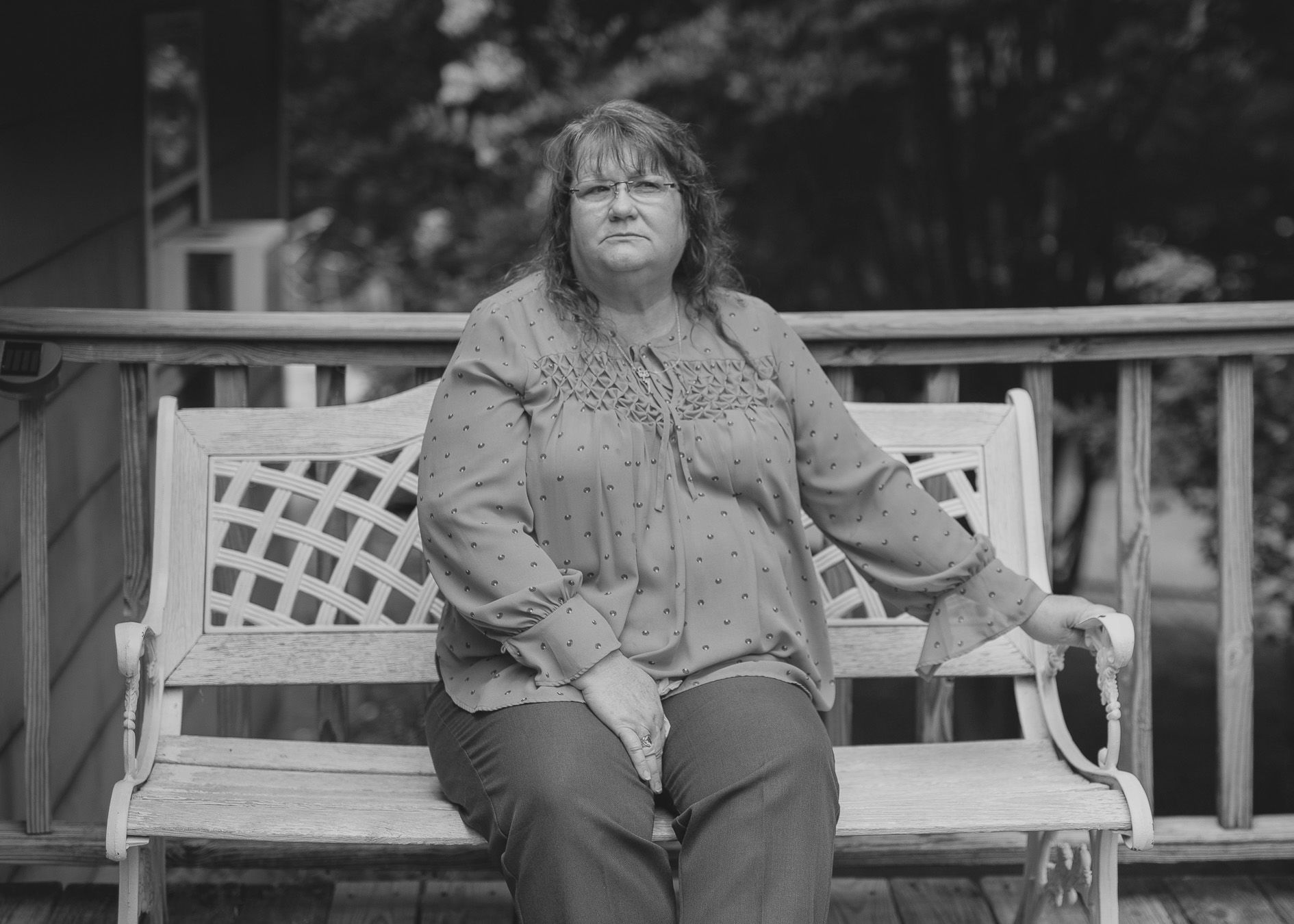
DALTON, Ga. — On a humid evening in August, Nancy Davis Womac paced anxiously on her front deck. Her hands trembled as she stared at a text message from her firstborn daughter, Melanie Spencer, saying that she was minutes away.

The two had never met.

Forty-three years ago, Womac was pregnant and living in an orphanage when she was sent to the Bethesda Home for Girls on the outskirts of Hattiesburg, Mississippi. It was run by Baptist preachers who forced girls to memorize Bible chapters and scrub carpets by hand. Staff members beat the girls with wooden boards if they broke a rule

Image: Nancy Womac

Nancy Davis Womac waits for her daughter to arrive on Aug. 3. (Brock Stoneham / NBC News)

 KEEP READING

Researchers identify 102 students who died at Native American school in Nebraska

School was operated by the federal government between 1884 and 1934 and was known for brutal punishments and hard labour

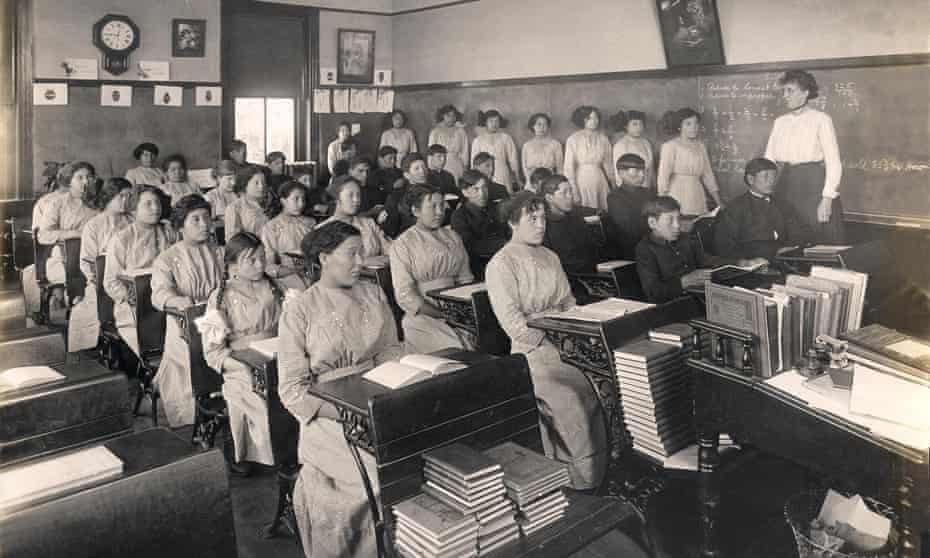
A fifth-grade class is seen at the Genoa US Indian Industrial School in Nebraska in 1910.
A fifth-grade class is seen at the Genoa US Indian Industrial School in Nebraska in 1910. Photograph: National Archives and Records Administration

Researchers say they have identified more than 100 students who died at a harsh residential school for Native Americans in Genoa, Nebraska. The search for the cemetery where many are believed to be buried continues.

The Genoa US Indian School was operated by the federal government between 1884 and 1934. Brutal punishments and hard labour were commonplace for students, large numbers of whom were removed from their families and homelands against their will, prohibited from speaking tribal languages and forced to convert to Christianity in an effort to subdue or eliminate Indian culture.

The announcement from the Genoa Indian School Digital Reconciliation Project, a collaboration between the University of Nebraska-Lincoln (UNL), the Genoa US Indian School Foundation and descendants and representatives from five Nebraska tribes, is among the most significant developments since the project began in 2017.

The names of 102 deceased students were gathered from sources including newspaper archives and school newsletters, according to the researchers who say official records were destroyed or scattered when the school closed.

While some names are likely to be duplicates, the death toll from the school which enrolled thousands from more than 40 tribal nations in its 50-year history is probably far higher, said Margaret Jacobs, professor of history at UNL and project co-director.

She said the names would be released after consultation with tribal leaders and after efforts to trace living relatives of the deceased were exhausted.

“These children died at the school,” Jacobs told the Omaha World-Herald. “They didn’t get a chance to go home. I think that the descendants deserve to know what happened to their ancestors.”

Some of the students, aged four to 22, died in accidents, by drowning or by shooting and in one case reportedly after being hit by a freight train. But most died from disease. Tuberculosis and pneumonia were rife in the federal Indian school system set up in the 1860s with the intention of educating tribal youth in the English language.

The system took a dark turn in 1879 when a US army brigadier general, Richard Henry Pratt, founded Pennsylvania’s Carlisle Indian Industrial School, the first off-reservation boarding school for Native Americans, with the motto: “Kill the Indian, save the man.”

In a harsh era, thousands of children were forced to leave their families and travel to schools in other states, to “remove them from tribal influences”. Many teachers forced students to speak only English, and many schools imposed military style rules. Braids were cut off and students given “white” names.

Some graduates said they benefited from the experience and educational opportunities they would not otherwise have received, but numerous other accounts record harsh discipline, abuse and exploitation, the Genoa project says.

One descendant claimed his great-grandmother was blinded while a student at Genoa, likely by having lye soap rubbed into her eyes as a punishment.

The search for the school’s cemetery is continuing in partnership with the Nebraska Commission on Indian Affairs and the state archaeology office. Maps from the 1920s marked a plot of the 640-acre campus where it was believed to exist but ground-penetrating radar has failed to find any graves, project leaders said.

“If we’re not able to find them, I think we need to do something to recognize that they lost their lives there,” Judi gaiashkibos, a citizen of the Ponca Tribe and the commission’s executive director, told the World-Herald.

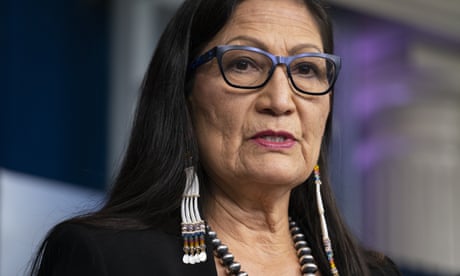
The troubled legacy of Native American boarding schools became a focus of Joe Biden’s administration in June when the interior secretary, Deb Haaland, announced an investigation into “horrific assimilation policies”.

It followed the discovery of the graves of more than 200 children at an Indigenous residential school in Canada in May. In the US, Haaland, a Laguna Pueblo tribe member, said her maternal grandparents were among those forcibly removed, her grandfather to the Carlisle school.

“Many Americans may be alarmed to learn that the United States has a history of taking Native children from their families in an effort to eradicate our culture and erase us as a people,” Haaland wrote in an opinion piece in the Washington Post.

“It is a history that we must learn from if our country is to heal from this tragic era.”

The Federal Indian Boarding School Truth Initiative will investigate allegations of abuse and assist efforts to locate burial sites.

“I’m looking to see something good come out of this,” gaiashkibos said. “Perhaps we will find some way to restore language, to restore some of the culture that was stripped from us.

“Everyone needs to learn the stories and say, ‘America did this and we can do better’.” SOURCE


Monday, November 8, 2021

Reframing Adoption Stories #NAAM2021


Alice Stephens is a fiction writer. She is also an adoptee, born to a Korean mother but raised by a white American family. Stephens shares her humble opinion on “parent narratives” and how she learned to become the subject of her own adoption story, rather than the object.

WATCH: Author Alice Stephens on reframing adoption stories | PBS NewsHour

Friday, November 5, 2021

Who is Delusional? What is Stockholm Syndrome? #NAAM2021

(written in 2014) Updated in 2021

By Trace L Hentz
 
"...I’ve been thinking about this concept for a long time. Adopters, when it comes right down to it, count on Stockholm Syndrome. Children who don’t succumb are labelled RAD.
Whenever I encounter an infertile woman so desperate to be a mother that she’ll bring home a stranger’s baby and force it to live in her fantasy, I always secretly wonder what she would do if she were single and desperate to be married.
Would she drag some strange man home and force him to watch the Notebook and cuddle? And if she did, would society think it was beautiful and precious?  Or would they think she was delusional and dangerous?  Rhetorical question, of course.  But why? Why is what is clearly a crime between adults viewed in such an overwhelmingly positive way when one of the parties is a child?..."  - Renee Musgrove 
 
This comment by Renee has been in my head (since 2014) then I did research on Stockholm Syndrome!
 
What was legally thrust upon us as adoptees is an illusion/fantasy, right?  From babyhood, we are supposed to pretend these are our only parents -- years pass and if they raised us, they ARE our parents. They are the only people we know that intimately so we call them mom and dad. We don't know anything else. Of course, years pass...
 
Then one day you wake up and think, "What about my ancestry, what about my medical history?" and you start to feel despondent since you can't ask your "parents" since you found out they get upset when you ask about your identity (We chose you, you're ours...) -- and even if you do ask, too often they know absolutely nothing. Why is that?
 
Eventually you realize that you are really not "their" child. You're not related in any physical sense or biology.  Then the adoptee realizes and finds out quickly enough that lawmakers (and your adoptive parents) are on the side of secrecy - that they don't want you to know who you are and they DEMAND privacy for the mother who created you.  REALLY?

On my writing blog LARA, I wrote about the ADOPTION EXPERIMENT and then my friend Cully Ray did a guest post about Stockholm Syndrome: which is when you are abducted and start to identify with your captors.
 

Cully wrote:

As do Stockholm Syndrome victims, these Adoptees have great difficulty identifying and expressing their feelings, tragically some are unable to go on with their lives.
Some of the effects that are seen in adoptees and foster children who are objectified by their adoptive parents, foster care givers, and/or communities and peers are:

* Denial of actions by the adoptive parents or foster caregivers that make the child feel inadequate or physically hurt.
* Co-dependency
* Substance abuse
* Minimizing their feelings – self-sacrifice
* Disassociation with the idea of natural family or parent-child relationships
* Failure to make realistic relationships in both personal and professional life
* Internalizing – blame and guilt for things they have/had no control over
* Over achieving – fear of not being “good enough”
* Anger/Rage/Overwhelming depression often triggered by birthdays or celebrations
* Suicide


No matter how much I write then think about this - we still come back to the lawmakers still demanding sealed adoptions and secrecy again and again. 

What about you? Do you think they are delusional?


From my post Adoption Experiment:

The modern process of breaking the spirit of an expectant mother for the purpose of stealing her infant, reminds me of that old film taken by Hitler’s doctors of their own medical experiments, whereby they left a parent locked alone in a room with their baby, but without food or drink. They watched and filmed through a one-way mirror as the adult victim unraveled. It only took a couple of days for the adults to crack completely. In the same way a vulnerable expectant woman is easy pickings for the public and its press. The North American press behaves just like Hitler’s doctors, carrying out goulash experiments on defenseless victim mothers, who are unable to fight back or protect themselves. The North American press appears to be in love with adoption. Or maybe in love with the wash of money always associated with slavery?  -Joss Shawyer, Death by Adoption

Thursday, November 4, 2021

Complex PTSD

READ MORE: http://traumadissociation.com/complexptsd


Complex Post-traumatic Stress Disorder. (Nov 01, 2021). Traumadissociation.com. Retrieved Nov 1, 2021 from http://traumadissociation.com/complexptsd. Read more: http://traumadissociation.com/complexptsd

Wednesday, November 3, 2021

What you need: Court Order Petition

 written in 2012 for this blog (Nation Adoption Awareness Month - #NAAM)

What you need: Court Order Petition

Hi! I wrote about this in my memoir One Small Sacrifice but I am going to post it again. (p.s. what is in your adoption file will AMAZE you)

Since it's National Adoption Awareness Month and we still need our information, adoptees can petition the state court for your adoption file! You get a court order to request a copy of your adoption file! A judge has to agree to release it to you!

You have to pay for it ($75-100+) but what is in the adoption file are documents about your birth, your social worker, where you were placed in foster care, who they were, and even doctor appointments you had prior to your adoption.

What is in my adoption file:

1 - State of Wisconsin Order for Hearing and Investigation, where my adoptive parents petition in writing to adopt me: Laura Jean Thrall and the court ordered Catholic Welfare Agency of Superior, Wisconsin and the State of Wisconsin to investigate, as required by law.

2 – The letter to my parent’s lawyer from the Wisconsin State Supervisor of Adoptions, Division for Child and Youth who wrote, “According to our incomplete record, it appears this child was committed permanently to the Catholic Child Welfare Bureau and that agency placed this child in this home. If that is true, no action is necessary on the State Dept. of Public Welfare. We are sure that if our assumption is incorrect, the agency will so notify us and appropriate action of the state dept. can be taken upon receipt of the investigator’s report.” Dated June 9, 1958.
ALSO in my file, the state of Wisconsin sent a letter to the Judge in Superior, Wisc. acknowledging the date of my adoption hearing: June 24, 1958. The investigator was the Catholic Welfare Agency who had complete control of me.

3- Report: Movements of Child while Under Care: Catholic Infant Home, Foster Care in Superior (with their name and address) and Foster-Adoptive Home (DeMeyer).

4-Certificate of Baptism: First Baptism: 9-18-56 (requested by my mother Helen) and a New Baptismal Certificate was issued on 2-21-1964. Wow – Catholics get this done quick and recorded. Up on the top of the form is Legal Status: Illegitimate and Mother’s Name: Helen Thrall. My Birthplace: St. Paul, MN. In my adoption file is the signed “Certificate of Baptism, Cathedral of St. Paul,” listing my adoptive parents and my new name! It is signed by Rev. Barr and dated March 10, 1959 when in fact I had been baptized in Sept. 1956. This falsified baptismal certificate and my amended birth certificate are two fake documents made to hide my adoptee status – in case my parents decide not to tell me I am adopted.

5- Hospital Discharge Report: The Physical Record of Mother. She was admitted to the Catholic Infant Home on May 23, 1956. Her home address is in Chicago, IL. She delivered on 9-9-56. She stayed in the hospital 5 days until 9-14-56. Children living: One. (This is the proof Helen had already had a child who was also given up for adoption before me!) Delivery: Normal, spontaneous (Helen had an lml episiotomy with no complications). On 5-25-56, Helen’s blood work: Her RH factor was positive. Helen was allergic to penicillin. No Sauk Vaccine given. (I am also allergic to penicillin.) ALSO: The Child (me) Physical Report: full-term, 10 lbs., 3 oz., 21 ½ in., Head Circumference 14” and Chest Circumference 14 ½ in. I was discharged from the hospital on 9-26-1956 as a normal female infant. Social Worker: Miss Underhill.

6- Catholic Infant Home Report – Their Address, Nurse: Sister Enid, Physical Exam at Birth and Physical Exam on Discharge from Hospital to Infant Home, 2 doctors signed. Feeding: Similac every 4 hours. (Obviously no breast milk for me!)

7- Medical Exam (Infant to Two Years, Wisconsin Child Center) – Laura Jean Thrall in Foster Care, General physical: Ok with Mild eczema on face. March 12, 1957.

8- Medical Exam – July 15, 1957 – now named Tracy DeMeyer, General Development: Normal and lists all the various immunizations and vaccines I had. (My adoptive mother told me I was covered in rashes and bald on the back of my head when they got me.)

9- State of Juvenile Court, Vilas Country, Wisconsin, Parental Consent to Termination of Parental Rights, dated December 5, 1956. Miss Alverna Underhill (social worker) is the witness. "Father’s consent is not necessary In case of illegitimate child." Signed by my mother Helen Thrall.

10- Leo Block, Director of Catholic Welfare Agency appears before Judge Robert Curran on May 28, 1958, in the matter of Adoption of Laura Jean Thrall and Mr. Block consents to my adoption on this legal form. Block’s reason for consent: for the best interest of the child.

11 – Form letter: Request to the State of Minnesota Dept. of Public Welfare on April 9, 1958, states that Catholic Welfare Agency needs a copy of my birth record to be used as proof of birth to protect the interest of this child at the time of placement of adoption. Required fee enclosed $1.00. Signed Jean Johnson, Supervisor Protection Unit. Certified Photostat April 16, 1958 sent to Social Worker Miss Underhill.

12- Copy of Investigation, submitted by Catholic Welfare Agency, done March 17, 1957 through May 28, 1958 to the County Court in Wisconsin. Describes The Child (me) and Mother of Child (Helen). INFORMATION NECESSARY FOR CHANGING BIRTH CERTIFICATE in bold type. This is the story I wanted – all the details and dates.  My first months, Helen’s life, and my adoptive parents life and their desire to adopt me, was revealed on four typed pages.

This is what to expect: PAGES of legal documents, reports, letters, stories, arrangements, explanations, descriptions, maybe even a Baptismal Certificate, places and dates.

The BUREAUCRACY they created for each adoptee, all the paperwork, judges, lawyers, social workers, no wonder they don't want to change their system - it's jobs and generates billions of dollars each year!

Every adoptee needs to read their file.

Tuesday, November 2, 2021

Out of the Shadows: An Adoptee Perspective on "American Baby" by Gabrielle Glaser #NAAM2021


2021 BOOK REVIEW:

Lost Daughters: Out of the Shadows: An Adoptee Perspective on "American Baby...: American Baby is a new non-fiction book about the history of closed adoption in the United States that takes a critical look about adoption...  While anyone reading about these situations would be horrified, reading it from the perspective of an adoptee made them very personal.

Monday, November 1, 2021

U.S. Poet Laureate Joy Harjo and Secretary of the Interior Deb Haaland

Still here 17 years later... #NAAM2021 #Adoptee


This post was written in 2014 - now UPDATED in 2021 for National Adoption Awareness Month (#NAAM2021)


By Trace L Hentz (formerly DeMeyer)

If you had asked me in 2004 what I had planned for myself, I would have not said “writing” about adoption and child trafficking. I had just left my editor’s job at the Pequot Times in Connecticut in August and by September I was married, my second time. I have always known adoptees. It's like some (╋) magic radar that we seem to find each other... (which has always been life-saving for me.)

When I first started writing the article GENERATION AFTER GENERATION WE ARE COMING HOME in 2004, finally written and published in 2005 by American Indian Community House in New York City then in News From Indian Country, it was like a door opened.  That door is still open and I am still learning (and blogging here and covering news). I am not in Higher Ed nor do I wish to be. 

I write for adoptees like me. I am not a leader of adoptees/Lost Birds/SplitFeathers. I am an adoptee, someone who gathers stories who happens to be trained as a journalist (aka blogger.)

Second, I do help adoptees (Native and non-Native) connect with one another. There are plenty of adoptees with leadership skills, like my friend Levi EagleFeather and Sandy WhiteHawk, both are Lakota. If adoptees need ceremony, they are the people to approach. I am a bridge and can help you reach them.

Third, I am an adoptee myself so I know what I went through. And I write about it in great detail but that doesn't make me an expert. I do feel like I have an advanced degree in adoption after 17+ years of reading and writing on this topic. (And I'm 65 so it's a lived experience too.)

To me it doesn’t seem possible that those years went so fast – I didn't have any idea my skills would be put to use in this way. I am deeply humbled and deeply grateful to Great Spirit...Wakan Tanka.

Since I started American Indian Adoptees in late 2009, I met and know many bloggers on the topic of adoption (and many are good friends to me). We had hoped we’d made a strong and lasting impact by now.  

We all knew:

The adoptee voice was missing. 


Chapters of history were blank. The changes I worked for: giving voice to adoptees and writing that chapter, and I did what I could. There are four books in the Lost Children Book Series. That was the history few had ever documented...I had saved one article from Canada when I was working as a journalist at NFIC from 1996-1999. One!

 
Changing adoption? I had that dream myself.  I am not sure we can actually gauge or measure how worldviews of adoption have changed. States still have adoption files sealed tight. Are they hiding something? Are they afraid of a massive uprising of adoptees? (There are an estimated 10 million of us, maybe more!) Are they afraid we'll find out adoption agencies and churches were trafficking in children? For a profit?

The governments of Canada and America have much to fear.

Other changes? If books on Amazon are an indication, adoptee memoirs are still climbing the ranks over all the propaganda books about how to adopt a baby.


If the statistics on adoption are any indication, the number of babies adopted by Americans are dropping each and every year. There is definitely a demand for infants (primarily because of rising infertility since the 1950s) but there is still a short supply of newborn flesh to adopt.  (I do believe the adoption traffickers are constantly reinventing new ways to grab a fresh supply of infants. Think of what new poor countries or communities they will invade as the demand increases!! Propaganda will change.)


Will there be more adoptees? Sadly yes.

A happy ending in the media erases the very real structural realities of the adoption industrial complex, one that orchestrates the exchange of babies for money. - Alexa Strabuk

What hasn’t changed much since 2004 are adoption laws, sealed adoption files or the old archaic views of promised secrecy and confidentiality for first mothers.

Haven’t we moved past shaming women for unwed pregnancies? Yes, but not enough, apparently.  Lawmakers are still being wined and dined by adoption agency lobbyists so I don’t expect to see much change in the laws – but I hope I am wrong.

What I’d hoped would change faster is the perception of adoption, that it’s not as great and wonderful for adoptees as the public was made to believe. (In fact, vocal adoptees have changed everything in that regard.) 

As much as I’ve read in these past 17+ years, blogs and books changed me beyond recognition!  

Many times I have emailed legislators (like in New Jersey and Illinois) and offered my memoir (as a free book) hoping they would see the light and change existing adoption laws. Maybe it helped?

The big question: Open Adoption--when adoption is necessary--is also an indication that times are changing! But we have a long way to go…This is a quote I saved about open adoption:

…ignored by the adoption agencies is the reality of “open adoption.” Only 22 of fifty states in America (in 2014) recognize open adoption agreements, but failure of the adoptive parents to comply with the agreement is not legally enforceable by the surrendering mother.  (It is failing from many accounts I have read.)
There are many excellent writers making profound statements too.
A quote by adoptee-author-blogger Elle Cuardaigh: 
And adoption certainly is “worked.” When supply of newborns decreased in the 1970s, the adoption industry had to put a new spin on relinquishment  to stay in business. Since women could not be so easily shamed by single motherhood, they changed tactics. Potential suppliers (pregnant women) are now encouraged to “make an adoption plan.” She reads the “Dear Birthmother” letters and interviews hopeful adoptive parents. She is provided with medical care and possibly even housing.  She is promised this is her choice, and that she can have ongoing contact with her child in an open adoption. It would seem she has all the power, but she is being systematically conditioned to accept her role, her place. She doesn’t want to hurt the baby’s “real parents,” feels indebted to them, emotionally invested. She is soon convinced they are better than she is. She becomes “their birthmother.” It almost guarantees relinquishment.  READ Elle’s blog and new book THE TANGLED RED THREAD.  Or visit: http://ellecuardaigh.com


Read any and all posts at THE LIFE OF VON. (Von has since passed.)  Powerful WRITING!

In Blogland,  when your topic is adoption, you can never be free of trolls, extremists, zealots, fundamentalists, missionaries, the blinkered and the closed-minded. - (adoptee) Elizabeth Von Hughes

The number of excellent powerful blogs by adoptees and first parents (and even some APs) exploded in the past 15 years but there are far fewer now.

Helping to writing and publish four books about the Indian Adoption Projects and Programs and contributing to books like ADOPTIONLAND certainly changed me. And the Vance twins are doing a new anthology on Adoptionland and I have contributed (in 2021).

Back in 2014, #FliptheScript in November was brand new and really moved people - tweets and comments were flying everywhere, some good, some not so good. Discussion is still needed and the people who need to hear adoptees out are the ones we don't reach that well: ADOPTIVE PARENTS. They have their own fog to lift.

Last but not least: I am happily shocked this blog AMERICAN INDIAN ADOPTEES reached over 1,600,000 million hits with 1800+ posts!  If that is any indication, times really are a changin’.  Thanks to all the people who comment and read and subscribe!

There are thousands of Lost Children/Adoptees who are Native American. They are still out there. I do hope they find this blog and reach out and contact me!

There are two things I hope to see for Lost Bird Adoptees: A class action lawsuit in the USA on behalf of those children who were taken from their tribes because of the gov't programs (IAP and ARENA) and admitting PUBLICLY it happened with a declaration of this FACT. 

(Canada is now doing this for the 60s Scoop adoptees.)

I never would have guessed my life would move in the direction it did. I want to thank those hundreds of adoptees and families who have inspired me so much over past 17+ years.

So what will the next 17 years be like? I don’t have a clue.

November Adoption (beware) Awareness Month


Facts About Adoption You Won’t Hear from Adoption Professionals

Every November we post accuracy about the effects of adoption on the adoptee and mother.  

Check the Blog Archive (below the posts) and read prior years.


Adoptees United Inc. Upcoming Events

 Join Us for Two Upcoming Events

We're excited to announce two upcoming events in November:

The November 9 event will review what legislatively developments around adoptee rights in 2021, what bills still remain active, and what you can do now and in the coming year to help move the legislative needle toward equality for all adopted people.

https://adopteesunited.org/adoptee-rights-legislative-overview/

Registration: Legislative Overview

Native American Heritage Month Statement 2021


In November, National Native American Heritage Month raises awareness about our history, our present-day struggles and our hope for the future 

Submitted by StrongHearts Native Helpline

Through colonization Native American cultures, languages, lands and lives were all systematically and forcibly taken. The histories of Native peoples should never be forgotten and that’s why it’s vital that we remember and share our histories not only in November but also all year.

Beginning in 1990, U.S. presidents have issued executive orders declaring November as National Native American Heritage Month. Proclamations have called for governments, groups, organizations and people across the country to observe the month with appropriate programs, ceremonies and activities.

National Native American Heritage Month provides Native peoples the opportunity to celebrate their diverse and rich cultures and traditions as well as educate non-Natives about their nations, raise awareness about the unique history of the United States and Native peoples, and acknowledge the strength and resiliency of Native survival. The special commemoration is a platform for American Indians and Alaska Natives to share their cultures through the performing and visual arts, history programs and food.

In 2021, there was a positive movement toward more inclusion of Native peoples in positions of influence on the federal level. A record number of six Native Americans were elected to Congress and began serving in 2021; and with the Biden administration came a renewed openness and willingness to include more Native voices in the national conversation. Most significantly, we celebrated the appointment of Deb Haaland  (Pueblo of Laguna) as the first Native American Secretary of the U.S. Department of Interior. Haaland swore in Bryan Newland (Bay Mills Indian Community) as Assistant Secretary on September 8, 2021. In October, President Biden announced the restoration of protection to Bears Ears National Monument in Utah. Bears Ears is sacred to many of the region’s Indigenous nations.

Throughout the year, Native peoples across Turtle Island have continued to protest fossil fuel extraction, mining activities, oil pipelines and other actions that cut through fragile territories and threaten Mother Earth and Indigenous lifeways. Public awareness was increased through heightened mainstream media coverage of important issues, including missing and murdered Indigenous relatives (MMIR) and the abuse of Indigenous students who were forced to attend Native boarding schools.

Generations of Native Americans have been persecuted by European settlers leading to historical trauma and high rates of domestic and sexual violence. Domestic violence isn’t a Native American tradition; it was introduced through colonization. Today, there is ample evidence that colonization still occurs through the inhumane conditions on reservations and the jurisdictional issues that prevent the prosecution of non-Native perpetrators on tribal lands.

“It’s important that we always remember to honor the resilience, love and strength of our ancestors who brought us to this point in time and to our elders and all of our relatives who continue to be courageous and committed to practicing our sacred traditions through song and prayer,” says StrongHearts Native Helpline Director Lori Jump (Sault Ste. Marie Tribe of Chippewa Indians).

Observing National Native American Heritage Month is an acknowledgment that Native peoples live on and are ever more resilient despite historical trauma and continued oppression. American Indians and Alaska Natives continue to create solutions and programs to address their unique issues. Through StrongHearts Native Helpline, Native Americans who have experienced domestic, dating and sexual violence can now get culturally-appropriate support. When our relatives are hurting, we are here to answer the call.

“National Native American Heritage Month gives us a chance to reflect on our peoples’ shared existence on this continent and to share our accomplishments as well as our continuing challenges — this includes the need to confront violence in our communities and raise awareness of the work that needs to be done to eradicate it,” says Jump. “With the collective strength of all our relatives we can work toward our vision of safety for our relatives and restoration of sacredness in communities free from violence.”

Wednesday, October 27, 2021

At this Indigenous Elders’ literacy circle, survivors find healing


'We’re not going to be walking around in the dark anymore,' says founder, Cowichan Tribes Elder and survivor Linda Jack.

The first day in The Literacy Circle, a new Indigenous Elders’ literacy program at Vancouver Island University, meant a new experience for Elder student ‘U’nihi-ya (Catherine) Jim: For the first time, she felt encouraged to pursue her education.

“[Years ago] I went back to school and did some upgrading, and when I was doing that, the instructor told me that he didn’t think I was ever going to amount to anything except being a housekeeper. And that discouraged me, so I quit,” she says.

“I’ve always been discouraged by the words that people have said to me when I did try to go back [to school]. And right here, it’s like, ‘We’re here to support you.’ Wow. I’ve never heard that,” says Jim, who is a day school survivor from Cowichan Tribes and is currently undergoing chemotherapy for cancer.

GOOD READ: At this Indigenous Elders' literacy circle, survivors find healing

This story shares information about residential “schools.” The Indian Residential School Survivor Society’s Crisis Line can be reached any time at 1-866-925-4419.

Tuesday, October 26, 2021

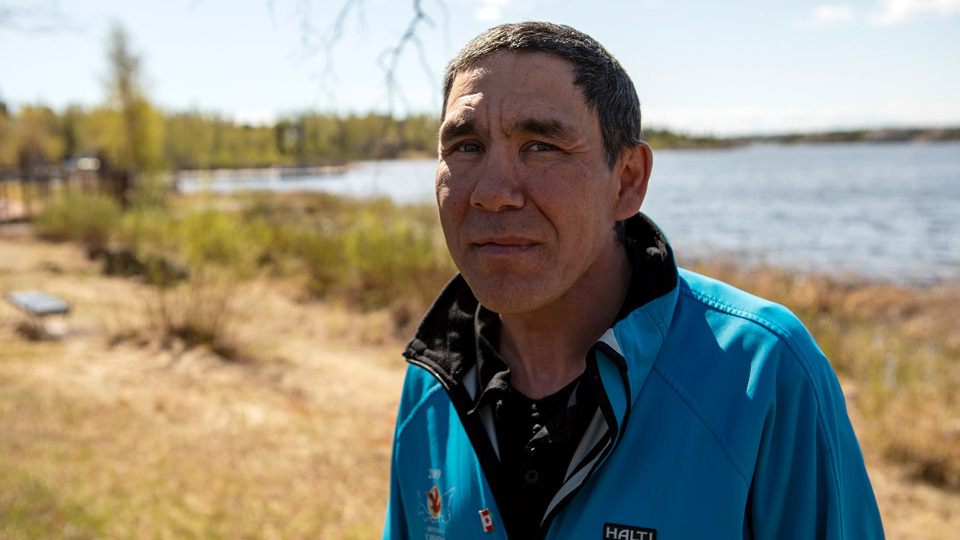
After an early forced adoption, an Indigenous man rediscovers his identity #60sScoop


Eric Wardell, an Indigenous man from Canada’s Northwest Territories, was taken from his parents at just three weeks old, in what is known in Canada as the “sixties scoop.” In this first-person story, Wardell explores his identity — what it means to discover who you are, and how your past can shape your future. This story is part of the ‘Turning Points’ series: stories told by Indigenous people from Yellowknife, Canada in partnership with the Global Reporting Centre.  Transcript Audio

WATCH 

Turning Points

Eight short films about alcohol use, addiction, and healing in Yellowknife, directed by the storytellers themselves. WATCH

PBS NewsHour Global Reporting Centre


Survivors see a link between Indigenous boarding schools’ harsh discipline and later domestic violence

 Utah had boarding schools in Aneth, Intermountain, Ouray, Uintah and Panguitch.

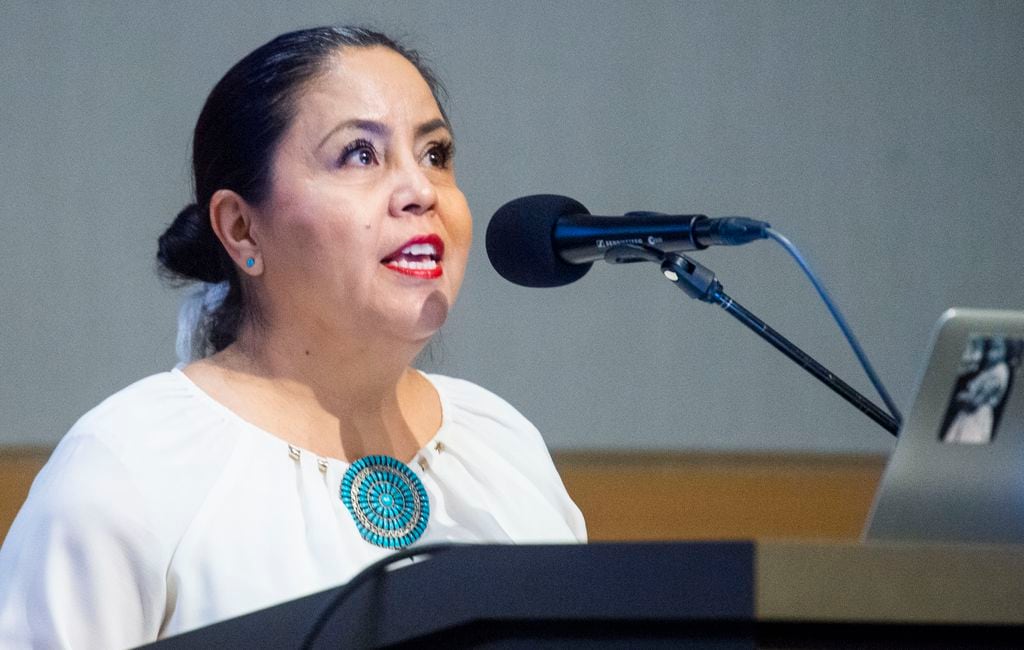
(Rick Egan  |  The Salt Lake Tribune)   Yolanda Francisco-Nez, Executive Director, Restoring Ancestral Winds, speaks about "Missing and Murdered Indigenous People in Utah" during a workshop at the Salt Lake City Library Auditorium, Monday, July 22, 2019.
(Rick Egan | The Salt Lake Tribune) Yolanda Francisco-Nez, Executive Director, Restoring Ancestral Winds, speaks about "Missing and Murdered Indigenous People in Utah" during a workshop at the Salt Lake City Library Auditorium, Monday, July 22, 2019.


Since the discovery of Indigenous children at boarding schools in Canada and then the unverified findings of Paiute bodies at the Panguitch Boarding School, the nonprofit Restoring Ancestral Winds (RAW) began research on the association between Indigenous boarding schools and domestic violence across Utah’s Indigenous communities.

On a panel called “Utah Native American Boarding Schools and other Assimilation Projects on Native Children and Families” hosted by RAW, Indigenous organizers said the Indian Civilization Act of 1819 is a precursor to some of the domestic violence among Native Americans in Utah.

The Indian Civilization Act, or Civilization Fund Act of 1819, is a federal policy that encouraged the assimilation of Indigenous children via boarding schools. From that policy came the formation of Utah boarding schools in Aneth, Intermountain, Ouray, Uintah and Panguitch.

“We have known that there’s a connection between missing and murdered Indigenous women, girls and two-spirit with domestic violence,” said Yolanda Francisco, executive director for RAW. Two-spirit people identify as being both feminine and masculine in spirit. “We have to mention that domestic violence plays a role; it’s a precursor to going missing or murdered.”

While the correlation between domestic violence and Indigenous boarding school has not been well studied, Francisco says she knows that the discipline experienced among Indigenous children influences how they eventually parent.

“There is definitely a role that punishment plays in the life of an individual who survives the boarding school experience, particularly those who were victims of that abuse that occurred,” she said.

Children were subjected to harsh punishments in the schools, ranging from the forced cutting of their hair, which is considered an important part of tribal identity, to eating soap for speaking their language, and other physical, emotional and sexual abuse. The living conditions were also poor and kids died from tuberculosis, whooping cough, measles, the flu and smallpox.

Thursday’s panel featured speakers Davina Smith, who is Navajo (Diné), Denae Shanidiin, who is Diné and Korean, and Kalama Ku’ikahi, who is Diné and Native Hawaiian, who all shared their experiences of boarding schools — either as survivors or through the experience of their parents and grandparents.

“When I think about boarding and foster care children, they’re also considered underneath this umbrella of missing and murdered Indigenous peoples,” Shanidiin said. She hoped the panel would bring more awareness of the Paiute children who attended the Panguitch Boarding School and other Indigenous children at other schools.

Ku’ikahi made connections between the Indian Civilization Act and the early boarding schools in Utah, noting that Christian churches and missionaries influenced the policy.

For example, the Uintah Boarding School, or Ute Indian Boarding School, was established in 1881 by the Episcopal Mission, as was the Ouray Boarding School in 1885. The Panguitch school was Presbyterian.

The Church of Jesus Christ of Latter-day Saints’ Indian Student Placement Program, which operated from 1947 to 2000, took approximately 50,000 Native children from reservations and placed them in Latter-day Saint homes, he said.

Smith said the connections between domestic violence and boarding schools run deep in her family.

Recently, Smith ran over 360 miles from Bears Ears National Monument and Grand Staircase Escalante National Monument to bring awareness to Indigenous issues like boarding schools and missing and murdered Indigenous people.

“I know for me I had to end that generational trauma for my kids because I did not want them to go through that,” Smith said. “And it was also about me talking and opening up my traumas with my kids. Just recently, I was able to open up to my mother and talk about it.”

Monday, October 25, 2021

Lawyering ICWA | White Mother to a Dark Race

Fletcher and Singel have posted "Lawyering the Indian Child Welfare Act," forthcoming in the Michigan Law Review's upcoming symposium on civil rights lawyering. Here is the abstract:

This Essay describes how the statutory structure of child welfare laws enables lawyers and courts to exploit deep-seated stereotypes about American Indian people rooted in systemic racism to undermine the enforcement of the rights of Indian families and tribes. Even where Indian custodians and tribes are able to protect their rights in court, their adversaries use those same advantages on appeal to attack the Constitutional validity of the law. The primary goal of this Essay is to help expose those structural issues and the ethically troublesome practices of adoption attorneys as the most important ICWA case in history, Brackeen v. Haaland, reaches the Supreme Court.

MUST READ book:

White Mother to a Dark Race

Settler Colonialism, Maternalism, 

and the Removal of Indigenous Children 

in the American West and Australia, 1880-1940

AUTHOR Margaret D. Jacobs

592 pages
24 photographs, 2 maps, index

Paperback

March 2011

978-0-8032-3516-8

buy


In The News

 Here are some links if you are interested in the latest news:


Indian Law Issues in the News (10/25/2021)

by Wenona T. Singel


Detroit News: First lady Jill Biden visits Saginaw Chippewa center to discuss youth mental health

Arizona Capitol Times: Ducey gives tribe $30M for water rights

NYTs: Can This Tribe of ‘Salmon People’ Pull Off One More Win?

WaPo (April article): Canada’s Supreme Court says some Native Americans who are not Canadian citizens can hunt in British Columbia

Grist: EPA finally has an action plan to improve water infrastructure and sanitation for US tribes

AP: Oklahoma court adds Quapaw Nation to those covered by McGirt ruling

Curbed: A Lenape Tribe Finally Wrests Its Sacred Site Back from Developers

AZ Central: Indigenous peoples seek greater voice and more influence at COP26 climate conference

NYTs: How Is ‘Dune’ So Prescient About Climate Change? Thank This Native American Tribe.

KTAR: Apaches ask appeals court to oppose transfer of Arizona land

The Hill: Human rights panel will hear case claiming US regulators violated Navajo tribe's rights: report

Tulsa World: Tulsa, Owasso join state in seeking to overturn McGirt ruling

Great Lakes Now: Enbridge temporarily stops Michigan pipeline due to protests

NYTs: Film Club: ‘A Conversation With Native Americans on Race’

Salt Lake Tribune: Survivors see a link between Indigenous boarding schools’ harsh discipline and later domestic violence

Keloland: South Dakota ACLU says Dept. of Education may have violated federal and constitutional law by removing elements of Native American culture and history from draft of state social studies standards


Saturday, October 23, 2021

Creating a Separation Plan and Preparedness Kit


From the StrongHearts Native Helpline
 

It has been a long time coming, but you’ve made up your mind. It’s time to escape a life of domestic and sexual violence and leave an abusive partner. You're scared and for good reason. Danger increases when leaving an abusive partner because they often lash out to regain control over their partner. It is imperative that you carefully navigate the following process.  

You are the best judge of your own safety. Consider a safety plan — a personalized, practical plan that includes ways to remain safe while in an abusive relationship, planning to leave or after you leave. Safety plans can be continuously updated, even if you return to a partner that is abusive.

Separation Plan

A separation plan can help you to safely leave an abusive partner. A preparedness kit contains documents, clothing and comfort items needed to stay away from home for an extended period of time. Once you complete your separation plan and preparedness kit, be sure to keep any documentation of them in an accessible but secure location and/or consider storing them with a trusted friend, family member or advocate. 

The Escape Route

The important first step to creating a separation plan is being mindful of your surroundings and to plan an escape route from any room in the home. You may also want to identify alternate routes to the grocery store, school and/or work. Practice using escape routes regularly. When tensions are starting to escalate, plan to do the following:

      Try to be in a room close to an exit and/or plan an escape route from any room in the home. 

      Look for potential exits through windows and practice using them. 

      Stay away from the kitchen where the abuser has access to weapons.

      Stay away from bathrooms, closets, or small spaces where the abuser can trap you. 

      If the violence escalates, call for help! Call 911, a close relative, friend or neighbor.

Assemble a Preparedness Kit 

When assembling a preparedness kit, pack a bag with a change of clothes for you (and your children) and include comfort items. Store the preparedness kit outside of the home either with a trusted neighbor, friend or relative or keep it in a secret location where you can safely retrieve it. Important documents can be included or stored separately.

Important documents include:

      Identification 

      Tribe-issued enrollment card

      Driver’s License or State ID

      School ID(s)

      Passport(s)

      Social security card(s)

      Birth certificate(s)

      Health insurance card(s)

      Copy of Protection/Restraining Order

      Marriage, divorce and custody papers

      Vehicle registration and insurance

      Lease or rental agreements 

Important items include:

      A change of clothes for you (and your child)

      An extra cell phone and/or cell phone charger

      Extra set of house and car keys

      Medication (e.g., asthma inhaler, insulin, Epi-Pen)

      Cash or ATM card

      Personal items such as your medicines, smudge and sentimental items

      Comfort items such as a favorite stuffed animal, blankets and baby supplies (formula, diapers, and wipes).

There Is Hope

There is hope in planning to leave an abusive relationship. You can escape violence. You can call for help. StrongHearts advocates are available 24/7 to support all victim-survivors of domestic and sexual violence regardless of relationship status, gender identity or sexual preference. To speak with an advocate: Call or Text 1-844 672-8483 or chat online at strongheartshelpline.org

Other resources include: National Domestic Violence Hotline: Call 1-800-799-SAFE (7233) or 1-800-787-3224 (TTY). Domestic Abuse Helpline for Men and Women: Call 1-888-7HELPLINE (1-888-743-5754). The National Teen Dating Abuse Helpline: Call 1-866-331-9474 or 1-866-331-8453 (TTY).

Preparedness kit adapted from information from The National Domestic Violence Hotline. 


October is Domestic Violence Awareness Month


Happy Visitors!

WRITTEN BY HUMANS!

WRITTEN BY HUMANS!

Blog Archive

Featured Post

Your History Class Was a F*cking Lie | #NOMOAR

  Your History Class Was a F*cking Lie by Sean Sherman (Or: How the American Educational System Has Always Been a Racist Propaganda Program...


Native Circles

Native Circles
click logo for podcasts!

Most READ Posts

Bookshop

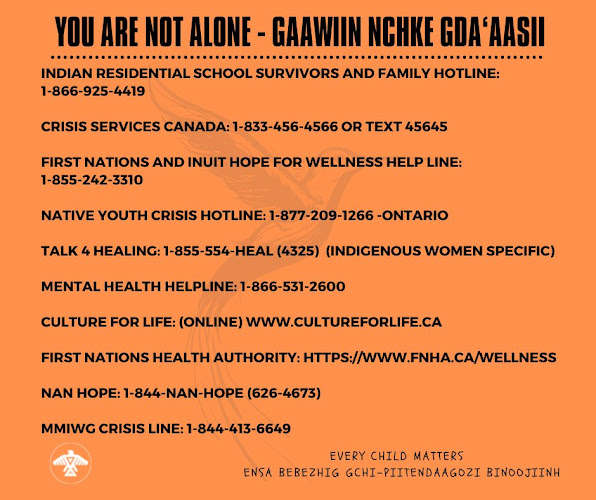
You are not alone

You are not alone

To Veronica Brown

Veronica, we adult adoptees are thinking of you today and every day. We will be here when you need us. Your journey in the adopted life has begun, nothing can revoke that now, the damage cannot be undone. Be courageous, you have what no adoptee before you has had; a strong group of adult adoptees who know your story, who are behind you and will always be so.

Diane Tells His Name


click photo

Lost Birds on Al Jazeera Fault Lines

Lost Birds on Al Jazeera Fault Lines
click to read and listen about Trace, Diane, Julie and Suzie

NO MORE STOLEN SISTERS

NO MORE STOLEN SISTERS
click image

ADOPTION TRUTH

As the single largest unregulated industry in the United States, adoption is viewed as a benevolent action that results in the formation of “forever families.”
The truth is that it is a very lucrative business with a known sales pitch. With profits last estimated at over $1.44 billion dollars a year, mothers who consider adoption for their babies need to be very aware that all of this promotion clouds the facts and only though independent research can they get an accurate account of what life might be like for both them and their child after signing the adoption paperwork.

Original Birth Certificate Map in the USA

Google Followers