They Took Us Away

They Took Us Away
click image to see more and read more

it's free

click

How to Use this Blog

BOOZHOO! We've amassed tons of information and important history on this blog since 2010. If you have a keyword, use the search box below. Also check out the reference section above. If you have a question or need help searching, use the contact form at the bottom of the blog.


We want you to use BOOKSHOP to buy books! (the editor will earn a small amount of money or commission. (we thank you) (that is our disclaimer statement)

This is a blog. It is not a peer-reviewed journal, not a sponsored publication... WE DO NOT HAVE ADS or earn MONEY from this website. The ideas, news and thoughts posted are sourced… or written by the editor or contributors.

EMAIL ME: tracelara@pm.me (outlook email is gone) THANK YOU CHI MEGWETCH!

SEARCH

Tuesday, October 17, 2023

Angela Sterritt discusses systemic violence against Indigenous women

Sterritt’s newest book Unbroken showcases Indigenous cultures unbroken by colonialism

This is a photo of Angela Sterritt giving her lecture. She is standing at a podium, speaking to a large audience. The photo is close on her face. Behind her there is a painting of nature, forest, and animals.
PHOTO: Joelle Lee

By: Karissa Ketter, News Editor

Editor’s Note: This article was updated on October 13, to correct the title of the Haíłzaqv (Heiltsuk) Washing Ceremony. Also, to correct that Angela Sterritt investigated the cases of Ramona Wilson and Tina Fontaine in her book.

Content warning: mentions of missing and murdered Indigenous women and police brutality.

On September 25, Gitxsan author and investigative journalist, Angela Sterritt, spoke at SFU for the annual Andrew Mack Memorial Lecture series. Sterritt spoke on the systemic violence Indigenous communities and women face today, as highlighted in her newest book, Unbroken. 


“The reason why my book is called Unbroken is because when I grew up, I always heard Elders say, they took everything away from us, but we are unbroken,” explained Sterritt. “A lot of people think that colonization ripped everything away from us, which it temporarily did: our languages, our cultures, our children, our communities, our connections to our lands.” 

Sterritt said all the things colonization attempted to take away from Indigenous communities, they are powerfully reclaiming today. “I am proof that our cultures, our laws, and our land are still alive today.” 

Sterritt is a “bestselling author from the Wilp Wiik’aax of the Gitanmaax community within the Gitxsan Nation on her dad’s side and from Bell Island Newfoundland on her maternal side.”  Her lecture, “How Indigenous women’s knowledge and power can transform our understanding of human security,” was hosted by SFU international studies. 

In Sterritt’s lecture, she said, “I want to talk about what human security means for women, girls and two-spirit people in Canada.”  To do this, Sterritt outlined three case studies of systemic violence that she investigated in her book.  Two of these cases were those of missing and murdered Indigenous women, Ramona Wilson and Tina Fontaine.  Both young Indigenous women inspired Sterritt to write her book, “and have also really illuminated the tragedy and the crisis of missing and murdered Indigenous women and girls in this country.”

Indigenous women in Canada make up only 4% of the female population. Despite this, they disproportionately make up “25% of all female homicides in Canada. Indigenous women are 12 times as likely to be murdered or go missing as any other woman in Canada and 16 times as likely to be murdered as white women,” said Sterritt.

The lack of government action to protect Indigenous women sends a strong message to Indigenous communities, according to Sterritt: “That we don’t matter.”  Canada’s colonial policies “ushered in the idea that we were not human,” said Sterritt. 

Many Indigenous women have gone missing along a 700 km stretch of highway between Prince George and Prince Rupert in BC, including Ramona Wilson.  This portion of Highway 16 has been named Highway of Tears, after the women who have gone missing there. Sterritt explained there are several Indigenous communities along that highway, some as far as 70 km away from the highway. “The reserves are far away, and the colonials set this up on purpose. It’s a system of apartheid that they created to make way for white settlers to come to thrive off the land.” 

Their communities being far from the main highway and urban centres made it increasingly difficult for Indigenous peoples to engage with the local economies. Additionally, the provincial government refused to set up a public transportation system along this highway until 2019. “Women have been forced to hitchhike on these lands.” 

One of the goals of Canadian colonialism was to dismantle Indigenous cultures and Indigenous sovereignty. Colonizers enforced that Indigenous communities “temporarily had the inability to enact [their] own laws [ . . . ] The colonials that came over understood deeply and intricately women here have power,” said Sterritt. She noted that Indigenous women were the “backbone of their communities.” Indigenous women were targetted in colonial society, to disenfranchise their humanity and power. 

“In order for Indigenous women and girls to have safety, we need Canadians to see Indigenous people as full dimensional beings,” said Sterritt.

Another priority for Sterritt is for Canadians to recognize Indigenous governance systems and sovereignty. The third case study she included was that of Maxwell Johnson, “a grandfather who was handcuffed while trying to open a bank account with his 12 year old granddaughter,” in Vancouver. 

After Sterritt covered the story in a CBC article, she found people “were shocked that anti-Indigenous systemic racism still happens. They were shocked that people of colour trying to open a bank account might be arrested.” In response, the BMO employee and Vancouver police officers were called on to attend a Washing Ceremony, which is part of the Haíłzaqv (Heiltsuk) justice system when wrongdoing has occurred. 

The two arresting officers from the Vancouver police department refused to attend. Sterritt noted that if the officers had attended, it would have been “such an amazing opportunity for these two officers to come and to bear witness to a different form of justice, a different court system. One that doesn’t handcuff people and put them in jail and forget about them. One that upholds people in all the things that they’ve done.”

When taking part in a Washing Ceremony, Sterritt said the person is symbolically saying, “I’m responsible, I’m accountable, and I’m honouring your system of governance and your system of law.”

Angela Sterritt concluded the lecture by sharing what white settlers on this land can do for Indigenous people. “I want to implore you to uphold Indigenous laws and governing structures, implore you to speak the truth. But I also want to implore you to dismantle the systems that our white ancestors have created.”

Angela Sterritt’s book, Unbroken, is available for purchase at Massey Books and on their website at www.storestock.massybooks.com/.

Monday, October 16, 2023

Why these women are building a database of 12,000 missing, murdered people in Canada

The group includes academics and lawyers who, in their spare time, have entered the names of missing or murdered Canadians, hoping to shed light on unsolved murders and stories of missing people.

Sasha Reid was rattled by the unexpected death of a high school friend, overcome by the realization that someone who had been a part of her life was gone.

“I was struck by this feeling of: ‘I knew her. We went to school together, we walked beside each other.'”

She wanted to find a way to commemorate this young woman. So she started a database of missing people and unsolved murders in Canada.

It’s a choice that might seem odd to many, but not Reid.

focus of story
Sasha Reid (middle), Florence Tang (right) and Ayah Ellithy (left). Photo by Jason Payne /PNG

At that time, in 2016, she was a University of Toronto PhD student in developmental psychology who was already compiling a massive database on Canadian serial killers, the focus of her doctoral dissertation. Creating a new missing-and-murdered database, Reid thought, would be a break from her daily research into serial homicide.

KEEP READING:  https://vancouversun.com/news/crime/why-these-women-are-secretly-building-a-massive-database-of-missing-murdered-cases-in-canada

 Next week in Part 2 of this feature, we will meet some of the B.C. victims in the database.

A New York Museum’s House of Bones


Another major news story today is art crime professor Erin L. Thompson’s deep dive into the American Museum of Natural History’s possession of the remains of at least 12,000 individuals, including Native and Black Americans. Thompson spent a year investigating the museum's collection of human remains for this massive report. Days before the publication of our story, an internal email at the museum announced a change in its policy regarding the display of human remains. - Hyperallergic


Felix Kaaya, a member of the Meru people of Tanzania, spent decades searching for his grandfather’s bones. Mangi (“Chief”) Lobulu was among the 19 Indigenous leaders hanged from a single tree on March 2, 1900, during Germany’s brutal suppression of the Meru’s resistance to colonization of East Africa. After that, his body disappeared.

Kaaya, who is now in his early 70s, suspected that Lobulu was one of the many dead African individuals whose remains were shipped to German universities and museums for study and experimentation.  Konradin Kunze, a German performer and director, met Kaaya while preparing an exhibition advocating for the return of these remains.  Kunze promised to help Kaaya find Lobulu. His research in German archives revealed that Lobulu’s skeleton had indeed been sent to the Berlin anthropologist Felix von Luschan and that Lobulu’s bones were among the 200 skeletons and 5,000 skulls the American Museum of Natural History purchased from von Luschan’s widow in 1924.  Lobulu’s remains have spent a century on the Upper West Side.

The AMNH collected the remains of at least 12,000 individuals through 150 years of purchases, donations, and expeditions. While the existence of this collection is not a secret, their identities are generally unknown.  After I received an anonymous tip last year, I began trying to identify these individuals, many of whom came from Indigenous or colonized populations around the world.

Most of the human remains still held in American museums are those of Native Americans (nearly 100,000, according to a recent ProPublica report).  But the remains of thousands of individuals from outside the United States also sit in storage at institutions including Chicago’s Field Museum, the University of California, Berkeley’s Hearst Museum, and the University of Pennsylvania. The Smithsonian Institution, with the remains of 33,000 individuals, and Harvard University, with 22,000, hold the largest human remains collections in the United States. 

KEEP READING: https://hyperallergic.com/850350/a-new-york-museums-house-of-bones/


My Childhood Was Stolen, Says Linda Raye Cobe, Indian Boarding School Survivor

Linda Raye Cobe discusses the growing movement of survivors seeking to heal from the “Indian boarding school” system.

Linda Raye Cobe at the edge of the woods at her childhood home in Watersmeet, Michigan, where she used to run "free as a bird" before being taken to Indian boarding school in Harbor Springs, more than five hours away from her parents, when she was only 5 years old.


Linda Raye Cobe, 64, is a member of the Lac Vieux Desert Band of the Lake Superior Chippewa Tribe, whose healing journey led her to publish in 2015 a short courageous and straightforward memoir called Red, White & Blues. In it, she tells what happened to her just before her 6th birthday, when she, her siblings and cousins were taken from their family homes in Watersmeet, Michigan, to the Holy Childhood School in Harbor Springs, an Indian boarding school five hours away. Cobe writes of arbitrary beatings raining down from the nuns as they screamed that the holy children under their care, whose childhoods they were ending with their fists, were “good for nothing, stinking little, dirty Indians.” 

READ:  https://truthout.org/articles/my-childhood-was-stolen-says-linda-raye-cobe-indian-boarding-school-survivor/

Report confirms slow progress on repatriation of ancestors and sacred items


https://indianz.com/News/2023/10/10/report-confirms-slow-progress-on-repatriation-of-ancestors-and-sacred-items/ 
 

Supported by a federal NAGPRA grant, tribal nations, History Colorado, Colorado State University, Colorado Department of Natural Resources and the Colorado Commission of Indian Affairs participated in a reburial ceremony in Colorado in June 2016. Photo courtesy History Colorado
 

Tuesday, October 10, 2023
By Acee Agoyo
Indianz.Com
 
It’s been more than 30 years since the passage of the Native American Graves Protection and Repatriation Act (NAGPRA) but federal agencies and museums are still far behind in returning ancestral remains and cultural property to their rightful places. A snapshot report released by the Government Accountability Office (GAO) on Tuesday shows just how NAGPRA’s promises to Native peoples are going unfulfilled. Since 1990, fewer than half of the 208,698 ancestral remains being held by agencies and museums have gone through the complete NAGPRA process, according to official data. And when it comes to the 2,619,951 sacred items being held by agencies and museums, the record is better — but the GAO identifies ongoing “challenges” in complying with NAGPRA. According to the report, issued a day after President Joe Biden declared Indigenous Peoples’ Day, nearly a third of funerary objects haven’t gone through the complete process. “The program’s 2022 report notes that these agencies and museums have not completed the NAGPRA regulatory process for 52 percent of human remains and 29 percent of associated funerary objects,” the GAO report states. “Until the process is complete, the items are not available for repatriation,” the report adds, confirming that American Indians, Alaska Natives and Native Hawaiians are still being denied their ancestral and cultural heritages, some 33 years after NAGPRA’s passage in 1990. To help improve compliance with NAGPRA, GAO recommends federal agencies strengthen their tribal consultation policies. The report refers to “concerns” raised by lineal descendants, tribes and Native Hawaiian organizations. “Failure to consult with tribes, or to consult effectively, may result in irrevocable damage to cultural resources,” the GAO states. The report also states that the U.S. government isn’t doing enough to address the illegal removal of cultural items from federal and tribal lands. According to the GAO, “resource constraints, competing priorities, and limitations with data to support decision-making have hampered agencies’ efforts to prevent, investigate, and prosecute incidents of theft and damage.” Congress has taken additional action to protect tribes with the passage of the Safeguard Tribal Objects of Patrimony Act, also known as the STOP Act. The GAO report notes that the Department of the Interior has started developing regulations to implement the new law, an effort that began just a few months ago. The GAO also points out that Interior has yet to finalize new NAGPRA regulations that are supposed to streamline the repatriation of items held by federal agencies and museums. The work began more than two years ago, in the fall of 2021, and the proposed revisions were released almost a year ago.
Native American Priorities:
Protection and Repatriation of Human Remains and Other Cultural Items
According to the Government Accountability Office, federal agencies and museums have not completed the NAGPRA regulatory process for 52 percent of human remains and 29 percent of associated funerary objects as of September 2023. Source: Native American Priorities: Protection and Repatriation of Human Remains and Other Cultural Items

Finally, the GAO said the sale of tribal items in overseas markets remains an ongoing challenge. Implementing outstanding recommendations from prior NAGPRA reports in 2010, 2018, 2019 and 2021 could help address the issue, according to the report. “Implementing the remaining eight could help Interior target efforts to analyze and address risks to Native American cultural resources and improve how federal agencies communicate with tribes that request assistance with repatriating cultural items from overseas auctions,” the GAO said, noting that 47 other NAGPRA recommendations have been “fully implemented” as of September 2023. “This could also improve agencies’ efforts to consult with tribes on certain federal efforts that could affect cultural resources,” the report continued. The 2010, 2018, 2019 and 2021 NAGPRA reports were followed by Congressional testimony in February 2022, when the GAO discussed the challenges facing federal agency compliance with the law. 
The leader of the Senate Committee on Indian Affairs said it was clear that the work was far from complete. “While progress is certainly being made, the journey continues for tens of thousands of ancestors and millions of cultural items to find their way home,” said Sen. Brian Schatz (D-Hawaii), the chair of the legislative committee, noting that Congress originally thought it would take 10 years to repatriate ancestors and items held by agencies and museums. “And the promise of NAGPRA continues,” said Schatz.
 
Indianz.Com Video: ‘Our iwi, our bones are sacred’: Nāpua Greig #NAGPRA
 
Sen. Lisa Murkowski (R-Alaska) said NAGPRA has helped Native people in her home state of Alaska reclaim 1,843 ancestors from museums and agencies. “But there is much more to be done,” she added. “The work is not finished,” said Murkowski, the vice chair of the committee. “There are still 406 Alaska Native individuals who remain housed in 26 museums or federal agencies, pending consultation and notification prior to repatriation.” At the hearing, experts on repatriation in Native communities explained why compliance with NAGPRA is so important to them. Carmen Hulu Lindsey, the chair of the board of trustees for the Office of Hawaiian Affairs, said it is critical for the iwi, or the bones, of ancestors to return home. “We identify with each other, literally, by the bone,” Lindsey told the committee, which opened the hearing with a Native Hawaiian song about the important cultural tradition. “Not only do the iwi possess the spiritual power and essence of the individual, they are also our direct connection to our ancestors for communication and guidance.” “For we do not bury our dead, we kanu, or plant them, back into the earth from whence they came to continue to nourish, heal and guide future generations,” she continued. “This critical cycle has been disrupted due to the mass disinterment and disaggregation of our ancestors, especially in the last century of unfettered development in our island home.” 
 
 Rosita Worl, the president of the Sealaska Heritage Institute in Alaska, served on the NAGPRA Review Committee for 13 years, monitoring and reviewing the implementation of the law. She said Native people face a second indignity even when their ancestral remains are returned to their communities. “I would also recommend and allow for the reburial of ancestral human remains at the site from which they were taken,” said Worl, a citizen of the Central Council of Tlingit and Haida Indian Tribes. “Often, we are told to sneak onto federal lands, to rebury our ancestors from the original site from which they were taken. We do not believe that this is appropriate.”
 The GAO’s snapshot report was based in part on data released by the Department of the Interior’s National NAGPRA Program. The figures about completed reviews of ancestral remains and funerary objects are taken from the annual program reports. The 2022 report, for example, shows that 108,328 ancestral remains are still being held in collections across the country. 
According to the data, Illinois, Ohio and California are home to museums and agencies with the largest numbers of Native ancestors. A table in the report further shows that the University of California at Berkeley, the Illinois State Museum and the Ohio History Connection are holding onto the three largest collections of Native ancestors. Harvard University in Massachusetts closely follows.

How PBS Indigenous Drama ‘Little Bird’ Relates to Today’s ‘Very Profound’ Real-World Conflicts


“There’s something about understanding each other’s trauma and trying to be human beings,” star Lisa Edelstein tells TheWrap

Without directly addressing the harrowing Hamas attacks on Israel this week, she added, “Even in this horrific time period that we’re in right now, there’s something about storytelling and understanding each other’s trauma and trying to be human beings. This is very profound right now.”

In the series, Esther Rosenblum (Darla Contois), who was cruelly ripped away from her mother, father and siblings when she was 5 years old, begins searching for her birth family in her 20s. Her adoptive mother Golda (Edelstein) has always discouraged her from finding out more about her past, having been told that Esther, whose given name was Bezhig Little Bird, had been rescued from a “neglectful” family.

READ: https://www.thewrap.com/lisa-edelstein-pbs-indigenous-drama-little-bird-interview/ 


***


Read Next
“You want to have more Natives writing Native stories,” Gladstone said in an interview with Vulture. “You also want the masters to pay attention to what’s going on.  American history is not history without Native history.”
'Killers of the Flower Moon' Star Lily Gladstone Calls Film a 'Double-Edged Sword' With Script Written by Non-Natives


**
See Susan Devan Harness, “The goal is to take away our kids, dismantle our cultures and traditions, Reflections on a life given, a life removed,” Indian Country Today, 9 October 2018. In the conclusion she writes:

They are still trying to dismantle American Indian culture and traditions through the removal of our children. They have cunning arguments which, with their large and boisterous words and white privilege, carefully shadow the fact that they just aren’t seeking our children, but ethnic annihilation. Through court cases, such as Baby Veronica, A.D. vs Washburn, and Texas v. Zinke powerful groups are working at a frantic pace to undo the Indian Child Welfare Act of 1978, which was put into place to stop the wholesale removal of children who were flying off the reservation by the early 1970s.

Recently, I spoke to a friend who follows these legal battles. ‘Why do they want to undo ICWA,’ I asked, perplexed because I don’t believe any of those litigators care one whit about what happens to American Indian children or American Indian families. My friend replied, ‘If they can get rid of ICWA, they can begin to work to disassemble all the laws and protections that have been put into place by American Indian treaty rights.’

The bottom line, economic interests want the land, and the resources beneath that land. They always have. They are hiring legal experts to take away our kids to achieve that goal, like they always have. I’m fighting to keep that from happening. And that fight starts with keeping our children.

See also United States Settler Colonialism: Erasing Indigenous Identity – A Policy of Cultural Genocide.  


Saturday, October 7, 2023

Karen Pheasant-Neganigwane

Indigenous author impacted by 60s Scoop

Story and Photo By Steffanie Costigan - Lethbridge Herald | September 29, 2023.

Pheasant-Neganigwane shares her book Powwow: A Celebration through Song and Dance at the annual library event Word on the Street last weekend.

Indigenous author Karen Pheasant-Neganigwane talked about her book “Powwow: A Celebration through Song and Dance” at the Word on the Street Festival last weekend at the downtown branch of the Lethbridge Public Library.

Pheasant-Neganiwane is an assistant professor at Mount Royal University in the Treaty Seven region and at the library she shared the lack of education schools have regarding Indigenous culture.

“I came to realize the ignorance that exists in our society. I mean, maybe it’s a presumptuous of me to say, Canada because I was teaching in Edmonton. When I was asked to write about powwow by Orca publishers, their intention was to share what is my story about my journey of dance, but I put it in the context of the experience I had with these Albertan pre-service teachers,” said Pheasant-Neganiwane.

Pheasant-Neganiwane noted some inspiration she got in her writing from former member of the Canadian Senate and First Nations lawyer Murray Sinclair.

“Senator Justice Murray Sinclair did a TVOntario interview in December, 2020. And when he was asked about the situation here in Canada, as a senator, he said, ‘you know, what is at fault is our school system, our curriculum perpetuates white supremacy.’ And one of his also most often cited quote is, ‘it was education that got us in this mess, and it will be education that gets us out of this mess.”

Pheasant-Neganiwane is an Anishinaabe dancer, writer and artist and her parents are residential school survivors. She shared her personal upbringing living in Ontario in the time of the Sixties Scoop.

“I’m from Ontario, and we had the Sixties Scoop that occurred there. That means children that were apprehended in the 1960s as infants from their parents. I was an infant, a toddler in the Sixties. We had to live a very regimented life so my parents lived in fear of Child and Family Services.”

Pheasant-Neganiwane noted she was surprised to learn while living in Calgary the Prairies also experienced the Sixties Scoop.

“But the reality is the Sixties Scoop. If you were to look at the percentage, the Sixties Scoop is more prevalent here in the Prairie provinces. I didn’t know that until I lived here. Not until I met people, not until I worked in education system.”

Pheasant-Neganiwane book can be purchased through amazon at https://www.amazon.ca/Books-Karen-Pheasant-Neganigwane/s?rh=n%3A916520%2Cp_27%3AKaren+Pheasant-Neganigwane.

Pheasant-Neganiwane recalled a statistic she read regarding the connection Indigenous homeless individuals have with the child welfare system.

“I think I read a statistic somewhere that said 85 per cent of Indigenous homeless people came from the systems, that means they were in the child welfare system. So those couple of things are what provide the context of why I wrote this book.”

Pheasant-Neganiwane expressed the importance of educating generations about Indigenous culture along with history.

SOURCE : https://lethbridgeherald.com/news/lethbridge-news/2023/09/29/indigenous-author-impacted-by-sixties-scoop/


Friday, October 6, 2023

Local Sixties Scoop survivor shares story ahead of National Day for Truth and Reconciliation

Christin Dennis shared his story in the lead up to Canada's National Truth and Reconciliation Day

At just six years old, Christin Dennis was taken from his home on Walpole Island.

He was forcibly rehomed with a white family as part of the Sixties Scoop, a nationwide mass removal that took Indigenous children from their families and placed them into the child welfare system, often without family or band consent.

Following a screening of the National Film Board of Canada documentary Birth of a Family Wednesday night at the Falstaff Family Centre in Stratford, Dennis shared details of his personal journey that took him away from a happy, healthy home and exposed him to years of physical and emotional abuse, isolation, addiction, crime, and a debilitating post-traumatic stress disorder before he found a way to reconnect with his culture and his people, and began to heal.

“When this gentleman (from the Children’s Aid Society) had my suitcase, I remembered thinking, ‘There’s something not right here,’ ” Dennis recounted. “He says, ‘You’re going for a car ride,’ and I’m thinking, ‘I don’t want to leave.’ I really enjoyed being where I was. Sure enough, I start screaming, ‘I’m not getting in that car.’ … It’s interesting. You can actually manipulate children quite easily. They could be in a mood and you give them some candy … and it changes. I remember the Children’s Aid Society guy … was there to pick me up to go see somebody to be adopted. He says, ‘I’ll let you drive my car,’ and I thought that was the coolest thing.”

Dennis said he was taken to live with his adoptive family and, while his new life didn’t seem too bad at first and there were some good times growing up with his new siblings, he was forced to cut his long hair and quickly learn to speak proper English or incur the wrath of his adoptive father, a local minister.  As a young child, Dennis said there were numerous instances when he was beaten so badly by his father that he wanted to die, leaving him with severe PTSD that would manifest itself with severe shaking and even seizures when he became stressed or scared.

The trauma didn’t stop when he went to school. Once the family moved to Wellington County, he was constantly bullied for being one of very few – if not the only – Indigenous student in class.

“I learned to hate my culture,” Dennis said. “I learned to be white as much as possible. I learned to speak English. I learned the Bible. I read the Bible. I remember I found alcohol, too, at the age of 11. Alcohol was kind of interesting. It actually made me feel good. I spent most of my life in fear. That six-year-old was gone. From seven years old and on, I was just living in that survival mode.”

His discovery of the numbing effects of alcohol began a cycle of addiction and non-violent crime that landed him in a Guelph prison for the first time just before his 16th birthday.  For almost the ensuing decade, Dennis said he was in and out of prison, unable to hold down a job when he was out, and ultimately began selling marijuana to pay for his addiction.

But that time in prison was a turning point.  He said he met more Indigenous people on the inside in school or in the community.  While in prison, Dennis found religion and became a born-again Christian, but still hated his own culture.  It wasn’t until a prison chaplain convinced Dennis to experience a sweat lodge offered through the Native Sons program at the Guelph Correctional Centre – a program led by Indigenous counsellors and elders to reconnect Indigenous inmates with their cultures — that he started to come to terms with who he was.

“You could feel the intensity of the heat and it’s like, ‘What the heck,’ and then the (sweat lodge conductor) closes the door,”said Dennis, who also goes by Gzhiiquot or Fast Moving Cloud and is originally from Aamjiwnaang (Chippewas of Sarnia First Nation). “Next I know, he starts praying in a language and he’s throwing cedar tea and lavender tea onto these (red-hot rocks), and every now and then, I’d see sparks flying off the rocks like it was the universe upside down.

“I realized there’s something really powerful here. I was so humbled in that moment, I actually realized God is here and I realized God is everywhere. I think that’s what the (chaplain) wanted me to realize. You don’t need to be something that you’re not in order to be who you are.”

Thursday, October 5, 2023

Residential school, Sixties Scoop survivors reflect on National #TRC DAY

*

'A mixed-emotion day': Day of Reflection honours Sixties Scoop victims

The day included drumming, singing, round dancing, and smudging, among other Indigenous ceremonies. (Source: Zach Kitchen, CTV News) The day included drumming, singing, round dancing, and smudging, among other Indigenous ceremonies. (Source: Zach Kitchen, CTV News)
 
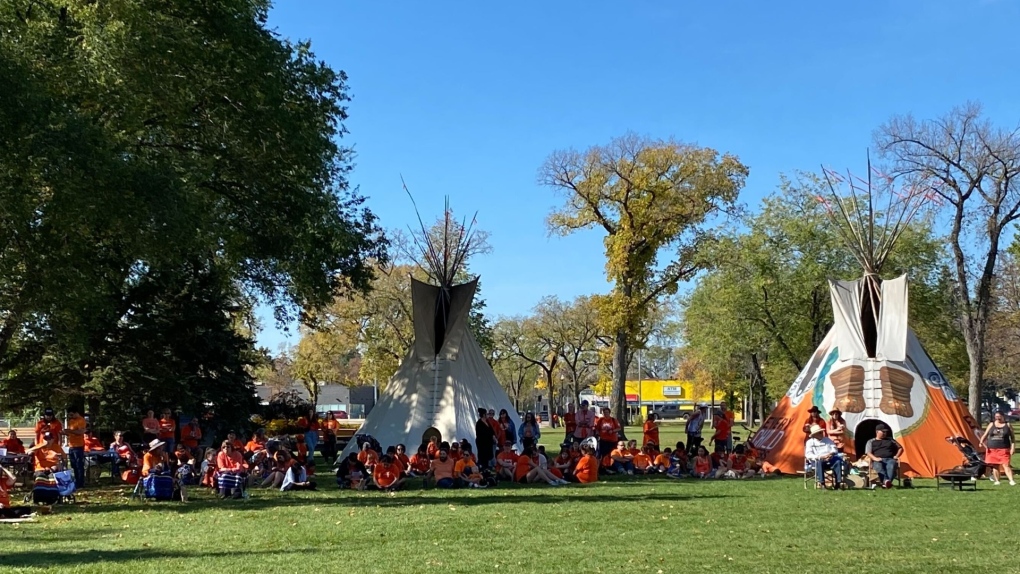
As Manitobans marked the third National Day for Truth and Reconciliation, an event in Winnipeg's North End remembered Residential School victims and those affected by the Sixties Scoop.

The Day of Reflection, Sacred Fire and Gathering took place at St. John's Park Saturday afternoon, jointly organized by the Anish Corporation, Manito Ahbee Festival, and 60s Scoop Legacy of Canada.

The day included drumming, singing, round dancing, and smudging, among other Indigenous ceremonies.

"We wanted to provide a space where people could come and learn a little bit about Indigenous culture, but also be mindful that today is kind of a mixed-emotion day for Indigenous people who have been affected by Residential Schools and the Sixties Scoop and day schools," said Katherine Strongwind director of the 60s Scoop Legacy of Canada.

Beginning in the late 1950s through the 1980s, the Canadian government enacted a series of policies allowing Indigenous children to be "scooped" from their families and then adopted into white homes.

Strongwind said Canada's Indigenous peoples have been through a lot of tragedy. "It's important to remember that we're still here, our culture is still alive," she said.

Orange-clad families gathered at the park to enjoy free entertainment and food, and to learn about Indigenous culture through tipi teachings.

Members of the White Horse Ranch in South Dakota brought "Sunka Wakan," or sacred horses to the event.

"They're often the lead for our walks and our events, and so it was really important to have them here so that we could honour the horses today," Strongwind said.

More information about the Sixties Scoop can be found online(opens in a new tab).


How one Sixties Scoop survivor fought for an apology — and won

As a child, Adam North Peigan was taken from his family and placed in a non-Indigenous household.  In recognition of the National Day for Truth and Reconciliation, North Peigan joined Edmonton AM to share his family’s story, and how he fought for an official apology — and won.

AG Ferguson creates Indian boarding schools Truth & Reconciliation Tribal Advisory Committee


OLYMPIA, Washington — Following the National Day of Remembrance for Indian Boarding Schools on Saturday, Attorney General Bob Ferguson announced today the five members of his office’s Truth & Reconciliation Tribal Advisory Committee.  The committee will study how Washington state can address the harms caused by the government’s historical role in the shameful legacy of Indian boarding schools.

The National Day of Remembrance for Indian Boarding Schools, also known as “orange shirt day,” is observed on Sept. 30 to raise awareness about residential boarding schools.

The five new members of Ferguson’s Truth & Reconciliation Tribal Advisory Committee will hold public listening sessions across the state over the next year to begin a two-year journey toward uncovering the full history of Indian boarding schools in Washington.

“These schools are not just a shameful part of our history — the trauma they caused reverberates through generations of Indigenous families,” Ferguson said. “This week, we do more than just observe the National Day of Remembrance for Indian Boarding Schools. With this new committee, we start a long but essential journey toward healing.”

“We are grateful for Washington state’s leadership in not only investigating its role during the Indian boarding school era, but also its willingness to promote healing for survivors,” said Deborah Parker (Tulalip), CEO of The National Native American Boarding School Healing Coalition. “We need other states to follow suit and work with Tribes and Native communities to bring the truth about this dark history to light.”

During the 2023 session, the Legislature directed the Attorney General’s Office to convene the Tribal Advisory Committee to study boarding schools in Washington through a truth and reconciliation model. The committee’s five members must be citizens from federally recognized tribes in diverse geographic areas across the state. They must also either have personal, policy or specific expertise with Indian boarding school history and policies, or have expertise in traditionally and culturally appropriate truth and healing endeavors.

The Truth & Reconciliation Tribal Advisory Committee members are:

  • Edward Washines (Yakama). 
  • Tamika LaMere (Anishinaabe enrolled with the Little Shell Tribe of Chippewa Indians of Montana).
  • Rebecca Black (Quinault). 
  • Abriel Johnny (Tlingit and Cowichan First Nations).
  • Diana Bob (Lummi).

The committee had its first meeting on Sept. 26. The Tribal Advisory Committee will hold the first of its public listening sessions around the state in January 2024.

Newmarket gathers for healing, awareness on Day for Truth & Reconciliation


PHOTOS: https://www.newmarkettoday.ca/local-news/newmarket-gathers-for-healing-awareness-on-day-for-truth-reconciliation-7625697

Tauni Sheldon, 60s Scoop Adoptee

READ THIS: https://www.iheartradio.ca/ctv-news-content/there-are-thousands-of-us-sixties-scoop-survivor-shares-story-following-national-day-for-truth-and-reconciliation-1.20319957

Monday, October 2, 2023

What do we need to do?


By Trace L Hentz (blog editor and adoptee)

Yesterday I was talking to my husband about an adoptee who is in another country and needs help to find her family and tribe.  Her (amended) (fake) birth certificate is from Utah.

Utah is a closed record state.  BAD NEWS. But Utah has an adoption registry: and she can register online,  which is new.  https://adoptionregistry.utah.gov/ - Their website says: The Utah Adoption Registry is a voluntary, mutual consent registry that helps adult adoptees born in Utah and their birth parents and blood related siblings reunite with one another.

There is a form to fill out: Register Now

Of course there is a fee:  Check or Money Order made out to 'Vital Records'. New registration: $25. Update to Match Search information: $10.

She was adopted in Utah but could be born somewhere else.  She sent me a copy of her fake OBC (the original birth certificate, amended after adoption) and it lists her adoptive parents as her birth parents.

She told me in an email her adoption was private, which means lawyers were involved, I guess. Why? Paperwork.

I emailed back: Are your adoptive parents still alive? I ask this because they have your adoption papers (from the adoption hearing) that probably lists your birth mother. (mine did)  There had to be a hearing in order to produce your fake birth certificate with the adopters names.  This adoptee was born in 1981 but the birth certificate was issued in 2006. (Weird -- 25 years later?)  Even if it was a private adoption, lawyers and a judge had to create paperwork to make the (fake) birth record.
 
Nothing on her birth certificate tells us where she was actually born, what hospital, what time, her weight and length, etc.
 
I had already sent her a list of tribes in Utah: Utes, Goshutes, Paiutes, Shoshone, and Navajo.  There are eight federally recognized tribes.
 
What are her choices now? I suggested she use a search angel. https://www.searchangels.org/gettings-started
 
I also suggested that she do a DNA test to find a relative.
 
But the problem with DNA tests- some Native people DO NOT WANT to have their DNA and blood is some database. We know why.  History is a horror show.  The government created this barbaric practice of closed adoptions and fake papers.  And they created the INDIAN ADOPTION PROJECTS: we do not know how many children were trafficked and given new fake identities to make them "white" and "American."  
Canada claims about 20,000 were part of the 60s Scoop (their adoption trafficking project) but others say it was triple that number. The US has never released any numbers of children for all their Indian Adoption Projects or ARENA or an apology.  It was thousands and thousands.
 
Until we reunite with our relatives, which many of us have done, Closed Adoption accomplished our erasure as sovereign citizens in our tribal nations.

 
I do think about what we need to do.  Do we need a website for Native moms to list their children's date of birth and their names, to help her find them. That might not work since adoptees have little to no information.  How can the adoptee know their real date of birth or where they were born? Adoptees are the most lied to, and denied the truth, and denied their paperwork. I can barely stomach this ongoing atrocity.
 
How can we match missing children to their parents and their tribes?
Do you see the mess this is?  Do you realize this was created by a government to make it nearly impossible to find your tribe?
 
The clock is ticking.  Parents age and pass. How long must we wait to see a change in the US?
 

Sunday, October 1, 2023

The Times is Now... A Virtual Conversation on the U.S. Truth and Healing Commission...


Webinar on the U.S. Truth & Healing Commission Bill on 9.27.23


The National Native American Boarding School Healing Coalition (NABS) hosted a virtual conversation on the Truth and Healing Commission on Indian Boarding School Policies Act (S. 1723). 

NABS is joined by U.S. Congresswoman Sharice Davids (Ho-Chunk) and a guest panel featuring Sterlin Harjo (Seminole/Muscogee), Dallas Goldtooth (Lower Sioux Dakota Nation), Mato Wahuyi (Oglala Lakota), and Georgeanne Growingthunder (Fort Peck Assiniboine and Sioux Tribes). 

Learn how you can advocate for the U.S. Truth and Healing Commission Bill. 

 Learn More: https://boardingschoolhealing.org/truthcommission/

 Explore our Advocacy Toolkit: https://sites.google.com/nabshc.org/nabs-truth-and-healing-toolkit/home

Why a Truth and Healing Commission

We have a right to know the truth of what happened in Indian boarding schools in the United States.

Over the course of a century, hundreds of thousands of our children were taken or coerced away from our families and Tribes and forced to attend government-sanctioned Indian boarding schools.  These schools were tools of assimilation and cultural genocide, resulting in the loss of language and culture and the permanent separation of children from their families.  To date, there has never been an accounting of:

  • the number of children forced to attend these schools;
  • the number of children who were abused, died, or went missing while at these schools; and
  • the long-term impacts on the children and the families of children forced to attend Indian boarding schools.

We have a limited amount of time to hear directly from survivors and record their stories.  A Congressional Commission is needed to locate and analyze the records from the 523 known Indian boarding schools that operated in the U.S.  A Commission would also bring together boarding school survivors with a broad cross-section of tribal representatives and experts in education, health, and children and families to fully express and understand the impacts of this federal policy of Indian child removal.


Happy Visitors!

NEW WEB ADDRESS

Because we don't want to lose information on this blog, we now have a domain name: American Indian Adoptees.com - click and save this link:

2026: WE HAVE A BACK UP BLOG COMING SOON: www.americanindianadoptees.blog (on wordpress) We are no longer on Facebook. We deleted our accounts.

WRITTEN BY HUMANS!

WRITTEN BY HUMANS!

Blog Archive

Featured Post

Your History Class Was a F*cking Lie | #NOMOAR

  Your History Class Was a F*cking Lie by Sean Sherman (Or: How the American Educational System Has Always Been a Racist Propaganda Program...


Native Circles

Native Circles
click logo for podcasts!

Most READ Posts

Bookshop

You are not alone

You are not alone

To Veronica Brown

Veronica, we adult adoptees are thinking of you today and every day. We will be here when you need us. Your journey in the adopted life has begun, nothing can revoke that now, the damage cannot be undone. Be courageous, you have what no adoptee before you has had; a strong group of adult adoptees who know your story, who are behind you and will always be so.

Diane Tells His Name


click photo

Lost Birds on Al Jazeera Fault Lines

Lost Birds on Al Jazeera Fault Lines
click to read and listen about Trace, Diane, Julie and Suzie

NO MORE STOLEN SISTERS

NO MORE STOLEN SISTERS
click image

ADOPTION TRUTH

As the single largest unregulated industry in the United States, adoption is viewed as a benevolent action that results in the formation of “forever families.”
The truth is that it is a very lucrative business with a known sales pitch. With profits last estimated at over $1.44 billion dollars a year, mothers who consider adoption for their babies need to be very aware that all of this promotion clouds the facts and only though independent research can they get an accurate account of what life might be like for both them and their child after signing the adoption paperwork.

Original Birth Certificate Map in the USA

Google Followers