BOOZHOO! We've amassed tons of information and important history on this blog since 2010. If you have a keyword, use the search box below. Also check out the reference section above. If you have a question or need help searching, use the contact form at the bottom of the blog.
We want you to use BOOKSHOP to buy books! (the editor will earn a small amount of money or commission. (we thank you) (that is our disclaimer statement)
This is a blog. It is not a peer-reviewed journal, not a sponsored publication... WE DO NOT HAVE ADS or earn MONEY from this website. The ideas, news and thoughts posted are sourced… or written by the editor or contributors.
EMAIL ME: tracelara@pm.me (outlook email is gone)
THANK YOU CHI MEGWETCH!
These adoptees are Native Americans and opened their adoptions. That should give you hope.
By
Trace Hentz (blog editor)
As adoptees, we all face the same questions: How do we open our sealed files
and how do we find out who our tribal nation is and when can we meet our
relatives?
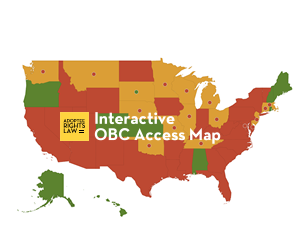
The first place to start: KNOW that state where the adoption took place. What
is their law governing your rights to your own adoption records?
LOOK
Second: Get your non-identifying (Non-ID) from the state where you were
adopted. Non-identifying information includes birthparents age and (in recent
years) medical history at the time of the child's birth; their physical
description (height, weight, eye color); heritage (religion, national origin,
race); number of other children, and whether they’re adopted. More detailed
data is collected describing your birthparents, not adoptive parents.
Do not be discouraged if you will need to get a court order and pay to get your
adoption file, in many states this is the law... The states that are closed do
not make it easy.
I found out in my own search that none of this is easy -- but it
can be done.
Adoptee Rights Law Center PLLC
Gregory D. Luce
PO Box 19561
Minneapolis Minnesota 55419
T: (612) 221-3947
E: info@adopteerightslaw.co
Luce has created an Adoptee-Driven Law
Center:
Original Birth Certificates
Some
states recognize adult adoptees' unrestricted right to obtain a copy of their
own original birth certificates. I represent those who are denied that right.
Citizenship
Intercountry
adoptees may not have received United States citizenship—or may have trouble
proving it—even after being adopted in the U.S. decades ago. That's wrong. I
advocate to correct it.
Personal Information
Adult
adoptees are entitled to their own personal information, which may include
information that is in an agency, court, or other locations. I help adoptees
get what's rightfully theirs.
The Unites States is a deeply divided nation, struggling to
reconcile the legacies of its history. If that was ever in doubt, surely
these last few months have exposed that stark truth, and this week’s
election results made clear how far these rifts are from closing.
"The
truth and reconciliation effort in Maine demonstrates how critical it
is to build shared understanding of the different experiences each
individual and community brings to the process," writes Martin Levine.
Individually and collectively, we are left to ponder a way forward
that could change this depressing reality. Can we find a path that heals
wounds? Can we find a way toward a common future, rather than seeing
every issue as a competition over scarce resources? Are we doomed to a
nation in which our success requires others to fail?
For real change, we may have to reconcile with those from whom we
have grown separate and develop a shared understanding of our different
life experiences. That’s the lesson we can learn from the state of
Maine’s approach to meeting the child welfare needs of its Native
American community.
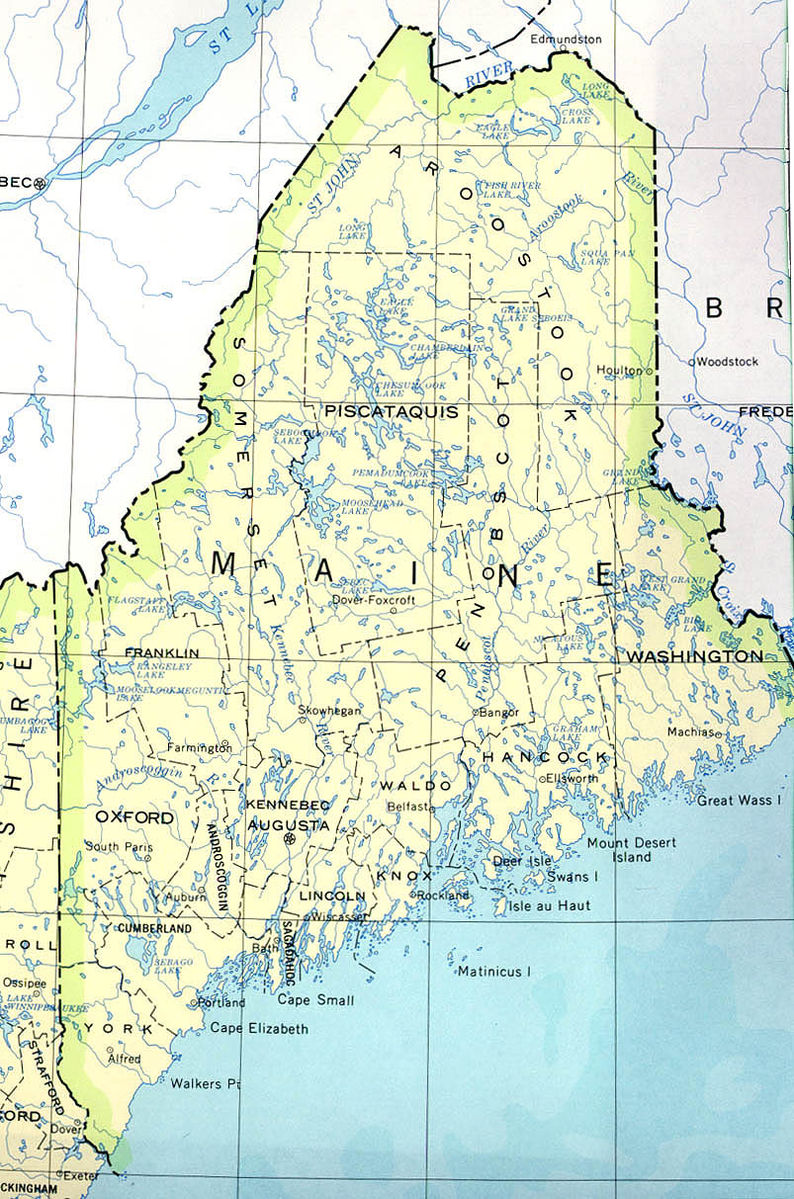
Maine’s child welfare system was found to have entirely ignored the
mandates of the Federal Indian Child Welfare Act, which was put in place
to protect the interests of the Maliseet, Mi’kmaq, Passamaquoddy, and
Penobscot tribes in their jurisdiction. Faced with the loss of critical
federal funding, state child welfare officials moved quickly to create
plans for making needed changes. As described in Next City by Valerie Vande Panne:
A group of social workers from the state’s Department of Health and
Human Services (DHHS) reached out to the Muskie School of Public Service
at the University of Southern Maine for help with fixing the problem.
The idea became to go around the state and train social workers in Maine
about ICWA requirements. But the state social workers were totally
ignorant of tribes, history, and the way state policies had harmed the
tribes, and they were suddenly trying to work with the very people that
had been abused by their system.
And then… they stopped. They recognized that in order to move
forward, more than good intentions were necessary. If the biases and
divisions at the root of the problems were not addressed, even the best
plans would fail.
Denise Altvater (Passamaquoddy), a leader in Maine-Wabanaki REACH
(Restoration, Engagement, Advocacy, Change, Healing) who had been hired
to help state social workers better understand the culture of the Native
communities they served, noted, “One day, we decided we were stuck.”
When racial tensions wouldn’t ease, a decision had to be made: “Do we
keep doing what we’re doing, and call it the best we can do, or do we
take the giant leap and go deeper?”
They went much
deeper, forming what would be known as the Maine Wabanaki-Child Welfare
Truth and Reconciliation Commission (TRC) to explore that which
separated Native and white communities before they returned to building a
new and improved system together.
For Maria Girouard (Penobscot), the executive director of
Maine-Wabanaki REACH, the barrier to moving forward was not the lack of a
plan, but the lack of a trusting relationship. “How the TRC did the
work and fulfilled its purpose was just as important as the product it
produced,” says Girouard. “More important was the truth-telling. There
was a good deal of pushback all around to the idea.”
Social work educator Gail Werrbach, one of the five commissioners,
recognized the need to address the historic realities that we all have
inherited.
The white people are dying to reconcile. “Let’s reconcile and [now]
everyone loves each other.” It’s such important work, and it’s hard
work. I think the biggest challenge is that white people, we want to go
faster, fix faster, feel better faster. That’s just not how historical
trauma works. So, any cities or communities looking at similar kinds of
commissions need to take a long-view time frame in anything they set up,
and not get trapped in thinking people will be reconciled and move on.
It’s been 500 years.
Penthea Burns, now a board member of Maine-Wabanaki REACH, describes
the key learning that must guide efforts to address deep, systemic
change. “We should always be talking about repair and reparations
through the lens of understanding the harm that has been done,” says
Burns. “As a white woman, how do I get my association to hear, and
repair from a different level of commitment? How do we be different
together? Our state officials had a lot of reticence around reparations
from a bottom-line perspective, holding that as just writing a check.
Reparations is so much deeper and more engaging than that.”
From this process emerged a new approach for the state to provide
needed child welfare services to its Native American residents. This
would be a shared construct, supported from a foundation of common
understanding and shared responsibility.
TRC Commissioner
Sandy White Hawk says truth and healing will happen only when the people
are ready. Only then it will be possible to make deep and systemic
change together. “You cannot heal during trauma. You can’t get over
something that is still happening to you. It’s impossible. You don’t say
to someone suffering from cancer, ‘get over it.’”
The truth and reconciliation effort in Maine demonstrates how
critical it is to build shared understanding of the different
experiences each individual and community brings to the process. If we
have the patience to take the time this will take, we can make a
difference. If we have the strength to feel the pain, to recognize the
hurt of others and our responsibility for it, we have a chance to move
beyond it. In this moment of great division, we will need to be strong
and brave if we hope to make the future better.
Martin Levine is a
Principal at Levine Partners LLP, a consulting group focusing on
organizational change and improvement, realigning service systems to
allow them to be more responsive and effective. Before that, he served
as the CEO of JCC Chicago, where he was responsible for the development
of new facilities in response to the changing demography of the
Metropolitan Jewish Community. In addition to his JCC responsibilities,
Mr. Levine served as a consultant on organizational change and
improvement to school districts and community organizations. Mr. Levine
has published several articles on change and has presented at numerous
conferences on this subject.A native of New York City, Mr. Levine is a
graduate of City College of New York (BS in Biology) and Columbia
University (MSW). He has trained with the Future Search and the Deming
Institute.
This article was originally published in the Nonprofit Quarterly(Volume xx, Issue xx, Season Year), www.npqmag.org.
Used with permission.
A bill to protect Native American children so they can remain within
their tribal communities and extended families will be pre-filed in the
state Legislature in January, supporters say.
The bill, still in draft form, will codify the federal Indian Child
Welfare Act (ICWA) into state law if it’s passed by the state
Legislature next year. The U.S. Congress passed the Indian Child Welfare
Act into law in 1978 but it is too often not enforced, according to
experts working on the state law.
Because of implicit bias against Native Americans, Native children
are often removed from the home when a white child in an identical
situation is not, said Donalyn Sarracino, director of Tribal Affairs for
the Office of the Secretary for Child, Youth and Families Department
and of the Pueblo of Acoma.
She said this is a national problem and that, in some cases, the rate
of removals of Native children from their families is sometimes four
times higher than white children removals.
“(Native) children are removed for reasons white children might not be removed,” Sarracino said.
Jacqueline Yalch, President of New Mexico Tribal Indian Child Welfare
Consortium and of the Isleta Pueblo, said that often, tribal
communities are seen “as unfit to raise our children.”
The consortium formed in 2015 to address this issue.
For decades, child welfare authorities have been removing Native American children from their homes. DAWNLAND
goes behind-the-scenes as this historic body grapples with difficult
truths, redefines reconciliation, and charts a new course for state and
tribal relations.
World Channel in partnership with Vision Maker Media commemorates Native American Heritage Month and Veterans Day with films showcasing the rich culture and history of Native Americans highlighting documentaries like ‘Blood Memory’ Nov. 17 and ‘The Blessing’ Nov. 24.
More information about the film can be found at https://www.bloodmemorydoc.com/ and at www.worldchannel.org,
where audiences can also find the line-up of films being shown as part
of Native American Heritage Month.
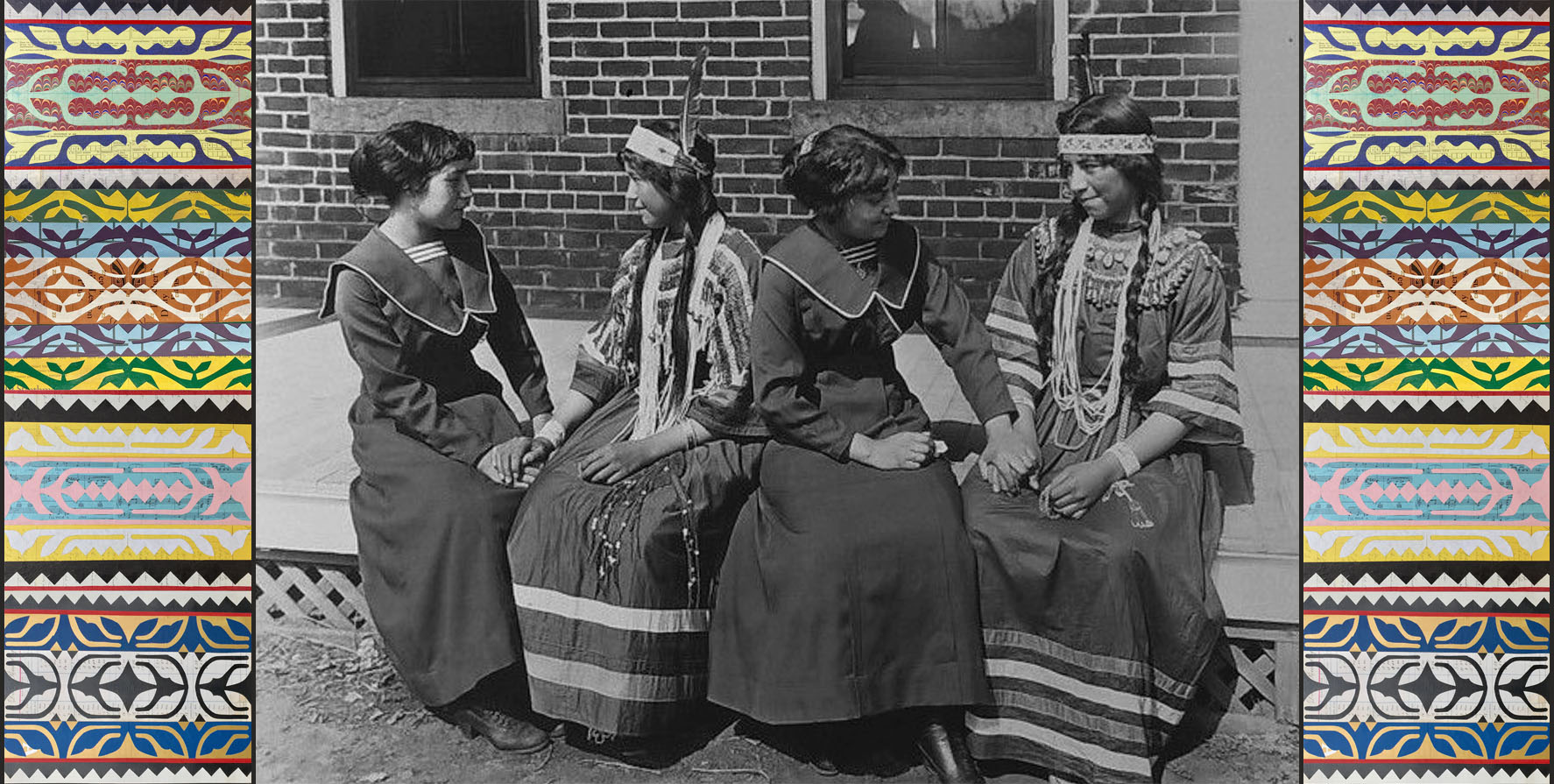
The Genoa Indian School Digital Reconciliation Project is
a new effort to tell the story of the thousands of American
Indian children from forty Indian nations who attended the Genoa Indian
Boarding School in Genoa, Nebraska. The school was open from 1884-1934
and sprawled over 640 acres. The first phase of the project has
digitized and described government records. Later
phases will digitize oral histories, community narratives, and
artifacts. The project is a collaboration between the University of
Nebraska-Lincoln; the Genoa U.S. Indian School Foundation; Community
Advisors from the Omaha, Pawnee, Ponca, Santee Sioux, and
Winnebago tribes of Nebraska; and descendants of those who attended
Genoa. It aims to bring greater awareness of the schools and their
legacies at the same time as it hopes to return the histories of Indian
children from government repositories back to their
families and tribes. So far, project members have digitized, described,
and published about 4,000 pages of documents. Communities and
individuals will be able to contribute their own digital content to the
record.
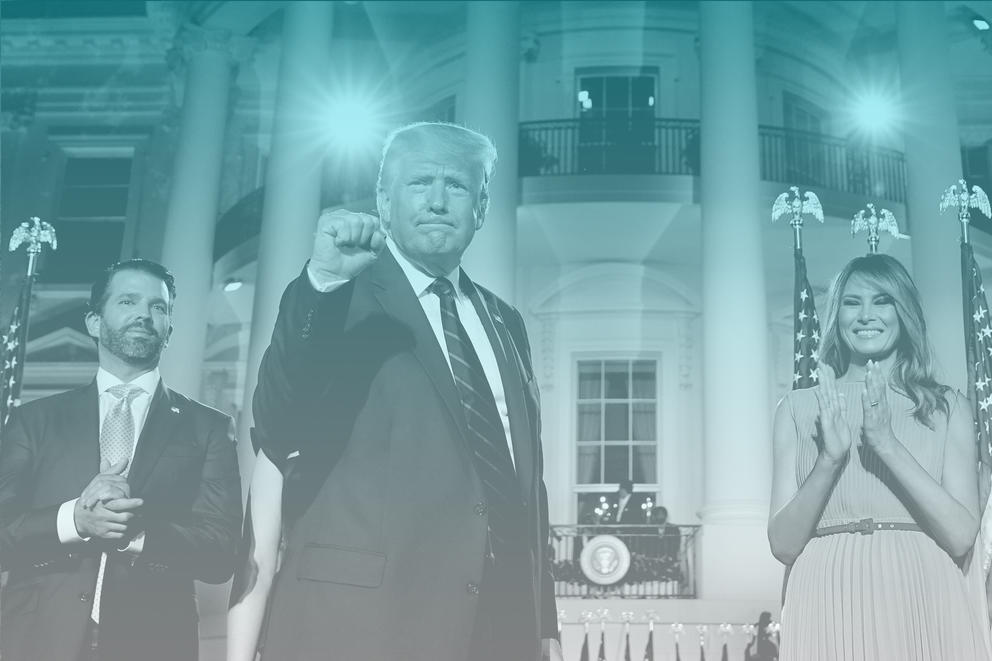
caption: Healing
our past wrongs must begin with a thorough accounting of transgressions
committed by the Trump administration, write Fawn Sharp and Mathew
Randazzo V. (Evan Vucci/AP)
It is an existential necessity that America finally face its darkest truths and reconcile ourselves to our core values.
As Donald Trump’s handling of the COVID-19 pandemic amply proved, we
cannot treat a disease we refuse to acknowledge. Through a reckless
disregard for the truth, we become complicit in its spread.
The
574 Tribal Nations that have experienced four centuries of trauma,
genocide, rape and pillage will no longer accept lip service. Likewise,
we must relieve Black Americans of the trauma of living in a hostile
civic society defined by arbitrary state violence, mass imprisonment,
systematic voter disenfranchisement and the multigenerational
deprivation of resources from their communities.
America must draw the line with this generation to finally confront
and remediate past and present wrongs — starting with a thorough and
honest accounting of the Trump administration’s transgressions.
We can’t let this essential work be sabotaged or shortchanged by the
Washington D.C. establishment’s self-immunization from accountability.
We either establish a precedent for accountability that was lacking
after Watergate, Iran-Contra, the Iraq War and the 2008 economic crisis,
or risk inviting a more authoritarian and lawless counter-attack.
The Biden-Harris administration must take a full-court press approach
and utilize every investigatory and disciplinary tool available to the
federal government to reveal the truth, devise effective solutions,
bring the corrupt to justice and restore the constitutional balance
between the three branches of government.
We need presidential truth and reconciliation commissions on the
systemic abuses that Native Americans, African Americans and Latin
American migrants all face; congressional select committees to provide a
comprehensive overhaul of the laws restraining executive overreach,
police violence and carbon pollution; and gloves-off inspector general
and criminal investigations into the flagrant abuses of the Trump
administration and its corporate accomplices.
Truth and reconciliation is not simply a racial matter. Working-class
white families are also economically and politically disenfranchised by
the inhuman corporate machinery that controls our institutions and
toxifies our lands and food, preventing vastly popular reforms like
Medicare for All, drug decriminalization, law enforcement violence
de-escalation strategies and action on climate change from gaining
national momentum.
The Biden-Harris administration offers hope that the executive branch
will at least consider bold reforms. But passing the type of drastic
legislation necessary to put this republic on a sustainable path will
require the mass organization and activation of the public at large.
Our society and governments can no longer serve the Dow Jones
Industrial Average instead of the life, liberty and happiness of its
citizens or the indispensable health of our ecosystems.
We are the ancestors of future generations.
We cannot leave them a sick, fatally flawed society.
To heal our country we must be courageous, and boldly confront generations of injustice and exploitation.
Dear Trump
Voter: As a theatre prof, I want you to know that the WH’s “outrage”
over election results is pure theatre. Trump KNOWS he has lost, but he’s
in the bargaining stage of his grief. He’s bargaining that you’ll help
him pay his campaign debts. (There. I reached out.)
"I
don't like hope. Hope was the last thing to come out of Pandora's box.
It's a sedative word. If we want something to happen, it's better to
pray; that way we're activating our intelligence."- John Trudell (Santee Sioux)
During
the Sixties Scoop, over 20,000 Indigenous children in Canada were
removed from their biological families, lands, and culture and
trafficked across provinces, borders, and overseas to be raised in
non-Indigenous households. Ohpikiihaakan-ohpihmeh delves into the
personal and provocative narrative of Colleen Cardinal’s journey growing
up in a non-Indigenous household as a '60s Scoop adoptee. […]
Historical, generational trauma cannot be overcome by slogans, marches, or performative allyship. Determining who suffers from racially oriented, systemic harm cannot be measured by an evaluation of skin tone. The harms done to communities of color across the country expand well beyond the Black community and deep into Native, Hispanic, and immigrant communities.
We are now 528 years after Columbus’ unfortunate arrival in the Caribbean and the enslavement of the Native population, 401 years after the first enslaved Africans arrived on these shores. The deficit and trauma will not be reconciled in a week, a month, or a year.
U.S. and Canadian authorities took Native children from their
homes and tried to school, and sometimes beat, the Indian out them. Now
Native Americans are fighting the theft of language, of culture, and of
childhood itself.
By Andrea Smith (2015 reblog)
A little while ago, I was supposed to attend a
Halloween party. I decided to dress as a nun because nuns were the
scariest things I ever saw,” says Willetta Dolphus, 54, a Cheyenne River
Lakota. The source of her fear, still vivid decades later, was her
childhood experience at American Indian boarding schools in South
Dakota.
Dolphus is one of more than 100,000 Native Americans forced by the
U.S. government to attend Christian schools. The system, which began
with President Ulysses Grant’s 1869 “Peace Policy,” continued well into
the 20th century. Church officials, missionaries, and local authorities
took children as young as five from their parents and shipped them off
to Christian boarding schools; they forced others to enroll in Christian
day schools on reservations. Those sent to boarding school were
separated from their families for most of the year, sometimes without a
single family visit. Parents caught trying to hide their children lost
food rations.
Virtually imprisoned in the schools, children experienced a
devastating litany of abuses, from forced assimilation and grueling
labor to widespread sexual and physical abuse. Scholars and activists
have only begun to analyze what Joseph Gone (Gros Ventre), a psychology
professor at the University of Michigan, Ann Arbor, calls “the
cumulative effects of these historical experiences across gender and
generation upon tribal communities today.”
“Native America knows all too well the reality of the boarding
schools,” writes Native American Bar Association President Richard
Monette, who attended a North Dakota boarding school, “where recent
generations learned the fine art of standing in line single-file for
hours without moving a hair, as a lesson in discipline; where our best
and brightest earned graduation certificates for homemaking and masonry;
where the sharp rules of immaculate living were instilled through
blistered hands and knees on the floor with scouring toothbrushes; where
mouths were scrubbed with lye and chlorine solutions for uttering
Native words.”
Sammy Toineeta (Lakota) helped found the national Boarding School
Healing Project to document such abuses. “Human rights activists must
talk about the issue of boarding schools,” says Toineeta. “It is one of
the grossest human rights violations because it targeted children and
was the tool for perpetrating cultural genocide. To ignore this issue
would be to ignore the human rights of indigenous peoples, not only in
the U.S., but around the world.”
The schools were part of Euro-America’s drive to solve the “Indian
problem” and end Native control of their lands. While some colonizers
advocated outright physical extermination, Captain Richard H. Pratt
thought it wiser to “Kill the Indian and save the man.” In 1879 Pratt,
an army veteran of the Indian wars, opened the first federally
sanctioned boarding school: the Carlisle Industrial Training School, in
Carlisle, Penn.
“Transfer the savage-born infant to the surroundings of civilization,
and he will grow to possess a civilized language and habit,” said
Pratt. He modeled Carlisle on a prison school he had developed for a
group of 72 Indian prisoners of war at Florida’s Fort Marion prison. His
philosophy was to “elevate” American Indians to white standards through
a process of forced acculturation that stripped them of their language,
culture, and customs.
Government officials found the Carlisle model an appealing
alternative to the costly military campaigns against Indians in the
West. Within three decades of Carlisle’s opening, nearly 500 schools
extended all the way to California. The Bureau of Indian Affairs (BIA)
controlled 25 off-reservation boarding schools while churches ran 460
boarding and day schools on reservations with government funds.
Both BIA and church schools ran on bare-bones budgets, and large
numbers of students died from starvation and disease because of
inadequate food and medical care. School officials routinely forced
children to do arduous work to raise money for staff salaries and
“leased out” students during the summers to farm or work as domestics
for white families. In addition to bringing in income, the hard labor
prepared children to take their place in white society — the only one
open to them — on the bottom rung of the socioeconomic ladder.
Physical hardship, however, was merely the backdrop to a systematic
assault on Native culture. School staff sheared children’s hair, banned
traditional clothing and customs, and forced children to worship as
Christians. Eliminating Native languages — considered an obstacle to the
“acculturation” process — was a top priority, and teachers devised an
extensive repertoire of punishments for uncooperative children. “I was
forced to eat an entire bar of soap for speaking my language,” says
AIUSA activist Byron Wesley (Navajo).
The loss of language cut deep into the heart of the Native community.
Recent efforts to restore Native languages hint at what was lost. Mona
Recountre, of the South Dakota Crow Creek reservation, says that when
her reservation began a Native language immersion program at its
elementary school, social relationships within the school changed
radically and teachers saw a decline in disciplinary problems.
Recountre’s explanation is that the Dakota language creates community
and respect by emphasizing kinship and relationships. The children now
call their teachers “uncle” or “auntie” and “don’t think of them as
authority figures,” says Recountre. “It’s a form of respect, and it’s a
form of acknowledgment.”
With the passage of ICWA, Congress found that
terminations of parental rights had the effect of separating Indian
children from their tribal communities. Around the time of the law’s
enactment, up to 35% of Indian children were living in foster care or
were adopted or institutionalized. A lack of culturally-competent
standards for assessing Indian families, poverty in Indian country and
economic incentives for adoption all led to the high rates of removal.
Despite the fact that states routinely violated the rights of the Indian parents and children, the Bureau of Indian Affairs found
as recently as 2016 that states have implemented ICWA inconsistently,
with the upshot that “an Indian child and her parents in one State can
receive different rights and protections under Federal law than an Indian child and her parents in another State.”
TheNational Indian Child Welfare Association reports
that even with ICWA, native children still experience removal from
their homes at two to three times the rate of white children.
The
bureau did not immediately answer an inquiry about the number of
custody hearings pursuant to ICWA that occur in Colorado annually.
Kathryn E. Fort, director of the Indian Law Clinic at Michigan State
University's College of Law, said there were at least 16 appeals of
ICWA-related custody proceedings in Colorado between 2017 and 2019. She
added that the difficult nature of aggregating cases meant that not all
proceedings are included in her tally.
The
appellate panel returned the adoption case to the Larimer County
juvenile court with instructions to the human services department to
notify all relevant parties.
Almost 40 years after the Indian Child Welfare Act (ICWA) passed,
American Indian children are still being removed from their homes in
highly disproportionate numbers– at a rate almost three times higher
than any other ethnicity, excepting African American children.
Minnesota leads the list of states with the worst rates of
disproportionate removal– where American Indian children are overly
represented in the foster care system– according to a June 2015 report
from the National Council of Juvenile and Family Court Judges. Other
states with high numbers of disproportionate removal include Nebraska,
Iowa, Idaho, Wisconsin, Washington, South Dakota and Oregon.
Even in states without dramatic removal rates– like Arizona and New
Mexico– many American Indian children find themselves removed from their
families and placed in group homes, treatment centers or foster care.
In McKinley County, New Mexico, American Indian children make up 73
percent of all children in foster care, according to a 2015 third
quarter report from the New Mexico Children, Youth and Families
Department (CYFD). And in Arizona, over 1,300 American Indian children
were in the foster care system as of March 31, 2015, according to a
Department of Child Safety Child Welfare Report.
The Indian Child Welfare Act of 1978 applies to any child of American
Indian descent who is an enrolled member or eligible for enrollment in
any federally recognized tribe. When an American Indian child enters
state custody, the state must contact the child’s tribe, and the tribe
has the right to transfer the case to tribal court or to participate in
court proceedings.
In order to help American Indian children stay connected to their
tribal cultures and identities, ICWA also established a placement
preference that starts with the child’s extended family and clan
relatives and then progresses to enrolled members of the child’s tribe
and enrolled members from any tribe– with placement of the child in a
non-Indian family as a last resort.
“Any child who might be Native American, they have a [cultural]
identity,” said Regina Yazzie, Program Director of the Navajo Nation
Division of Social Services. “It’s a benefit.”
Yazzie added that across the country, state agencies struggle to find
American Indian foster families for children. Finding placement
families on reservation land can prove equally challenging.
Data from the Children, Youth and Families Department of New Mexico
shows there are currently 43 American Indian foster care providers who
have 79 placements available– nowhere near enough for the 262 American
Indian children in New Mexico’s foster care system. Melissa Otero from
AdoptUsKids.org also said through an email correspondence that less than
1 percent of all AdoptUsKids placement families identify as American
Indian.
When speaking with the Navajo Post, several tribal members mentioned
hardships on reservations that negatively impacted families’ ability to
foster– including poverty, poor housing, poor mental health care,
suicide, and addiction.
“Part of what’s going on [is] drug and alcohol numbers are sky high,”
said one tribal member, who wished to remain anonymous in order to be
able to speak freely. “There are not a lot of healthy families. There
are tons of families that care, but it takes structure, it takes money
[to foster], and so many families are overwhelmed with the day to day
living, how could they bring another child into their home?”
For the San Carlos Apache Tribe, methamphetamine poses a particular
devastating problem. Social services Director Terry Ross said that the
reservation currently has an “epidemic of mothers with meth-exposed
babies.”
“We try to work with the family, but when mothers are addicted to
meth… it’s hard,” Ross said. “We can’t make people do anything. They
have to want to change for their child.”
Many tribes offer social services like counseling, parenting classes,
detox centers and emergency supplies to American Indian families in
need. But representatives from several tribes mentioned that funding is
limited and resources are stretched thin, so that American Indian
children continue to find themselves in foster care– where many undergo
significant trauma and loss of identity when growing up separated from
their tribes, communities, and cultures.
(repost from 1/15/2012) I do agree: an impossible job description: be someone you cannot be... adoption causes grief...hunger for attachment...trauma played out...catastrophic thinking...enormous wound at beginning of life...PTSD... Absolutely... Yes, all true... Trace
For about 100 years, the U.S. government supported a system of boarding schools where more than 100,000 American Indian and Alaska Native children were stripped of their culture, their languages, and their religions and forced to assimilate to white customs.
That policy, which continued until the 1960s, has continued affects on native communities today, says a bill filed this week by Sen. Elizabeth Warren, D-Mass., and Rep. Deb Haaland, D-N.M.
The United States has never fully accounted for the harms caused by the schools, the lawmakers said. Their bill, which has attracted a bipartisan list of cosponsors, would form a "Truth and Healing Commission on Indian Boarding School Policy" to compile records and oral accounts of what happened in at 367 Indian boarding schools across 30 states. Those schools educated children as young as five years old and sometimes forced them into labor in white communities far from their homes, advocacy groups say, but many records of their practices have been lost or destroyed.
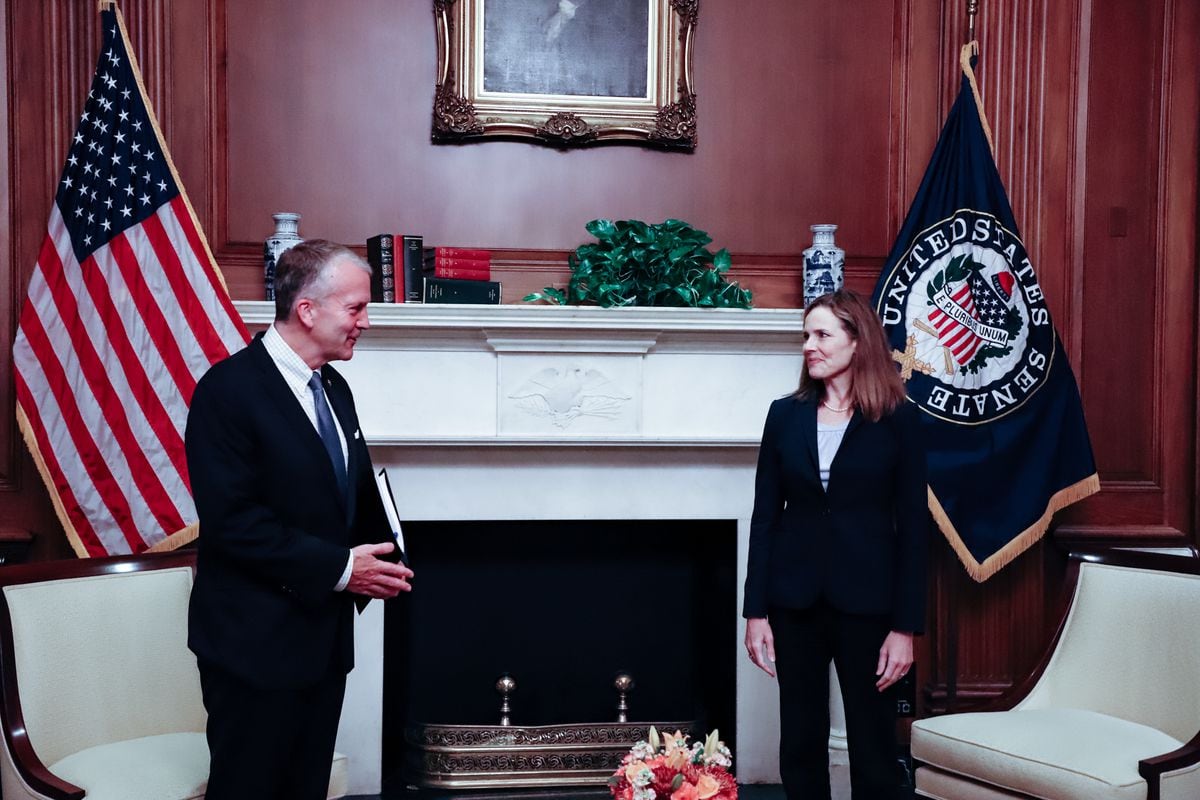
Sullivan should stand up for principle, stand down on Barrett nomination
caption: Senator Dan Sullivan met with U.S. Supreme Court nominee Judge Amy Coney
Barrett on Sept. 30, 2020. (Photo provided by Sen. Sullivan office)
Where does Judge Barrett stand on Native American issues?
While her record is thin, Alaska Natives should be concerned. Barrett has repeatedly stated that she shares the late Justice Scalia’s judicial philosophy, and he voted against tribal interests in over 86% of the cases he heard, including all of the cases he considered when she clerked for him in 1999.
Justice Scalia was also skeptical of the Indian Child Welfare Act (ICWA), a 1978 law enacted to prevent state agencies from forcibly removing Indian children from their families and placing them in Native American boarding schools or in non-Indian foster and adoptive homes. In the earliest Supreme Court case to interpret ICWA, Justice Scalia voted to uphold tribal jurisdiction, but in later years said that it was a vote he regretted.
Adoption is dangerous. Oftentimes we do it and we don’t even really know or understand why we are doing it. We do it because in the moment, it feels like the right thing. We do it because we think it is going to fix something in us. Maybe it does fix something in us…but it leaves the adoptee with scars, bruises and longing for what could have been.
Dear dad, now you are dead and can probably see and understand the pain you caused. If there is any way you can infiltrate the lives of others who have adopted or are hoping to adopt and warn them of the dangers; we adoptees will forever be grateful.
May you not rest in peace until you have saved other adoptees from the same pain.
If you watch one thing on twitter today please take the time to watch the powerful story of @RomeoSaganash telling the story of what happened to his brother at residential school. It was one of the most powerful moments I remember in Parliament. https://t.co/5so6LzSrEs
After forcing the vote, @RomeoSaganash started to speak. Never heard the lobby quieter. Pages hushed another, attendants stopped clearing mugs, everyone just watched. This part, Jonish's story, broke that silence when several of us started crying. #OrangeShirtDaypic.twitter.com/BlXAE5hsRf
Today’s post continues our assessment
of TRC Call to Action #4, specifically in relation to the following
requirements of the national standard for Indigenous child welfare:
ii. Require all
child-welfare agencies and courts to take the residential school legacy
into account in their decision making.
iii. Establish,
as an important priority, a requirement that placements of Aboriginal
children into temporary and permanent care be culturally appropriate.
The United States enacted the Indian
Child Welfare Act (CWFA) in 1978, in response to overrepresentation of
Indigenous children in the child welfare system. The CFWA is exemplary
as it empowers Indigenous communities with inherent jurisdiction to
resolve matters involving children in need of care.[7]
When determining the best course of action for an Indigenous child, the ICWA requires US courts to consider the following:
A genuine desire from the biological parents to place an Indigenous child in care.[8]
Active efforts to keep the family together (e.g. rehabilitative programs) to be unsuccessful before any placement is ordered. [9]
A higher burden of proof to require placement/adoption.[10]
A legislated order for placement to keep the child close to their family and community.[11]
StrongHearts Native Helpline: October is Domestic Violence Awareness Month
Native American Elders
A
Native American is usually considered an elder when they are above the
age of 60 to 65, although it varies from tribe to tribe.
In
our Native communities, we are taught to respect our elders. We honor
them at ceremony, community gatherings, and pow wows. Their presence is
considered to be an honor. We depend on them for wisdom and guidance
gleaned from their years of experience. They are invaluable to us. Yet,
they can still be victims of domestic violence.
Abuse
can happen to anyone. It is not limited to a specific age, class,
religion, gender or sexual orientation. Abuse can happen in
relationships where couples are married, living together, dating or have
children together. Violent behavior can appear at any time in a
relationship, though possessive, controlling and other alarming behavior often reveals itself as the relationship becomes more serious.
Domestic
violence happens when an intimate partner uses a repetitive pattern of
abuse to maintain power and control over their partner. The abuse can
physically harm, intimidate, prevent a person from acting freely, or
force them to behave in ways they do not want.
What
can domestic violence look like in elder relationships? Domestic
violence can look similar in elder relationships as it does in their
younger counterparts, but some elders may be more vulnerable to the
impacts of abuse and less able to get support.
●Physical
abuse includes inflicting physical pain or injury upon the victim like
pushing, holding or pinching. It can also include prohibiting one to get
medical help, withholding medicine, or not allowing one time to heal
after illness or surgery.
●Emotional
abuse includes verbal assaults, threats of abuse, and intimidation. It
also includes isolation, where the abusive partner will not let the
victim visit with their relatives. Isolation can be particularly harmful
to elders as they may already have limited mobility or
relationships.
○Gaslighting
is also a form of emotional abuse. This can occur when the abusive
partner blames the victim for their behavior in such a way that the
victim begins to question their own version of events or reality. In this situation, it can be very difficult for the victim to recognize that abuse is happening.
●Spiritual
and cultural abuse happens when the abusive partners uses hurtful
stereotypes to criticize the victim, uses tribal membership against
them, won’t allow them to participate in traditions, or restricts them
from honoring their beliefs.
●Sexual
abuse includes grabbing and hurting the sexual parts of the victim’s
body, pressuring the victim for sex and becoming angry or violent when
refused sex.
●Financial abuse happens when an abusive partner keeps
money, accounts or financial information hidden from the victim. The
abusive partner may also give an allowance to the victim or keep the
victim’s social security or per capita checks. They may also use
gaslighting as a tactic of control here. They may say things like, “I’ve
always controlled the money.” or “You aren’t good with money.”; or “You
have everything you need, don’t you?”
●Digital
abuse happens when the abusive partner takes away phones, iPads, or
computers in a bid to control who the victim can contact.
A Stay Together Era
Elders
can be more traditional. They came of age when families stayed together
even during abuse. Some elders have endured a lifetime of domestic
violence. To understand why elder-survivors of domestic violence stay,
consider the following.
●Love: They have a long history of loving their partner and believe the abuse will someday end.
●Family: They want to maintain harmony within the family.
●Normalization:
Elders may feel they have lived through the violence their whole life
and there is no need or way to change it now.
●Community:
They fear having to leave the community in order to escape the abuse or
are embarrassed about what other members of the community would think
about the abuse.
●Manipulation and Low Self-Esteem: They blame themselves for the abuse, or feel hopeless.
●No
Money/Resources: They don’t have the resources to leave their
situation, or feel a responsibility to financially support their abusive
partner.
●Denial/Shame:
Denial or shame happens when a survivor is embarrassed and wants to
protect themselves, their children and/or families from being associated
with the stigma of abuse.
Help is Available
At
StrongHearts Native Helpline, we know that Native American elders are
humble and it can be difficult for them to ask for help. Native
Americans and Alaska Natives experience domestic violence at higher
rates than any other ethnic group and that elders still suffer intimate
partner violence.
StrongHearts
Native Helpline is a free, culturally-appropriate, and anonymous
helpline for Native Americans and Alaska Natives impacted by domestic
violence and dating violence. We
acknowledge and support all victims regardless of age, gender, sexual
orientation or relationship status. If you or someone you love is
experiencing domestic violence, help is available.
Contact StrongHearts at 1-844-7NATIVE or click on the Chat Now icon to connect one-on-one with and advocate daily from 7 a.m. to 10 p.m. CT. As
a collaborative effort of the National Domestic Violence Hotline (The
Hotline) and the National Indigenous Women’s Resource Center, after-hour
callers can connect with The Hotline by choosing option one.
Hey readers! It's Trace, your editor. I started this blog/website in 2010 to help adoptees like me navigate the waters and terrors of c...
Bookshop
You are not alone
To Veronica Brown
Veronica, we adult adoptees are thinking of you today and every day. We will be here when you need us. Your journey in the adopted life has begun, nothing can revoke that now, the damage cannot be undone. Be courageous, you have what no adoptee before you has had; a strong group of adult adoptees who know your story, who are behind you and will always be so.
Diane Tells His Name
click photo
Lost Birds on Al Jazeera Fault Lines
click to read and listen about Trace, Diane, Julie and Suzie
NO MORE STOLEN SISTERS
click image
We conclude this series & continue the conversation by naming that adoption is genocide. This naming refers to the process of genocide that breaks kinship ties through adoption & other forms of family separation & policing 🧵#NAAM2022#AdoptionIsTraumaAND#AdopteeTwitter#FFY 1/6 pic.twitter.com/46v0mWISZ1
As the single largest unregulated industry in the United States, adoption is viewed as a benevolent action that results in the formation of “forever families.” The truth is that it is a very lucrative business with a known sales pitch. With profits last estimated at over $1.44 billion dollars a year, mothers who consider adoption for their babies need to be very aware that all of this promotion clouds the facts and only though independent research can they get an accurate account of what life might be like for both them and their child after signing the adoption paperwork.


















 Posts

