


November 12, 2025 By Vanessa Lillie
 |
| The author at the Great Swamp Massacre memorial in South Kingston, RI, 2025. (Courtesy Vanessa Lillie) |
Five years ago, from the dark of my living room in Providence, I was surprised to see the action of HBO’s “Watchmen” open in a familiar but unexpected place: Tulsa, Oklahoma, about an hour from where I grew up. It wasn’t superheroes and aliens, not yet, but instead a violent and harrowing recreation of real history: the 1921 Tulsa Race Massacre. In the span of just 18 hours, 35 blocks of the affluent “Black Wall Street” community were leveled, killing as many as 300. Even today, the search for mass graves continues.
My heart sank at my own ignorance. I was shocked that these horrors happened just down the road from where I went to school, that the education I received did not include any mention of one the worst incidents of racial violence in the history of America. Instead I was relying on an HBO adaptation of a dystopian graphic novel.
Being a citizen of the Cherokee Nation has long shaped how I see history. My earliest memory of being Native is associated with my family cemetery, in Oklahoma. Our ancestor, George Washington Walker, was on the Trail of Tears as a boy and built a new life in the northeast corner of the state. I remember thinking, as I stood staring at his grave and the historical marker, how the reason we were in Oklahoma was because the government went back on their word. President Andrew Jackson ignored the Supreme Court and stole our land, while trying to erase our existence. Even if some version of that was taught to me in school, I don’t remember any meaningful discussions about what was stolen or how the impact continues in communities today.
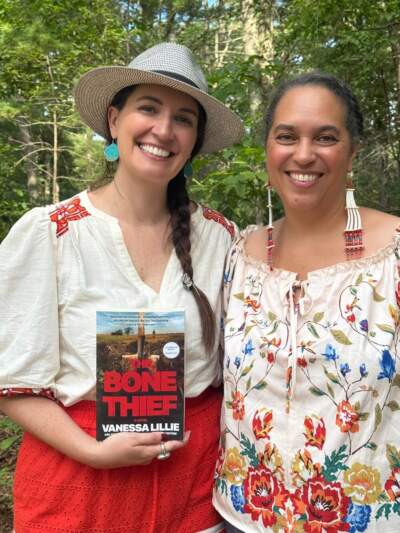 |
| The author with Lorén Spears, executive director of the Tomaquag Museum, at the 350th August meeting and pow wow, in Charlestown, RI, 2025. (Courtesy Vanessa Lillie) |
As I grew up, I sought to understand my family’s heritage and found it to be a reflection of the resiliency of the Cherokee Nation. And as a writer, I realized how I could use story to share history and explore questions of colonization, both past and present. I’ve written seven novels, but it was only in the most recent that I learned how little I knew about the land and tribes in the smallest state I now call home.
Toward the end of King Phillip’s War (or, if you’d like to decolonialize the term, The War for New England), in December, 1675, English colonists attacked the winter homes of the Narragansett tribe. In what’s now known as the Great Swamp Massacre, at least 650 men, women and children were killed, and at least 300 were taken captive. It’s an echo of what President Jackson would later do to my own tribe: genocide perpetrated at the hands of men in power.
It wasn’t until recently, 2021, that the land was officially returned to the Narragansett tribe, having belonged to the Rhode Island Historical Society since 1906. The grounds are open to the public, with small rocks, shells and feathers placed around the obelisk that stands sentry at the memorial where tribal members gather every year to remember.
While as Cherokee, we were forced out of our homelands, the Narragansett remained. One of my first summers in Rhode Island, I attended the Narragansett August Meeting and Pow Wow in Charlestown. During the Grand Entry, I watched as many citizens of the tribe, dressed in regalia passed down generation to generation, entered to the sounds of drums and voices, often with the refrain, “we are still here.” The Narragansett have been gathering there for over 350 years; it’s the oldest recorded pow wow in North America.
And yet, I’ve also spoken to young citizens of the tribe who were told in school that the Narragansett no longer exist, as if they’re extinct like the dinosaurs. It’s a sentiment supported by hundreds of years of treating Indigenous remains and cultural items as trophies or objects to exploit. When it comes to preserving and amplifying Indigenous culture, it’s not enough to understand history. We must also ask: who’s doing the telling?
These are questions I often ask myself when I’m researching a plot or just enjoying a museum with my family. Who’s creating the narrative on those small plaques near the objects in the museums we shuffle through? Or fund? I know there are thousands of Indigenous remains on shelves across the country, from museums to academic institutions, despite federal laws meant to mandate their return. They’re questions I explored in my research for my new book, “The Bone Thief,” using real examples from history: from Yale’s Skull & Bones club allegedly stealing, and hiding, the skull of Geronimo to the history of grave robbers in colonial America.
Even the language I used changed. Thanks to guidance from the Tomaquag Museum, an Indigenous led museum telling first person histories, and leaders like Executive Director Lorén M. Spears, I’ve decolonized my language from “artifacts” to “belongings.” Because these objects belong somewhere — to a place, a people — and they should be returned and shared by the people from which they originated.
While on book tour this month, I’ve been speaking at stores and events across New England, and I like to ask people to raise their hands if they’ve heard of the Great Swamp Massacre. Some crowds have more hands up than others, but it’s rarely more than half, and often a lot fewer.
Native American Heritage Month puts a well-deserved spotlight on books by Native American authors (including some of my own “must-reads”), and that’s a good thing. But it’s hardly something that can be highlighted, even honored, one month out of the year.
As for me, I hope by taking the real history of a place, and wrapping it in the page-turning plot of a thriller, I’m able to give people that same experience I had with “Watchmen”: not only shock, or even embarrassment, but a charge to go out and find the hidden truths of our homelands. Our heritage is an ongoing story. Our people are still telling it.
On Wednesday, Nov. 12, Vanessa Lillie spoke & signed copies of "The Bone Thief" at Authors on Stage at Wellesley College . and Brookline Booksmith





%20You%20Were%20Never%20Supposed%20to%20Know%20We%20Were%20Still%20Here.png)



 Posts
Posts


No comments:
Post a Comment
Please: Share your reaction, your thoughts, and your opinions. Be passionate, be unapologetic. Offensive remarks will not be published. We are getting more and more spam. Comments will be monitored.
Use the comment form at the bottom of this website which is private and sent direct to Trace.